

iStock, sintendo
At first glance, it might appear that sustainability is in crisis. We are seeing political backlash against environmental, social and governance (ESG) reporting and sustainability, particularly in the US and other Western markets. This has fueled headlines about regulatory rollbacks and corporate retreat from sustainability and climate commitments. New terms such as greenlash and greenhushing have entered the business lexicon, describing public reactance to sustainability efforts and companies' increasing reluctance to talk about what they are doing for fear of political or consumer backlash. This has led some observers to argue that sustainability is falling out of favor. But beneath the surface, a different and more nuanced story is unfolding.
Sustainability isn't dead: It's growing up
Despite this doom-and-gloom narrative, evidence points to another reality. While some companies have retreated from sustainability targets, the majority of organizations are maintaining or accelerating their climate action, according to industry analyses. PwC's recent State of Decarbonization report shows that although 16% of companies are reducing sustainability commitments, most are holding steady or increasing their efforts – 47% are maintaining their commitments, and 37% are strengthening them. A 2026 Reuters Impact Report found that 75% of C-suite leaders rate sustainability as a “top priority”. Blue Yonder reports that, in 2026, 78% of consumers say that sustainability is important when making purchase decisions. In other words, overall, industry and consumer support for sustainability remains strong. At the same time, however, companies report growing concern about being accused of greenwashing, and consumers remain skeptical of many sustainability claims.
What is fading is not support for sustainability itself, but a particular version of it – one built on slogans, symbolic gestures and superficial claims. What is emerging instead is a more strategic, operational, and psychologically informed approach: sustainability woven into business decision-making, operations, and product and service design. Sustainability continues to serve as a strategic tool for reducing operational costs, anticipating regulatory pressures and mitigating risk. Within the organization, sustainability can attract and retain talent, as well as spur creativity and innovation. Moreover, it can differentiate brands and create a competitive advantage in ways that align with consumer values. Thus, sustainability can be good for business, enhancing resilience, competitiveness, and customer goodwill.
What is changing: From talk to transformation
Our research suggests that sustainability marketing is growing and evolving rather than shrinking. Based on our systematic analysis of topics published in top marketing journals over the past 50 years, we find that while traditional areas such as conservation and green communication remain important, newer themes are gaining momentum. One topic on the rise is the circular economy, an approach that redesigns production and consumption around closed-loop systems in which products are reused, repaired, resold or shared to reduce waste and resource extraction. Other topics gaining prominence include the examination of higher-impact actions related to climate and carbon, sustainability as a strategy and sustainable innovation. In short, sustainability marketing is shifting toward more impactful actions, with greater emphasis on circular models, carbon reduction, strategic integration and innovation.
We are seeing shifts in marketing practice, too. There are declines in the use of sustainability checklists for optics rather than insight, vague or unverifiable green claims, low-impact token initiatives, and attempts to shame consumers into compliance. These approaches increasingly backfire, generating backlash, cynicism and disengagement instead of real progress.
„What is fading is not support for sustainability itself, but a particular version of it – one built on slogans, symbolic gestures, and superficial claims.”
How companies talk about sustainability is also changing. As the term “ESG” has become politically charged, some companies have moved away from that language and have become more cautious about publicly promoting their sustainability initiatives. At the same time, this rhetorical retreat does not signal inaction: Companies continue to track emissions, supply chains and social impacts. In other words, sustainability is not collapsing – it is being re-operationalized.
Sustainability is shifting from something companies say to something they design and build. Companies may speak less about their commitments, but at the same time, they are embedding them more deeply into strategy, operations and product design. Measurement, too, is moving from a reporting exercise that merely satisfies disclosure requirements to a strategic tool that guides decisions and tracks meaningful outcomes. Those most likely to succeed in this next phase will replace virtue signaling with value creation and sustainability-focused design in ways that align with how people actually think and behave. This is where marketing and behavioral science become essential and where the SHIFT framework provides a practical guide.
The SHIFT framework: Designing sustainability for real behavior change
To motivate real consumer engagement with sustainability, companies must rely less on green claims and moralizing behaviors and more on designing products and experiences that work with our psychology rather than against it. The SHIFT framework, based on our review of over 300 research articles, highlights five psychological levers for encouraging sustainable behavior change – social influence, habit formation, individual self, feelings and cognition and tangibility (see Figure 1).
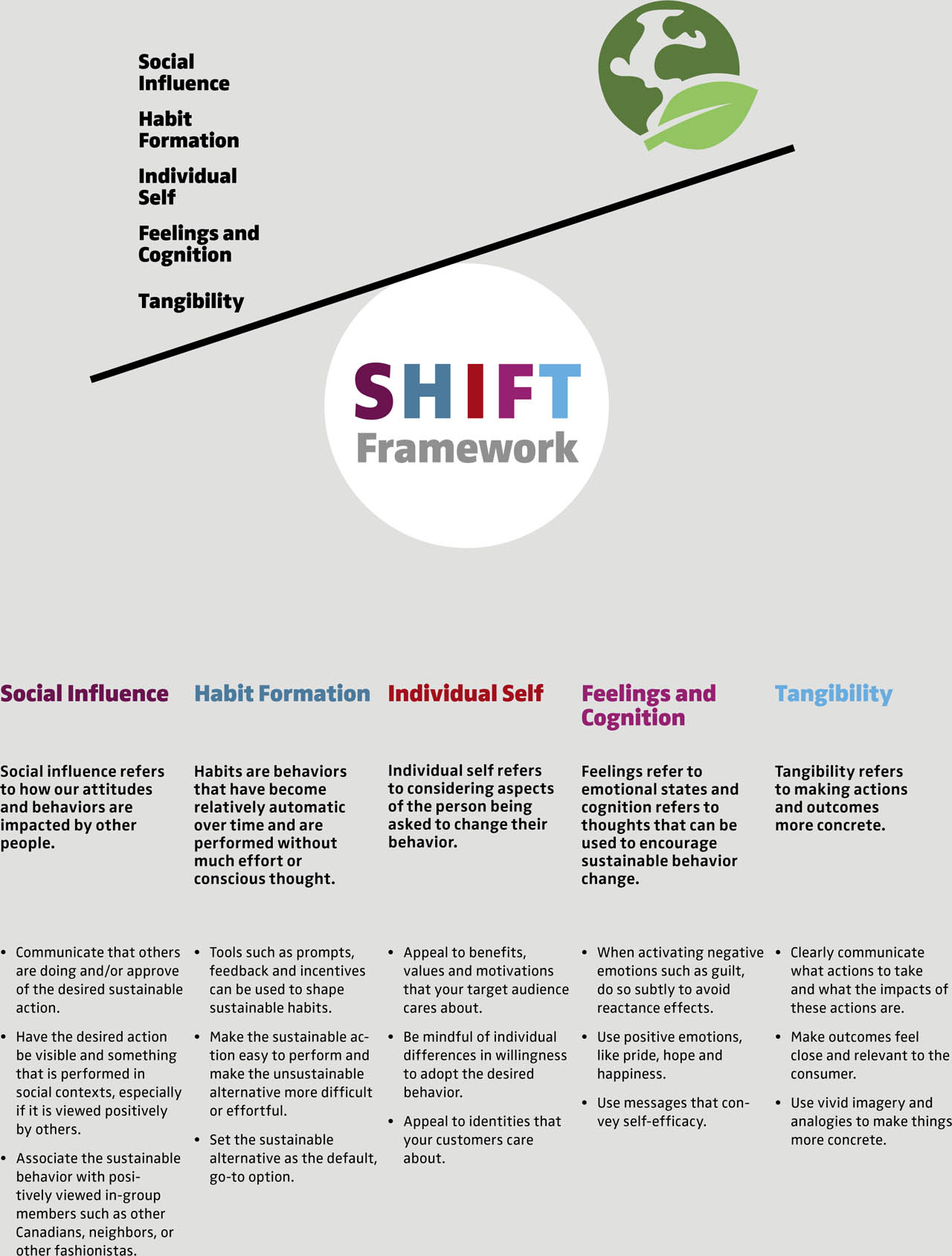
FIGURE 1
The SHIFT Framework: Five psychological levers for encouraging sustainable behavior change
Social influence: Make sustainable actions visible, socially endorsed and socially connecting
People look to others to determine what is expected and appropriate. Leveraging social norms, social desirability and social group connections can increase sustainable behavior. Social norms are the idea that people are more likely to engage in sustainable consumer behaviors when others do so and when there is a shared expectation that the behavior is appropriate or right. Social desirability refers to the tendency for people to be more likely to engage in actions that others approve of, especially when these actions are public or observable. Finally, we are more likely to engage in behaviors that are connected to important social group memberships. For example, Booking.com highlights the popularity of sustainable accommodations by signaling that many like-minded travelers are choosing them. Trainline's “#ICameByTrain” campaign encourages passengers to share their journeys publicly via social media, transforming rail travel from a private sacrifice into a socially celebrated behavior. In both cases, the sustainable action becomes more visible, socially endorsed and socially connecting, which encourages sustainable consumer behaviors.
Habit formation: Sustainability should be the path of least resistance
Many unsustainable behaviors are entrenched habits. Tools such as prompts, feedback and incentives can be used to shape more sustainable habits. Importantly, habit change is most likely to stick when sustainable behaviors are simply easier to do. One way to do this is to use defaults. Defaults work with our psychology by reducing deliberation and effort, allowing the sustainable action to become the automatic, go-to choice. For example, Google Maps will make the more sustainable trip the default, when the eco-friendly route has a similar ETA to the fastest route. Many online retailers now default to eco-friendly delivery options, leading consumers to often stick with the more sustainable choice. Making sustainable choices the default leverages the “status-quo bias” – the tendency to stick with the current state of affairs – as consumers tend to stay with pre-selected options, rather than actively opting out.
„Companies must rely less on green claims and moralizing behaviors and more on designing products and experiences that work with our psychology rather than against it.“

Visualization, AI-generated, Prompt GCO Medienagentur
Individual self: Appeal to the benefits, values and identities your target audience cares about
Companies often lead by highlighting green attributes when promoting sustainable products and services. However, environmental sustainability is not a top concern for everyone. Effective sustainability strategies begin by understanding what matters most to the target audience, rather than assuming environmental concern alone will motivate action. People are more likely to act sustainably when the behavior connects to what they, as individuals, care about, be it health, family, money, aesthetics or comfort. Consider what your target audience values and take into account relevant individual differences. For example, those who differ in green values or political identity may have different preferences regarding engaging in sustainable behaviors.
In one example, Rothy's makes its shoes from recycled plastic bottles using low-waste knitting and designs them to last, which reduces material use and landfill waste. However, the brand leads with consumer benefits – stylish design, comfort and machine-washability – positioning sustainability as a built-in feature of a better shoe rather than the main selling point or a trade-off that consumers need to make. In another example, peer-to-peer resale platform Depop emphasizes social experiences and highlights unique, fashionable finds and affordability before mentioning sustainability. Rather than positioning solely around sustainability, let products and services speak for themselves by riding on co-benefits people already value.
„People are more likely to act sustainably when the behavior connects to what they, as individuals, care about.“
Another way to appeal to the individual self is to speak to important identities that consumers care about. Retailers can offer options labeled “the climate-friendly choice” or “green choice” so that they resonate with consumer identities. Patagonia's brand image invites consumers to see themselves as environmental activists, not just shoppers. By aligning the product with a valued aspect of the self-concept, Patagonia strengthens the link between identity and behavior.
Feelings and cognition: Help people to feel positive, hopeful and capable of action
When communicating with consumers, practitioners seeking to encourage sustainable choices often have the option to focus on motivators related to feelings or more rational, cognitive arguments. Fear and guilt are often used by marketers to motivate action, but this can backfire. While smaller amounts of guilt can sometimes motivate behavior change, excessive negativity can be overwhelming, leading to climate anxiety, paralysis or avoidance.
„Sustainability can attract and retain talent, as well as spur creativity and innovation.”
More effective strategies combine emotion with efficacy. Campaigns that emphasize positive emotions, such as hope and pride or collective progress – while showing consumers exactly what they can do – are more likely to sustain behavior over time. Rather than telling people that climate change is catastrophic or moralizing behavior, balance urgency with empowerment by helping customers feel hopeful and capable. In one example, Ikea's positioning around sustainability is “small changes make a big difference” and “every small action adds up.” Their webpage provides clear examples of simple, achievable actions that ordinary people can take – such as using LED lightbulbs, buying energy-efficient appliances, and reducing food waste with storage containers – to make an impact. By activating self-efficacy, IKEA helps consumers feel that their actions matter and that positive outcomes are within reach.
Tangibility: Turn invisible impacts into visible, concrete and comparable examples
Sustainability is abstract and future-oriented, which can make it feel vague and psychologically distant to people. Making actions and outcomes concrete and visible helps consumers understand impact and stay engaged. This can be done by being clear about outcomes and actions, making sustainability feel close and relevant to the consumer or using vivid examples and analogies. In one example, Ecosia is an online search engine that, instead of keeping advertising revenue, dedicates profits to planting trees. Ecosia tells users exactly how their everyday actions (searching the web) can translate into meaningful impact by showing a real-time counter of trees planted. By making actions and impacts concrete (“your searches planted X trees”), Ecosia helps people clearly see what to do and how it makes a difference, rather than feeling climate action is abstract or futile.
Why we need change at multiple levels
The SHIFT model focuses on how businesses, non-profits and governments can encourage sustainable behavior change among individuals. However, some critics argue that individual behavior is irrelevant and that only large-scale systemic change can address the complex, “wicked” problems of sustainability. This critique often stems from a legitimate concern about scaling sustainability efforts. However, this framing draws the wrong conclusion, presenting a false trade-off. Individual behavior change does not replace system change; it complements it and is a necessary part of meaningful progress. Sustainable transformation requires coordinated action across systems, businesses and individuals. Change at any single level is unlikely to endure without reinforcement from the others.
„Individual behavior change does not replace system change; it complements it and is a necessary part of meaningful progress.”
System-level change focuses on the broader infrastructure, policies and regulations that shape what is possible, practical and affordable. These include investments in clean energy and public transportation, regulations that limit harmful practices and policies that incentivize sustainable innovation and actions. Systems determine the choice architecture within which both businesses and consumers operate, often making certain behaviors easier, cheaper or more socially accepted than others. In this way, systems quietly shape the actions of both businesses and consumers.
Business-level action plays a critical role in bridging between systems and individuals. Companies translate policies and technological possibilities into concrete products, services and business models. Through innovation, supply-chain decisions, pricing, defaults and design, businesses can normalize sustainable options at scale. Importantly, businesses also influence systems by lobbying for or against regulation and by signaling what is operationally feasible and desirable in markets. Companies can respond to and redefine systems, as well as shape the options available to consumers.
Consumer-level action reflects how individuals contribute through everyday behaviors, advocacy and civic engagement. Consumers influence sustainability outcomes not only through purchasing decisions, but also through donating, investing, advocating and voting. While any single action may seem small, collectively, these behaviors shape demand, legitimize new markets, signal support for given outcomes and create pressure for organizational and policy change. Consumer behavior is often the mechanism through which broader shifts gain momentum and visibility, signaling market preferences and creating the impetus for business innovation and system-level change.

Visualization, AI-generated, Prompt GCO Medienagentur
These levels are deeply interconnected (see Figure 2). Systems shape business and individual behavior through infrastructure, incentives and constraints. Businesses shape systems and consumers through scale, innovation and market offerings. Individuals, in turn, shape markets and politics through demand and voice. Given the scale and urgency of sustainability challenges, progress requires an “all hands on deck” approach – one that aligns action across all levels rather than pitting them against one another. The most effective sustainability strategies recognize that individual behavior change is not a distraction from system or industry change – it is often the catalyst that makes broader system and business change possible.
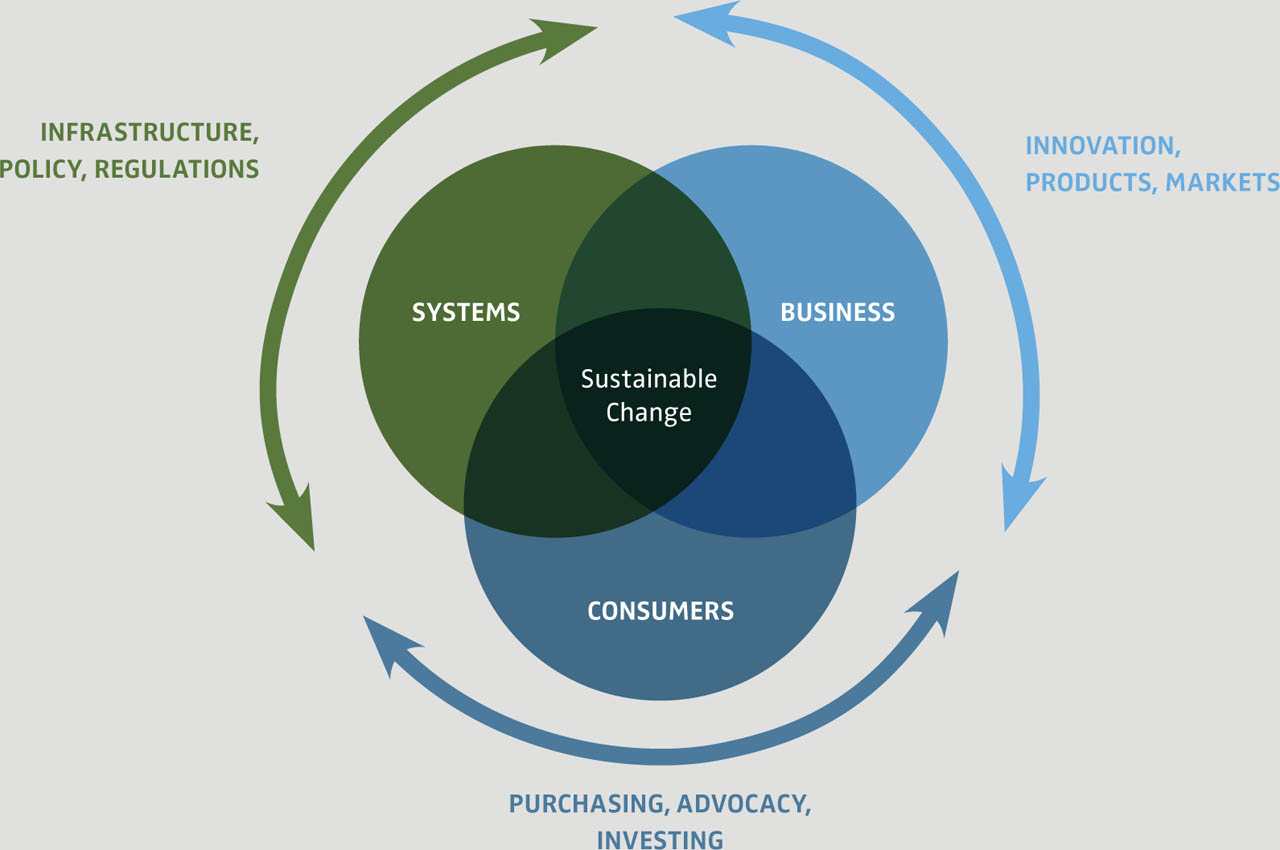
FIGURE 2
Role of Systems, business and consumers for sustainable transformation
The bottom line: Sustainability is not fading. It is maturing.
The next phase of sustainability will be about substance, strategic sustainability and designing choices that resonate with our psychology.
Less signaling and more substance
Companies are moving away from broad claims, slogans and symbolic gestures and toward concrete actions that reduce environmental and social impact in measurable ways. This means focusing more on influencing high-impact behaviors and operational changes, such as redesigning products, supply chains and services, rather than on low-effort initiatives designed primarily to look good and virtue signal. This type of substance builds credibility, resilience and trust in an era of heightened scrutiny and skepticism.
Less reporting and more strategy
Measurement and disclosure still matter, but they are no longer the end goal. Leading organizations are embedding sustainability into core strategic decisions – how they compete, innovate, allocate resources and manage risk. Sustainability is shifting from a compliance or communications function to a strategic lens that shapes long-term value creation, operational efficiency and competitive advantage.
Less telling people what to do and more designing environments that make better choices easy, enjoyable and value-aligned
Rather than relying on moral appeals, guilt-based messaging or information overload, effective sustainability efforts focus on psychological architecture. By designing defaults, incentives, product offerings and experiences that align with how people actually think and behave, organizations can make sustainable actions feel intuitive, rewarding and compatible with everyday life.
The companies that succeed will stop asking, “How do we talk about sustainability?” and start asking, “How do we design sustainability into our strategy, operations and how people live, buy and use?” That shift – from messaging to meaningful change – is what will define the future of sustainable marketing. And it is already underway.