
Crossed out bars or pages in the music manuscript are no uncommon situation. Those fragments seem to have been most likely no longer essential for the composer, so researchers presumably do not need to bother about them. However, it turns out that just these seemingly ‘insignificant’ fragments can provide particularly valuable information. The following article will focus on a specific example of such extracts from Johann Adolf Hasse's Siroe, re di Persia composed (and re-arranged) in 1763. An analysis of those fragments allows us to reach conclusions about the compositional process and people associated with it. Furthermore, this case study is accompanied by a presentation of one of our project's (Pasticcio. Ways of Arranging Attractive Operas)1 primary outputs, namely, the visualisation of various types of data, as well as the possibilities and interoperation of our digital tools. Those are: 1. the database, with its option of visualising relations between persons, places, and sources, 2. a synoptical overview of the textual sources of selected operas.
The re-working of Siroe by the composer himself 30 years after its première in Bologna in 1733 was associated with significant musical and dramaturgical changes, a fact meticulously discussed by scholars.2 Not only was there a large time gap between the first and the second version but also the 1763 Siroe was the result of production dynamics far removed from those of the Bolognese Teatro Malvezzi, where Siroe was first given.3 The commercial aims of the 1733 production context significantly differed from the circumstances at the court, where the 1763 Siroe would conclude a decade of opera staging with a more or less permanent vocal ensemble.4 The changes applied by the composer and the librettist must therefore be viewed through the prism of a completely different production system.
Hasse's re-staging of the opera at the court was accompanied by heavy modifications on the dramaturgical, but also on the musical level. Siroe was thus adapted to new tastes and necessities, which are reflected not only in Hasse's way of re-composing the Sinfonia, most of the arias and accompagnato recitatives, but also in a complete change of instrumentation and a shift in the dramaturgical weight of certain characters.5 In addition, there was a notable tendency to shorten the text. This way of reworking goes far beyond mere rearrangement, which was common in eighteenth-century operatic practice.6 In the case of Siroe 1763, the composer became the arranger of this ‘new’ opera and re-assembled it using exclusively music composed by himself (be it pre-existent or new). This new version therefore fits perfectly into the quite specific (and narrow) definition of ‘self-pastiche’, a sub-category of pasticcio7, as ‘an amalgam of the composer's own arias in a new context’.8 The outcome of this reassembling and modifying was something so far removed from the original (musically, stylistically and to a certain extent also textually) that it ought to be defined as more independent than just a revival. It is therefore a central idea of the Pasticcio research project to view Hasse's work9 as an actual self-pasticcio rather than a rearrangement.10
Hasse started re-working his existing opera Siroe in the autumn of 1762. The pasticcio was planned for performance during the carnival in Warsaw at the Polish court of Augustus III. However, that plan never came true, and the première of his new Siroe took place in Dresden instead, on Augustus’ patron saint's day in 1763.11 The completion of the work in 1763 was further delayed by Hasse's deteriorating health. During that time, he suffered from severe gout attacks, which, according to Raffaele Mellace, to some extent compelled Hasse to recycle several arias from the 1733 Siroe.12 During our research project we aimed to re-group and summarise general information about the work, the genre (in the case of the 1763 Siroe, we applied the term ‘self-pasticcio’13 for reasons mentioned above), and a short description of the work's genesis. All that information is displayed in the so-called ‘work description’ in the project's database. The level of detail varies in entries on individual works, depending on their significance to our project. Hasse's Siroe, however, constitutes one of our main case studies, and thus its entry in the database contains detailed information on the available sources (libretti and scores), cast, performances, and structure. All this information, as well as other records, will be available on the Pasticcio project's website at the end of April 2022.
What is striking about the 1763 version of Siroe, apart from it being a primary example of the self-pasticcio-practice, are the internal differences between the two surviving musical sources which constitute the basis for the project's digital edition: Hasse's autograph score (IMc Part. Tr. ms. 178),14 which he had started to prepare for the planned Warsaw performance, and an almost identical copy D-Dl Mus.2477-F-17, made by scribe Carl Gottlieb Uhle for the actual première in Dresden. In the autograph, our Pasticcio-team has discovered numerous instances where the composer seems to have rethought initial musical choices, often adapting material to the individual abilities of his prestigious singers.15 They were all members of the Augustus III's court ensemble, in some cases hand-picked by Hasse. The majority of them had already been a part of that well-established Kapelle for several years.16
A SYNOPTICAL OVERVIEW
Before we go into the specifics concerning one singer and the possibilities afforded by the database mentioned above, we would like to present another digital tool of our project, namely, the synoptical overview. As outlined by Mellace,17 the musical changes and adaptations to the cast in 1763 were accompanied by an overall tendency to shorten and/or replace portions of the opera's poetic text from Hasse's 1733 version of Siroe. Most of the new text can be traced back to other versions of Metastasio's Siroe libretto, many of them edited and publicly available via the website of the editorial project Progetto Metastasio, conducted by Anna Laura Bellina and Luigi Tessarolo.18 As the Pasticcio project's synoptical overview of Hasse's textual sources in Siroe will demonstrate, much of the 1763 text was taken from the 1727 version of Metastasio's libretto.19 Interestingly, it is precisely this version of Metastasio's libretto, which is often regarded (wrongfully, as it turns out) as the text's first edition and is presented as such in one of the earliest attempts to edit Metastasio's Opera omnia.20 It seems that this Neapolitan Siroe became the most widely disseminated version, which is ultimately corroborated by the fact that in 1763 the librettist in charge, Giannambrogio Migliavacca, relied heavily on the libretto of 1727.
However, Metastasio's Siroe was actually first published in Venice in 1726, as emerges also from the Progetto Metastasio.21 Our work on the synoptical overview aims to visualise the fact that Hasse's 1733 Siroe consisted mainly of text from the 1726 version, with very few alterations.22 As represented in the synopsis, all the major differences from the first edition, i.e. those not concerning spelling and punctuation, have been marked in bold. Details regarding orthography have only been considered if they carry relevant information regarding a possible earlier template for the Siroe-libretti, e.g. when the spelling of the given word was identical in two sources. In each such case an explanation was added. However, those bold markings mainly concern substitutions of text, far more prominent in the 1763 version than in Hasse's earlier opera. Where the provenance of the new text marked in bold (e.g. one taken from a specific Metastasio libretto) could be determined, it will be indicated in the synopsis. In some cases, such an identification was not possible, as portions of text seem to have been rewritten for the Dresden performance. Preparing the textual synopsis of the later pasticcio therefore proved to be more complicated than in the case of the 1733 Siroe: firstly, because some of the text could not be traced back to any of Metastasio's libretti, and secondly, because the 1763 plot was heavily modified. However, the oft-cited 1727 Naples libretto undoubtedly constituted the main literary basis for the significantly shortened Scene 7 of Act I in the 1763 version of Siroe, which we have selected for the needs of our exemplary case study to illustrate how the project's digital tools can be used and what information can be obtained.
The case study revolves around Act I Scene 7 of the 1763 Siroe. This version differs that from Hasse's 1733 opera in two main respects (Tab. 1)23 First, in the latter version the scene belongs entirely to Laodice who, though emotionally involved with Cosroe, has just confessed her feelings to Siroe in the previous scene. After trying to make up excuses as to why he cannot reciprocate her feelings, Siroe ultimately confesses that his heart belongs to someone else. He makes it clear that he will never love her, in fact, that her mere presence is a nuisance for him – and leaves. Laodice is greatly offended by his confession and seeks revenge (Tab. 2). Not even her brother Arasse, a confidant of Siroe, can convince her to refrain from hatching a plot against the latter.
Table 1
Synoptical overview: comparison of the libretti, Act I Scene 7 from Siroe 1733 and 1763
| (1733) SCENA VII | (1763) SCENA VII |
|---|---|
| Laodice, e poi Medarse. LAODICE E tolerar potrei così acerbo disprezzo. MEDARSE Sventurata Laodice quanto mi fai pietà. Siroe è un ingrato. LAODICE (Oh Dio tutto ascolto) che parli ò Prence[?] MEDARSE Eh non celarti à me, ti son amico, e del Germano altero l'ingiustizia detesto. Una donzella leggiadra qual tù sei che mill'alme innamora importuna chiamar perche l'adora! Tanto non soffrirebbe la più deforme, e vile femina della Persia. LAODICE Ed io lo soffro, ne posso vendicarmi. [...] MEDARSE (In questo sdegno veggo un nuovo soccorso al mio disegno). | Laodice. LAODICE E tollerar potrei così acerbo disprezzo? Ah non sia vero. Si vendichi l'offesa: ei non trionfi del mio rossor; mille nemici a un punto contro gli desterò: farò che il Padre nell'affetto, nel regno lo creda suo rivai: farò, che tutte, Arasse, il mio Germano, a Medarse in aita offre le schiere. E se non godo appieno, non sarò sola a sospirare almeno. |
Table 2
Synoptical overview: comparison of the libretti, Act I Scene 8 from Siroe 1733 and 1763
| (1733) SCENA VIII | (1763) SCENA VIII |
|---|---|
| Laodice, e Arasse. ARASSE Di te german [sic!]in traccia sollecito io ne Vengo, il Rè sdegnato vuol Medarse sul Trono. Tù dell'ingiusto Padre svolgi se puoi lo sdegno, ed in Siroe un eroe conserva al Regno. LAODICE Siroe un'eroe! t'inganni: hà un alma in seno stoltamente feroce, un Cor superbo che solo è di se stesso insano ammirator ch'altri non Cura, e che tutto in tributo il Mondo al suo valor Crede dovuto. ARASSE Che insolita favella! e credi... LAODICE E credo necessaria per noi la sua rovina. La caduta è vicina, non t'opporre alla sorte. ARASSE E chi mai fece così cangiar Laodice? LAODICE Penetrar quest'Arcano à te non lice. ARASSE Condannerà Ciascuno il tuo genio volubile, e leggiero. LAODICE Costanza è spesso il Variar pensiero. | Arasse e detta. ARASSE Di te, Germana, in traccia sollecito io ne vengo. LAODICE Ed opportuno giungi per me. ARASSE Ascolta. Cosroe di sdegno acceso vuol Medarse sul trono: il cenno è dato del solenne apparato: il popol freme, mormorano le squadre. Tu dell'ingiusto Padre svolgi, se puoi, lo sdegno, ed in Siroe un Eroe conserva al regno. LAODICE Siroe un Eroe? T'inganni: ha un'alma in seno stoltamente feroce, un cor superbo, che solo è di se stesso insano ammirator, ch'altri non cura, e che tutto in tributo il mondo al suo valor crede dovuto. ARASSE Che insolita favella! E credi... LAODICE E credo necessaria per noi la sua rovina. La caduta è vicina, non t'opporre alla sorte. ARASSE E chi mai fece così cangiar Laodice? LAODICE Penetrar questo arcano a te non lice. ARASSE Condannerà ciascuno il tuo genio volubile e leggiero. LAODICE Costanza è spesso il variar pensiero. |
Secondly and as a consequence of the first point, in 1763 Laodice has to find the urge for taking revenge on Siroe in her own mind. Siroe's brother and antagonist Medarse, who in 1733 instigated Laodice's vengeful desire against Siroe, does not appear in this revised scene. His absence is compensated by new poetic text for Laodice, which puts major emphasis on her inner quandary. In this version she states that she cannot accept being scorned by the object of her love. What follows in her monologue, however, changes her characterisation drastically. It is now Laodice who hatches the complot against Siroe, rather than his brother and antagonist Medarse. Ultimately, this will lead to everybody turning against Siroe, including his own father.
The scene that follows provides Laodice with a new text which extended this section slightly, despite the overall tendency to shorten the libretto in 1763 and cut out sections of text completely rather than replace them. As mentioned earlier, this portion of new text could not be traced back to the aforementioned Neapolitan 1727 version of the libretto, nor to any other text by Metastasio. In Scene 8, Arasse appears on the stage, as he also did in the 1733 version, and Laodice seizes the opportunity to lament her misfortunes. Laodice's text was extended by adding a short exclamation (‘Ed opportuno giungi per me’), which does not alter the content of the scene at all but at the same time underlines her desire for revenge, as if she wanted to say, ‘You are just in time to assist me in my devious plan.’ Arasse's response to Laodice's words is slightly extended, although the basic meaning of the 1733 version was not modified, either. However, during our research on the textual sources of Siroe, another idea has been put forward: One could suppose that, apart from cutting and shortening the text, the goal might also have been to simplify the language. After all, by referring to Cosroe using his actual name instead of the description ‘il re sdegnato’ (as in the 1733 version), the author enhanced the comprehensibility of the text. We suppose that this was the motive behind modifying the text also in other cases. The poetic text of the pasticcio demonstrates some changes in the libretto that cannot be explained solely by the need to shorten the opera, as e.g. in the case of Arasse's new text added to his recitative. In the case of Laodice's modified recitative, however, the circumstances point in another direction.
ELISABETH TEYBER AS LAODICE
Scene 7 of Act I can be regarded as Laodice's ‘grand entry’ into the operatic world. Although she first appears in Scene 5, it is in Scene 7 that the full spectrum of her personality is revealed to the audience. In comparison with the 1733 version, where Laodice (then impersonated by Anna Maria Peruzzi24) made her appearance with Medarse, Laodice's recitative ‘E tolerar potrei’ from Siroe 1763 endows her character with a different degree of vindictiveness. This might explain why Hasse reflected carefully on the musical setting of this scene. As previously pointed out, today we have at our disposal two main sources of Hasse's Siroe, re di Persia from 1763. The following case study is premised on the autograph, where Hasse apparently composed two different versions of Laodice's recitative ‘E tolerar potrei’: one accompagnato recitative and one secco version with the same, unmodified poetic text. Ultimately, the accompagnato version was chosen to underline the dramatic tension in the scene. The later, Dresden copy contains only this variant. Considering the definitive musical setting of Laodice's recitative, one can easily understand why this scene works well as an accompagnato: Not only does it ‘fill up’ a scene with only one character on stage, but the increased dramatic intensity also lines up with the emphasis on Laodice's plans for revenge.
This shows that the autograph was most likely the composer's working version. Uhle's copy, which contains only the final accompagnato version of Scene 7, must therefore have been prepared during a later stage of composition, when the final decision of including the accompagnato version had already been made. What is interesting about this particular scene, though, is the supposed chronology of events: Hasse wrote the definitive accompagnato-version out first, followed by the secco recitative, which was subsequently crossed out (Fig. 1), as is evident from the folio structure of the autograph. There is no inserted page, which could have been added later (Fig. 2). It seems as if the composer rethought his initial idea and wrote another version of the number, only to cancel it later on and return to his original plan. In the final version, Hasse added musical and dramaturgical weight to Laodice's role and provided the newly arrived soprano with a prominent first entry in the form of a more striking recitativo accompagnato.
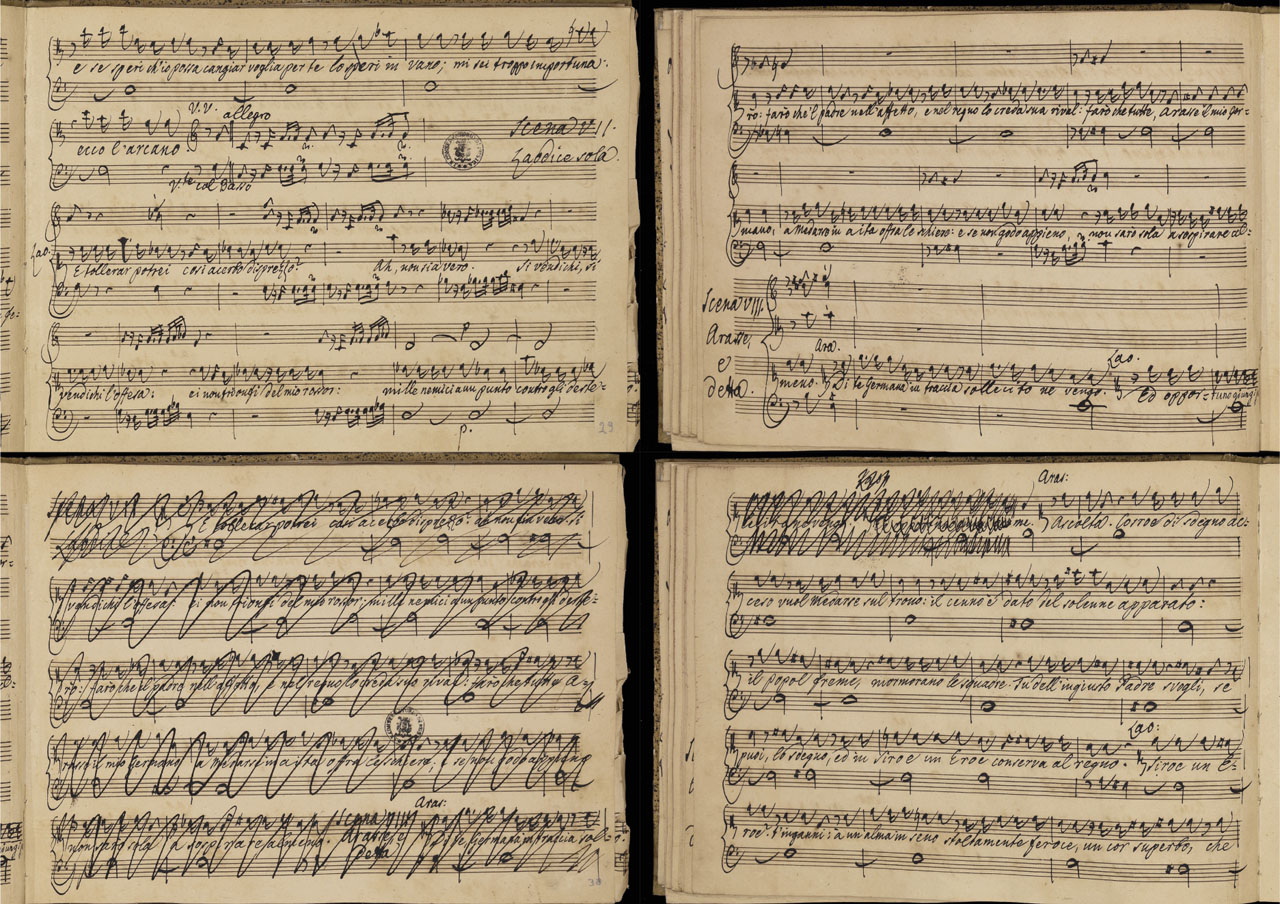
Figure 1
Hasse's autograph of Siroe 1763 (I-Mc Part. Tr. ms. 178), fols 29r-30r: beginning of Scene 7 Act I (recitativo accompagnato ‘E tollerar potrei’ and the crossed-out beginning of the secco version)
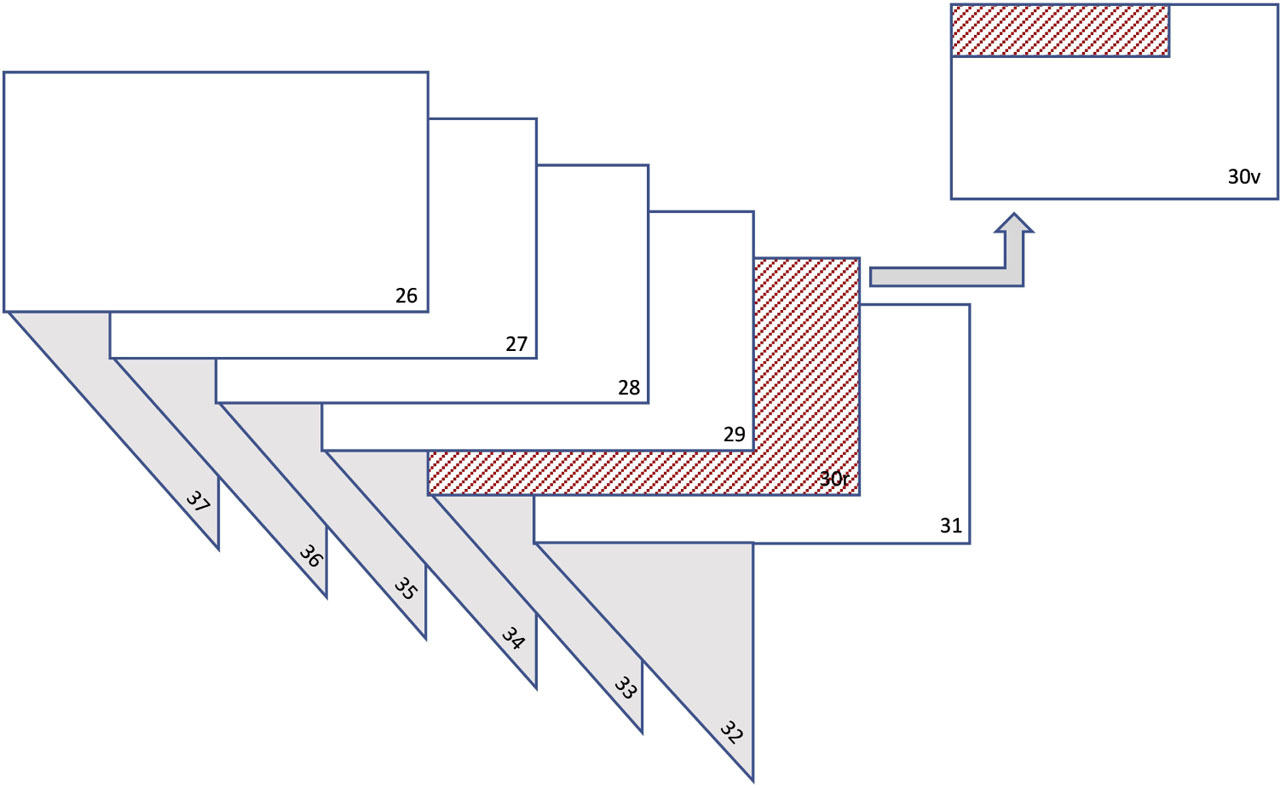
Figure 2
Siroe 1763, autograph manuscript (I-Mc Part. Tr. ms. 178): folio structure of the quire which contains Scene 7 of Act I. The location of crossed-out bars has been marked in red
The soprano for whom Hasse reconsidered this scene was the famous Viennese singerElisabeth Teyber.25 She was born in 1744 in the Habsburg capital as a member of a dynasty of musicians; both her father and her brother were heavily involved in the city's cultural life. Elisabeth started her career as a teenager in the late 1750s at the Theater an der Wien, where she sang in numerous productions. Her travels (Dresden was most likely her first guest appearance outside the Austrian capital) took her to various Italian cities and even to Saint Petersburg. Teyber was a pupil of none other than Vittoria Tesi Tramontini26 (who had sung the role of Emira in Hasse's Siroe in 173327) and of Hasse himself.28
Hasse must have held her to a higher standard, as is evident from the way he referred to her in many of his letters to composer and economist Giammaria Ortes. Since she was only eighteen years old at that time, it was most likely due to Hasse's preference for her that she was recommended for the Dresden première of Siroe in 1763. All the other singers had been members of Augustus’ court ensemble for at least a year prior to the première. As Alina Żórawska-Witkowska pointed out, Hasse's recommendation was the catalyst for the involvement of such a young and relatively unknown singer.29 As can be seen from the letters to Ortes, Hasse hoped that his pupil would become a regular member of this prestigious Hofkapelle. In a letter of 31 October 1767 Hasse wrote: ‘Io le ho volute sempre del bene, e la misi perciò in servizio del defonto mio padrone il Re di Polonia; ma la sua fortuna, che appena era principiata finì colla morte del re.’30 Augustus’ death in October 1763 seems to have forced both Hasse and Teyber to look for other possibilities of employment, which ultimately lead her to the Venetian theatre of San Benedetto and to other European theatres.
Independntly of her future engagements, the technical difficulty of her arias in Siroe shows that the soprano must already have been a promising talent and Hasse wanted to pull her into more focus. Not only did the author provide her with a solo scene and the accompagnato recitative (where the absence of Medarse may have been intentional and ultimately served to make Teyber the centre of attention and provide her role with a broader emotional spectrum) but also her first aria ‘O placido il mare’, which comes after the above-dicussed accompagnato, certainly reflects Teyber's proneness to excessive coloratura. Comparing her aria to the corresponding version in the 1733 opera, with the poetic text unmodified, one can clearly see an increase in virtuosity and technical difficulty, evident even in the incipit (Fig. 3). It seems the young Teyber had a lot to offer, both technically and acting-wise. Her voice and technical ability even reminded some critics of the famous Faustina Bordoni. Perhaps this association was no coincidence, since Teyber was Hasse's pupil.
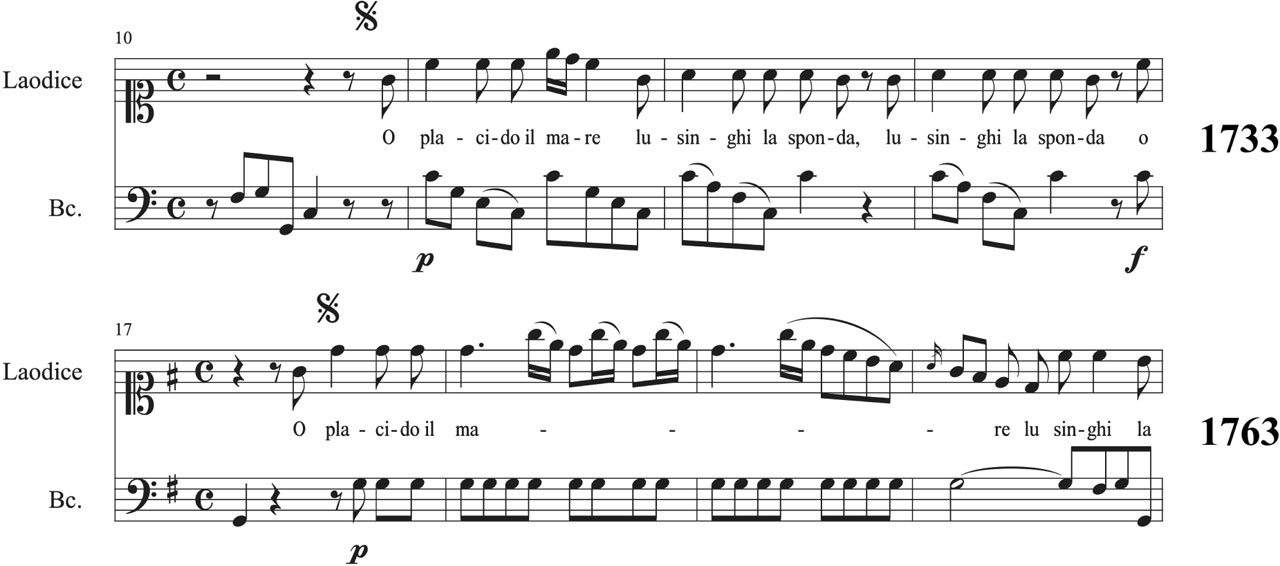
Figure 3
Incipits of the vocal part from two versions of Laodice's aria ‘O placido il mare’ from Siroe 1733 and 1763
It remains to be answered why Hasse rethought his initial idea of composing an accompagnato in Scene 7. Hasse and Teyber's fruitful collaboration most likely began with Siroe in 1763, even though he had already known her and her voice beforehand. Possiblythe composer was not yet sure of her abilities on the stage. It seems reasonable to think that Hasse wrote out two versions of the same recitative in order to check (perhaps even during rehearsals) whether the singer was able dramatically to render the more emotionally intense accompagnato. Despite Teyber's young age, however, the role of Laodice showcases an enormous vocal flexibility. The stable engagement at the prestigious court of Augustus III, which was seemingly what Hasse hoped for by recommending her, did not eventually take place. Nevertheless, following her interpretation of Laodice, the Viennese singer managed successfully to ‘break out’ of her home city and conquer Italy's most important stages (see Fig. 4).
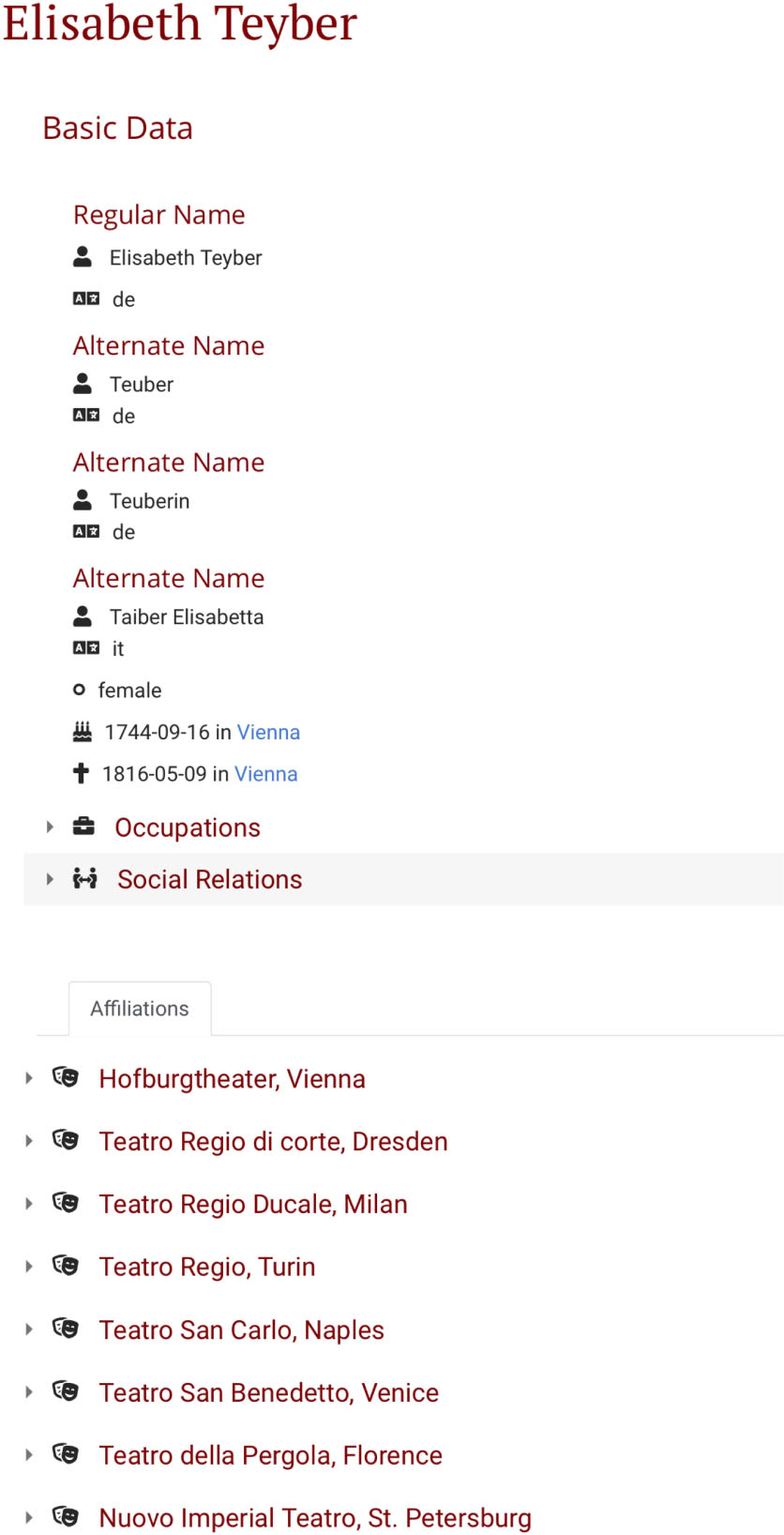
Figure 4
The record of Elisabeth Teyber with a list of her affiliations in the Pasticcio database
This scene in question is a prime example of how modifications of the libretto can have a significant impact on the overall semantic content of a scene and, furthermore, on the personal qualities of a role. An analysis and contextualisation of these semantic differences may even explain certain choices which the composer made in the later version of his opera and which ultimately served the introduction of his protégé, Elisabeth Teyber. This example, one of many, not only allows us to look at the process of composing, which was greatly influenced by the unique abilities and capabilities of the given singer, but also gives us food for thought over the hierarchy and chronology of Siroe's musical sources. This and other cases have persuaded us to include the so-called Special Interest Annotation (SIA), a tool of our digital edition directed towards a broad spectrum of potential ‘consumers’. It involves a short, simple, but scientifically valid description of particular circumstances regarding the origins of the opera, item corrections, afterthoughts and modifications. They are so important that their omission or laconic description could obscure the picture of the work. However, they do not constitute a coherent enough group of modifications to be described in the introduction to the edition.
THE DATABASE
The hub of the Pasticcio project consists of two parts: musical editions and the database mentioned at the beginning of this article. The database collects and shows the results of all individual sub-projects which take into consideration both Italy as a model culture and the musical activities of the Polish Crown in the context of the pasticcio genre. To represent its complexity, it has been necessary to collect not only information on the works themselves (in this case, as combinations of libretti and music) but also data concerning the context in which these works were created: singers and opera troupes, the role of the people involved in the production of libretti, music and performances of the operas, aria transfers, and arrangements of text and music. All this information adds up to a dense data network difficult to present in a traditional way, for instance in an article such as this one. In line with expectations from modern science, in which data should be widely and permanently available and usable, as well as the standards of digital humanities, the research results of the Pasticcio project will be presented and visualised in a database using XML (Extensible Markup Language) format within the MEI (Music Encoding Initiative)31 and TEI (Text Encoding Initiative).32 The application of these standardised data recording formats, suitable for each type of source and material we have used and wish to present, makes the Pasticcio project's scientifically valid assets findable, accessible, interoperable, and reusable to a wide range of users beyond academia.33
The database structure is founded on the FRBR (Functional Requirements for Bibliographic Records) model34, which employs groups of entities such as ‘work’, ‘expression’, ‘manifestation’, and ‘item’ (presented in the database within the MEI scheme). The second group of entities are ‘persons’ and ‘corporate bodies’ (presented within the TEI scheme), which are linked to entities from the first group through relationships such as ‘realisation’, ‘production’, ‘ownership’, ‘creation’. etc. However, for the database the project uses adapted FRBR ontology, where the ‘work’ as an entity is presented in a way which reflects the nature of the pasticcio genre: namely, its variability and performativity. Consequently, this approach requires that the ‘work’ records contain information which goes beyond the categories of ‘expression’ (versions of the work associated with particular performances) and ‘manifestations’ (sources, such as music manuscripts or printed libretti). For the purposes of the project, the FRBR model was extended to include an additional unit: ‘work component’ (section of a work, recitative, aria). This allowed the ‘work’ to be considered as a whole composed of various components, which – a quality specific to the pasticcio – are derived from other ‘works’. In this way, the so-called migration of arias (i.e. the ‘journey’ of an aria from one operatic work to another) can be more accurately described, including composer attribution, the singers involved (‘person’) and their workplaces (‘organisation’ and ‘place’).
As a result, the user will be able to trace the careers of singers and search their affiliations, i.e. the theatres (‘organisation’) where they sang (Fig. 4). Records also contain lists of operas and roles performed by each of them in every institution (Fig. 5). In the case of composers’ records, the user will find analogous affiliations regarding theatres for which they composed or where their operas where performed. More information about a given theatre, singer or work can be called up using a clickable permalink icon. In the case of a work, this information concerns the people involved in it: composers, librettists, even impresarios, as well as the sources and history of the work (Fig. 6). In the section for ‘expressions’ of the ‘work’ record, the user will find versions of the work associated with a given performance, including a list of dramatis personae (Fig. 7). The cast is displayed with the option of clicking on the singers’ names and obtaining information about them. Our goal has not only been to represent relations between each person and places, organisations, or works, but also, where possible, to enrich persons’ records by adding the social dimension, such as their marriages, relatives, or pupil-teacher relationships (Fig. 8).35
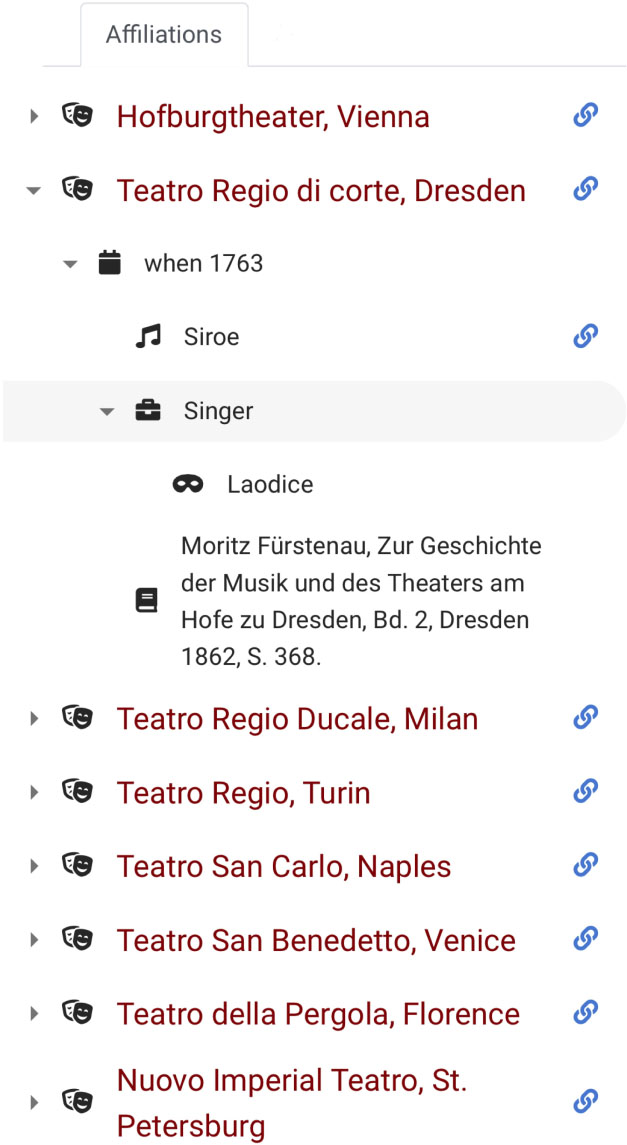
Figure 5
The record of Elisabeth Teyber in the Pasticcio database: affiliation (organisation) with the date, work title, and role
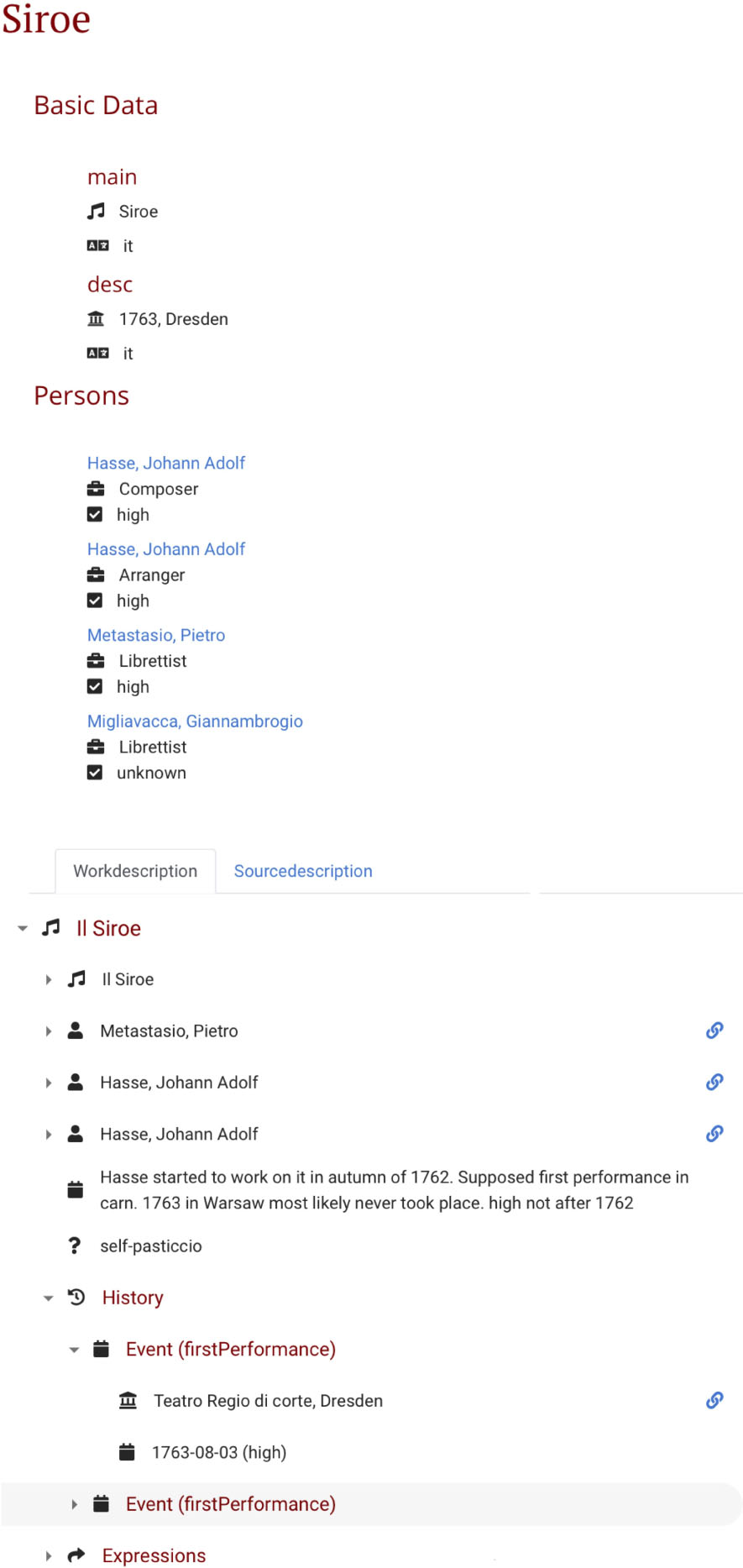
Figure 6
The ‘work’ record of Siroe 1763 in the Pasticcio database
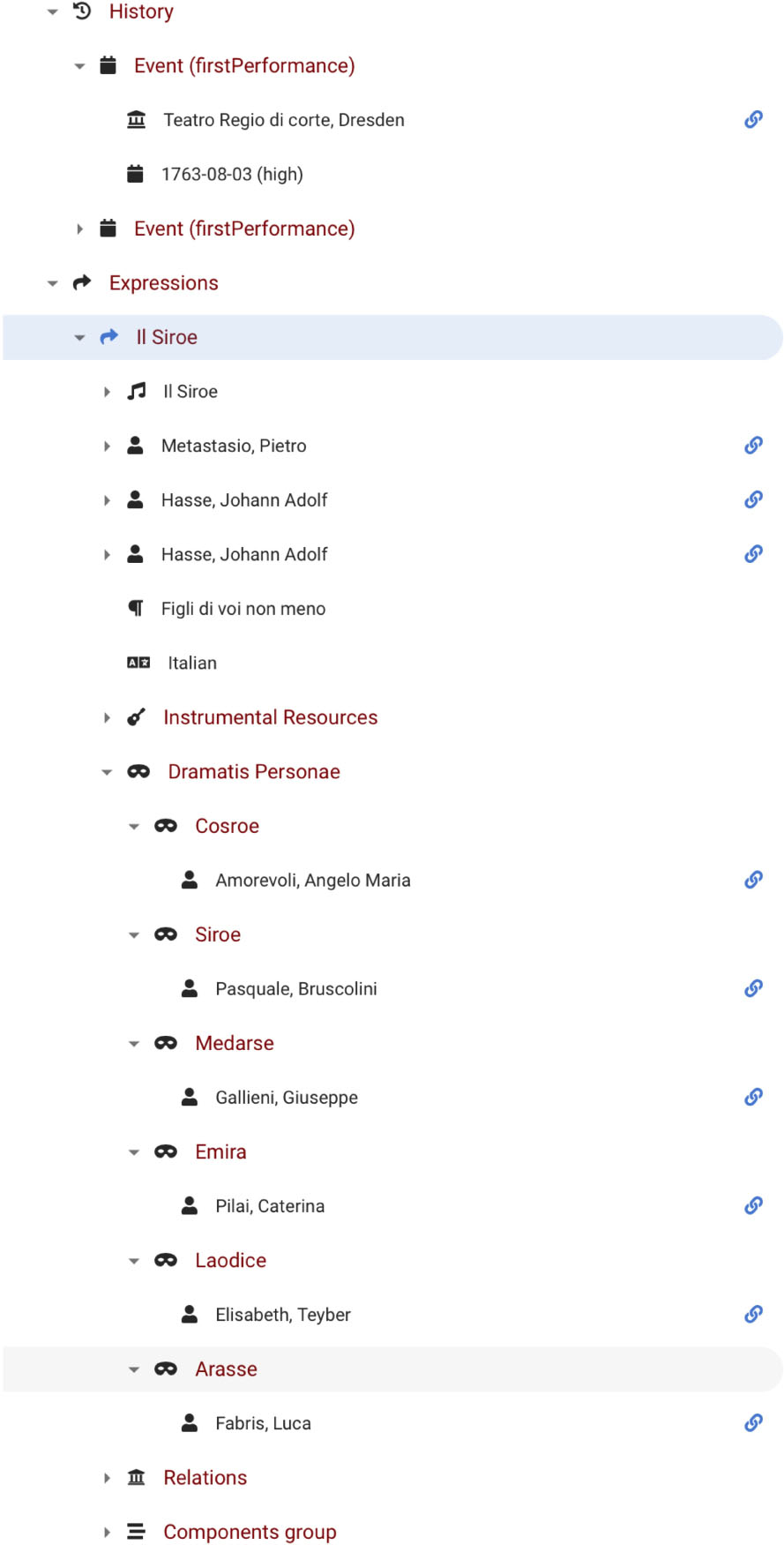
Figure 7
The Dresden cast list from the Pasticcio database record of Siroe 1763
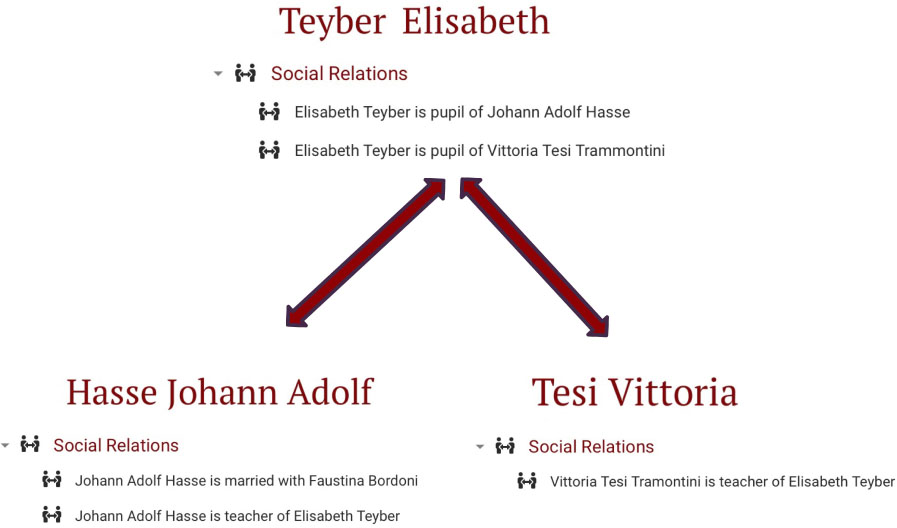
Figure 8
Social relations from the Pasticcio database on the example of Elisabeth Teyber
A collection of data, however large, does not constitute knowledge by itself. One of our Pasticcio project's primary goals has been to be able to visualise those various and complex types of data collected by our team, and ultimately to represent the network of persons, places and sources, shedding light on eighteenth-century pasticcio practice. Hasse's auto-pasticcio Siroe is one very special case, but no case is like any other, and the density of data varies greatly from work to work. This article aims to offer you a glance at the potential of our research project's tools: the database, the synoptical overview of the poetic text, and the critical edition online, which, we hope, will prove useful also for future research.
Emilia Pelliccia is a PhD candidate at the University of Vienna's Department of Musicology. She studied musicology in Vienna and Cremona and completed her master's degree with a thesis on the tenor Francesco Borosini in 2017. Since then, Emilia Pelliccia's research has mainly focused on singers of the Italian Baroque opera. Her current dissertation project investigates the role of low male voices at the Viennese court opera in the early eighteenth century. Moreover, Emilia Pelliccia collaborates with the research project PASTICCIO. Ways of Arranging Attractive Operas implemented by the Universities of Greifswald and Warsaw. Her responsibilities have included researching and entering data on singers and works in the project's database and a synopsis of the textual sources of Hasse's Siroe, re di Persia.
Sonia Rzepka graduated with honours in musicology from the University of Warsaw in 2017. At present, she is a PhD candidate at the Doctoral School of Humanities at the University of Warsaw. Under the supervision of Prof. Tomasz Jeż, she is preparing a doctoral dissertation on the geographic and interfaith transmission of sixteenth-to eighteenth-century music repertoires on the example of sources from the German Protestant parish of Wschowa (Fraustadt). In the years 2017–2020, she worked at the Music Department of the National Library of Poland, where she was responsible for cataloguing music manuscripts and old prints. Currently, she is involved in two international research projects: The Musical Repertoire of the Society of Jesus in the Polish-Lithuanian Commonwealth (1565–1773) and Pasticcio. Ways of Arranging Attractive Operas.