
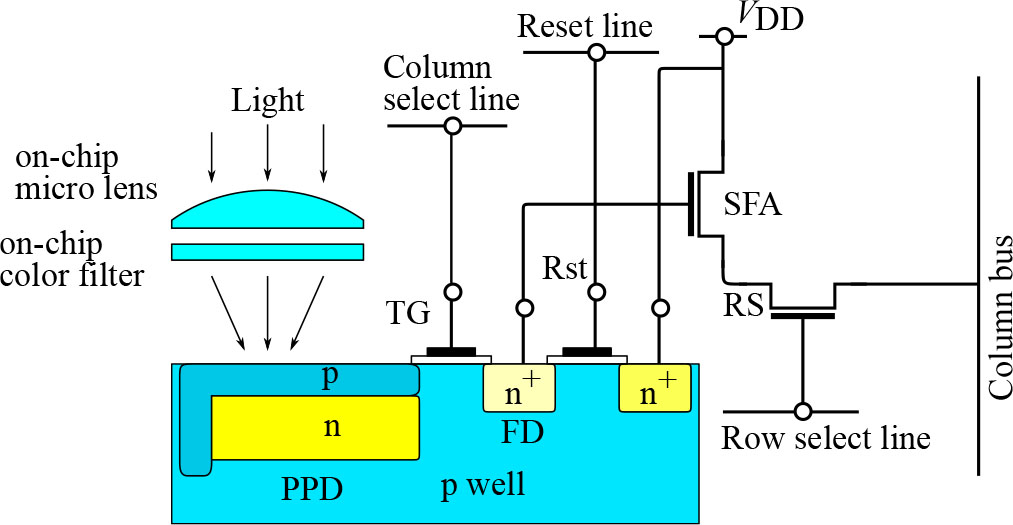
Fig. 1.
Schematic of a single four-transistor pixel in a CMOS image sensor based on an active pixel sensor design. The pixel includes a pinned photodiode (PPD), a transfer gate (TG), a floating diffusion (FD), a reset transistor (Rst), a source follower amplifier (SFA), and a row select transistor (RS). An on-chip microlens and an on-chip color filter are positioned above the PPD.
Table 1.
Cameras and lenses used, along with their corresponding symbols. In subsequent sections, each camera and lens is represented by the symbols listed in the Symbol column.
| Camera/Lens | Manufacturer | Product name | Symbol |
|---|---|---|---|
| Camera | Canon | EOS 9000D | CamC |
| Camera | Nikon | D5600 | CamN |
| Camera | Panasonic | Lumix DC-GF10W | CamP |
| Lens | Canon | EF-S18-55mm F4-5.6 IS STM | Cf18-55 |
| Lens | Nikon | AF-P DX NIKKOR 18-55mm f/3.5-5.6G VR | Nf18-55 |
| Lens | Panasonic | Lumix G VARIO 12-32mm/F3.5-5.6 ASPH./MEGA O.I.S. | Pf12-32 |
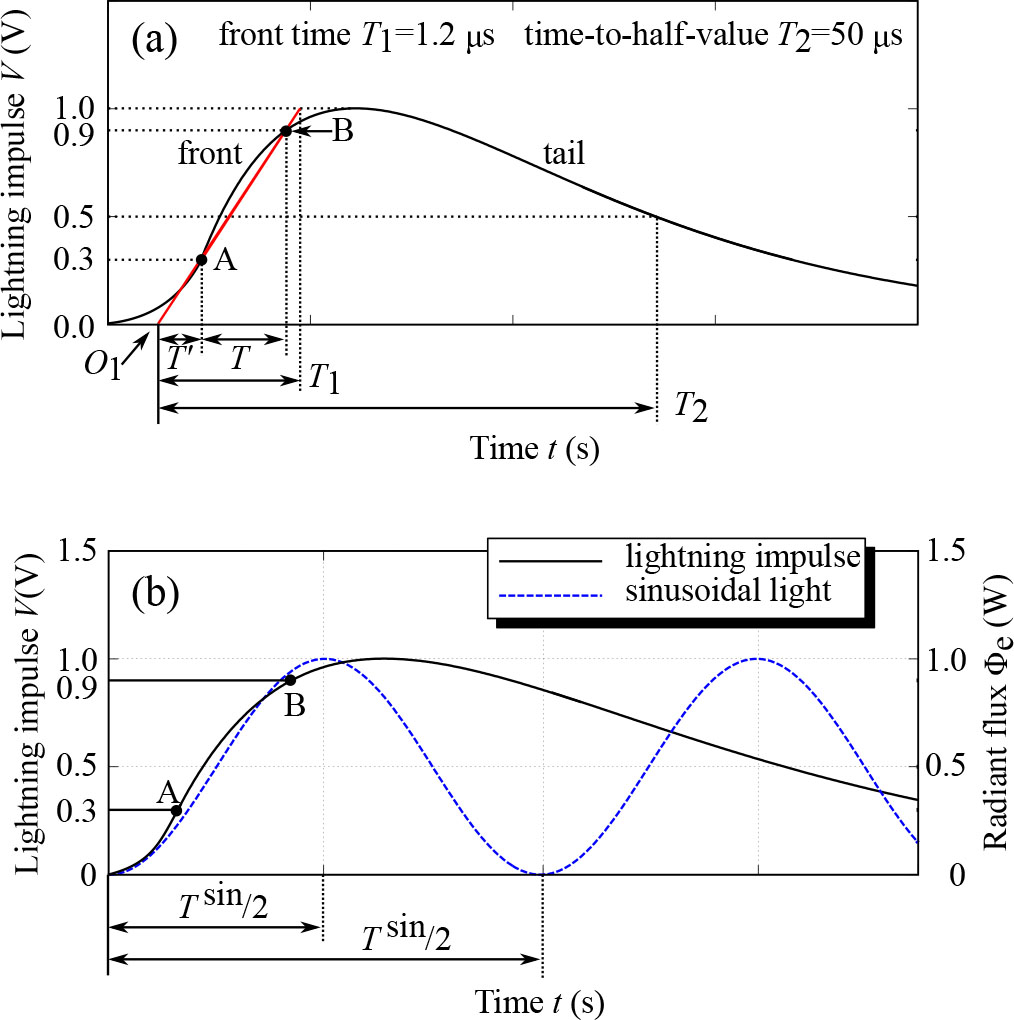
Fig. 2.
(a) Lightning impulse voltage waveform (e.g., Fig. 2.23, Chapter 2 [28]), and (b) illustration of the wavefront of the lightning impulse voltage (solid line) approximated by sinusoidal light (dashed line) as indicated by the radiant flux Φe. The front time T1 is 1.2 μs, and the time-to-half-value T2 is 50 μs. Both T1 and T2 start from the virtual origin O1. The period of the sinusoidal light is denoted by Tsin. The lightning impulse voltage and radiant flux Φe are normalized, with their maximum values expressed as unity, respectively.
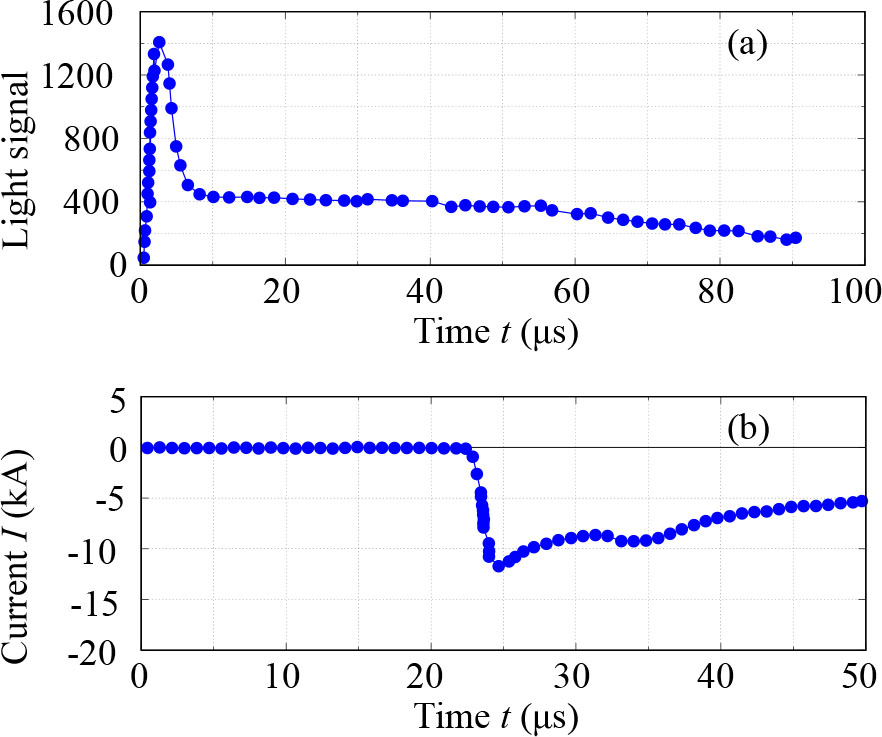
Fig. 3.
(a) Light signal (Fig. 2 [29]) and (b) current waveform (Fig. 4 [30]) of lightning. The 10/90 rise time of the light signal is approximately 1.15 μs, and that of the current is approximately 1.13 μs. Since a strong correlation between current and light intensity has been shown up to the peak of the lightning current, the current waveform up to the peak can be directly interpreted as the light intensity [29].
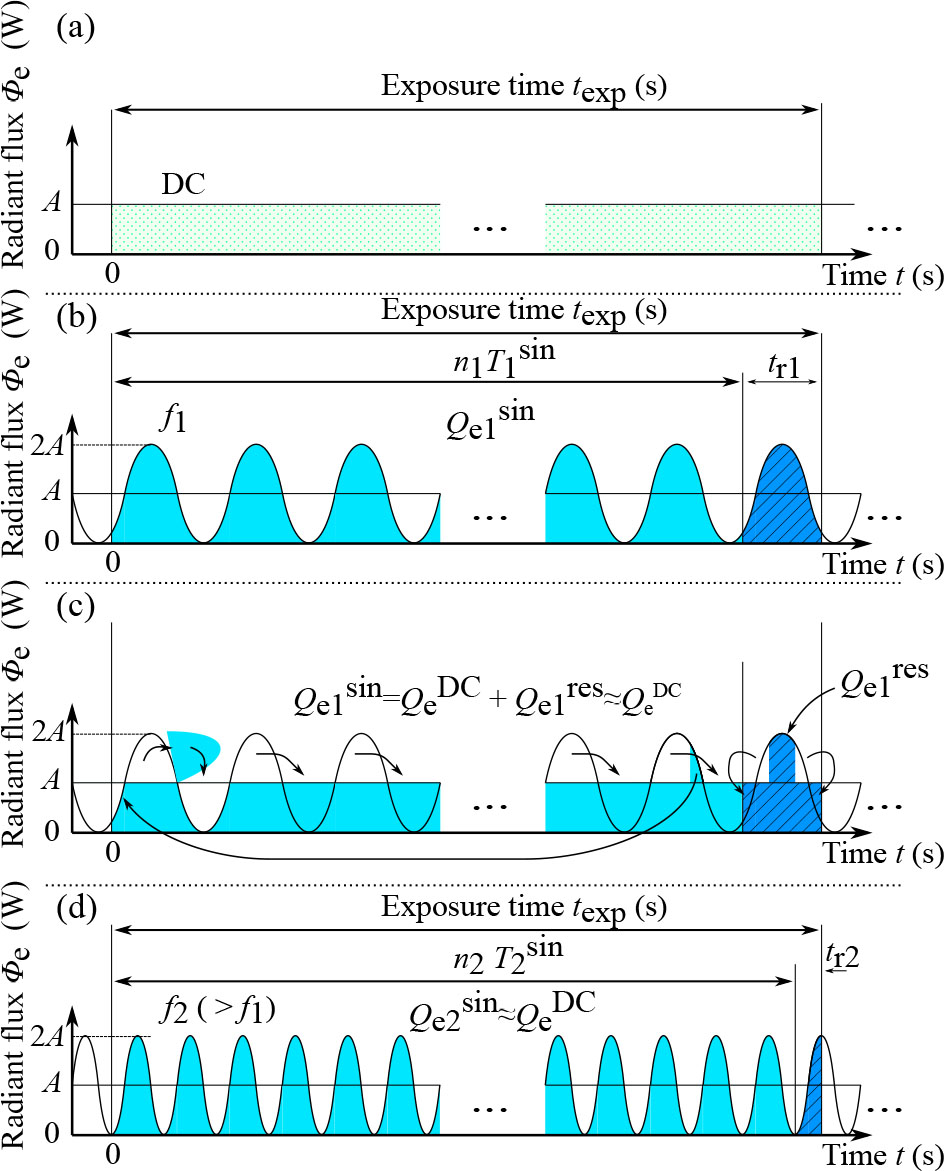
Fig. 4.
Radiant flux Φe (t) vs. time t. (a) The radiant flux of constant brightness light remains constant with respect to t, and its radiant energy is represented by the dotted (green) region. (b) is a sinusoidal wave with frequency f1. The period of is , and during the exposure time texp, there are n1 periods. The difference between texp and is the residual tr,1. (c) Intuitive illustration of the integral of , where the radiant energy of the sinusoidal light is approximately equal to , since the residual indicated by the upper part of the diagonal stripe region is smaller than . (d) is the sinusoidal light with frequency f2, where f2 > f1. Since the frequency f2 is greater than f1, the period is shorter than , and the number of waves n2 within the exposure time texp is greater than n1. Moreover, the residual radiant energy approaches zero as the frequency increases.
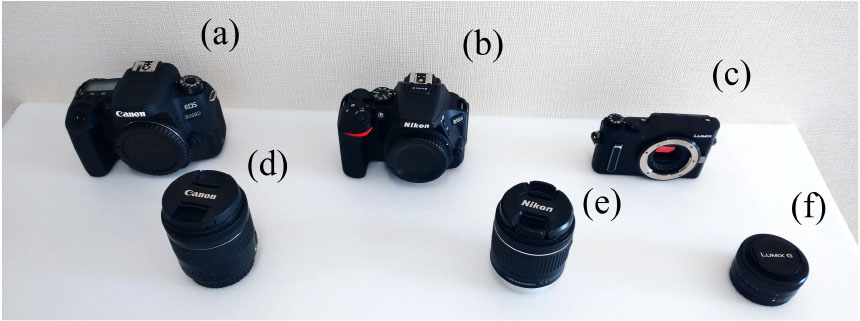
Fig. 5.
Digital cameras and lenses used: (a) CamC, (b) CamN, (c) CamP, (d) Cf18-55, (e) Nf18-55, and (f) Pf12-32.
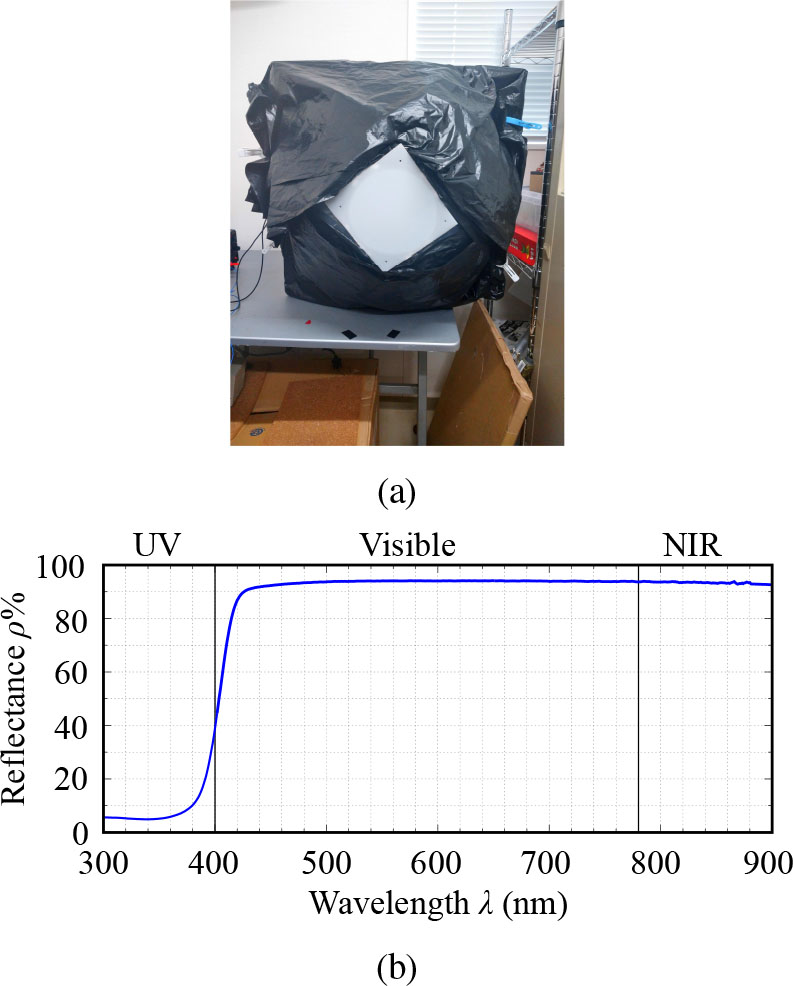
Fig. 6.
(a) Front view of the integrating sphere used in the study, and (b) reflectance ρ of the white pigment coating the interior of the integrating sphere.
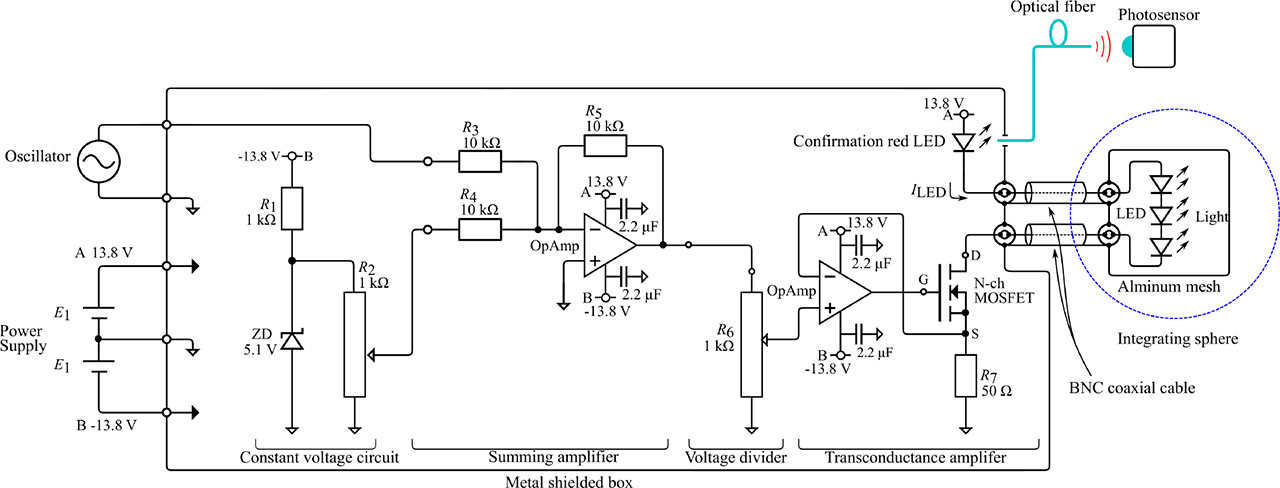
Fig. 7.
Schematic circuit diagram of the sinusoidal light source. To minimize noise, the LED driver is housed in a metal aluminum shielded box, while the light-emitting component is placed inside an aluminum mesh box. The sinusoidal wave (peak voltage Vp = 0.5 V, peak-to-peak voltage Vpp = 1 V) from the oscillator and the bias voltage (Vbias = 0.5 V) from the constant voltage circuit are input to the summing amplifier.
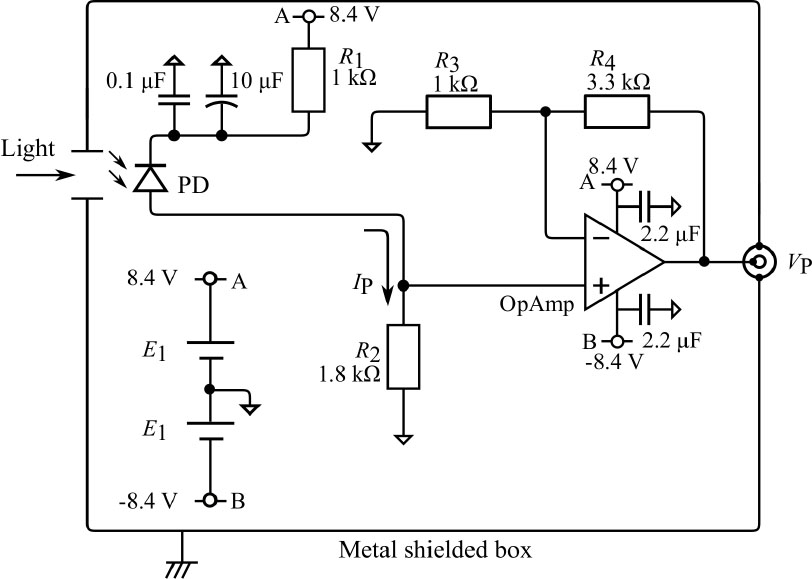
Fig. 8.
Schematic circuit diagram of the photosensor. Due to the small photocurrent IP (in the range of several tens of microamperes), the output voltage VP is amplified by a factor of 3.3 using the non-inverting amplifier, with the voltage across the shunt resistor R2 serving as the input.
Table 2.
Camera settings for photography. Brightness information is influenced by the exposure time t, ISO gain, focal length f, and F-number F/#. The exposure time and ISO gain are directly related to the image sensors, while the focal length and F-number pertain to the lenses used.
| Combination | Camera | Lens | ||
|---|---|---|---|---|
| Camera-Lens | t (s) | ISO | f (mm) | F/# |
| CamC-Cf18-55 | 1 | 100 | 18 | 4 |
| CamN-NCf18-55 | 1 | 100 | 18 | 4 |
| CamP-Pf12-32 | 1/2 | 200 | 13 | 4 |
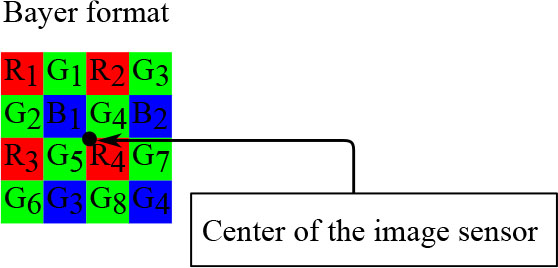
Fig. 9.
Central 4 × 4 pixels of the RAW data in Bayer format. This region includes 4 pixels for the blue (B) channel, 8 pixels for the green (G) channel, and 4 pixels for the red (R) channel.
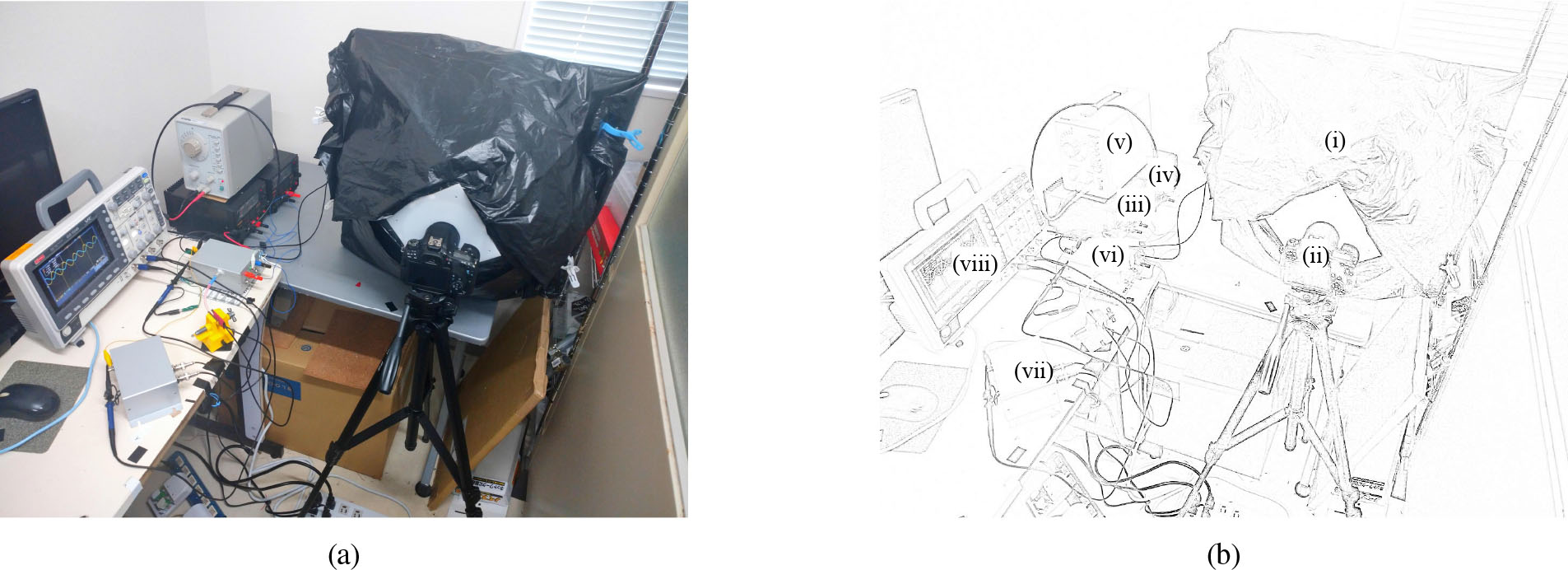
Fig. 10.
(a) Setup of the camera and integrating sphere, and (b) arrangement of each measurement module. The positioning of each module is as follows: (i) integrating sphere, (ii) digital camera, (iii) and (iv) DC-stabilized power supply, (v) oscillator, (vi) LED driver, (vii) photosensor, and (viii) oscilloscope. To shield ambient light, the integrating sphere and camera were covered with a black plastic sheet during photography.
Table 3.
Dark values of the image sensors in three cameras.
| Camera | B | G | R |
|---|---|---|---|
| CamC | 2045.90 | 2045.28 | 2045.72 |
| CamN | 2408.16 | 2406.07 | 2408.68 |
| CamP | 2288.0 | 2282.0 | 2284.0 |
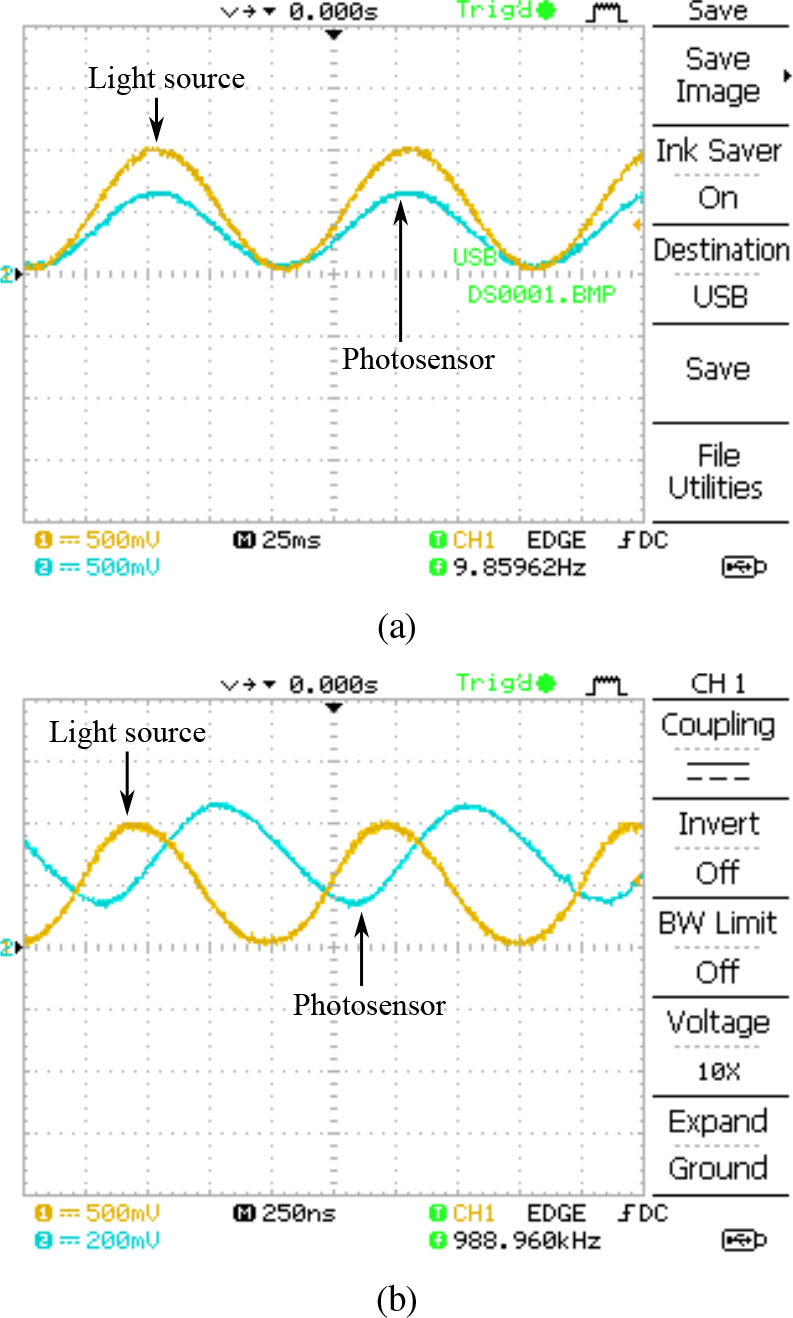
Fig. 11.
Output waveforms of the sinusoidal light source and photosensor at frequencies of (a) 10 Hz and (b) 1 MHz.
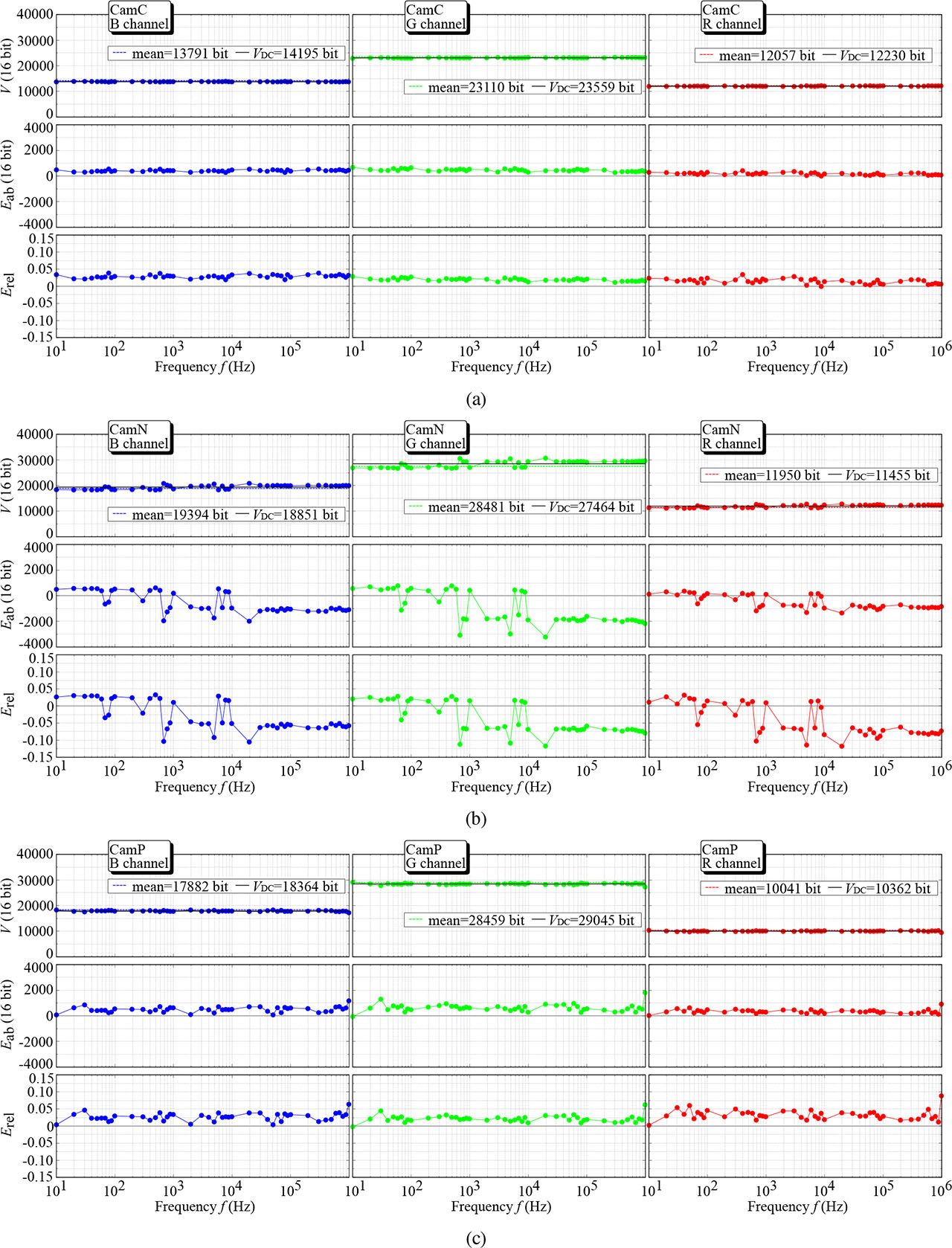
Fig. 12.
Pixel value V versus frequency f, absolute error Eabs versus frequency f, and relative error Erel versus frequency f for (a) CamC, (b) CamN, and (c) CamP. The results for the B, G, and R channels are presented from left to right. The solid and dashed horizontal lines represent the DC pixel value VDC and the mean pixel value, respectively.
Table 4.
Electronic components in the LED driver and photosensor. The physical quantities listed include: bias current and slew rate of the operational amplifier (IB and SR), rise and fall times of the MOSFET (tr and tf), zener voltage (VZ), luminous intensity (IV), forward current of the LED (IF), photocurrent of the photodiode (IP), and illuminance (EV).
| Circuit | Part symbol | Part name | Manufacturer | Product number | Description |
|---|---|---|---|---|---|
| LED driver | OpAmp | Operational amplifier | Nisshinbo Micro Devices | NJM2742D | IB = 80 nA, SR= 10 μs |
| LED driver | N-ch MOSFET | MOSFET | Microchip Technology | DN2540N3-G | tr = 15 ns, tf = 20 ns |
| LED driver | ZD | Zener diode | Nexperia | BZX79-C5V1,113 | VZ = 5.1 V |
| LED driver | LED | White LED | Cree LED | C503D-WAN-CCbEb151 | Iv = 40 cd, IF = 20 mA |
| LED driver | Red LED | Red LED | DiCUNO | – | Red, Iv = 3 cd, IF = 20 mA |
| LED driver | Coaxial cable | Coaxial cable | – | RG174 | BNC terminated, 1.5 m, 50 Ω |
| Photosensor | OpAmp | Operational amplifier | Nisshinbo Micro Devices | NJM072BD (discontinued) | IB = 13 pA, SR = 13 μs |
| Photosensor | PD | Photodiode | ams-OSRAM | BPW 34 | IP ≥ 55 μA, EV = 1000 lx |
| Photosensor | E1 | Ni-MH rechargeable battery | RS Pro | 199-646 | 8.4 V, capacity 200 mAh |