
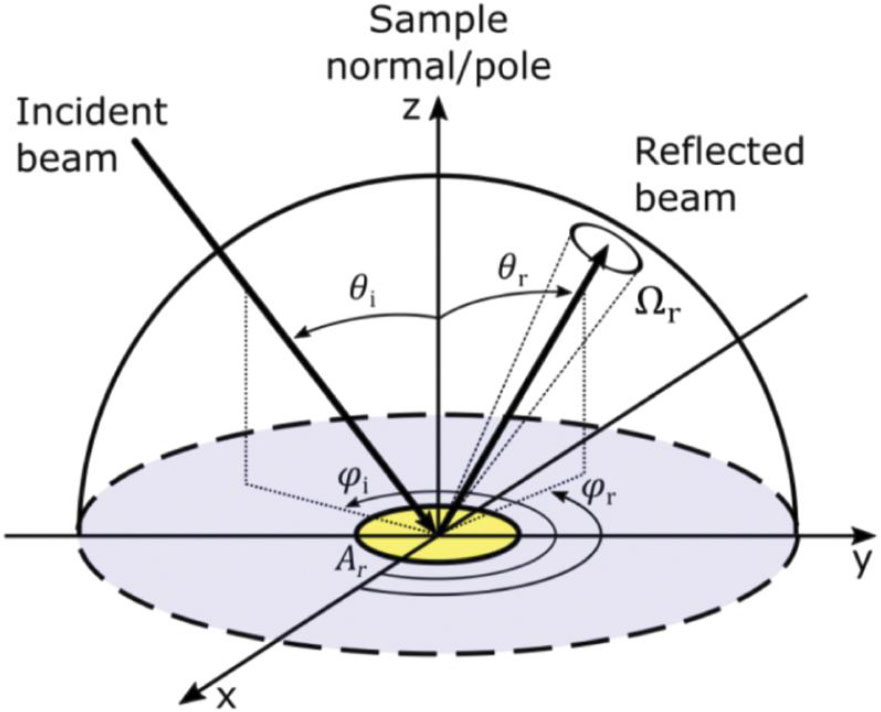
Fig. 1.
Description of notation and angles [4].
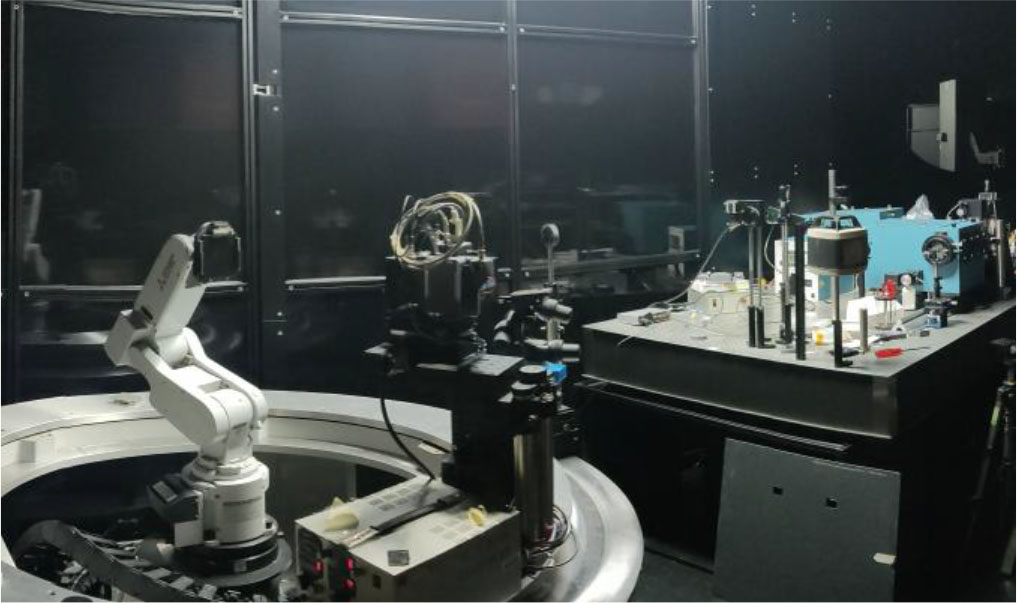
Fig. 2.
CMI robo-goniospectrophotometer facility (a photo documentation from the sources of the Department of Radiometry and Photometry of CMI).
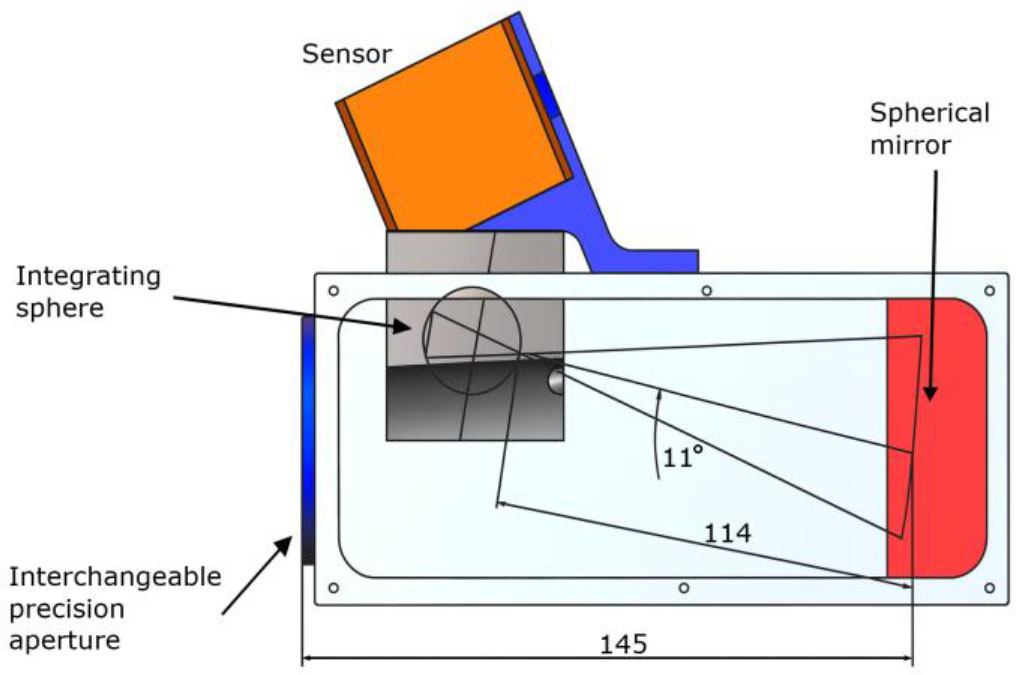
Fig. 3.
Diagram of the RoboCapp detection system [6].
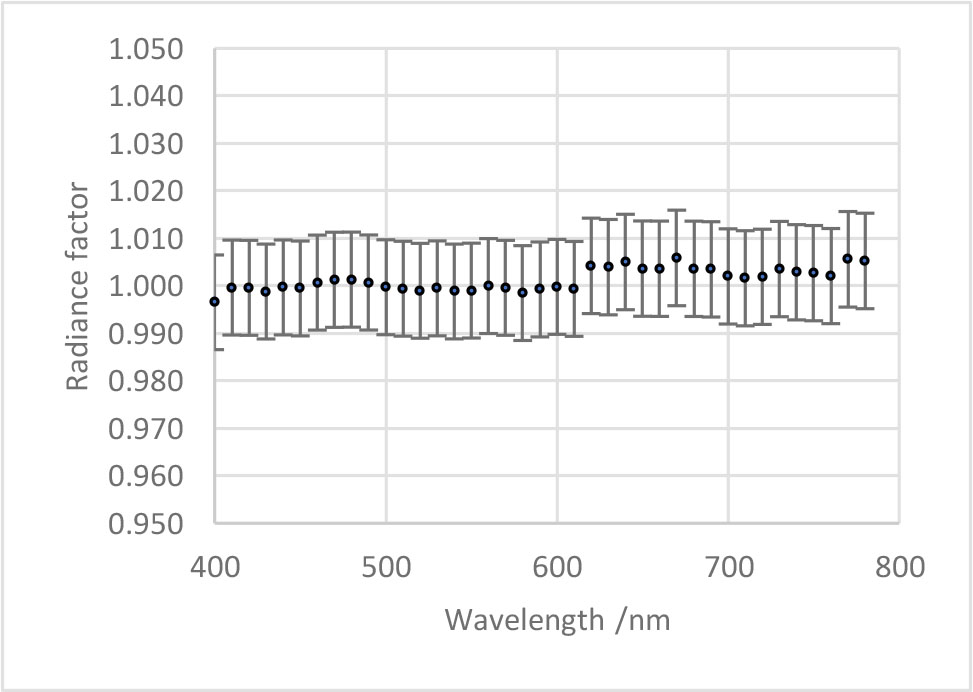
Fig. 4.
Measured spectral radiance factor of Spectralon 99 (0.45).
Table 1.
Uncertainty budget.
| Individual input parameter | Uncertainty contribution to the spectral radiance factor measured value | The individual factors can be assessed as follows: |
|---|---|---|
| Uncertainty in angles / Cosine of θi / Zenith angle / Axis alignment | 1.34E-06 | This value is very small, indicating that the angles and axis alignment have a minimal effect on the overall measurement uncertainty. Therefore, this contribution is negligible. |
| Aperture + Sample-to-detector distance | 8.54E-03 | This factor contributes the most to the total uncertainty. The distance and geometry of the sample can significantly affect the measurement, which is reflected in the relatively high uncertainty value. |
| Detector uniformity / Linearity | 2.03E-03 | This is a significant factor, but smaller than the geometric aspects. Although the linearity of the detector may influence the measurement, it contributes moderately to the total uncertainty. |
| Noise / Reading of signal | 3.54E-03 | This factor also contributes a relatively high portion to the total uncertainty, suggesting that the signal is susceptible to noise, which could compromise the accuracy of the measurements. |
| View factor / Illuminated area | 1.67E-04 | This contribution is very small, indicating that the view factor and illuminated area have only a minimal impact on the measurement uncertainty. |
| Instability of the light source | 2.31E-03 | This uncertainty is significant because the stability of the light source can affect the measurement intensity, and consequently, the results. |
| Wavelength | 8.11E-04 | This contribution is very small and can be considered negligible in the context of the overall uncertainty. |
| Reproducibility | 3.32E-03 | This factor has a relatively high impact on the measurement results, suggesting some variability between individual measurements [9], [10]. |
| Total uncertainty | 1.03E-02 |