
1. Introduction
The new complex optical material surfaces require characterization using goniometric spectral measurements, which cover arbitrary angles of incident radiation as well as various observer orientations relative to the sample surface.
To advance the metrological capabilities for the characterization of optical materials, the Czech Metrology Institute (CMI) has designed and constructed, through dedicated in-house development at the Laboratory of Radiometry and Photometry CMI LPM in Prague, a unique primary robotic goniospectrophotometer, designated RoboCapp. This metrological grade measuring equipment represents a significant innovation in the field of spectrophotometry and colorimetry, enabling spectral and spatially resolved measurements of surface optical properties.
RoboCapp provides metrological determination of both reflective characteristics [1] in the front hemisphere and transmissive characteristics [2] in the back hemisphere, thereby covering the complete spherical response of optical material surfaces.
The reliable quantification of angle-dependent appearance properties demands either high-precision measurement of the Bidirectional Reflectance Distribution Function (BRDF) or the spectral radiance factor. The CMI, Primary Metrology Laboratories in Prague, Department of Radiometry and Photometry, has developed a new independent scale for the spectral radiance factor of spectrally neutral quasi-Lambertian diffuse materials, measured in the 0°/45° geometry. The RoboCapp enables absolute radiance factor measurements, i.e., without reliance on a reference standard, on any optical material.
The new RoboCapp, a measurement equipment designed as a robotic goniospectrophotometer, provides the capability to independently maintain physical-metrological continuity for a range of photometric and colorimetric quantities, which are of significant importance in transport infrastructure and automotive technologies. The optical properties of product surfaces are crucial in many industrial sectors, as they strongly influence customer purchasing decisions. Therefore, maintaining consistency and reproducibility in industrial production is essential to ensure effective quality control of manufactured products. Advances in product surface design have created a growing need for new measurement methods and equipment capable of accurately assessing complex optical surfaces.
This paper describes the development driven by the need to optimize the measurement setup of the CMI primary BRDF measurement system to provide a reliable realization of the spectral radiance factor scale for spectrally neutral quasi-Lambertian diffuse standard samples across the visible spectral region. An integral component of this effort is the validation of the measurement system using standard samples with quasi-Lambertian diffusion characteristics and neutral spectral properties.
2. Subject & Methods
Methods
BRDF is a function describing the transformation of radiance of a surface element in the given observation angle at a given wavelength λ, Lr(θr,ϕr,xr,yr,λ), depending on the illumination direction (θi,ϕi) and the observation direction (θr,ϕr) in relation to the irradiance incident on the environment from a given direction at a given wavelength Ei(θi,ϕi,λ). [3]
where: ρ is BRDF, i is the direction of illumination described by its zenithal angle θi and its azimuthal angle ϕi, r is the direction of observation described by its zenithal angle θr and its azimuthal angle ϕr, Ei is incident irradiance, Lr is reflected radiance, and λ is wavelength.The BRDF function is a more general fundamental physical property, as it can define the reflection characterization for any angle of incident optical beam and any detection direction across all possible wavelengths. The spectral radiance factor is a more specific quantity derived from the spectral BRDF for a particular wavelength and a reference Lambertian surface under specific geometries, used when a full BRDF measurement is impractical.
The spectral radiance factor is the spectrally defined physical quantity that indicates the ratio of the radiance Le,n of a surface element in a given direction and the radiance Le,d of a reflection perfect or a transmission perfect scatterer irradiated and observed in the same way:
The definition applies in a given direction under given irradiation conditions for a surface element of the environment that does not itself emit radiation [3].
The spectral radiance factor is thus an essentially relative quantity.
Experimental setup
The robot-based goniospectrophotometer RoboCapp (see Fig. 2) consists of a motorized circular ring with an external diameter of 1.3 m, which allows the rotation of the detection system around the sample.
The sample positioning is achieved by the 6-axis Mitsubishi robotic arm located in the center of the circular ring. A sample holder is placed on the top of the robotic arm. Due to the 6 degrees of freedom provided by the robot, it is possible to measure in any arbitrary geometric configuration (see Fig. 1), which allows for any desired orientation of the sample with respect to the incident optical beam.
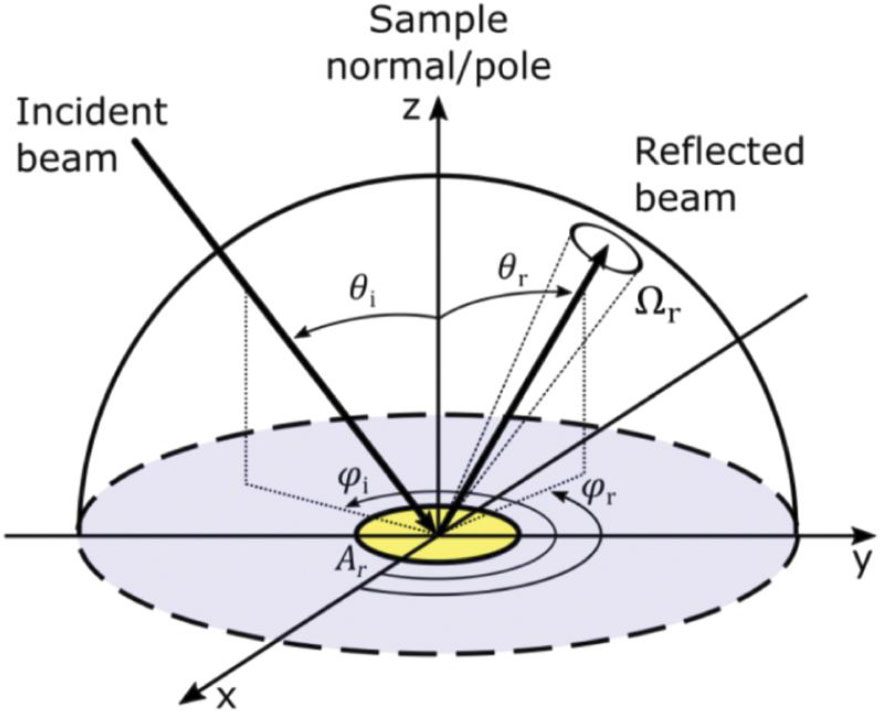
Fig. 1.
Description of notation and angles [4].
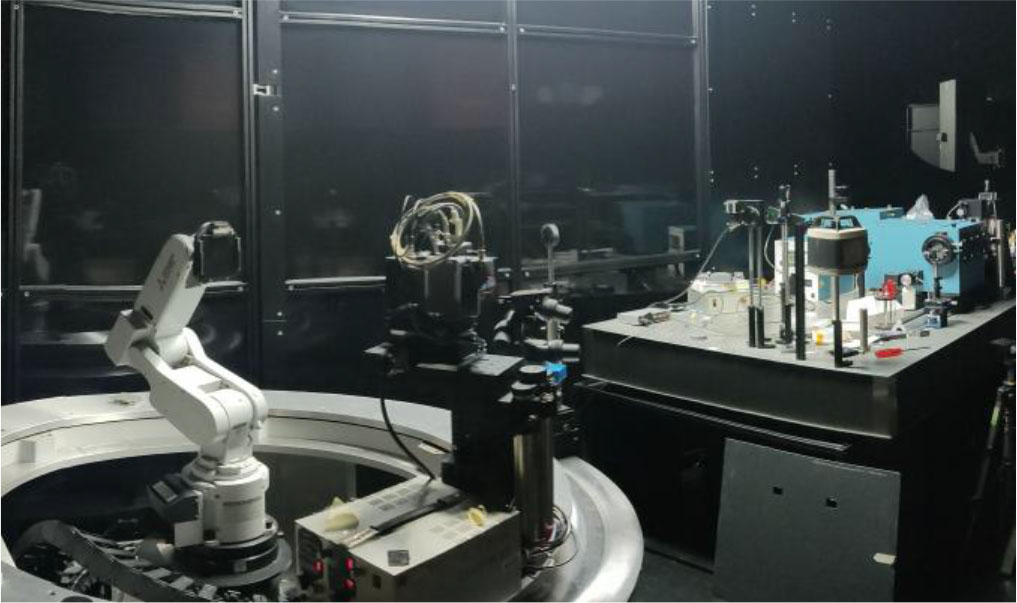
Fig. 2.
CMI robo-goniospectrophotometer facility (a photo documentation from the sources of the Department of Radiometry and Photometry of CMI).
To produce monochromatic optical radiation suitable for precise spectrophotometric and colorimetric applications, the experimental setup integrates a high-intensity laser-driven light source (LDLS) with a diffraction grating monochromator. This configuration allows wavelength tuning across a broad spectral range, extending from the visible into the infrared light spectrum, with a spectral bandwidth of approximately 5 nm. The output optical beam from the monochromator is subsequently collimated using a reflective optical assembly. The polarization plane of the illumination beam is regulated using a high-extinction-ratio film polarizer, which is integrated into a computer-controlled motorized rotation stage.
The RoboCapp detection system (see Fig. 3) was developed through a joint effort between the CMI and the Measurement Standards Laboratory of New Zealand (MSL). The unit has been specifically engineered to achieve an exceptionally wide dynamic range of 10 orders of magnitude within the visible spectral range, accommodating optical powers from the fW level up to several tens of μW [5].
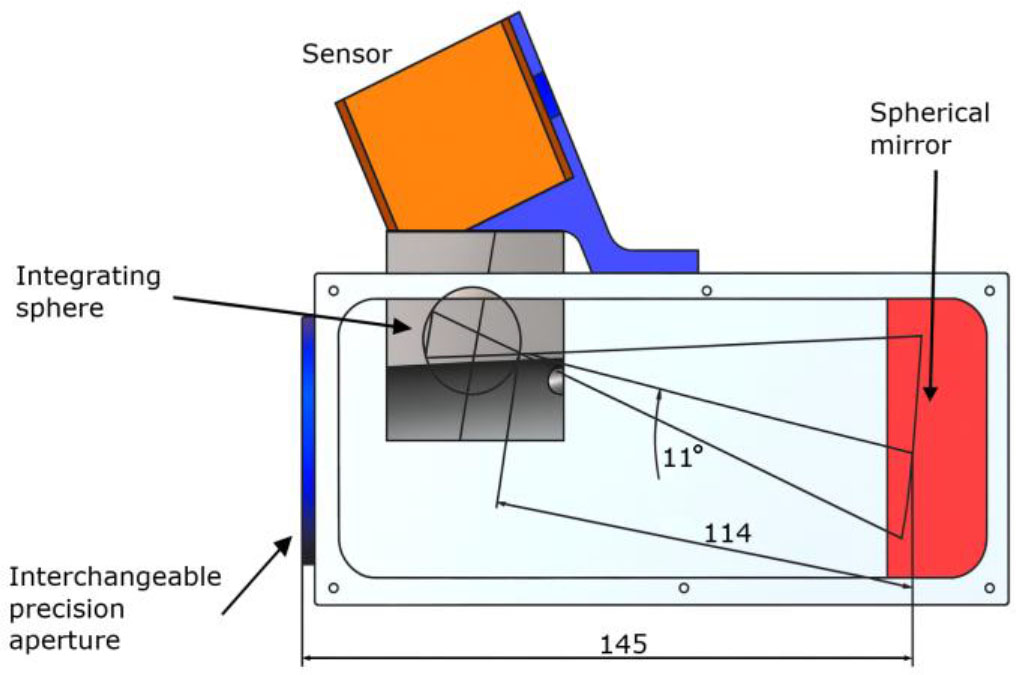
Fig. 3.
Diagram of the RoboCapp detection system [6].
The system incorporates an aperture, a mirror, and sensors integrated into a small, compact integrating sphere. To suppress inter-reflections, a mirror with a focal length of 150 mm is employed in place of a lens. The mirror is tilted by 5.5° along both horizontal and vertical axes to minimize stray light and improve measurement fidelity.
The integrating sphere, manufactured from sintered halon with an internal diameter of 25 mm, contains three ports. A 10 mm entrance port directs the focused optical beam from the mirror. Two additional recessed ports house the detectors: a Hamamatsu photomultiplier and a Si low-noise Si photodiode. This dual-sensor configuration ensures continuous coverage across the entire dynamic range of the instrument.
A key feature of the design is its insensitivity to the polarization of the detected optical light beam. As BRDF characterization exhibits dependence on both vertical and horizontal polarization of the incident optical radiation, the detection system was constructed to ensure equal detection efficiency for both polarization orientations. Therefore, two measurements are performed using vertically and horizontally polarized incident light.
In measurement configurations typical for the RoboCapp system, where the sample surface over a relatively small spot area is illuminated, the spectral radiance factor is determined by [1]
where: ϕr(λ) is the spectral reflected radiant flux, ϕi(λ) is the spectral incident radiant flux, Rr is the distance from the detector aperture to the sample surface, and rr is the detector aperture radius. The quantities ϕr(λ) and ϕi(λ) generate proportional photocurrent signals, Ir(λ) and Ir(λ), respectively, in the RoboCapp Si photodiode that are given by the equations where: k is a constant value derived by the geometrical factor of the RoboCapp detector integrating sphere, and s(λ) is the Si photodiode spectral responsivity.Applying (4) and (5) to (3), the measurement equation for the spectral radiance factor as determined by RoboCapp is obtained:
where: Rr value is measured with a non-contact calibrated laser meter, rr value is calibrated by the CMI length department, Ir(λ) and Ii(λ) are measured by custom-made switched integrator amplifier electronics [7], [8].For the characterization of the quasi-Lambertian diffuse standard material sample Spectralon 99, the 0°/45° measurement geometry was selected. The measurement was conducted within the visible light spectrum, covering wavelengths between 400 nm and 780 nm.
3. Results
Results of the RoboCapp measurements for the Spectralon 99 sample in the visible light spectrum for the 0°/45° geometry are displayed in Fig. 4.
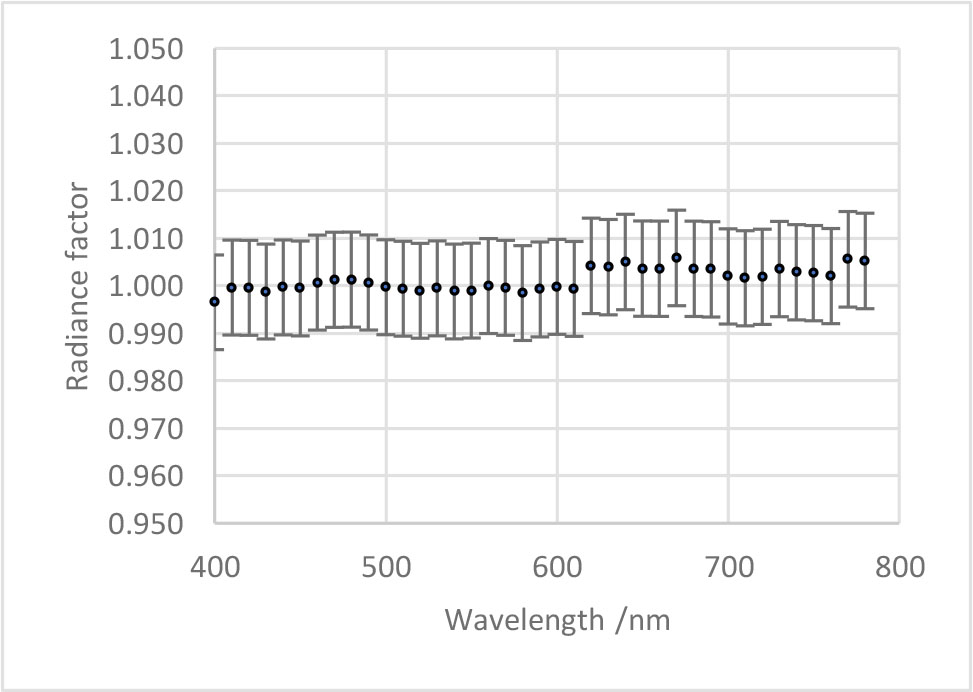
Fig. 4.
Measured spectral radiance factor of Spectralon 99 (0.45).
The measurement uncertainty budget is presented in Table 1. The individual input parameters of the measurement system are presented in the first column of the table. The uncertainty contributions to the spectral radiance factor (the spectral radiance factor is a relative quantity) measured value are stated in the second column.
Table 1.
Uncertainty budget.
| Individual input parameter | Uncertainty contribution to the spectral radiance factor measured value | The individual factors can be assessed as follows: |
|---|---|---|
| Uncertainty in angles / Cosine of θi / Zenith angle / Axis alignment | 1.34E-06 | This value is very small, indicating that the angles and axis alignment have a minimal effect on the overall measurement uncertainty. Therefore, this contribution is negligible. |
| Aperture + Sample-to-detector distance | 8.54E-03 | This factor contributes the most to the total uncertainty. The distance and geometry of the sample can significantly affect the measurement, which is reflected in the relatively high uncertainty value. |
| Detector uniformity / Linearity | 2.03E-03 | This is a significant factor, but smaller than the geometric aspects. Although the linearity of the detector may influence the measurement, it contributes moderately to the total uncertainty. |
| Noise / Reading of signal | 3.54E-03 | This factor also contributes a relatively high portion to the total uncertainty, suggesting that the signal is susceptible to noise, which could compromise the accuracy of the measurements. |
| View factor / Illuminated area | 1.67E-04 | This contribution is very small, indicating that the view factor and illuminated area have only a minimal impact on the measurement uncertainty. |
| Instability of the light source | 2.31E-03 | This uncertainty is significant because the stability of the light source can affect the measurement intensity, and consequently, the results. |
| Wavelength | 8.11E-04 | This contribution is very small and can be considered negligible in the context of the overall uncertainty. |
| Reproducibility | 3.32E-03 | This factor has a relatively high impact on the measurement results, suggesting some variability between individual measurements [9], [10]. |
| Total uncertainty | 1.03E-02 |
The uncertainty contributions associated with system alignment are evaluated using a Monte Carlo method, based on the RoboCapp angular accuracy estimated from prior experience. The contributions related to the wavelength scale and detector linearity are determined from performance measurements. Reproducibility and noise are assessed from statistical variance.
The following analysis evaluates the individual factors that contribute to the overall measurement uncertainty. By examining the influence of each factor, we can better understand how they affect the accuracy of the results and identify areas for potential improvement. The factors considered include geometrical aspects, detector characteristics, signal noise, and the stability of the light source, among others.
The total uncertainty (1.03E-02) is predominantly influenced by factors such as the sample-to-detector distance, signal reading noise, light source instability, and reproducibility. While some factors, such as angles, axis alignment, or view factor, have a negligible impact, other factors should be considered to improve measurement accuracy [9], [10].
The individual factors are assessed in the third column of the table.
4. Conclusion
The development of the unique robotic goniospectrophotometer RoboCapp at the CMI represents a significant advancement in the characterization of optical materials. It enables precise and metrologically reliable measurements of both reflective and transmissive surface properties over the full hemispherical range, without the need for reference standards. This measurement system employs a novel combination of polarization-controlled monochromatic illumination and a large-dynamic-range, polarization-independent detection system. RoboCapp thus establishes a new, independent scale of the spectral radiance factor, strengthening physical-metrological traceability in the fields of photometry and colorimetry, with practical relevance particularly in the transport infrastructure and automotive industries.
The paper presents results obtained for the spectral radiance factor of the quasi-Lambertian diffuse standard material sample Spectralon 99, covering the visible light spectrum. The measurement was validated by a peer-reviewed international comparison [1], although it was restricted to a wavelength of 550 nm. The uncertainty budget is presently dominated by the contribution from the sample–detector aperture distance.
The first spectral radiance factor measurement using the primary robotic measurement equipment RoboCapp brings significant benefits. The input parameters are completely controlled by the measurement operator. RoboCapp is a unique, flexible measuring system that allows direct spectral radiance factor measurement without the need for a reference standard, achieving especially low measurement uncertainty values.
Acknowledgment
We gratefully acknowledge the Faculty of Mechanical Engineering at the Slovak University of Technology in Bratislava, the Czech Metrology Institute, and projects APVV-21-0216, APVV-21-0195, and KEGA 024STU-4/2023 for their support, which made the creation of this contribution possible.