
1. Introduction
The exponential growth of the Internet of Things (IoT) has transformed conventional communication paradigms by interconnecting billions of smart devices for real-time monitoring [2], data processing, and control across various domains, such as smart homes, healthcare, and industrial automation. [3]. However, this proliferation introduces significant challenges regarding energy efficiency, trust, and security in Wireless Sensor Networks (WSNs), which form the foundational infrastructure of IoT ecosystems [11]. These challenges are further magnified by limited energy resources, node heterogeneity, and susceptibility to malicious attacks [4]. To address these issues, software-defined networking (SDN) has emerged as a promising paradigm, decoupling the control and data planes to enhance programmability and centralized network management in WSNs, thus forming Software-Defined Wireless Sensor Networks (SDWSNs) [1]. Trust-aware SDWSNs integrate trust evaluation mechanisms into the SDN architecture to ensure that data are transmitted through reliable nodes, thereby mitigating the risks associated with node compromise and untrusted behaviors [17]. Moreover, the OpenFlow protocol has been widely adopted in SDWSNs to dynamically manage routing paths based on real-time network conditions, significantly improving network adaptability and performance. Among various intelligent optimization techniques, the Coati Optimization Algorithm (COA), inspired by the cooperative foraging behavior of coatis, offers a biologically inspired method for achieving energy-aware and trust-based routing decisions. The algorithm efficiently balances exploration and exploitation in selecting optimal routes by minimizing energy consumption, while maximizing trust scores among participating nodes. The COA has shown promise in enhancing reliability, reducing latency, and supporting scalability in dynamic IoT environments. Especially in time-sensitive applications, such as smart cities and industrial control systems, COA can ensure robust performance by dynamically adjusting routes based on changing network and trust metrics. To further strengthen the security of transmitted data, Blind Signcryption, an amalgamation of digital signature and encryption, is integrated within the SDWSN architecture. This mechanism not only ensures data confidentiality and integrity, but also provides anonymity by concealing the sender's identity, thus meeting the stringent privacy requirements of IoT communication. The use of hyperelliptic curve (HEC) cryptography in blind signcryption improves computational efficiency and strengthens security, especially for resource-constrained IoT devices [6]. Despite advancements in optimization and security protocols for WSNs, three critical gaps remain: 1) Partial optimization – most approaches optimize only energy or delay while neglecting trust and security; 2) Security limitations – cryptographic mechanisms like ECC and RSA introduce high computational overhead unsuitable for IoT; 3) Scalability issues – traditional metaheuristics struggle to adapt in large heterogeneous SDWSNs.
2. Related works
Recent research on WSN optimization has highlighted various meta-heuristic approaches to improve energy efficiency and security. Amir et al. [5] introduced Ex-GWO and I-GWO protocols that prioritize energy conservation by considering residual energy, distance, and traffic load in route selection. Similarly, Singh et al. [8] developed a fuzzy Gray Wolf Optimizer (GWO) with opportunistic routing to minimize power expenditure, and GirijaVani et al. [7] proposed the SEAMHR protocol, which enhances security through meta-heuristic analysis and counter mode cryptography. Mauro Conti et al. [13] further contributed with SARP, a scalable and secure IoT routing protocol that prevents insider attacks while maintaining energy efficiency. Khalid Haseeb et al. [9] designed the Secure and Energy-Aware Heuristic-Based Routing (SEHR) protocol to optimize energy and resource routing decisions while protecting against unauthorized malicious attacks. In another study, Haseeb et al. [10] presented an energy-efficient and secure multi-hop routing protocol (ESMR). Majid Alotaibi [12] implemented the Improved Blowfish Algorithm (IBFA) in conjunction with the Crossover Mutated Marriage in Honey Bee (CM-MH) model for encryption, decryption, optimal route determination, and encoding processes.
Yao et al. [19] proposed an adaptive particle swarm optimization ensemble and genetic mutation-based routing for selecting control nodes in IoT-enabled software-defined WSNs. Prachi et al. [15] developed the Butterfly Optimization Algorithm (BOA) to select optimal cluster heads from sets of nodes. Yang Liu et al. [20] presented IEE-LEACH to address the energy consumption challenges of the LEACH protocol in WSNs. Sharmin et al. [18] introduced an approach to enhance energy efficiency and network longevity in WSNs by developing a solution using HPSO and ILEACH for Cluster Head selection during data aggregation. Mukesh Mishra et al. [14] proposed a multi-objective optimization method to ensure efficient packet transmission from source to sink or base station. This approach [21] uses a novel hybrid algorithm, PSOGA, which combines particle swarm optimization and genetic algorithms to determine optimal data transmission paths. Esau Taiwo et al. [6] proposed a new Wireless Sensor Network model using multicore WS clustering to reduce power consumption. Table 1 compares existing approaches with the proposed COA-HEC framework. In contrast, the proposed COA-HEC framework integrates the exploration–exploitation efficiency of COA, a Bayesian trust model for node reliability, and HEC-based blind signcryption [22] for lightweight secure communication [23]. This unique integration ensures not only efficient and adaptive routing, but also robust confidentiality, integrity, and anonymity, making it particularly suitable for large-scale, dynamic IoT environments [24] and smart city infrastructures.
Table 1.
Summary of key related works and their limitations.
| Method / Protocol | Optimization technique | Security mechanism | Parameters considered | Limitations |
|---|---|---|---|---|
| Ex-GWO, I-GWO [5] | GWO variants | None | Energy, distance, traffic load | Poor adaptability in dynamic networks, high complexity |
| Fuzzy-GWO [8] | Hybrid fuzzy + GWO | None | Energy efficiency | Performance degradation in heterogeneous networks |
| SEAMHR [7] | Metaheuristic analysis | Counter-mode cryptography | Delay, energy, security | Security issues due to CTR reuse, high overhead |
| SEHR [9] | Heuristic-based routing | Lightweight cryptography | Energy-aware routing | Integrity flaws, limited energy optimization |
| ESMR [10] | Secret sharing | Key sharing + multi-hop | Energy, security | No mobility support, ignores QoS metrics |
| IBFA [12] | Blowfish with CM-MH | Symmetric encryption | Energy, security | No authentication, high complexity, vulnerable patterns |
| GMPSO [16] | Genetic mutation PSO | None | Energy efficiency, throughput | High controller overhead, ignores trust, longer flow times |
| BOA-ACO [15] | BOA + ACO | None | Cluster-head routing, energy | No built-in security, limited scalability |
| IEE-LEACH [20] | Improved LEACH hybrid routing | None | Energy | Focuses only on lifespan, no security |
| HPSO-ILEACH [18] | PSO + Improved LEACH | None | Energy aggregation | Lacks robust trust/security |
| PSOGA [14] | PSO + GA hybrid | None | Energy, packet transmission | Limited scalability, no lightweight security |
The methodological innovations of this work are based on the integration of three key components:
A COA-based multi-objective routing mechanism,
A Bayesian trust model that combines interaction and efficiency trust, and
A HEC-based blind signcryption scheme for light-weight, secure communication.
The motivation for these choices arises from the limitations identified in existing approaches, where optimization is often only partial (energy- or delay-centric), cryptographic techniques such as ECC and RSA result in high computational costs, and scalability in large, heterogeneous SDWSNs remains a persistent challenge.
3. Proposed framework
The framework establishes a separation between control management logic and data, comprising three layers: application, control, and information. The application layer contains definitions, objectives, services, and network operations, while the control layer handles administration, configuration, and forwarding node selection. Fig. 1 shows the system architecture of the proposed model, with nodes featuring three modules and a controller with three primary modules.
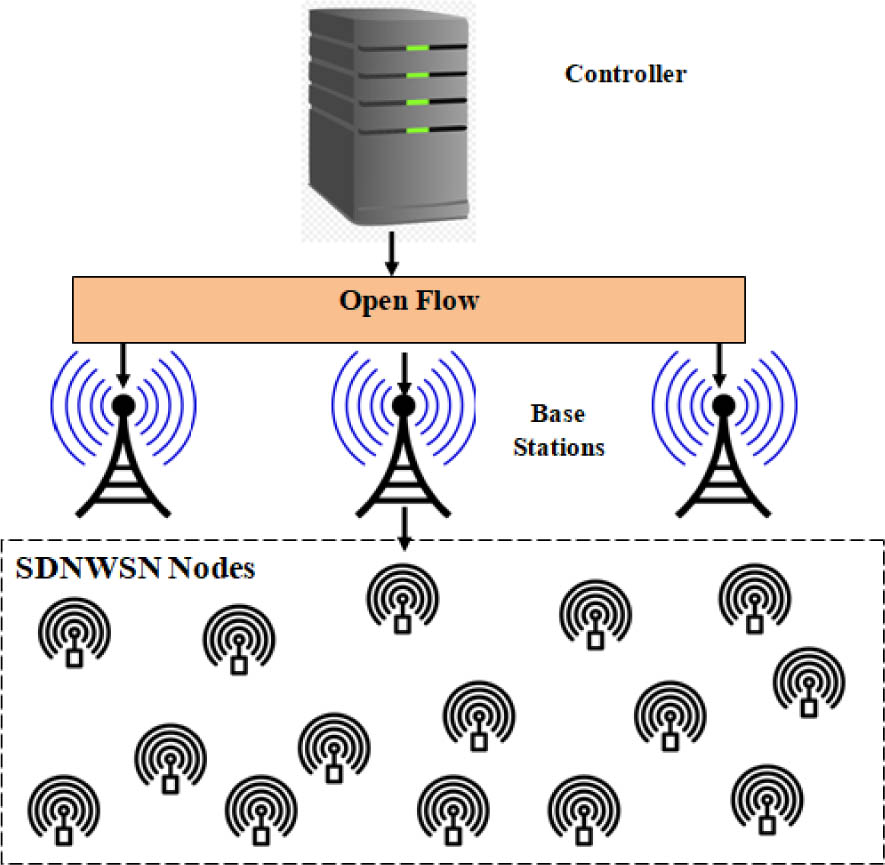
Fig. 1.
Proposed system model overview.
The proposed algorithm, shown in Fig. 2, defines an objective function to enable diverse, trust-based routing. The proposed system includes three node modules and three principal controller modules. The data plane incorporates discovery modules for the BS, adjacent nodes, and the controller, while the controller contains modules for topology discovery, link discovery, and virtual routing.
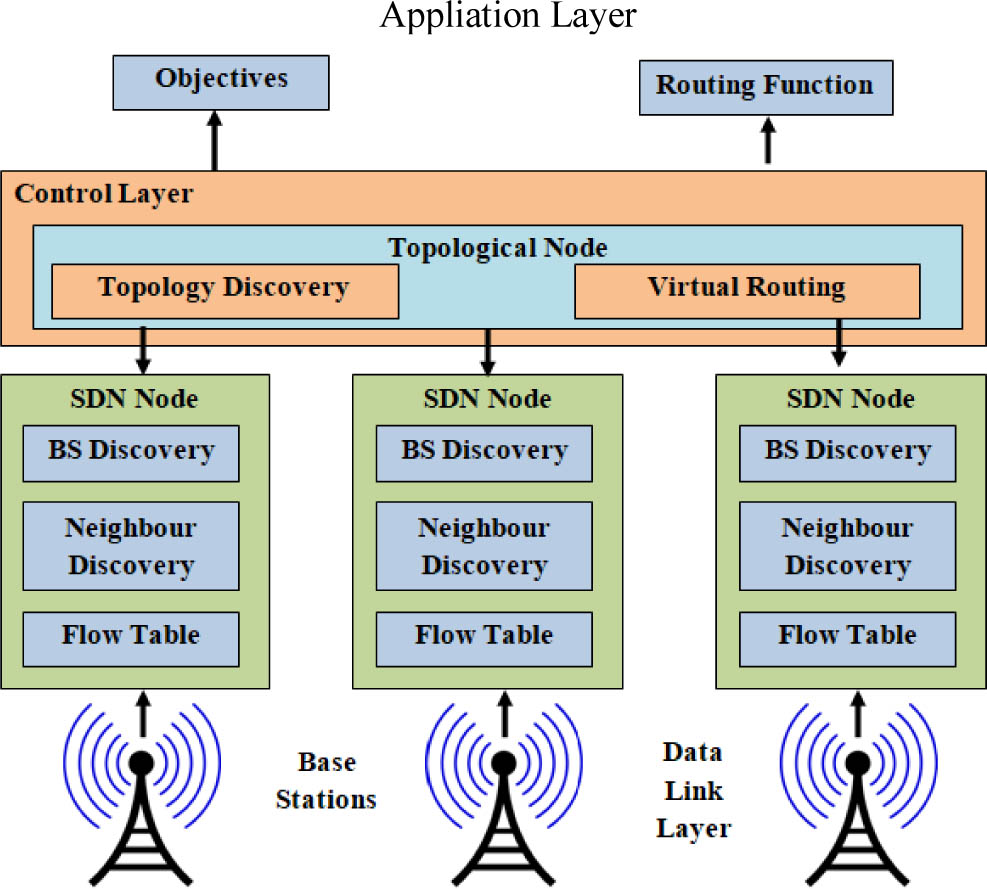
Fig. 2.
Proposed system architecture for SDWSN.
A. Discovery modules in data plane
The proposed methodology combines neighbor discovery, base station (BS) identification, and controller recognition into a unified module using a singular broadcast message disseminated by the controller. This broadcast communication includes the sender's identification, remaining energy levels, and hop count to the base station. Neighboring nodes use this information to populate their respective tables and build a three-dimensional array (TDA[n][n][2]) that records the proximity, energy metrics, and hop counts of neighbors. This strategy effectively reduces communication overhead and energy consumption compared to traditional multi-message approaches.
B. Link discovery module
This module efficiently identifies and monitors node interconnections. Instead of transmitting comprehensive neighbor lists, nodes share information only about neighbors with lower identification numbers. This data, stored in the same TDA array, avoids redundancy and allows the controller to determine the existence of links. The architecture supports bidirectional link configuration.
C. Topology discovery module
Leveraging the global perspective gained from the preceding modules, the controller systematically constructs and maintains the network topology by clustering nodes and identifying common nodes within clusters. Since the nodes are static, the topology remains stable until the energy of the nodes is depleted.
D. Routing module
This module determines optimal routing pathways based on application-specific quality of service (QoS) requirements. The controller selects the next hop by evaluating node trust, proximity to the base station, and residual energy levels to ensure efficient and reliable data transmission.
E. Trust calculation
Trust estimation is essential for maintaining secure and reliable communication in SDWSN. The proposed trust model evaluates node behavior using two key components: interaction trust and efficiency trust, each tailored for both control and data traffic. By employing a lightweight Bayesian approach, the model accurately quantifies trust, enabling the identification and exclusion of malicious nodes and thereby enhancing network security. This is modeled by the expectation of the beta distribution:
where is the interaction trust value, ranging from 0 to 1. If denotes the number of packets correctly forwarded by neighbor j, and is the total number of packets sent to j, efficiency trust is calculated as:To capture both behavioral aspects, the combined regional trust Tij for routing purposes is given by a weighted sum:
where 0≤α≤1 balances the importance of interaction and efficiency trust. The energy consumed in transmitting J bits over a distance d follows the LEACH model: where Eelec, εfs, and εmp are hardware parameters, and d0 is the threshold between channels. Additionally, the end-to-end delay for a path from source c to sink s is evaluated as the sum of per-hop latencies:F. Proposed Coati Optimization Algorithm
This proposed algorithm can applied in smart home environments, including applications such as home sensors. It represents the weight of the jth node in routing as the next node of the ith node. The objective function (4), which considers delay, energy, trust, and distance, is provided as input to the COA, which selects the optimal forwarding node based on the decisions made by the COA algorithm.
where δ1, δ2, δ3, and δ4 are relative coefficients with δ1+δ2+δ3+δ4=1. Distj represents the distance between the BS and the neighbor node j. The COA is an optimization technique that uses a population of coatis to search for a solution to a given problem. Each coati has a location in the search space (SS), corresponding to a set of values for the decision variables. This position serves as a potential solution to the problem. The starting point of the COA is determined using (6) through random initialization of the positions of the coatis.The coatis population in COA is mathematically represented using the matrix “X” called the population matrix.
Candidate solutions (CSs) are positioned in the decision variables, leading to the assessment of different values for the problem's objective function, as shown in (9).
In the proposed meta-heuristic algorithm, the quality of the CS determines the outcome of the objective function, with the optimal member selected accordingly. The mathematical foundation of COA lies in population-based optimization inspired by natural cooperative behaviors. This approach accounts for topological and energy constraints to achieve optimal routing.
Phase 1: Hunting as well as attacking strategy on iguana (exploration)
The initial stage of population updating in SS is modeled by simulating the coatis' attacking approach on iguanas. A group of coatis climbs a tree to capture an iguana and frighten it. This causes the coatis to move to various locations in SS, demonstrating exploration capability in the global search. In the COA design, the location of the best member is identified as the iguana's location. The positions of the coatis climbing the tree are given by (10), representing the diversification of node selection.
Once an iguana falls to the ground, it relocates to a random position in SS. Depending on these random locations, the coatis found on the ground move within SS as described below. They move based on random positions, ensuring broader exploration of the SS as in (11) and (12)
A new position determined for each coati is accepted for updating if it improves the value of the objective function (better path). Otherwise, the coati remains in its previous location. The update condition is determined using (13) for i = 1,2,...,N.
Phase 2: Escaping from predators (exploitation)
The next stage involves updating the location of coatis in SS, which is mathematically modeled based on the natural behavior of coatis when facing and escaping predators. To simulate this behavior, an arbitrary location is generated near the current location of each coati using (14) and (15).
The newly considered location is accepted if it increases the objective function value (16),
A HEC-based blind signcryption scheme is proposed (illustrated in Fig. 3) to ensure secure data routing between sensor nodes and the BS in WSNs. The scheme guarantees sender anonymity, reduces computational and communication costs, and involves three participants: the controller, the sender node, and the BS, across four stages: setup, key generation, blind signcryption, and unsigncryption.
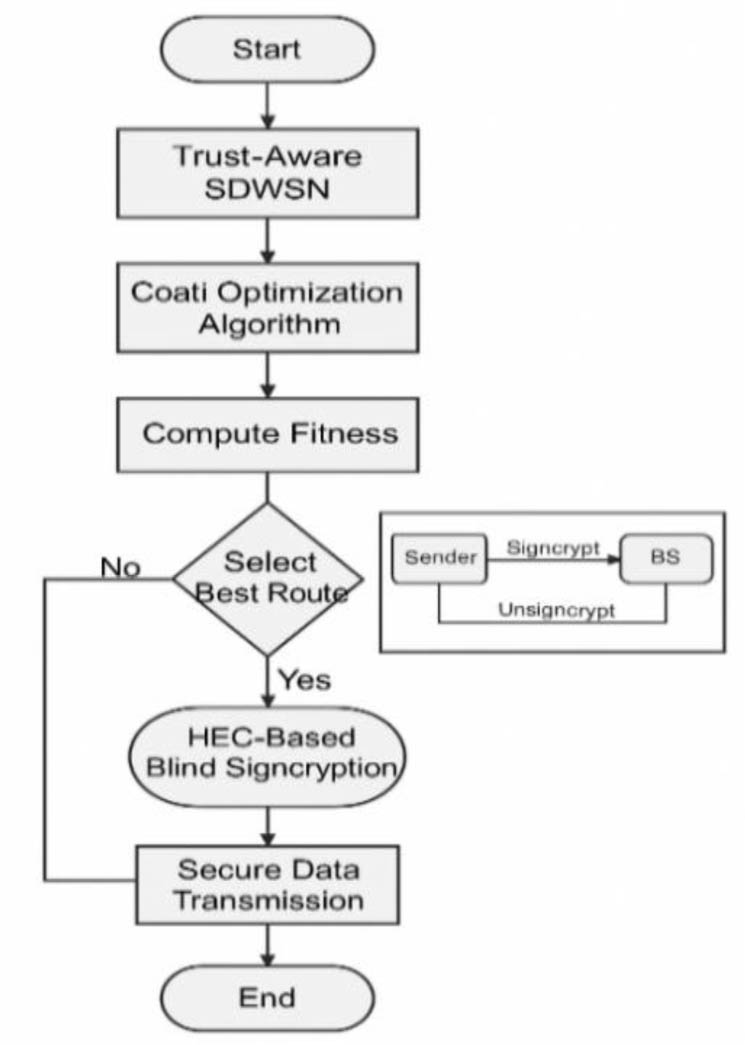
Fig. 3.
COA–HEC secure routing flowchart.
Setup stage:
The controller selects a finite field 𝔽_q and a divisor D of the HEC, chooses n ∈ℤq ∗, and computes the public–private key pair:
Key generation:
The controller sends (Ppub, Ppriv) to the requesting sensor node via a secure channel.
Blind signcryption:
The sender selects two random values r1, r2∈ ℤq ∗ and computes:
The blind message (C, s) is sent to the controller for signing without revealing M. The controller signs blindly:
The sender unblinds and forwards (C, σ) to BS.
Unsigncryption:
BS verifies validity by checking:
If valid, the message is accepted; otherwise, it is rejected. The HEC-based approach offers higher security with smaller key sizes compared to traditional ECC, making it well-suited for resource-constrained WSN environments. The proposed framework incorporates COA, HEC-based signcryption, and trust-aware routing to optimize secure and energy-efficient data transmission within WSNs. Dynamic selection of the cluster head is enabled by the global search efficiency of COA and low overhead. This approach combines the advantages of each approach to provide a comprehensive solution. Simulation results verify our approach's performance advantage across various metricscompared to existing configurations. HEC-based blind signcryption is preferred over traditional lightweight cryptographic algorithms such as ECC, RSA, or AES due to its efficient computational balance.
4. Results and discussion
The proposed model was analyzed using the NS3 simulator. Various metrics were evaluated to compare the COAHBS scheme with the SEHR and IBFA models: including computational cost, packet delivery ratio, average delay, average throughput, network lifetime, packet loss, communication overhead, and energy consumption. The simulation parameters used in this research are summarized in Table 2. The analysis indicates that COAHBS achieves optimal performance in terms of energy efficiency, packet delivery ratio, minimized packet loss, and reduced computational costs.
Table 2.
Details of simulation parameters setup.
| Parameter | Values |
|---|---|
| Simulator model | NS-3.26 |
| Sensor nodes count | 50, 100, 150, 200, 250 |
| Simulation area | 500×500 m |
| Optimal path finding protocol | COA |
| SDN controller count | 1 |
| Base station | 3 |
| Size of packet | 512 bytes |
| Initial energy | 50 J |
| Simulation time | 300 sec |
| Transmission range | 250 m |
As shown in Fig. 4 and Table 3, COAHBS consistently outperformed other protocols, achieving an average throughput of 75.6 %, surpassing SEHR, IBFA, ESMR, and GMPSO by 18.8 % – 59.4 %. This improvement is attributed to multi-objective path selection that optimizes trust, delay, hop count, and energy.
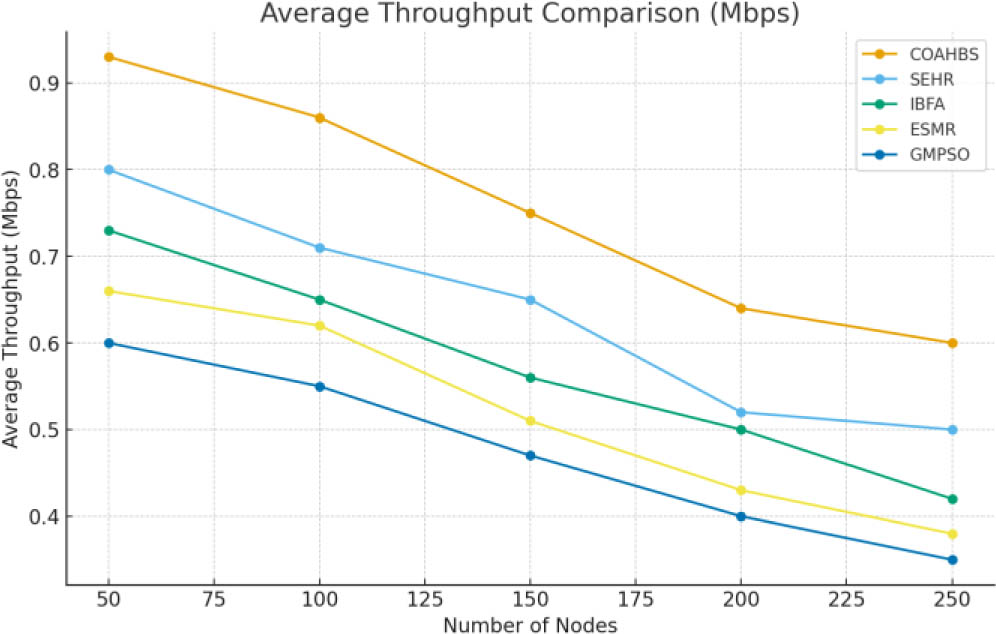
Fig. 4.
Average throughput analysis.
Table 3.
Average throughput comparison [Mbps].
| Nodes | COAHBS | SEHR | IBFA | ESMR | GMPSO |
|---|---|---|---|---|---|
| 50 | 0.93 | 0.80 | 0.73 | 0.66 | 0.60 |
| 100 | 0.86 | 0.71 | 0.65 | 0.62 | 0.55 |
| 150 | 0.75 | 0.65 | 0.56 | 0.51 | 0.47 |
| 200 | 0.64 | 0.52 | 0.50 | 0.43 | 0.40 |
| 250 | 0.60 | 0.50 | 0.42 | 0.38 | 0.35 |
Fig. 5 and Table 4 show that COAHBS maintained the highest packet delivery ratio (PDR) across various node densities, averaging 88.8 %, compared to SEHR 84 %, IBFA 81.4 %, ESMR 77.8 %, and GMPSO 76.4 %. This improvement results from reduced route failures and improved route reliability.
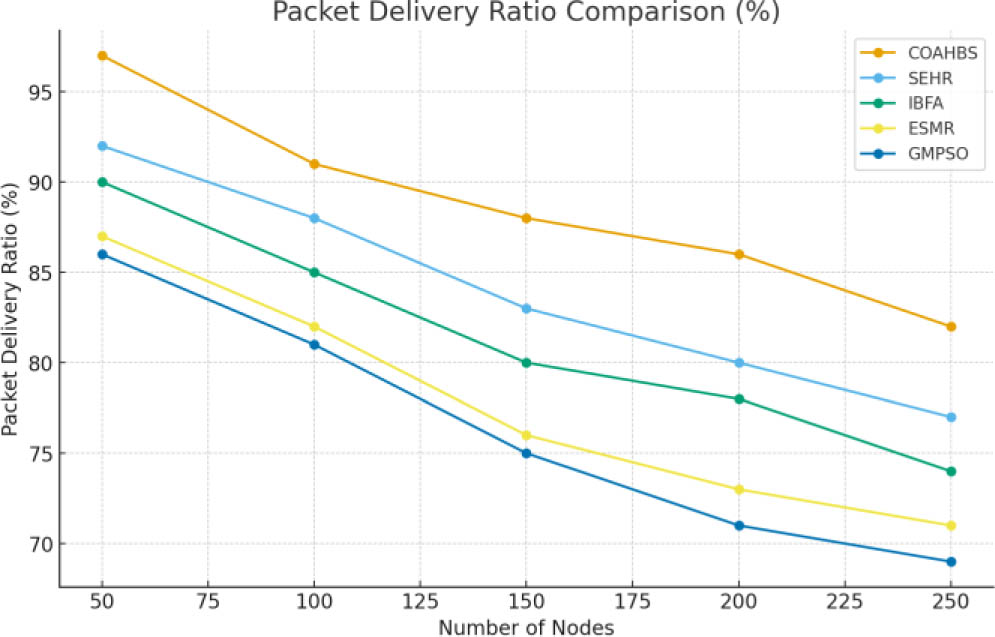
Fig. 5.
Analysis of PDR.
Table 4.
PDR comparison [%].
| Nodes | COAHBS | SEHR | IBFA | ESMR | GMPSO |
|---|---|---|---|---|---|
| 50 | 97 | 92 | 90 | 87 | 86 |
| 100 | 91 | 88 | 85 | 82 | 81 |
| 150 | 88 | 83 | 80 | 76 | 75 |
| 200 | 86 | 80 | 78 | 73 | 71 |
| 250 | 82 | 77 | 74 | 71 | 69 |
COAHBS exhibited the lowest delay among all approaches (average 4.83 ms) across all node counts (Fig. 6, Table 5). It achieved a delay reduction of up to 61 % compared to GMPSO, enabling faster data transmission through optimal route selection based on trust and hop-count criteria.
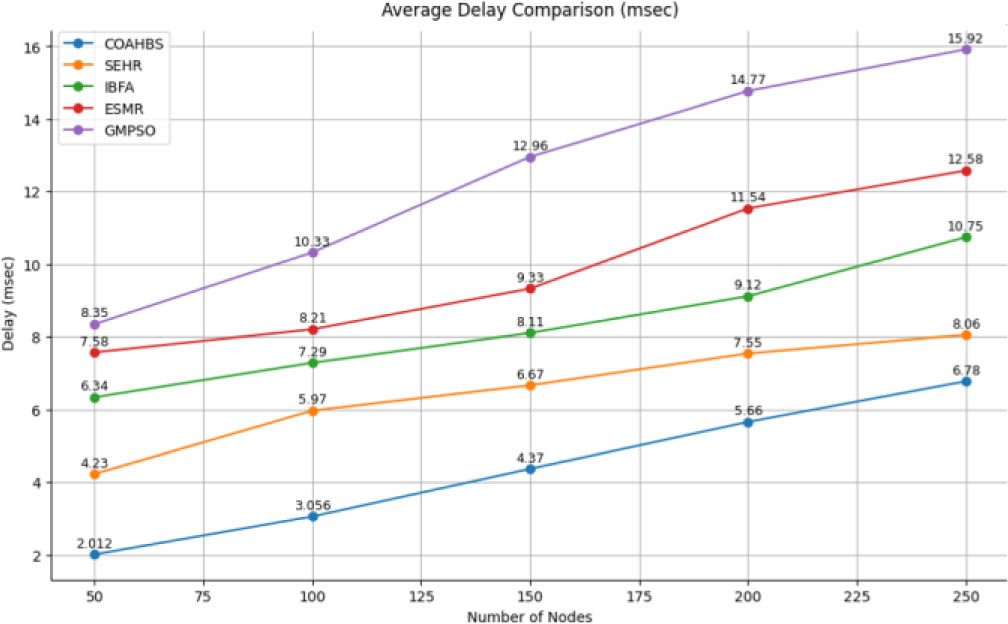
Fig. 6.
Average delay analysis.
Table 5.
Evaluation of average delay comparison [msec].
| Nodes | COAHBS | SEHR | IBFA | ESMR | GMPSO |
|---|---|---|---|---|---|
| 50 | 2.012 | 4.23 | 6.34 | 7.58 | 8.35 |
| 100 | 3.056 | 5.97 | 7.29 | 8.21 | 10.33 |
| 150 | 4.37 | 6.67 | 8.11 | 9.33 | 12.96 |
| 200 | 5.66 | 7.55 | 9.12 | 11.54 | 14.77 |
| 250 | 6.78 | 8.06 | 10.75 | 12.58 | 15.92 |
Fig. 7 and Table 6 show that COAHBS was the most energy-efficient protocol, with energy consumption rising from 0.23 J to 0.63 J as the node count increased from 50 to 250, which is significantly lower than that of alternative protocols. This represents a 173.91 % increase, which is considerably more efficient than GMPSO's maximum increase of 160.53 %.
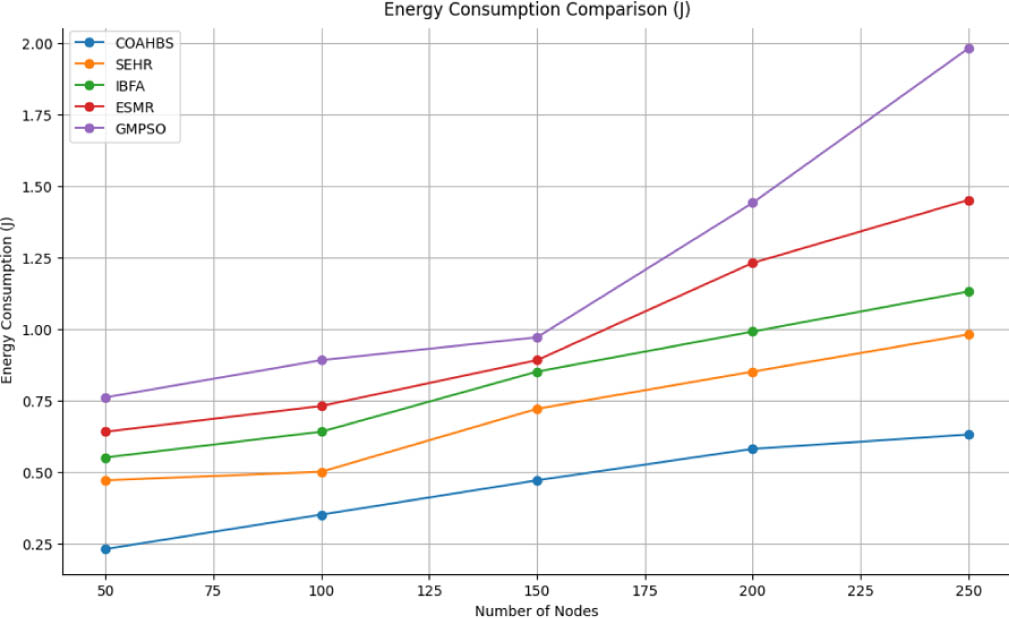
Fig. 7.
Energy consumption analysis.
Table 6.
Energy consumption comparison [J].
| Nodes | COAHBS | SEHR | IBFA | ESMR | GMPSO |
|---|---|---|---|---|---|
| 50 | 0.23 | 0.47 | 0.55 | 0.64 | 0.76 |
| 100 | 0.35 | 0.50 | 0.64 | 0.73 | 0.89 |
| 150 | 0.47 | 0.72 | 0.85 | 0.89 | 0.97 |
| 200 | 0.58 | 0.85 | 0.99 | 1.23 | 1.44 |
| 250 | 0.63 | 0.98 | 1.13 | 1.45 | 1.98 |
The COA-HEC framework demonstrates significant scientific contributions by efficiently integrating multi-objective optimization with lightweight cryptography, achieving comprehensive performance improvements in SDWSNs. It ensures energy efficiency [25], trust, reduced delay, and minimal packet loss while maintaining scalability [26] for dense IoT networks. Outperforming existing algorithms, it provides secure, reliable, and practical communication for industrial automation, healthcare monitoring, and smart city infrastructures. While the manuscript presents promising theoretical results, some proofs remain concise. Expanding these proofs with additional intermediate steps and mathematical justifications would enhance the rigor of the work, thereby strengthening the credibility and validity of the proposed framework.
The presented examples effectively validate the applicability of the theoretical results. However, incorporating more varied and complex case studies would better demonstrate the breadth and versatility of the proposed methods, further reinforcing their potential for diverse IoT deployment scenarios.
5. Conclusion
This work presents a significant advancement in SDWSN-based IoT routing through the COA-HEC framework, which integrates multi-objective optimization, trust management, and lightweight cryptography to address critical gaps in existing research, including the simultaneous optimization of energy, trust, delay, and hops, the lack of efficient security, and the limited scalability of traditional metaheuristics. The COA ensures optimal exploration–exploitation for dynamic path selection, while the trust model enhances resilience against malicious nodes. The HEC-based blind signcryption provides confidentiality, integrity, and anonymity with minimal computational and communication overhead, making it suitable for constrained IoT nodes. Extensive NS-3 simulations demonstrate superior performance over SEHR, IBFA, ESMR, and GMPSO, improving throughput by 59.4 %, PDR by 12.4 %, and reducing delay by 61 %. The framework scales efficiently to dense networks and is directly applicable to industrial IoT, healthcare monitoring, and smart city infrastructures. By combining holistic optimization, lightweight security, and real-world applicability, COA-HEC establishes a scalable, secure, and energy-efficient paradigm for next-generation IoT routing, with future work focusing on hardware validation, mobility-aware trust models, and AI-driven predictive optimization. In addition to the theoretical contributions, a more detailed discussion of practical applications such as deployment in large-scale industrial IoT systems, healthcare monitoring platforms, and smart city infrastructures, would be beneficial. Although the manuscript briefly addresses open questions and possible extensions, expanding this discussion would provide a clearer roadmap for future research.