
1. INTRODUCTION
The definition of a non-linear system is a system whose performance is not proportional to changes in the input. Due to its unpredictable changes, controlling a non-linear system is more challenging than controlling a linear system [1]. A few linear systems operate near the operating point in actual systems that are primarily non-linear in nature [2]. The process industry is characterized by non-linearity, which affects system performance. Due to variations in the tank's cross-sectional area, problems have developed in the non-linear system. Non-linear characteristics such as measurement delays, parameter uncertainties and interaction effects reduced the accuracy of industrial processes [3]. In practice, non-linear systems can be found in all process areas, and tuning such systems is a complicated task. Therefore, several controllers are developed in the process industry to overcome non-linearity [4], [5]. For linear tanks, such as cylindrical tanks, the design of controllers is generally a simple task. In contrast, modeling a process control system with minimal interaction is a challenging task in automatic control applications. Conversely, designing controllers for non-linear tanks is a tedious task in process control applications due to changes in cross-sectional areas [6].
Spherical tanks (STs) and conical tanks (CTs) are the two variants of the non-linear model where the limit of control becomes complex due to the shape of the tank. In a CT, the stored liquid can be completely emptied without leaving any residue [7]. In a real-time process, the problem arises in a non-linear system because in the event of an overflow, the liquid inflow is not proportional to the outflow rate [8]. In the process industry, maintaining the required liquid level is an important consideration, especially in CTs due to the non-linear structure. In such a system, the liquid level is the control variable performed by the percentage of valve opening. From an industrial point of view, liquid level control is a necessary task to make the system suitable for a variety of applications. Therefore, several controls have been developed in the past to cope with system variations. Most often, the proportional integral derivative (PID) controller is used in industrial applications because of its simplicity. However, the PID controller cannot provide better results when the system is subject to fluctuations and disturbances [9].
Initially, basic controllers such as proportional integral (PI) were used in industrial applications for liquid level control. Later, tuning approaches were introduced into the control architectures to improve the control behavior. On the other hand, sliding mode control (SMC) is used in the non-linear process control [10]. However, the processability of the PID controller is better in a linear system, but in the case of a non-linear system, it should be tuned with a minimum error. Therefore, metaheuristic algorithm based controllers are developed to provide notable solutions for non-linear applications. Here, the controlling complexity is added in the form of different cross-sectional areas [11],[12],[13]. In recent decades, fractional order based controllers have gained more attention in non-linear process control [14], [15]. The fuzzy logic approaches provide better performance under varying system conditions [16], [17]. An extensive comparison of current control approaches was made in [18], which shows that the existing PID controller leads to severe overshoot. Therefore, an efficient controller with lower peak overshoot is required for liquid level control. Several other controllers were placed in the CT with the goal of minimizing peak overshoot, but they used numerous optimization methods to fine-tune the parameters and increase performance.
From a controller tuning point of view, the model reference adaptive controller (MRAC) is the better choice. The MRAC provides the desired performance based on the reference model in non-linear process control [19], [20]. Therefore, the objective of the proposed work was to develop an MRAC-based controller for maintaining the liquid level in a conical water tank (CWT).
The contributions to this work are listed below:
Design an MRAC with a modified PID named D-PI controller for liquid level control under varying system conditions and disturbances.
Optimize the controller parameters based on the reduced MSE between the reference point and the liquid level of the tank.
Examine the performance of the proposed MRAC by implementing the existing approaches into the SIMULINK model of the CT.
The structure of the paper is as follows. Section 2 discusses related works, while Section 3 explains the methodological approach, such as the MRAC, the PID controller, and the flamingo search algorithm (FSA). The proposed method results are analyzed in Section 4, and the conclusion follows in Section 5.
2. RELATED WORKS
Recently developed controllers for liquid level control in the CWT are discussed in this section.
Arun and Sahaya Aarti [21] have developed a model of predictive control (MPC) for the CT. For linear models, a process model was adopted to calculate the output in the present state and the input in the future. In the gain scheduling MPC, the scheduler was used to tune the weights at the sampling moment and the weights were selected based on the manipulated inputs. Then, the set of weights is fed into to the plant.
Kumar et al. [22] proposed an internal model controller (IMC)-based PID controller for the CT to minimize the overshoot and settling time. This proposed method provided optimal controller parameters with respect to the variations in set points. The set point filter in this model was used for selecting the optimal tuning parameter to minimize overshoot. In this approach, an optimal tuning parameter was selected based on maximum sensitivity.
Rajiv Ranjan [23] developed MRAC for liquid level control in process industry. The proposed approach uses MIT rules for first and second order bounded disturbances. Unknown parameters of the plant were tuned using adaptive laws to produce zero tracking error.
Espitia-Cuchango et al. [24] developed a neuro-fuzzy adaptive control (NFAC) strategy for CT. In this proposed method, the parameters of the controller were optimized based on the identification of the plant in the system operation. In this approach, the descending gradient algorithm and back propagation algorithm were used to minimize the system error.
Aguila-Camacho et al. [25] proposed the fractional order PI for controlling the liquid level in the CT. In this method, the controller gains were tuned by the particle swarm optimization (PSO), which optimized the controller values based on 13 operating ranges. The results of the proposed model were verified under varying step changes. It was found that the PI controller has a higher steady state error than the proposed controller.
Balaska et al. [29] introduced a fractional-order model reference adaptive control (FO-MRAC) strategy for liquid level control in a CT system. The proposed FO-MRAC uses a fractional-order reference model to define the desired closed-loop performance characteristics. In addition, the control approach includes fractional integration in the parameter update process to improve adaptability. Both integer-order and fractional-order model reference adaptive controllers (FO-MRAC) are implemented for the non-linear system and their performance is compared to evaluate the effectiveness of the fractional-order approach.
Patil and Agashe [30] introduced a novel deep reinforcement learning (DRL) based control method to reduce the structural complexity and non-linear dynamics for liquid level control in CTs. The DRL controller regulates the liquid level in a CT by dynamically adjusting the inlet and outlet flow rates. The DRL agent interacts with the environment to optimize its control strategy and maximize cumulative rewards over time.
Ramanathan et al. [31] introduced machine learning-based controllers for the control of non-linear systems. In particular, a smart controller utilizing a reinforcement learning algorithm was proposed and evaluated for controlling the liquid level in a non-linear CT system. The system was modeled as a Markov decision process (MDP) and the control strategy was implemented using a reinforcement learning technique based on the Q-learning algorithm. The performance of the proposed controller was demonstrated by its ability to effectively regulate the liquid level in the non-linear tank system.
In this paper, a FO-MRAC strategy for controlling the liquid level in a CT system is presented. The proposed FO-MRAC uses a fractional-order reference model to define the desired closed-loop performance characteristics. In addition, the control approach includes fractional integration in the parameter update process for to improve adaptability. Both integer-order and fractional-order model reference adaptive controllers MRAC are implemented for the non-linear system and their performance is compared to evaluate the effectiveness of the fractional-order approach. Table 1 lists different methods for liquid level control in the CT.
Table 1.
Literature review.
| Author | Method | Outcome | Advantages | Drawbacks |
|---|---|---|---|---|
| Arun and Sahaya Aarti [21] | MPC | Rise time is 262 s, overshoot is 9.3 % | Lower peak and settling time | Overshoot is higher in the second tank |
| Kumar et al. [22] | IMC-PID | ITAE is 0.0661, overshoot is 7.611·10-4 | It can be applied to the conical transfer function | Poor robustness |
| Rajiv Ranjan [23] | MRAC | Settling time is 30 s | System performance is stable under unmodelled dynamic | Longer settling time |
| Espitia-Cuchango et al. [24] | NFAC | Desired response is obtained under varying system conditions | Suitable for multi-input and multi-output systems | More settling time |
| Aguila-Camacho et al. [25] | FOPI | ITAE is 1.4465·106 | Lower variance | More time to settle |
| Balaska et al. [29] | FO-MRAC | Sampling period is 0.1 s | Lowest error cost | Increases the noise |
| Patil and Agashe [30] | DRL | Desired response is obtained under varying system conditions | Reduces the complexity and non-linearity | Higher rise time |
| Ramanathan et al. [31] | Reinforcement learning algorithm | Settling time for trial 1 is 452 s | Reduces the non-linearity issues and settling time | Learning process slow |
CTs are used in a variety of industrial processes for drainage of slurries, viscous liquids, and solid mixtures. Level control in a CT is difficult due to its non-linearity and constantly changing cross-section. The main objective of this paper is to develop a suitable controller for the CT system to maintain the desired level. It is clear from the literature that an efficient controller is required to improve the time domain and time integral performance measures.
3. PROPOSED METHODOLOGY
In liquid level control of a CT, the level of the liquid is kept within the desired level depending on the application. The controller used in these applications should minimize the difference between the liquid level in the tank and the reference level of the liquid. In addition, the controller parameters should be set to minimize overshoots. Taking these considerations into account, the MRAC-based controller is proposed in this work. The MRAC allows a plant to follow a reference model regardless of the variations of the plant parameters; therefore, it minimizes the difference between the reference and the output of the plant. In contrast, an adaptive controller without a stable tuning method causes instability in the system, and the improved PID controller is used together with the MRAC. First, a suitable model is developed using the system identification procedures, then the parameters are tuned using the FSA.
A. Mathematical modelling of CT
Conical shapes are still the strongest structure; they can withstand the greatest pressure. A low surface-to-volume ratio reduces the amount of heat entering the tank. High-pressure liquids are not a problem for the CT. Such tanks are used to store fuels, cryogenic liquids, and other materials in various industries. Fig. 1 shows the basic structure of a CT in which the liquid level is controlled at a steady rate by controlling the tank F input.
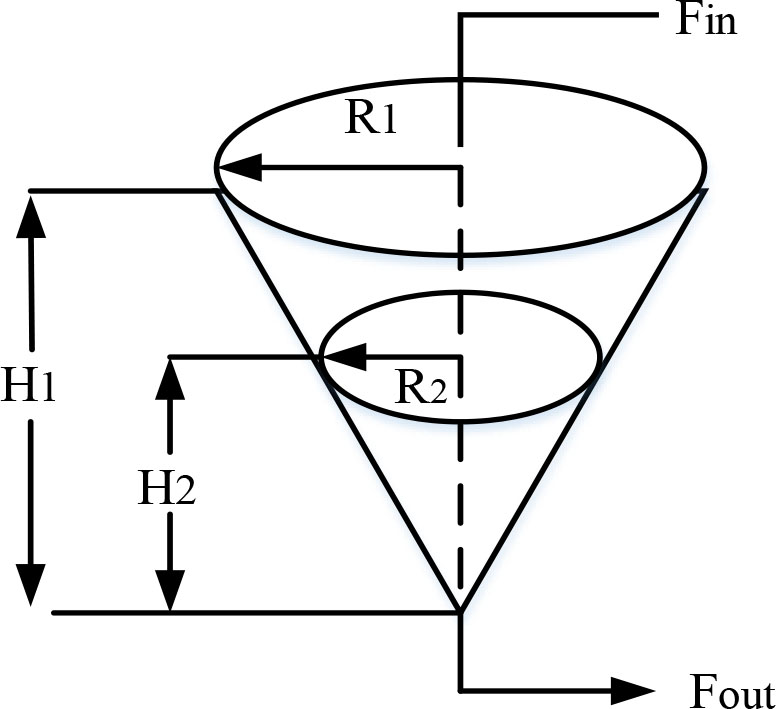
Fig. 1.
Structure of a CT.
The accumulation rate of the CT ARate is analyzed using the following equation:
where Fin is the flow rate of the incoming stream, Fout is the flow rate of the output stream. where R1 is the radius of the large CT, R2 is the radius of the CT in the steady state, H1 is the height of the CT, H2 is the height of the CT in the steady state, and RV is the resistance of the value. The volume of the tank V is analyzed by the following equation: where λ is the ratio of radius to height of the CT [26].B. Proposed MRAC
The goal of MRAC is to create a responsive control system that adjusts the controller's parameters so that the actual output of the plant matches the output of a reference model. MRAC techniques are used to control the level of the non-linear tank by variable manipulation of the tank's liquid level. An adjustment or adaptation mechanism and a reference model are integrated into the MRAC. The MRAC aims to design a closed loop controller with parameters that can be varied based on the system response. The system's output is then compared with the desired response of the reference model. The error difference between the plant output and the reference model output is used to adjust the controller settings. In addition, the controller input and the measured output are required for the investigation of the reference model. Fig. 2 shows the block diagram for the basic MRAC.
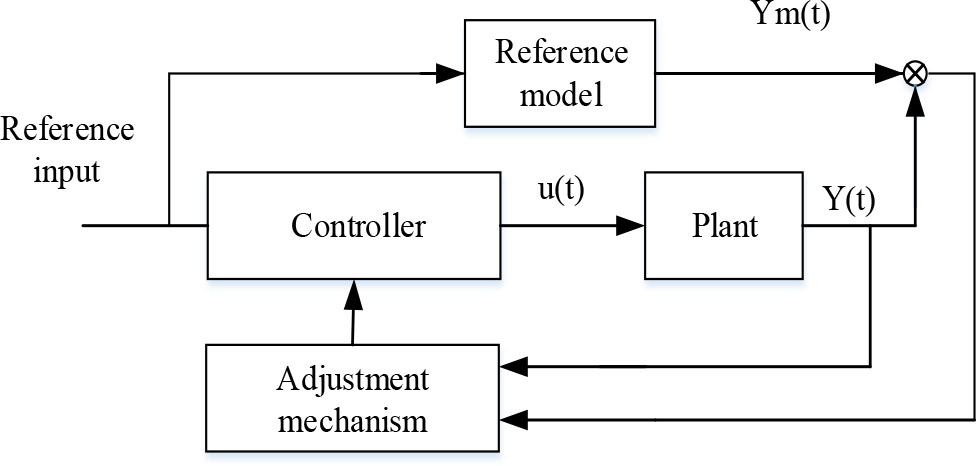
Fig. 2.
Block diagram of MRAC.
The adaptive gain θ is multiplied by the controller's output to achieve the system's adaptability to changes.
where θ represents the adaptive gain in the MRAC structure, which adjust dynamically based on the system error to ensure the plant output follows the reference model. The term Uq (t) represents the control signal generated by the adaptive MRAC with the D-PI structure. It is applied to the system to minimize the error between the reference model output and the plant output.The D-PI controller is proposed in the MRAC to improve the control mechanism. The proposed D-PI controller is the improved version of the PID controller. The D-PI consists of two PID blocks in the first block, the proportional and integral gains are kept at zero. In the second block, the derivative gain is kept at zero.
Here Kp, Ki, and Kd are proportional, integral, and derivative gains. The error between the reference model and the actual output is measured using the following equation:
where Y(t) is the actual plant output and Ym(t) is the reference model output.In the proposed MRAC, the controller parameters are modified by the FSA based on the minimum error. The adaptation algorithm modifies the controller parameters when the reference parameters are varied. The basic flow of the proposed MRAC is shown in Fig. 3.
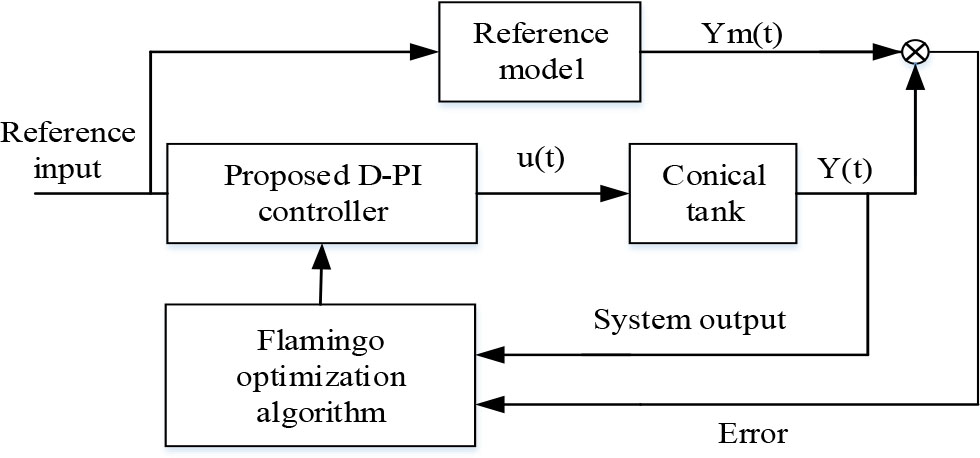
Fig. 3.
Proposed MRAC with D-PI.
In this proposed work, the error generated from the reference model of the CT and the set points is passed to the FSA to tune the optimal controller parameters. The reference model of the CT is designed as the expected response of the plant model. The reference model requires a lot of experience with the dynamic system. In the case of liquid level control, an overshoot of 2 % and a settling time of 180 s are considered for the reference modeling [27], which is given by:
Here γ is the damping ratio, the natural frequency . The transfer function for the reference model is given as follows:
FSA for parameter tuning
The FSA is a recently developed metaheuristic optimization method inspired by the foraging behavior and group dynamics of flamingos. This algorithm mimics their collaborative strategies for finding food-rich regions while balancing exploration and exploitation during optimization. [28]. A population of potential solutions (flamingos) is randomly initialized in the search space. Each flamingo represents a candidate set of controller parameters. Each flamingo evaluates its fitness based on an objective function. In this study, the mean square error (MSE) between the reference model and the actual liquid level of the CT is used as the fitness function. Based on this consideration, the fitness function of the FSA is formulated and expressed in the following equation:
Here MSE is represented as mean square error, P is represented as peak overshoot, Tsettling is represented as settling time, Trise is represented as rise time, w is the weight of the objective function and varies between 0 and 20. The moving distance of nth flamingo in the mth dimension of the population at iteration t during foraging can be expressed as:
where represents the position of the nth flamingo in the mth dimension of the population, represents the position of the nth flamingo in the mth dimension of the population at iteration t, C1 and C2 are random numbers and ∈1, ∈2 are standard normal distributions. The position of the food-rich region in the mth dimension is Xfm.The equation for modifying the position of the flamingo during foraging at iteration (1+t) is:
where G denotes the diffusion factor and the equation for the movement of the flamingo population is:The location of the nth flamingo in the mth dimension of the population at iteration (1+t) is represented by and β is a Gaussian random number. At iteration t, denotes the mth dimension location of the flamingo with the best fitness in the population.
The FSA procedure is given below:
➢ Step 1: Set the total flamingo population P, the maximum number of iterations Imax and the migration proportion PMa.
➢ Step 2: In the nth iteration of the flamingo population update, the population is divided into three groups based on the proportion parameter PMa. The number of foraging flamingos is calculated as PRM=R[0,1] · (1−PMa) · P, where R[0,1] is a random number between 0 and 1, and P is the total population size. The number of flamingos in the first section is PCM=PMa · P. The number of flamingos migrating in the second section is PSM=P−PRM−PCM. Individual flamingo fitness values are determined and the population of flamingos is organized according to individual flamingo fitness values. The flamingos in the first section PCM with low fitness and flamingos in the second section PSM with high fitness are considered as migratory flamingos, while the remaining flamingos are considered as foraging flamingos.
➢ Step 3: Foraging flamingos update their position using (15) and migratory flamingos update their position using (16).
➢ Step 4: Ensure that each updated flamingo position remains within predefined bounds of the controller parameter space. If a flamingo exceeds these bounds, it is corrected either by limiting it to the nearest boundary value or by reinitializing it randomly within the valid range.
➢ Step 5: If the iteration count reaches Imax, terminate and return the flamingo with the best fitness (optimal controller parameters). Otherwise, return to step 2 for the next iteration.
The FSA-tuned controller reduces the rise time and settling time compared to other optimization methods, resulting in faster system responses. FSA uses fewer parameters compared to techniques such as differential evolution (DE) or artificial bee colony (ABC), making it easier to implement while maintaining computational efficiency. Since FSA strikes a balance between exploration and exploitation, it converges to optimal solutions faster than traditional methods such as PSO, where more iterations may be required to fine-tune the solutions.
4. RESULTS AND DISCUSSION
The proposed work is carried out in MATLAB/SIMULINK platform and the results are measured in different operational domains. The Simulink model of the proposed work is shown in Fig. 4.
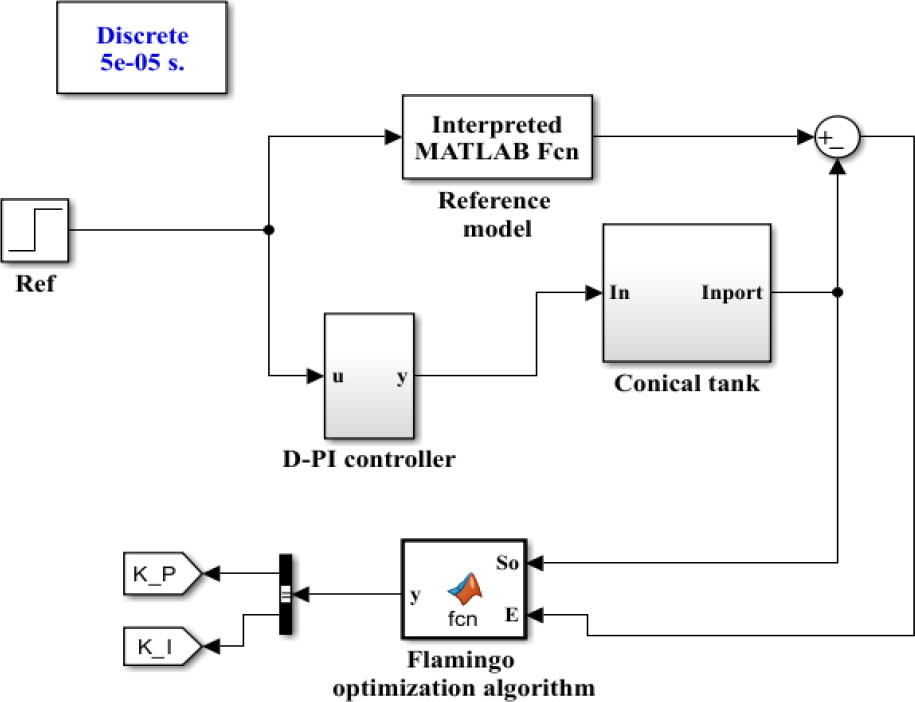
Fig. 4.
Simulink model of MRAC with CT.
The time domain analysis of the different controllers is shown in Table 2. The results obtained with the proposed model are compared with the existing PI, PID, FOPI, and MRAC with PID controllers using the implemented models. First, the set point for the liquid level is set to 25 cm. The results are shown in Fig. 5. The model reference adaptive control-modified proportional integral derivative (MRAC-MPID) controller shows better performance in terms of lower overshoot, faster settling time, and faster rise time than the existing controllers. Specifically, the MRAC-MPID achieves an overshoot of 0.8 %, which is significantly lower than other controllers (e.g., FOPID: 2.8 %, MRAC: 1.6 %). This lower overshoot can be attributed to the precise tuning of the controller gains with the FSA, which optimizes the balance between stability and responsiveness. The settling time for MRAC-MPID (200 s) is also shorter compared to MRAC (245 s) and FOPID (273 s), demonstrating the improved adaptability and transient response provided by the MPID structure within the MRAC framework. The FSA ensures that the controller gains are tuned to minimize error metrics such as integral square error (ISE) and integral absolute error (IAE), resulting in improved steady-state accuracy and transient performance. For example, MRAC-MPID achieves an ISE of 38.25 and an IAE of 2167, both of which are lower than other controllers. Furthermore, in scenarios with varying set points or disturbances, MRAC-MPID shows faster recovery and lower deviation compared to MRAC alone. This is evident in the smooth transition curves and minimal oscillations shown in Fig. 5.
Table 2.
Comparative analysis of different controllers.
| Controllers | Peak overshoot [%] | Settling time [s] | Rise time [s] | ISE | IAE |
|---|---|---|---|---|---|
| PI | 18.17 | 402 | 109 | 47.73 | 2681 |
| PID | 21.32 | 421 | 114 | 51.03 | 2968 |
| FOPI | 12.74 | 408 | 157 | 43.09 | 2902 |
| MRAC-PID | 7.19 | 391 | 174 | 41.35 | 2863 |
| MRAC (Proposed) | 0.8 | 200 | 103 | 38.25 | 2167 |
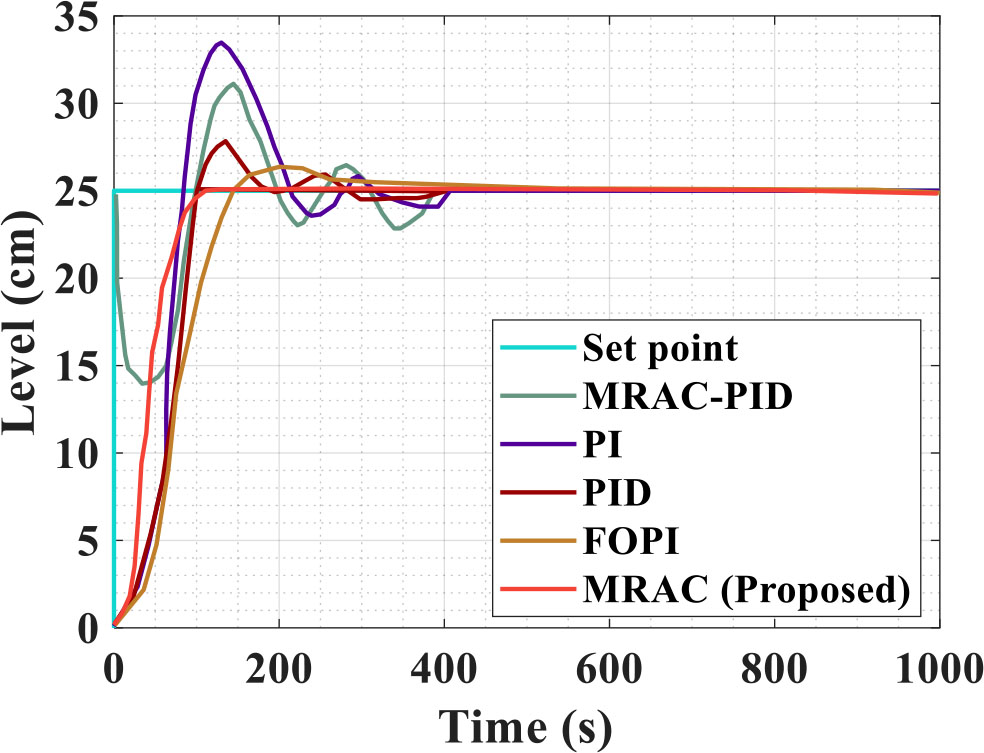
Fig. 5.
Controller output under constant set point.
The performance analysis of controllers in response to random disturbances in the input flow is shown in Fig. 6. Here, the disturbance is applied at 500 s in the input flow and the results are measured for all controllers. The results are measured to evaluate the controllers' ability to reject disturbances and maintain the liquid level at the desired set point. The PID controller exhibits noticeable oscillations and delayed recovery after the disturbance. This is primarily due to its fixed gain parameters, which limit its ability to handle the non-linear dynamics and unpredictable changes in the system. The FOPID controller performs better than the traditional PID, but lags behind the MRAC-MPID in terms of disturbance rejection. The fractional-order terms provide some degree of adaptability, but are not sufficient to efficiently handle the randomness and magnitude of the disturbances. The standard MRAC with a PID controller shows better adaptability compared to PID and FOPID, but lacks the fine-tuned response of the MRAC-MPID. The lack of MPID leads to increased oscillation amplitudes and prolonged stability, which emphasizes the significance of the MPID enhancement. The MRAC-MPID demonstrates superior performance by tracking the set point with minimal oscillations after the disturbance is introduced. The adaptive nature of the MRAC ensures that the controller dynamically adjusts to the non-linear characteristics of the CT, while the MPID component improves damping, reducing the amplitude of the oscillations.
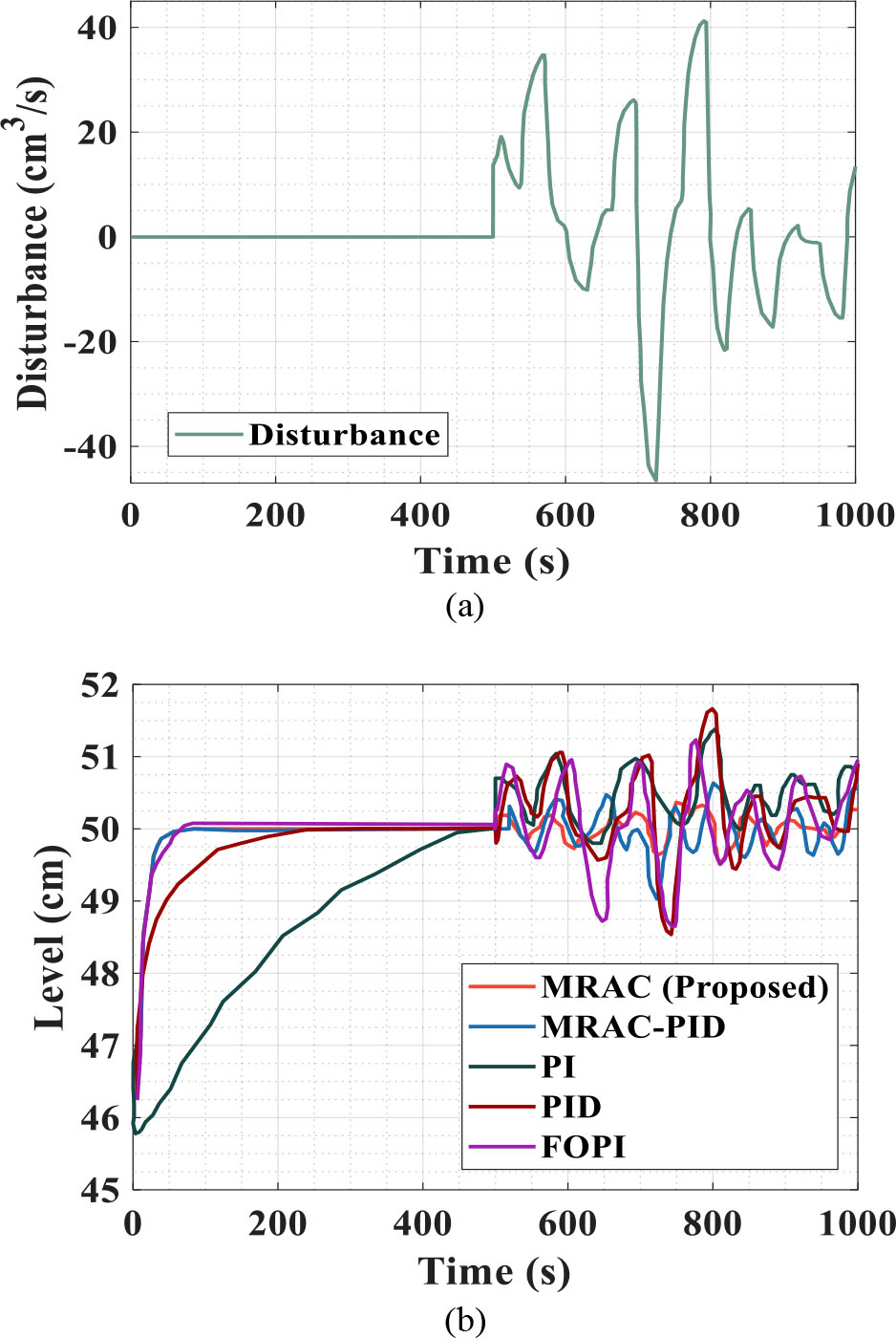
Fig. 6.
Performance analysis under random disturbance in constant setpoint.
Controller performance under sudden disturbance in the load is shown in Fig. 7. In this case, the disturbance in the liquid level occurs between 300 s to 700 s. The PID controller struggles to cope with the abrupt load changes, resulting in significant deviations from the reference level. The FOPID controller performs better than the PID due to its fractional-order terms, which allow for some flexibility in response. However, it still cannot match the precision and adaptability of MRAC-MPID, as evidenced by the larger oscillations and slower recovery times. While the standard MRAC-PID controller has better adaptability than PID and FOPID, it lacks the fine-tuned control offered by the MPID enhancement. The MRAC-MPID controller handles sudden changes in load with minimal impact on the liquid level, ensuring process stability. The combined benefits of MRAC's adaptability and MPID's improved control precision minimize the effect of load disturbances, resulting in negligible overshoot and rapid stabilization.
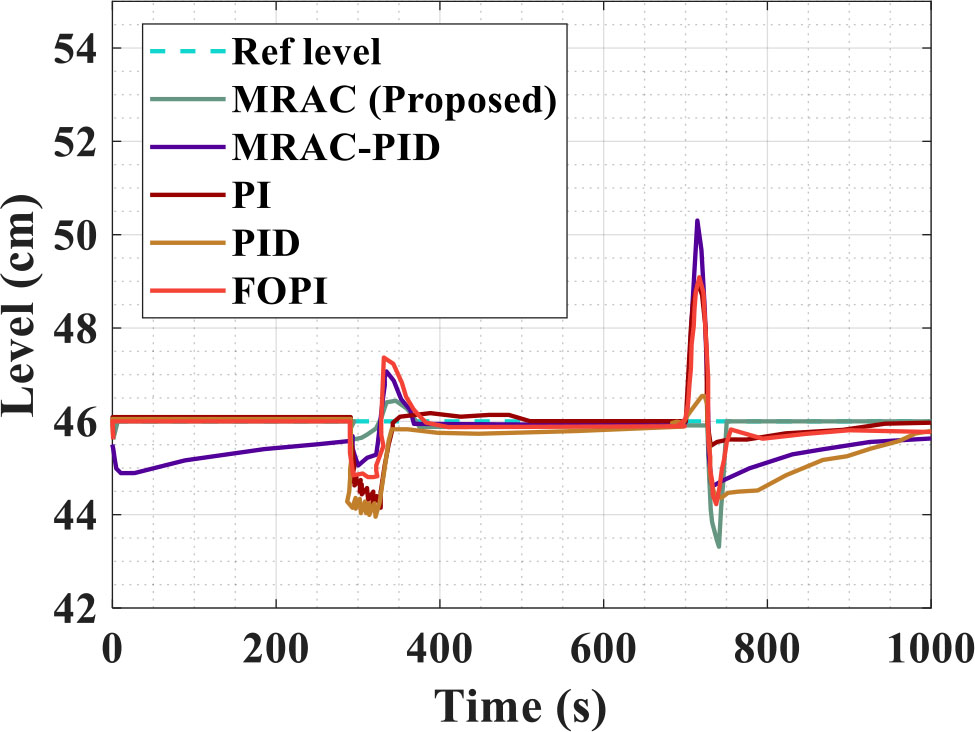
Fig. 7.
Performance analysis under load variations.
The results of the controllers when the liquid level varies between 30 cm and 46 cm are shown in Fig. 8. The PID controller has difficulty dealing with the non-linear characteristics of the CT system, resulting in greater overshoot and prolonged settling time. The FOPID controller offers better adaptability compared to the PID controller due to its fractional-order terms. As a result, the FOPID controller has a higher overshoot and a slower response time during input range transitions. The MRAC-MPID controller achieves better liquid level regulation during input range variations, with minimal overshoot and smooth transitions compared to the existing techniques. The controller quickly stabilizes the liquid level after a change in input, ensuring efficient and reliable operation of the system. By combining MRAC's self-tuning capability with MPID's precise control, the proposed approach effectively manages the non-linearities inherent in the CT system.
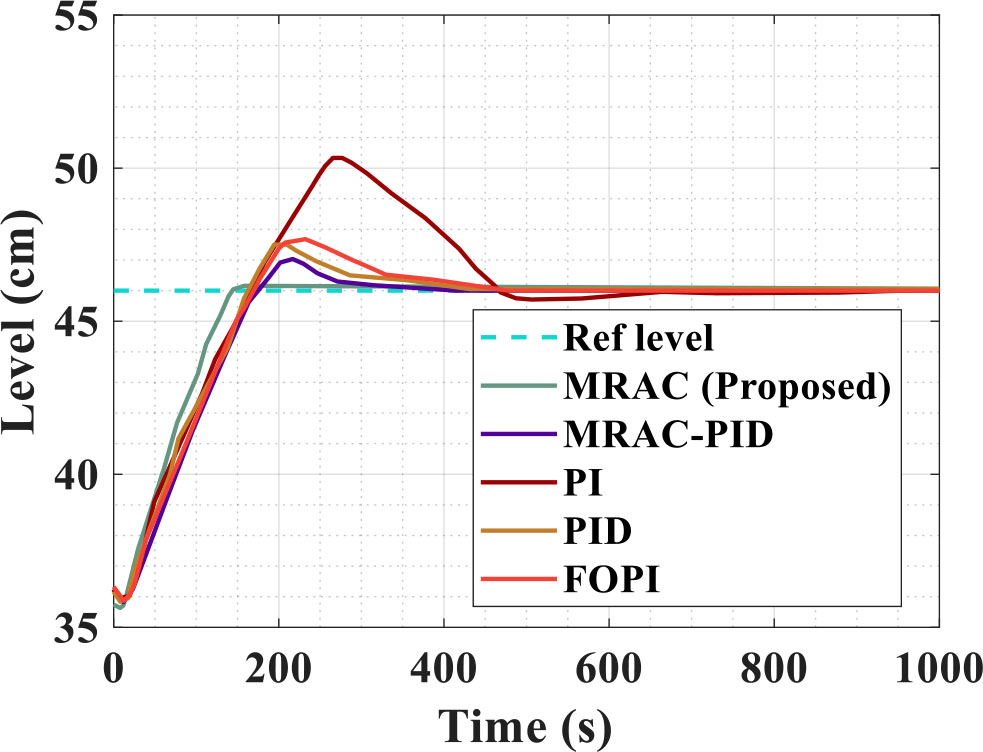
Fig. 8.
Controller output under variation in reference from 30 cm to 46 cm.
Controlling liquid levels in multiple variations of reference points is shown in Fig. 9. In this figure, the liquid level is varied from 32 cm to 62 cm and the response of all controllers is measured. The proposed MRAC-MPID controller shows better adaptability and allows more precise tracking of varying reference points than the existing controllers. The PID controller shows significant overshoot and longer settling times as it cannot adapt to the system's non-linear dynamics. The FOPID controller performs better than the PID controller due to its fractional-order terms, which offer a certain degree of adaptability. However, it still lags behind the MRAC-MPID in terms of overshoot and response speed because it cannot dynamically tune itself to changing reference points like the MRAC-MPID.
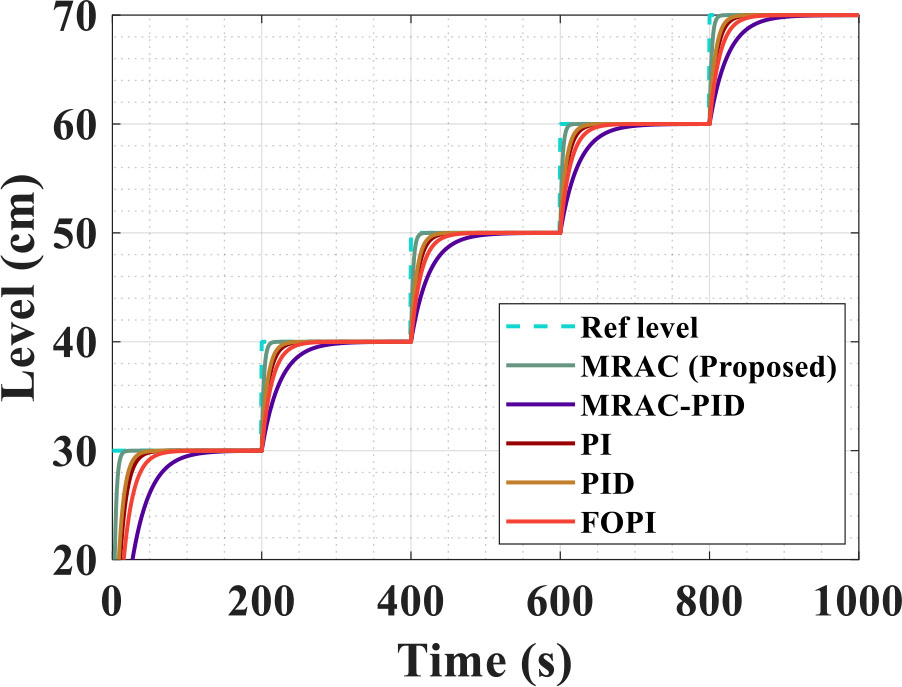
Fig. 9.
Controller response under varying liquid levels.
As observed, the proposed MRAC outperforms the existing controllers under different operating conditions. The convergence plot of FSA with GA and PSO is shown in Fig. 10. The FSA achieves a more accurate solution with minimal error metrics and ensures that the MRAC-MPID controller is fine-tuned to respond better in non-linear systems such as the CT. From the results, it is verified that the FSA has a better convergence speed than GA and PSO.
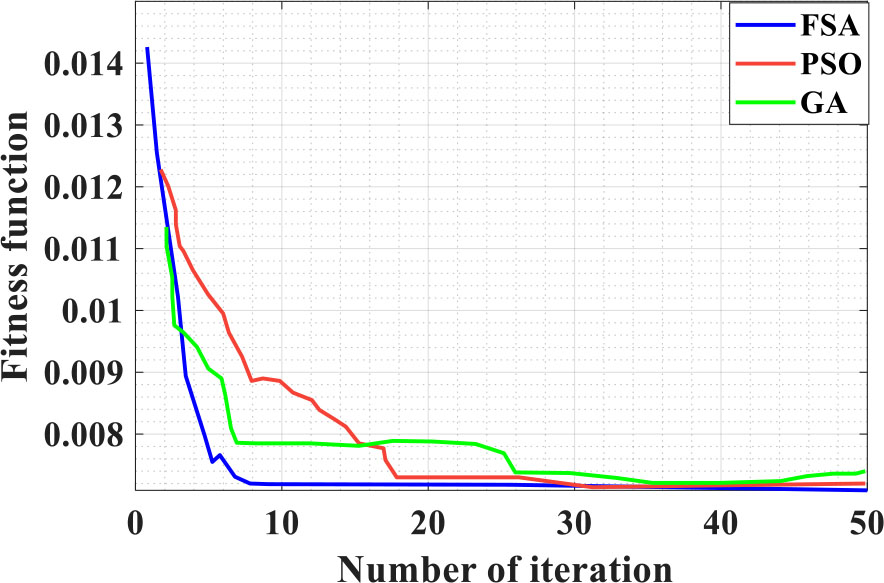
Fig. 10.
Convergence plot for optimization algorithms.
Table 3 shows a comparative analysis of the PID controller performance using different optimization techniques, including genetic algorithm (GA), PSO, and FSA as applied in the proposed MRAC-MPID framework. Key performance metrics such as peak overshoot (%), settling time (s), rise time (s), ISE, and IAE are evaluated to highlight the effectiveness of each optimization approach. The manually tuned PID controller exhibits the highest peak overshoot (21.32 %) and the longest settling time (421 s), together with the largest ISE (51.03) and IAE (2968). This shows the limitations of manual tuning in handling the non-linearities and dynamic variations of the CT system. The PID controller optimized with the GA shows significant improvement over manual tuning, with a lower overshoot (10.52 %) and a shorter settling time (376 s). However, the ISE (44.17) and IAE (2888) are still relatively high, indicating room for further improvement in the system's transient and steady-state performance. The use of PSO further improves the controller's performance, reducing overshoot to 5.44 % and shortening the settling time to 305 s. The ISE and IAE also improve to 40.93 and 2657, respectively, showing the effectiveness of PSO in optimizing PID parameters but still leaving some performance gaps. The proposed MRAC-MPID controller optimized with the FSA outperforms all other configurations and achieves the lowest peak overshoot (0.8 %) and settling time (200 s). In addition, the ISE (38.25) and IAE (2167) are significantly lower compared to GA- and PSO-optimized PID controllers. These results highlight the superior ability of the FSA to explore the parameter space and converge to optimal values, resulting in a robust and precise control response. The results emphasize that the FSA effectively minimizes both transient and steady-state errors, resulting in improved system stability and reduced energy consumption. Since the FSA-optimized MRAC-MPID controller accounts for the non-linear dynamics of the CT system more effectively than GA or PSO, it ensures better performance under varying operating conditions and disturbances.
Table 3.
Comparative analysis of PID controller with different optimization techniques.
| Controllers | Peak overshoot [%] | Settling time [s] | Rise time [s] | ISE | IAE |
|---|---|---|---|---|---|
| PID | 21.32 | 421 | 114 | 51.03 | 2968 |
| PID with GA | 10.52 | 376 | 131 | 44.17 | 2888 |
| PID with PSO | 5.44 | 305 | 122 | 40.93 | 2652 |
| MRAC (Proposed) | 0.8 | 200 | 103 | 38.25 | 2167 |
Fig. 11 shows the comparison of the control signals for different controllers such as PI, PID, FOPI, MRAC-PID, and the proposed method. Table 4 shows the results in terms of control energy and peak values based on the simulation control signals. The control energy values show that the proposed MRAC requires less control energy compared to traditional controllers such as PI, PID, FOPI, and MRAC-PID. This indicates that the proposed MRAC controller is more efficient in terms of energy required to maintain system stability and performance. The peak values show that MRAC controllers have the lowest peak values, indicating that the control signals are smoother and less aggressive compared to the traditional controllers.
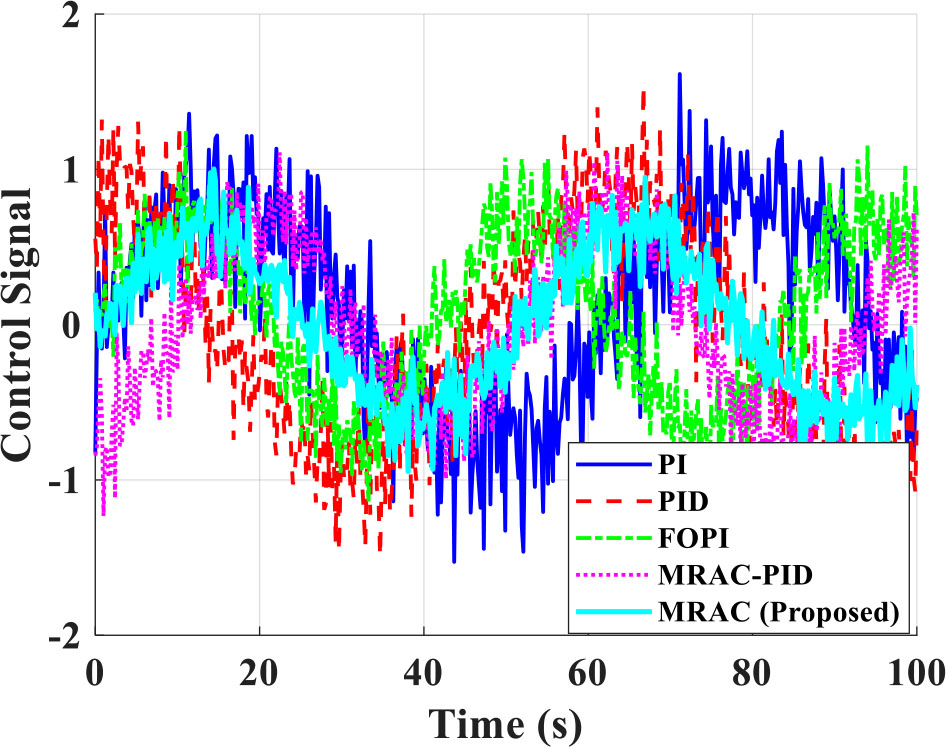
Fig. 11.
Comparison of control signals for different controllers.
5. DISCUSSION
The proposed MRAC-MPID controller tuned using the FSA, was evaluated under different scenarios including random disturbances, load variations, and reference point changes. The proposed MRAC-MPID controller shows lower oscillations and faster recovery when subjected to random disturbances in the input flow compared to other controllers. This proves its robustness under dynamic and unpredictable conditions, which is crucial for real-world industrial systems. During load variation scenarios, the MRAC-MPID controller maintains stable operation with minimal impact on liquid levels and exhibits excellent disturbance rejection. This ability to handle varying loads efficiently makes it highly relevant for industries dealing with fluctuating operational demands. The MRAC-MPID controller effectively tracks changing reference points with minimal overshoot and reduced settling times. This proves its adaptability and precise control in dynamic systems that require frequent set point adjustments. The results consistently show that the proposed controller outperforms conventional approaches, such as PI, PID, and FOPI controllers as well as MRAC-PID. Key performance metrics such as lower overshoot, shorter settling time, and better disturbance rejection highlight the controller's ability to effectively handle non-linearities in CT systems. The work focuses on liquid level control in a CT system, although the proposed MRAC-MPID controller is potentially applicable to many non-linear systems and industrial processes. Renewable energy systems, such as wind turbines and solar power plants, are often subject to non-linear dynamics due to environmental fluctuations. The proposed controller could optimize power generation and stabilize system performance with changing wind speeds or solar irradiance levels. Moreover, in the chemical industry, non-linear systems such as Continuous Stirred Tank Reactors and distillation columns show complex dynamic behavior. The proposed MRAC-MPID controller can effectively control parameters such as temperature, concentration, and pressure to ensure the process stability and efficiency. The proposed MRAC-MPID controller is particularly effective in handling system non-linearities, disturbances, and varying operating conditions. However, its performance depends on accurate modeling and proper tuning of the controller. Future research can address these limitations by integrating the method with real-time machine learning models for adaptive tuning in highly uncertain environments.
6. CONCLUSION
Liquid level control is an important aspect in the process industry with CTs. To improve the liquid level control, an MRAC based controller is proposed in this work. In the proposed MRAC, the MPID is used to improve the level of control under varying inputs and disturbances. The controller gains of MPID are tuned by the FSA based on the MSE. The proposed method is implemented in MATLAB/SIMULINK and the results are compared with existing approaches. The results are verified under constant set point, varying set point, and disturbance conditions. It is found that the proposed MRAC has a 0.8 % overshoot and requires 200 s and 103 s for settling time and rising time, respectively. Moreover, the proposed MRAC offers lower ISE and IAE values of 38.25 and 2167, respectively. In addition, the fitness estimation has proved the operating efficiency of FSA compared to existing methods. However, MRAC-MPID outperforms other controllers in handling non-linearities and disturbances and has limitations in terms of its dependence on an accurate reference model. If the reference model does not adequately represent the system dynamics, the controller's performance may deteriorate. While the computational complexity of FSA is lower than that of some optimization methods, it still requires a significant amount of time for parameter tuning in large-scale systems or real-time applications. This could limit the applicability of MRAC-MPID to systems with strict real-time constraints. The proposed method could also face challenges in highly stochastic environments where disturbances are unpredictable and vary significantly over time. These scenarios may require further improvements such as the incorporation of machine learning techniques for adaptive parameter tuning. Future work will develop artificial intelligence-based controllers for two interacting tank systems.