
1. Introduction
The development of advanced metallic materials capable of operating under extreme conditions, including high temperatures, severe mechanical stresses, wear, and corrosive environments, remains a major challenge for strategic sectors such as aerospace, energy conversion and storage, tooling, and defense industries. Among the most promising candidates, iron-based alloys reinforced with refractory constituents such as tungsten (W) and carbides have attracted considerable attention because of their exceptional hardness, thermal stability, and wear resistance. Powder metallurgy has emerged as a particularly effective processing route for these materials, enabling precise control of composition, microstructure, and porosity while minimizing segregation effects commonly encountered in conventional casting processes [1,2,3,4]. Solid-state sintering is especially attractive for the fabrication of Fe–W–C systems because it promotes densification through diffusion-controlled mechanisms without the formation of a liquid phase. Combined with high-energy mechanical milling and compaction, this approach enhances particle refinement, increases defect density, accelerates diffusion kinetics, and facilitates the formation of homogeneous microstructures and stable interfacial phases [5,6,7]. Recent studies have demonstrated that microstructural homogeneity and interfacial engineering are critical parameters governing the mechanical performance of carbide-containing alloys and complex concentrated alloys processed by powder metallurgy [8,9,10]. The metallic binder plays a fundamental role in controlling densification behavior, phase evolution, and mechanical performance. Nickel (Ni) is widely recognized for its ability to enhance diffusion, stabilize austenitic phases, and promote the formation of homogeneous solid solutions within Fe-based systems [11]. However, its relatively limited wettability with carbide phases may restrict densification efficiency and interfacial cohesion [12]. In contrast, cobalt (Co) exhibits superior wettability toward refractory carbides and contributes to improved grain bonding, fracture resistance, and structural integrity [13]. Recent investigations have shown that combining Ni and Co can generate a synergistic effect by simultaneously enhancing atomic diffusion, interfacial bonding, and microstructural stability, leading to superior densification and mechanical properties compared with single-binder systems [14,15,16]. Furthermore, the growing interest in complex concentrated alloys and carbon-containing high-entropy alloy systems has highlighted the beneficial role of multicomponent metallic matrices in achieving enhanced phase stability and mechanical reliability. In such systems, the simultaneous presence of Fe, W, Ni, Co, and carbon can promote lattice distortion, strengthen solid-solution effects, and improve the stability of carbide-reinforced microstructures under demanding service conditions [17,18,19]. Recent reports published have confirmed that the combined effects of refractory elements, carbide phases, and multicomponent binders significantly improve hardness, strength, and microstructural stability through synergistic strengthening mechanisms [20,21,22]. In this context, the present work investigates three Fe3C–W-based alloys incorporating Ni, Co, and NiCo binders. The powders were mechanically milled, uniaxially compacted, and subsequently sintered by solid-state sintering under a controlled atmosphere. Particular attention was devoted to evaluating the influence of binder chemistry on densification behavior, porosity evolution, phase formation, and microstructural homogeneity. The resulting materials were characterized by scanning electron microscopy (SEM), energy-dispersive spectroscopy (EDS), and X-ray diffraction (XRD). Their mechanical performance was assessed through microhardness, flexural strength, and impact toughness measurements. The objective is to establish clear relationships between binder composition, microstructural development, and mechanical behavior, thereby identifying the most effective binder system for Fe3C–W alloys. The findings contribute to the design of advanced carbide-strengthened materials for demanding engineering applications requiring a combination of high strength, wear resistance, and microstructural stability.
2. Materials and methods
The investigated Fe3CW-based alloys were produced from high-purity elemental powders (≥99 wt%). The iron carbide matrix contained 1.2 wt% carbon and was reinforced with 10 wt% tungsten [23], together with various additions of Ni and Co (Table 1). The powders (38–150 μm) were homogenized by high-energy ball milling at 950 rpm for 10 h using 5 and 10 mm steel balls [24]. The resulting mixtures were uniaxially compacted at 50 MPa and subsequently sintered at 1400°C for 2 h in a hydrogen atmosphere to promote diffusion-controlled densification [25]. The green and sintered densities were determined using Archimedes’ method. Microstructural characterization was performed using SEM (JEOL JSM-6063), while phase identification was carried out by XRD using Cu Kα radiation (λ = 1.5406 Å) over a 2θ range of 20–90°, with a step size of 0.02° and a scanning rate of 2° min⁻¹. Mechanical properties were evaluated through Vickers microhardness (HV0.1) measurements were carried out using an AFFRI D-M2D, three-point bending tests on 35 × 5 × 5 mm specimens (ISO 3327) (Figure 1b), and Charpy V-notch impact tests on 55 × 10 × 10 mm specimens (ISO 148-1) (Figure 1a). All reported values correspond to the average of at least three independent measurements.
Table 1
Composition of model alloys (wt%).
| Alloy | Fe3C (%) | W (%) | Ni (%) | Co (%) |
|---|---|---|---|---|
| Fe3C–W–Ni | 85 (1.2%C) | 10 | 5 | — |
| Fe3C–W–Co | 85 (1.2%C) | 10 | — | 5 |
| Fe3C–W–NiCo | 80 (1.2%C) | 10 | 5 | 5 |
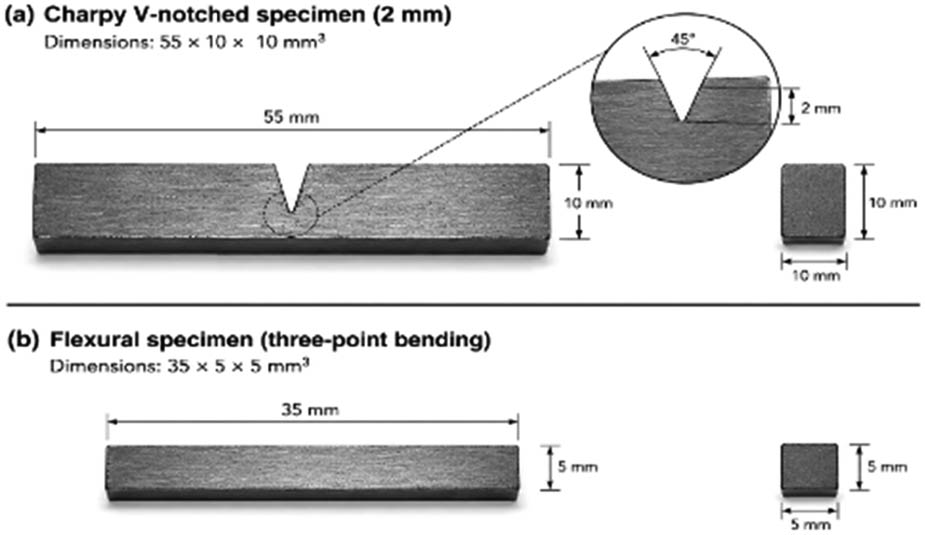
Figure 1
Charpy impact specimen and flexural.
3. Results and discussion
3.1. Structural characterizations
3.1.1. Porosity analysis
Figure 2 illustrates the microstructure and porosity of the Fe3C–W alloys with Ni, Co, and NiCo binders after solid-state sintering at 1400°C under a uniaxial pressure of 50 MPa. The images clearly reveal the direct influence of binder composition on densification and pore distribution. In the Fe3C–W–Ni alloy, a relatively high level of porosity with medium to large pores is observed. This result is consistent with its measured density of 7.4 g·cm⁻³, corresponding to a relative density of 90.8% and a residual porosity of approximately 9.2%. The higher porosity can be attributed to the limited wettability of Ni and less-efficient pore elimination during solid-state sintering [26]. The Fe3C–W–Co alloy exhibits a more compact microstructure with fewer pores. Its density of 7.5 g·cm⁻³ corresponds to a relative density of 92.0% and a residual porosity of approximately 8.0%. The improved densification is associated with the stronger chemical affinity of Co toward carbide particles, which promotes interfacial bonding and diffusion-assisted pore closure [27]. Among the investigated materials, the Fe3C–W–NiCo alloy presents the most homogeneous and dense microstructure. With a sintered density of 7.7 g·cm⁻³, it achieves a relative density of 93.7% and the lowest residual porosity, approximately 6.3%. The synergistic action of Ni and Co enhances both atomic diffusion and wettability, resulting in superior consolidation and a marked reduction in intergranular pores [28]. Consequently, the porosity follows the order Fe3C–W–Ni (9.2%) > Fe3C–W–Co (8.0%) > Fe3C–W–NiCo (6.3%), confirming the increasing effectiveness of the binder system in promoting densification and improving the mechanical integrity of the composites.
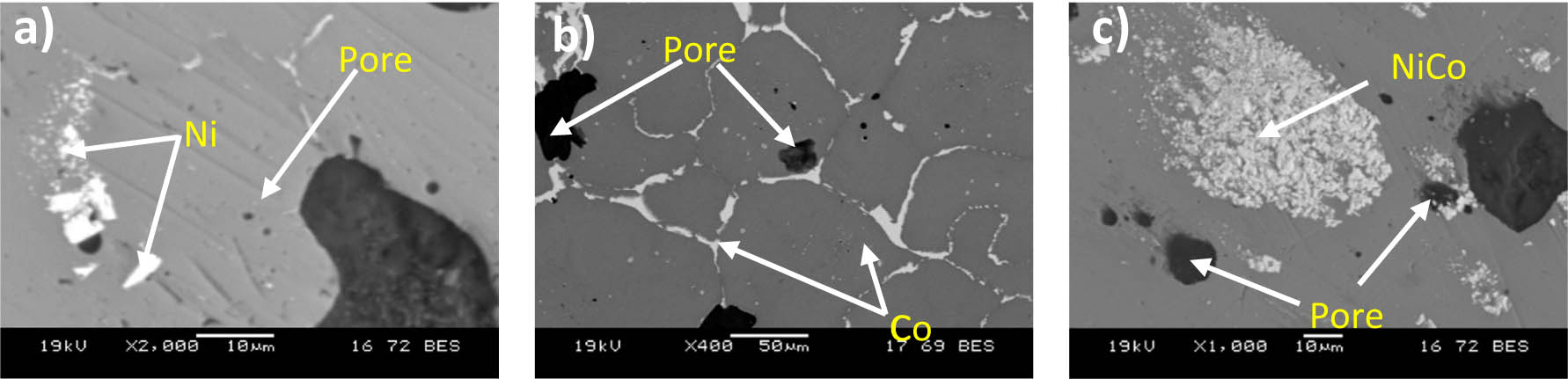
Figure 2
SEM image showing the porosity of alloys: (a) Fe3C–W–Ni, (b) Fe3C–W–Co, and (c) Fe3C–W–NiCo.
3.1.2. Scanning electron microscopy analysis
Figure 3 presents the backscattered electron (BSE) micrographs of Fe3C–W alloys containing Ni, Co, and NiCo binders after solid-state sintering at 1400°C under a uniaxial pressure of 50 MPa. The strong atomic-number contrast provided by BSE imaging allows clear differentiation between the bright W-rich regions and the darker Fe-rich matrix and binder phases, enabling detailed observation of phase distribution, interfacial characteristics, and densification behavior. The Fe3C–W–Ni alloy exhibits a heterogeneous microstructure characterized by W-rich particles dispersed within a Fe–Ni matrix. Although Ni enhances atomic diffusion and promotes solid-solution formation during sintering, its relatively limited wettability toward carbide phases results in incomplete interfacial bonding and the presence of residual porosity. Consequently, some carbide particles remain poorly integrated into the matrix, reducing microstructural uniformity. In contrast, the Fe3C–W–Co alloy displays a more homogeneous microstructure with improved grain-boundary cohesion and fewer pores. The superior wettability of Co toward refractory phases enhances interfacial adhesion and diffusion-assisted densification. As a result, carbide particles are more effectively bonded to the matrix, producing cleaner interfaces and improved structural continuity. Similar effects of Co on phase stability and microstructural refinement have been reported in advanced multicomponent alloy systems [29]. The Fe3C–W–NiCo alloy demonstrates the most compact and homogeneous microstructure. The combined addition of Ni and Co promotes a chemically uniform binder phase, benefiting simultaneously from the diffusion-enhancing effect of Ni and the excellent wettability of Co. This synergistic interaction results in uniform carbide dispersion, well-developed grain boundaries, and negligible residual porosity. Recent studies have shown that multicomponent alloy systems exhibit enhanced phase stability, lattice distortion, and mechanical performance through optimized elemental interactions and solid-solution stabilization mechanisms [29,30,31]. Therefore, the superior densification and microstructural homogeneity observed in the Fe3C–W–NiCo alloy confirm the beneficial role of the NiCo binder in improving interfacial cohesion and overall structural integrity.
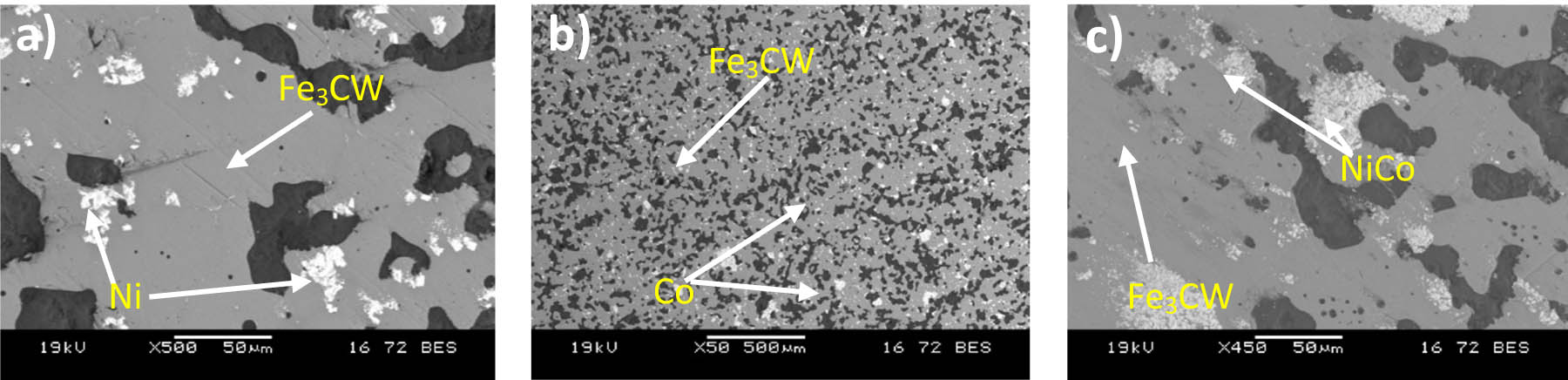
Figure 3
SEM image by backscattered electrons of phase: (a) Fe3C–W–Ni, (b) Fe3C–W–Co, and (c) Fe3CWNiCo.
Figure 4 presents the EDS elemental maps of the 85Fe3C–10W–5Ni, 85Fe3C–10W–5Co, and 80Fe3C–10W–5Ni–5Co alloys, confirming the presence and distribution of the main constituent elements after sintering. In all three alloys, iron constitutes the dominant matrix phase and exhibits a relatively homogeneous distribution throughout the microstructure. Tungsten is mainly concentrated in the bright regions observed in the BSE micrographs, indicating the presence of W-rich particles or complex tungsten-rich carbides. In the Fe3C–W–Ni alloy, nickel is uniformly distributed within the matrix, promoting atomic diffusion and enhancing densification during sintering. Similarly, in the Fe3C–W–Co alloy, cobalt exhibits a homogeneous distribution and contributes to microstructural refinement and improved interparticle bonding. Among the investigated materials, the 80Fe3C–10W–5Ni–5Co alloy displays the highest degree of chemical homogeneity, characterized by a uniform dispersion of both Ni and Co and a reduced segregation of W-rich phases. This homogeneous elemental distribution reflects strong interactions among the alloying elements, resulting in improved interfacial cohesion, enhanced densification, and consequently superior mechanical performance.
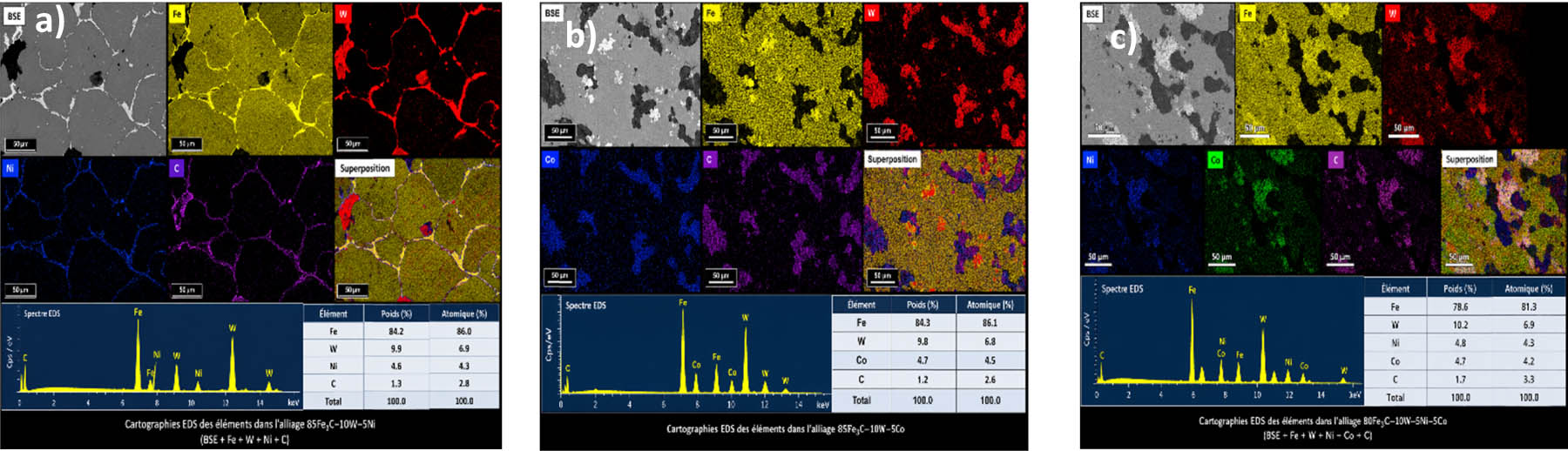
Figure 4
EDS elemental maps of the investigated alloys after sintering: (a) 85Fe3C–10W–5Ni, (b) 85Fe3C–10W–5Co, and (c) 80Fe3C–10W–5Ni–5Co alloys.
3.1.3. X-ray diffraction analysis
Figure 5a shows the XRD patterns of the Fe3C–W-based alloys with Ni, Co, and combined NiCo binders after sintering at 1400 °C, compared to the initial powder mixture. All samples exhibit a dominant FeW phase, with sharp peaks corresponding to the (110), (200), and (211) planes of the body-centered cubic structure, indicating that the main crystalline framework remains stable after sintering. However, notable differences are observed depending on the binder used. In the Fe3C–W–Ni sample, intense peaks are detected around 43°, 51°, and 74°, associated with the (111), (200), and (220) planes of the γ-austenitic (Fe,Ni) phase. Minor traces of δ-ferrite (planes (110), (200)) are also present. This phase distribution suggests a stable solid solution facilitated by Ni diffusion, which causes a slight shift of diffraction peaks toward lower 2θ angles due to lattice expansion [32]. For the Fe3C–W–Co alloy, stronger diffraction peaks from δ-ferrite are observed, particularly at (110) and (200) planes, indicating its preferential crystallization. Cobalt promotes ferritic structures at high temperatures but exhibits limited solubility in FeW, leading to minimal lattice distortion and smaller peak shifts. In contrast, the Fe3C–W–NiCo alloy exhibits peak broadening especially near 44°, 65°, and 82° pointing to a finer microstructure and the potential formation of intergranular or complex carbide phases such as (Fe, Ni, Co)₆W₆C, characterized by diffraction from planes like (121), (300), and (222). These broadened and slightly shifted peaks confirm partial dissolution of Ni and Co into the FeW matrix and the formation of stable solid solutions supported by mixing entropy [33]. The XRD analysis reveals controlled structural evolution depending on the binder composition: Ni stabilizes austenite, Co enhances ferrite formation, and the NiCo combination induces synergistic solid solution effects, improved phase distribution, and finer grain structure. This explains the enhanced mechanical properties observed in the NiCo-based composite.
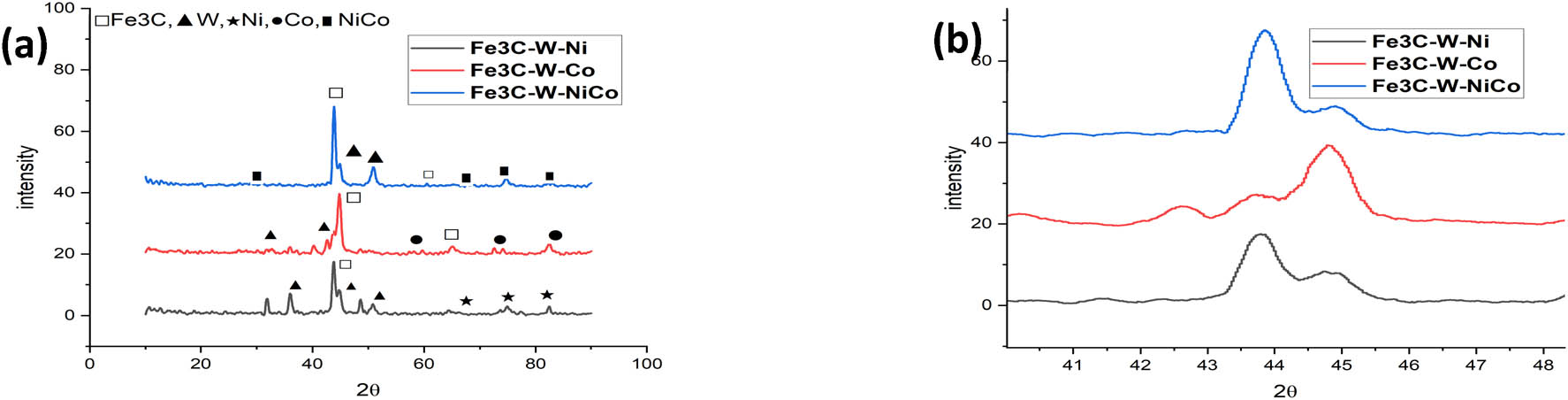
Figure 5
X-ray diffraction evolution (a) XRD patterns of Fe3C–W-based alloys with Ni, Co, and NiCo binders after sintering at 1400°C compared to the initial powder mixture; (b) diffraction peak shifts in the 43–45° (2θ) range for the (110) plane.
The diffraction peak shifts observed in the 43–45° (2θ) range provide important information about lattice distortion and residual stresses in the investigated Fe3C–W-based alloys. The main body-centered cubic Fe–W reflection corresponding to the (110) plane shifts from approximately 44.00° for Fe3C–W–Ni to 44.55° for Fe3C–W–Co, representing a positive displacement of about +0.55° (Figure 5b). According to Bragg’s law, this shift toward higher angles indicates a decrease in the interplanar spacing (d₁₁₀), revealing lattice contraction and the presence of compressive strain. In contrast, the Fe3C–W–NiCo alloy exhibits a peak position near 43.95°, corresponding to a −0.60° shift relative to Fe3C–W–Co, indicating lattice expansion and partial relaxation of internal stresses. These variations are mainly associated with the substitutional incorporation of Ni and Co atoms into the Fe–W matrix, which induces atomic-size mismatch and local elastic distortions. Such lattice distortions generate stress fields that hinder dislocation movement and contribute to solid-solution strengthening [34,35]. The combined Ni–Co addition promotes a more homogeneous atomic arrangement, reducing localized strain accumulation while maintaining significant lattice distortion. Similar relationships between peak displacement, lattice distortion, phase stability, and mechanical enhancement have been reported in complex concentrated and high-entropy alloys [36,37].
3.2. Mechanical characterizations
3.2.1. Density analysis
Figure 6 shows the density evolution of the Fe3C–W–Ni, Fe3C–W–Co, and Fe3C–W–NiCo alloys before and after solid-state sintering at 1400°C under 50 MPa. All green compacts exhibited similar densities of approximately 5.4 g·cm⁻³. After sintering, the densities increased to 7.4 g·cm⁻³, 7.5 g·cm⁻³, and 7.7 g·cm⁻³ for Fe3C–W–Ni, Fe3C–W–Co, and Fe3C–W–NiCo, respectively. Correspondingly, the relative densities reached 90.8%, 92.0%, and 93.7%, indicating efficient densification. According to sintering theory, the increase in density is accompanied by dimensional contraction caused by pore elimination and particle rearrangement during diffusion-controlled densification [38]. The linear shrinkage coefficients, calculated from the green and sintered densities, were approximately 9.9% for Fe3C–W–Ni, 10.3% for Fe3C–W–Co, and 11.2% for Fe3C–W–NiCo. The higher shrinkage of the Fe3C–W–NiCo alloy reflects its superior densification capability and more effective pore closure. This behavior can be attributed to the synergistic role of Ni and Co in the binder phase. Nickel enhances atomic diffusion, while cobalt improves wettability and interparticle bonding, promoting grain rearrangement and consolidation during sintering [39]. Consequently, the Fe3C–W–NiCo alloy exhibits the highest final density and the lowest residual porosity, consistent with SEM observations and its improved mechanical performance.
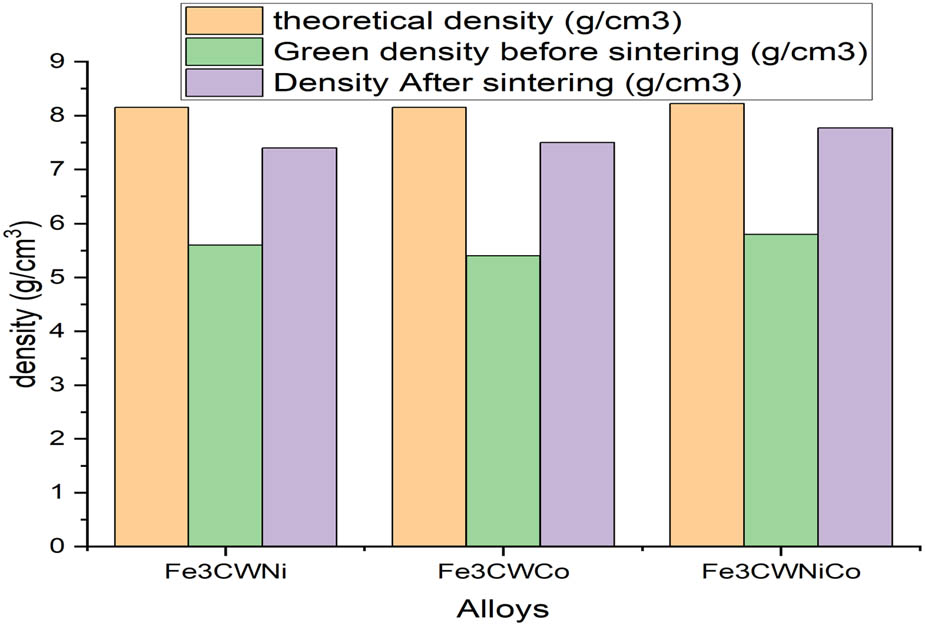
Figure 6
Density evolution before and after sintering.
3.2.2. Microhardness analysis
Figure 7 presents the Vickers microhardness (HV0.1) of the Fe3C–W–Ni, Fe3C–W–Co, and Fe3C–W–NiCo alloys after solid-state sintering at 1400°C. The hardness values increase from 750 HV for Fe3C–W–Co to 820 HV for Fe3C–W–Ni and reach a maximum of 885 HV for Fe3C–W–NiCo. This improvement is closely associated with enhanced densification, reduced residual porosity, and a more homogeneous distribution of the binder phase within the matrix. The superior hardness of the NiCo-containing alloy is attributed to the synergistic effect of Ni and Co, which promotes grain refinement, solid-solution strengthening, and improved interfacial cohesion. In addition, the uniform dispersion of W-rich carbides and the lattice distortion induced by the simultaneous incorporation of Ni and Co contribute to impeding dislocation motion and enhancing mechanical strength. Similar strengthening mechanisms have been reported in advanced multicomponent alloys, where lattice distortion and phase stabilization significantly improve hardness and structural performance [39,40]. Consequently, the hardness follows the order Fe3C–W–NiCo > Fe3C–W–Ni > Fe3C–W–Co.
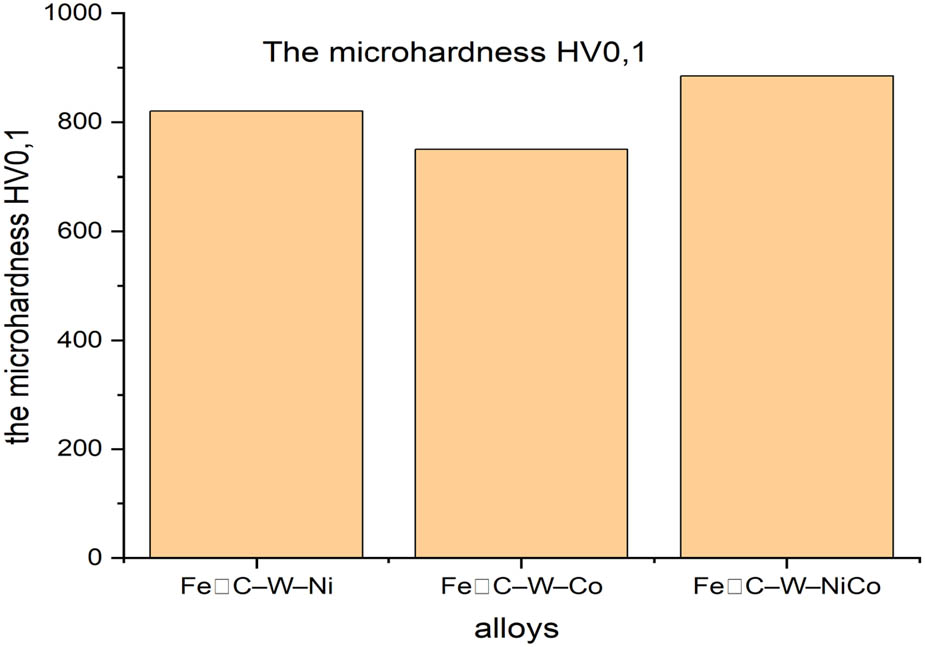
Figure 7
Microhardness evolution.
3.2.3. Flexural and resilience analysis
Figures 8 and 9 present the flexural strength and impact toughness of the Fe3C–W–Ni, Fe3C–W–Co, and Fe3C–W–NiCo alloys after sintering at 1400°C. The results clearly demonstrate the strong influence of binder composition on the mechanical performance of the investigated materials. The Fe3C–W–NiCo alloy exhibited the highest flexural strength, reaching a maximum load of 4500 N and a corresponding strength of approximately 1620 N·mm−2, compared with 4000 N (1440 N·mm−2) for Fe3C–W–Ni and 3800 N (1380 N·mm−2) for Fe3C–W–Co. A similar trend was observed for impact toughness, which increased from 1.4 J cm−2 for Fe3C–W–Ni and 1.6 J cm−2 for Fe3C–W–Co to 2.0 J cm−2 for Fe3C–W–NiCo. The superior performance of the NiCo-containing alloy can be attributed to the synergistic effect of Ni and Co, which promotes enhanced densification, reduced residual porosity, and improved interfacial bonding between the Fe-rich matrix and W-rich carbide phases. The resulting homogeneous microstructure facilitates efficient stress transfer and delays crack initiation and propagation under both static and dynamic loading conditions. Furthermore, the higher hardness and density values obtained for the Fe3C–W–NiCo alloy support the observed improvements in flexural and impact properties. The simultaneous presence of Ni and Co also contributes to solid-solution strengthening and lattice distortion effects, which enhance resistance to plastic deformation and fracture. Similar relationships between microstructural homogeneity, phase stability, and mechanical performance have been reported in advanced multicomponent alloy systems, where optimized elemental interactions significantly improve strength–toughness combinations and structural reliability [41,42]. Therefore, the Fe3C–W–NiCo alloy exhibits the most balanced combination of strength, toughness, and structural integrity, making it a promising candidate for demanding engineering applications involving severe mechanical and impact loading.
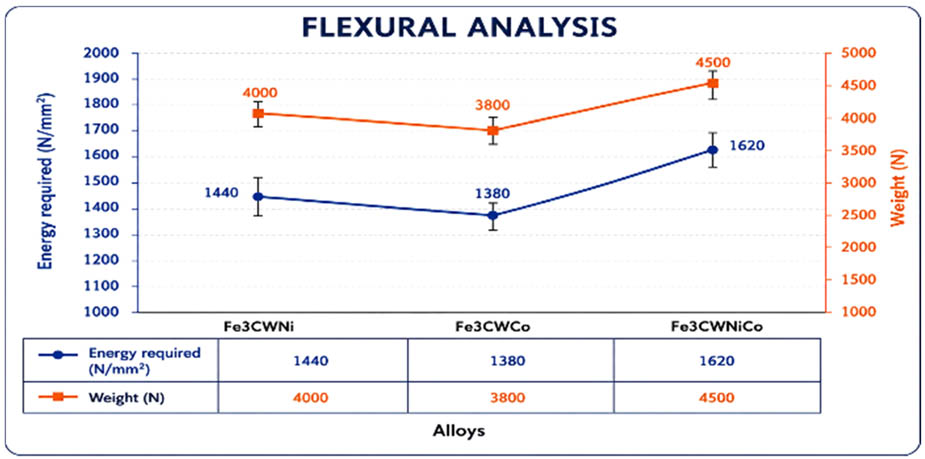
Figure 8
The evolution of flexural strength.
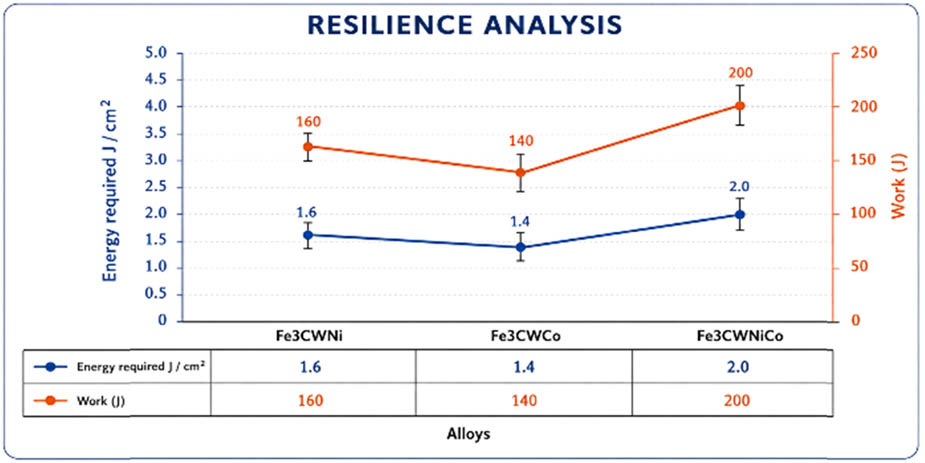
Figure 9
The evolution of resilience values.
Figure 10 presents the Fe3CWNi, Fe3CWCo, and Fe3CWNiCo alloys exhibited distinct mechanical responses during Charpy impact and three-point bending tests. The Fe3CWCo alloy showed limited plastic deformation and rapid crack propagation, indicating relatively low toughness. The Fe3CWNi specimen displayed greater deformation and improved energy absorption due to the ductilizing effect of nickel. The Fe3CWNiCo alloy exhibited the largest notch opening during impact and the highest deflection during bending, reflecting superior toughness and ductility. Its enhanced performance is attributed to improved densification, reduced residual porosity, and stronger interparticle bonding, resulting in an optimal combination of strength, toughness, and crack propagation resistance. During the three-point bending test, the Fe3CWNi, Fe3CWCo, and Fe3CWNiCo specimens underwent elastic and plastic deformation under the applied load. Tensile stresses developed at the lower surface, while compressive stresses acted on the upper surface. The Fe3CWNiCo alloy exhibited the highest deflection and crack resistance, followed by Fe3CWNi, whereas Fe3CWCo showed earlier crack initiation and a more brittle response.
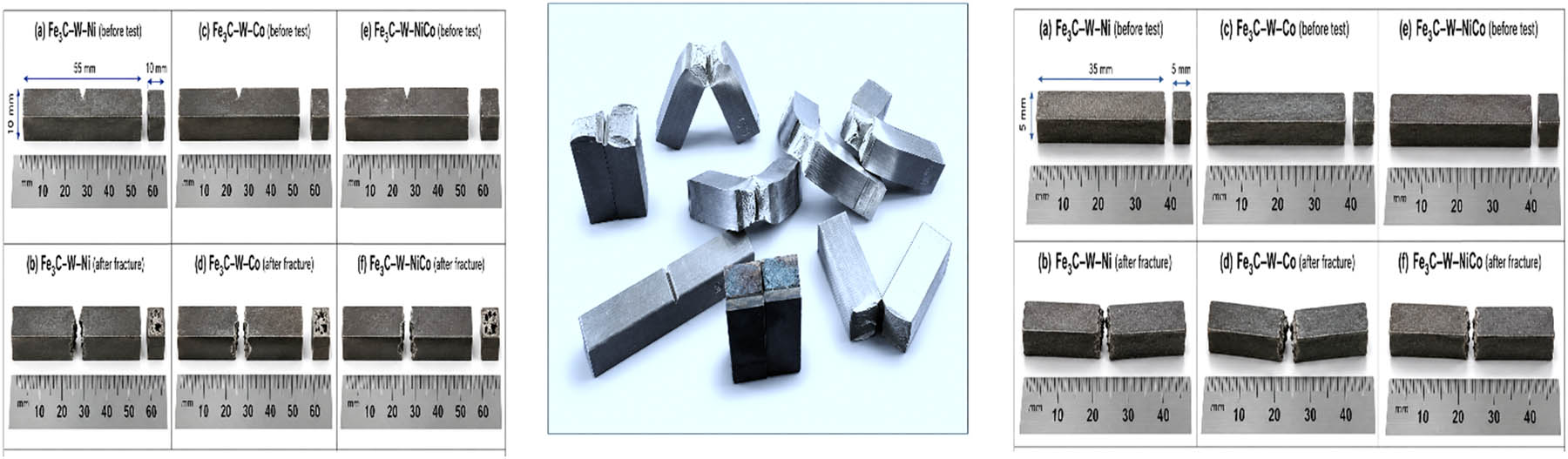
Figure 10
Charpy V-notched specimens and flexural after impact testing. Mechanical responses of the investigated Fe3CWNi ,Fe3CWCo and Fe3CWNiCo alloys under Charpy impact and three-point bending tests: (a) Charpy impact of Fe3CWNi; (b) Charpy impact of Fe3CWCo; (c) Charpy impact of Fe3CWNiCo; (d) three-point bending of Fe3CWNi; (e) three-point bending of Fe3CWCo and (f) three-point bending of Fe3CWNiCo alloys.
4. Influence of the Ni/Co binder on Fe3CW alloy
Figure 11 illustrates the microstructural evolution and densification behavior of Fe3C–W alloys containing Ni, Co, and NiCo binders after solid-state sintering at 1400°C. The micrographs demonstrate that the binder composition strongly influences diffusion kinetics, grain growth, and phase homogeneity. In the Fe3C–W–Ni alloy (Figure 11a, b), Ni promotes solid-state diffusion and enhances atomic mobility, leading to moderate densification and a relatively uniform microstructure. However, residual porosity remains visible, indicating incomplete pore elimination. The Fe3C–W–Co alloy (Figure 11c, d) exhibits improved densification due to the superior wettability and diffusivity of Co, resulting in stronger particle bonding and reduced porosity. Nevertheless, localized grain coarsening is observed, suggesting accelerated grain growth at high temperature. In contrast, the Fe3C–W–NiCo alloy (Figure 11e, f) displays the most homogeneous and compact microstructure.
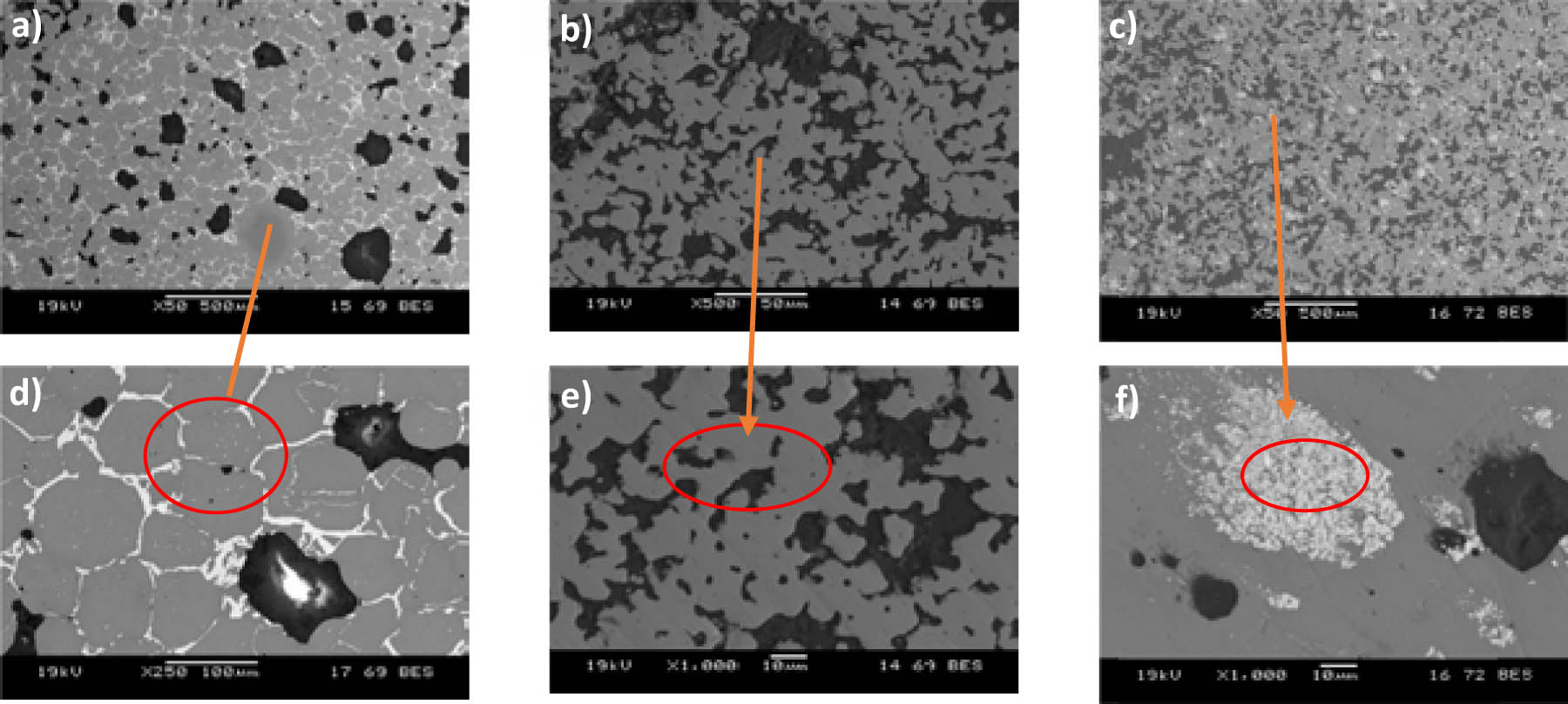
Figure 11
Evolution of the sintering mechanism and phase transformation of Fe3C–W–Ni, Fe3C–W–Co, and Fe3C–W–NiCo alloys. Microstructural evolution and densification behavior of Fe3C-W alloys containing Ni, Co, and NiCo binders after solid-state sintering at 1400 °C: (a, b) Fe3C–W–Ni alloy; (c, d) Fe3C–W–Co alloy; and (e, f) Fe3C–W–NiCo alloy showing advanced densification and microstructural homogeneity.
The combined effect of Ni and Co enhances mass transport, interfacial cohesion, and phase stability, producing uniformly distributed grains and negligible residual porosity. The enlarged regions reveal well-developed necks and strong interparticle bonding, confirming advanced densification. Overall, the microstructural evolution follows the classical stages of solid-state sintering, including neck growth, grain development, and pore elimination. The superior homogeneity of the NiCo alloy confirms the synergistic role of the mixed binder in optimizing densification and structural stability, in agreement with recent studies on multicomponent alloy systems [20,21].
5. Conclusions
This study investigated Fe3C–W alloys reinforced with different metallic binders – nickel (Ni), cobalt (Co), and a binary NiCo mixture – to evaluate the influence of binder composition on the microstructure, densification, and mechanical performance of solid-state sintered composites. The materials were successfully fabricated through high-energy mechanical milling, uniaxial compaction at 50 MPa, and solid-state sintering at 1,400°C. This processing route promoted the formation of stable intermetallic and solid solution phases while ensuring strong intergranular bonding and enhanced structural integrity.
Among all investigated compositions, the Fe3C–W alloy reinforced with the binary NiCo binder exhibited the best overall performance. It achieved the highest relative density (7.7 g cm−3), microhardness (885 HV), flexural strength (1620 N·mm−2), and impact resistance (2.0 J cm−2). These superior properties demonstrate the effectiveness of the NiCo binder in improving both the densification process and the mechanical behavior of the composite.
The remarkable enhancement observed with the NiCo binder is attributed to the synergistic interaction between nickel and cobalt. The combined effect of these elements promotes faster diffusion kinetics, improves wettability at particle interfaces, and enhances phase stability during sintering. Consequently, porosity is significantly reduced, reinforcing phases are more uniformly distributed, and a finer, more homogeneous microstructure is obtained. These microstructural improvements are directly responsible for the observed increase in mechanical performance.
The findings confirm that binder composition is a critical parameter governing the final properties of FeW–C alloys produced by powder metallurgy. The binary NiCo binder represents a promising alternative to conventional single-metal binders, providing a balanced improvement in density, hardness, strength, and toughness. This work provides valuable insights into the design of advanced binder systems and establishes a foundation for the development of high-performance sintered materials intended for demanding structural, tribological, and wear-resistant engineering applications.
Funding information
The authors received no specific funding for this research.
Author contributions
Abdelyamine Boukhobza. and Kamel Fedaoui: Investigation, data analysis, visualization, and writing– original draft. Lahcene Mebarki: Conceptualization, methodology, supervision, Lazhar Baroura and Zidani Mosbah: Investigation, validation, and writing review and editing. All authors read and approved the final manuscript.
Conflict of interest statement
Authors state no conflict of interest.
Data availability statement
The raw and processed datasets used to support the findings of this study can be provided by the corresponding author upon reasonable request.