
1. Introduction
The worldwide acceptance of fiber-reinforced polymer (FRP) composite materials as a concrete reinforcement is due to their corrosion resistance, considerably high strength in tension, and lighter weight [1,2,3]. Recent advancements have resulted in the production of basalt FRP (BFRP), which is derived from basalt rocks. BFRP rebars offer enhanced cost-effectiveness, enhanced temperature and chemical resistance, and ecofriendly nature as compared to other FRP rebar options available in the market [4]. However, for BFRP rebars to gain widespread acceptance in the construction industry, further investigation is needed to understand the bond-development phenomenon. The bond behavior of FRP rebars differs from steel rebars due to notable distinctions in force transfer and failure mechanisms [5].
The advancement of FRP reinforcing rebars over the past few decades on a global scale has highlighted the need and significance of continuously updating design specifications that are valuable for engineers in the concrete industry [6]. The BFRP rebars’ bond with concrete is a vital property that governs the behavior of reinforced concrete (RC) elements. Consequently, ensuring the development of a suitable bond is always crucial in structural design for controlling cracking and flexural strength [4,7].
The existing design codes [8,9,10,11,12] have been established to facilitate the design of structural elements using FRP composites like glass FRP (GFRP), carbon FRP (CFRP), and Aramid FRP. Nonetheless, these codes do not provide design procedures for BFRP reinforced concrete. This limitation arises from the comparatively recent emergence of BFRP composites in contrast to other FRP composites, which has restricted fundamental studies and related applications.
Adhikari [13] examined the mechanical characteristics of BFRP rebars to assess their appropriateness for use in RC beams. The researchers suggested a formula for predicting the development length of BFRP rebars. Wu et al. [14] examined the tensile properties of 8 mm diameter BFRP rebars with vinylester resin for elevated temperature of up to 300°C. The rebars retained approximately 85%, which was attributed to the elevated glass transition temperature of resin. Additionally, basalt fiber bundles underwent testing up to 500°C, showing a gradual reduction in tensile strength between 200°C and 300°C and a significant drop at 500°C. Vincent et al. [15] conducted a characterization of recently developed BFRP rebars and assessed their bond strength. The study comprised the mechanical and physical evaluation of sand-coated BFRP rebars of diameters varying from 10 to 16 mm. According to the results of the tested beams, the BFRP rebars were physically and mechanically in compliance with applicable standards [9,12].
Altalmas et al. [16] examined the bond behavior and strength of BFRP and GFRP rebars in various accelerated environments. Pullout failures occurred due to shearing between rebar layers for basalt specimens and surface rib shearing for glass specimens. Surface treatment and manufacturing quality were found to influence the bond behavior more than the type of fibers used. BFRP rebars having sand coating outperformed helically grooved BFRP rebars in bond strength, concrete adhesion, and slip at peak load. Heating up to 80°C had minimal impact on FRP rebar bond regardless of fiber type. Benmokrane et al. [17] studied GFRP and BFRP rebars with vinylester and epoxy resins. Rebars were tested for physical, mechanical, and durability properties in an alkaline environment. Glass/Vinylester rebars had the best bond, flexural strength, modulus, and shear strength. Basalt/Vinylester rebars had the weakest interface and lowest strength. Accelerated aging affected Basalt/Vinylester rebars the most. Glass/Vinylester rebars showed superior durability. Conditioning had no major effect on the tested fibers and resins. Wang et al. [18] investigated the impact of matrix properties, concrete cover to rebars, rebar diameter, length of rebars embedded in concrete, on BFRP rebar bond behavior in engineered cementitious composite (ECC). Pullout tests with different parameters were conducted. Failure modes varied with cover thickness. Polyvinyl alcohol fibers reduced crack width. Sufficient matrix coverage led to pullout failure without cover splitting. Bond strength increased with cover thickness but plateaued at 20 mm. An embedded length of 15Ф (Ф = diameter of rebars) was sufficient for 4 mm BFRP rebars in ECC.
Hassan et al. [19] examined experimentally the impact of harsh environment exposure on BFRP rebars’ bond. The exposure of specimens to heating and alkaline solution exhibited typical pullout failure and shearing at the rebar–concrete interface. Bond strength increased with temperature during accelerated conditioning. After one and a half month, bond strength rose by 25% to 26% at 50°C and 60°C, while slightly decreasing by 4.3% at 40°C. Bond strength reduced after 6 months, most notably in alkaline solution specimens at 40°C (16% loss). Li et al. [20] experimentally examined the bond performance of BFRP and GFRP bars with concrete at varying temperatures. Factors including embedded length, temperature, rebar diameter, concrete cover, concrete grade, and fire-resistant coating were taken into account. The findings indicated a decrease in the bond strength of BFRP rebars as the temperature increased, while GFRP rebars exhibited more severe degradation. BFRP rebars had higher bond strength than GFRP rebars at different temperatures. The researchers also reported loss of bond strength for larger rebar diameter and embedment length, but increased with higher concrete strength and thicker cover.
Henin et al. [7] explored the influence of sand coating (primary and secondary) on BFRP rebar bond behavior in concrete. They tested 23 pullout and beam specimens to determine bond strength and bond-dependent coefficient compared to deformed steel rebars. Results were compared with ACI 440-1R-15 [8] and other codes. Secondary sand coating showed 80% higher bond strength but lower bond-dependent coefficient than primary sand coating. Calculated k b values at service levels were lower than those measured using 0.7 mm crack width, indicating conservative estimation. It was reported that the design codes [8,21] underestimate k b values, while CAN/CSA S806-12 [10] prediction closely matched secondary sand coated BFRP rebars. Liu et al. [22] studied FRP rebar bond with concrete using 48 pullout specimens. BFRP, GFRP, and CFRP rebars were used with four surface treatments (screw threaded, sand coated, helical wrapped, sand coated with helical wrapped) and different rebar diameters (8, 10, and 12 mm). BFRP outperformed GFRP in bond strength (10 mm diameter, helical wrapping surface). The researchers recommended screw threaded or helical wrapped surface treatment for FRP rebars. Sand-coated FRP rebars had steeper initial micro-slippage segment.
Recent studies consistently show that elevated temperatures significantly degrade the tensile properties of FRP bars and their bond with concrete. Yi et al. [23] highlighted the temperature-dependent reduction in strength and bond of thermoplastic FRP, while Liang et al. [24] found similar bond deterioration for BFRP bars in ultra-high performance concrete, but with some residual capacity due to the dense matrix. Prakash and Parthasarathi [25] further demonstrated that FRP-rehabilitated RC joints lose capacity under heat, but predictive artificial neural network models can effectively predict this degradation.
The aforementioned review indicates that BFRP rebars represent a potential of replacing steel reinforcement more than other types of FRP rebars. While the bond behavior of steel and FRP rebars has been extensively studied under ambient conditions, comparative investigations of BFRP and steel rebars embedded in plain concrete (PC) and fiber-reinforced concrete (FRC) under elevated temperatures remain scarce. Existing studies typically focus on single rebar types, limited concrete mixes, or ambient conditions, leaving a gap in understanding the combined effects of concrete reinforcement type and temperature on bond stress–slip behavior. Moreover, most of the studies that investigated the BFRP rebars’ bond with concrete employed pullout tests, which does not accurately simulate real-world conditions in concrete structural elements [26]. Instead, the beam-end test offers a better option for examining the BFRP rebars’ bond with concrete [26], which has been adopted in this study. This test method provides a relatively simple yet representative approach, closely resembling the stress experienced by RC flexural members wherein the concrete as well as the reinforcement are under tensile stress. This study examined experimentally the bond performance of BFRP rebars embedded in FRC under elevated temperature and compared their performance with the conventional steel reinforcement. The parameters investigated include: (i) types of concrete (PC and steel FRCs), (ii) type of rebars (steel and BFRP rebars), and (iii) exposure temperatures (ambient temperature, 100°C, and 200°C). Additionally, the study introduces a modified mBPE bond model incorporating temperature-dependent parameters for both rebar types, providing a predictive tool for elevated temperature bond performance. This work thus uniquely contributes to knowledge on temperature-induced bond degradation and the influence of fiber reinforcement on bond mechanisms. The findings of this study are particularly relevant for concrete structures exposed to moderate temperatures, such as in nuclear power plants, industrial chimneys, and fire-protected infrastructure. The test setup for testing beam-end specimens was designed and fabricated in the laboratory in accordance with ASTM A944-15 [27]. The bond performance observed through experiments was evaluated in terms of average bond strength, modes of failure, and rebar slip behavior.
2. Experimental tests
2.1. Material properties
The study involved the laboratory preparation of both plain concrete (PC) and FRC. The selected compressive strength of PC was chosen to be 40 MPa, which is compatible to values recommended by ASTM A944-15 [27] for beam-end test and emulates the practical mix design most commonly used in construction. The FRC was produced by mixing 78.5 kg/m3 of hooked end steel fibers, which were 60 mm long (diameter = 0.75 mm, tensile strength = 1,225 MPa), as shown in Figure 1(a). The locally available ingredients were utilized for producing concrete. The quantity of cement used was 400 kg/m3 and water-to-cement ratio was 0.45. The compressive and splitting tensile strengths of PC and FRC, measured on standard cylinders (150 × 300 mm, n = 3) in accordance with relevant code provisions [28,29] at ambient conditions and after exposure to 200 °C, are summarized in Table 1. The results indicate that moderate heating did not significantly alter the mechanical properties of either concrete type.
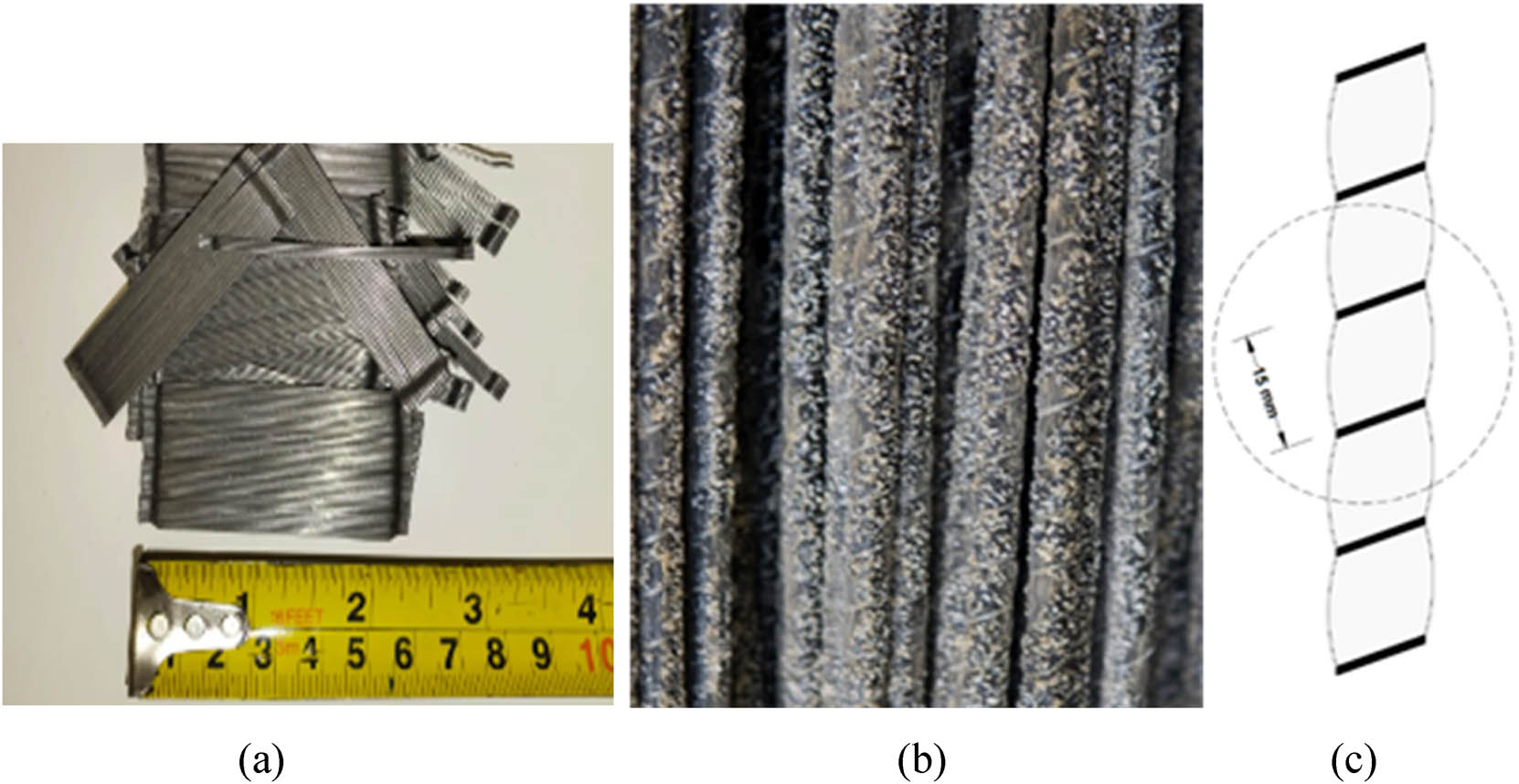
Figure 1
(a) Steel fibers; (b) BFRP rebars used in the study; and (c) BFRP rebar's surface profile.
Table 1
Compressive and splitting tensile strengths of concrete at ambient and elevated temperature.
| Concrete type | Compressive strength (MPa) | Splitting tensile strength (MPa) | ||
|---|---|---|---|---|
| Ambient temperature | 200 °C | Ambient temperature | 200 °C | |
| PC | 42.0 ± 2.8 | 41.4 ± 3.2 | 3.8 ± 0.2 | 3.7 ± 0.3 |
| FRC | 46.0 ± 3.1 | 45.2 ± 3.3 | 6.0± 0.5 | 5.8 ± 0.6 |
The study employed BFRP and steel rebars of 12 mm diameter to assess their bond performance with PC and FRC. The ultimate tensile strength, fracture strain, and elastic modulus of BFRP bars obtained from laboratory tests were 964 MPa, 3.0%, and 44.7 GPa, respectively. However, the yield and ultimate tensile strengths of steel bars were 582 and 665 MPa, respectively. The BFRP rebars utilized in this investigation had a helical sand coating on the surface (Figure 1(b)). The surface of BFRP rebars had deep indentations made by wounding filaments in their longitudinal directions. The indentations were spaced by 15 mm along the rebar which were introduced to increase its bond concrete, while the sand coated surface was helpful in reducing the rebar slippage.
2.2. Test specimens and test details
All test specimens were cast in accordance with ASTM A944-15 [27]. The test specimens consist of RC blocks, 575 long, rectangular cross-sections (200 × 300 mm) having a rebar of 60 mm bonded length. Steel pipes of 18 mm diameter were employed as bond breakers to regulate the specified embedded length of the rebar and for preventing local failure of the concrete. The test block was confined by stirrups and flexural steel rebars in order to prevent any other failure type other than bond failure. The test specimen details that conform to ASTM A944-15 [27] provisions are shown in Figure 2.
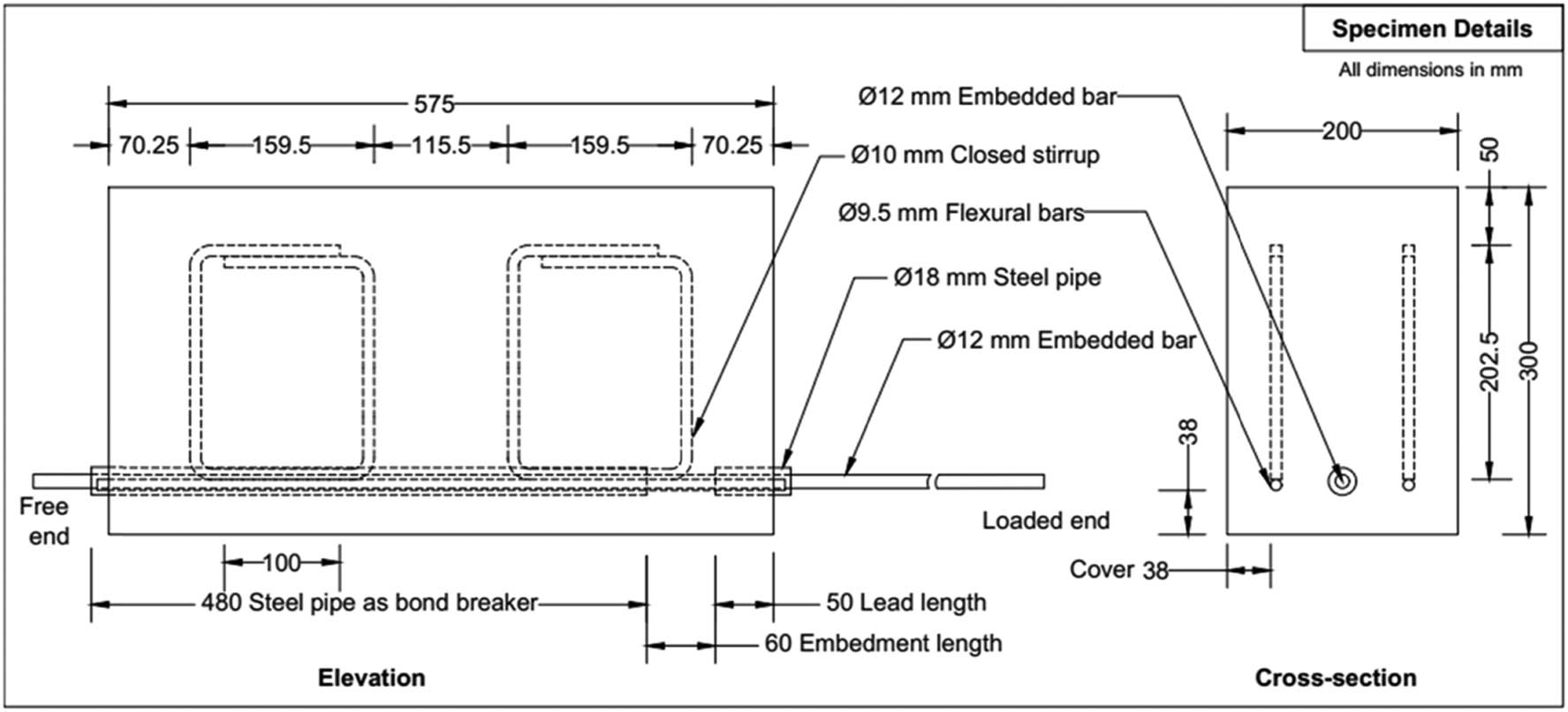
Figure 2
Beam-end test specimen details (all dimensions are in mm).
A total of 24 beam-end specimens were cast and tested in an attempt to examine the bond performance of BFRP rebars after exposure to elevated temperature and compare their behavior with the bond of steel rebars. The test parameters were: (i) type of rebars (steel and BFRP), (ii) type of concrete (PC and FRC), (iii) exposure temperature (Ambient temperature, 100°C, and 200°C). The specimens were tested in replicates. Table 2 depicts the test matrix. The designation of specimens can be described as follows: PC refers to plain concrete; FRC refers to steel fiber-reinforcement concrete; SB means steel rebar; BB means basalt rebar; and exposure temperature in °C (A means ambient) is at the end of the specimen ID after dash. For example, the designation PCSB-200 indicates steel rebar embedded in PC and tested after exposure to 200°C temperature.
Table 2
Test matrix.
| S. No. | Specimen ID | Volume fraction of steel fibers | Type of test rebar | Diameter of rebar (mm) | Exposure temperature | No. of test specimens |
| 1 | PCSB-A | 0 | Steel | 12 | Ambient temperature | 2 |
| 2 | PCSB-100 | 0 | Steel | 12 | 100°C | 2 |
| 3 | PCSB-200 | 0 | Steel | 12 | 200°C | 2 |
| 4 | FRCSB-A | 1% | Steel | 12 | Ambient temperature | 2 |
| 5 | FRCSB-100 | 1% | Steel | 12 | 100°C | 2 |
| 6 | FRCSB-200 | 1% | Steel | 12 | 200°C | 2 |
| 7 | PCBB-A | 0 | BFRP | 12 | Ambient temperature | 2 |
| 8 | PCBB-100 | 0 | BFRP | 12 | 100°C | 2 |
| 9 | PCBB-200 | 0 | BFRP | 12 | 200°C | 2 |
| 10 | FRCBB-A | 1% | BFRP | 12 | Ambient temperature | 2 |
| 11 | FRCBB-100 | 1% | BFRP | 12 | 100°C | 2 |
| 12 | FRCBB-200 | 1% | BFRP | 12 | 200°C | 2 |
| Total = 24 | ||||||
The specimens were demolded after 7 days and cured under laboratory conditions (70% RH, 25°C) for 28 days. Heating was performed in a dry electric oven at a ramp rate of 30°C/h up to the target temperature, followed by a 3 h soak period. Specimens were then cooled gradually inside the switched-off oven and subsequently in ambient laboratory conditions until room temperature was reached, after which testing was conducted. No pre-drying treatment was applied before heating. The temperature–time curve followed in the heating program is depicted in Figure 3. To prevent degradation of the resin matrix, which could cause difficulties in bar gripping during pull-off testing, the exposed BFRP rebar was insulated prior to heating using a steel tube packed with mineral wool, effective up to 850°C. In contrast, no insulation was required for steel rebar specimens, as the bars retained their integrity after cooling.
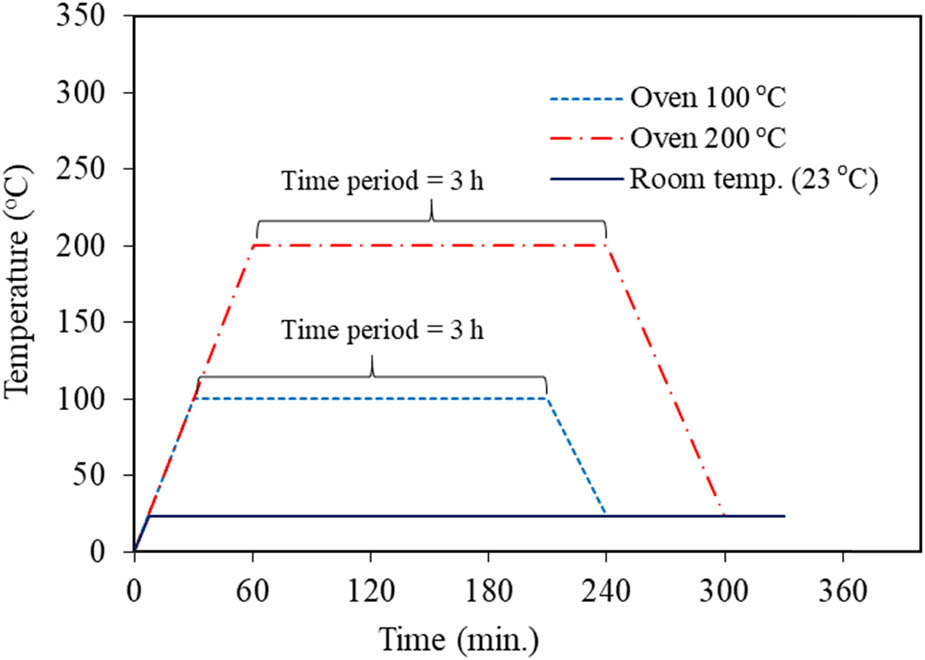
Figure 3
Temperature–time variation followed in heating and cooling.
2.3. Test setup
The test set up was developed and fabricated in accordance with ASTM A944–15 [27] (Figure 4). The loading was applied using a servo-controlled hydraulic jack under force-control mode at a rate of 0.1 kN/s until failure. The system was operated through a closed-loop digital controller. Data acquisition was performed at a sampling rate of 10 Hz. Two linear variable differential transformers (LVDTs) were installed at both loaded and free ends of the specimen to record the end slips. Prior to testing, both the LVDTs and the loading system were calibrated following the manufacturer’s procedures. The alignment of the specimen was checked before each test to minimize eccentricity. System compliance was verified to be negligible compared with the specimen deformation and was therefore not corrected. The tensile force and the resulting displacement at both ends of the rebar were recorded using a load cell and LVDTs. The BFRP rebar being soft, special grip was prepared by inserting the rebar in epoxy filled steel tube. Aluminum caps were fixed at the two ends of the tube to maintain uniform around the BFRP rebar.
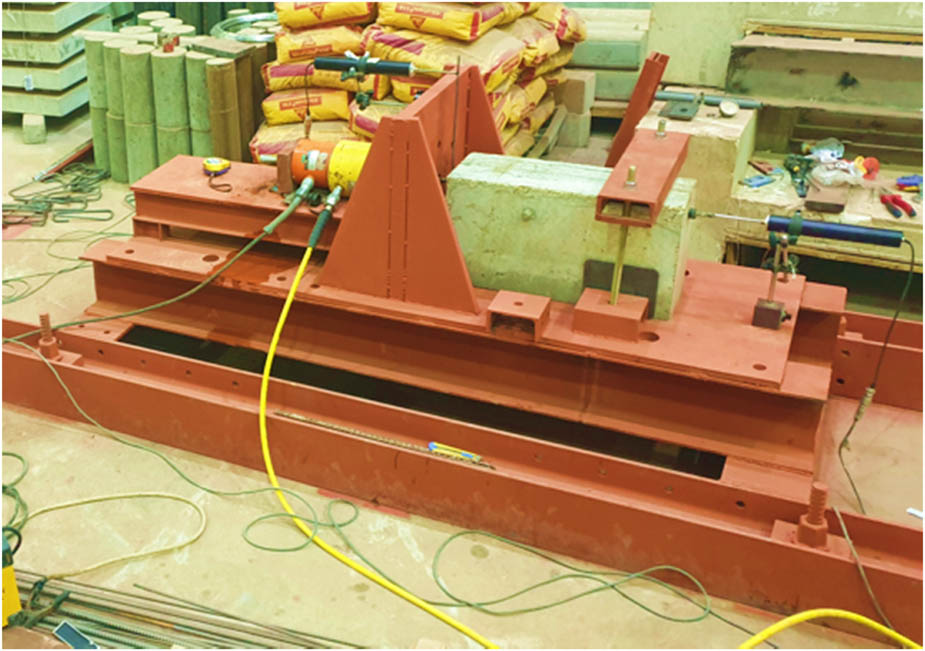
Figure 4
Setup for testing beam end specimens.
3. Results and discussion
The average bond stress of steel and BFRP rebars, , was determined from the test results using
where is the peak tension load, is the rebar diameter, and is the bonded length of rebar. The rebar slip at free end was obtained directly from the attached LVDT at the unloaded end. However, the net slip at loaded end was calculated by deducting the increase in rebar length from the total displacement recorded by LVDT at that end, (i.e., slip at loaded end = recorded slip at loaded end – increase in rebar length).The study results of beam end test contain average values (along with standard deviation) of bond strength, slip at free end, slip at ultimate load, residual bond strength, and the type of failure mode, which are reported in Table 3.
Table 3
Summary of study results.
| Specimen ID | Peak force (kN) | Average bond strength (MPa) | Slip at peak load (mm) | Residual bond stress (MPa) | Failure mode* |
|---|---|---|---|---|---|
| PCSB-A | 43.9 ± 2.40 | 19.3 ± 1.05 | 2.895 ± 0.12 | 2.9 ± 0.14 | P & S |
| PCSB-100 | 42.8 ± 2.91 | 18.9 ± 1.29 | 3.200 ± 0.13 | 2.3 ± 0.16 | P & S |
| PCSB-200 | 32.5 ± 1.84 | 14.4 ± 0.81 | 3.445 ± 0.15 | 7.9 ± 0.54 | P & S |
| FRCSB-A | 40.4 ± 2.51 | 17.9 ± 1.11 | 1.540 ± 0.1 | 3.6 ± 0.28 | P |
| FRCSB-100 | 39.3 ± 3.10 | 17.4 ± 1.37 | 1.615 ± 0.12 | 4.4 ± 0.28 | P |
| FRCSB-200 | 32.9 ± 2.37 | 14.5 ± 1.05 | 2.835 ± 0.24 | 4.4 ± 0.35 | P |
| PCBB-A | 37.5 ± 1.58 | 16.6 ± 0.7 | 1.955 ± 0.09 | 5.0 ± 0.28 | P & S |
| PCBB-100 | 41.7 ± 2.42 | 18.4 ± 1.07 | 2.735 ± 0.15 | 1.8 ± 0.13 | P & S |
| PCBB-200 | 40.7 ± 2.46 | 18.0 ± 1.09 | 2.865 ± 0.19 | 3.2 ± 0.28 | P & S |
| FRCBB-A | 32.9 ± 2.13 | 14.5 ± 0.94 | 1.630 ± 0.08 | 3.6 ± 0.25 | P |
| FRCBB-100 | 40.7 ± 3.34 | 18.0 ± 1.48 | 2.295 ± 0.12 | 8.7 ± 0.64 | P |
| FRCBB-200 | 38.5 ± 3.02 | 17.0 ± 1.34 | 1.935 ± 0.13 | 9.5 ± 0.78 | P & S |
3.1. Failure patterns
The failure modes of test specimens having rebars embedded in PC and FRC are depicted in Figure 5. In PC, the failure mode was rebar pullout accompanied with small cracks in concrete cover. Post peak the cracks began to propagate and expand in concrete cover until the rebar was totally pulled out. For specimens tested at ambient temperature, the failure steel rebar embedded in PC exhibited more brittle behavior after peak load than the BFRP rebar. This is because the bond of BFRP rebar mainly depends on the friction between rebar surface (which was full of sand grains) and the surrounding concrete. The specimens of BFRP rebar did not exhibit sudden failure and the rebar continued taking load gradually after reaching peak for some time before the final failure. After exposure to elevated temperatures, BFRP rebars experienced sudden failure just after reaching peak load. This was because bond between sand grains and rebar epoxy resin got damaged due to the heating. The epoxy was softened and the sand grains got detached from the surface under the action of tensile load. As a result, the rebar was pulled out from specimen just after peak load.
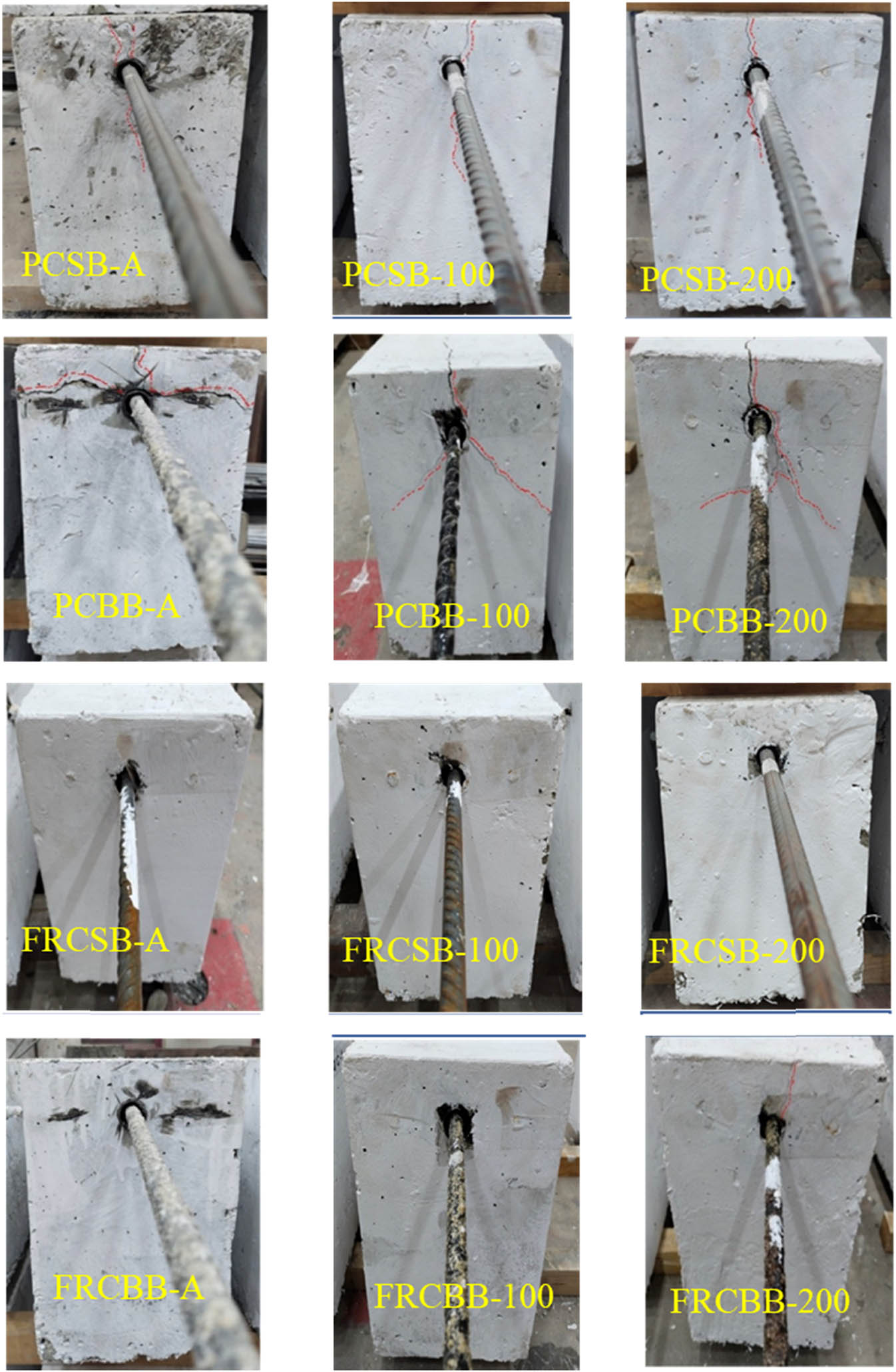
Figure 5
Failure modes of rebars embedded in PC and FRC.
In case of FRC, both steel and BFRP rebars experienced pullout failure at ambient and elevated temperatures. However, specimens of BFRP rebar at 200°C experienced very small cracks in concrete cover before the rebar was totally pulled out. After reaching peak load, the rebars continued taking load gradually for some time before final failure. This was because of the inclusion of fibers in concrete matrix helped in arresting concrete cracks and led to this type of failure, which conforms to the findings reported in previous literature [30,31]. Moreover, the fibers distributed around the rebar also tried to hold it from sudden pull out during the test and this probably caused it to fail in such ductile manner after reaching peak load. The difference between the failure modes of steel and BFRP rebars in case of FRC is that the steel rebar was totally pulled out earlier than BFRP rebar and this is because of the sand grains on the rebar surface, which interact with steel fibers and concrete around the rebar and enhanced the friction-resistant between them.
3.2. Effect of elevated temperature on bond strength of rebars
The bond strength of BFRP rebars after heating to different temperatures is compared with steel bars in Figure 6(a and b). The error bars are also shown in Figure 6. For rebars embedded in PC, the experimental results showed a degradation in bond of steel rebar when specimens were exposed to 200°C. However, steel rebar experienced almost no change in bond strength after exposure to 100°C, as compared to ambient temperature. The bond strength of steel bars decreased by 1.9% and 25.4%, respectively, for specimens tested after exposure to 100°C and 200°C. This was due to the decrease in compressive as well as the tensile strengths of concrete after heating. On the other hand, the bond strength of BFRP rebar increased by 10.9% and 8.4%, respectively, when exposed to 100°C and 200°C. This enhancement in bond strength of BFRP bars and surrounding concrete might be due to the swelling of rebar epoxy, which probably filled some voids around the rebar; in addition to concrete shrinkage after heating [31], which results in a radial stress between rebar and concrete. The bond strength enhancement due to the swelling of BFRP rebars has also been reported by Heshmat et al. [32]. As a consequence, the friction resistance component of bond enhanced and led to more enhancement in bond strength after exposure to elevated temperature. Mechanistic interpretations regarding the influence of epoxy swelling, concrete shrinkage, and fiber reinforcement on bond behavior are plausible but not directly evidenced by microstructural characterization. The explanations are based on prior literature and observed macroscopic behavior. Further studies are recommended to provide direct microstructural validation using scanning electron microscope imaging, differential scanning calorimetry, and thermogravimetric analyses. Furthermore, BFRP rebars performed better than steel rebars at 200°C. The bond strength of BFRP rebars increased by 25.2% (Figure 6(a)), as compared to steel rebar, and this is because of the expansion of bar epoxy and concrete shrinkage. However, at ambient and 100°C, steel rebars performed better than BFRP bars as the bond strength of BFRP bars decreased by 13.8% and 2.5%, respectively, as compared to steel rebars (Figure 6(a)). This can be attributed to the differences between the rebar properties and bond mechanism of the two rebars and how they resist bond stresses at ambient and low levels of temperature.
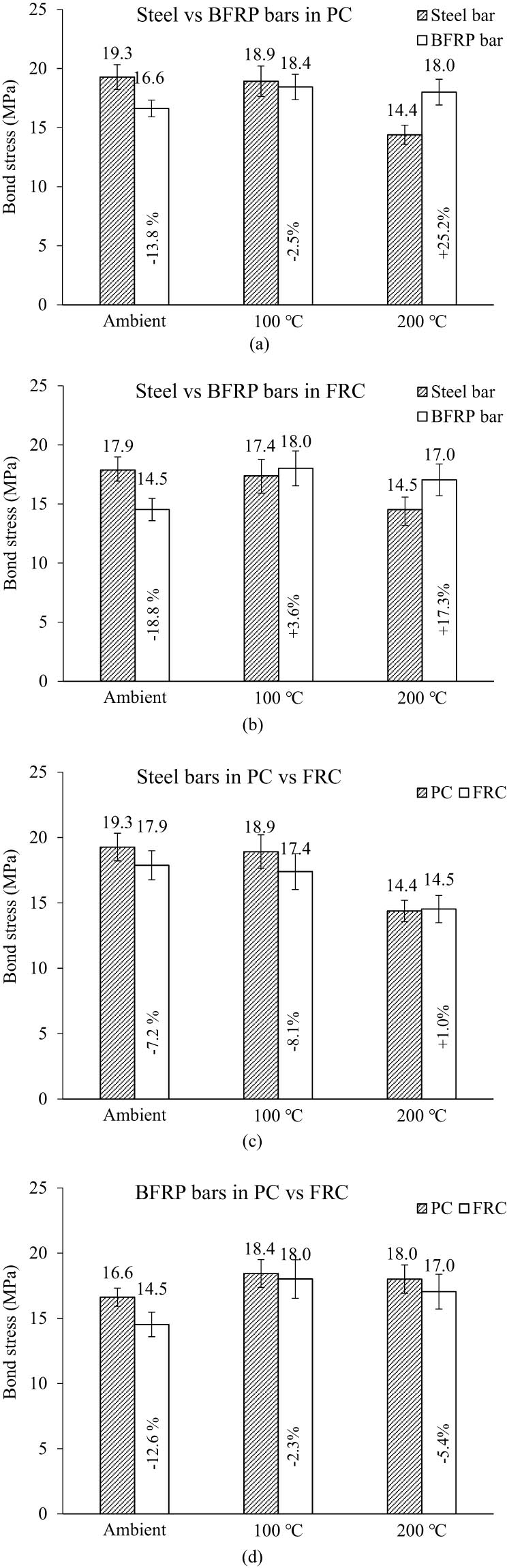
Figure 6
Comparison of bond strength of rebars embedded in PC and FRC after exposure to different temperatures: (a) steel vs BFRP bars in PC; (b) steel vs BFRP bars in FRC; (c) steel bars in PC vs FRC; and (d) BFRP bars in PC vs FRC.
For rebars embedded in FRC, the results showed a degradation in bond of steel rebars after heating to 200°C. However, the rebar experienced almost no change in bond strength when the specimens were heated to 100°C. The bond strength of steel bar with FRC after heating to 100°C and 200°C was reduced by 2.7% and 18.8%, respectively. This could be due to the decrease in the concrete strength after heating. Additionally, the damage caused to the interface of concrete with steel fibers also contributed to the decrease in bond strength. On the other hand, a substantial increase in bond strength of BFRP rebars in FRC was recorded when heated to the same level of temperature. The bond strength was enhanced by 24.0% and 17.3%, respectively, after exposure to 100°C and 200°C. This increase in bond strength of BFRP rebars could be because of the expansion of bar epoxy and concrete shrinkage, which helped in forming better bond in the presence of steel fibers at elevated temperature. Although the bond strength of BFRP bars as compared to the steel bars was 18.8% lower at ambient temperature, it became at par (3.6% higher) after exposure to 100°C temperature (Figure 6(b)). However, BFRP rebar embedded in FRC performed better than steel rebars in terms of bond strength at 200°C, as the gain in strength on exposure to the elevated temperature was much higher than the loss in bond strength at ambient temperature resulting in 17.3% higher bond strength of BFRP rebars.
Under the present boundary conditions, the average bond index of BFRP bars at 200°C was comparable to, or marginally higher than, that of steel. Because n = 2 per condition and no formal statistical inference was performed, differences are interpreted as trends.
3.3. Influence of incorporating fibers in concrete on bond strength of rebars
Figure 6(c and d) compares the bond strength of rebars embedded in FRC with that of PC after heating. At ambient temperature, the bond strength of both steel and BFRP rebars reduced when steel fibers were incorporated into the concrete matrix. The bond strength of steel bars with FRC decreased by 7.2% as compared to PC (Figure 6(c)). For BFRP rebar, the bond strength also decreased by 12.6% in FRC as compared to PC (Figure 6(d)). The decrease in bond strength of bars in FRC could be because of the random distribution of fibers in the matrix which minimized the interfacial contact between rebars and surrounding concrete and left some gaps around the rebar surface not filled by concrete. A comparison of the two rebar types shows that steel rebar performed better than BFRP rebar at ambient conditions.
After exposure to 100°C, the test results show a decrease in bond strength of BFRP as well as steel rebars when fibers were incorporated into concrete. This could be due to the joint effect of elevated temperature and fibers added into the matrix, which resulted in lowering bond strength of bars. The bond strength of steel and BFRP bars embedded in FRC decreased by 8.1% and 2.3%, respectively (Figure 6(c and d)). Although the bond strength of steel rebars with FRC at ambient temperature was 7.2% less than steel rebars embedded in PC, it became at par with PC after exposure to 200°C (Figure 6(c and d)). However, the bond strength of BFRP bars embedded in FRC is 5.4% lower than PC after exposure to 200°C (Figure 6(d)).
3.4. Effect of elevated temperature on bond stress–slip curves
Bond stress–slip curves were drawn for slip at both ends but the two curves were almost identical. However, the bond stress–slip curves at free end, plotted in Figure 7, are used in the discussion of test results. In PC, although the exposure to elevated temperature resulted in increase in bond strength of BFRP rebars, post-peak decrease is steeper as compared to ambient temperature. Moreover, the slope of initial micro-slippage segment (i.e., initial stiffness) is slightly reduced and the slip corresponding to peak load increased because of heating. This is because the rebar epoxy exhibited some damage after specimens being heated for temperature greater than the T g of epoxy, which is approximately 100°C, as reported by Liang et al. [24]. Furthermore, the descending branch of bond stress–slip curve of BFRP rebars experienced sudden drop and the slope of this portion of the curve increased with elevated temperature increase. Since the bond stress at this stage was mainly governed by friction between rebar surface and surrounding concrete, this can be attributed to the sand grains glued on rebar surface, which experienced partial detachment from epoxy during heating phase and led to such sudden failure after peak load. On the other hand, the influence of elevated temperature on bond behavior of steel bar embedded in PC is quite different, as shown in Figure 7. At ambient temperature and 100°C, steel rebar showed almost the same performance in respect of bond strength, initial stiffness, and slip at peak load. However, the initial stiffness exhibited significant decrease at 200°C, as compared to ambient. Thus, the slip at the peak load experienced substantial increase. This could be due to the loss of concrete strength after heating. At ambient temperature, BFRP rebar showed better performance than steel rebar because of the initial stiffness, slip at peak load, and the avoidance of the sharp post-peak drop in bond stress. At 100°C, both steel and BFRP rebars behaved almost in same way in terms of initial stiffness, bond strength, and slip at peak load. However, the initial stiffness of BFRP rebars and bond strength were more than steel rebars and slip corresponding to the peak bond stress decreased after exposure to 200°C.
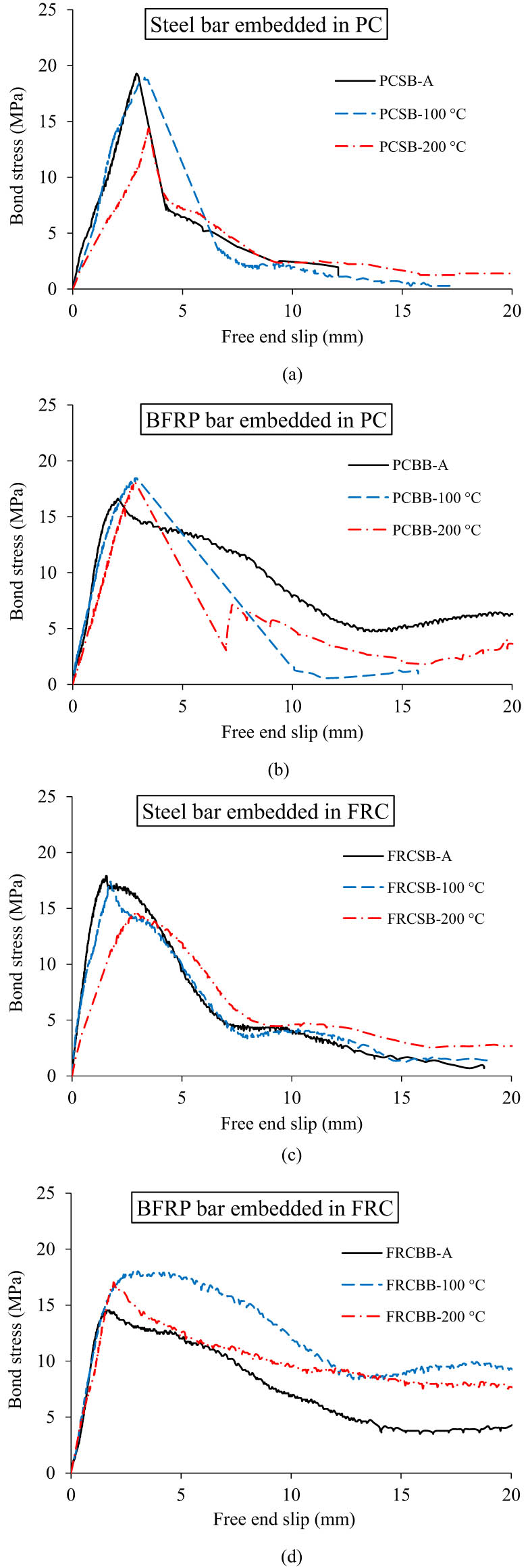
Figure 7
Bond stress–slip curves of steel and BFRP rebars embedded in PC and FRC after exposure to different temperatures: (a) steel bar embedded in PC; (b) BFRP bar embedded in PC; (c) steel bar embedded in FRC; and (d) BFRP bar embedded in FRC.
As seen from Figure 7, the presence of steel fibers in FRC enhanced the bond performance of BFRP rebar after exposure to elevated temperature. The bond strength did not experience sudden drop after peak load as in PC, instead, the bond stress continued to decrease gradually until the rebar was pulled out. The bond mechanism after the inclusion of steel fibers into concrete matrix could now be governed by adhesion, friction (sand grains), and mechanical interlock (indentations), and the interaction between rebar and surrounding steel fibers. The bond performance of BFRP rebars embedded in FRC after exposure to elevated temperature enhanced only in terms of the bond strength. However, slip corresponding to peak load increased and the slope of descending part of the curves exhibited minor decrease. Furthermore, the initial stiffness was observed to be not influenced by elevated temperature as seen in PC. This shows that the presence of steel fibers in concrete matrix enhanced the concrete’s tensile strength and prevented the development of cracks in concrete before the peak load. In case of steel bar embedded in FRC, the results showed a substantial influence of heating on bond behavior of the rebars, especially after exposure to 200°C. The initial stiffness and bond strength of rebars decreased with elevated temperature increase, and as a result, the slip at peak load increased. It is also observed that the behavior of steel rebar after peak was almost the same at ambient and elevated temperatures. When steel fibers were present in concrete, BFRP rebar showed better performance than steel rebars after exposure to elevated temperature in terms of bond strength, initial stiffness, post-peak behavior, and slip at ultimate load. The BFRP rebars experienced gradual decrease in bond stress until the rebar was totally pulled out, whereas steel rebars failed at smaller slip. At ambient temperature, steel rebars performed better in terms of only the bond strength and then experienced relatively sudden drop in bond stress, as compared to BFRP rebars.
As the compressive strength and elastic modulus of PC and FRC were not affected by exposure to elevated temperature considered in this study, the reported changes in bond behavior are attributed primarily to rebar and interface effects rather than degradation of concrete mechanical properties.
The observed failure patterns of steel and BFRP rebars in PC and FRC at ambient and elevated temperatures generally correspond to the shapes of the bond stress–slip curves, including initial stiffness, peak slip, and post-peak behavior. While individual specimens exhibited variability, these qualitative trends provide insight into the interplay between bond mechanics and failure progression under different conditions.
4. Bond stress–slip constitutive model
In order to assess the recorded bond stress–slip curves, the mBPE model proposed by Cosenza et al. [33] is employed. The model encompasses three parts. The first ascending part of the curve represents the initial micro-slippage segment, which is modeled as a power function with the shape controlled by an exponent . In this part, the bond stress increases up to the maximum bond stress (i.e., bond strength), , at a slip of . The second descending part of the model is linear of negative slope . The third part of the model represents the constant residual bond stress, . The model is given by equation (2)
Assuming the ratio of the residual bond stress to the bond strength as r, the residual bond stress is given by . The model parameters , , determined from regression analysis of the experimental data (using excel spreadsheet and trend lines) are given in Table 4. It is seen from the values presented in the table that is increasing almost linearly with elevated temperature for both rebars embedded in PC or FRC. The values of related to steel rebars were greater than that of BFRP rebars embedded in PC and lower in case of FRC. The results also showed that the slip at peak load is increasing almost linearly with elevated temperature for both types of concrete. The slip corresponding to peak load for steel rebars is greater than the slip of BFRP rebars only in case of PC, while in FRC, the slip of the two rebar types was close to each other only at 100°C. Furthermore, the parameter for BFRP rebars embedded in PC as well as FRC is proportional to the elevated temperature. The values of are increasing with temperature for PC, whereas, values of exhibited almost no change in case of FRC. On the other hand, the parameter related to steel rebar varies nonlinearly with elevated temperature for PC and FRC. Moreover, values of related to steel rebars are greater than that of BFRP rebars in all types of concrete. It is also observed that the factor related to residual bond stress r is found to change linearly with elevated temperature for both concrete types and rebar types. For BFRP rebars, the residual bond stress factor, r, increased with elevated temperature for PC as well as FRC. However, the residual bond stress factor related to steel rebars increased with elevated temperature for both types of concrete.
Table 4
mBPE model parameters obtained by curve fitting.
| Concrete type | Rebar type | Exposure temperature | Model parameters | |||
|---|---|---|---|---|---|---|
| s max | ||||||
| PC | Steel rebar | Ambient temperature | 0.88 | 1.500 | 0.15 | 2.895 |
| 100°C | 0.91 | 0.750 | 0.12 | 3.200 | ||
| 200°C | 0.96 | 2.300 | 0.55 | 3.445 | ||
| BFRP rebar | Ambient temperature | 0.69 | 0.124 | 0.300 | 1.955 | |
| 100°C | 0.72 | 0.340 | 0.100 | 2.735 | ||
| 200°C | 0.85 | 0.550 | 0.18 | 2.865 | ||
| FRC | Steel rebar | Ambient temperature | 0.55 | 0.190 | 0.20 | 1.540 |
| 100°C | 0.62 | 0.205 | 0.25 | 1.615 | ||
| 200°C | 0.72 | 0.380 | 0.30 | 2.835 | ||
| BFRP rebar | Ambient temperature | 0.70 | 0.100 | 0.25 | 1.630 | |
| 100°C | 0.72 | 0.110 | 0.48 | 2.295 | ||
| 200°C | 0.88 | 0.105 | 0.56 | 1.935 | ||
The modified mBPE model adopted in this study extends the original formulation by Cosenza et al. through the incorporation of temperature-dependent laws for the parameters α, ρ, r, and sₘₐₓ. This enhancement enables the model to capture the effects of elevated temperatures on the bond behavior of both steel and BFRP rebars embedded in PC and FRC matrices. Linear or quadratic expressions were selected for each parameter based on observed experimental trends. The bond stress–slip parameters as a function of the exposure temperature, T, are given in Table 5. The goodness-of-fit values (R 2) for each parameter are summarized in Table 5. A comparison of the predicted bond stress vs slip curves using these parameters are shown in Figures 8 and 9, with corresponding R 2 values, for rebars embedded in PC and FRC, respectively. The predictions of the model align well with the test outcomes.
Table 5
Equations of bond model parameters as a function of exposure temperature.
| Embedded in PC* | Embedded in FRC* |
|---|---|
| Steel rebars | |
| (R 2 = 0.99) | (R 2 = 0.99) |
| (R 2 = 1.00) | (R 2 = 1.00) |
| (R 2 = 0.98) | (R 2 = 0.86) |
| (R 2 = 0.99) | (R 2 = 0.99) |
| BFRP rebars | |
| (R 2 = 0.93) | (R 2 = 0.89) |
| (R 2 = 0.99) | (R 2 = 1.00) |
| (R 2 = 0.79) | (R 2 = 0.95) |
| (R 2 = 0.88) | (R 2 = 0.88) |
*For quadratic models, R 2 is unity, as there are only three points.
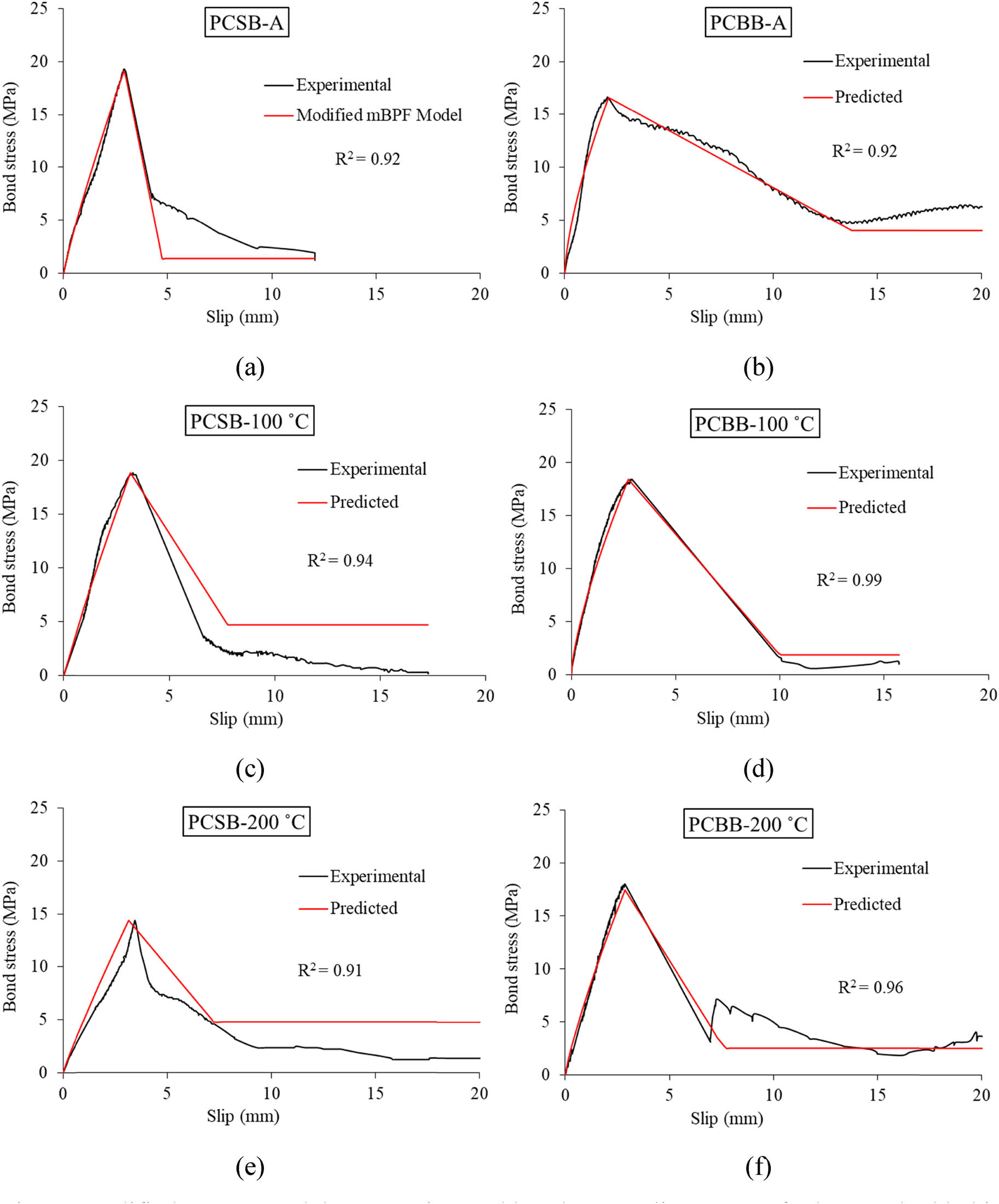
Figure 8
Modified mBPE model vs experimental bond stress–slip curves of rebars embedded in PC at ambient and elevated temperatures: (a, c, and e) steel rebars exposed to ambient temperature, 100°C, and 200°C; and (b, d, and f) BFRP rebars exposed to ambient temperature, 100°C, and 200°C.
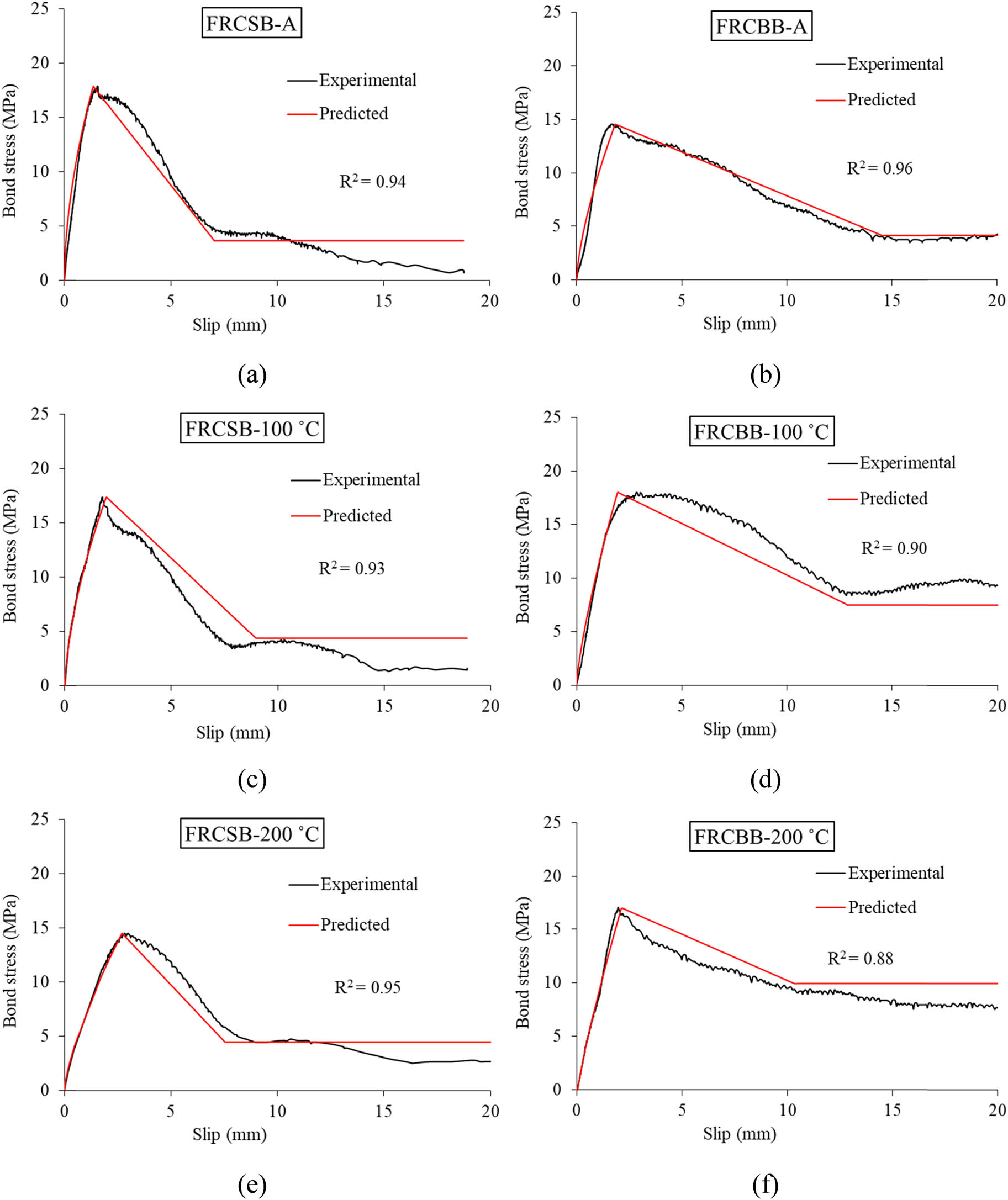
Figure 9
Modified mBPE model vs experimental bond stress–slip curves of rebars embedded in FRC at ambient and elevated temperatures: (a, c, and e) steel rebars exposed to ambient temperature, 100°C, and 200°C; and (b, d, and f) BFRP rebars exposed to ambient temperature, 100°C, and 200°C.
5. Comparison with codes and researchers’ models
In this section, the bond strength of steel and BFRP bars embedded in PC and FRC was calculated using available models from different codes and researchers. The predicted bond strength was then compared with the test outcome, as discussed in Sections 5.1 and 5.2.
5.1. Steel rebars embedded in PC and FRC
Table 6 summarizes the models of different codes and researchers, available in the accessible literature, for computing the bond strength of steel rebars embedded in concrete. The codes listed in Table 6 included the ACI 408R-03 [26], the CEB-FIP Model Code [34], and the CEB-FIP Model Code [35]; whereas, the researchers’ models depicted in Table 6 involved Huang [36] and Lublóy and György [37]. The bond strength models of the three codes are for the ambient temperature condition; yet, for bond strength of steel rebars exposed to elevated temperature environment, codified models are not available. However, both Huang [36] and Lublóy and György [37] developed bond strength models for steel rebars exposed to elevated and ambient temperatures. It should also be noted that bond strength models of steel bars embedded in FRC under ambient and elevated temperatures exposure could not be found in the accessible literature. Therefore, the models listed in Table 6 were used for both PC and FRC, and the only difference is the value of compressive strength for both concretes. It is also worth stating that in the ACI 408R-03 [26] model listed in Table 6, the upper limit of bond strength (= 5.52 MPa) set by the code was ignored in this study. For both the CEB-FIP Model Codes, the case of good bond condition for unconfined concrete was assumed. For the ambient temperature condition, Huang [36] used the CEB-FIP Model Code’s formula [35], while Lublóy and György [37] used the formula of CEB-FIP Model Code [34], as seen in Table 6.
Table 6
Codes and researchers’ models for bond strength of steel rebars embedded in concrete*.
| Code/Researcher | Model for ambient temperature | Model for elevated temperature |
|---|---|---|
| ACI 408R-03 [26] | NA | |
| CEB-FIP Model Code [34] | NA | |
| CEB-FIP Model Code [35] | NA | |
| Huang [36] | ||
| Lublóy and György [37] |
* = bond strength at room temperature (MPa); = specified compressive strength of concrete (MPa); = diameter of rebar (mm); = bond strength at elevated temperature (MPa); T = exposure temperature (°C); NA = not available model.
Table 7 presents the bond strength predicted by the three codes for the two specimens tested at ambinet temperature (PCSB-A and FRCSB-A). It also shows the bond strength assessed by the two researchers’ models for the six specimens tested at different temperatures exposure. The predicted bond strength was then compared with the test outcomes, as shown in Table 7. Comparison between the predicted-to-tested bond strength ratio () of the test samples are depicted in Figure 10(a) and (b) for steel rebars embedded in PC and FRC, respectively. It is identified from Table 7 and Figure 10 that the three codes conservatively predicted bond strength of steel bars embedded in either PC or FRC at ambient temperature condition. Among the three codes, the most conservative prediction was given by the ACI 408R-03 [26]; however, the least conservative assessment was provided by the CEB-FIP Model Code [35]. Also, the three codes predicted the bond strength for FRC more accurately than PC. For both PC and FRC, the model of Huang [36] was conservative for all range of studied temperature. For this model, the predicted-to-experimental bond strength ratio varied from 65% to 80% and from 74% to 83% for cases of PC and FRC, respectively. For both PC and FRC, the model of Lublóy and György [37] was conservative for exposure to ambient temperature and 100°C; nevertheless, it overpredicted the bond strength for exposure to a temperature of 200°C, as seen in Table 7 and Figure 10. Therefore, it is recommended in this study to use the model developed by Huang [36] for assessment of bond strength of steel bars embedded in either PC or FRC and subjected to elevated temperature environment not exceeding 200°C. For temperature exposure more than 200°C, experimental research is needed for validating the available researchers’ models.
Table 7
Prediction of bond strength of steel rebars using codes and researchers’ models*.
| Specimen ID | Bond strength model | |||||||||
|---|---|---|---|---|---|---|---|---|---|---|
| ACI 408R-03 [26] | CEB-FIP model code [34] | CEB-FIP model code [35] | Huang [36] | Lublóy & György [37] | ||||||
| (MPa) | (MPa) | (MPa) | (MPa) | (MPa) | ||||||
| PCSB-A | 10.80 | 0.56 | 12.96 | 0.67 | 16.20 | 0.84 | 12.96 | 0.67 | 16.20 | 0.84 |
| PCSB-100 | NA | — | NA | — | NA | — | 12.33 | 0.65 | 16.20 | 0.86 |
| PCSB-200 | NA | — | NA | — | NA | — | 11.54 | 0.80 | 16.20 | 1.13 |
| FRCSB-A | 11.3 | 0.63 | 13.56 | 0.76 | 16.96 | 0.95 | 13.56 | 0.76 | 16.96 | 0.95 |
| FRCSB-100 | NA | — | NA | — | NA | — | 12.90 | 0.74 | 16.96 | 0.97 |
| FRCSB-200 | NA | — | NA | — | NA | — | 12.07 | 0.83 | 16.96 | 1.17 |
* = predicted bond strength; = experimental bond strength; NA = not available results.
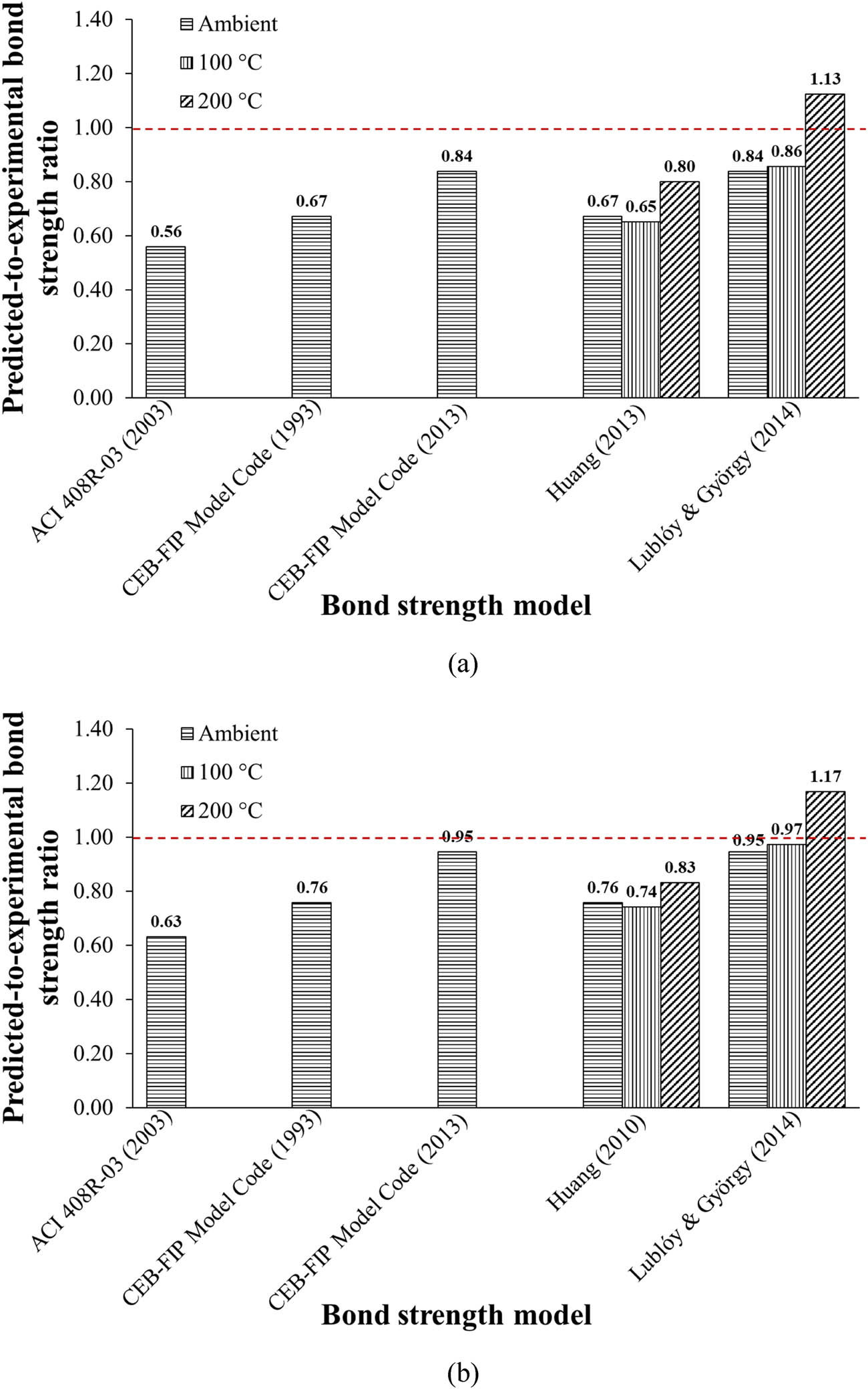
Figure 10
Comparison of predicted and experimental bond strength for: (a) steel rebars embedded in PC and (b) steel rebars embedded in FRC.
5.2. BFRP rebars embedded in PC and FRC
Table 8 summarizes the models of various codes and researchers, available in the accessible literature, for assessing the bond strength of BFRP rebars embedded in concrete. The codes listed in Table 8 included ACI 440.1R-15 [8], the CAN/CSA-S6-14 [11], and the JSCE recommendation [38]; while, the researchers’ models presented in Table 8 involved the two models developed by El-Gamal [39] and the one proposed by Özkal et al. [40]. It is important noting here that the models given in Table 8 are, in general, for bond strength of FRP rebars embedded in concrete, and in this study, they were assumed to be applicable to BFRP rebars. It should be noted that the bond strength models of the three codes are for the ambient temperature condition; nevertheless, for BFRP rebars exposed to elevated temperature environment, codified models are not available. However, both El-Gamal [39] and Özkal et al. [40] developed bond strength models for FRP rebars under ambient and elevated temperature exposure. It should also be noted that bond strength models of BFRP rebars embedded in FRC under ambient and elevated temperature exposure could not be found in the accessible literature. Therefore, the models listed in Table 8 were used for both PC and FRC, and the only difference is the value of compressive strength for both concretes. It is also worth stating here that in the equations listed in Table 8 for both CAN/CSA-S6-14 [11] and JSCE Recommendation [38], the transverse reinforcement effect was ignored, and the concrete was considered unconfined. For the ambient temperature condition, Models (1) and (2) of El-Gamal [39] employed, respectively, the same equations as the ACI 408R-03 [26] and the CEB-FIP Model Code [35] for steel rebars. However, at ambient temperature condition, Özkal et al. [40] utilized the same model as the ACI 440.1R-15 [8] for FRP rebars (Table 8).
Table 8
Codes and researchers’ models for bond strength of BFRP bars embedded in concrete*.
| Code/Researcher | Model for ambient temperature | Model for elevated temperature |
|---|---|---|
| ACI 440.1R-15 [8] | NA | |
| CAN/CSA-S6-14 [11] | NA | |
| JSCE [38] | NA | |
| Model (1) – El-Gamal [39] | ||
| Model (2) – El-Gamal [39] | ||
| Özkal et al. [40] |
* = bond strength at ambient temperature (MPa); = specified compressive strength of concrete (MPa); C = smaller of the cover to the center of the BFRP rebar or 1.5 times of the center-to-center spacing of the rebars (mm) (= 44 mm used in this study); c = = diameter of rebar (mm) (= 12 mm used in this study); = embedment length of BFRP rebars (mm) (= 60 mm used in this study); d cs = smaller of distance from the closest concrete surface to the center of the BFRP rebars and 2/3 of the center-to-center spacing of the BFRP rebars (mm) (= 44 mm used in this study); k 1 = rebar location factor = 1.0; k 4 = rebar surface factor = 0.8; c = smaller of concrete cover to the BFRP rebar and 1.5 times of the rebar spacing (mm) (= 38 mm used in this study); f fu = tensile strength of BFRP rebars (MPa); = bond strength at elevated temperature (MPa); ΔT = difference between exposure temperature (T) and ambient temperature (20°C); t = exposure duration in hours (= 3 h used in this study); = bond strength of BFRP rebar at room temperature (MPa); = bond strength of steel rebar at room temperature (MPa); T = exposure temperature (°C); NA = not available model.
Table 9 lists the bond strength predicted by the three codes for the two specimens tested at ambient temperature (PCBB-A and FRCBB-A). It also presents the bond strength computed by the researchers’ models for the six specimens tested at different temperatures exposure. The predicted bond strength was then compared with the test results, as shown in Table 9. Comparison between the predicted-to-experimental bond strength ratio () of the test samples are depicted in Figure 11(a) and (b) for BFRP rebars embedded in PC and FRC, respectively. It is identified from Table 9 and Figure 11 that the three codes conservatively predicted the bond strength of BFRP rebars embedded in either PC or FRC at ambient temperature condition. Among the three investigated codes, the most conservative prediction was given by the JSCE model [38]; however, the least conservative assessment was provided by the ACI 440.1R-15 [8]. Also, the three codes predicted the bond strength for FRC more accurately than PC. For both PC and FRC, both Model (1) of El-Gamal [39] and Özkal et al. [40] were conservative for all range of studied temperature, and for both models, the predicted-to-tested bond strength ratio reduced as the exposure temperature increased. As shown in Table 9 and Figure 11, the model of Özkal et al. [40] predicted the bond strength more accurately than Model (1) of El-Gamal [39]. Table 9 and Figure 11 identify that Model (2) of El-Gamal [39] is non-conservative for BFRP rebars embedded in FRC and tested at ambient temperature condition; however, it is conservative for all other cases. In conclusion, it is recommended to use the model proposed by Özkal et al. [40] for assessment of bond strength of BFRP rebars embedded in either PC or FRC and subjected to elevated temperature environment not exceeding 200°C. For temperature exposure more than 200°C, experimental research is needed for validating the available researchers’ models.
Table 9
Prediction of bond strength of BFRP rebars using codes and researchers’ models.
| Specimen ID | Bond strength model | |||||||||||
|---|---|---|---|---|---|---|---|---|---|---|---|---|
| ACI 440.1R-15 [8] | CAN/CSA-S6-14 [11] | JSCE [38] | Model (1) – El-Gamal [39] | Model (2) – El-Gamal [39] | Özkal et al. [40] | |||||||
| (MPa) | (MPa) | (MPa) | (MPa) | (MPa) | (MPa) | |||||||
| PCBB-A | 13.50 | 0.81 | 8.40 | 0.51 | 6.47 | 0.39 | 10.93 | 0.66 | 16.20 | 0.98 | 13.50 | 0.81 |
| PCBB-100 | NA | — | NA | — | NA | — | 8.85 | 0.48 | 14.12 | 0.77 | 11.68 | 0.63 |
| PCBB-200 | NA | — | NA | — | NA | — | 6.25 | 0.35 | 11.53 | 0.64 | 10.02 | 0.56 |
| FRCBB-A | 14.13 | 0.97 | 8.80 | 0.61 | 6.81 | 0.47 | 11.43 | 0.79 | 16.96 | 1.17 | 14.13 | 0.97 |
| FRCBB-100 | NA | — | NA | — | NA | — | 9.36 | 0.52 | 14.88 | 0.83 | 12.22 | 0.68 |
| FRCBB-200 | NA | — | NA | — | NA | — | 6.76 | 0.40 | 12.28 | 0.72 | 10.49 | 0.62 |
* = predicted bond strength; = experimental bond strength; NA = not available results.
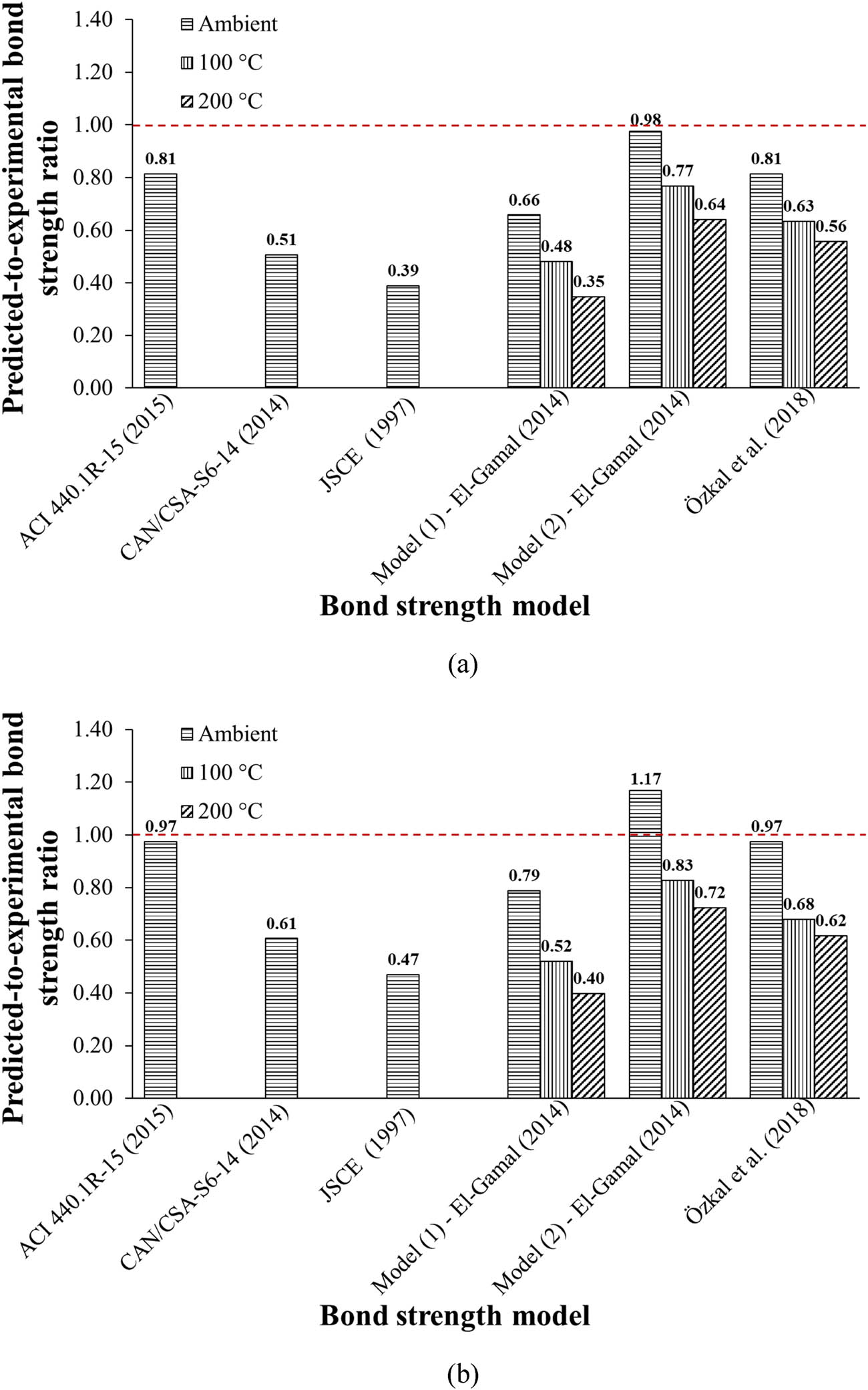
Figure 11
Comparison of predicted with experimental bond strength for: (a) BFRP rebars embedded in PC and (b) BFRP rebars embedded in FRC.
It should be noted that the selected code-based and literature models were originally developed for plain concrete at ambient temperature. In this study, these models were applied to FRC by using its compressive strength. This approach does not fully account for the effects of steel fibers or thermal exposure on bond behavior. The influence of fibers is expected to modify local confinement and splitting resistance, potentially affecting the bond-dependent coefficients and altering the failure mechanisms compared to model assumptions. Therefore, the model comparisons presented here are intended as indicative benchmarks to provide context rather than as precise predictions for FRC at elevated temperatures.
6. Conclusion
From the test outcomes of this study, major conclusions drawn are as follows:
i) In general, the mode of failure was rebar pullout in PC as well as FRC. However, in plain concrete, the rebar pullout was accompanied by fine cracks in concrete cover.
ii) The test outcomes revealed a degradation in the bond strength of steel rebars embedded in both PC and FRC after exposure to 200°C. The bond strength of steel bars decreased by 25.4% and 18.8%, respectively, whereas almost no change was observed after exposure to 100°C.
iii) In contrast to steel rebar, BFRP rebars exhibited an apparent increase in bond strength when exposed to elevated temperatures. For rebars embedded in PC and FRC, the bond strength increased by 8.4% and 17.3%, respectively, after heating to 200°C. This improvement is likely related to thermally induced epoxy swelling and concrete shrinkage, though the mechanism requires further microstructural verification.
iv) Although the bond strength of BFRP rebars at ambient temperature was lower than that of steel rebars (by 13.8% in PC and 18.8% in FRC), BFRP rebars exhibited comparable or slightly higher bond strength at 200°C. These observations suggest potential thermal resilience of BFRP at moderate elevated temperatures; however, the results are based on limited replicates (n =2) without formal statistical inference. Within the limits of this setup and n = 2, these findings are protocol-specific and should be confirmed with in-specimen temperature measurements.
v) The initial pullout stiffness of steel and BFRP rebars embedded in PC as well as FRC decreased after exposure to elevated temperature, and as a consequence, the slip at peak bond stress increased for all types of concrete.
vi) At ambient and elevated temperature, the greatest impact of fibers added into concrete matrix was only on the initial stiffness and slip at peak bond stress in case of steel rebars. However, this effect was almost negligible in case of BFRP rebars.
vii) The mBPE model available in literature is modified to account for the influence of elevated temperature on the bond stress–slip curves of steel and BFRP rebars embedded in PC as well as FRC. The predictions of the models align well with test results.
viii) The bond strength of steel and BFRP rebars embedded in PC and FRC was computed using available models from codes and researchers. The codified models were only used for rebars under ambient temperature; whereas, the researchers’ models were employed for rebars under ambient and elevated temperature environment. For steel and BFRP rebars under ambient temperature, the codified models conservatively predicted the bond strength, and it was predicted for the case of FRC more accurately than PC. For researchers’ models, it is recommended to utilize the models developed by Huang [36] and Özkal et al. [40] for assessing the bond strength of steel and BFRP rebars, respectively, subjected to elevated temperature environment not exceeding 200°C. For temperature exposure more than 200°C, experimental research is needed for validating the available researchers’ models.
Acknowledgements
The authors gratefully acknowledge the funding received through Ongoing Research Funding program – Research Chairs (ORF-RC-2025-0400), King Saud University, Riyadh, Saudi Arabia.
Funding information
The authors gratefully acknowledge the funding received through Ongoing Research Funding program – Research Chairs (ORF-RC-2025-0400), King Saud University, Riyadh, Saudi Arabia.
Author contributions
Mohammed Abdulaziz: methodology, validation, writing – original draft, Husain Abbas: conceptualization, methodology, validation, writing – original draft, Hussein Elsanadedy: investigation, validation, writing – original draft, Aref Abadel: conceptualization, methodology, writing – original draft, Tarek Almusallam: investigation, Writing – review and editing, funding acquisition, Yousef Al-Salloum: methodology, writing – review and editing, funding acquisition, supervision.
Conflict of interest statement
The authors declare that there is no conflict of interest regarding the publication of this article.
Data availability statement
All data and models generated or used during the study appear in the article. However, data will be available on request from the authors.