
1. Introduction
The urgent surge to switch to renewable energy sources is alarming for society. One renewable energy source that might provide a sustainable solution is solar energy [1], provided that high-quality sun energy harvester cell materials are available [2]. Among the many options that the researchers focus on are perovskite [3], chalcopyrite [4], chalcogenides [5], silicon-based materials [6], etc. Metal chalcogenides are an emerging class of photovoltaics due to their outdoor stability and photostability. However, other classes like perovskite and Si-based materials face stability and production cost issues, respectively [7]. In addition, intense research is being conducted to replace the acute toxic elements used in solar cells, such as Te, Cd, and Pb [8].
Tin sulphide (SnS) is one of the auspicious optoelectronic materials among metal chalcogenides like SnSe [9], Sb2Se3 [10], SnSe2, etc. [11]. It has been used in various applications such as photodetectors, batteries, gas sensors, supercapacitors, and field-effect transistors [12]. It crystallizes in two phases, cubic and orthorhombic while stoichiometrically found in SnS2 and Sn2S3. These stoichiometric phases may easily form during the growth of SnS and hence hamper the cell efficiency due to their intrinsic n-type nature [13]. SnS displays intrinsic conductivity (p-type) as a result of the presence of Sn vacancies [14]. Properties such as the high absorption coefficient, tuneable band gap from the monolayer to the bulk, viz. 1.11–1.79 eV, large mobility [15], simple composition, ease of synthesis, and earth abundance have attracted researchers to explore SnS [16].
This material has shown an experimental solar cell efficacy journey from 0.29 to 5.4% [17]. First fabricated solar device based on p-SnS and n-CdS showed an efficiency of 0.29%. Though it is not easy to replace the well-established CdS buffer layer, the efficiency of solar cells using SnS as the absorber layer and CdS or ZnS as the buffer layer showed huge variation in the efficiency of cells from 7.27 × 10⁻⁹% (i.e., ≪1) to 4% for the ZnS [18] or CdS buffer layer with SnS, respectively [19]. The efficiency barrier was broken by Sinsermsuksakul et al. in the detailed study conducted on SnS and zinc oxysulfide as the absorber and the buffer layer [20]. They stepwise removed the limiting parameters for the efficiency of the cell. First, they annealed SnS to remove the defect states and promote grain growth. Also, treatment with H2S gas passivated the sulphur vacancies that again removed the recombination states in the mid band gap [21]. The conduction band offset (CBO) in Zn(S, O) appeared to be minimized by adjusting the sulphur and oxygen concentrations. Additionally, the diode quality was enhanced by introducing nitrogen (N2) doping in Zn(S, O) [19]. Insertion of a few layers of SnO2 greatly reduced the recombination at the interface and improved the device’s open circuit voltage. Ultimately, they achieved a high efficiency of 4.36% by stepwise logical treatments over buffer layers as well as over absorber layers. SnS-based bifacial solar cells achieved an efficiency of 1.2% with the front face [22] and 0.2% with the rear face by utilizing the reflected part of the sun’s energy from the environment [23]. This journey included various treatments like different techniques of deposition for better quality, pre-and post-treatment, etc. [24]. Jaramillo et al. demonstrated that SnS-based solar cells prepared by ALD are more effective than those prepared by thermal deposition [25]. Gupta and Arun displayed the potential of p- and n-type SnS as solar cells; they reported the larger absorption coefficient of n-SnS over p-SnS and the large diffusion length of p-SnS over n-SnS [26]. Homojunction solar cells based on single crystal (n-SnS) and film (p-SnS) showed an efficiency of 1.4% [27]. Wang et al. fabricated the simple SnS/TiO2 device geometry and achieved 0.1% efficiency [28]. A highly efficient SnS/TiO2 nanostructured solar cell was reported by Yun et al. Solution processing and heat treatment methods of cell fabrication were the prime hits over costly fabricated techniques like atomic layer deposition (for the highest efficiency of 4.36%) [29]. They attained a record high efficiency of 4.8% by secondary treatment with SnCl2 for the SnS/TiO2 solar cell [29]. Various simulation results of SnS containing many buffer layers (ZnO [30], CdS, SnO2 [31], SnO2/Zn(O,S), and CdS/ZnO) showed its utmost importance as a solar cell material [32].
Here, we report the numerical simulation path of a simple device based on the Ni/NiO//SnS/TiO2/ITO structure that can exhibit an attractive efficiency of 24.0%. Parameters simulated well lie within the region and can be achieved under better quality control. The CBO and the conduction band density of states (CBDOS) are the most and least sensitive parameters among the simulated parameters, respectively.
2. Results and discussion
2.1. Simulation methodology
A solar cell capacitive simulator was utilized to simulate the solar cells by using SnS as the absorber layer (SCAPS-1D) [33]. This software was initially designed at Gent University, and for details of the algorithm and program one can refer to the study of Burgelman et al. [34]. The software’s output relies on solving the continuity and Poisson equations for both electrons and holes as described below.
where Ψ, ε 0, ε r, n, p, ρ P, and ρ n are the electrostatic potential, vacuum permittivity, relative permittivity, electron and hole concentrations, and charge densities of p- and n-type, respectively. ND, NA, G, and R represent the donor charge impurity, acceptor impurity, and generation and recombination rates, respectively. Simulation was done under the AM1.5 spectrum at room temperature with 100 mW cm−2 power density.2.2. Simulation parameters
The efficiency of a solar cell is sensitive to various parameters like band gap, valence band density of states (VBDOS) or CBDOS, etc. Here, in this study, we varied the SnS band gap from 1.1 to 1.79 eV, VBDOS from 2.4 × 10¹⁸ to 4.6 × 1019 cm−3, CBDOS from 1.17 × 10¹⁸ to 8.846 × 1018 cm−3, work function of back contacts from 4.4 to 5.0 eV, the radiative recombination factor (coefficient) (RRC) from 1 × 10⁻⁴ to 1 × 10⁻¹² cm3 s−1, and the thickness of SnS from 0.7 to 2 µm, respectively. Table 1 displays the values of several parameters used in the simulation of SnS, TiO2, and ITO layers.
Table 1
Parameters for different layers.
| Parameters (unit) | ITO [35] | TiO2 [36] | SnS [37] | NiO [38] |
|---|---|---|---|---|
| Thickness (µm) | 0.2 | 0.5 | 2 | 0.03–0.1 |
| Energy gap (eV) | 3.3 | 2.26 | 1.3 [39] | 3.8 |
| CBDOS (cm−3) | 5.2 × 10¹⁸ | 2 × 10¹⁷ | 7.5 × 10¹⁸ | 2.8 × 10¹⁹ |
| Dielectric constant | 8.9 | 10 | 12.5 | 10.07 |
| Hole mobility (cm2 V−1 s−1) | 10 | 25 | 4 | 56.5 |
| VBDOS (cm−3) | 1 × 10¹⁸ | 6 × 10¹⁸ | 1 × 10¹⁹ | 1 × 10¹⁹ |
| Electron mobility cm2 V−1 s−1 | 10 | 100 | 100 | 130 |
| Shallow uniform-acceptor density (cm−3) | 0 | 0 | 5.7 × 10¹⁵ | 2.8 × 10¹⁹ |
| Shallow uniform-donor density (cm−3) | 1 × 10²⁰ | 1 × 10¹⁷ | 0 | 0 |
| Electron affinity (eV) | 4.4 | 4.2 | 3.52 [40] | 1.46 |
| RRC (cm3 s−1) | 1 × 10⁻⁸ | 1 × 10⁻⁸ | 2.3 × 10⁻⁹ [41] | 2.3 × 10⁻⁹ |
| Absorption coefficient | — | — | 5 × 10⁴ [27] | — |
Figure 1a presents the diagram of the solar cell, consisting of SnS as the absorber layer, TiO2 as the electron transport layer, and ITO as the window layer. Figure 1b depicts the relationship between solar cell parameters and the thickness of the absorber layer, SnS. The thickness of the absorber layer must be in the right range so that it can effectively absorb the light incident on it. The minimum required thickness should be the reciprocal of the absorption coefficient in the visible range to cut 1/e of the incident light. With increasing thickness, J SC increases and hence the fill factor and efficiency. Efficiency tends to saturate at 2 µm (a slight increase of 9.38–9.99% from 1.5 to 2 µm). By absorbing light, the absorber layer thickens and increases the number of electron–hole pairs, leading to a decrease in defect states due to the increased crystallite size and a smaller ratio of materials exposed to the surrounding environment. A similar trend can be found in the literature [42].
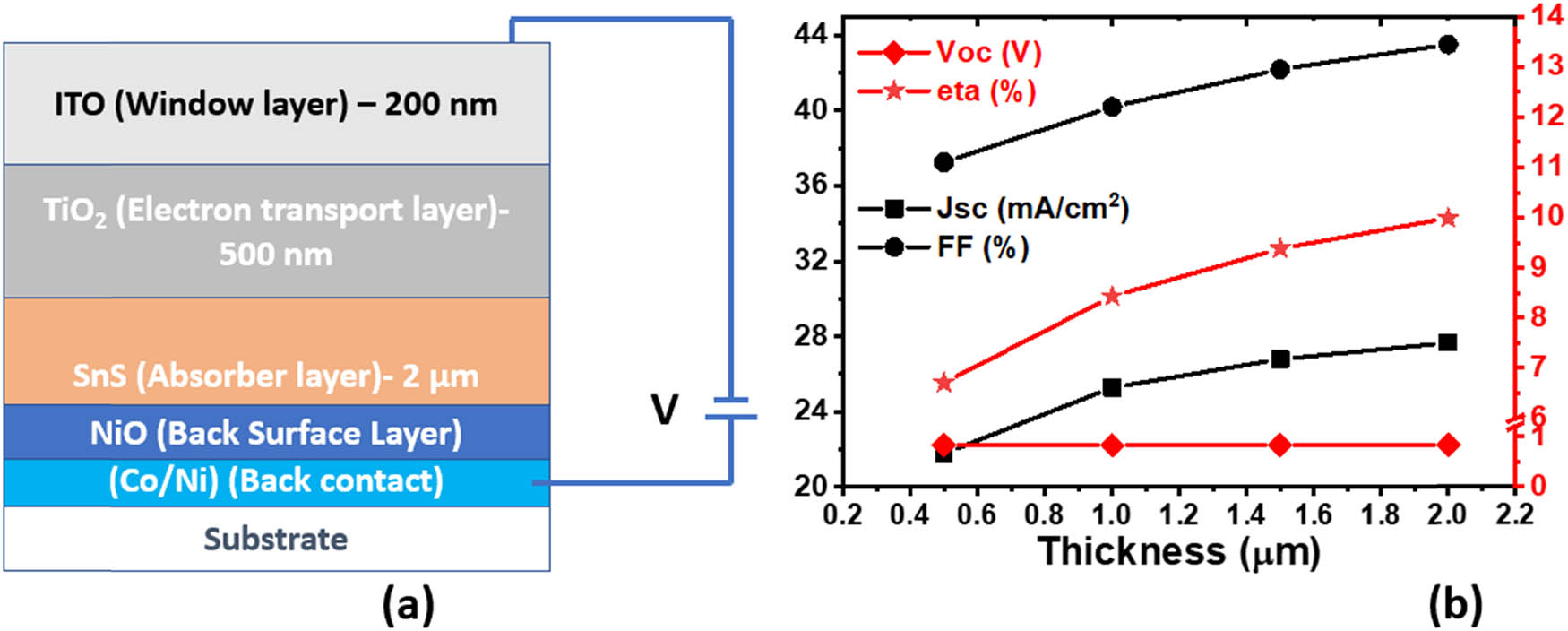
Figure 1
(a) Structural representation of a solar cell device based on SnS, TiO2, and ITO. (b) Adjustment of solar cell parameters (J SC, V OC, ɳ, and fill factor) with the thickness of SnS.
The open circuit voltage depends on the band gap width of the absorber layer, as can be seen in Figure 2a. The Shockley–Queisser model provides information about the efficiency limit of a single-junction device, which operates by carefully balancing the absorption and emission of light. The efficiency of a cell is maximum in the range of 1.1–1.45 eV and decreases on both sides [43]. From Figure 2a, it can be verified that efficiency starts increasing from 1.1 eV and then increases to a maximum at 1.5 eV after which it starts decreasing.
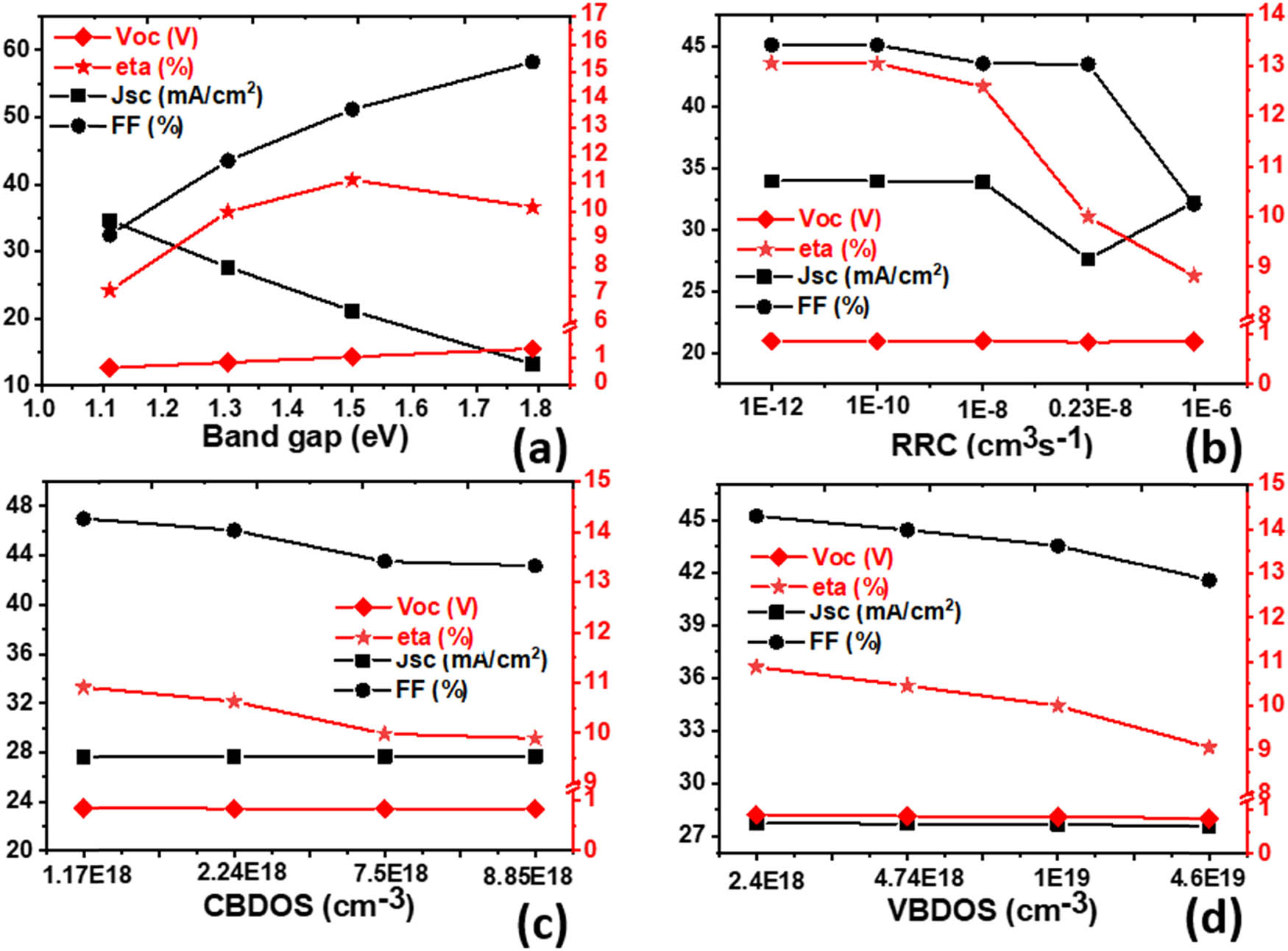
Figure 2
Variations in the parameters of a solar cell (J SC, V OC, ɳ, and fill factor) with (a) band gap, (b) radiative recombination coefficient, (c) CBDOS, and (d) VBDOS of SnS.
The band gap of the materials can be tuned by the material synthesis technique [44], doping, and pre- and post-annealing [45]. Shuai and Cheng successfully showed the tuning of the electrical and optical parameters of the thermally evaporated SnS with Cu doping [46]. Herein, we simulated the range of the band gap between 1.11 and 1.79 eV reported for the SnS (thickness-dependent) [15]. The maximum efficiency is attained when the band gap is ∼1.5 eV, which is near the optimized band gap [47]. RRC describes the direct recombination of the carriers from the conduction band (CB) to the VB. It is very low for the indirect band gap materials, while it is high for the direct band gap materials. As the RRC value increases (Figure 2b), the recombination probability increases, leading to a decrease in the collection of carriers. RRC is a function of the carrier concentrations of electrons and holes, as well as temperature [48]. It varies inversely with the carrier concentration and temperature [49]. The efficiency of the cell tends to saturate at the value of 1 × 10⁻¹⁰ cm³ s−1. VBDOS and CBDOS were calculated with the help of the equations given below [50].
where and are the effective mass of DOS in CB and VB, respectively. The effective masses of the hole and electrons along different directions are given by , , and and , , and , respectively, in the VB and CB [13]. Here, m 0 is the mass of a free electron. Considering the variation of effective mass along different directions, we obtain the VBDOS and CBDOS as 2.4 × 10¹⁸ to 4.6 × 10¹⁹, and 1.17 × 10¹⁸ to 8.846 × 1018 cm−3, respectively.The DOS in both VB and CB talks about the available states to the carriers. The higher the density, the higher the state’s availability. Hence, a higher density triggers the recombination mechanism in the materials, which leads to lower efficiency. A similar trend in Figure 2c and d can be seen with increasing DOS in both VB and CB, respectively.
The back electrode contact gathers the holes at the interface, necessitating a proper band alignment for efficient collection. If the work function of the metal is greater than the work function of the absorber layer (p-type) [51], it results in the formation of ohmic contacts, which facilitates the efficient collection of carriers [52]. CBO also governs efficiency optimization. Ikuno et al. studied the detailed CBO in SnS/Zn1−x Mg x O (ZMO). The doping concentration of Mg in zinc oxide controls the band gap of ZMO and hence the conduction band minima. They demonstrated the optimal efficiency for this structure at nearly zero CBO [53]. Sinsermsuksakul et al. also conducted a CBO study for the SnS/Zn(O, S) solar cell [22]. The magnitude of the CBO is positive or negative depending on the position of the CB levels at the interface. Here, electrons are transported from SnS to the TiO₂ layer, and if the CBO is positive from the SnS to the TiO₂ side, then it impedes the transportation of the electrons. If the CBO is negative, it provides an easier path for electron transfer (Figure 3).
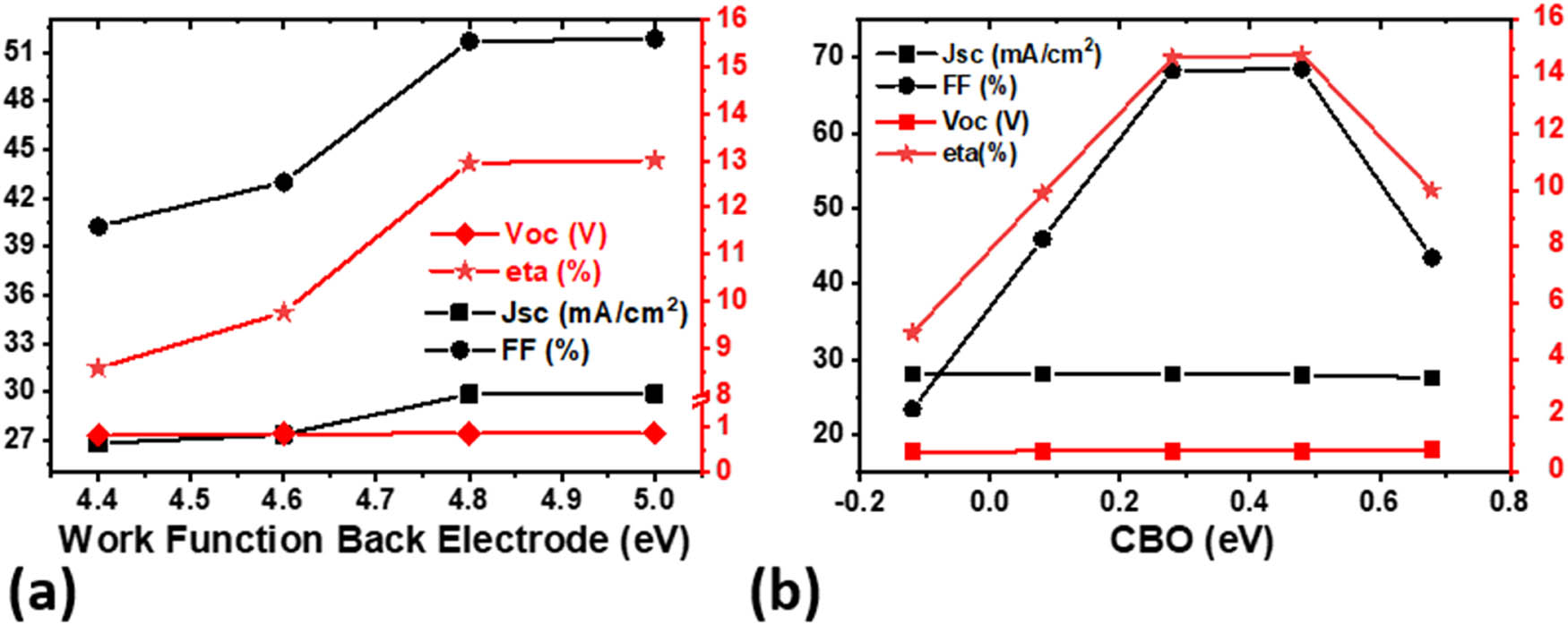
Figure 3
(a) Variations in parameters of solar cells with the work function of back contacts and (b) CBO.
Herein, the electron affinities of SnS and TiO₂ are 3.52 and 4.2 eV, respectively. CBO is studied in the range of −0.12 to 0.68 eV. The efficiency of the cell reached its maximum (14.77%) for the CBO at 0.48 eV. There is slightly less efficiency for the CBO at 0.28 eV (14.66%). The current density shows a tiny variation, while the open circuit voltage varies from 0.74 to 0.83 V for the CBO at −0.12 to 0.5 eV. Temperature distribution throughout the globe varies from near freezing point of water to 50°C. This operating temperature affects the performance of the solar cell. With increasing operating temperatures, the band gap of the material varies as per the following relation [54].
where α and β are the temperature fitting parameters of the given material.Variation in I sc and V OC can be related to the variation in the material’s band gap with temperature. I sc increases, while V OC decreases with increasing temperature due to the decreasing band gap of the material [54]. Hence, the overall efficiency of the cell is hampered by the increased recombination rates of carriers. Variation in the cell parameters with temperature is shown in Figure 4a.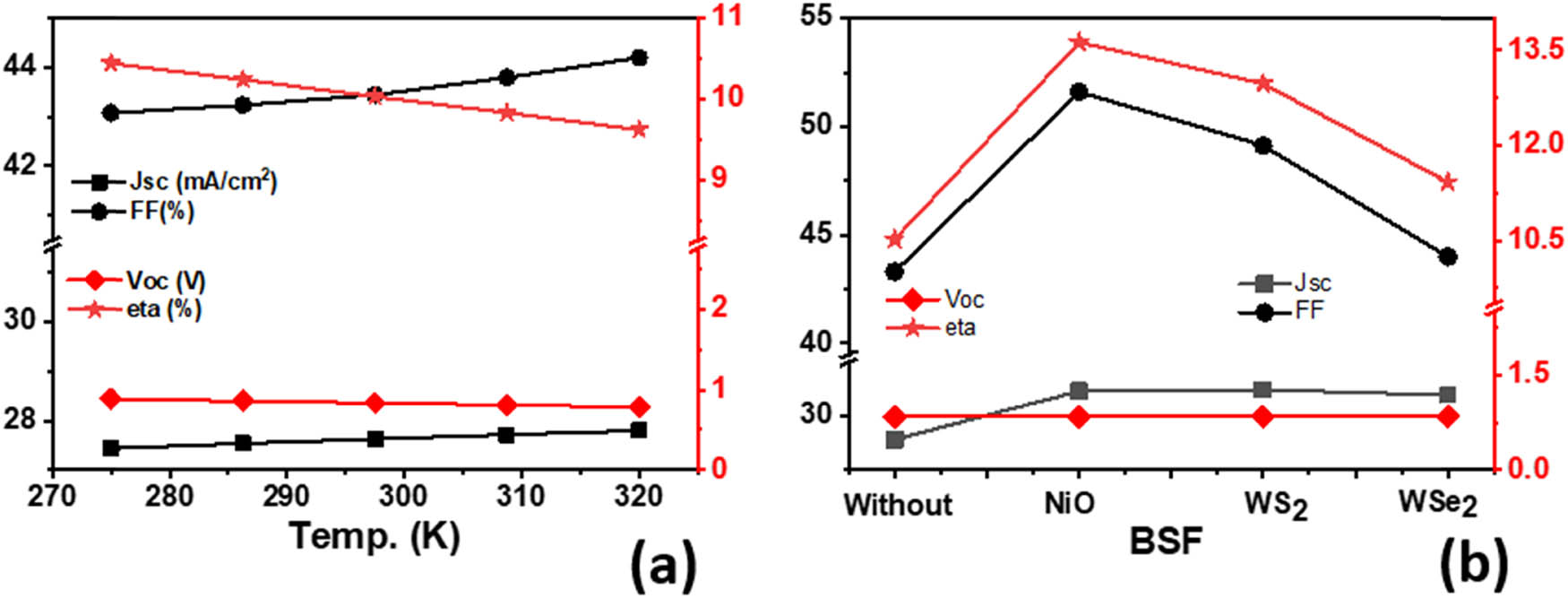
Figure 4
Variation in the cell parameters with (a) operating temperature and (b) without and with BSF layers.
The cell is tested for the back-surface layer (BSF layer) by inserting different BSF layers. Inserting the BSF improves the cell efficiency by introducing the barriers to the minority carrier’s flow to the rear surface and reducing the misalignment between the back contact and the absorber layer. The BSF layer always consists of a higher doping concentration than the absorber layer, and this constitutes the electric field due to the p+/p region. Cells with NiO, WS2, and WSe2 BSF layers and without BSF layers are simulated, and output parameters are shown in Figure 4b, where parameters are chosen from studies of Ghori et al. and Alok and Brahma [55,56].
Later, the thickness of the NiO BSF layer and absorber layer will be optimized for the cell. After selecting NiO as the BSF layer for this cell, various thicknesses of NiO (30–100 nm) were tested, but there was no significant variation in the cell parameters. The BSF layer generally enhances the values of V
OC and I
sc due to reduced recombination of the minority carriers at the surface of the rear absorber layer [57]. Here, the values of V
OC and I
sc increase from 0.8405 (without BSF) to 0.8466 V (for NiO), while J
SC increases from 28.90 to 31.17 mA cm−2. The metal having work function >4.8 eV is enough to form the ohmic contacts, which can be achieved using Ni, Co, Pt, Au, etc.
With optimized parameters, the solar cell showed efficiencies of 24.00% at 300 K operating temperature and 24.05% at 275 K (Figure 5a and b). Quantum efficiency seems to reach 100% for the visible region (550–750 nm) for this structure (Figure 5c), and energy band alignment is shown in Figure 5d. A list of optimized parameters is shown in Table 2.
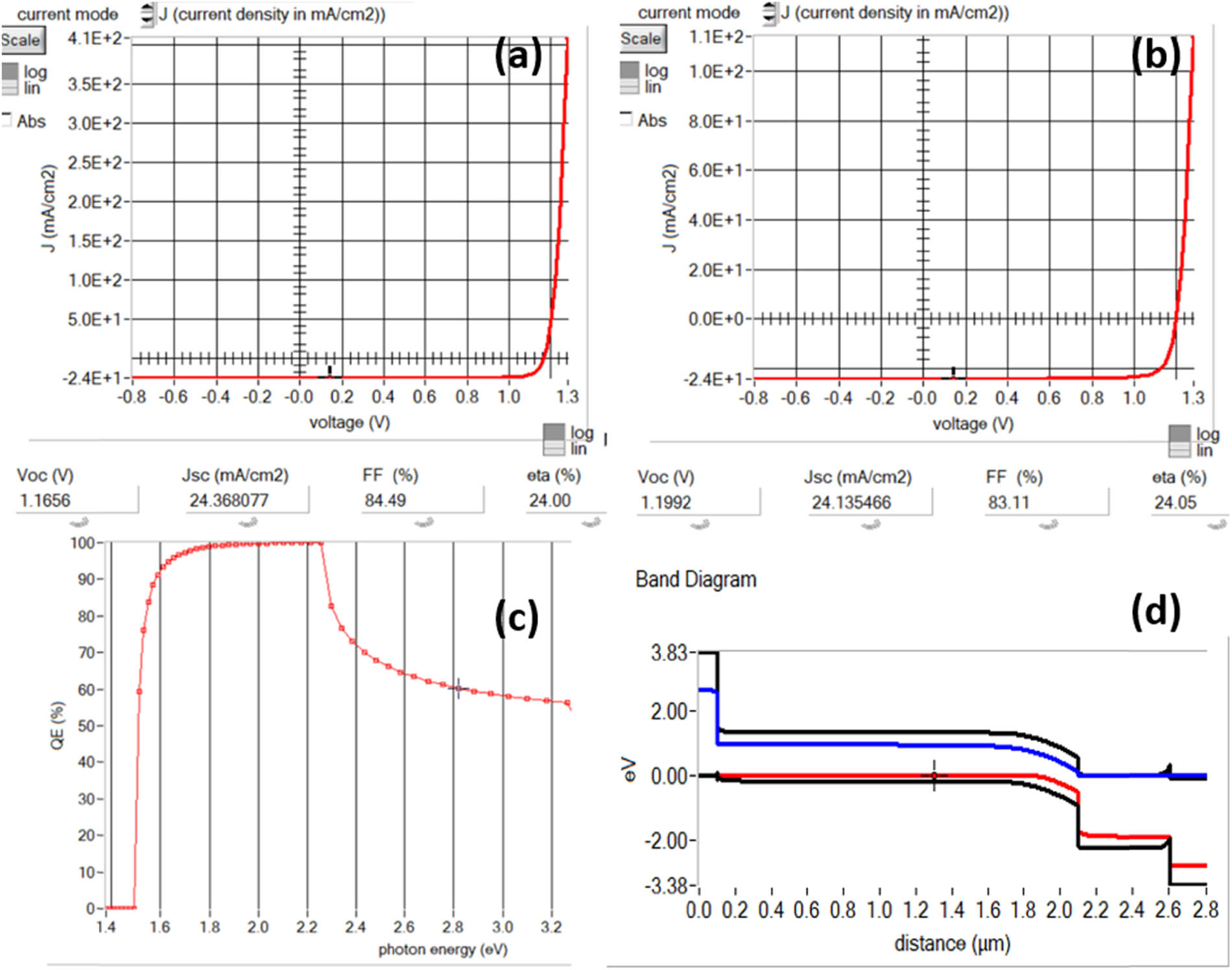
Figure 5
J–V curves of the output panel at operating temperatures of (a) 300 K and (b) 275 K, (c) quantum efficiency of the cell, and (d) energy band alignment for the cell.
3. Conclusions
It is beneficial to save energy, time, and money for the possible target by using the theoretical gains. We enhanced the efficiency of an SnS-based solar cell construction by employing SCAPS-1D simulation software. These optimized parameters are taken within the defined range of parameters in the literature. This structure showed the highest efficiency of 24.00% under the optimized conditions of VBDOS, RRC, CBDOS, band gap, thickness, CBO, and presence of a BSF layer of 2.4 × 1018 cm−3, 1 × 10⁻¹⁰ cm3 s−1, 1.17 × 1018 cm−3, 1.5 eV, 2 µm, 0.48 eV, and NiO, respectively under the flat band condition for the back contact at 300 K. The efficiency of the solar cell showed a decreasing trend in parameters such as the CBO, work function of the back electrode, RRC, thickness, band gap, VBDOS, and CBDOS of the absorber layer.
Acknowledgements
The author extends the appreciation to the Deanship of Postgraduate Studies and Scientific Research at Majmaah University for funding this research work through the project number R-2024-1445.
Author contributions
Khairiah Alshehri: Writing – Review & Editing, Formal analysis; Mohammad Shariq: Supervision, Writing – Original Draft, Writing – Review & Editing; Project administration; Aeshah Alasmari: Writing – Review & Editing ;Formal analysis; Hussain J. Alathlawi: Validation; Rachid Karmouch: Validation; Writing – Review & Editing; Mohd Shakir Khan: Validation, Writing – Review & Editing, Project administration; Ali Alzahrani: Writing – Review & Editing; Noura E. Alhazmi: Writing – Review & Editing; Eman Almutib: Validation, Writing – Review & Editing; Rubina Sultana Mohammed: Writing – Review & Editing.
Conflict of interest statement
The authors declare no conflict of interest.
Data availability statement
Datasets generated during and/or analysed during the current study are available from the corresponding author on reasonable request.