
1. Introduction
Nanotechnology is a field of materials science that deals with manipulating fine-sized matter within a range of 1–100 nm. These nanomaterials, due to their large surface area-to-volume ratio, have unique physiochemical, magnetic, optical, and electrical properties [1]. Iron oxide-based nanoparticles are a part of these well-known transition metal oxides. They have been prepared using various preparation methods, including wet chemical methods [2], liquid phase deposition [3], and green preparation methods [4]. Transition metal oxide nanoparticles have been characterized by unique properties [5]. Particularly, iron oxide nanomaterials have been used and studied for various applications, such as water treatment [6], drug delivery [7], catalysis [8], water splitting [9], imaging [10], chemical energy conversion and storage technologies [11], sensors and bio-sensors [4], and biomedical applications [12].
Mixed metal oxide nanocomposites (MONCs) could be defined as a multiphase solid substance possessing one, two, or three dimensions with a size less than 100 nm on the nanometer scale. The nanometric size and multifunctionality of each metal gave the nanocomposite (NC) different mechanical, electrical, optical, electrochemical, catalytic, and structural properties than those of each metal alone. The researchers concluded that the mixed MONCs stopped the bacterial cell’s pathogenicity by breaking its outer and inner cell walls, which caused the cell membrane to become disorganized and leak [13]. Regarding the novel techniques for MONC formation and evaluation, several studies have been investigated [14,15]. The antibacterial capacity of co-assembled core-shelled MONCs has been characterized by the co-precipitation technique . The synthesized co-assembled MONCs of CuO, Fe2O3 (FeO), ZnO, ZnO/CuO–FeO x , and ZnO–CuO–FeO showed a wide protection action against many bacterial strains [16]. Furthermore, the oxalate precursor route was recently used to synthesize CuO/c–CuFe2O4 NCs [17]. The substitution of Cu2+ ions by Fe3+ ions (Cu1−X Fe X O) resulted in the formation of CuO/CuFe2O4 NCs with monoclinic-like shape. The substitution within X values from 0 to 0.2 boosted the magnetization properties in the formed CuFe2O4 phase composite from 0.13 to 9.8 emu/g [18]. Eventually, the mechanism of MONCs depends on the generated reactive oxygen species (ROS), such as anions of superoxide radical and hydrogen peroxide, which interact with the cell wall of bacteria, leading to notable damage in the cell membrane and subsequently growth inhibition and death [19].
Several conventional antimicrobial agents that are commonly used in agriculture applications have various pros and cons [20]. Among the worldwide traditional antimicrobial products were copper(ii) formate and gentamicin [21]. A copper ester of formic acid has been proven to work better against microbes when combined with other copper complexes [22,23]. Copper(ii) formate has been commonly used as an antibacterial agent for coatings [24], cotton cellulose fabric curing [22], and medicinal applications [25]. Furthermore, it has been known for its antifungal activity against Rhizoctonia solani [26] and Botrytis cinerea [27]. Gentamicin, an additional aminoglycoside antibiotic used in plant agriculture, differs from streptomycin in terms of the arrangement of the heterocyclic ring and the hydroxyl substitutions linked to the amino sugars [28]. Gentamicin is considered a conventional bacteriostatic broad-spectrum antibiotic that targets the protein synthesis of the bacterial pathogen. However, it is still widely used in agriculture in developing countries as it gained approval for treating blight in apples and pears as well as certain vegetable diseases, primarily in regions of South and Central America, alongside Mexico [29].
Therefore, it is crucial to create a composite material that possesses distinct attributes to meet these requirements, such as a straightforward manufacturing process, an environmentally benign composition, long-lasting durability, and potent antimicrobial properties. In this regard, the present study focuses on the hydrothermal process of synthesizing a copper oxide–ferric oxide nanocomposite (CuO/Fe2O3-NC). This NC’s characteristics were assessed by powder X-ray diffraction (XRD). Chemical bond formation, vibration mode analysis, and functional group identification were also identified using a Fourier transform infrared spectrophotometer. The morphological structures and elemental analysis were carried out by transmission electron microscopy (TEM). The CuO/Fe2O3-NC was tested for antimicrobial activity against various strains of phytopathogenic microorganisms, including fungal and bacterial isolates.
2. Materials and methods
2.1. Preparation of nanomaterials
Iron metal powder (>99%), copper nitrate (Cu(NO3)2 [>99%]), and sodium hydroxide (NaOH [>99%]) were acquired from Belaqmi Fine Chemicals, India. Bi-distilled water was used throughout the experiments. In summary, a 0.1 M solution of Cu(NO3)2 was initially prepared, followed by the addition of 4 g of iron metal powder and 10 g of NaOH. The mixture was agitated for 10 min at ambient temperature. A Teflon-coated steel autoclave was used to confine and mature the mixture for 24 h at 120°C. Subsequently, the acquired materials underwent multiple rinses with distilled water and were subsequently dried at a temperature of 60°C overnight.
2.2. Nanomaterial characterization
The crystallographic phase of the samples and their crystal size were studied by XRD with Cu-Kα radiation (Shimadzu 7000, USA). Various vibration modes, formations, chemical bonds, and function groups were determined by Fourier-transform infrared spectroscopy (FTIR), with infra-red spectra collected from 400 to 4,000 cm−1 (Shimadzu FTIR-8400s, Japan). This is used to identify the presence of functional groups in the obtained nanoparticles. The morphological structures and elemental analysis of the resulting nanoparticles were examined by transmittance electron microscopy (TEM; JEOL, JEM2100 plus, Japan).
2.3. Source, morphological, and molecular recognitions of fungal isolates
The fungal strains were isolated from infected strawberry plants, and the fruits showed signs of rot and gray mold. The morphological recognition of the fungal strains was performed using the identification manual illustrated by Campbell et al. [30]. The genus of fungal isolates was identified using a light microscope [31]. Amplification of the “Internal Transcribed Spacer” (ITS) area of the ribosome-encoding genes was used for the molecular identification of the fungal isolates by universal primers for ITS1 and ITS4 [32]. The polymerase chain reaction (PCR) was conducted as previously reported [33]. The final PCR products were refined and subjected to a Sanger sequencing machine. The fungal isolates were BLAST reconnoitered, and their identified sequences were coded by accession numbers using the NCBI database’s GenBank portal.
2.4. Origin of bacterial isolates
The tested bacterial strains of Pectobacterium carotovorum (OQ878656), Streptomyces scabies (OR437480), Pectobacterium atrosepticum (MG706146), and Ralstonia solanacearum (OQ878653) were previously isolated from potato [34,35].
2.5. Antimicrobial activity evaluation
2.5.1. Antifungal activity
The effectiveness of CuO/Fe2O3-NCs in inhibiting the growth of fungal isolates was assessed using food-poisoned procedures [36]. Four concentrations of CuO/Fe2O3-NCs at 25, 50, 75, and 100 µg/mL were assessed utilizing potato dextrose agar (PDA) medium plates. CuO/Fe2O3-NCs were evaluated compared to the negative control (no chemical treatment-PDA) and the positive control (100 µg/mL copper formate-PDA). Circular paper discs (10 mm in diameter) of the tested fungal strain were laid on the PDA plates and incubated at 25°C for 7 days. The experiment was done in triplicate. The differences in radial growth diameters were expressed as inhibition percentages [37], as follows:
where P is the mycelial growth length (mm) in the negative control (no chemical treatment-PDA), and D is the mycelial growth length (mm) of the tested CuO/Fe2O3-NCs-PDA.2.5.2. Antibacterial activity
Following the agar disc-diffusion method described by Heatley [38] and modified by Balouiri et al. [39], routine antibacterial susceptibility tests were done on the chosen bacterial isolates using a final inoculum of 2 × 10⁸ CFU/mL on agar plates with nutrient agar (NA) as the growth medium. Thereafter, filter paper discs (about 6 mm in diameter) containing CuO/Fe2O3-NCs at concentrations of 10, 20, 30, 40, and 50 µg/mL were placed on the agar surface compared to the negative control (no chemical treatment-NA) and the positive control (30 µg gentamicin-NA). The Petri dishes are incubated under suitable conditions of 29 ± 1°C for 2 days. The experiment was replicated three times. Finally, the antimicrobial agent diffuses into the agar and inhibits the germination and growth of the test bacterial isolates. Then, the diameters of inhibition growth zones are measured.
2.6. Data analysis
All the data obtained from the laboratory trials were analyzed using a one-way ANOVA. Significant differences in mean values were determined using the least significant difference test at a 0.05 significance level, utilizing the Statistical Analysis System (SAS) software [40].
3. Results and discussion
3.1. XRD analysis
Figure 1 displays the XRD pattern of the prepared quantum dot-composite (CuO/Fe2O3). The XRD peaks of the CuO nanoparticles appeared at 35.61°, 38.69°, 57.17°, 60.74°, 66.35°, and 68.45°, which correspond to (−111), (004), (200), (105), (220), and (215), respectively. This demonstrates the formation of a monoclinic (CuO) crystal structure that matches the monoclinic structure (JCPDS No. 01-076-7800) forms, as shown in Figure 1. The XRD peaks of the Fe2O3 nanoparticles appeared at 35.6°, 47.39°, 57.24°, and 62.86°, which correspond to (110), (207), (201), and (300), respectively (Figure 1). This shows that the Fe2O3 structure is hexagonal. This finding is consistent with the standard (JCPD 01-078-6916) data. The peaks then become sharper with the formation of NC (CuO/Fe2O3), as shown in Figure 1. The XRD patterns obtained in the sample CuO/Fe2O3 display the usual peaks of (−111) and (004) reflections of CuO, which are found at two values of 35.69° and 37.73°, respectively. In addition, the XRD pattern of (110) Fe2O3 is found at 35.69° with a broadening shape in sample CuO/Fe2O3. Figure 1 shows a mix of two XRD pattern peaks (105), (220), CuO, and (201) Fe2O3 that appear in the range 55°–60°. This shows that the NC of CuO/Fe2O3 is formed. Table 1 summarizes the crystal sizes of the resulting nanoparticles. Each side of the polygon MNP had a length of approximately 12 nm. The diameter of the spherical CuO particles ranged from around 7–10 nm. Using the Debye–Scherer equation [41], the crystal diameters of all the nanoparticles obtained can be determined as follows:
where λ is the Cu-Kα wavelength (0.1542 nm), β is the FWHM, and K is a constant.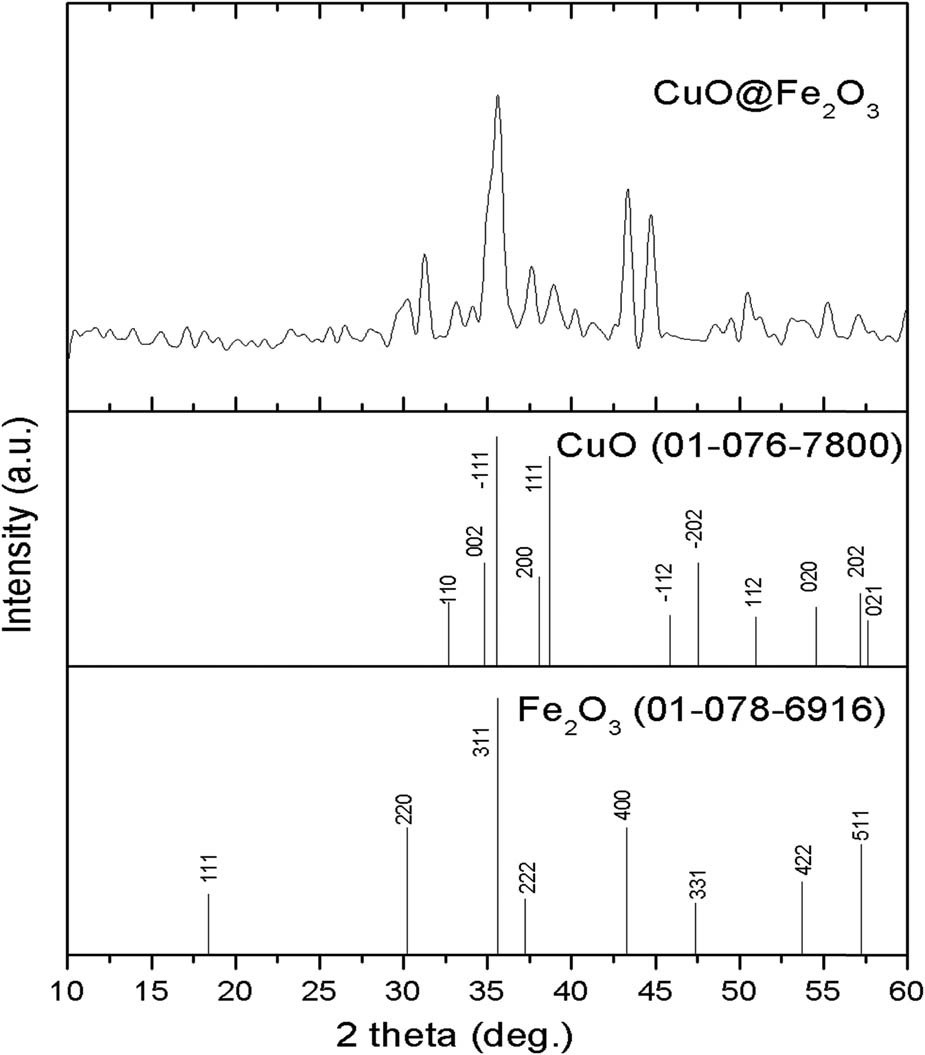
Figure 1
XRD pattern of the prepared nanoparticles; CuO, Fe2O3, and the NC CuO/Fe2O3.
3.2. FTIR results
The produced NC was analyzed using FTIR spectroscopy to determine the functional groups present [42]. Figure 2 shows the FTIR spectrum of CuO/Fe2O3. It has noticeable characteristic peaks at 525 cm−1 which belong to the bending vibration of the Cu–O bond [43]. The strong band below 700 cm−1 reveals the Fe–O stretching mode. The band corresponding to the Fe–O stretching mode of Fe2O3 is shown at 567 cm−1 [44]. Briefly, all prepared metal oxide nanomaterials were characterized by bending vibration of the metal–O bond, CuO, and Fe2O3, which appeared in a broad band at around ν 500 cm−1 [45]. The FTIR results are consistent with the XRD patterns of the NC (CuO/Fe2O3) and confirm the chemical reaction that takes place during the hydrothermal treatment of copper hydroxide and iron(III) oxide-hydroxide, leading to the creation of the NC (CuO/Fe2O3).
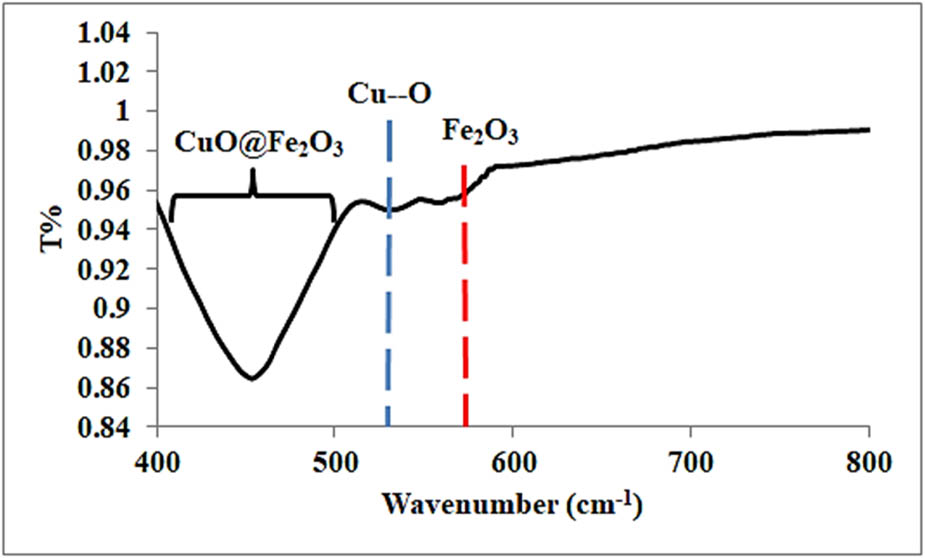
Figure 2
FTIR spectrum of the prepared NC (CuO/Fe2O3).
3.3. Chemical reaction
The elemental analyses of the prepared nanomaterials were determined by energy-dispersive X-ray spectroscopy (EDX). We detected the percentage and type of each element present. Figure 3 displays the EDX of the prepared NC (CuO/Fe2O3), as well as the percentage and type of each containing element. EDX confirms the presence of Cu, Fe, and O with weight percent. The EDX results then align with the XRD and FTIR results. As shown in the EDX results, the current percentage of iron is nearly double the copper element percentage. Figure 4 shows the TEM micrograph of the obtained NC (CuO/Fe2O3). It is noticeable that it contains two mixed shapes: the polygon shape of the NC, which consists of a spherical shape of CuO, and plate-like-shaped Fe2O3 quantum dots. These findings are consistent with the results reported in a previous publication [4].
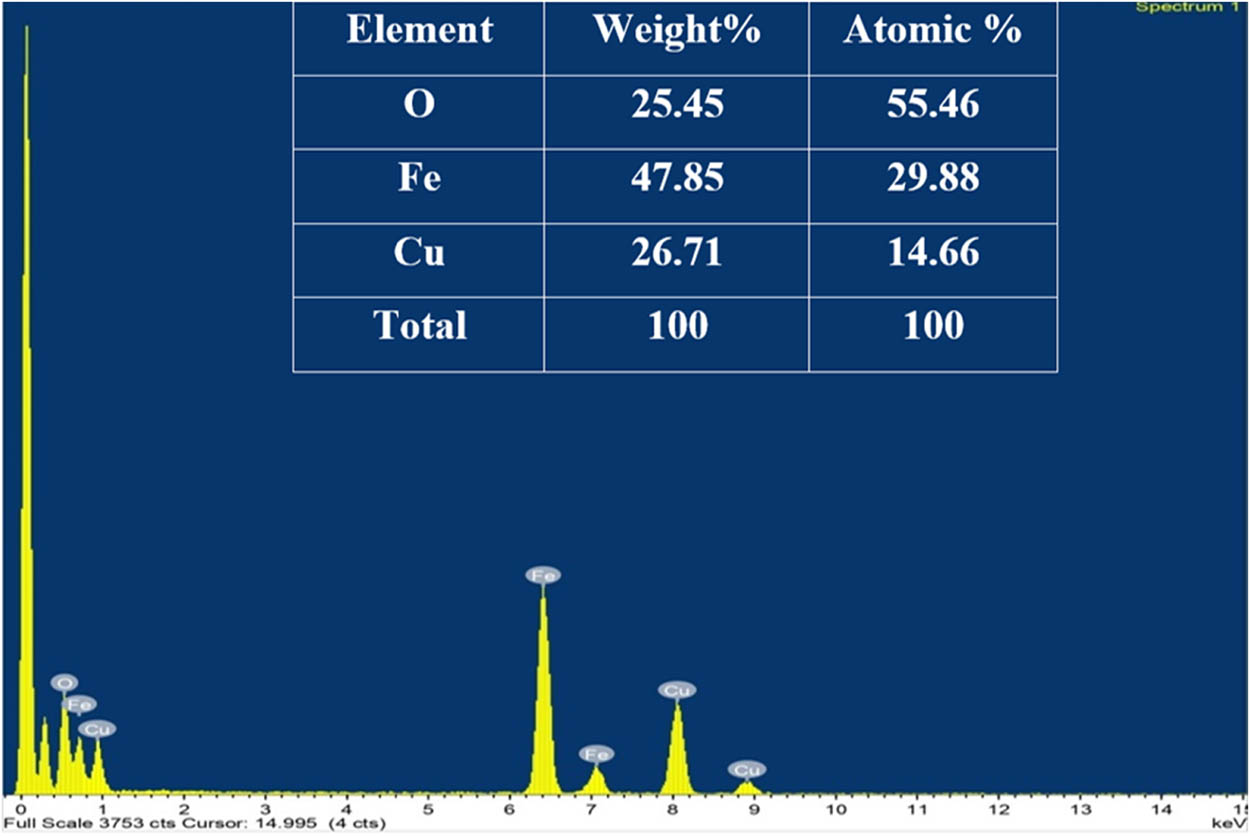
Figure 3
EDX analysis of the obtained NC (CuO/Fe2O3).
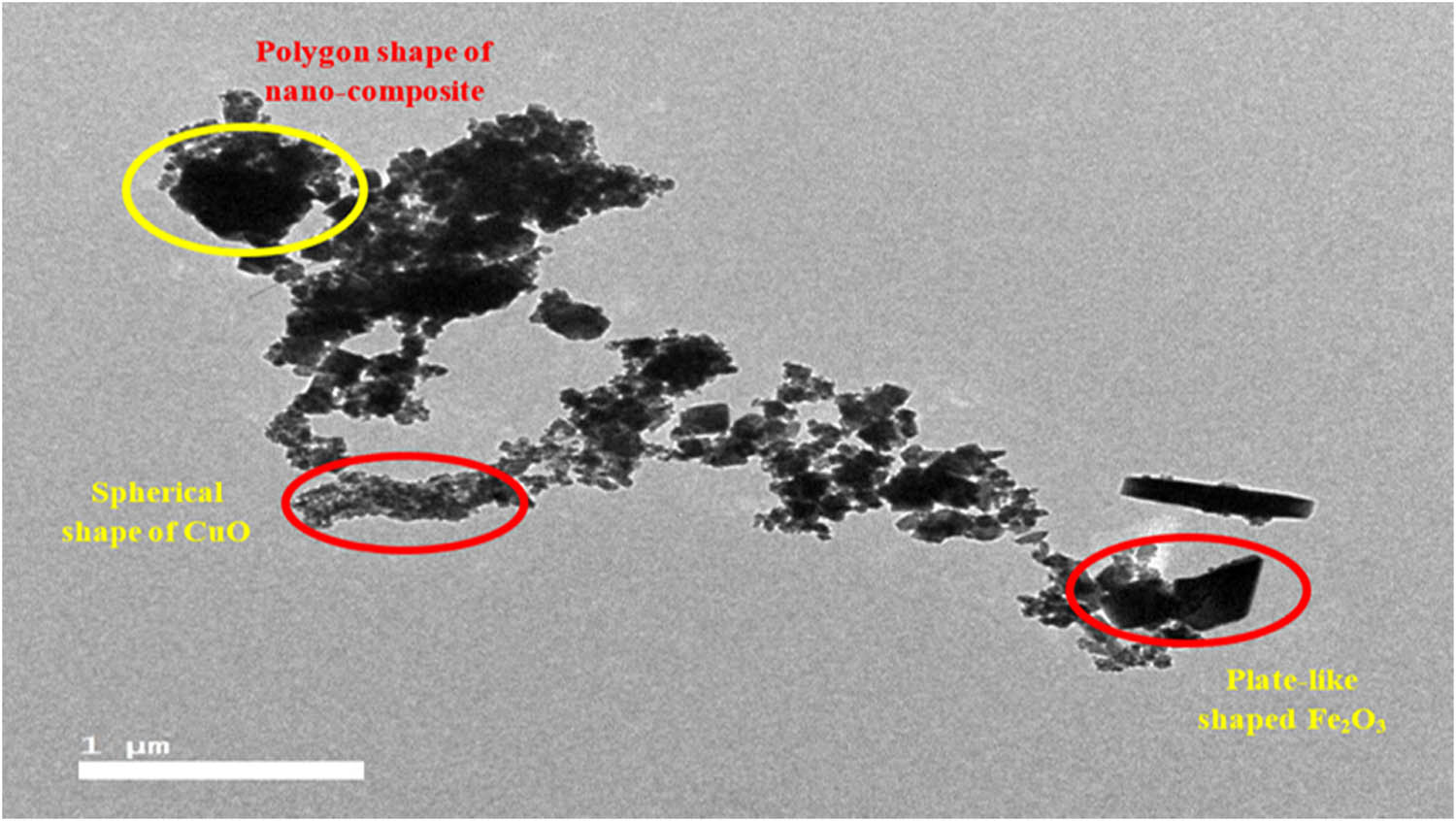
Figure 4
TEM micrograph of the obtained NC (CuO/Fe2O3).
3.4. Identification and growth response of fungal isolates to CuO/Fe2O3-NC
The isolated fungi were identified as Fusarium oxysporum, B. cinerea, and R. solani through morphological and molecular analysis. These fungi may be found in GenBank with the accession codes OR116510, OR116494, and OR116531, respectively. The results presented in Table 2 demonstrate the growth response of the chosen fungal isolates to the CuO/Fe2O3 NC at various concentrations (25, 50, 75, and 100 µg/mL). The growth response was compared to both negative controls (without chemical treatment) and positive controls (copper formate at a concentration of 100 µg/mL).
Table 2
Hyphal growth response of the fungal isolates to series concentrations of CuO/Fe2O3-NCcompared to copper formate after 7 days of incubation.
| Concentrations (µg/mL) | Growth response (diameter [mm] ± SD1; inhibition [%]) | |||||
|---|---|---|---|---|---|---|
| Fusarium oxysporum | Botrytis cinerea | Rhizoctonia solani | ||||
| (OR116510) | (OR116494) | (OR116531) | ||||
| 25 | 29.3 ± 0.58b | 67.4 | 53.7 ± 4.04b | 40.4 | 19.7 ± 0.58b | 78.2 |
| 50 | 28.0 ± 1.73b,c | 68.9 | 50.0 ± 0.00b,c | 44.4 | 18.0 ± 0.00c | 80.0 |
| 75 | 26.3 ± 1.53c,d | 70.7 | 46.3 ± 1.15c,d | 48.5 | 18.0 ± 0.00c | 80.0 |
| 100 | 26.0 ± 0.00d | 71.1 | 45.0 ± 3.00d | 50.0 | 17.0 ± 0.00d | 81.1 |
| −ve control2 | 90.0 ± 0.00a | 0.00 | 90.0 ± 0.00a | 0.00 | 90.0 ± 0.00a | 0.00 |
| + ve control3 | 25.7 ± 1.15d | 71.5 | 46.7 ± 0.58 cd | 48.5 | 16.0 ± 1.00e | 82.2 |
The growth of the fungal isolates that were tested was significantly slowed down by CuO/Fe2O3 NCs and copper formate at different concentrations when compared to the negative control. The smallest growth diameters for F. oxysporum were found in CuO/Fe2O3-NCs, which are similar to copper formate. These were 26.3 and 26 mm at 75 and 100 µg/mL, respectively. In the same way, the smallest B. cinerea growth measurements were 50, 46.3, and 45 mm when CuO/Fe2O3-NCs were used at 50, 75, and 100 µg/mL, respectively. In contrast, copper formate effectively counteracted the inhibitory impact of all concentrations of CuO/Fe2O3 NC on R. solani. According to the results shown above, CuO/Fe2O3-NCs at a concentration of 100 µg/mL had the best effect on stopping B. cinerea, with a 50% success rate. Copper formate at a concentration of 100 µg/mL had the best inhibition percentages against F. oxysporum (71.5%) and R. solani (82.2%). Eltarahony et al. [46] verified these results and found that metal oxide hybrid NCs possess remarkable capability to penetrate and disrupt the inflexible composition of glycoprotein–glucan–chitin in the fungal cell wall. In this case, a biogenic Cu/Fe hybrid NC exhibited significant protection against the fungus Candida albicans at concentrations of 250 and 500 µg/mL. Parameswaran et al. [47] evaluated the antifungal properties of the Co/CeO2 NCs against C. albicans and Aspergillus fumigatus. The findings indicated that Co/CeO2 NCs serve as a moderate antifungal agent for both C. albicans and A. fumigatus. At a concentration of 30 μL, the inhibition zones measured 12 mm for C. albicans and 14 mm for A. fumigatus, compared to 22 mm for the standard antifungal agents. As an antifungal agent, the copper formate complex exhibited a significant inhibitory effect on the growth of R. solani at a concentration of 200 µg/mL [26], as well as effectively reducing the infection of Rosa hybrida flowers by B. cinerea at a concentration of 1,000 mg/L [27]. In a recent study [48], an innovative NC was synthesized using mycosynthesized bimetallic zinc–copper oxide nanoparticles, nanocellulose, and chitosan, and the results demonstrated significant antifungal activity against Aspergillus brasiliensis with an MIC of 7.81 μg/mL. However, the NC had limited antifungal effectiveness against Cryptococcus neoformans and C. albicans, with an MIC of 250 μg/mL for both. However, it was evident that smaller particles enhance the interaction between nanoparticles and fungal cells, allowing them to penetrate bacterial and fungal cell walls more easily [49].
3.5. Inhibition zone of bacterial isolates to CuO/Fe2O3-NC
The findings indicated that the synthesized CuO/Fe2O3-NCs effectively suppressed the growth of bacterial isolates at doses of 10, 20, 30, 40, 50, and 100 µg/mL, as compared to the negative control (no chemical treatment) and positive control (gentamicin, 30 µg) (Table 3). It was noted that gentamicin exhibited the most potent inhibition zones against the selected bacterial isolates, surpassing the inhibitory effects of all tested doses of CuO/Fe2O3-NCs. Furthermore, all of the tested concentrations exhibited inhibition zones compared to the negative control (Table 3). All the assigned concentrations of CuO/Fe2O3-NCs showed equipollent inhibitions on P. carotovorum and S. scabies. At the same time, 40 and 50 µg/mL of CuO@ Fe2O3 NCs were the most effective amounts against P. atrosepticum, with inhibition zones measuring 9.33 and 10.67 mm. Similarly, CuO/Fe2O3-NCs at 50 µg/mL achieved the highest inhibition zone of 14.7 mm against R. solanacearum.
Table 3
Inhibition zone of the bacterial isolates to series concentrations of CuO/Fe2O3-NC compared to gentamicin.
| Concentrations (µg/mL) | Inhibition zone (diameter [mm] ± SD1) | |||
|---|---|---|---|---|
| P. carotovorum | S. scabies | P. atrosepticum | R. solanacearum | |
| 10 | 11.0 ± 0.00b | 9.00 ± 0.00b | 9.00 ± 0.00c | 10.7 ± 0.58d |
| 20 | 11.0 ± 0.00b | 9.00 ± 0.00b | 9.00 ± 0.00c | 11.0 ± 0.00d |
| 30 | 11.7 ± 0.58b | 9.00 ± 0.00b | 9.00 ± 0.00c | 11.0 ± 0.00d |
| 40 | 11.7 ± 0.58b | 9.00 ± 0.00b | 9.33 ± 0.58c | 12.0 ± 0.00c |
| 50 | 12.3 ± 1.15b | 9.00 ± 0.00b | 10.7 ± 0.58b | 14.7 ± 0.58b |
| −ve control2 | 0.00 ± 0.00c | 0.00 ± 0.00c | 0.00 ± 0.00d | 0.00 ± 0.00e |
| + ve control3 | 19.0 ± 1.73a | 41.7 ± 2.89a | 16.00 ± 1.73a | 25.0 ± 0.00a |
The data can be interpreted by considering the mechanism of MONCs, which involves the generation of ROS, such as superoxide radicals and hydrogen peroxide anions. These ROS can attack bacteria’s cell walls, causing damage to the membrane and internal organelles, ultimately leading to growth inhibition or even cell death [19]. Moreover, it was concluded that the MONCs, Fe2O3@Cu2O, showed inhibitory effects on the pathogenicity of the bacterial cell by rupturing its outer and inner cell walls to cause disorganization and leakage in the cell membrane [13]. In addition, the co-assembled core-shelled MONCs, ZnO–Fe2O3x –CuO x using the co-precipitation technique, demonstrated obvious anti-growth activity against bacterial cells. For instance, the anti-growth activity was clearly exhibited in the descending order for the co-assembled core-shelled MONCs of CuO > ZnOFeO0.5CuO0.5 > CuOFeO0.5 > ZnOFeO0.1CuO0.1 > Fe2O3 > ZnOFeO0.5 > ZnO against Staphylococcus pneumonia [16]. Conversely, copper formate and copper formate-based NPs possessed an antimicrobial augmentation synergized with Cu(ii) ions, having the ability to generate free radicals that could promote disordering in the cell membrane and lipid peroxidation within the bacteria. In particular, the cell membranes of Staphylococcus aureus and Escherichia coli were robust and unruffled in the control-treated groups compared to the copper formate-treated groups, which had some puckers on the cell membranes leading to the release of cytoplasm from the bacterial cells [25]. The antibacterial properties of Co/CeO2 NCs were tested against four pathogenic bacteria: E. coli, S. aureus, Salmonella paratyphi, and Klebsiella pneumonia at a concentration of 30 μL. The results indicate that CeO2 inhibited the growth of all bacteria. Specifically, K. pneumonia showed an inhibition zone of 18 mm, while E. coli, S. aureus, and S. paratyphi exhibited inhibition zones of 12, 14, and 16 mm, respectively. In comparison, amoxicillin (10 μL) created inhibition zones of 22 mm against E. coli, S. aureus, and S. paratyphi, and 24 mm against K. pneumonia, indicating slightly higher effectiveness than Co/CeO2 NCs [47]. To prepare antimicrobial composites, different methods were used, including physically combining methylphenyl silicone resin with two plants, Houttuynia and Scutellarin, to create antifouling coatings. The prepared coatings exhibited inhibition rates of 90% against S. aureus and E. coli [50].
The antibacterial mechanisms of NCs are varied, often involving smaller particles that possess larger surface areas and can penetrate cells more easily, leading to cell death. The interaction between NCs and bacterial cell walls, due to electrostatic attraction, also contributes to bacterial cell death [51]. Ansari et al. [52] demonstrated the antibacterial activity of TiO2 against Pseudomonas aeruginosa and S. aureus at a concentration of 2 mg/mL. Similarly, Almessiere et al. [51] reported the antibacterial effects of Ce3+/Dy3+ co-activated Mn–Zn nanospinel ferrites against E. coli and S. aureus. However, the inhibition effects of both pure CeO2 and Co/CeO2 NCs were not as pronounced as those of the antibiotics used as positive controls. Zhang et al. [53] analyzed ternary lanthanide coordination polymers (LCPs) against several bacterial strains, revealing MIC and MBC values ranging from 50 to 400 ppm. 8-Hydroxyquinoline showed the most potent antibacterial action, while other composites had comparable MIC and MBC values. The MIC/MBC values showed greater efficacy against Gram-positive bacteria like S. aureus. TEM analysis showed a bactericidal process in E. coli, confirming LCPs’ ability to kill bacteria.
The antimicrobial activities of NPs were subjectively determined by their characteristics, such as size, shape, concentration, and physicochemical properties [54]. The current results confirm that the obtained CuO/Fe2O3-NC has remarkable antimicrobial capabilities.
4. Conclusions
In conclusion, the hydrothermal process for synthesizing CuO/Fe2O3 NCs provides a flexible approach that has a wide range of antibacterial capabilities. The CuO/Fe2O3 NCs were analyzed using XRD, FTIR, and TEM techniques and were tested against specific fungal and bacterial isolates. The inhibitory effects of CuO/Fe2O3-NCs on F. oxysporum and B. cinerea were shown to be similar to those of copper formate. Nevertheless, controls containing copper exhibited superior performance compared to CuO/Fe2O3-NCs when tested against R. solani and all bacterial strains. However, CuO/Fe2O3-NCs exhibited notable inhibitory effects on P. carotovorum, S. scabies, P. atrosepticum, and R. solanacearum, indicating their potential as strong antibacterial agents against these specific diseases. Therefore, incorporating further modifications and improvements in the methods employed for preparation could lead to a wide range of antimicrobial effects.
Acknowledgments
The authors would like to extend their appreciation to the Researchers Supporting Project number (RSP2024R505), King Saud University, Riyadh, Saudi Arabia.
Author contributions
Conceptualization and methodology: M.E., M.N., S.B., A.A. Software and validation: M.N., M.E., A.A. Formal analysis and writing – original draft: M.N., M.E., S.B., A.A.Al., P.K., and A.A. Supervision: A.A. All co-authors reviewed the final version and approved the manuscript before submission.
Conflict of interest statement
The authors declare no conflict of interest.
Data availability statement
The datasets used and/or analyzed through this study are accessible from the corresponding author upon reasonable request.