
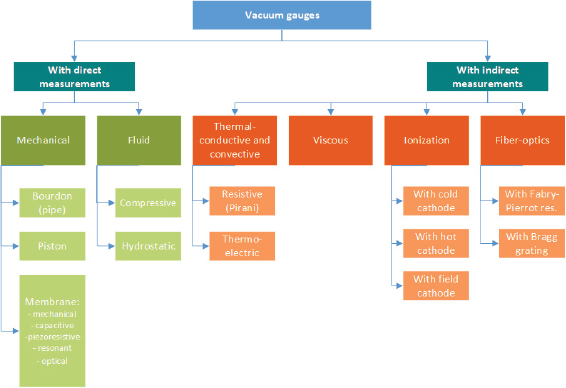
Fig. 1.
Classification of vacuum gauges by operating principle/structure, based on [10–15]
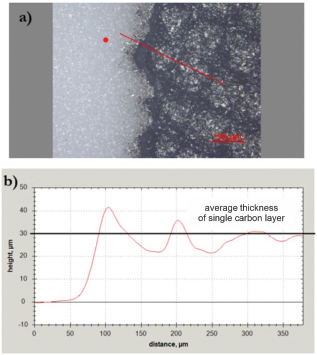
Fig. 2.
Optical microscope imaging results: a) top view of the structure with the thickness testing trajectory (red line), b) thickness profile of the tested structure according to the set trajectory
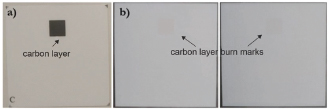
Fig. 3.
Samples: a) before firing, b) after firing using different two-stage temperature profile
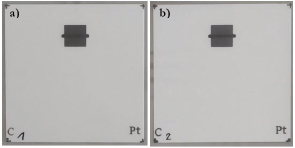
Fig. 4.
Structures of platinum bridge directly on Al2O3 substrate before firing: a) 1 SVM layer, b) 2 SVM layers
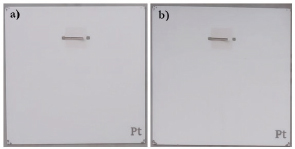
Fig. 5.
Structures of platinum bridge directly on alundum substrate after firing in a chamber furnace: a) 1 SVM layer, b) 2 SVM layers
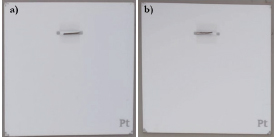
Fig. 6.
Structures of platinum bridge directly on alundum substrate after belt furnace firing: a) 1 SVM layer, b) 2 SVM layers
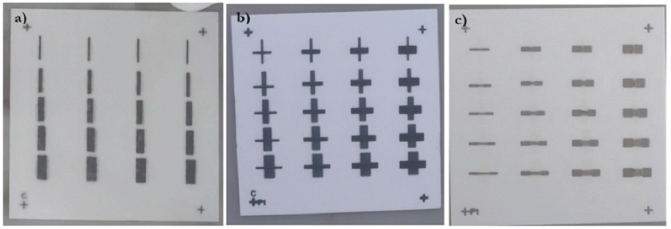
Fig. 7.
Matrix of platinum bridges with different geometries: a) after application of carbon layer, b) after application of platinum layer, c) after firing
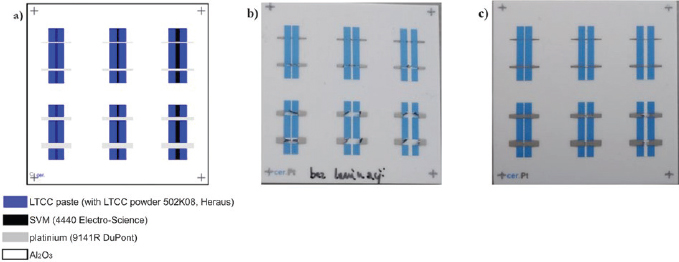
Fig. 8.
Platinum bridge structures on ceramic supports: a) design pattern, b) fired structures without the lamination process, c) fired structures with the lamination process before firing
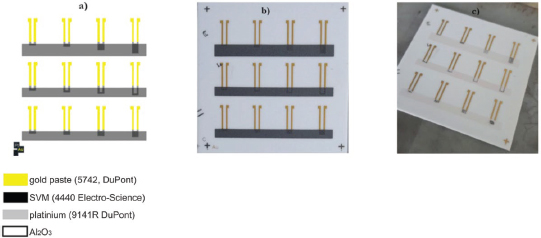
Fig. 9.
One-sided structures: a) design pattern, b) unfired structures, c) fired structures
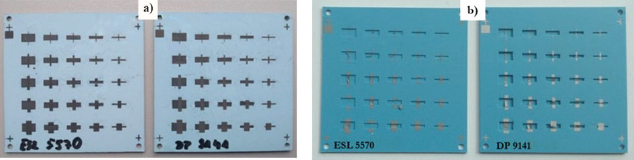
Fig. 10.
LTCC platinum bridges: a) after screen printing of the platinum layer, b) after the firing process
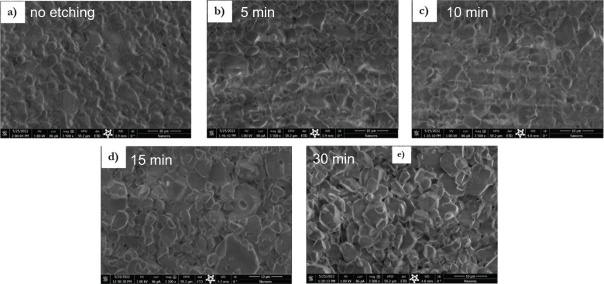
Fig. 11.
Surface characterization using SEM/Ga-FIB of FEI Helios Nanolab 600i (operating voltage and current of 1 kV and 86 μA, respectively) for Al2O3 samples: a) without etching and after etching for: b) 5 min, c) 10 min, d) 15 min, e) 30 min
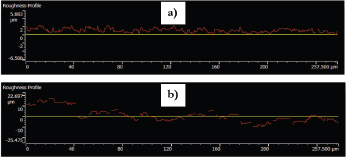
Fig. 12.
Surface roughness profile of alundum substrates: a) before etching, b) after etching in KOH for 30 min and ?380 °C
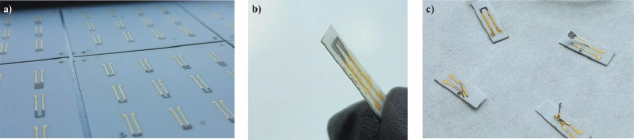
Fig. 13.
Al2O3 wet etching process in KOH: a) structures before etching, b) acceptable result, c) unacceptable result
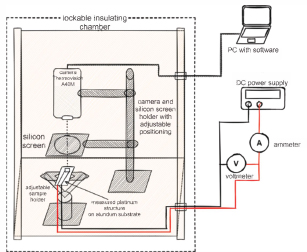
Fig. 14.
Schematic diagram of the bench for thermal measurements of a platinum thermionic cathode
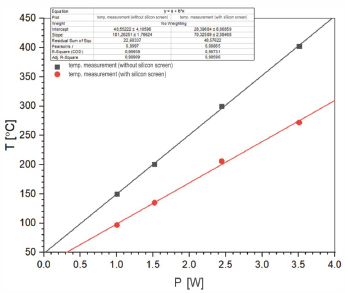
Fig. 15.
Calibration curves of the measurement station using a thermal imaging camera
Table 1.
Calibration measurements for silicon shutter bench
| Supply current I [A] | Supply voltage U [V] | Power P [W] | Structure temp. without shutter T [°C] | Structure temp. with shutter TSi [°C] | Loss rate TSi/T [%] |
|---|---|---|---|---|---|
| 0.33 | 3.05 | 1.0065 | 150 | 97 | 64.7 |
| 0.386 | 3.94 | 1.52084 | 201 | 135 | 67.2 |
| 0.45 | 5.43 | 2.4435 | 300 | 206 | 68.7 |
| 0.5 | 7.02 | 3.51 | 402 | 272 | 67.1 |
| Mean | 66.925 | ||||
| Standard deviation | 1.654 |
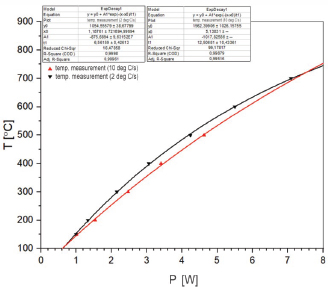
Fig. 16.
Temperature dependence of platinum planar structures as a function of applied electrical power
Table 2.
Results of thermal measurements for planar platinum structures
| Supply current I [A] | Supply voltage U [V] | Power P [W] | Structure temp. Without shutter T [°C] | Structure temp. with shutter TSi [°C] = T·0.66925 |
|---|---|---|---|---|
| Measurement with rapid temperature rise | ||||
| 0.33 | 3.05 | 1.01 | 150 | 100.39 |
| 0.39 | 3.94 | 1.54 | 200 | 133.85 |
| 0.46 | 5.43 | 2.48 | 300 | 200.78 |
| 0.50 | 6.83 | 3.41 | 400 | 267.70 |
| 0.55 | 8.42 | 4.63 | 500 | 334.63 |
| Measurement with slow temperature rise | ||||
| 0.35 | 2.847 | 0.99645 | 150 | 100.39 |
| 0.39 | 3.44 | 1.33 | 200 | 133.85 |
| 0.46 | 4.73 | 2.15 | 300 | 200.78 |
| 0.51 | 6.02 | 3.06 | 400 | 267.70 |
| 0.56 | 7.52 | 4.24 | 500 | 334.63 |
| 0.611 | 9.00 | 5.50 | 600 | 401.55 |
| 0.66 | 10.70 | 7.09 | 700 | 468.48 |
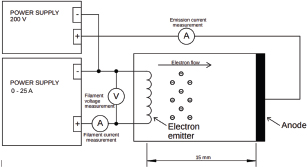
Fig. 17.
Experimental setup (emission performance)
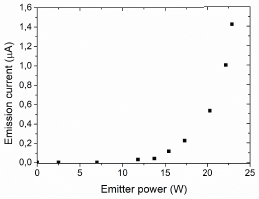
Fig. 18.
Emission current vs thermionic cathode power