
1. Introduction
In recent years, Artificial intelligence (AI) models and tools, including Generative AI (GenAI), have been developed and implemented in many areas, revolutionizing the way companies, institutions, and individuals interact with technology within the Industry 5.0 paradigm (Hosseini et al., 2024). Chatbots and AI agents can boost the smart digital automation process of companies, driving effective business decisions and creating more efficient work conditions as well as smoother user experiences (Anagnoste et al., 2021; Savastano et al., 2024). More specifically, the term GenAI is commonly used to denote machine learning systems trained on vast datasets to generate outputs in response to user inputs (Sætra, 2023). This technology is distinguished by its ability to generate new and original content through the use of advanced deep learning models, such as transformative neural networks (Lv, 2023). One of the most widely recognized examples of GenAI is ChatGPT, developed by OpenAI (Ray, 2023), which has played a central role in fueling the surge of global interest in this technology. Its impact extends across multiple sectors, promoting both automation and process customization (Liang et al., 2024). As a large language model (LLM) designed for Natural language processing, it represents a class of machine learning models trained to generate human-like text through advanced deep learning techniques. The designation “large” refers to the massive datasets on which it has been trained, to the billions of parameters it incorporates, and features that enable the production of highly realistic and contextually coherent text. Since 2023, other GenAI models have also been released, including Gemini (Chen et al., 2025) and Copilot (Gupta et al., 2024), developed by Google DeepMind and Microsoft, respectively. While these technologies offer considerable advantages and opportunities, they also pose a number of challenges and limitations. From an ethical and privacy standpoint, one of the most pressing concerns relates to the lack of algorithmic transparency, a problem that has been widely debated in the literature for several years (e.g., Coglianese & Lehr, 2019; Pasquale, 2015; Rodrigues, 2020). A particularly salient issue concerns the way in which GenAI systems extract and reproduce content originally produced by human creators. In many cases, such content is incorporated into training datasets without the creators’ consent, leaving them with no control over the process. This situation raises the risk of human creators being displaced by AI, often without receiving any form of economic compensation or the right to object, thereby exposing a critical gap in the current regulatory frameworks governing data extraction and use in AI training (Zuboff, 2023). Another concern relates to the potential for cognitive atrophy: as AI increasingly undertakes cognitively demanding tasks, individuals may gradually lose the ability to perform these tasks independently over time (Sætra, 2019). Just as calculators, while simplifying complex computations, have also contributed to a gradual decline in individuals’ ability to perform mental arithmetic, ChatGPT may similarly have detrimental effects on writing skills by diminishing the need for critical reflection and personal creativity.
Finally, AI also raises significant concerns from an environmental perspective. Training and operating AI models require vast amounts of data, which in turn demand considerable processing capacity and, consequently, substantial energy consumption. For example, the training of a model such as ChatGPT-3, with 175 billion parameters, has been estimated to consume approximately 1,287 MW h of electricity annually (Alzoubi & Mishra, 2024). This high demand stems primarily from the energy-intensive operations of data centers, which process and store data and, above all, power and cool the servers (United Nations, 2024). Projections further indicate that the global electricity consumption of AI could reach 85–134 TWh by 2027 (de Vries, 2023). An even more aggressive forecast by the U.S. Department of Energy suggests that, by 2028, AI servers in the United States alone may consume between 150 and 300 TWh of electricity (Shehabi et al., 2024). In addition, data centers hosting AI servers are substantial consumers of water. For example, the training of ChatGPT-3 alone has been estimated to require approximately 700,000 L of fresh water annually (Li et al., 2023). Projections further suggest that, by 2027, global AI-related water demand could reach between 4.2 and 6.6 billion cubic meters, equivalent to four to six times Denmark’s annual water consumption (WC), or roughly half of the United Kingdom’s. Beyond water and energy demands, the production of the hardware required to run GenAI also depends on critical raw materials, which are frequently extracted under socially unsustainable conditions (Baldassarre & Carrara, 2025). Taken together, these issues underscore how the environmental and social externalities of AI extend well beyond its direct energy footprint, raising broader concerns for the long-term sustainability of digital technologies. From this point of view, among the methodologies used to quantify environmental impacts, one of the most established is Life cycle assessment (LCA), which refers to the ISO 14040 and 14044. Thus, the aim of this research is to assess the environmental impacts of GenAI, adopting the LCA methodology, to estimate the set of impacts associated with the entire life cycle of GenAI, going beyond the carbon footprint and water footprint (WF) analyses and including other impact categories, such as environmental toxicity and depletion of abiotic resources. In addition, given the increasing pressure on the use of global water resources, the WF (Hoekstra et al., 2011) was also incorporated into the LCA to assess water withdrawal and consumption in the various processes involved, both considering direct and indirect use. On the one hand, direct use refers to the water used in the operational processes of AI, e.g., in data center cooling systems, where it is used to dissipate the heat generated by the high computational load. On the other hand, indirect use includes the water needed for secondary processes related to the entire life cycle of AI (e.g., dilution of pollutants and waste produced in industrial processes). Thus, this research attempts to answer the following research question:
R1: What are the main environmental impacts arising from the development, deployment, and use of GenAI systems?
This research question holds theoretical relevance as it expands the application of LCA to an emerging class of digital technologies whose resource requirements are rapidly escalating. At the same time, it carries strong practical significance, given the growing adoption of AI across industries and its implications for corporate sustainability strategies, energy policy development, and evolving regulatory frameworks.
Existing literature offers valuable insights into how AI can enhance sustainability assessments, including its integration with LCA for predictive modeling and decision support. However, these contributions primarily examine AI as a tool for evaluating the environmental impacts of other systems, rather than as an object of assessment in its own right. As a result, knowledge concerning the direct and overall environmental footprint of AI technologies remains limited. Addressing this gap represents a crucial opportunity to provide policymakers, industry, and the academic community with an evidence-based understanding of the sustainability implications and concerns associated with AI deployment.
By evaluating GenAI across 18 environmental impact categories, integrating WF assessment, and advancing the application of LCA to digital technologies, this research aims to meaningfully contribute to the scholarly debate on the environmental consequences of AI.
The remainder of the study is organized as follows: Section 2 presents a review of the existing literature on AI and LCA; Section 3 describes the methodological framework adopted in this study, including goal and scope definition, inventory analysis, and impact assessment; Section 4 reports and discusses the results of the LCA and WF analyses; Section 5 outlines the managerial implications and policy recommendations; and Section 6 concludes the study by highlighting limitations and avenues for future research.
2. Literature review
To contextualize the study within the current scholarly developments, a Scopus search using the keywords “Life Cycle Assessment” AND “Artificial Intelligence” in article titles and abstracts identified 29 publications (Figure 1), 72% of which were published in the last 2 years. This sharp increase likely reflects the rapid diffusion of GenAI technologies, particularly following the public release of ChatGPT in late 2022, which has intensified academic and policy interest in the environmental implications of large-scale AI systems.
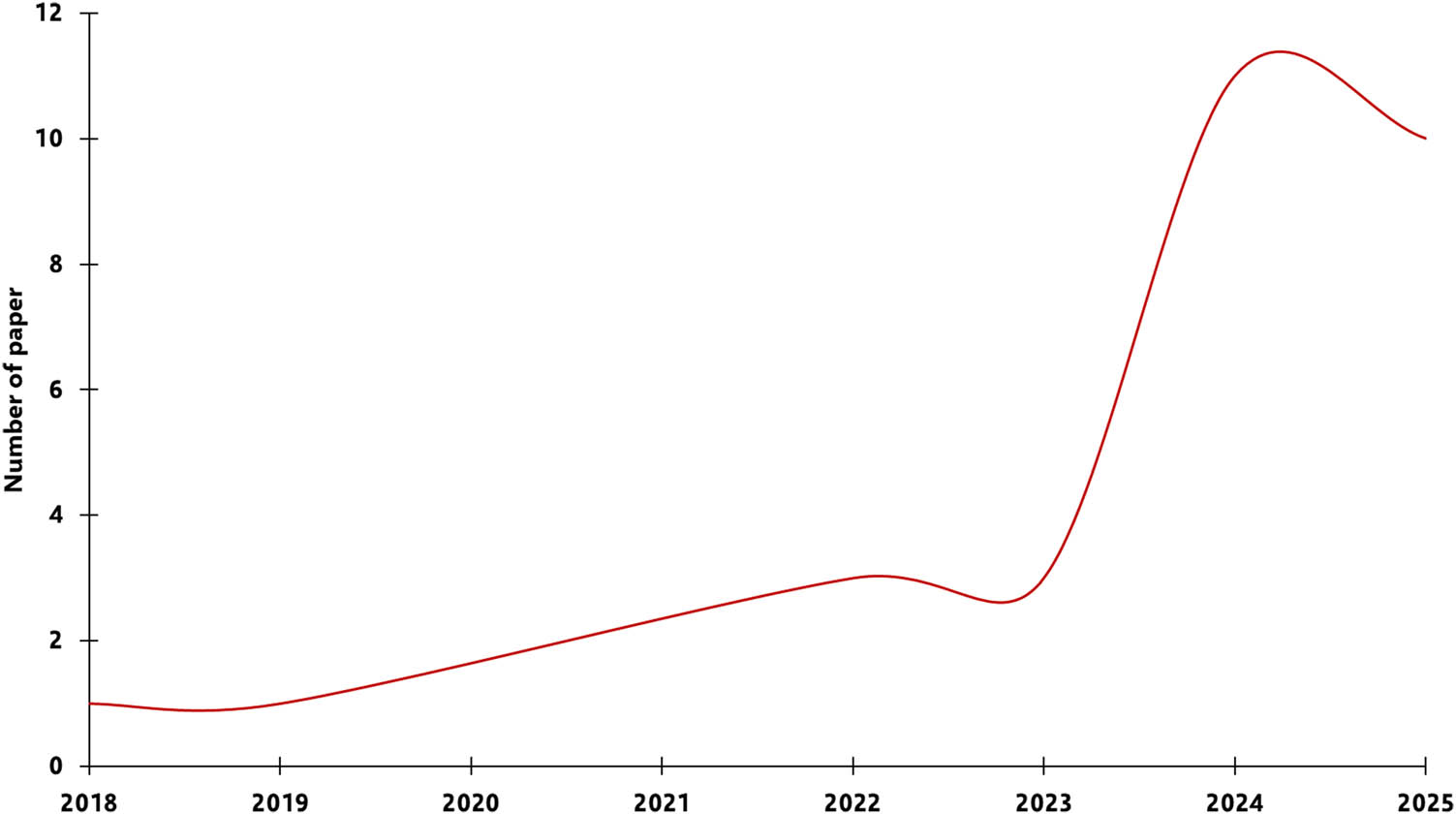
Figure 1
Trend of the scientific literature on “Life Cycle Assessment AND Artificial Intelligence” (Scopus) (2018–2025 ongoing).
Source: Author’s contribution.
From a geographical perspective, the most prolific contributors are Iran, China, the United States, and India. Several factors may explain this distribution. First, these countries already exhibit strong scientific output in LCA-related fields: Iran and India have longstanding traditions in applying LCA to energy and industrial processes, whereas the United States and China currently lead global publication outputs focused on AI. In addition, China and the United States host a significant share of the world’s high-performance computing infrastructure and data centers used for AI training, making these contexts especially conducive to research aimed at quantifying the environmental impacts of digital technological systems. Most of the studies concentrate on the practical applications of AI, rather than on a systematic evaluation of its environmental impacts. For example, Yu and Li (2025) combined LCA with system dynamics modeling to assess the potential of AI-enhanced anammox in industrial wastewater treatment. Similarly, Lamnatou et al. (2024) integrated AI and LCA to analyze its role in photovoltaics, smart grids, and small island economies.
In the building sector, Płoszaj-Mazurek and Ryńska (2024) applied machine learning, LLMs, and Building information modeling (BIM) technologies to improve sustainable design. Qaadan et al. (2024) investigated AI techniques for evaluating traction batteries, optimizing diagnosis, and end-of-life decision-making. Finally, Dokic et al. (2024) discussed the absence of universal standards for AI-specific LCAs, while identifying key factors that shape environmental impacts, such as energy mix, training time, algorithm efficiency, hardware configuration, and data center operations. Despite these contributions, most studies still neglect a comprehensive assessment of AI’s life cycle impacts. LCA is often employed to show how AI can support the environmental analysis of other systems, rather than to quantify AI’s own footprint. Ligozat et al. (2022) explicitly call for a holistic approach, urging the integration of LCA methodologies to capture all impact dimensions. At the same time, a growing body of research explores how AI and digital technologies (e.g., machine learning, LLMs, BIM) can be integrated with LCA to improve sustainability assessments (Ghoroghi et al., 2022; Nabavi-Pelesaraei et al., 2018; Popowicz et al., 2024; Salla et al., 2025). In sum, while existing studies illustrate promising applications of AI within LCA, a significant research gap remains in the systematic quantification of AI’s own environmental impacts across its life cycle. Literature shows that current contributions tend to be fragmented, focusing on isolated applications in specific sectors (e.g., energy, construction, transport) without providing a comprehensive methodological framework. Furthermore, recent research, such as Plociennik et al. (2025), highlights how the systematic assessment of the life cycle of AI technology should not be limited for calculating CO2 eq, but should take into account a broader set of environmental impact indicators, ranging from resource depletion to human toxicity and WC, while also incorporating upstream and downstream processes. Therefore, in light of these considerations and the research gaps identified in the literature, this article applies a comprehensive LCA to GenAI, assessing its environmental impacts across 18 impact categories and integrating the WF to capture wider resource implications. By doing so, the study advances the academic debate on AI sustainability and offers policymakers, industry, and researchers a more robust evidence base to support informed decision-making.
3. Methodology
3.1. LCA
The environmental impacts of GenAI were assessed using the LCA approach, described as the quantitative analysis and evaluation of the environmental impacts and effects of a product or technology system throughout its life cycle, as defined by the International Standardization Organization (ISO) in 2006. It is a methodology widely used in multiple fields, such as, for instance, agri-food (Zhang et al., 2025), wastewater management (Samsami et al., 2025), the energy sector (Afrinaldi et al., 2024), and transport (Muley & Singh, 2024). It refers to two specific standards, namely ISO 14040 and 14044. According to ISO 14040, each LCA consists of four basic steps: (i) goal and scope definition; (ii) Life cycle inventory (LCI); (iii) Life cycle impact assessment (LCIA), and (iv) interpretation, of which the first three are mandatory. Within this research, the first three mandatory steps were followed, detailed in this study.
3.1.1. Goal and scope definition
This phase involves the identification of the purpose, functional unit (FU), and system boundaries. Regarding the first aspect, this research aimed to assess the environmental impacts associated with the annual energy and WC of GenAI, with particular reference to ChatGPT-3. As a FU, the reference is the annual consumption of the model, both in terms of energy and water, i.e., 1,287 MW h of electricity (Alzoubi & Mishra, 2024) and 700,000 L of fresh water (Li et al., 2023). As system boundaries, only the water and energy consumption associated with the development and training phase of the model were considered, excluding consumption during daily use by users, thus following a gate-to-gate perspective.
3.1.2. LCI
Since this is a preliminary analysis, the data used for this research were extracted exclusively from the literature (i.e., secondary data), also considering how the direct estimation of these values is widely variable. Particularly, annual energy consumption values for training ChatGPT-3 were taken from the study of Alzoubi and Mishra (2024), who estimated that the model requires approximately 1,287 MW h of electricity per year. For WC, the reference data were drawn from Li et al. (2023), who calculated that training ChatGPT-3 directly requires around 700,000 L of freshwater annually, largely attributable to cooling processes in data centers. These sources were selected because they represent some of the most recent and widely cited studies quantifying the energy and water requirements of large GenAI models. However, it should be stressed that the use of validated data from scientific literature makes it possible to construct a representative picture of the environmental impacts of GenAI, while being aware that these values may vary depending on the specific infrastructure, the energy efficiency of the data centers, and the energy source used. Furthermore, in this research, only peer-reviewed or institutionally validated studies were considered, thus ensuring the reliability of the baseline values adopted. Nevertheless, the use of secondary data implies that the present analysis should be interpreted as exploratory, aimed at outlining the potential magnitude of GenAI’s impacts and identifying key environmental hotspots, rather than providing an exact quantification of resource use. Future research should collect primary data directly from AI developers and data center operators to obtain more precise and context-specific life cycle inventories.
3.1.3. LCIA
For the environmental impacts assessment, the ReCiPe 2016 Midpoint method was selected (Huijbregts et al., 2017), following an individualistic perspective (20 years), focusing on short-term impacts. The ReCiPe methodology was selected for three main reasons. First, it is widely recognized and used in LCA studies, as stated by Schmidt Rivera et al. (2020). As a robust and standardized method, it aligns with ISO 14040/44 guidelines and integrates the latest scientific developments, ensuring reliable and comparable results. Second, compared to other evaluation methods such as ILCD 2011, CML 2001, IMPACT 2002+, or TRACI, ReCiPe is distinguished by the inclusion of 18 impact categories. Specifically, it includes more categories compared to 16 in ILCD 2011 MidPoint, 15 in IMPACT 2002+, 11 in CML-IA Baseline, and 9 in TRACI. This broader coverage makes ReCiPe capable of capturing a more holistic and accurate spectrum of environmental impacts. By focusing on detailed intermediate indicators (Midpoint), it provides a quantitative and granular analysis of specific environmental impacts, which is particularly relevant for studies aiming to compare processes or techniques. Third, ReCiPe 2016 Midpoint is particularly well-suited to identify trade-offs and differences between two technological systems, such as the two industrial production techniques, as it returns results based on physical quantities (e.g., kg, etc.). The 18 impact categories considered, grouped into 4 macro-areas, are as follows and include:
Atmospherical effects (this category covers the impact of emissions on air quality and climate): Global warming potential (GWP); Stratospheric ozone depletion (SOD); Ionizing radiation (IR); Ozone formation, human health (OFHH); Fine particulate matter formation (FPMP); Ozone formation, terrestrial ecosystems (OFTE); Terrestrial acidification potential (TAP).
Eutrophication (this category assesses nutrient pollution in water bodies, leading to excessive algae growth and oxygen depletion): Freshwater Eutrophication Potential and Marine Eutrophication Potential.
Toxicity (this category evaluates the harmful effects of pollutants on living organisms): Terrestrial ecotoxicity (TEC); Freshwater ecotoxicity (FEC); Marine ecotoxicity (MEC); Human carcinogenic toxicity (HCT); Human non-carcinogenic toxicity (HNCT).
Abiotic resources (this category measures the depletion of non-living natural resources): Land use (LU); Mineral resources scarcity (MRS); Fossil resources scarcity (FRS); WC.
The software SimaPro Craft 10.2 was used for the impact analysis.
3.2. Water footprint
WF is an environmental indicator that measures the total volume of freshwater consumed, used, or polluted to produce goods and services throughout their supply chain. It was introduced by Arjen Hoekstra in 2002 (Hoekstra et al., 2011) and is now widely used to assess the water impact of products, companies’ processes, and entire industrial sectors. For the calculation, equation (1) was used
Where:is the blue WF, i.e., water withdrawn from surface and groundwater sources (lakes, rivers, aquifers) and not returned to the local ecosystem since evaporated, incorporated into products, or transferred elsewhere. For example, water is used for cooling industrial processes.
is the green WF, namely, rainwater stored in the soil and used by plants for growth. For example, in the case of GenAI, if biomass or natural raw materials are used in the energy mix.
is the grey WF, or the volume of water needed to dilute the pollutants generated by a production process to levels acceptable by environmental standards.
SimaPro Craft 10.2 software was used for WF calculation.
4. Results and discussions
4.1. LCA
Following the described methodology, the results of the LCA are shown in Table 1. More in detail, the most significant environmental impacts concern GWP, IR, TEC, LU, and FRS. In particular, GWP showed the highest value, amounting to 767,814 kg CO₂ eq, highlighting the strong contribution of AI to greenhouse gas emissions. IR followed, with an impact of 190,145 kBq Co-60 eq, reflecting the potential damage due to the use of energy sources that generate IR.
Table 1
LCIA results for GenAI training, expressed across 18 impact categories.
| Impact categories | Unit | Total | Water | Electricity |
|---|---|---|---|---|
| Atmospherical impacts | ||||
| Global warming | kg CO2 eq | 767814.26 | 843.30 | 766970.97 |
| SOD | kg CFC11 eq | 0.20 | 0.001 | 0.20 |
| IR | kBq Co-60 eq | 190145.83 | 90.50 | 190055.33 |
| OFHH | kg NO x eq | 779.68 | 1.64 | 778.03 |
| FPMP | kg PM2.5 eq | 1454.96 | 0.96 | 1454.00 |
| OFTE | kg NO x eq | 783.06 | 1.64 | 781.41 |
| Terrestrial acidification | kg SO2 eq | 1607.23 | 2.52 | 1604.71 |
| Eutrophication | ||||
| Freshwater eutrophication | kg P eq | 589.54 | 0.44 | 589.10 |
| Marine eutrophication | kg N eq | 42.34 | 0.04 | 42.30 |
| Toxicity | ||||
| TEC | kg 1.4-DCB | 13283.52 | 51.84 | 13231.68 |
| FEC | 954.52 | 2.73 | 951.79 | |
| MEC | 406.16 | 1.21 | 404.95 | |
| HCT | 35.09 | 0.24 | 34.85 | |
| HNCT | 824.07 | 3.17 | 820.90 | |
| Abiotic resources | ||||
| LU | m2a crop eq | 28485.60 | 31.69 | 28453.92 |
| MRC | kg Cu eq | 556.29 | 3.87 | 552.42 |
| FRC | kg oil eq | 184690.84 | 195.53 | 184495.31 |
| WC | m3 | 4928.78 | 701.61 | 4227.18 |
Source: Authors’ own research.
TEC stands at 13,283 kg 1.4-DCB eq, indicating a significant risk of contamination of TEC by toxic substances released along the production chain. LU reaches 28,485 m2a crop eq, and finally, FRS amounts to 184,690 kg oil eq, highlighting the high dependence on fossil fuels for the generation of energy needed to run the AI systems. Each impact category is analyzed separately in this study to provide a clearer understanding of the results.
4.1.1. GWP
Regarding GWP, as also shown by the International Energy Agency (IEA, 2020), CO2 emissions are due to the burning of fossil fuels for electricity generation. Today, data centers operate 24/7 and mostly derive their energy from fossil fuels, although there are increasing efforts to utilize renewable energy resources (Bennagi et al., 2024). Most of the energy in a data center is used to run processors and chips. Like other computer systems, AI systems process information using zeros and ones. Every time a bit changes its state between one and zero, it consumes a small amount of electricity and generates heat. Since servers must be kept cool to function, about 40% of electric data center usage goes to massive air conditioners and cooling systems. Without them, servers would overheat and fail (Cho, 2023). For comparison, a typical passenger vehicle emits about 4.6 t CO2 eq/year (EPA, 2024), although this figure varies depending on the number of kilometers driven. This means that AI's emissions could be equivalent to the consumption of about 167 cars in a year. Similarly, a London-New York round-trip flight emits about 1.9 t CO2 eq, which means that annual AI emissions are equivalent to more than 400 round-trip flights between London and New York.
4.1.2. IR
The US National Cancer Institute defines IR as “radiation generated by X-ray procedures, radioactive substances, rays entering the earth's atmosphere from outer space, and other sources.” At high doses, such radiation can increase chemical activity within cells, which can have health consequences, including an increased risk of cancer (Tulchinsky et al., 2023). The main sources of IR include radon, X-rays, radioactive materials emitting alpha, beta, and gamma radiation, as well as cosmic rays from the sun and space (Gupta, 2018). There is, therefore, always a level of background radiation from natural sources, although IR is also derived from artificial sources within a wide range of sectors, such as nuclear power generation. In more detail, in the case of this research, the IR value is 190.145 kBq Co-60 eq, which reflects the dependence on the regional energy mix used to power the data centers: where a significant proportion of electricity comes from nuclear power plants, the IR indicator is particularly high, as shown in this study. Consequently, these results reflect how, in strategic decision-making processes, the location of data centers, the composition of the energy mix, and the degree of dependence on nuclear energy should also be considered in particular depth.
4.1.3. TEC
Considering TEC, the 13,283 kg 1.4-DCB eq value could be due to hydraulic fracturing for the extraction of fossil fuels, including shale gas (used in thermal power plants to generate electricity, often replacing coal) (Chen et al., 2017), leading to contamination of groundwater and, consequently, drinking water. This is due to accidental leaks and spills of fracturing fluids containing toxic chemicals or improper disposal of wastewater containing heavy metals, hydrocarbons, and other toxic contaminants. In this context, toxic substances could be introduced into the aquatic and terrestrial environment, affecting biodiversity and living organisms. This value is comparable to the emissions generated by applying about 300 L of pesticides on 1 ha of agricultural land, which corresponds to roughly 130 kg of 1.4-DCB eq (Wernet et al., 2016). Therefore, the TEC associated with AI is equivalent to that generated by treating about 102 ha of land with pesticides.
4.1.4. LU
Regarding LU (28,485 m2a crop eq, which can be approximated to the surface of four football fields), the impact of AI would be equivalent to the production of about 77.03 kg of lamb meat (369.81 m2), 87.32 kg of beef meat (326.21 m2), and 324.47 kg of cheese (87.79 m2) (Poore and Nemecek, 2018). This is quite a large area for something as intangible as AI, comparable to the high-impact agricultural and livestock production, such as red meat and dairy products.
4.1.5. FRS
Finally, the impact of AI on FRS amounts to 184,690 kg oil eq, or the equivalent of about 184.7 tons of oil. This corresponds to the combustion of approximately 615 barrels of oil (a barrel contains about 159 L and a liter of oil weighs about 0.85 kg), equivalent to the annual fossil energy consumption of 116 people in Romania (whose average consumption is 1,592 kg oil eq per person/year), 74 people in Italy (whose average consumption is 2,482 kg oil eq per person/year), and 28 people in the USA (whose average consumption is 6,482 kg oil eq per person/year) (OECD/IEA, 2014).
4.2. WF
Finally, the WF results showed that training ChatGPT-3 could induce a consumption of 5.159 m3/year of water, considering together WFblue, WFgreen, and WFgrey. To provide an idea, this figure would correspond to approximately the entire annual needs of a person in an EU country with an average water supply (which is about 4,000–5,000 m3 per year) or 100–130 times the annual consumption of an average European citizen (which is about 40–50 m3 per inhabitant) (Eurostat, 2024). In this context, in the case of AI, the use of blue water is mainly related to data center cooling systems. In fact, AI models, especially large ones such as ChatGPT, Gemini, or Copilot, require powerful computing infrastructures that generate enormous amounts of heat. To avoid overheating, server farms use water cooling systems, drawing large volumes of fresh water that are then evaporated or discharged with temperature variations (Azarifar et al., 2024). Another important aspect of the use of blue water in AI concerns the production of electricity needed to operate the infrastructure.
If the electricity comes from thermal power plants, a large amount of water is used for cooling generators and electrical towers. Green water, although less evident in AI-related processes, could manifest itself mainly in the production of hardware infrastructure, e.g., through the cultivation of biomass to produce bioplastics or electronic components. Finally, grey water in this field is often related to the use of water to dilute the release of toxic chemicals, including heavy metals, solvents, acids for chip production, or drilling waste to extract fossil fuels with which to produce electricity (Miglietta et al., 2017; Hess, 2024).
5. Managerial implications and policy recommendations
Building on the evidence presented, policymakers, regulatory bodies, and technology firms are encouraged to collaboratively develop strategies that reduce the environmental impact of AI. These strategies can address both technical and systemic aspects of AI deployment, ensuring its alignment with broader sustainability goals (i.e., European Green Deal and the UN Sustainable Development Goals). To do that, these stakeholders should approach a 360-degree strategy, as follows:
At the infrastructure level, strategies include placing large data centers in locations where energy can be more easily sourced from renewable networks, thereby reducing reliance on fossil fuels for system operation. Additional measures would involve the development of innovative cooling solutions, for instance, the underwater data centers piloted by Microsoft, which leverage natural oceanic cooling and nearby wind power. Similar benefits could be achieved by situating facilities in naturally cold regions, where ambient temperatures reduce the need for energy-intensive thermal management. Furthermore, improving hardware efficiency and scheduling AI model training during off-peak or overnight hours, when energy demand is lower, can help optimize overall consumption.
At the software and algorithmic level, interventions should also deliver significant benefits. Examples include designing modular training schedules aligned with periods of lower grid load and promoting the development of lightweight or “green” models optimized for energy and water efficiency.
At the regulatory and reporting level, standards may exert a high-leverage effect. Introducing mandatory sustainability disclosures for AI development, analogous to environmental impact assessments required for physical infrastructure, could strengthen transparency and accountability. In parallel, governments and institutions may establish certification frameworks, such as “AI Sustainability Labels,” capable of classifying models based on lifecycle impacts and guiding more informed procurement decisions across both public and private sectors.
At the cross-sectoral collaboration level, coordinated action should be actively promoted. Public–private partnerships could support R&D into advanced cooling technologies, such as passive heat-exchange systems or liquid-immersion cooling, with potential applications extending well beyond AI infrastructures.
Finally, at the organizational level, educational and awareness programs are essential. Organizations that implement GenAI models should ensure that employees and decision-makers are adequately informed about the environmental implications associated with the deployment and use of AI systems. In addition, sustainability-related key performance indicators can be integrated into the performance evaluation of digital transformation initiatives, ensuring that considerations of environmental efficiency become an integral part of discussions on AI return on investment. The implementation of these strategies could contribute significantly to reducing the environmental impact of AI, making it a more sustainable technology in the long term.
6. Conclusion, limitations, and future research directions
The results of the present LCA-based study highlight the considerable environmental burden of AI, demonstrating that its operation entails the consumption of vast amounts of energy and material resources, while generating substantial emissions across multiple impact categories, with consequences comparable to those observed in resource- and emission-intensive industrial sectors.
It should be emphasized that the present analysis provides a representative, albeit necessarily indicative, approximation of the environmental impacts associated with AI. The objective is to elucidate the potential order of magnitude of these impacts rather than to deliver a comprehensive or fully parameterized quantification. The estimates reported are intentionally conservative; however, they may understate the true extent of the impacts, which could be substantially higher under certain real-world conditions. Such variability is driven by multiple context-specific factors, including the operational energy efficiency of data centers, the relative contribution of renewable vs fossil-based sources within the electricity mix, the geographical and infrastructural characteristics of the hosting environments, and the particular technical and operational configurations of the AI systems themselves. Moreover, such variables often interact in nonlinear ways, meaning that localized improvements in one domain (e.g., hardware efficiency) may be offset by adverse developments in another (e.g., reliance on carbon-intensive energy grids). These variables, taken together, suggest that while the current estimates offer a significant and useful baseline, they should be interpreted with caution and complemented by further research to account for context-specific variations.
Despite this limitation, the exploratory findings of this study significantly contribute to highlighting the potential magnitude of the impacts associated with the rapidly growing global phenomenon of GenAI. By shedding light on these implications, the study serves as a warning to big tech companies and governments regarding the unintended consequences of further developing and adopting this technology, which underpins the paradigm shift toward Industry 5.0.
This study, based on its assumptions and results, can also contribute to a brief research agenda for future developments in this field from a sustainable perspective. Indeed, future studies could focus on obtaining more precise assessments of specific GenAI agents’ environmental impact by collecting and analyzing primary data on energy consumption, hardware usage, and data center efficiency.
In addition, by concentrating on geographical variations in AI Impact, future research could assess how AI’s environmental impact varies based on regional energy grids, regulations, and climate conditions, helping tailor sustainability strategies. Finally, it would be crucial to further investigate how governments and organizations can regulate AI development to promote environmental sustainability, including potential carbon footprint disclosures and energy consumption benchmarks.
Funding information
Authors state no funding involved.
Author contributions
All the authors have contributed equally.
Conflict of interest statement
Authors state no conflict of interest.