
Introduction
Biodiversity representing variation within genetic resources at gene, population, species and ecosystem level is our heritage that makes a key contribution to well-being and sustainable development (Hassan, 2018). Plant genetic resources encompass cultivated varieties, local landraces, wild relatives, and materials preserved in gene banks. These resources are utilized in the improvement of traits such as resistance to diseases and pests, tolerance to abiotic stresses like drought and salinity, and enhancements in yield and quality (Ulukan, 2011; Swarup et al., 2020; Şahin et al., 2020; Salgotra and Chauhan, 2023; Simionca-Mărcășan et al., 2023).
As mentioned above, like plant genetic resources, fruit genetic resources also constitute a fundamental basis for both sustainable agriculture and the environment, as well as for breeding programs. In many regions of the world, studies focusing on the identification, characterization, and conservation of genetic resources in various plant species are gaining importance. Türkiye is particularly significant for fruit genetic resources and diversity, situated at the junction of the Near Eastern and Mediterranean Centers of Diversity. It encompasses three phytogeographical regions Euro-Siberian, Mediterranean, and Irano-Turanian resulting in high plant diversity and endemism due to the varied environmental conditions (Karagöz, 2001). The identification, collection, characterization, and evaluation of genetic resources are of strategic importance for both biodiversity assessment and conservation, as well as for breeding programs. Being the center of origin, or one of the centers of origin, for many economically and commercially important fruit species, Türkiye possesses a rich diversity of fruit genetic resources. In nearly all regions of Türkiye, studies have been conducted on the identification of genetic resources in different fruit species such as apple, pear, plum, sweet cherry, apricot, fig, chestnut, hawthorn, and quince (Akça and Sen, 1990; Asma et al., 2007; Caliskan and Polat, 2008; Serdar et al., 2014; Öz and Aslantaş, 2015; Şahin et al., 2020; Akca and Bostan, 2022; Bakɪr et al., 2022; Taşkın and Ercişli, 2025; Yavuz et al., 2025).
As evidenced by previous studies, Türkiye, being one of the centers of origin for many fruit species, possesses remarkable richness in fruit genetic resources. Among these fruit species, quince (Cydonia oblonga Miller) which has experienced rapid production growth over the past decade is emerging as a strategically important crop for Türkiye, due both to the country being one of its centers of origin and to its leading position in global production and export. Numerous selection studies on quince genetic resources have been conducted in different regions of Türkiye including Central Anatolia (Güngör, 1989), Aegean Region (Ercan et al., 1992; Şahin 2017), Eastern Marmara Region (Şahin et al., 2020). Kayseri province and its districts (Çil, 2014; Uzun et al., 2020), and Yozgat province and its districts (Koç and Keleş, 2018). These studies demonstrate that, with the exception of Bilecik province, quince genetic resource research has been carried out extensively across the country.
In Türkiye, where fruit growing has had a long history, completed and ongoing pomological studies have shown how valuable local genotypes are in different areas and brought many forgotten types back into the spotlight (Akça and Sen, 1990). Nonetheless, specific areas remain unexamined, and many genotypes have yet to be identified (Akça and Sen, 1990). In this context, it is significant that, despite the plentiful quince genetic resources, no systematic selection studies have been undertaken in Bilecik province, highlighting a considerable deficiency in the characterization and application of local quince germplasm.
As no previous research has been conducted on quince genetic resources in this region, our work specifically aims to identify the phenological and pomological characteristics of local genotypes in Bilecik, thereby contributing to the national efforts on quince germplasm and cultivar improvement.
Material and Methods
Plant material
Five quince genotypes, identified in surveys conducted at two major villages of Bilecik province (Fig. 1) in the Southeast Marmara Region, were used as plant material.
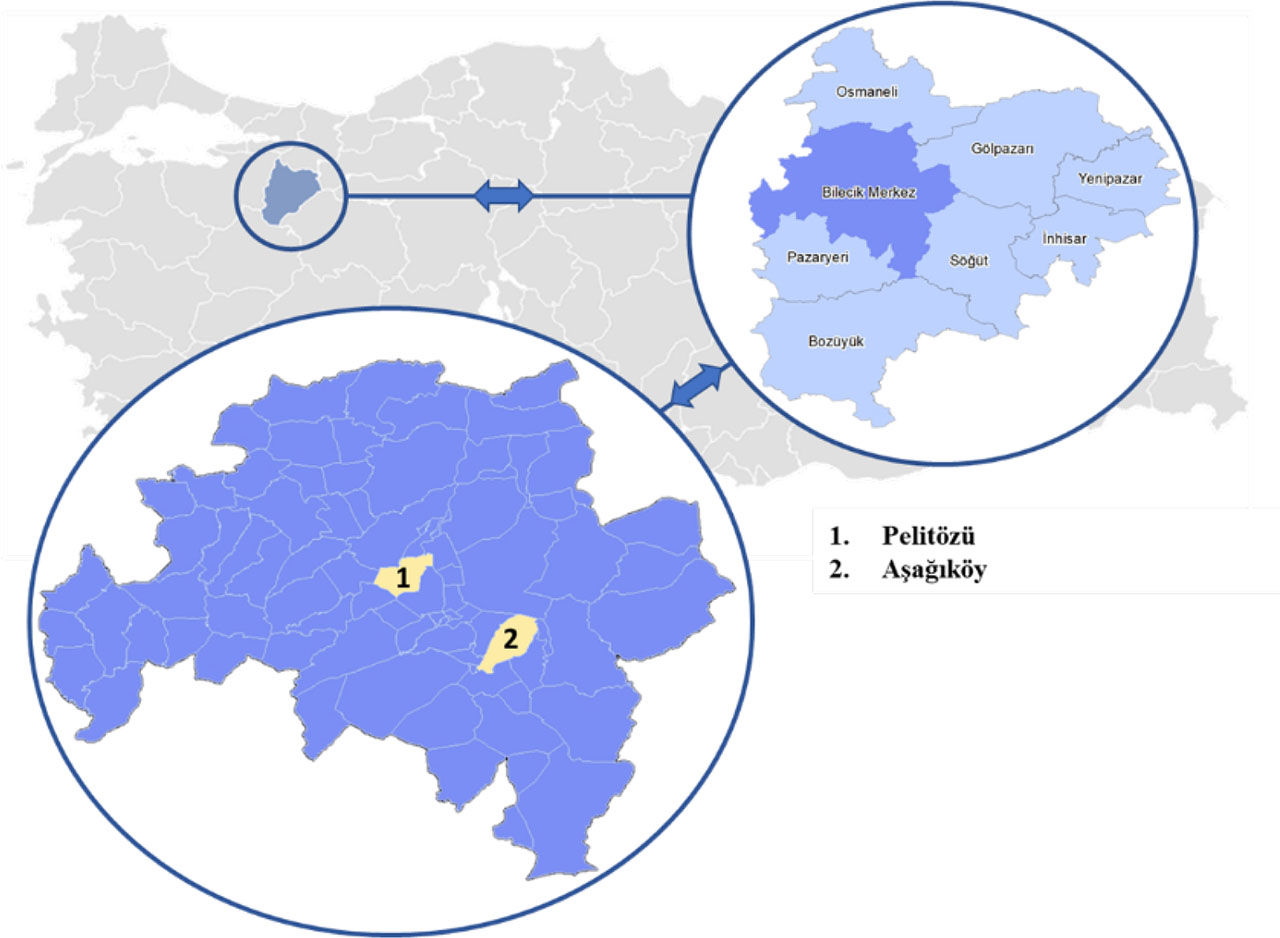
Fig. 1:
Collection locations of selected quince genetic resources.
Morphological and pomological observations and measurements
In the study, 21 characters included in the current quince trait document prepared by the International Union for the Protection of New Varieties of Plants (UPOV 2003) were evaluated as measurable characters and non-measurable characters.
Leaf blade width, leaf blade length, petiole length, fruit width, fruit length, and fruit weight were evaluated as measurable (quantitative) traits, while all other traits were classified as non-measurable (qualitative) characteristics.
Fruit width, length and weight parameters were added instead of fruit size (UPOV Characteristic no: 26). Among the features included in the document, only the criteria related to leaf and fruit features were examined (Tab. 1).
Tab. 1:
Descriptors used for the morphological and pomological characterization according to the UPOV TG/100/4 guidelines (UPOV 2003).
| Upov No | Characteristic | Note | State of expression |
|---|---|---|---|
| 9 | Leaf blade: attitude | 1 | Upright |
| 2 | Horizontal | ||
| 3 | Downwards | ||
| 10 | Leaf blade: length | 3 | Short |
| 5 | Medium | ||
| 7 | Long | ||
| 11 | Leaf blade: width | 3 | Narrow |
| 5 | Medium | ||
| 7 | Broad | ||
| 12 | Leaf blade: shape | 1 | Elliptic |
| 2 | Circular | ||
| 3 | Ovate | ||
| 4 | Ovate | ||
| 13 | Leaf blade: shape of base | 1 | Cuneate |
| 2 | Rounded | ||
| 3 | Truncate | ||
| 4 | Cordate | ||
| 14 | Leaf blade: angle at apex (excluding pointed tip) | 1 | Acute |
| 2 | Right-angled | ||
| 3 | Obtuse | ||
| 15 | Leaf blade: length of tip | 3 | Short |
| 5 | Medium | ||
| 7 | Long | ||
| 16 | Leaf blade: profile in cross section | 1 | Straight |
| 2 | Concave | ||
| 17 | Leaf blade: undulation of margin | 1 | Absent or very weak |
| 3 | Weak | ||
| 5 | Medium | ||
| 7 | Strong | ||
| 18 | Petiole: length | 3 | Short |
| 5 | Medium | ||
| 7 | Long | ||
| 27 | Fruit: general shape in longitudinal section | 1 | Elliptic |
| 2 | Circular | ||
| 3 | Square | ||
| 4 | Obovate | ||
| 5 | Pyriform | ||
| 29 | Fruit: neck | 1 | Absent |
| 9 | Present | ||
| 30 | Fruit: length of neck | 3 | Short |
| 5 | Medium | ||
| 7 | Long | ||
| 31 | Fruit: prominence of ribs at stalk end | 1 | Absent or very weak |
| 3 | Weak | ||
| 5 | Medium | ||
| 7 | Strong | ||
| 32 | Fruit: prominence of ribs at calyx end | 1 | Absent or very weak |
| 3 | Weak | ||
| 5 | Medium | ||
| 7 | Strong | ||
| 33 | Fruit: stalk cavity | 1 | Absent or very weak |
| 3 | Weak | ||
| 5 | Medium | ||
| 7 | Strong | ||
| 34 | Fruit: size of eye basin | 3 | Small |
| 5 | Medium | ||
| 7 | Large | ||
| 35 | Fruit: color | 1 | Yellow-green |
| 2 | Yellow | ||
| 3 | Yellow-orange |
All measurable characteristics were assessed on 10 fruits and leaves per tree. Fruit and leaf measurements were carried out using a mechanical vernier caliper. Subsequent to assessing the geometric measurements, the fruits were weighed using a digital balance with an accuracy of 0.1 g.
Statistical analysis
For measurable characters, variance analysis was performed on the data obtained from morphological and pomological analyses using JMP 13.0 pro statistics package program, and the means with differences between them were grouped using LSD multiple comparison test. Min., Max., Mean, and coefficient of variation (CV) values of all traits were determined.
Correlation analyses were performed between measurable traits to determine the relationships between traits. In terms of measurable and un-measurable characters, the score values and numerical results of quince genotypes from UPOV criteria were subjected to two-way cluster and heat map analysis, and the results were interpreted on the obtained morphological dendogram.
Results and Discussion
As a consequence of variance analysis, differences between genotypes were confirmed to be statistically significant for all measurable characteristics evaluated (Tab. 2). When looked at in general, the highest results in terms of leaf characteristics were obtained from the genotypes YG-11-4 and YG-11-5, whereas the genotype YG-11-1 came to the fore in terms of fruit features (Tab. 2).
Tab. 2:
Results of measurable fruit and leaf traits of quince genotypes
| Genotype no | Leaf blade: length (cm) | Leaf blade: width (cm) | Petiole: length (cm) | Fruit width (mm) | Fruit length (mm) | Fruit weight (g) |
|---|---|---|---|---|---|---|
| YG-11-1 | 8.39±0.11 B | 7.30±0.11 AB | 1.15±0.05 D | 72.07±1.45 A | 79.58±1.21 A | 189.70±10.52 A |
| YG-11-2 | 8.14±0.25 B | 6.66±0.12 C | 1.27±0.07 CD | 68.08±1.34 B | 73.82±1.89 B | 147.15±8.88 B |
| YG-11-3 | 8.72±0.28 B | 6.96±0.27 BC | 1.43±0.1 BC | 61.60±1.71 C | 72.19±1.18 B | 123.76±8.31 C |
| YG-11-4 | 10.20±0.3 A | 7.29±0.22 AB | 1.72±0.14 A | 44.70±0.63 E | 56.65±0.62 D | 50.74±1.57 E |
| YG-11-5 | 9.62±0.39 A | 7.60±0.23 A | 1.54±0.11 AB | 49.83±1.43 D | 61.93±1.75 C | 68.03±4.75 D |
| P value | <.0001 | 0.0264 | 0.0012 | <.0001 | <.0001 | <.0001 |
Leaf blade: length and leaf blade: width values were highest in YG-11-5 genotype (9.62 cm, 7.60 cm, respectively) and were lowest in YG-11-2 genotype (8.14 cm, 6.66 cm, respectively). Petiole: length varied between 1.15 and 1.72 cm, with the YG-11-4 genotype having the greatest value (Tab. 2).
Leaf blade: length, leaf blade: width, and petiole length varied significantly among the quince genotypes chosen from the Eastern Marmara and Aegean regions of Türkiye (5.5–10.86 cm, 4.46–8.08 cm, and 0.45–2.22 cm, respectively) (Şahin, 2017). For the same traits, 28 genotypes from various parts of Iran showed values of 5.85–8.90 cm, 5.15–8.10 cm, and 0.76–2.01 cm (Mirabdulbaghia and Abdollahi, 2014). These Turkish and Iranian genotypes showed significant variations in the minimum and maximum values of leaf traits when compared to our study, underscoring the unique phenotypic variation found in genotypes from various geographic locations.
The evaluation of genotypes in terms of fruit traits revealed that fruit width, fruit length, and fruit weight ranged between 44.70–72.07 mm, 61.93–79.58 mm, and 50.74–189.70 g, respectively. Genotype YG-11-1 stood out as the genotype with the highest values compared to other genotypes in terms of fruit length, fruit width (mm), and fruit weight (g) and received the values of 79.58 mm, 72.07 mm and 189.70 g, respectively. On the other hand, the lowest fruit length, fruit width, and fruit weight values were determined in genotype YG-11-4.
The fruit sizes found in this study are either within or above the ranges provided for both locally grown and extensively grown quince varieties in Türkiye when compared to earlier reports. The average fruit width and length values of local cultivars in the Van region, for instance, ranged from 7.36 to 7.88 cm in ‘Memeli’, 7.58 to 7.34 cm in ‘Katırburnu’, and 8.33 to 7.92 cm in ‘Van Yerlisi’ genotypes (Tekintaş et al., 1991). In contrast, ‘Ekmek Ayvası’ ranged from 7.47 to 8.35 cm (Koyuncu et al., 1999). Sykes (1972) also reported fruit sizes of 8.7–8.6 cm for ‘Bencikli’, 8.9–9.8 cm for ‘Şekergevrek’, and 9–10.1 cm for ‘Havran’. Similarly, fruit weight, width, and length ranged from 109 to 975 g, 6.25 to 12.13 cm, and 5.60 to 13.75 cm, respectively, for quince genotypes chosen from the Eastern Marmara and Aegean regions of Türkiye (Şahin, 2017). Comparatively, quince genotypes chosen from various Pakistan ecological zones showed fruit weight values between 68.38 and 328.82 g (Shah et al., 2024). The adaptation and cultivation capability of 27 quince cultivars in tropical climates have been examined, with the maximum fruit weight recorded at 223.3 g (Coutinho et al., 2019).
However, the minimum fruit weight observed in our study (50.74 g in genotype YG-11-4) was lower than that reported for the genotype ‘Talash’ (68.38 g) (Shah et al., 2024). In our study, the highest fruit weight (189.70 g) was determined to be well below the maximum fruit weight (975.0 g) reported by Şahin (2017) for the ‘QFBNT20-3’ genotype. The ‘QFBNT20-3’genotype, locally called ‘Pit-bull’, maintains its distinction as the genotype with the highest fruit weight determined in the world so far. In contrast to many previously described cultivars, these comparisons suggest that some of the genotypes investigated in this study have a promising potential for fruit sizes.
The minimum, maximum, average values, and CV of the genotypes were assessed concerning the evaluated traits (Tab. 3). In our study, the highest CV were determined for fruit: neck length (136.93%), fruit: neck (104.32%), and leaf blade: undulation of margin (81.33%), whereas the lowest CV values were recorded for leaf blade: width (5.03%), leaf blade: length (9.62%), and fruit length (13.54%) (Tab. 3).
Tab. 3:
Descriptive statistics for leaf and fruit traits
| Upov No | Characteristic | Abbreviation | Min. | Max. | Mean | CV (%) |
|---|---|---|---|---|---|---|
| 9 | Leaf blade: attitude | LBA | 2 | 3 | 2.6 | 21.06 |
| 10 | Leaf blade: length (cm) | LBL | 8.14 | 10.2 | 9.01 | 9.62 |
| 11 | Leaf blade: width (cm) | LBW | 6.66 | 7.60 | 7.16 | 5.03 |
| 12 | Leaf blade: shape | LBS | 2 | 4 | 2.4 | 37.26 |
| 13 | Leaf blade: shape of base | LBSB | 2 | 4 | 2.8 | 29.88 |
| 14 | Leaf blade: angle at apex | LBAA | 2 | 3 | 2.8 | 15.97 |
| 15 | Leaf blade: length of tip | LBLT | 1 | 5 | 3 | 47.14 |
| 16 | Leaf blade: profile in cross section | LBPCS | 1 | 2 | 1.6 | 34.23 |
| 17 | Leaf blade: undulation of margin | LBUM | 1 | 5 | 2.2 | 81.31 |
| 18 | Petiole: length (cm) | PL | 1.15 | 1.72 | 1.42 | 15.72 |
| 27 | Fruit: general shape in longitudinal section | FGSLS | 3 | 4 | 3.6 | 15.21 |
| 29 | Fruit: neck | FN | 1 | 9 | 4.2 | 104.32 |
| 30 | Fruit: length of neck | FLN | 0 | 5 | 2 | 136.93 |
| 31 | Fruit: prominence of ribs at stalk end | FPRSE | 3 | 5 | 3.4 | 26.30 |
| 32 | Fruit: prominence of ribs at calyx end | FPRCE | 1 | 3 | 1.8 | 60.85 |
| 33 | Fruit: stalk cavity | FSC | 1 | 3 | 1.8 | 60.85 |
| 34 | Fruit: size of eye basin | FSEB | 3 | 5 | 3.4 | 26.30 |
| 35 | Fruit: color | FC | 1 | 2 | 1.6 | 34.23 |
| - | Fruit Length (mm) | FL | 56.65 | 79.58 | 68.83 | 13.54 |
| - | Fruit Width (mm) | FWi | 44.70 | 72.07 | 59.25 | 19.75 |
| - | Fruit Weight (g) | FWe | 50.74 | 189.70 | 115.87 | 49.24 |
Studies of different plant species indicate that when the coefficient of variance is less than 20%, there is a homogeneous distribution among the individuals tested, while values of 20% or more show high genetic diversity in the population under study, proving that CV can be effectively used as a variability indicator (Liu et al., 2020; Şahin, 2023). The coefficients of variation of the genotypes were assessed concerning the evaluated traits, indicating that this value over 20% was achieved in 66.67% of the traits analyzed (Tab. 3). The largest CV was observed for the trait Fruit: length of neck (136.93%), followed by Fruit: neck (104.32%) and Leaf blade: undulation of margin (81.31%) whereas the lowest CV values were recorded for Leaf blade: width (cm) (5.03%), Leaf blade: length (cm) (9.62%), and Fruit length (mm) (13.54%) (Tab. 3).
In contrast to the findings of our study, the highest CV value (13.95) was found for leaf area in a study on the morphophysiology of the leaves of 28 quince genotypes chosen from various parts of Iran (Mirabdulbaghi and Abdollahi 2014). Similar to this, 394 quince progenies were characterized using the UPOV descriptor and the results showed that the CV for non-measurable leaf traits varied from 14.39 to 47.83%, with the trait "Leaf blade: shape of base" having the highest CV (Şahin 2023). In addition, Leaf blade: undulation of margin trait, characterized by a high CV (42.31%), exhibited a significant positive correlation with fire blight disease resistance in quince (Şahin, 2023).
Based on qualitative morphological trait tests, quince genotypes in Pakistan also exhibited statistically significant variation, with CV values ranging from 2.23% to 30.38% (Shah et al. 2024). When studies conducted not only on quince genetic resources, but also on other fruit species are examined, it becomes evident that certain traits such as fruit weight, leaf blade: position in relation to shoot, and fruit: stalk cavity often exhibit a CV exceeding 20% (Zarei et al., 2019; Li et al., 2024; Taşkın and Ercişli, 2025).
Since plant genetic resources studied in different countries and even regions exhibit distinct characteristics, the CV values vary accordingly, even for the same traits. Given these findings, we noted that despite the limited number of genotypes in our study, we achieved a population exhibiting significant variance. The fact that this study was conducted in a previously unstudied region adds validity to these findings.
Although correlation analysis between leaf and fruit morphological traits generally revealed both significant positive and negative relationships, the correlations between leaf blade width and petiole length (r=0.0537, p≤0.7113), fruit length (r=−0.1338, p≤0.3543), fruit width (r=−0.2474, p≤0.0831), and fruit weight (r=−0.2072, p≤0.1488) were statistically non-significant (Fig. 1). Furthermore, leaf blade width exhibited only significant (+) relationships with the leaf blade length (Fig. 2).
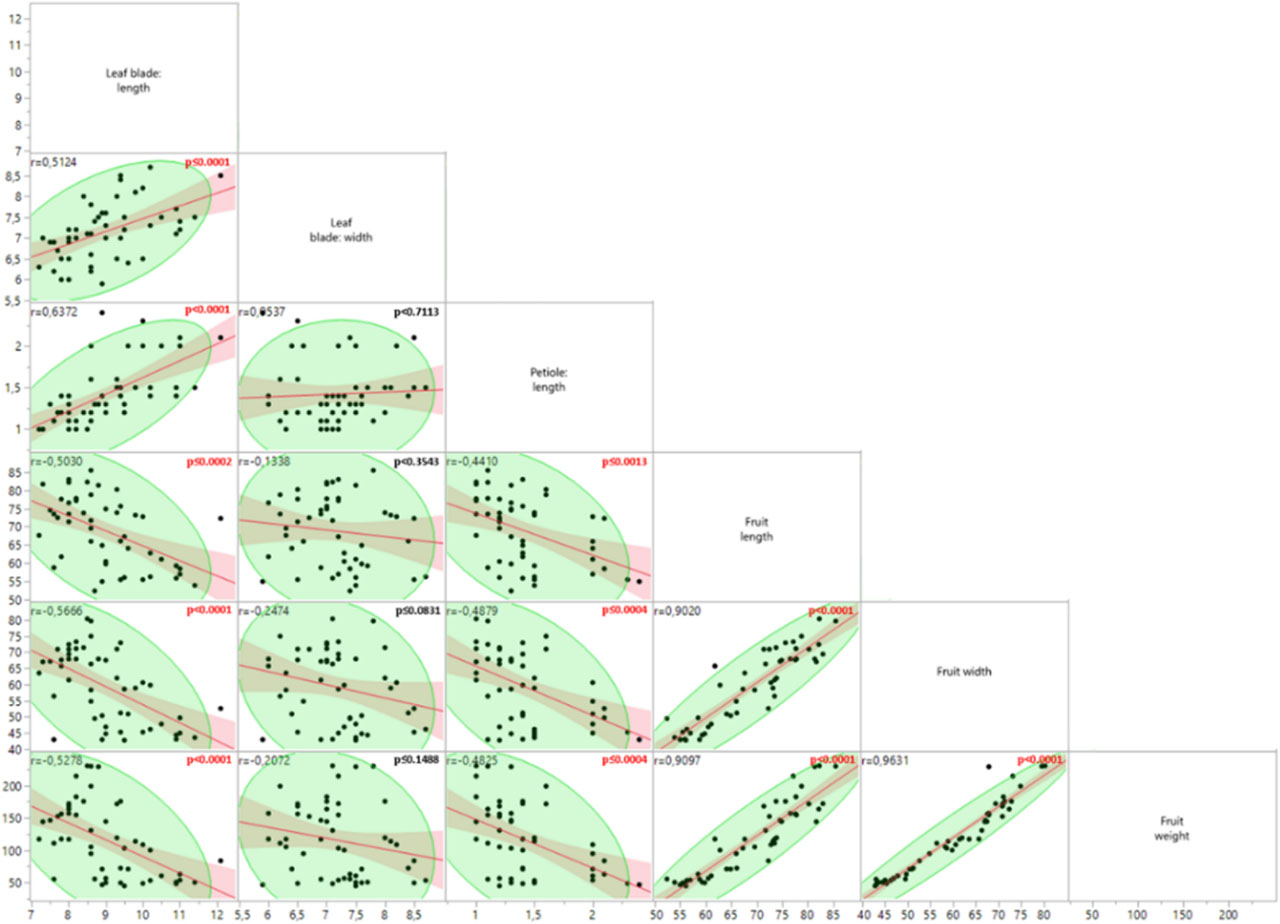
Fig. 2:
Correlations between measurable fruit and leaf traits
Strong and statistically significant positive correlations were observed among all fruit traits, notably between fruit width and fruit length (r=0.9020, p<0.0001), fruit weight and fruit length (r=0.9097, p<0.0001), and fruit width and fruit weight (r=0.9631, p<0.0001). In contrast, fruit length showed significant negative correlations with leaf blade length (r=−0.5030, p≤0.0002) and petiole length (r=−0.4410, p≤0.0013). Moreover, leaf blade length exhibited a moderate positive correlation with both leaf blade width (r=0.5124, p≤0.0001) and petiole length (r=0.6372, p<0.0001) (Fig. 2).
Similar to our study's results, correlation analysis of quince genotypes in Pakistan also found strong and positive relationships, especially between fruit length and fruit weight (r=0.89) and between fruit weight and fruit width (r=0.90) (Shah et al., 2024). Strong and positive correlations between fruit weight and fruit diameter have also been observed in quince varieties grown in tropical regions (r=0.94) (Coutinho et al., 2019), supporting the consistency of trait associations across different genetic backgrounds. In a study conducted on 2800 hybrid quince individuals, Tatari et al. (2020) reported a statistically negative (r=−0.069) and insignificant correlation between leaf length and leaf width, whereas our findings demonstrated a moderate and significant positive correlation between leaf blade length and leaf blade width. Such differences may primarily reflect the effect of genetic diversity, as hybrid populations often display a broader range of phenotypic variation, which can influence the direction and strength of trait correlations (Booy et al., 2000).
Significant negative correlations were identified between fruit weight and petiole length (r=−0,4825, p≤0.0004), as well as between fruit weight and leaf blade length (r=−0,5278, p<0.0001). Likewise, a significant negative correlation was also detected between leaf blade length and fruit width (r=−0,5666, p<0.0001) (Fig. 2). As we mentioned, fruit weight showed a significant negative correlation with petiole length and leaf blade length in our study. While a similar trend was also reported by Bostan (1994), and Odufale et al. (2022), most studies have found the opposite pattern. For instance, Zarei et al. (2019), Gharibi et al. (2023), and Simionca Mărcășan et al. (2023) reported positive or non-significant associations, indicating that this relationship is generally not negative but depends on species and genotype.
A two-way cluster and heat map analysis was conducted to assess the correlations among five quince genotypes (YG-11-1, YG-11-2, YG-11-3, YG-11-4, YG-11-5) concerning a total of 21 leaf and fruit morphological characteristics (Fig. 2). The heat map showed the correlation patterns in a way that made it possible to group genotypes and traits at the same time. The analysis showed that the genotypes could be grouped into three main groups (Fig. 3).
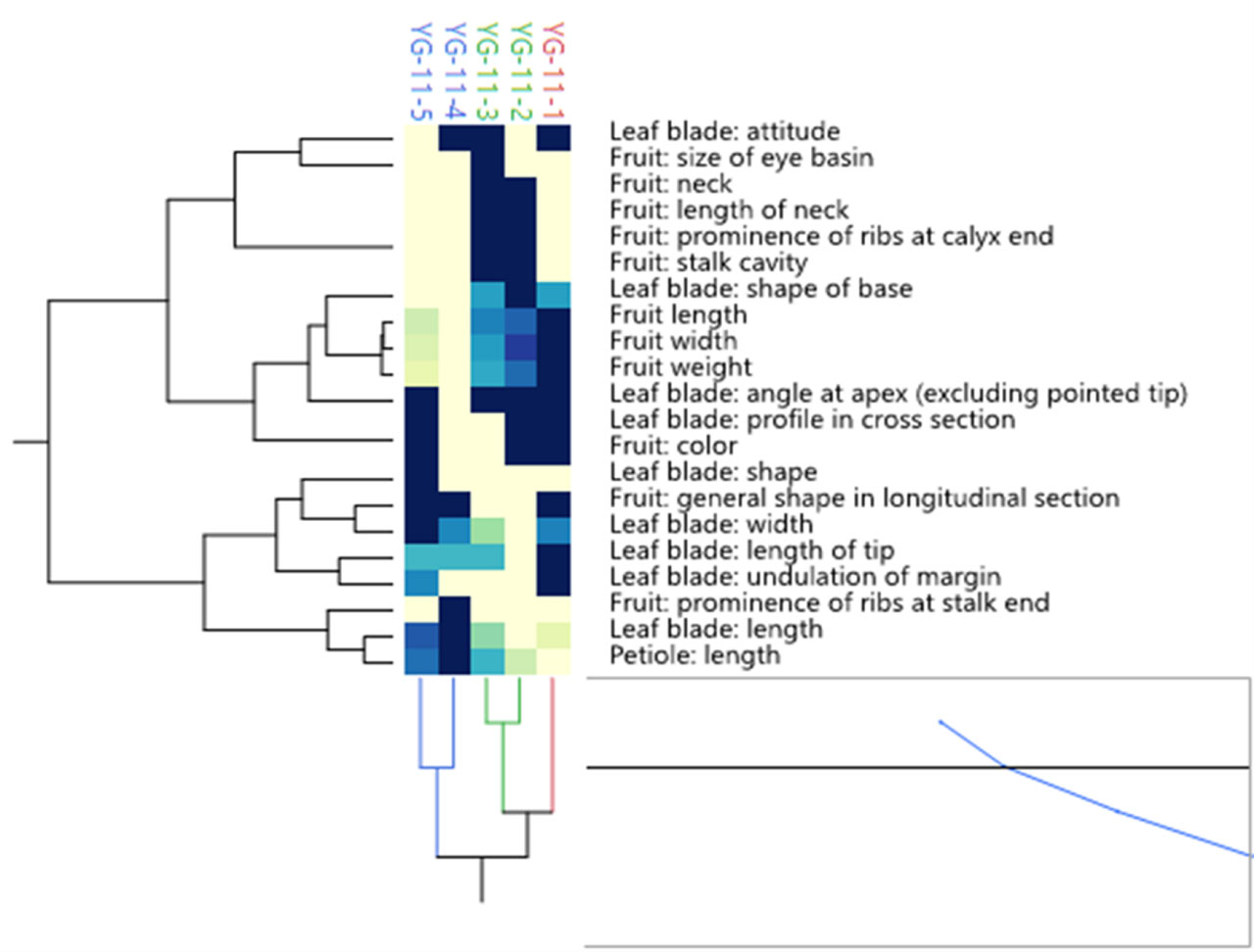
Fig. 3:
Two-way cluster and heat map analysis.
Cluster I included the YG-11-1 genotype with relatively larger fruit size parameters (fruit length, fruit width, and fruit weight), which were positively correlated with each other. Cluster II contained genotypes (YG-11-2, YG-11-3) with average values for both leaf and fruit traits. On the other hand, Cluster III had genotypes (YG-11-4, YG-11-5) with smaller fruit but bigger leaves. This shows that there is a negative relationship between leaf size traits (like petiole length and leaf blade length) and fruit size traits (Fig. 2, 3).
The two-way clustering showed that fruit size traits were the most important factor in grouping genotypes, while leaf traits were less important (Fig. 3). This suggests that fruit morphology significantly impacts genotype characterization, whereas vegetative traits may involve trade-offs with reproductive allocation. The heat map made it clear how some vegetative and reproductive traits are related to each other and how they affect each other in opposite ways.
Contrary to our study's findings, a cluster analysis of local quince genotypes in Iran was performed based on four principal factors (maximum chlorophyll fluorescence, variable fluorescence, minimum chlorophyll fluorescence, and leaf area) which accounted for 86% of the total variance, and the genotypes were categorized into five main clusters (Mirabdulbaghi and Abdollahi 2014). Cluster analysis of 394 quince progenies, taking into account unmeasurable leaf traits and resistance to fire blight disease, identified 12 distinct main groups. Among these, the highest variance was observed in leaf traits, including leaf blade base shape, leaf blade margin undulation, and overall leaf blade shape (Şahin, 2023). In the present study, although the greatest variance was primarily detected in certain fruit traits, these important leaf traits also exhibited substantial values exceeding 20%, underscoring their persistent relevance in the evaluation of genetic diversity.
Conclusion
The research assessed five quince genotypes, concentrating on 21 morphological characteristics of leaves and fruits. Variance analysis revealed significant disparities across all variables, notably emphasizing considerable variance in fruit neck length, fruit neck, and leaf blade: undulation of margin, whereas leaf blade: width, leaf blade: length, and fruit length exhibited minor variation. Correlation analyses revealed robust positive correlations among fruit features and negative correlations between fruit and leaf size traits, suggesting potential trade-offs between vegetative and reproductive growth. Clustering and heat map studies classified the genotypes into three clusters: Cluster I with larger fruits, Cluster II with intermediate characteristics, and Cluster III displaying smaller fruits but larger leaves. The results highlight the importance of fruit characteristics in genotype differentiation, whereas leaf attributes played a lesser role in clustering, hence enhancing overall genetic diversity. This study offers significant insights for quince breeding and the management of genetic resources, especially in underexplored areas.
Notes
[1] Contributed by Author Contributions:
The study was carried out from Yılmaz Gül's undergraduate thesis. M.Ş. conceived and designed the experiments; Y.G, F.U an M.Ş performed the experiments; M.Ş. analyzed the data, wrote and proofread the final paper. All authors have read and agreed to the published version of the manuscript.
[2] Financial disclosure Funding:
The current research has received no funding from agencies in the public, commercial, or not-for-profit sectors.