
Introduction
Raspberry (Rubus idaeus L.) is an economically important perennial crop for Bosnia and Herzegovina (BiH) with the annual production of 16,833 tons in 2023 (Anonymous, 2023), ranking it 9th in world raspberry production by country. Raspberry and other Rubus spp. are particularly susceptible to many pathogens including viruses (Wilson, 2014). Viruses infecting raspberry are frequently transmitted through vectors, and propagation material (Mattew and Hull, 2002). Aphids are a well known vector of various plant viruses including raspberry viruses (Martin et al., 2013). Raspberry is infected with multiple viruses among which aphid transmitted viruses are responsible for most of the decline, especially black raspberry necrosis virus (BRNV), raspberry leaf mottle virus (RLMV) and rubus yellow net virus (RYNV) all of which cause raspberry mosaic disease (RMD) (Alford, 2007; Converse et al., 1987). RMD is used to describe a range of diseases caused by the various combinations of viruses transmitted by aphids (Wilson, 2014). The viruses of RMD complex are transmitted by Amphorophora (Am.) agathonica Hottes in North America and Am. idaei Börner in Europe (Martin et al., 2013). Beside these viruses, raspberry vein chlorosis virus (RVCV), which is transmitted by Aphis (Ap.) idaei van der Goot (Martin et al. 2013), is another important aphid borne virus. In BiH so far, the main causal agents of RMD and raspberry leaf blotch virus (RLBV), responsible for leaf blotch disease, have been identified throughout the country on raspberries (Delic et al., 2020; Radulovic et al., 2021; Voruna et al., 2023a). Vector borne viruses have a close relationship with their vector, which is their primary means of transmission to a new host in the orchard (Lightle and Lee, 2014). However, there is a lack of any reports about presence and distribution of raspberry aphids in BiH, so there is a big gap in the RMD epidemiology and in disease management, consequently. Thus, a better virus management strategy is necessary to propagate and cultivate healthy raspberries in BiH. Having this in mind, the main objective of the study was to perform a survey on the occurrence and distribution of aphids as potential vectors of RMD (Am. idaei and Ap. idaei) in selected areas of BiH.
Material and Methods
Surveys were carried out between June and July 2024, in different raspberry growing sites of BiH mainly located in a region called Podrinje, whichis the main raspberry growing area in the country (Tab. 1). Raspberry plants (“Miker” and “Willamette” varieties) were visually inspected for presence of virus symptoms, while shoots with leaves that had aphids (Fig. 2–3) were collected. Aphids were collected from six raspberry orchards (Tab. 1). The presence of aphids was determined by a detailed examination of the aerial parts of the plants, primarily the tops and abaxial surfaces, apical shoots and stems. The following accessories for collecting aphids were used: transparent plastic boxes of different sizes with an opening for air to enter, plastic bags, a pocket magnifier and scissors. Samples were taken by cutting off part of the plant and carefully placing them in plastic boxes. The aphids collected in the raspberry orchards were brought to the laboratory alive, along with the part of the plant they were on, so that the larvae would develop into adults. The samples consisted of larvae, and wingless and winged adults. The aphids were carefully examined under a stereo microscope (ZOOM mikroskop Leica EZ4HD) using 30x magnification and identified using keys for identification of apterae aphids (wingless morphs) (Blackman and Eastop, 2000) and alatae aphids (winged morphs) (Remaudière and Seco Fernandes, 1990). The total DNA of identified single aphid specimens (eight in total) was isolated using the DNeasy® Blood & Tissue Kit (QUIAGEN, Hilden, Germany), according to manufacturer’s instructions. For the PCR analyses primers LCO1490/HCO2198 amplifying the mtCOI fragment were employed (Folmer et al., 1994). Further identification was done by Sanger sequencing of obtained PCR products in Macrogen Europe BV. All sequences were blasted at BLAST: Basic Local Alignment Search Tool, using the megablast algorithm and default search parameters (Altschul et al., 1990). 20 symptomatic leaves were collected from each raspberry sampling site and pooled into one sample for further laboratory analyses. Leaf samples taken from each raspberry production site were submitted to the total nucleic acids (TNA) extraction according to Poudel et al. (2013) and reverse transcribed using random primers and the M-MLV Reverse Transcriptase (Sigma-Aldrich). cDNA quality was evaluated using the NADH dehydrogenase ND-2 subunit (ndhB gene) transcript as an internal control (Tzanetakis et al. 2007).
Tab. 1:
Number of aphids collected at each location
| Numb. | Location | Collection date | Species | Number of aphids |
|---|---|---|---|---|
| 1. |
| 21.6.2023. | Amphorophora idaei | 4 adults |
| 2. | 28.6.2023. | Amphorophora idaei | 20 (12 adults, 8 larvae) | |
| 3. |
| 7.7.2023. | Amphorophora idaei | 32 (22 adults, 10 larvae) |
| 4. |
| 12.7.2023. | Amphorophora idaei | 15 (10 adults, 5 larvae) |
| 5. |
| 27.6.2023. | Aphis idaei | 27 (21 adults, 6 larvae) |
| 6. | 04.7.2023. | Aphis idaei | 17 (12 adults, 5 larvae) | |
| 7. |
| 27.6.2023. | Amphorophora idaei | 9 (6 adults, 3 larvae) |
| 8. |
| 7.7.2023. | Aphis idaei | 2 adults |
The presence of BRNV was checked according to Radulovic et al. (2021), RLMV following Tzanetakis et al. (2007) procedure and RVCV using primers described in McGavin et al. (2011) in RT-PCR, while PCR amplifying conserved region of the reverse transcriptase and ribonuclease H genes (Diaz-Lara et al., 2015) was employed for RYNV detection.
Results and Discussion
In the observed raspberry orchards symptoms such as leaf chlorosis and leaf blotching (Fig. 1) were commonly encountered.
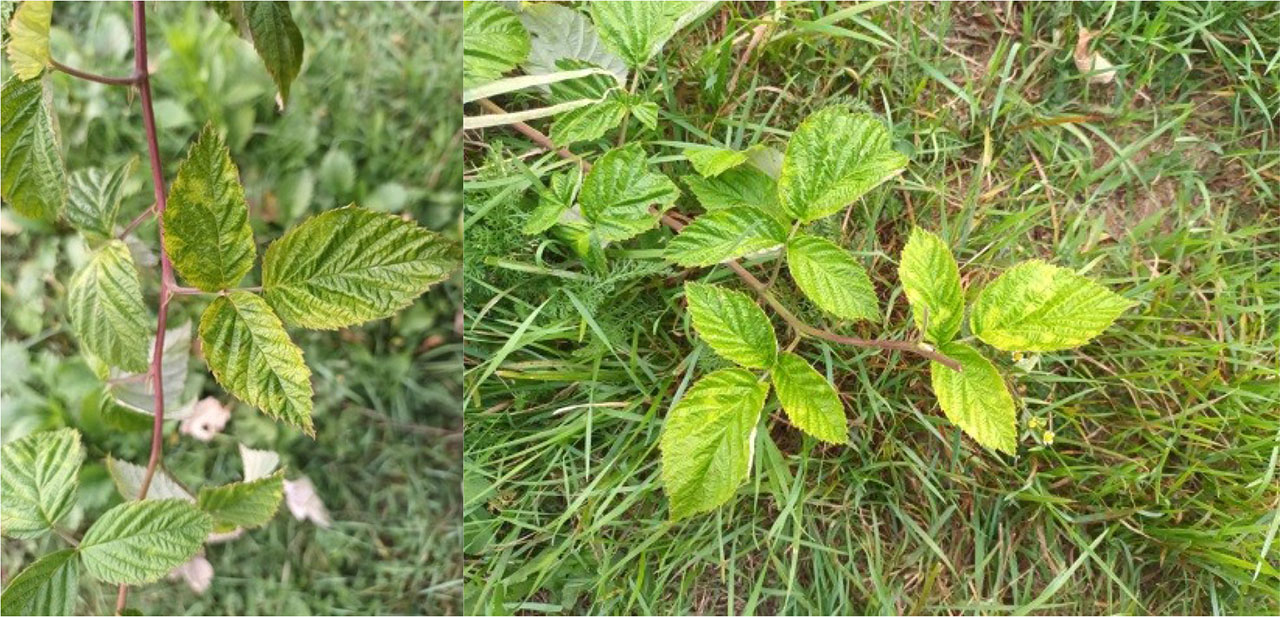
Fig. 1:
Virus symptoms on raspberry (orig.)
A total of 126 of aphid individuals were collected (Tab. 1). During surveys, following morphological identification keys (size and color of body, siphunculi, cauda, antennae) two aphid species were determined, the small raspberry aphid (Aphis idaei) (Fig. 2) and large raspberry aphid (Amphorophora idaei) (Fig. 3) on both sampled varieties. The highest number of aphids of both species were determined at the end of June and the beginning of July. In that period, winged and wingless aphids, as well as their larvae, were found (Tab. 1).
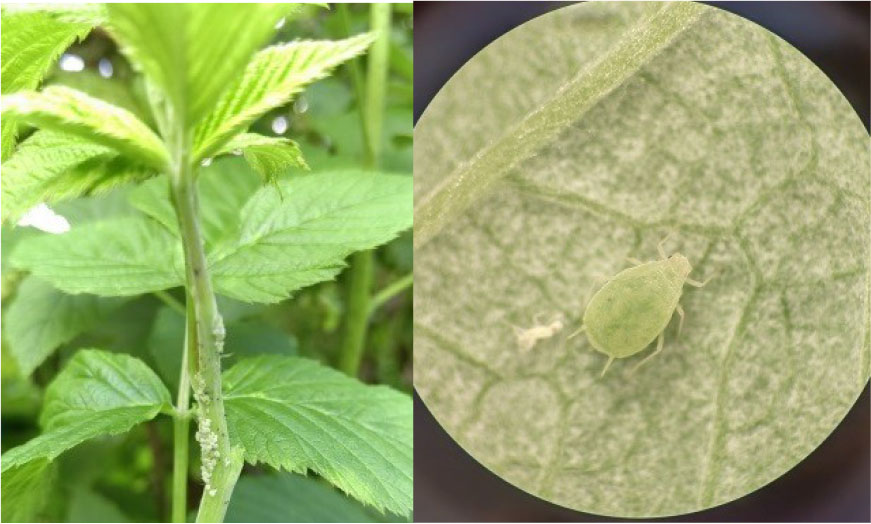
Fig. 2:
Aphis idaei (orig.)
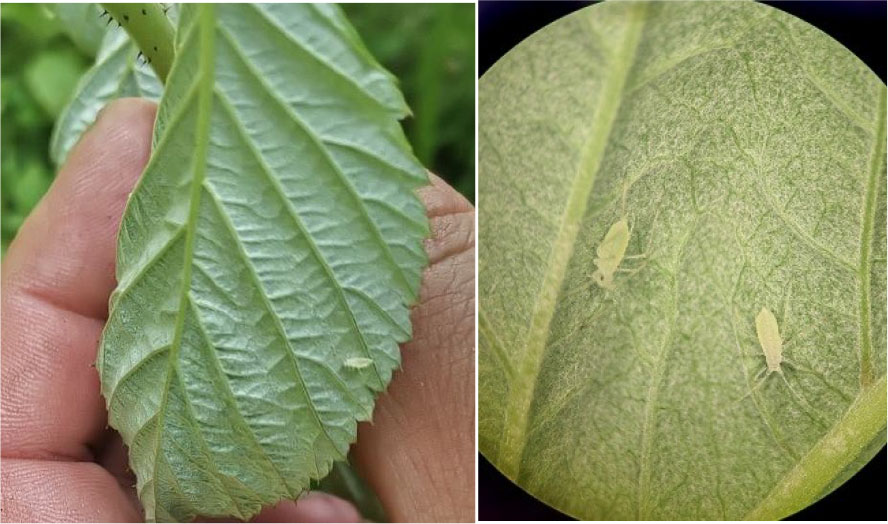
Fig. 3:
Amphorophora idaei (orig.)
The amplification of the COI gene provided fragments with a size of 730 bp in seven tested aphid samples. The COI sequences from all the amplified samples are available in GenBank. The BLAST analyses of the sequences with Acc. Nos. PQ471321-PQ471324; PQ471327 revealed that they were 99,72% identical with the Am. idaei specimen collected from Belarus (GenBank Acc.No. JF340095) and sequences with Acc. No. PQ471325 and PQ4713262 showed highest identity of 100% between themselves and with Ap. idaei specimen from France (GenBank Acc.No. KF638947). Only one virus, RYNV was detected in four raspberry orchards in Bratunac and Miljevina both on “Willamette” variety. For the first-time, this study provided evidence for the presence of Am. idaei and Ap. idaei in BiH raspberry orchards. The former, Am. idaei, is responsible for transmitting BRNV, RLMV and RYNV. All three viruses were found in BiH in raspberries during previous surveys in which RYNV was found to be the most prevalent (data not shown). Ap. idaei, the confirmed vector of RVCV, was also confirmed, although the virus presence has not been detected so far. Ap. idaei is spread throughout most of Europe, western Siberia, New Zealand and North America (Gordon et al., 1997). It is widespread in raspberry orchards in Croatia (Gotlin Čuljak et al., 2012), Montenegro (Hrnčić and Radonjić, 2012) and Serbia (Petrović-Obradović, 2003). Aphids are of light green color, 1.2 – 1.8 mm length and are covered with wax powder (Blackman and Eastop, 2000). This species develops numerous colonies on the tips of the shoots, causing deformation and twisting of the leaves (Gotlin Čuljak et al., 2012; Stanić and Spasić, 2024), which is in accordance with the results of our research because the colonies were located on the mentioned plant organs of raspberries. Am. idaei is the most economically important aphid pest of commercially grown raspberry cultivars in the U.K. and Northern Europe (McMenemy, 2009). It is often present in raspberry orchards in Croatia (Gotlin Čuljak et al., 2012) and Serbia (Petrović-Obradović, 2003; Tanasković et al., 2012). The body length of adults is in the range 2.5–4.1 mm (Blackman and Eastop, 2000). This species does not form colonies, but individuals inhabit young shoots or raspberry leaves without causing leaf deformation (Borowiak-Sobkowiak, 2006; Stanić and Spasić, 2024). The literature is consistent with our research regarding finding individuals on the abaxial surfaces of raspberry leaves without forming colonies. In previously published studies RYNV has been found to be widely distributed in raspberry orchards including orchards form the surveyed locations in BiH and has mostly been found integrated rather than episomal (Voruna et al., 2023a; 2023b). RYNV, is one of the important aphid borne viruses contributing to raspberry mosaic disease, in combination with BRNV and RLMV. Due to the small amount of the collected aphids in the present study, the presence of RYNV could not be checked so it cannot be used to claim the total absence of this virus in Am. idaei. The connection of the symptoms with the virus presence could not be made either because symptoms of blotching were probably connected with RLBV which is commonly found in the country (Delic et al., 2020).
Finally, this small-scale study presents the first step in the management of the RMD in BiH. Detailed aphid life cycles should be better studied in order to design proper control measures. However, infected planting material still represents the main threat for virus introduction and spread. Due to their limited mobility, aphids are primarily responsible for virus transmission at a local scale or within orchards. Further research should be dedicated to the detailed study of the identified aphids‘ life cycles and possible control measures.
Declarations
Acknowledgments
This work has been partially conducted through founds of Ministry of Agriculture, Forestry and Water resources of Republika Srpska.