
Introduction
Agriculture is one of the most fundamental activities of humanity and meets the food needs that ensure the sustainability of our lives. Agriculture is an important sector for the realization of societies and the world economy in many ways. Many factors such as the rapid increase in the world’s population, climate change and food waste bring about food problems (Tokatlıoğlu et al., 2018). With the emergence of the latter, the agricultural sector has become even more important. Producing, processing and trading agricultural products, agriculture and agriculture-based industries also contribute to the growth of the economy.
Agricultural products play a fundamental role in ensuring the sustainability of the global food supply and meeting the need for raw materials in various industrial areas. Mulberry, included in this product group, is an important agricultural product that attracts attention with both its nutritional content and its potential industrial uses. The homeland of the mulberry tree is China, and it spreads from the Northern Hemisphere to the Himalayas and from there to the tropical regions of the Southern Hemisphere (MAF, 2025). Mulberry trees are a widely distributed plant in the world because both their leaves and fruit contribute to the economy and because they are more ecologically durable than other fruits (Ercişli and Orhan, 2007). Although mulberry trees are grown in many countries around the world, their leaves are mostly used in sericulture rather than their fruits, and for this reason, data on the amount of mulberry fruit production in the world is not very common. Mulberry, which has an important place in Turkish cuisine, is consumed fresh in the summer months and is also frequently used in making molasses, jam, compote, fruit pulp, kome, vinegar and various desserts. Mulberry cultivation is very important for both export and consumption, and especially dried mulberries and molasses for snacks attract attention in various markets (Erdoğan and Pırlak, 2005).
Mulberry provides employment and income opportunities to many people with the opportunities it offers to the food and agriculture sectors. Mulberry is one of the most suitable fruits to grow in Türkiye and plays an important role in exports to the world as dried mulberry, molasses and fruit pulp. It is possible to see mulberry trees almost everywhere in Türkiye and the provinces where mulberry is most common are Kahramanmaraş, Elazığ, Malatya and Ankara (Ercişli and Orhan, 2008). In Türkiye, an average of 70000 tons of fresh mulberry is harvested annually from 2000000 mulberry trees (TSI, 2023). A very small portion of the mulberry produced is consumed fresh, while the majority is processed into molasses, fruit pulp, dried form, vinegar or similar forms.
The Erzurum region shows us a different potential and a different aspect of agriculture with mulberry cultivation. Mulberry is widely grown in the districts of İspir, Uzundere and Oltu in the north of Erzurum province. Uzundere district of Erzurum offers farmers and producers a very suitable ground for growing various agricultural products. It is quite suitable for growing mulberries in terms of climate and soil structure. Mulberry production in Uzundere district has an important economic value. In Uzundere, 1723 tons of fresh mulberry was obtained from 24615 mulberry trees in 2012, and 2121 tons of fresh mulberry was obtained from 24661 mulberry trees in 2022. It has been observed that the crop has increased iparallel with the number of fruit-bearing trees over the years. Uzundere covers approximately 42.50% of mulberry production among Erzurum districts. This shows that Uzundere is one of the important districts in mulberry production (TSI, 2023).
Cost analysis in agriculture is performed to evaluate and manage the production processes of agricultural farms from an economic perspective. The cost items of agricultural products are quite complex. Therefore, cost analysis of agricultural products is quite difficult and requires attention (Özkan et al., 2002). Agricultural farms must determine the input costs, operating costs, labor costs and marketing costs used in the production processes. It is important to identify these costs, understand which elements increase costs, and develop strategies to reduce costs when necessary (Acar and Aktaş, 2015). Mulberry is generally consumed and marketed as molasses in the Erzurum region. There are a number of cost elements in the molasses production and marketing phase (Ebrahimi et al., 2021).
The aim of this study is to analyse the cost of mulberry production and to reveal the marketing structure of enterprises engaged in mulberry cultivation in the Uzundere district of Erzurum province in 2022. It was also aimed to examine the stages of drying and selling fresh mulberries and making and selling molasses.
Materials and Methods
Materials
The basis of the data used in the research are the Farmer Registration System (FRS) records of the Erzurum Province Agriculture and Forestry Directorate. In Uzundere district, 259 farms between 0.025 and 0.40 hectares registered in FRS were taken into consideration. Farms under 0.025 hectares were not included in the calculation because they produce for self-consumption. Farms over 0.40 hectares were not included either, because they are too large and their numbers are too low and they therefore do not represent the population. 45.90% of the mulberry areas in Erzurum province are in Uzundere district. The data obtained from the surveys conducted in Uzundere constitute the primary data. In addition, national and international research articles on mulberry production cost and marketing as well as statistical information on the subject were used (TSI, 2023). The study covers the year 2022.
Methods
Determination of the research area
Uzundere district of Erzurum province, where mulberry production is concentrated, was determined as the research area. The research area was defined by evaluating the records collected from the Provincial and District Directorates of Agriculture and Forestry about mulberry production areas and farm numbers for the neighborhoods of Uzundere district (Fig. 1).
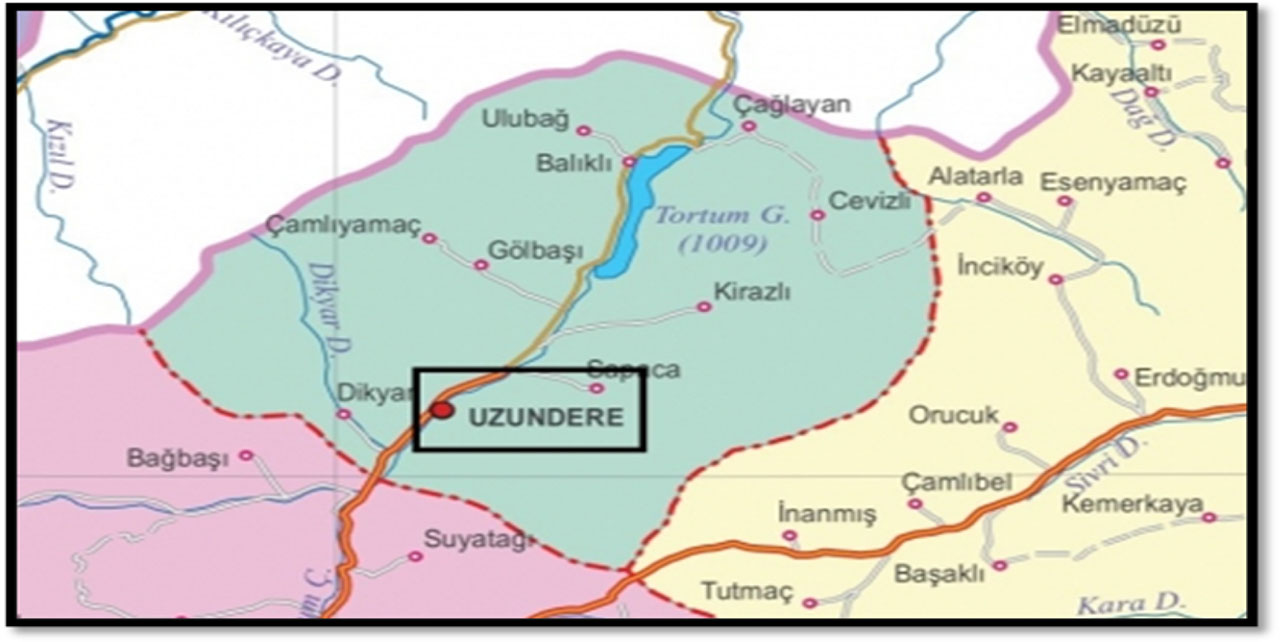
Fig. 1:
Uzundere District Study Area
Determination of sample size and number of sample farms in districts
Simple random sampling method was preferred in selecting sample farms and is defined as follows (Tuvanç and Dağdemir, 2009; Ağaş et al., 2024):
Here;
n = Sample size
S2 = Standard deviation
z = The table values for a 90% confidence interval (z=1.645)
N = Total number of units belonging to the sampling frame
d = Acceptable error (d = X * 0.10)
X = Average area per enterprise (X=1.02)
With a 90% confidence limit and a 10% deviation from the mean, the volume of the sample farm was determined as 96, 107 surveys were filled out with a 10% spare survey, and the evaluation was made over 100 surveys. The number of surveys conducted is given in Tab. 1.
Tab. 1:
Mulberry Farm Numbers, Rates and Survey Numbers
| Districts | Number of Farms | Percentage (%) | Number of Surveys | Spare Survey | Total Number of Surveys |
|---|---|---|---|---|---|
| Kirazlı, Sapaca | 55 | 21,23 | 20 | 2 | 22 |
| Merkez, Dikyar | 41 | 15,83 | 15 | 2 | 17 |
| Çağlayan | 39 | 15,06 | 14 | 1 | 15 |
| Cevizli | 36 | 13,90 | 13 | 1 | 14 |
| Gölbaşı | 18 | 6,95 | 7 | 1 | 8 |
| Altınçanak | 16 | 6,18 | 6 | 1 | 7 |
| Balıklı | 25 | 9,65 | 9 | 1 | 10 |
| Çamlıyamaç | 18 | 6,95 | 7 | 1 | 8 |
| Ulubağ | 11 | 4,25 | 5 | 1 | 6 |
| Total | 259 | 100,00 | 96 | 11 | 107 |
Method applied in preparing the survey forms
Questionnaire forms were prepared to analyze mulberry production and marketing and were created taking into account the demographic characteristics of the farmers (age, gender, production activities, household size, etc.), socioeconomic status (annual agricultural and non-agricultural income level), economic conditions (land size, amount of inputs used, amount and costs of production factors, yield per unit area, labor force and labor wage, product prices, etc.) and marketing processes (marketing chain, marketing margin, etc.).
Preparation of data and methods applied in economic analysis
In the study, the cost was calculated for mulberry by using the single product budget analysis method, taking into account facility and production costs, and additionally, other analyses were made. Mulberry production cost is calculated in two stages as the calculation of establishment and production costs. Establishment costs are the costs incurred after the mulberry orchard is established until it produces crop (Külekçi and Aksoy 2011; Kıral et al., 1999). Depreciation was calculated by dividing the total of the facility expenses incurred after the mulberry orchard was established until it started to bear fruit by the economic life of the mulberry, which is 60 years (MAF, 2024a). The economic life of a mulberry orchard was determined by the data obtained from the survey studies and the information received from the district agriculture directorate.
In the second stage, the costs in a production period were calculated. Various cost items were taken into account in the calculation of variable and fixed costs in the production stage (Topcu et al., 2012; Kumbasaroğlu and Dağdemir, 2011). The variable costs include fertilization, pruning and branch cleaning, irrigation, hoeing, plant protection activities and drug administration, harvesting and transportation costs, taking into account both, raw material and labor costs (Kıral et al., 1999).
Revolving fund interest is expressed as the opportunity cost of variable expenses. This interest is calculated based on the interest rates determined by Republic of Türkiye Ziraat Bank for plant production loans. In the calculation process, it was assumed that variable costs were not distributed evenly throughout the production period and did not remain stable at a farm for a full year, so half of the determined interest rate was used (Kıral et al., 1999; Topcu et al., 2012).
The interest rate determined by the Republic of Türkiye Ziraat Bank for plant production in 2022 is 12.50% and half of this, 6.25%, has been taken into account (TAB, 2024).
The items that constitute fixed costs include general administrative expenses and expenses for all common services related to the production activities of the farm. In mulberry production, general administrative expenses are calculated as 3.00% of total variable expenses (Külekçi and Aksoy, 2011; Aşkan and Dağdemir, 2015). Land rental fee is calculated by taking 5.00% of the bare land value (Kıral et all, 1999). Depreciation was determined by dividing the total facility costs by the economic life of the mulberry, which is 60 years. The facility capital interest was calculated by multiplying the total of variable costs by the interest rate of 6.25%.
While calculating the amount of labor in farms, the labor used at different stages was evaluated by taking into account gender, age and working hours and converted to male labor force unit (MLF)1. This method aims to balance the differences between genders. The family workforce of the farm is calculated by taking into account age, gender and working hours.
To eliminate gender and age differences, the current workforce was converted to male workforce unit (MLF) and thus the total workforce assets were calculated (Dağdemir, 2005). The value of agricultural outputs obtained as a result of economic activities carried out in a production period is called gross production value (GPV). Gross Profit (GPV – VC) is calculated by subtracting variable costs from GPV, and Net Profit (GPV – PC) is calculated by subtracting production costs from GPV (Topcu et all, 2012; Aşkan et all, 2018a).
There is usually a difference between the ex-farm price of a commodity and the price paid by the consumer, and this difference is called the “marketing margin”. The marketing margin that occurs when an agricultural product reaches the consumer directly without being processed differs from the marketing margin in processed products. Marketing margin is generally defined as “the difference between the price the consumer pays for a kilogram of product and the income the farmer obtains from the same amount of product”. This margin includes not only additional expenses but also the profit margin provided to the brokers (Dağdemir and Aşkan, 2024; Aşkan et al., 2018b).
Marketing Margin is explained below with the functional formula;
Pf: Price of the first product equivalent to one unit of product (Price received by the farmer)
Pr: Price of one unit of product at the retail level (Price paid by the consumer)
Results and Discussion
Results Regarding Demographic and Socioeconomic Structure
45.00% of mulberry producers are in the 50–64 age group and 38.00% in the 15–49 age group, while and the 65+ age group accounts for 17.00%. The age average of mulberry producers was determined as 53, 46.40% percent are female and 53.60% male.
In two studies where the economic analysis and cost analysis of agricultural farms in Erzurum were conducted, it was stated that 48.31% and 48.23% of the population of the farms were women, and 51.69% and 51.77% were men, respectively (Kumbasaroğlu and Dağdemir, 2007 ve 2010). In the study conducted in Van province, it was stated that 47.00% of the average farm population was female and 53.00% was male (Ağaç et al., 2024).
When looking at the educational status of mulberry producers; secondary and high school graduates account for 31.57%, university graduates account for 28.60%, literate and primary school graduates account for 27.77%, illiterate individuals account for 6.56% and those with postgraduate education account for 5.50%.
It was determined that 96.00% of the farms have social security and 4.00% do not have any social security.
When the relationship between the average monthly income of farmers producing mulberry in Uzundere and the size of their holdings is examined, it is calculated that 12.00% of the holdings have an average monthly income below 575.87 €, 83.00% have an average monthly income between 575.88 – 2303.48 € and 5.00% have an average monthly income above 2303.49 €. The average monthly income of the farms was calculated as 1565.50 €.
It was determined that 79.00% of the farms had non-agricultural income, while 21.00% did not have any non-agricultural income and earned their living entirely from agricultural activities.
In the study conducted in Sakarya province, it was determined that 83.60% of the farms had non-agricultural income while 16.40% did not have non-agricultural income (Dağdemir and Yıldız, 2017). In another study conducted in Kahramanmaraş, it was determined that 57.05% of the producers had no income other than agriculture (Aytop and Akbay, 2018). In the study conducted in Giresun province, it was determined that 91.00% of the farms had non-agricultural income and 9.00% did not have non-agricultural income (Hazneci et all, 2022). In the study conducted in Van province, it was determined that 63.24% of the farms had non-agricultural income and 36.76% did not have non-agricultural income (Ağaç et all, 2024). In the study conducted in Gaziantep province, it was stated that 42.59% of the producers had non-agricultural income and 57.41% did not have non-agricultural income (Yavuz and Dağdemir, 2024).
Results Regarding Agricultural Structure
When the relationship between the land sizes of the farms in Uzundere and the number of farms was examined; it was determined that 54.00% of the farms had a land size of 0.5 hectares or smaller, 26.00% had a land size between 0.60–1.50 hectares, 15.00% had a land size of 1.60–2.00 hectares, and 5.00% had a land size of 2.10–3.00 hectares. The average land size of the farms was calculated as 1.65 hectares.
Uzundere district is a very mountainous area and does not have a large-scaled land structure. When the areas of mulberry orchards were examined in the context of the total land sizes of the farms, it was determined that 96.00% of the farms had a land size of 0.10–0.50 hectares, and 4.00% had a land size of 0.60 hectares or larger. There is an average of 0.34 hectares of mulberry orchards within the total area of 1.65 hectares owned by the farms. 0.28 hectares of the mulberry area consists of property land and 0.06 hectares consists of leased land.
The average age of mulberry trees was calculated as 15.40 years, and it was observed that the majority of trees were around 10.00 years old.
It was determined that 100.00% of mulberry producers do not earn their living only from mulberry production, but also have various other income sources other than mulberry.
In a study conducted in Buan-gun city in Korea, it was stated that 15.30% of the population earn their living only from mulberry, while 84.70% of the population do not earn their living only from mulberry (Kim et al., 2012).
It was observed that 80.00% of mulberry producers sell the mulberries they produce to intermediaries and 20.00% to retailers. Mulberry buyers generally come and buy the products in person and most farms do not make significant marketing expenses.
Labor, which is among the basic production factors of agriculture, varies in relation to age and gender in mulberry production. The workforce of the farms consists of both family members and foreign workforce. Family workforce is generally used during the mulberry growing period and harvesting processes. The age range at the farms was determined as follows: 1.91% in the 0–6 age group, 5.30% in the 7–14 age group, 33.47% in the 15–49 age group, 36.01% in the 50–64 age group and 23.30% in the 65+ age group. The average age of the family labor used is 34.97. This situation shows that the elderly population in this region is engaged in agriculture and tries to earn additional income. The average population per farm in the research region is 4.72 people.
In the research region, women’s MLF was calculated as 1.03 and men’s MLF was calculated as 1.56, and on average there was 2.59 MLF in farms. The amount of foreign labor used at farms was calculated as 0.24 MLF on average, and a total of 2.83 MLF was calculated at farms.
Input and Cost Calculation in the Examined Farms
According to the surveys conducted with producers in Uzundere, the daily working hours for family and foreign workers in the mulberry farm were determined as 8 hours. In addition, the daily wage of a foreign worker was determined as €57.59 and the hourly wage of a foreign worker was calculated as €7.20. Family labor wages were considered equal to foreign labor wages and were used in the calculations. The determined labor wage is used in the calculations in Tab. 2 and 3.
Tab. 2:
Fresh Mulberry Facility Expenses (€/ha) and Orchard Depreciation
| Expense Items | Year 1 | Year 2 | Year 3 | Year 4 | Total Amount (€) | % | |||||||||
|---|---|---|---|---|---|---|---|---|---|---|---|---|---|---|---|
| Unit | Price | Quantity | Amount (€) | Price | Quantity | Amount (€) | Price | Quantity | Amount (€) | Price | Quantity | Amount (€) | |||
| Tillage* | €/ha | - | - | 143.97 | 143.97 | 2.12 | |||||||||
| Marking sapling location | labor/hour | 7.20 | 10.3 | 74.16 | 74.16 | 1.09 | |||||||||
| Opening a sapling hole | labor/hour | 7.20 | 13.1 | 94.32 | 94.32 | 1.39 | |||||||||
| Sapling | piece | 8.06 | 240.0 | 1934.40 | 1934.40 | 28.50 | |||||||||
| Farm manure** | Kg | 0.018 | 2873.5 | 51.72 | 0.018 | 2873.5 | 51.72 | 103.44 | 1.52 | ||||||
| Giving farm manure | labor/hour | 7.20 | 12.4 | 89.28 | 7.20 | 12.4 | 89.28 | 178.56 | 2.63 | ||||||
| Tree planting | labor/hour | 7.20 | 22.0 | 158.40 | 158.40 | 2.33 | |||||||||
| Dry sapling renewal*** | labor/hour | 7.20 | 6.8 | 48.96 | 48.96 | 0.72 | |||||||||
| Pruning and branch cleaning | labor/hour | 7.20 | 12.6 | 90.72 | 7.20 | 12.6 | 90.72 | 7.20 | 12.6 | 90.72 | 272.16 | 4.01 | |||
| Irrigation | labor/hour | 7.20 | 14.0 | 100.80 | 7.20 | 17.5 | 126.00 | 7.20 | 17.5 | 126.00 | 7.20 | 18.2 | 131.04 | 483.84 | 7.13 |
| Hoeing | labor/hour | 7.20 | 16.0 | 115.20 | 7.20 | 16.8 | 120.96 | 7.20 | 17.2 | 123.84 | 7.20 | 17.5 | 126.00 | 486.00 | 7.16 |
| Plant Protection Agents | Kg | 57.58 | 4.0 | 230.32 | 57.58 | 4.0 | 230.32 | 57.58 | 4.0 | 230.32 | 57.58 | 4.0 | 230.32 | 921.28 | 13.57 |
| Plant Protection Activities | labor/hour | 7.20 | 8.0 | 57.60 | 7.20 | 8.0 | 57.60 | 7.20 | 8.0 | 57.60 | 7.20 | 8.0 | 57.60 | 230.40 | 3.39 |
| A. Total Variable Expenses | 3050.17 | 674.56 | 628.48 | 776.68 | 5129.59 | 75.56 | |||||||||
| General administration expense (A * %3) | 5129.89*0.03 | 153.90 | 2.27 | ||||||||||||
| Rental fee (5% of bare land value) | 17276.13*0.05 | 863.81 | 12.72 | ||||||||||||
| Interest on investment capital (A*%12.5) | 5129.90*0.125 | 641.24 | 9.45 | ||||||||||||
| B. Total Fixed Expenses | 1658.95 | 24.44 | |||||||||||||
| Facility Expense Total (A+B) | 6788.54 | 100.00 | |||||||||||||
| Orchard Depreciation (Total Facility Expenses / Economic Life) | 6788.54/60 | 113.14 | |||||||||||||
Tab. 3:
Fresh Mulberry Total Production Cost(€/ha) and Cost of 1 Kg Fresh Mulberry (€/kg)
| Expense Items | Unit | Price | Quantity | Amount (€) | % |
|---|---|---|---|---|---|
| Farm manure | Kg | 0.018 | 2873.5 | 51.30 | 2.10 |
| Giving farm manure | labor/hour | 7.20 | 13.1 | 94.30 | 3.85 |
| Plant Protection Agents | Kg | 57.59 | 04.0 | 230.35 | 9.41 |
| Plant Protection Activities | labor/hour | 7.20 | 08.0 | 57.59 | 2.35 |
| Irrigation | labor/hour | 7.20 | 13.0 | 93.58 | 3.82 |
| Hoeing | labor/hour | 7.20 | 15.4 | 110.86 | 4.53 |
| Pruning. Root shoots. Cleaning | labor/hour | 7.20 | 10.7 | 77.02 | 3.15 |
| Harvest | labor/hour | 7.20 | 23.5 | 169.16 | 6.91 |
| Transportation Cost | labor/hour | 7.20 | 10.1 | 72.70 | 2.97 |
| Total Expenses | 956.86 | 39.08 | |||
| Revolving Fund Interest (%6.25) | (956.86*0.0625) | 59.80 | 2.44 | ||
| A. Total Variable Expenses | 1016.66 | 41.52 | |||
| General administration expense (A*%3) | (1016.66*0.03) | 30.50 | 1.25 | ||
| Rental fee (5% of bare land value) | (17276.13*0.05) | 863.81 | 35.28 | ||
| Orchard Depreciation Share | 113.14 | 4.62 | |||
| Facility Capital Interest (%6.25) | (6788.54*0.0625) | 424.29 | 17.33 | ||
| B. Total Fixed Expenses | 1431.74 | 58.48 | |||
| Total Production Costs (A+B) | 2448.40 | 100.00 | |||
| Yield (Kg/ha) | 8444.00 | ||||
| Cost of 1 Kg Fresh Mulberry (€/kg) | (2448.40/8444.00) | 0.29 | |||
According to the calculations, the ratio of variable costs to the total facility cost of 6671.79 €/ha is 75.33%, while the ratio of fixed costs is 24.67%. The share of labor in variable costs was determined as 32.51% and input as 42.82%. Land rental fee was found by taking 5.00% of the bare land value. Land rental price was calculated as 863.81 €/ha (17276.13 €/ha * 0.05) by surveys. According to the surveys, the average establishment period of a mulberry garden was determined as 4 years. The expenses incurred during this period constituted the total facility expenses. The total facility costs were divided into 60 years and the depreciation share was calculated as 113.14 €/ha (Tab. 2).
The total production costs were calculated as 2448.40 €/ha, 41.52% of which were variable costs and 58.48% were fixed costs. Of the calculated variable costs, 27.57% consist of labor costs, 11.51% consist of fertilizer and plant protection agents costs, and 2.44% consists of revolving fund interest. While the facility capital interest has a share of 17.33%, the rental fee, general administrative expense and depreciation share constitute 41.15% of the total expenses (Tab. 3). In the surveys conducted, fresh mulberry yield in Uzundere district was found to be 8444.00 kg/ha. The cost of 1 kg of fresh mulberry was calculated as 0.29 € by dividing the total production costs by the yield.
In a study conducted in the Nan Province of Thailand, it was stated that the mulberry yield was 8486.0 kg/ha (Choosung et al., 2022).
Product costs per hectare of mulberry farms during a production period are given in Tab. 3.
Gross Profit and Net Profit
Gross Production Value represents the total income obtained from mulberry sales. It is found by multiplying the farmer sales price of fresh mulberries by the amount of mulberries. In the calculations gross profit was found to be 4303.06 €/ha, net profit 2871.32 €/ha and proportional profit 2.17 (Tab. 4).
Tab. 4:
Gross Profit, Net Profit and Proportional Profit According to Production Cost
| Total Changing Expenses (€/ha) | (1) | 1016.66 |
| Total Production Expenses (€/ha) | (2) | 2448.40 |
| Average Yield of Fresh Mulberry (kg/ha) | (3) | 8444.00 |
| 1 Kg Fresh Mulberry Production Cost (€/kg) | (4=2/3) | 0.29 |
| 1 Kg Fresh Mulberry Sales Price (€/kg) | (5) | 0.63 |
| Proportional Profit According to Production Cost | (6=5/4) | 2.17 |
| Fresh Mulberry Gross Production Value (GPV) (€/ha) | (7=3*5) | 5319.72 |
| Net Profit Based on Production Cost (€/ha) | (8=7-2) | 2871.32 |
| Gross Profit Based on Production Cost (€/ha) | (9=7-1) | 4303.06 |
Calculating Marketing Margin and Farmer Profit
In the research it was determined that the average farmer sales price of fresh mulberry in 2022 was 0.62 €/kg. The average farmer sales price of dried mulberry was 2.36 €/kg. and the average farmer sales price of molasses was 7.69 €/kg.
In 2022 the market price of fresh mulberry was determined as 0.81 €/kg. The market price of dried mulberry was determined as 2.88 €/kg and the market price of molasses was determined as 8.64 €/kg (MAF, 2024b).
Fresh mulberry farmer profit = 0.62–0.29 = 0.33 €/kg
Fresh mulberry marketing margin = 0.81 – 0.62 = 0.19 €/kg
of the price paid by the consumer for fresh mulberry go to the middlemen and to the farmer.
To obtain one kilogram of dried mulberries, we need 2 kilograms of fresh mulberries. In other words, 50% efficiency is achieved. Farmers stated that there were no significant drying costs.
Dried mulberry cost = 2.00 * 0.29 = 0.58 €/kg
Dried mulberry farmer profit = 2.36 − 0.58 = 1.78 €/kg
Dried mulberry marketing margin = 2.88 − 2.36 = 0.52 €/kg
of the price paid by the consumer for dried mulberries go to the middlemen and go to the farmer.
One kilogram of molasses is obtained from an average of 5.25 kilograms of fresh mulberries. In other words, 19.04% efficiency is obtained. There is generally no cost for firewood when making molasses, but the labor expense for 1 kg of molasses is 0.60 €.
Molasses cost = 5.25 * 0.29 = 1.52 + 0.60 = 2.12 €/kg
Molasses farmer profit = 7.69 − 2.12 = 5.57 €/kg
Molasses marketing margin = 8.64 − 7.69 = 0.95 €/kg
of the price paid by the consumer for molasses go to the middlemen and go to the farmer.
If all of the fresh mulberry produced is sold as fresh mulberry, the Gross Production Value (GPV) obtained from fresh mulberry is calculated as (0.63 €/kg * 8444.00 kg/ha) 5319.72 €/ha.
If all of the fresh mulberry produced is sold as dried mulberry, the Gross Production Value (GPV) obtained from dried mulberry is calculated as (2.36 €/kg * (8444.00 kg/ha*50.00%)) 9962.92 €/ha.
If all of the fresh mulberry produced is sold as molasses, the Gross Production Value (GPV) obtained from molasses is calculated as (7.69 €/kg * (8444.00 kg/ha * 19.05%)) 12370.00 €/ha.
Conclusion
It has been understood that mulberry orchards are generally composed of small and fragmented family farms, and are orchards where products are obtained without considering economic efficiency. It was concluded that most of the producers work in non-agricultural jobs but are more engaged in mulberry production during harvest time.
In the Uzundere region mulberry provides a significant economic contribution to both farmers and other stakeholders when processed and offered to the market. It has been calculated that when mulberries are marketed as fresh, 76.54% of the price paid by the consumer go to the farmer, when marketed as dried, 81.95%, and when marketed as molasses, 89.00%. According to farmers’ statements, there is no significant additional cost in converting fresh mulberries into dried mulberries. However, dried mulberries are sold at a better price than fresh mulberries. Therefore, farmers earn higher income. When molasses is made from fresh mulberries, there is no additional cost other than labor. Since firewood is plentiful in the region, it is obtained free of charge. Since the selling price of molasses to the consumer is much higher than its cost, farmers make more profit. As a result, selling the crop in the form of dried fruit or molasses brings more income to the farmer. Increasing product diversity and optimizing added value by processing mulberries has strategic importance for the economic sustainability of both the farmer and the agricultural production chain in the region.
It is necessary to develop solution proposals in order to increase the productivity and sustainability of mulberry, which is a good source of income for the region. In order to reduce mulberry production costs and increase profitability, it would be a more profitable approach for producers to unite in cooperatives and turn to common high-quality, value-added products such as molasses that comply with standards. This approach can both minimize production costs and increase competitiveness in domestic and foreign markets through branding. In addition. by reducing costs through mass production, income can be increased. The increasing demand for local and organic products in particular increases the potential for such initiatives.
Acknowledgements
This study is grounded in the master’s thesis of ÜGA, a student at Atatürk University, Institute of Science and Technology. In the capacity of thesis supervisor, VD devised and implemented the methodology.