
Introduction
Walnut, Juglans regia L., is a species originating from Central Asia (Iran, Afghanistan, Turkey) and some countries in the Balkans, cultivated worldwide for its fruits and high-quality wood (Iordănescu et al., 2018). Due to their ability to adapt to various ecological conditions, walnut species are found and cultivated worldwide, from the West Indies to Japan, China, South Asia including India and Turkey, Southeast Europe to the Carpathian Mountains of Poland, the United States, Mexico, Colombia, and Argentina. (Akça, 2001). Turkey with various eco-geographical regions is one of the major centers of walnut diversity. Native walnut populations are widely present in this region and are found as scattered individuals or groups of several trees in the borders of agricultural lands, orchards or by the rivers, usually close to human settlements (Miktat Şimşek, 2010). Walnut is one of the few indigenous fruit species in the Anatolian region, where fruit cultivation has ancient roots. It remains a significant contributor to both the economy and culture of Turkey, being valued for its nut and wood production alike (Aslantaş, 2006).
According to FAO's 2021 data, global walnut production totals 4 600 173 tonnes. China leads with 1 100 000 tonnes, followed by the USA with 657 710 tonnes, Iran with 386977 tonnes, Turkey with 325 000 tonnes, Chile with 148 000 tonnes, Burkina Faso with 137 267 tonnes, Mexico with 135 976 tonnes, and Ukraine with 115 420 tonnes. Notably, Turkey, contributing 7.06 % of the global production, paradoxically engages in walnut imports (FAO, 2023). The last five years’ average (from 2019 to 2023) data of TÜIK delve into Turkey's walnut production, revealing 13,948,557 trees at fruiting age, 11,835,246 trees at non-fruiting age, a combined fruiting area of 152,088 ha, a yield of 21.8 kg per tree, culminating in a total production of 306,341 tonnes (TÜİK, 2023). Within Turkey, the Mediterranean region stands out for its walnut output, encompassing 23,820 ha. Analyzing provincial production, Kahramanmaraş leads with 716,438 fruiting trees, 511,192 non-fruiting trees, a walnut orchard area spanning 9,161 ha, a tree yield of 22.4 kg, resulting in a production of 16,220 tonnes. Kahramanmaraş contributes 5.29 % to Turkey's walnut output (TÜİK, 2023). Çatak, a district connected to the city of Van, has gained geographical indication status for its walnut production. The walnut variety specific to this region is called Çatak walnut. In Van (Çatak and other few disticts), the area of focus for this study, there are 203,613 trees at fruiting age and 126,063 trees at non-fruiting age. The total fruiting of research area spans 2,436 ha, with each tree yielding 31 kg, leading to a production output of 6,281 tonnes, placing it 17th in the rankings in Türkiye. This production constitutes 2 % of Türkiye's overall walnut production (TÜİK, 2023).
The walnut, a hard-shelled fruit, is rich in vitamins B and D, as well as vitamins A, C, and E, and contains high levels of omega-3 fatty acids. Omega-3 fatty acids can only be obtained from natural sources and cannot yet be produced artificially. Due to the potential benefits of omega-3 fatty acids in reducing heart disease, cancer, stroke, diabetes, hypertension, and clinical depression, it has been suggested that daily consumption of 3-5 walnuts may have a positive impact on human health (Ergun and Sütyemez, 2008; Gülsoy et al., 2009). As society increasingly emphasizes healthy eating habits, individual consumption patterns are changing alongside rising income levels. Consequently, interest in certain agricultural products has surged (Ketenci and Bayramoğlu, 2018). Consumers now favor products boasting origin and authenticity certifications, particularly in the realm of food and agriculture. Moreover, the concept of 'geographical indication' has emerged to safeguard local goods, ensuring that residents of their respective regions reap the benefits. This initiative not only rejuvenates rural economies but also shields local cultures from the homogenizing forces of globalization. Geographical indications serve as a conduit for passing down cultural heritage and traditional production techniques to future generations (Doğru Çokran, 2022). Additionally, the cultivation of hard-shelled fruits, which witness a steady increase in consumption, presents lucrative investment opportunities for producers. (Ketenci and Bayramoğlu, 2018).
Understanding consumer adaptation to dynamic market conditions, along with the causes and consequences of such adaptation, as well as their awareness and interest in branded products, is paramount for decision-makers and researchers. In tandem with addressing the food requirements of a burgeoning population, the evolving quality of life and standards necessitate thorough research and evaluation of consumer perceptions toward these products. This approach enhances the producer's influence in product development and market impact.
The product characteristics of the Çatak walnut, such as its characteristic colour, taste, kernel yield and oil content, are mainly related to the geographical location of the region, the coloured soil structure, the continental climate and the production method of this walnut. The Çatak walnut is typically produced by establishing tree populations in walnut orchards using seed-grown saplings. According to the TÜRKPATENT report, those who cultivate this indigenous walnut in the region do not carry out a special pruning programme, only dry branches are pruned, but after obtaining the geographical indication it is recommended to apply the modified leader training system. Fertilization is conducted during winter months by incorporating farmyard manure into the soil around the canopy of the trees using a hoe. Harvesting is done by shaking the trees when the green fruit peel cracks. The remaining fruits are then dropped by tapping with a pole. The streams and rivers formed as a result of snowmelt in the mountains of the study area are irrigation resources. These water sources are used to irrigate the walnut orchards using the surface irrigation method (TÜRKPATENT, 2020; PDAFV, 2021). The geographical indication registration report does not mention any significant diseases or pests that cause economic losses in walnut cultivation.
No previous study has assessed the cost of Çatak walnut, branded by its geographical indication in Van province. Therefore, the aiming of this study was to calculate the walnut production cost and make a profitability analysis in agricultural enterprises that produce walnuts with origin characteristics.
Materials and Methods
Materials
The primary data used in the study were obtained from face-to-face surveys conducted with 254 walnut growers in the districts of Çatak, Gevaş, Bahçesaray, Tuşba and Edremit in Van province in 2022.
Methods
Determination of study area
The province of Van, where the study was conducted, comprises 13 districts. According to the data obtained from the Provincial and District Directorates of Agriculture and Forestry of Van, Çatak walnut is produced in 10 districts in Van province, and the 5 districts selected for the research area (Çatak, Bahçesaray, Gevaş, Edremit and Tuşba) account for 93.43 % of the total number of enterprises (Fig. 1, Tab. 1).
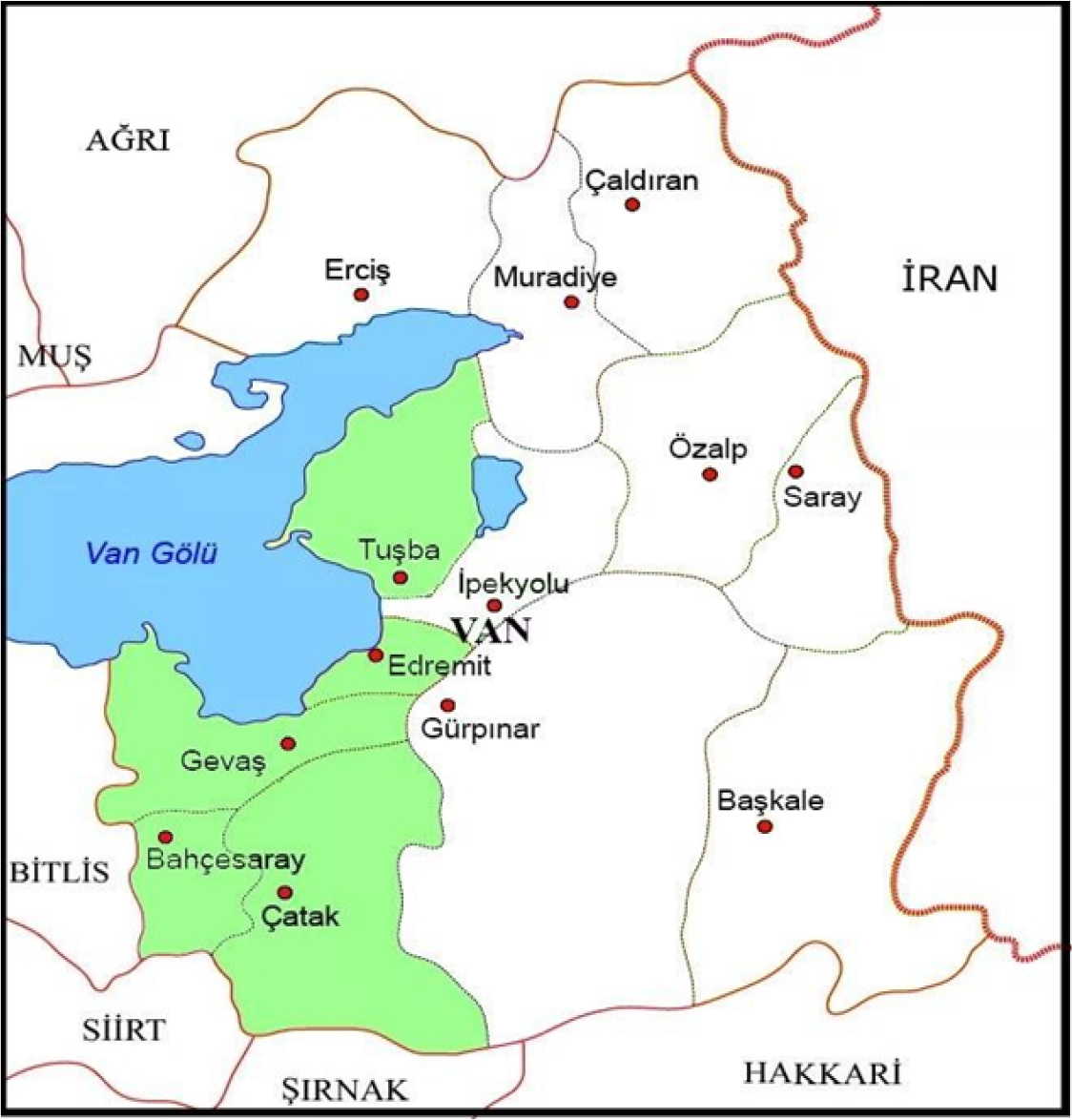
Fig. 1:
The study area for Çatak walnut in Van province is indicated in green in the map
Tab. 1:
Number of walnut enterprises and their ratio to cultivation areas (%)
| Districts | Number of enterprises (number) | (%) | Cultivated area (ha) | (%) |
|---|---|---|---|---|
| Çatak | 116 | 11,91 | 37,90 | 8,64 |
| Bahçesaray | 375 | 38,50 | 34,75 | 7,92 |
| Gevaş | 279 | 28,64 | 104,35 | 23,79 |
| Edremit | 40 | 4,11 | 58,99 | 13,45 |
| Tuşba | 100 | 10,27 | 118,82 | 27,09 |
| Diğer* | 64 | 6,57 | 83,78 | 19,10 |
| Total | 974 | 100,00 | 438,58 | 100,00 |
Determining the sample size and the number of sampled enterprises in districts
The equation used to determine the number of surveys is given in formula 1 (Topcu, 2012, Aşkan and Dağdemir, 2015).
Here:
n = Sample size
S2 = Standard deviation
Z = The table values for a 90 % confidence interval (z=1.645)
N = Total number of units belonging to the sampling frame
d = Acceptable error (d = X * 0.10)
X = Average land quantity per enterprise
As the Çatak walnut grown in Van and its region is ungrafted and no standard planting norm is applied, it was observed that the number of trees per hectare in each enterprise had a heterogeneous distribution. This led to a change in the standard deviation. When creating the sampling, enterprises between 0.01 and 1.00 hectares were taken into account. Within this scope, 745 enterprises were considered after excluding the points with the lowest and highest values. Among 745 walnut producers active in Van province, sample selection was carried out within a 90 % confidence interval and the sample size was determined as 230.
Tab. 2 shows the survey numbers of enterprises growing walnuts in Van province in 2022. Anticipating that there might be missing or incorrect information in the surveys, the amount of surveys was increased by 10 %, making a total of 254 surveys.
Data preparation and methods utilized in economic analysis
The production costs of walnuts were calculated in two stages using the "single product budget analysis method". In the first stage, the installation cost of the walnut orchard was determined through surveys and thus the depreciation value of the orchard was determined. Factors considered in determining the establishment costs include soil preparation, seedling and planting costs, general maintenance, fertilizer use, weeding, labor, and input costs associated with these activities, interest on investment, general management costs, and the cost of rented land. The establishment period for the walnut orchard has been set at 4 years, and to calculate the depreciation share of the establishment costs, the economic lifespan of the walnut orchard was considered 80 years (Ketenci and Bayramoğlu, 2020).
The second stage involves calculating production costs incurred during a production period. Cost items used in this calculation include fertilization, liming, spraying, pruning, shoot cleaning and transport, harvesting, threshing, transport, equipment maintenance and repair costs, labor and input costs, interest on the revolving fund, rental costs, general management costs, and the orchard's share of depreciation.
General administrative expenses were calculated by taking 3 % of variable expenses. A general administration cost of 3 percent was accounted for. The wages earned by the farmer and their family members for their labor were determined based on the prevailing wages paid to other workers in the area at that time (Aşkan ve Dağdemir 2015; Topcu 2004; Uzundumlu 2005; Yıldız ve Dağdemir 2017).
The depreciation of the orchard, which was a fixed cost in the cost analysis, was not calculated as there was no leased land. To equalize age and gender differences, the available labor force was converted to male labor force (MFL)1, and the total amount of labor was calculated. The family and other working workforce, expressed as EIB, were multiplied by the total working hours elapsed during the production process and the Male Working Day (EIG) value was determined. About 5 % of the bare land value was taken as land rent (Kıral, 1999). The revolving fund interest on variable expenses was calculated by considering half (4.875 %) of the 9.75 % interest rate applied by T.C. Ziraat Bank for crop production in 2022 (Anonim 2022). The cost of one kg of shelled walnuts is calculated as in formula 2.
Results and Discussion
Walnut orchard planting period cost
As a result of the survey, it was determined that the average field land per enterprise was 8,34 ha, vineyard-orchard land was 1,52 ha and meadow area was 1,10 ha. The average size of the walnut orchard within the vineyard-orchard land of the enterprises was determined as 1,3 ha. Walnut orchard facility expenses, depreciation of the Çatak walnut and the percentage distribution of these expenses was calculated as seen Tab. 3. As a result of the survey study, it was determined that the cost of bare land was 8500 ₺/ha. Among the variable costs in the installation process, sapling-planting costs had the highest share with 32.97 %. The average depreciation cost per hectare of Çatak walnut orchards was calculated as 973,2 ₺/ha (see Tab. 3). In the previous studies, soil preparation was identified as the highest cost group within the total crop costs in Kaman district of Kirşehir province, comprising 33.26 % (Ketencioğlu and Bayramoğlu). In another similar study conducted in Kirşehir, the highest cost item in the establishment period was found to be soil preparation and maintenance costs, with a value of 3164,4 per hectare (Uzun, 2006).
Tab. 3:
Walnut orchard facility expenses and depreciation calculation (₺/ha)
| Expense Items | Amount (₺/ha) | % | ||||
|---|---|---|---|---|---|---|
| 1. Year | 2. Year | 3. Year | 4. Year | Total | ||
| Tillage | 2815,6 | - | - | - | 2815,6 | 3,62 |
| Second Tillage | 1221,9 | - | - | - | 1221,9 | 1,57 |
| Planting Location Marking | 59,4 | - | - | - | 59,4 | 0,08 |
| Pit Digging | 875,0 | - | - | - | 875,0 | 1,12 |
| Fertilization | 2476,3 | 2460,3 | 2104,7 | 1756,0 | 8797,3 | 11,30 |
| Planting | 9036,0 | - | - | - | 9036,0 | 11,61 |
| Irrigation | 281,3 | 364,7 | 388,8 | 552,0 | 1586,8 | 2,04 |
| Raw spacing tillage | 4525,5 | 810,0 | 984,0 | 6319,5 | 8,12 | |
| Dry Sapling Renewal | 1142,1 | 1142,1 | 1,47 | |||
| Agricultural Struggle | 1613,1 | 2318,8 | 3109,1 | 7041,0 | 9,04 | |
| A-Total Variable Expenses | 16765,5 | 10105,7 | 5622,2 | 6401,1 | 38894,5 | 49,96 |
| General Administration Expense (A*%3) | 503,0 | 303,2 | 168,7 | 192,0 | 1166,9 | 1,50 |
| Bare Land Value (17000 * %5) | 8500,0 | 8500,0 | 8500,0 | 8500,0 | 34000,0 | 43,67 |
| Current Year Interest on Investment (A * %9,75) | 1634,6 | 985,3 | 548,2 | 624,1 | 3792,2 | 4,87 |
| B-Total Fixed Expenses | 10637,6 | 9788,5 | 9216,8 | 9316,1 | 38959,0 | 50,04 |
| Total Facility Expenses (A+B) | 27403,0 | 19894,2 | 14839,0 | 15717,2 | 77853,5 | 100,00 |
| Economic Life (Years) | 80 | |||||
| Walnut Garden Depreciation (total of facility costs / economic life = 77853,5/80) | 973,2 | |||||
In another study on the establishment period of closed walnut orchards, the total establishment costs of the farms studied were calculated to be 14048,4 ₺/ha (Bostan, 2012). The results of the present study indicated that the highest cost items in the establishment period were soil preparation and maintenance costs in the initial years, which aligns with the findings those of Bostan (2012).
Walnut orchard production period cost
The production cost of shelled Çatak walnuts is given in Tab. 4. The total expenses of Çatak walnut production in the research region was determined as 35996,0 ₺/ha (2073,5 €/ha). 61.29 % of these costs consist of variable costs and 38.71 % consist of fixed cost items. Among production cost items, pesticide costs constitute 4.58 %, fertilization costs 3.87 %, hoeing costs 2.73 % and pruning costs 0.42 % (Tab. 4). In a previous study conducted by Ketenci (2019), it was stated that 47.18 % of the production costs in the walnut orchard were variable costs, and 52.82 % were fixed costs.
Tab. 4:
Çatak Walnut Production Expenses Calculation (₺/ha)
| Expense Items | Unit | Price (₺) | Amount | Total amount (₺/ha) | Percentage (%) |
|---|---|---|---|---|---|
| Maintenance Costs | |||||
| Tillage | ₺/ha | - | - | 5670 | 15,75 |
| Farm fertilizers | kg/ha | 0,305 | 1500 | 458 | 1,27 |
| Chemical fertilizers | kg | 17,00 | 46 | 782,1 | 2,17 |
| Fertilizer crafting | labor/hour | 40,00 | 3,9 | 156 | 0,43 |
| Pesticide | kg | 60,08 | 24,3 | 1460 | 4,06 |
| Pesticide labor | labor/hour | 40,00 | 4,7 | 188,0 | 0,52 |
| Hoeing | labor/hour | 40,00 | 24,6 | 984,0 | 2,73 |
| Pruning | labor/hour | 40,00 | 3,8 | 152,0 | 0,42 |
| Irrigation labor | labor/hour | 40,00 | 4,0 | 160,0 | 0,44 |
| Water Fee | ₺/ha | - | - | 450,0 | 1,25 |
| Harvest Costs | |||||
| Harvest | labor/hour | 40,00 | 59,8 | 7475,0 | 20,77 |
| Transportation Cost | labor/hour | 40,00 | 10,5 | 372,9 | 1,04 |
| Sack | piece | - | 0 | 47,1 | 0,13 |
| Sorting and Drying | labor/hour | 40,00 | 67 | 2680,0 | 7,45 |
| Subtotal | 21035,1 | - | |||
| Revolvıng Capital Interest (Subtotal * %9,75/2) | 1026,5 | 2,85 | |||
| A-Total Variable Expenses | 22061,6 | 61,29 | |||
| a. General Administrative Expense (A * % 3) | 661,8 | 1,84 | |||
| b. Bare Land Value Interest (17000 * % 5) | 8500,0 | 23,61 | |||
| c. Depreciation share of facility expenses | 973,2 | 2,70 | |||
| d. Facility Capital Interest (77853,5 * % 4,88) | 3799,3 | 10,55 | |||
| B-Total Fixed Expenses | 13934,3 | 38,71 | |||
| C-Total Production Expenses (A+B) | 35996,0 | 100 | |||
| D-Production Amount (kg/ha) | 1319,6 | ||||
| E-1 kg Product Cost (C/D) (₺/kg) | 27,28 | ||||
| F-Sales Price of 1 kg Walnuts (₺/kg) | 60 | ||||
According to the results of the survey conducted in the research region, the cost of 1 kg of shelled walnuts per hectare was 27,28 ₺/kg (1.57 €/kg), the sales price was 60 ₺/kg (3.46 €/kg), the gross profit of 1 kg of shelled walnuts was 43.28 ₺/kg. (2.49 €/kg), and its net profit was calculated as 32,72 ₺/kg (1.88 €/kg). When the cost of 1 kg of walnuts in enterprises was analyzed, it became obvious that enterprises were profitable in walnut production (Tab. 5). In a previous study, conducted by Ketenci and Bayramoğlu (2020), the cost of 1 kg of shelled walnuts was 10.64 ₺/kg (1.63 €/kg) and the selling price of 1 kg of shelled walnuts was 24.00 ₺/kg (2.99 €/kg),. The net profit was determined as 13.36 ₺/kg (1.66 €/kg).
Tab. 5:
Net and Proportional Profit in the Production of 1 kg of Çatak Walnuts
| Expenses And Revenues | Value |
|---|---|
| Total Changing Expenses (₺/ha) | 22061,60 |
| Total Production Expenses (₺/ha) | 35996,00 |
| Average Yield (kg/ha) | 1319,60 |
| Product Cost (₺/kg) | 27,28 |
| Product Price (₺/kg) | 60,00 |
| Gross Production Value (₺/ha) | 79176,00 |
| Gross Profit (₺/ha) | 57114,39 |
| Net Profit (₺/ha) | 43180,00 |
| Product Gross Profit (₺/Kg) | 43,28 |
| Product Net Profit (₺/Kg) | 32,72 |
| *Proportional Profit | 2,20 |
Conclusion
Geographical indication, which is of great importance in terms of preserving traditional knowledge and cultural values, provides great advantages in marketing to the producer and also benefits the consumer who wants to consume quality and reliable products. As a result of the study, it was determined that the production of Çatak walnut, which is a product of origin as a geographical indication in the region, is a profitable product. For this reason, if the recognition of Çatak walnut is increased through marketing activities, walnut producers in the region will be able to further increase their income through domestic and international sales.
Acknowledgements
This study is based on the master's thesis of YA, a student at Iğdır University, Institute of Science and Technology. In the capacity of thesis supervisor, EA devised and implemented the methodology, while MP provided expertise on walnuts.