
Introduction
A considerable part of the copper contained in the grapes precipitates as sediment during fermentation, which means that its content in the wine is lower than in the must. Knowledge of the heavy metal content, especially the copper content, is important because it can affect both the stability of the wine and the health of the consumer (Banovic et al., 2009; Svancarova et al., 2022). Both the soil and the climate in the vineyard play a decisive role in the flavour of the wine. The chemical and physical composition of the soil, including minerals, rocks and other soil components, significantly influence the flavours of the wine.
In terms of technological aspects, the presence of metal ions plays a decisive role in the redoxreactions that lead to the browning of wine. The most reactive metals in this context are copper, iron and manganese (Cacho et al., 1995). Cu2+ is significantly involved in oxidative transformations that favour the oxidation of iron and could possibly lead to brown colouration and turbidity. However, high copper concentrations in wine can cause reactions or precipitation that can have a negative impact on sensory properties such as colour or taste (Wang et al., 2023).
The importance of copper in viticulture is emphasised by the results of numerous studies like Ambrosini et al. (2018), as it is used against the Peronospora fungal disease. The application of fosetyl to plants, which can leave phosphoric acid residues in the fruit, could lead to an increase in the copper content in the wine. A variety of foliar treatments could mimic the effect of these residues (Malusa, 2005).
The biological efficacy and selectivity of mandipropamide plus copper oxychloride and iprovalicarb plus copper oxychloride (Melody Compact, Bayer Crop Science, Leverkusen, Germany) were studied and no phytotoxic effect on the fruit was observed (Fanigliulo, 2009). The total copper (Cu) concentration in soils varies considerably and depends on the application of mandipropamid and other agrochemicals. The use of copper-containing pesticides on the surface of the fruit as a potential source of copper in grapes has also been investigated (Sedláčková, 2004). Most copper deposits were detected in leaves and stems, while less was present in the roots.
In addition, the copper content also depends on the maceration time. As a result, the skin contact technique can improve the quality of a wine by increasing flavour extraction from the skins (Gómez-Míguez et al., 2007; Ihl et al., 2023). Therefore, a comprehensive control of skin contact conditions related to the potential increase of copper content in wine is of great importance (Fabianowicz et al., 2021).
Copper sulphate or citrate is often added in wine production to remove hydrogen sulphide (H2S). As a result, quantities of copper can also enter the wine and lead to the formation of precipitates (Bekker et al., 2017). Due to this practice, the International Organisation of Vine and Wine (OIV) has set the limit for Cu2+ ions in wine at 1,0 mg/l. It is therefore crucial to detect, quantify and avoid copper in grapes and wine as much as possible.
Material and methods
Electrothermal atomization and AAS with Flame are common methods for the determination of Cu.
Background compensation in Atomic Absorption Spectroscopy is sophisticated and widely used for solving interference problems generated by real wine samples. During evaluation of different background compensation methods in flame and furnace operation Deuterium (2H), HighSpeed Self Reversal (SR) and Zeeman methods have been used (Oppermann, 2007). Up to now several methods for the determination of copper content in wine are suitable, not only AAS methods, inductively coupled plasma (ICP-MS), but also the fluorescence detection method was developed to detect Cu2+ ions in wine by using coumarin derivatives (Xiuxiu Dai et al., 2022).
Slovakian wines with a protected designation of origin (PDO) were collected over a period of five vintages and analysed to determine the copper content using ETA-AAS (atomic absorption spectrometry with electrochemical atomisation). The dry red and white wines came from renowned Slovakian wine producers such as Vinárske závody Topoľčianky, s.r.o. and HUBERT J.E., s.r.o., and were collected in different vintages. The samples were certified by the CCTIA (Central Control and Testing Institute in Agriculture) in an accredited laboratory.
For the analysis, copper was measured after filtration of the wine sample through a 0,45 μm membrane and direct injection of 20 μl of the sample into a graphite furnace. This method was carried out using an AA-6800 with graphite furnace (Fy Shimadzu) with background correction and autosampler. A Halow cathode lamp for copper with a resonance line of 324,8 nm was used as the light source. Argon was used as the carrier gas and the atomisation temperature was 2600 °C. The working standard solutions were prepared from Merck standards, nitric acid, modifier Pd+Mg(NO3)2 and demineralised water. The advantage of this method lies in the accuracy of the calibration curve and the possibility of following the atomisation process with a camera.
Results and discussion
Different results were obtained for the copper content in white and red wines. (Tab. 1).
Tab. 1:
Determination of the parameters alcohol, total sugar and total SO2 according to the OIV methods as well as the measurement of copper content using AAS-ETA
| Sample | alcohol [% vol.] | sugar[g/l] | Total SO2 [mg/l] | Cu [μg/l |
|---|---|---|---|---|
| FM2016 | 12,1±0,1 | 1,6±0,1 | 187,0±6 | 262,0±7 |
| FM2020 | 12,6±0,2 | 2,3±0,2 | 149,0±4 | 195,0±6 |
| FM2021 | 12,5±0,1 | 2,8±0,2 | 163,0±5 | 251,0±7 |
| FM2022 | 12,8±0,2 | 3,3±0,3 | 173,0±5 | 295,0±8 |
| RV2007 | 11,9±0,1 | 4,0±0,3 | 111,0±4 | 183,0±6 |
| RR2016 | 12,4±0,1 | 1,9±0,2 | 109,0±4 | 218,0±4 |
| RR2020 | 12,7±0,2 | 2,5±0,2 | 114,0±4 | 248,0±6 |
| RR2021 | 12,5±0,2 | 3,3±0,2 | 95,0±5 | 221,0±7 |
| RR2022 | 12,4±0,2 | 4,5±0,3 | 123,0±5 | 255,0±8 |
The OIV methods MA-AS312-01, MA-AS313-01, MA-AS311 and MA-AS323-04 were used to measure alcohol, total acids, sugars and total SO2. The AAS-ETA results showed a potential correlation between copper content and total SO2 content, with higher SO2 levels associated with higher copper content.
A copper content of 195 μg/l was measured in the red wine of the 2020 vintage, which was slightly lower than in the white wine of the same vintage. In the 2021 vintage, the copper levels in red and white wine were almost identical. However, the red wine of the 2022 vintage had a higher copper content. These results are in line with an earlier study on Australian and Portuguese wines, which showed that copper levels in red wines are usually slightly higher than in white wines (Catarino et al., 2018).
The excellent correlation between the calibration standards illustrates the value of the automatic AAS-ETA measurement. The calibration curve for copper shows an equation of y = 0,011249x-0,0056 and a correlation coefficient of R^2 = 0,9994 (see Fig. 1). This method proves to be suitable for the precise determination of the copper content in wine and beer. The EU and OIV limits for the trace elements lead, copper and zinc in wine are 0,15 mg/l, 1,0 mg/l and 5,0 mg/l respectively. In all cases analysed, the copper content in the wine was below the limit value of 1,0 mg/l.
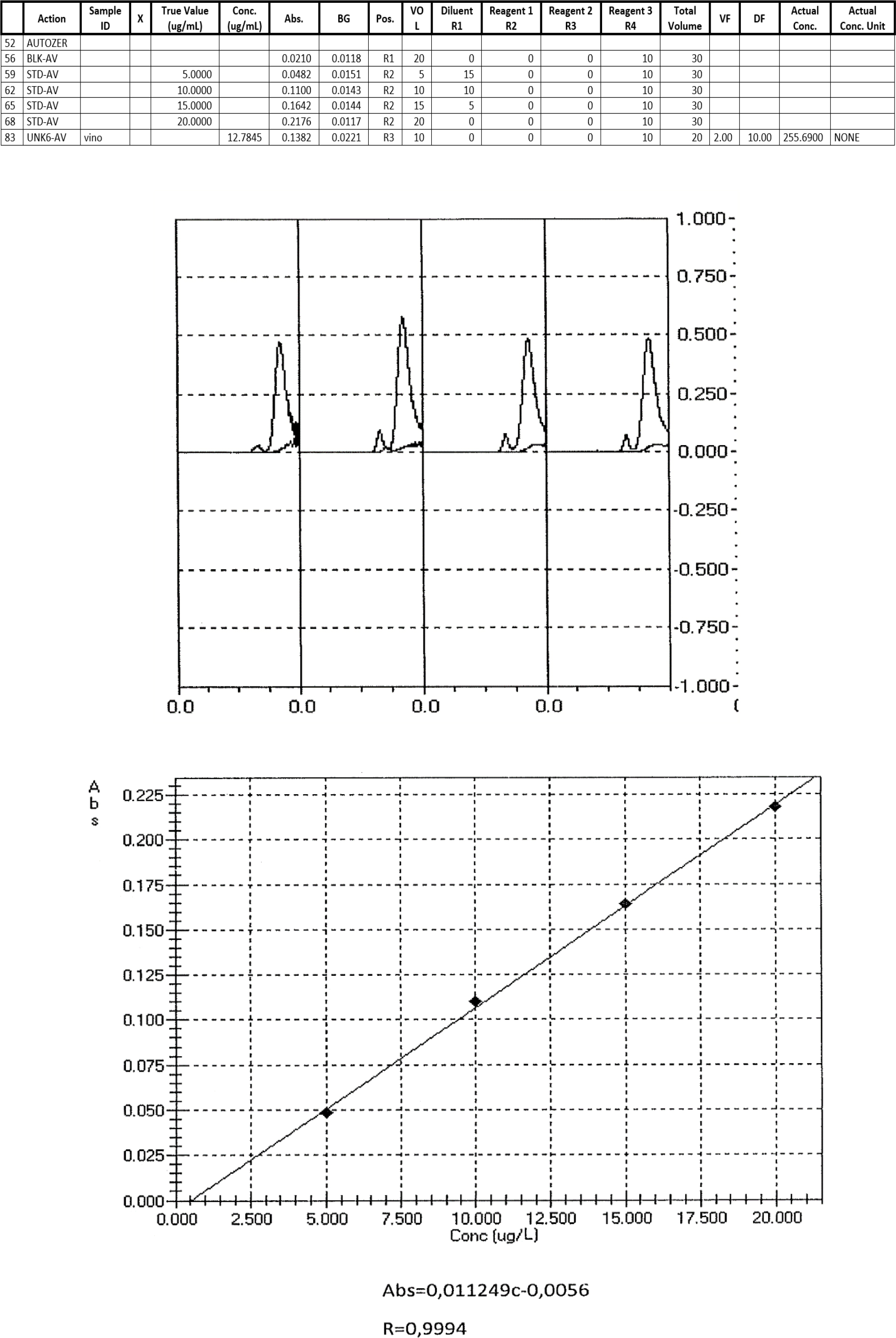
Fig. 1:
Calibration curve for Cu measurement.
A significant factor for the copper content in wine is the soil of the vineyard, where the copper is absorbed via the roots of the vines (Vasiliki et al., 2023).
However, research analysing wines and the soils of their origin is rare. Information on the metallic composition of Slovak wines and their classification by geographical origin is also limited. In this context, a study was designed to examine whether the protected designation of origin “Južnoslovenská” can serve as a tool for traceability of different geological formations by including different vineyards within the same region.
Although there was no notable increase in the copper content in the wines, careful monitoring of the chemical parameters, especially the metal content, is essential. Various factors such as the processing of the grapes, problems during fermentation, improper use of copper as an H2S fining agent or various cultivation factors such as the use of copper as a fungicide and the soil situation can potentially lead to increased levels. The situation regarding copper in the wine industry is extremely diverse and complex, and the forms of copper present vary greatly. This makes it fundamentally difficult to accurately measure the copper content in wines (Wang et al., 2023).
Conclusions
The aim of this study was to determine the copper content in wines of different vintages from the same region of origin, PDO "Južnoslovenská" (southern Slovakia). The study investigated whether there is a connection between global warming and the copper content in the wines. The results showed that Slovakian quality wines have a copper content below the limit value of 1 mg/l. This work demonstrates the ability of the AAS spectrometer to accurately measure the copper content of wines.