
Introduction
The European earwig Forficula auricularia, is a nocturnal insect species, feeding on many kinds of soft tissue such as plant tissue, fungi, or other invertebrates (Orped et al., 2019). In viticulture, the species is to some extent regarded as beneficial, linked to the control of grapevine pests such as the European grape berry moth (Eupoecilia ambiguella, Buchholz and Schruft, 1994) or the spotted wing drosophila (Drosophila suzukii; Bourne et al., 2019; Englert and Hertz, 2019). However, during the last decades, F. auricularia populations in vineyards in Central Europe have increased considerably, probably triggered by the warmer and drier weather conditions than the long-term average. As a result, the European earwig has more and more turned into a grapevine pest (Huth et al., 2009, Kührer and Gabler, 2020). Often, large numbers of earwigs colonise the vines, and massively feed on soft tissues and damaged berries. Due to their highly mobile lifestyle, the insects disperse fungal conidia between clusters and also between vines. Consequently, they promote Botrytis and possibly also Esca (Huth et al., 2009; Kalvelage et al., 2022). In addition to their role as vine pests, the earwigs may seriously jeopardise wine quality. They produce a repulsive secretion containing alkylated-1,4-benzoquinones. The insects excrete the exudates when disturbed and the malodorous compounds are also present in the insects’ faeces (Gasch et al., 2013). Especially during mechanical harvesting large quantities of earwigs can get into the grapes and are then processed with the crop. Moreover, high amounts of faeces contaminating the clusters may affect the olfactory sensation of vines (Huth et al., 2009, Kehrli et al., 2012).
In extensive studies on the effect of plant protection products, repellent substances and interventions in the habitat structure, the insecticide spinosad showed promising results on earwig populations (Huth et al., 2009). Since then, spinosad has been widely used in practice for earwig control. In Austria, e.g. two applications of this compound are registered for this purpose between the developmental stages BBCH 71 and BBCH 81 (according to the scale of Lorenz et al., 1994; BAES, 2024). However, spinosad is registered against a wide number of insect pests in viticulture (e.g. in Austria, BAES, 2024). Frequent use can lead to pest resistance against this compound and might entail adverse effects on beneficials such as predatory mites, lacewings and ladybirds (Lambert et al., 2018; Gress and Zalom, 2019; Duso et al., 2022).
Particle film technology based on fine-grained mineral or rock powder such as kaolin or diatomaceous earth has long been used for control of insect pests (Glenn and Puterka, 2005). Their effect is based on the abrasive properties of the particles and on their ability to damage the insects’ wax coating. In addition, insects have difficulties to move on covered surfaces. Particle films have already been used successfully to control other grapevine pests, e.g. D. suzukii (Linder et al., 2020, Krutzler et al., 2022). In the current study, we analysed the suitability of kaolin treatment for control of F. aricularia in grapevine clusters before and at harvest.
Material and methods
The experiments were carried out in two experimental vineyards, both located in Klosterneuburg, Lower Austria, in 2023. Vineyard 1 was planted with ‘Muskat Ottonel’ vines on T5C rootstock in 2002. It is trained according to Lenz-Moser with a stem height of 1 m, a vine spacing of 1 m and a row spacing of 3 m. In five adjacent rows, five blocks of five vines each were randomly defined and treated and the neighbouring five blocks of five vines were used as controls. Experimental vineyard 2 is actually a collection of varieties cultivated in the experimental vineyard of the Federal College for Viticulture and Pomology, Klosterneuburg, planted in 2013. Each variety is planted in a row of 20 vines with 2 m between rows. Vine training and plant spacing are as stated above. Four varieties, namely, Rotburger (Zweigelt), St. Laurent, Rheinriesling and Sauvignon blanc grafted on K5BB were selected for the experiments and divided into 2 treatment blocks and two control blocks as illustrated for vineyard 1.
Treatments started on August 17, at that time, vine development stages ranged from BBCH 81 (beginning of ripening) to BBCH 85 (softening of berries) (Lorenz et al., 1994). Further treatments were carried out on 24.08., 31.08., 07.09. and 18.09. The spraying formulation comprised kaolin (Cutisan, Biohelp, Vienna Austria; approximately 17 kg/ha in 370 l of spraying formulation/ha) and the wetting agent Wetcit Neo (Biohelp, 0.2% v/v). The application was carried out with a motorised backpack sprayer (Stihl, type SR 340, Vösendorf, Austria). Control vines received no treatment. At each sampling date (Fig. 1), five bunches per block were taken and the number of earwigs per bunch was counted. Data evaluation and statistical analyses were performed using the software SPSS Statistics 26 (IBM, Vienna, Austria). We computed a generalised linear model for the response variable i) number of earwigs per cluster. The model type Poisson with the link function Log and the explanatory variables i) treatment, (ii) sampling date and iii) variety (in case of vineyard 2 only) were included in the model. Data were analysed for the main effects, post hoc analysis was carried out by aid of Least significant difference (LSD) tests.
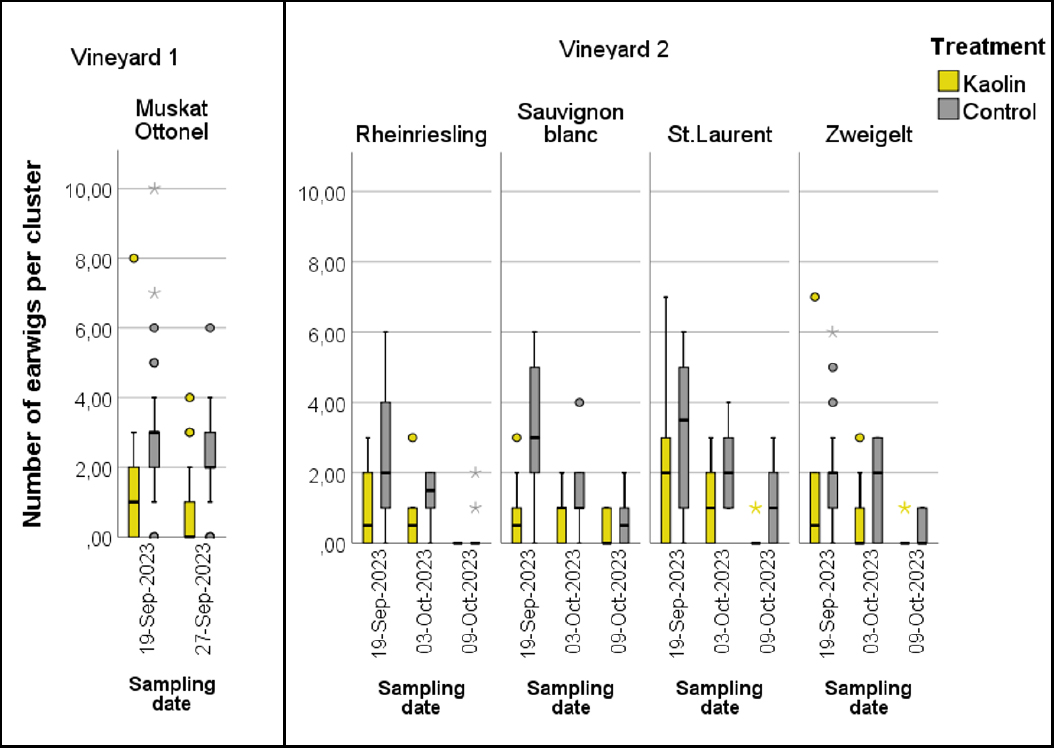
Fig. 1:
Numbers of earwigs per cluster in kaolin treated and untreated control plots. Vineyard 1: N = 100 (25/per treatment/sampling date). Vineyard 2: N = 240 (10/treatment/variety/sampling date). Each boxplot shows a median value, and the box boundaries indicate the 25th and 75th percentiles of each distribution. Outliers (values between 1.5 and three times the interquartile range) are identified with an O. Extreme values (more than three times the interquartile range) are marked with a *.
Results and discussion
Over all sampling dates and varieties, higher numbers of earwigs per cluster were present in control plots as compared to kaolin treated plots (Fig. 1). In vineyard 1, in treated plots the median number was 1 and 0 individuals of earwigs per cluster on September 19 and September 27 respectively, in control plots median numbers of 3 and 2 individuals were recorded. Statistical analysis proofed a significant effect of the factor treatment on insect density (χ2 = 34.78, df = 1, p = 0.000), the sampling date had no effect. Treatment efficacy calculated according to Abbott (1925) was 62.4 %.
In vineyard 2, in kaolin treated plots, a median number of 1 earwig was present on September 19 and October 03, in control plots the median number at these sampling dates was 2 individuals per cluster. On October 09, the majority of insects had obviously already migrated into the soil and a median number of 0 individuals per cluster was found both in treated and control plots. Statistical analysis confirmed a significant effect of the treatment and the sampling date on earwig densities of clusters in vineyard 2 (treatment: χ2 = 37.18 df = 1, p = 0.000; sampling date: χ2 = 73.47, df = 2, p = 0.000). Over all sampling dates and varieties, treatment efficacy according to Abbott was 51.9 %. In addition, in vineyard 2 the number of earwigs per cluster was significantly affected by the variety (χ2 = 22.34 df = 3, p = 0.000). St. Laurent was significantly more affected than all other varieties. The general susceptibility of the variety to rot and the advanced ripeness (the harvest was delayed for experimental purposes) apparently made St. Laurent particularly attractive to the earwigs.
The efficiencies according to Abbott achieved by the kaolin treatment in this study (from 51.9 to 62.4 %) were comparable to those reported for experiments with spinosad. In trials including spinosad applications in August, efficacy rates of 50-55 % at harvest were reported (Huth et al., 2009). The current results coincide with previous studies including kaolin treatment of apples (Markó et al., 2008). In contrast, no effect of kaolin on earwigs was observed by Huth et al., (2009). However, in the latter study, the kaolin was applied to the vine stems.
All data presented in the current work have been generated in one year in two vineyards in close proximity. Further experiments are necessary to develop strategies for the use of particle films for earwig control in practice, particularly to define the necessary number of applications and the ideal application times. Likely, the application of higher kaolin rates than the 17 kg/ha used in this study could increase the efficacy of kaolin treatments, as up to 30 kg kaolin/ha had been used in previous experiments (e.g. Krutzler et al., 2022).
In addition, further studies should focus on strategies to improve the rain resistance of particle films intended for pest control.