
Figure 1
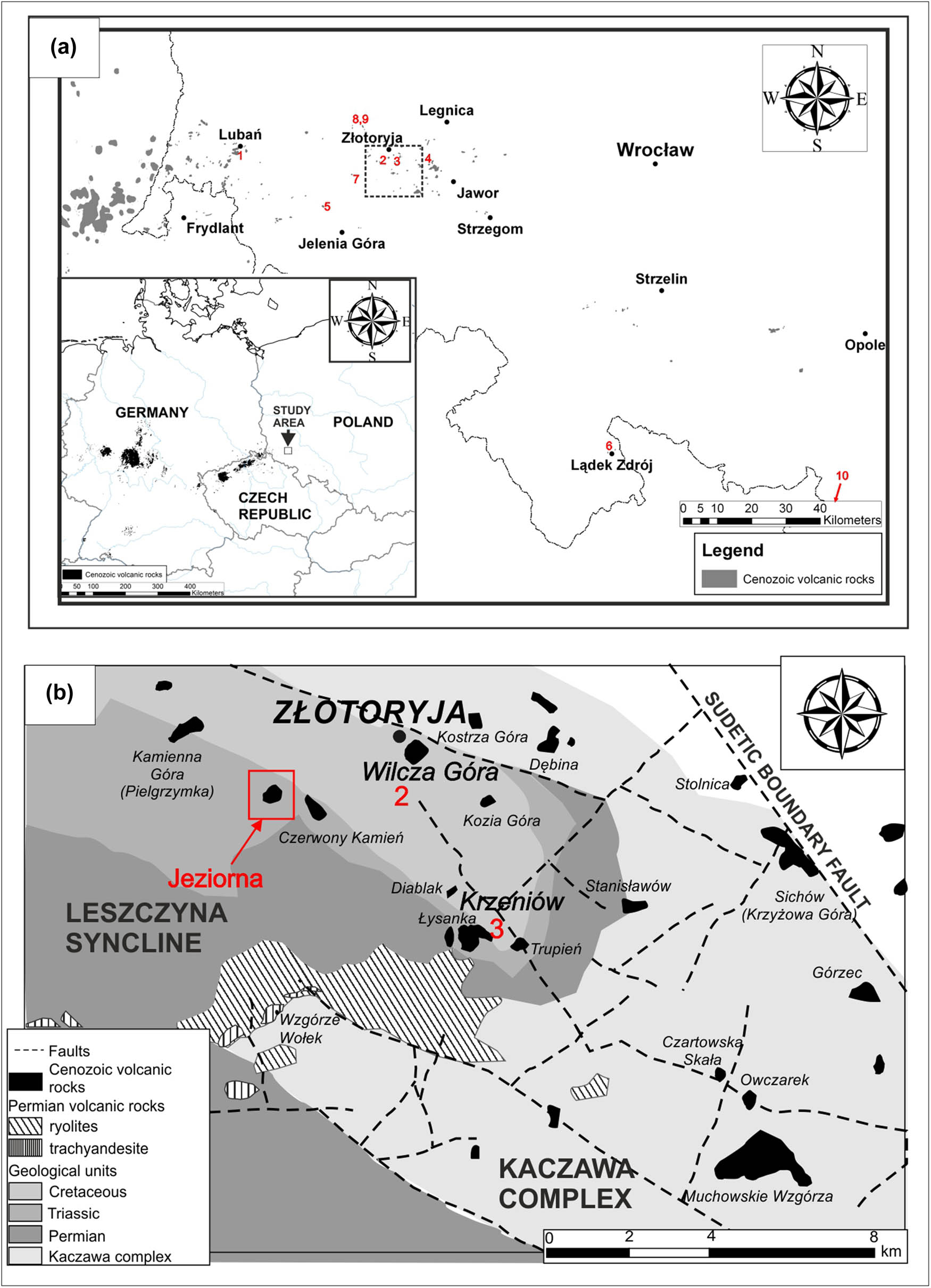
Location of the study site: (a) Occurrences of Cenozoic basalts in Poland against the background of the Central European Volcanic Province. Outcrops with xenoliths described in the literature in recent years are marked in red. 1. Księginki, 2. Wilcza Góra, 3. Krzeniów, 4. Winna Góra 5. Plichowice 6. Lutynia 7. Ostrzyca 8. Grodziec 9. Grodziec 2 and 10. Nowa Cerekwia (Ćwiek et al., 2018; Matusiak-Małek et al., 2010, 2017a, 2017b, 2021; Mazurek et al., 2025; Puziewicz et al., 2015, 2020). (b) Location of the studied Jeziorna outcrop against the background of geological divisions (Baranowski et al., 1990; Sawicki, 1967).
Table 1
Abbreviations used in the article.
| Abbreviation | Description |
|---|---|
| An | Anorthite |
| Amp | Amphibole |
| En | Enstatite |
| Di | Diopside |
| Ol | Olivine |
| Ol-Ia | Olivine – group Ia (main minerals in peridotites) |
| Ol-Ib | Olivine – group Ib (main minerals in pyroxenites) |
| Opx | Orthopyroxene |
| Opx-Ia | Orthopyroxene – group Ia (main minerals in peridotites) |
| Cpx | Clinopyroxene |
| Cpx-Ib | Clinopyroxene – group Ib (main minerals in pyroxenites) |
| Cpx-IIa | Clinopyroxene – group IIa (in melt pockets, peridotites) |
| Cpx-IIb | Clinopyroxene – group IIb (in melt pockets, pyroxenites) |
| Cpx-IIIa | Clinopyroxene – group IIIa (selvage, late generation, peridotites) |
| Cpx-IIIb | Clinopyroxene – group IIIb (selvage, late generation, pyroxenites) |
| Spl | Spinel |
| Spl-Ia | Spinel – group Ia (main minerals in peridotites) |
| Spl-IIa | Spinel – group IIa (in melt pockets, peridotites) |
| Spl-IIb | Spinel – group IIb (in melt pockets, pyroxenites) |
| Carb | Carbonate group mineral |
| Carb-IIa | Carbonate group minerals – group IIa (in melt pockets, peridotites) |
| Fs | Feldspar |
| Fs-IIb | Feldspar – group IIb (in melt pockets, pyroxenites) |
| mp | Melt pockets (fine-grained zones/intergranular aggregates) |
| Fo | Forsterite content in olivine (Mg/(Mg + Fe)*100) |
| Mg# | Magnesium number (Mg/(Mg + Fe)*100) in pyroxenes |
| apfu | Atoms per formula unit |
| BSE | Back-Scattered Electron (image in backscattered electrons) |
| Q1, Q2, Q3 | Quartile values used in statistical analysis |
| R | Crystal rim |
| C | Crystal core |
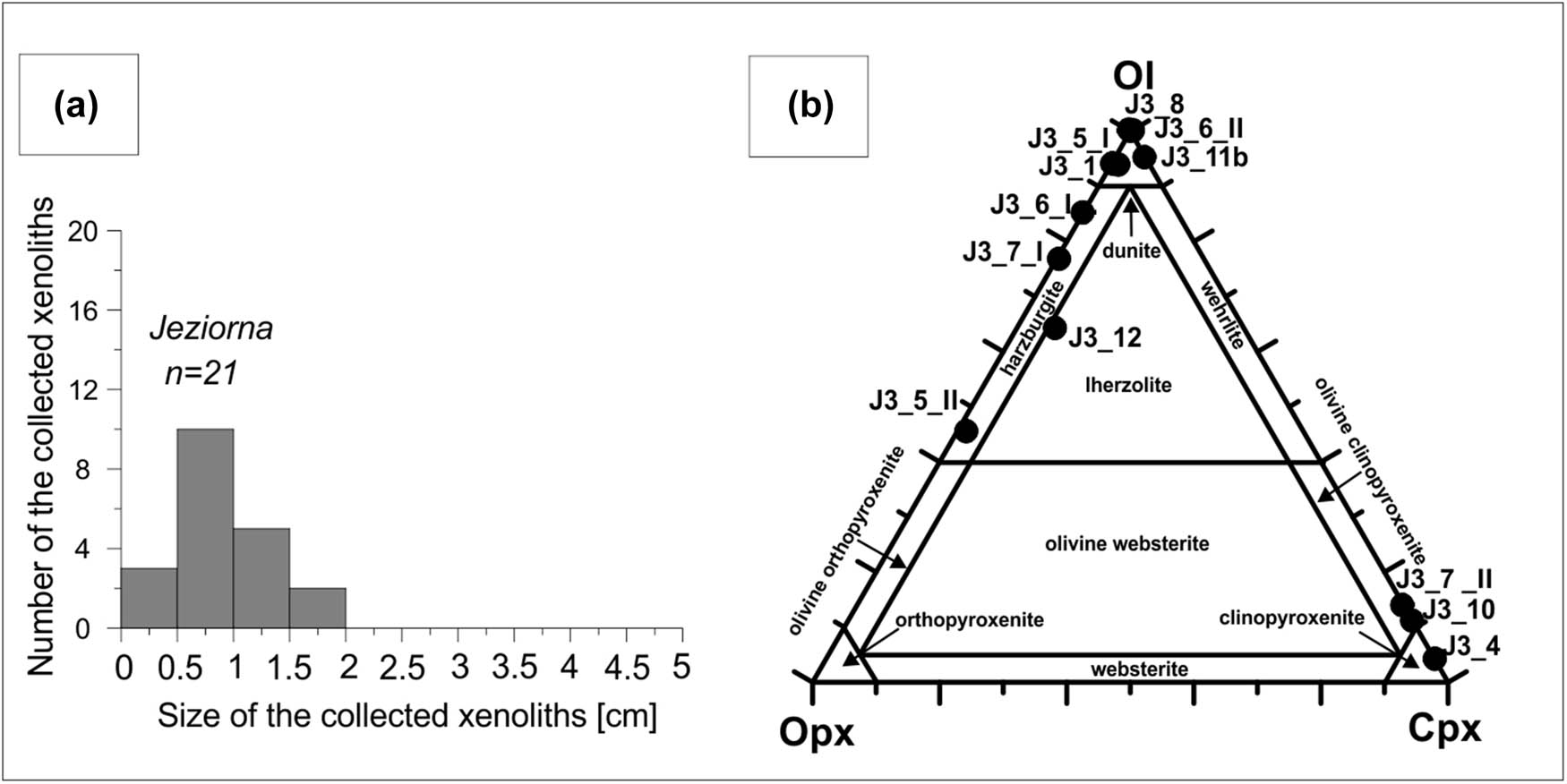
Figure 2
(a) Size distribution of collected xenoliths, and (b) petrographic classification of the studied xenoliths.
Table 2
Basic information about the studied xenolith samples.
| Xenolith name | Xenolith diameter (cm) | Macroscopic observation | Rock name | Rock texture | Olivine in Xenoliths (mm) | Orthopyroxene in xenoliths (mm) | Clinopyroxene in xenoliths (mm) | Melt pockets in xenoliths (mm) | Reaction rim between host rock and pyroxene (μm) | Diffusion rim in olivine (μm) | |
|---|---|---|---|---|---|---|---|---|---|---|---|
| 1 | J3_1 | 1.15 | Cumulate | Dunite | Protogranular | 0.38–1.77 | 0.28–1.31 | — | — | 114–283 | 68–75 |
| 2 | J3_4 | 1.1 | Clinopyroxenite | Clinopyroxenite | Porphyroclastic | 0.21–1.58 | 0.19–0.32 | 1.96–7.91 | 0.48–4.77 | 250–480 | — |
| 3 | J3_5_I | 1.1 | Cumulate | Dunite | Porphyroclastic | 0.22–2.94 | 0.57–1.79 | 0.18–1.28 | 1.29 | 52–232 | 36–58 |
| 4 | J3_5_II | 0.235 | — | Harzburgite | Protogranular | 0.13–1.14 | 0.63–1.38 | 1.76 | — | 179–672 | 20–52 |
| 5 | J3_6_I | 0.55 | Ultramafic xenolith | Harzburgite | Equigranular | 0.2–0.65 | 0.29–0.98 | 0.18–0.76 | 0.52–1.54 | 120–390 | — |
| 6 | J3_6_II | 0.12 | — | Dunite | Equigranular | 0.21–1.22 | — | — | — | — | 47–73 |
| 7 | J3_7_I | 0.65 | Ultramafic xenolith | Harzburgite | Equigranular | 0.16–1.33 | 0.29–0.70 | 0.410 | 0.51–0.94 | 150–830 | 18–138 |
| 8 | J3_7 _II | 0.15 | — | Olivine clinopyroxenite | Equigranular | 0.14–0.2 | — | 0.97–1.19 | 0.62 | — | — |
| 9 | J3_8 | 0.8 | Ultramafic xenolith | Dunite | Protogranular | 0.26–3.29 | — | — | 1.5 | 210–257 | 30–156 |
| 10 | J3_10 | 0.6 | Crustal xenolith | Olivine clinopyroxenite | Equigranular | 0.13–0.37 | — | 0.26–1.44 | 0.37 | — | 11–28 |
| 11 | J3_11b | 0.45 | Ultramafic xenolith | Dunite | Protogranular | 0.20–2.83 | — | 0.21–0.38 | — | — | 31–139 |
| 12 | J3_12 | 0.5 | Ultramafic xenolith | Lherzolite | Protogranular | 0.30–3.20 | 0.36–1.57 | 0.29–1.23 | 0.24–0.92 | 199–403 | 32–250 |
Table 3
Modal composition of minerals in the studied xenoliths based on planimetric analysis.
| Sample name | Ol (%) | Opx (%) | Cpx (%) | Amp (%) | Spl (%) | ‘Melt pockets’ (%) | ‘Secondary minerals’ (%) | Cpx- rim crystals (%) | |
|---|---|---|---|---|---|---|---|---|---|
| 1 | J3_1 | 54.3 | 3.3 | 0.0 | 0.0 | 0.0 | 0.0 | 42.1 | 0.3 |
| 2 | J3_4 | 3.6 | 0.0 | 81.7 | 0.0 | 0.0 | 5.8 | 0.0 | 9.0 |
| 3 | J3_5_I | 70.3 | 3.7 | 0.7 | 0.0 | 0.1 | 11.8 | 9.6 | 3.6 |
| 4 | J3_5_II | 29.4 | 34.1 | 0.8 | 0.0 | 0.0 | 0.9 | 0.0 | 34.8 |
| 5 | J3_6_I | 49.3 | 8.4 | 0.1 | 0.0 | 0.0 | 26.9 | 7.6 | 7.6 |
| 6 | J3_6_II | 96.1 | 0.0 | 0.0 | 0.0 | 0.0 | 3.9 | 0.0 | 0.0 |
| 7 | J3_7_I | 28.6 | 8.5 | 0.1 | 0.0 | 0.0 | 35.0 | 1.5 | 26.2 |
| 8 | J3_7 _II | 8.5 | 0.0 | 67.7 | 0.0 | 0.0 | 23.9 | 0.0 | 0.0 |
| 9 | J3_8 | 87.8 | 0.0 | 0.0 | 0.0 | 0.0 | 8.3 | 1.4 | 2.5 |
| 10 | J3_10 | 13.3 | 0.0 | 81.3 | 0.0 | 0.0 | 5.4 | 0.0 | 0.0 |
| 11 | J3_11b | 77.2 | 0.0 | 3.7 | 0.0 | 0.0 | 0.0 | 19.1 | 0.0 |
| 12 | J3_12 | 56.1 | 25.9 | 5.2 | 0.0 | 0.5 | 5.6 | 0.5 | 6.2 |
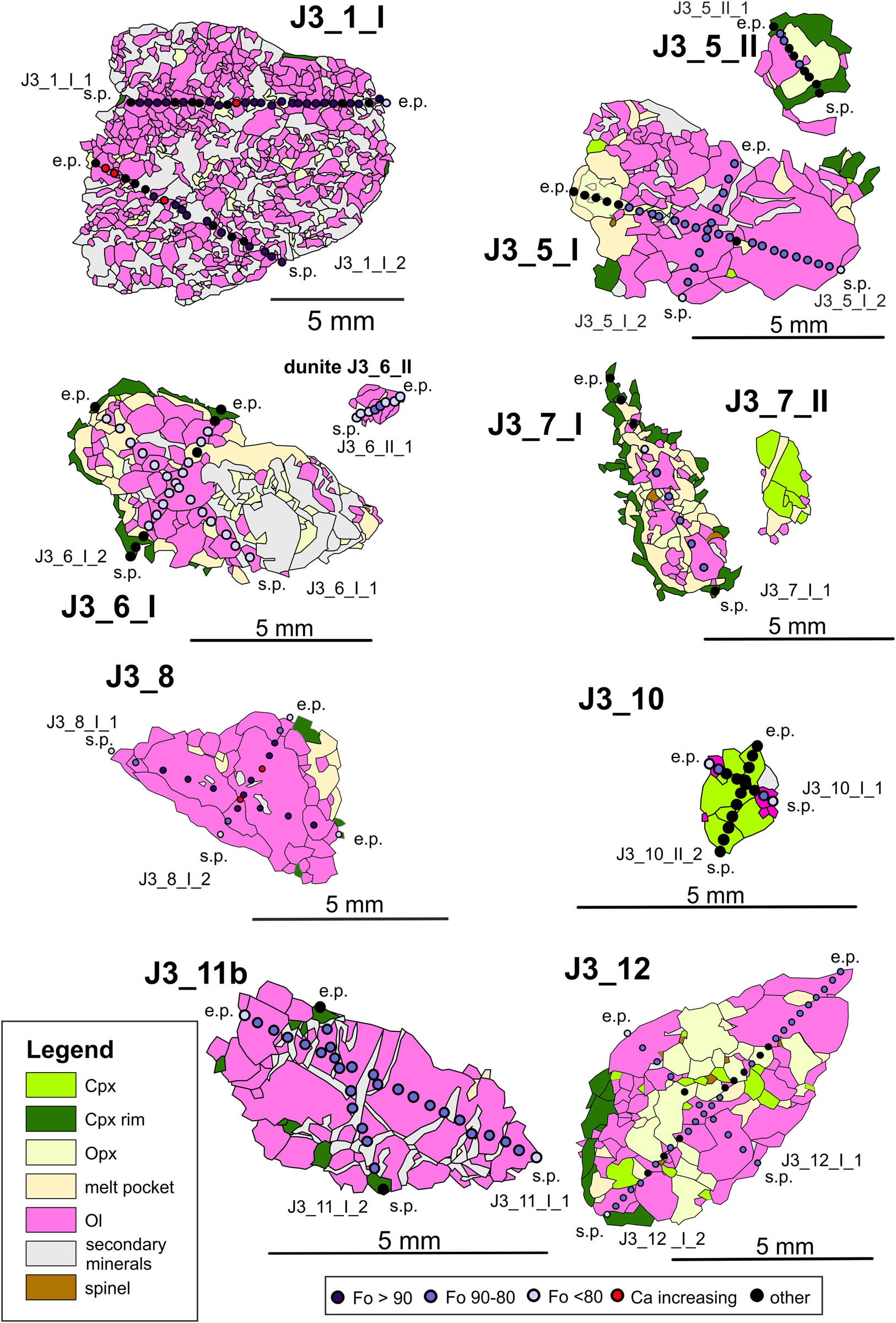
Figure 3
Maps of the studied xenoliths made in ArcGIS together with the research profiles, s.p. – starting point of the research profile, e.p. – ending point of the research profile. Other – analyses performed in minerals other than olivine.
Table 4
Detailed information on research profiles.
| Thin-section No. | Xenolith ID | Number of the xenoliths | Xenolith size on the thin-section (cm) | Number of measurement profiles | Length of measurement profile (mm) | Distance between measurement points (mm) | Number of measurement points |
|---|---|---|---|---|---|---|---|
| Jeziorna | |||||||
| 1 | J3_1 | 1 | 1.0–1.3 | 1 | 9.55 | 0.33 | 30 |
| 2 | 2 | 7.98 | 0.44 | 20 | |||
| 2 | J3_4 | — | — | — | — | — | — |
| 3 | J3_5_I | 2 | 1 | 3.88 | 0.53 | 10 | |
| 2 | 7.51 | 0.33 | 25 | ||||
| J3_5_II | 1 | 2.22 | 0.30 | 10 | |||
| 4 | J3_6_I | 2 | 0.5–0.9 | 1 | 4.82 | 0.34 | 15 |
| 2 | 6.03 | 0.51 | 15 | ||||
| J3_6_II | 0.1–0.1 | 1 | 1.35 | 0.21 | 8 | ||
| 5 | J3_7_I | 2 | 0.2–0.7 | 1 | 6.72 | 0.80 | 10 |
| J3_7_II | — | — | — | — | — | — | |
| 6 | J3_ 8 | 1 | 0.4–0.7 | 1 | 6.39 | 0.73 | 10 |
| 2 | 3.62 | 0.44 | 10 | ||||
| 7 | J3_10 | 1 | 0.1–0.2 | 1 | 2.07 | 0.23 | 8 |
| 2 | 1.35 | 0.21 | 10 | ||||
| 8 | J3_11b | 1 | 0.3–0.6 | 1 | 5.95 | 0.37 | 20 |
| 2 | 3.58 | 0.42 | 10 | ||||
| 9 | J3_12 | 1 | 0.5–0.9 | 1 | 8.83 | 1.38 | 30 |
| 2 | 4.89 | 1.00 | 10 |
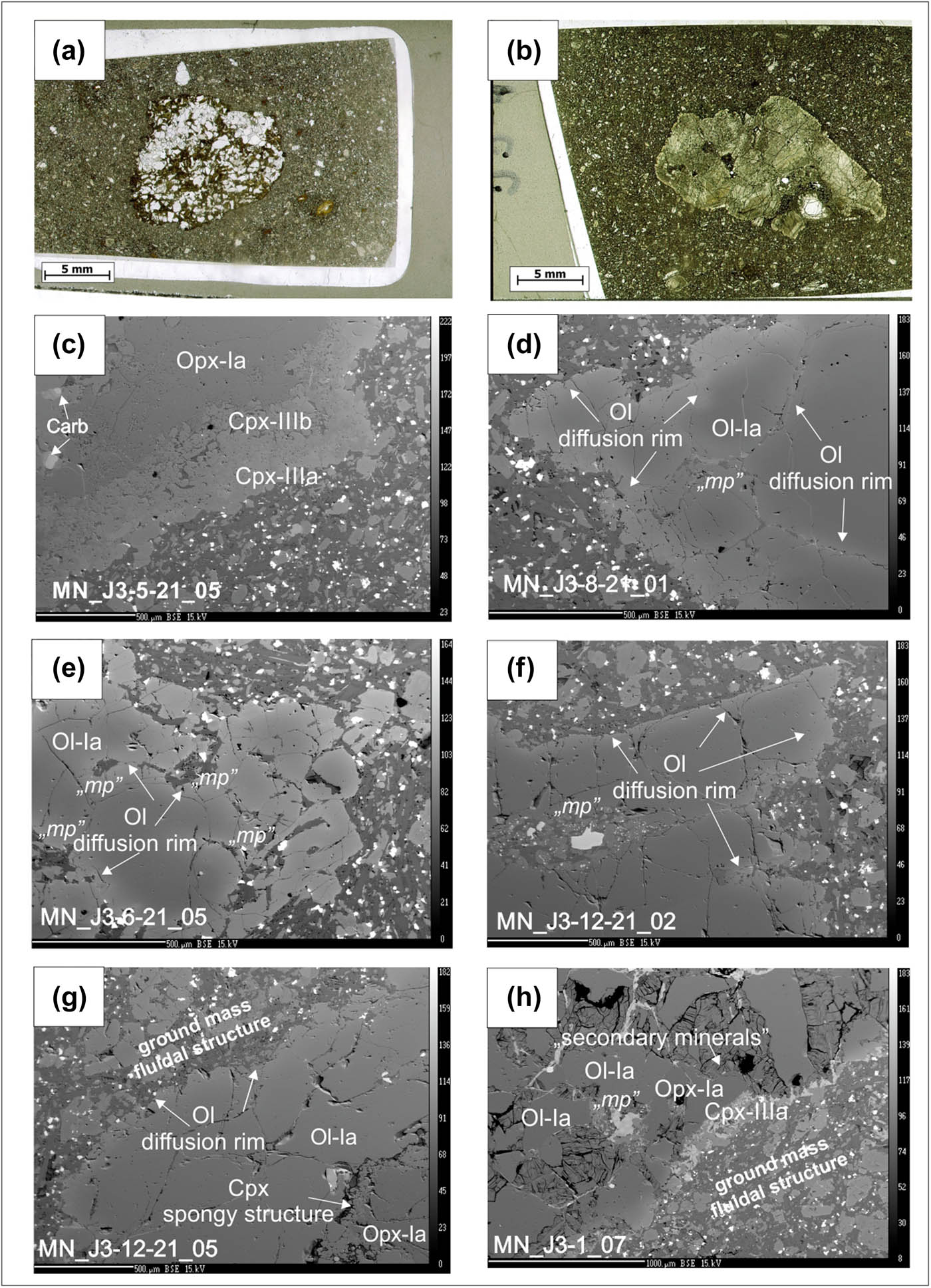
Figure 4
(a) Scan of sample J3-1, the largest of the studied xenoliths, showing degree of weathering changes, (b) Scan of sample J3_4 (Clinopyroxenite), BSE images showing (c) a ‘selvage’ on the xenolith-sample edge, (d) diffusion-rim zones occurring at the xenolith–volcanic rock edge and inside the xenolith near the cracks, (e) diffusion-rim zones that occur in olivine crystals and around the ‘mp’ changing the chemical composition of practically the entire sample J3-6-I, (f) diffusion-rim zones not covering the melt-pockets area in one of the larger xenoliths) J3-12, zone with Fo values (ca. 89) – darker BSE image, (g) diffusion-rim zone only on the xenolith edge in xenolith J3-12, area of the xenolith with lower Fo values (ca. 81) – lighter BSE image, and (h) secondary minerals with ‘selvage’ in sample J3-1.
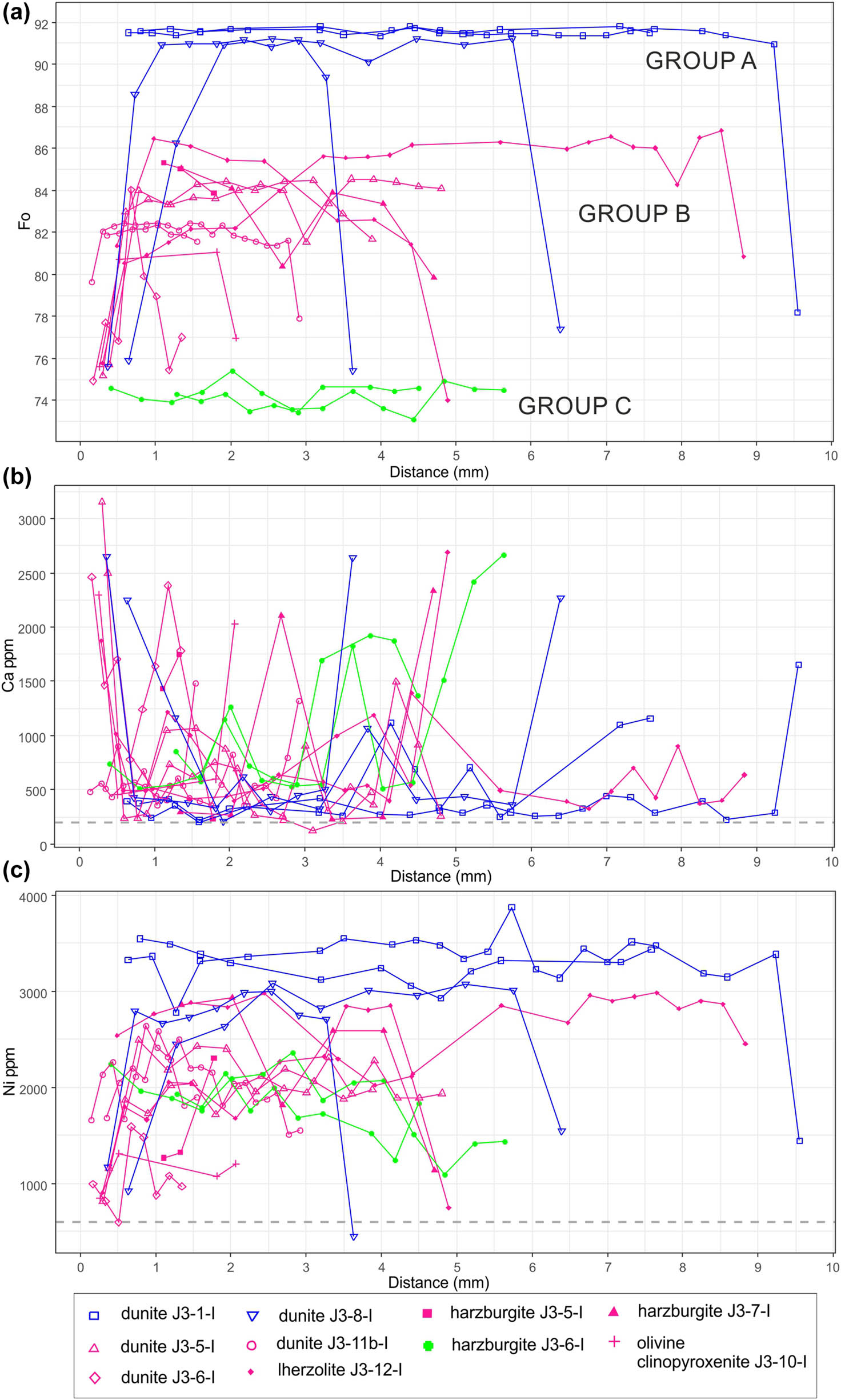
Figure 5
(a) Fluctuations of Fo content in olivine crystals along the research profiles, together with the division into groups A, B and C (sensu Matusiak-Małek et al., 2010, 2014, 2017a, 2017b); (b) fluctuations of Ca (ppm) content in olivine crystals along the research profiles, and (c) fluctuations of Ni (ppm) content in olivine crystals along the research profiles.
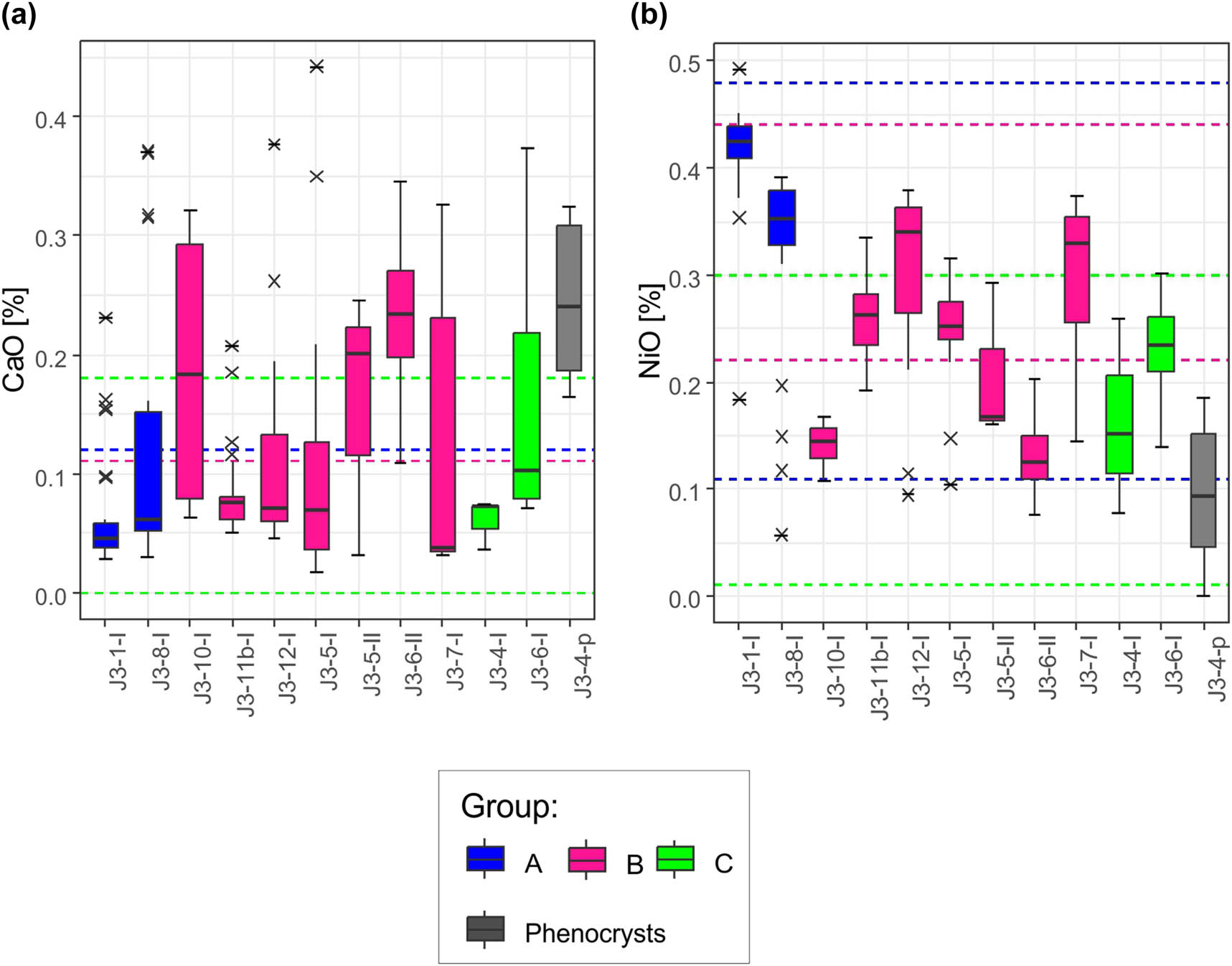
Figure 6
(a) Fluctuations of CaO (wt%) content in the tested samples, the dashed lines refer to the ranges recorded in other outcrops from Lower Silesia (Matusiak-Małek et al., 2014, 2017a, 2017b). (b) Fluctuations of NiO (wt%) content in the tested samples to the ranges recorded in outcrops from Lower Silesia (Mazurek et al., 2025).
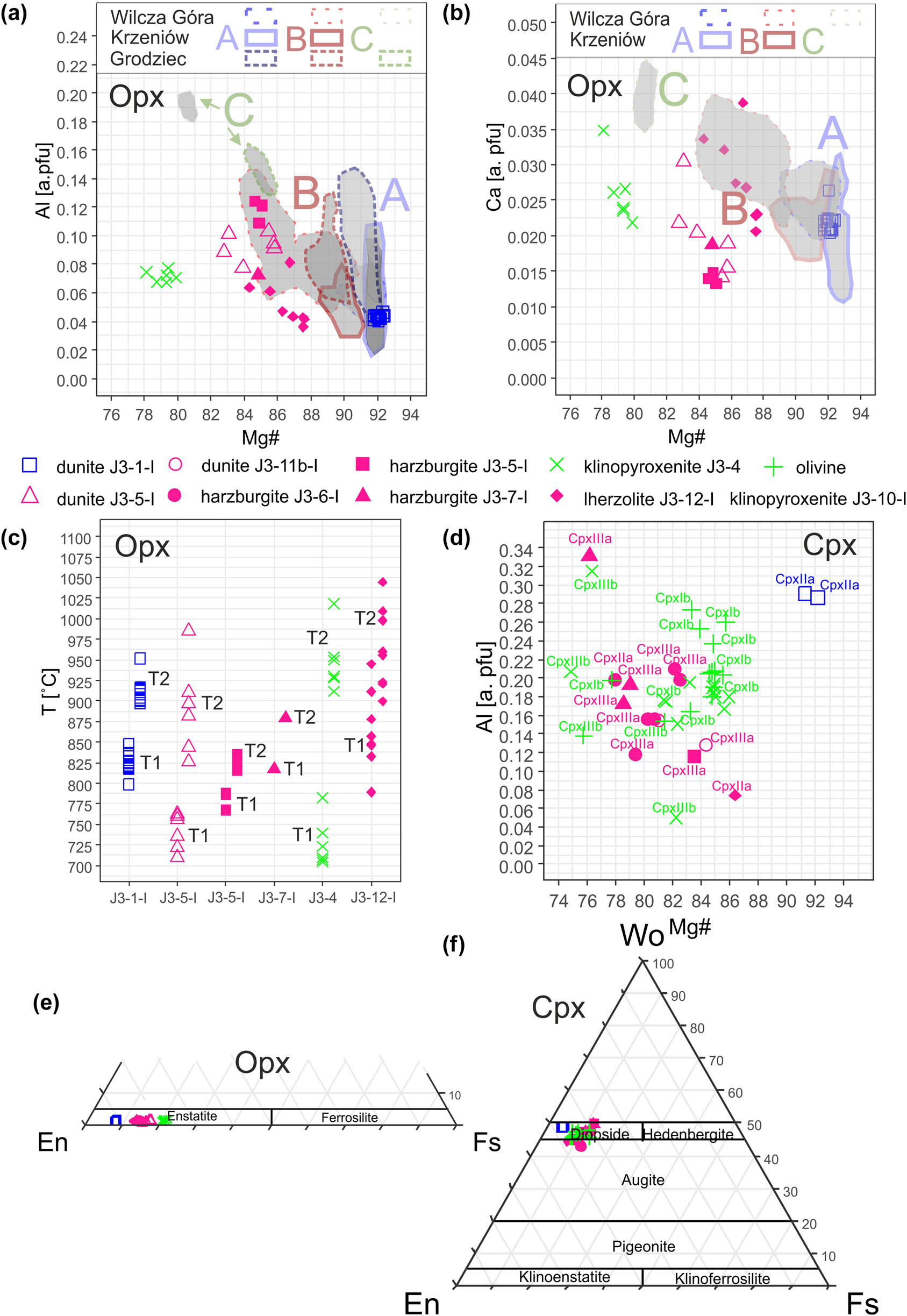
Figure 7
(a) Variations in Al content (a. pfu) versus magnesium number (#Mg) in the studied orthopyroxenes from Jeziorna, compared with samples from Krzeniów, Grodziec, and Wilcza Góra (Matusiak‑Małek et al., 2014, 2017a, 2017b). (b) Variations in Ca content (a. pfu) versus magnesium number (Mg#) in the studied orthopyroxenes from Jeziorna, compared with samples from Krzeniów and Wilcza Góra (Matusiak‑Małek et al., 2014, 2017b). (c) Temperatures calculated using the T1: Witt-Eickschen & Seck (1991) and T2: Brey & Köhler (1990) thermometers for orthopyroxenes. (d) Variations in Ca content (a. pfu) versus magnesium number (Mg#) in the studied clinopyroxenes from Jeziorna. (e) Classification diagram of orthopyroxenes from Jeziorna (after Morimoto et al., 1988). (f) Classification diagram of clinopyroxenes from Jeziorna (after Morimoto et al., 1988).
Table 5
Classification of chemical analyses of olivine (n = 185) according to geological processes that may have affected the studied xenoliths.
| Geological process | Regional variability among samples | Final-stage interactions | Other: analytical uncertainties | Other: weathering | Other: heating | ||
|---|---|---|---|---|---|---|---|
| Chemical composition of olivine (n = 185) | Group | Total analyses (n), Percentage of Group (%) | Geochemical composition Q2 Median (range Fo–3%, Ca + 400 ppm, Ni–400 ppm); (Aa, Ba, Ca) | Geochemical variation from Q2 (Fo decrease, Ca + 400 ppm, Ni–400 ppm) with diffusion rim in BSE image (Ac, Bc, Cc) | Geochemical variations from Q2 near Ca-bearing minerals (Ca + 400 ppm, Ni–400 ppm); (Bb1,Cb1) | Geochemical variations from Q2 near secondary minerals (Ca + 400 ppm, Ni–400 ppm); (Ab2, Bb2, Cb2) | Geochemical variations from Q2 (Ca + 400 ppm, Ni–400 ppm) – analyses without contact with Ca-bearing minerals (Bb3, Cb3) |
| Total number of analyses (n), Percentage (%) | A (Fo > 90) | 55, 29.7 | 43, 23.3 | 10, 5.5 | — | 2, 1.1 | — |
| Crystal core (n), percentage (%) | 21, 12.3 | 17, 9.2 | 4, 2.1 | — | — | — | |
| Crystal rim (n), percentage (%) | 34, 17.4 | 26, 14.1 | 6, 3.2 | — | 2, 1.1 | — | |
| Total number of analyses (n), percentage (%) | B (Fo 80–90) | 106, 57.3 | 68, 36.8 | 18, 9.7 | 8, 4.3 | 4, 2.2 | 8, 4.3 |
| Crystal core (n), percentage (%) | 50, 27.0 | 34, 18.4 | 8, 4.3 | — | — | 8, 4.3 | |
| Crystal rim (n), percentage (%) | 56, 30.3 | 34, 18.4 | 10, 5.4 | 8, 4.3 | 4, 2.2 | — | |
| Total number of analyses (n), percentage (%) | C (Fo < 80) | 24, 13.0 | 11, 6 | 5, 2.7 | 4, 2.1 | 2, 1.1 | 2, 1.1 |
| Crystal core (n), percentage (%) | 13, 7.1 | 9, 4.9 | 2, 1.1 | — | — | 2, 1.1 | |
| Crystal rim (n), percentage (%) | 11, 5.9 | 2, 1.1 | 3, 1.6 | 4, 2.1 | 2, 1.1 | — | |
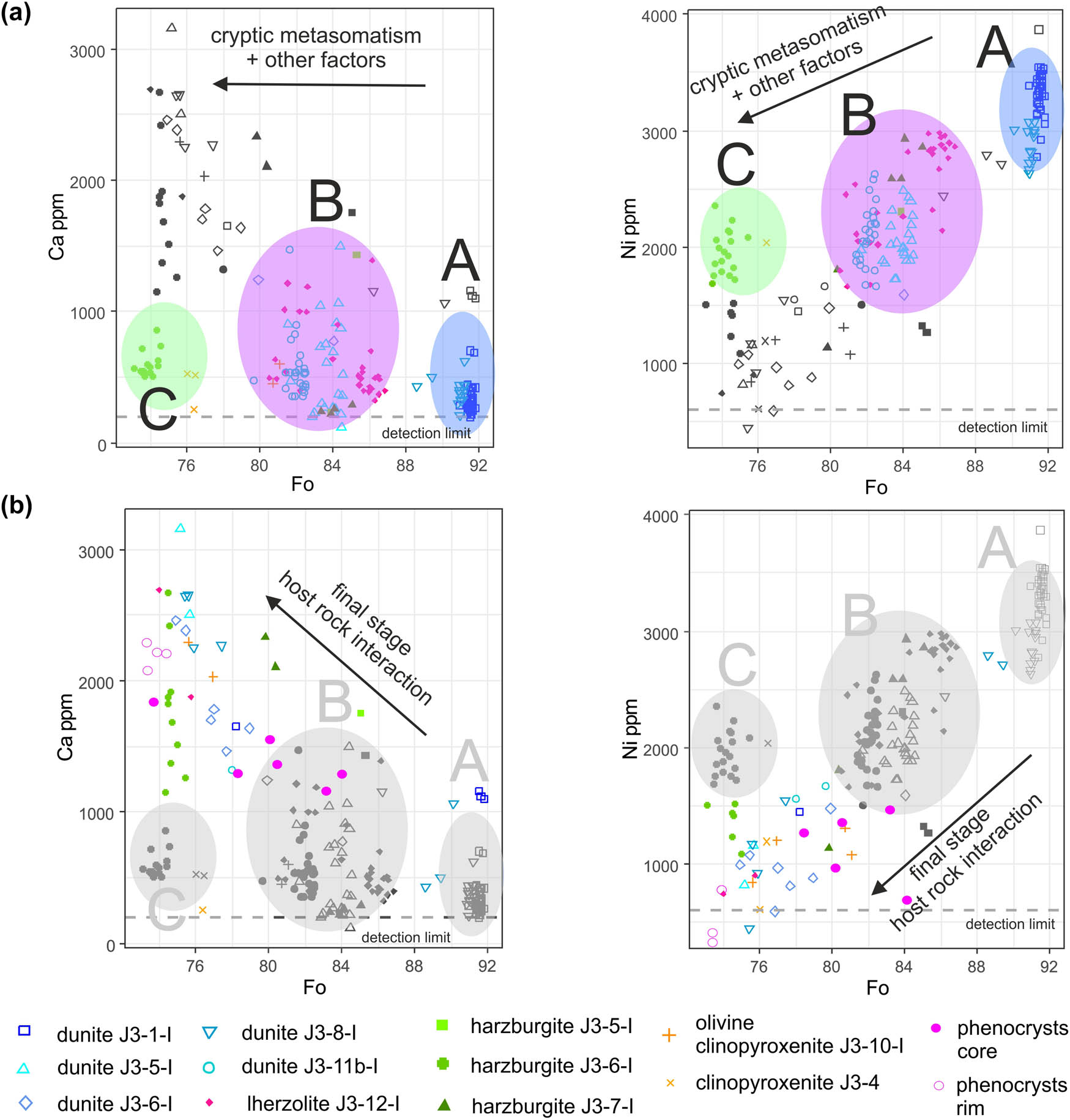
Figure 8
Division of the obtained data for olivine depending on the processes that may represent: (a) regional variability of xenoliths also related to metasomatic changes; (b) changes related to final stage host–rock interactions.