
1. Introduction
Peridotite and pyroxenite xenoliths offer valuable insights into the processes occurring in the upper lithospheric mantle or at the mantle–crust boundary, especially of the different types of mantle metasomatism which lead to mantle heterogeneity (e.g., alkaline metasomatism (Marchev et al., 2017; O’Reilly & Griffin, 2013; Roden & Murthy, 1985), Si-metasomatism (Marchev et al., 2017; Smith et al., 1999), carbonatite metasomatism (Bromley et al., 2025; Gorring & Kay, 2000; O’Reilly & Griffin, 2013), and modal/cryptic metasomatism (O’Reilly & Griffin, 2013; Roden & Murthy, 1985).
However, before interpreting the results of petrologic observations and the variation in chemical composition of minerals, it is important to determine whether the chemistry of minerals in the xenoliths has been modified by late/last host rock–xenolith interactions, referred to as ‘host basalt metasomatism’ (Marchev et al., 2017). The main features indicating late interaction between magma and xenolith are (1) diffusion rims (Fe, Ca-increasing, Mg-decreasing) in olivine crystals (Marchev et al., 2017; Shaw & Klügel, 2002; Shaw & Dingwell, 2007; Shaw et al., 2018) and (2) the presence of the selvages/selvedges (Klügel, 1998; Shaw et al., 2005) from the late generation of clinopyroxene growing at the xenolith–volcanic rock contact. Changes occurring inside xenoliths (e.g., formation of melt pockets/fine-grained aggregates and crystallization of sulphides) are more ambiguous and difficult to interpret (Kukuła et al., 2025; Marchev et al., 2017; Mazurek et al., 2025). Although it is not always possible to determine exactly when the interactions took place: (1) during ascent from the mantle (Klügel, 1998; Kukuła et al., 2025; Shaw & Dingwell, 2007), (2) during storage in crustal magma reservoirs (Klügel, 1998), or (3) at the surface in a volcanic body (Marchev et al., 2017), it is possible to partially reduce the contact between xenolith and host-rock and limit the influence of the late/last interactions to the chemical composition of whole xenolith. The most straightforward method to achieve this is to analyse internal zones of xenoliths with a diameter of more than 4–5 cm (Klügel, 1998; Marchev et al., 2017; Matusiak-Małek et al., 2014). An alternative approach is to analyse xenoliths erupted in pyroclastic material, where the contact between the xenolith and magma is relatively brief (Klügel, 1998; Shaw et al., 2018). However, these methods are not entirely effective in excluding xenolith–magma interactions (Klügel, 1998; Klügel et al., 2022; Marchev et al., 2017) and are unsuitable for xenoliths smaller than 1.5 cm in diameter, such as those discussed in this study.
Xenolith diameter is of particular importance in samples from Poland. More than 300 occurrences of Cenozoic volcanic rocks have been recognised in Lower Silesia and Opole Silesia, SW Poland (Birkenmajer et al., 2007; Ladenberger et al., 2006; Matusiak-Małek et al., 2017b; Pańczyk et al., 2023). Peridotitic and pyroxenitic xenoliths are well described from about ten occurrences (Ćwiek et al., 2018; Matusiak-Małek et al., 2010, 2017a, 2017b, 2021; Mazurek et al., 2025; Puziewicz et al., 2015, 2020). Xenoliths occur in a greater number of outcrops (Kowal-Linka et al., 2018; Nowak, 2012, 2021), but they are smaller (max. 5 cm in diameter), occur in smaller quantities, may show a high degree of weathering, and record a high level of host rock–xenolith interactions, which can disturb their chemical composition and make it difficult to interpret their chemical heterogeneity. To answer the question of whether the chemical composition of the entire small xenolith was influenced by interactions between the host magma and the xenolith, or whether such xenoliths can also be a source of information about processes in the Earth’s mantle, this study aims (1) to precisely trace the final changes that occurred at the xenolith–host rock contact based on the variability of the chemical composition in olivine crystals, and (2) to determine the spatial extent of the observed changes within individual grains and the entire xenoliths, using xenoliths from the Jeziorna occurrence.
Available chemical data on Jeziorna quarry xenoliths are limited (Nowak 2012, 2019). However, chemical and petrological data from its volcanic rocks indicate differentiation (e.g., in a shallow magma chamber), which suggests that the contact between xenoliths and magma was not limited only to the time of their being brought to the surface but was longer, improving the preservation of chemical changes.
2. Geological Setting
The study area belongs to the eastern part of the Central European Volcanic Province, which includes the Eger Rift area and several isolated volcanic centres in the Bohemian Massif (Lustrino & Wilson, 2007; Ulrych et al., 2011) (Figure 1). In Poland, the area of Cenozoic volcanic activity is limited to two larger and several smaller volcanic fields (Birkenmajer et al., 2007; Puziewicz et al., 2015, 2020; Matusiak-Małek et al., 2017a, 2017b; Pańczyk et al., 2023). The area between Złotoryja, Jawor and Świerzawa is the second largest volcanic field, just after the one located at the northeastern extension of the Eger (Ohře) Rift, and concentrated around Zgorzelec and Leśna.
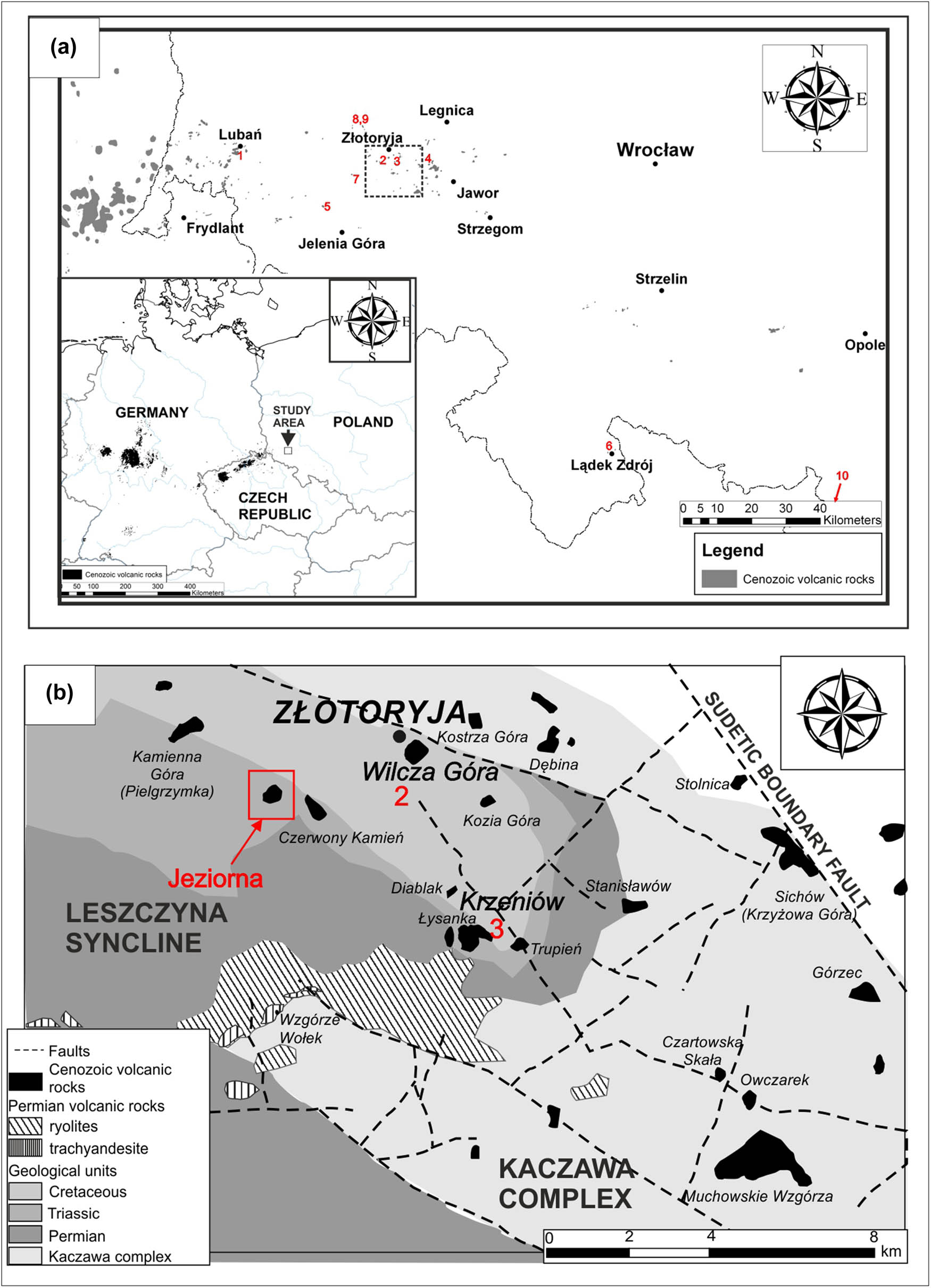
Figure 1
Location of the study site: (a) Occurrences of Cenozoic basalts in Poland against the background of the Central European Volcanic Province. Outcrops with xenoliths described in the literature in recent years are marked in red. 1. Księginki, 2. Wilcza Góra, 3. Krzeniów, 4. Winna Góra 5. Plichowice 6. Lutynia 7. Ostrzyca 8. Grodziec 9. Grodziec 2 and 10. Nowa Cerekwia (Ćwiek et al., 2018; Matusiak-Małek et al., 2010, 2017a, 2017b, 2021; Mazurek et al., 2025; Puziewicz et al., 2015, 2020). (b) Location of the studied Jeziorna outcrop against the background of geological divisions (Baranowski et al., 1990; Sawicki, 1967).
The Jeziorna outcrop (51° 5′ 38.4″ N 15° 52′ 0.9″ E, 285 m a.s.l.) is situated in an abandoned quarry, in the vicinity of the town of Złotoryja in Lower Silesia (South-West Poland), at a distance of approximately 3.5 km from the well-known Wilcza Góra (Matusiak-Małek et al., 2017b; see also references therein; Rizzo et al., 2018), 5.5 km from the occurrence in the active Krzeniów quarry and 12 km from Grodziec outcrop (Matusiak-Małek et al., 2014, Matusiak-Małek et al., 2017a; Puziewicz et al., 2015).
It is part of the North-Sudetic Basin (NSB), to the SW of the Sudetic Boundary Fault (Figure 1b). The Cenozoic volcanic neck cuts through Triassic formations located in the minor unit in the NSB of the Leszczyna Syncline (Biernacka et al., 2005), developed in the Permomesozoic cover and the underlying metamorphic rocks of the Paleozoic Varsican Kaczawa Complex (Kryza et al., 2004). No information is available on when exactly the quarry was active. Nowadays, the quarry is flooded, so all samples used for the study were taken from carved stone steps leading down to the water level. Based on geochemical studies, the Jeziorna rocks should be classified as basalts (Nowak, 2012, 2019). However, this lithology is rather unusual, as most volcanic rocks in Lower Silesia are less differentiated and belong to basaltoids or nephelinites (Ladenberger et al., 2006; Matusiak-Małek et al., 2017b; Pańczyk et al., 2023; Puziewicz et al., 2015).
The Jeziorna basalts differ from the remaining Cenozoic volcanic rocks from the Złotoryja-Jawor-Świerzawa area by a higher silica content (about 46%) and lower magnesium and titanium content (Nowak, 2019). The most characteristic feature of the basalts from Jeziorna, which distinguishes them from rocks from the nearby area outcrops, is the presence of a large amount (ca. 44%) of plagioclase (An62–67) in the groundmass (Nowak, 2019).
3. Methods
All abbreviations used in the manuscript are explained in Table 1. A total of 21 xenoliths, with a diameter ranging from less than 0.5–2 cm (Figure 2a), were collected. To prepare thin sections, nine xenoliths were chosen, and during preparation it turned out that nine larger xenoliths were accompanied by three additional smaller ones (less than 0.25 cm in diameter), which had not been previously taken into account. Therefore, there are a total of 12 xenoliths in nine thin sections (Table 2). It was assumed that the thin section was prepared through the centre of the xenolith; however, whether this condition was met in all samples is difficult to assess due to the small size of the xenoliths. The majority of observations and measurements of the chemical composition in the rock-forming minerals were conducted on thin sections with a thickness of approximately 50 μm; only two of them (J3_1, J3_4) had a thickness of approximately 25 μm.
Table 1
Abbreviations used in the article.
| Abbreviation | Description |
|---|---|
| An | Anorthite |
| Amp | Amphibole |
| En | Enstatite |
| Di | Diopside |
| Ol | Olivine |
| Ol-Ia | Olivine – group Ia (main minerals in peridotites) |
| Ol-Ib | Olivine – group Ib (main minerals in pyroxenites) |
| Opx | Orthopyroxene |
| Opx-Ia | Orthopyroxene – group Ia (main minerals in peridotites) |
| Cpx | Clinopyroxene |
| Cpx-Ib | Clinopyroxene – group Ib (main minerals in pyroxenites) |
| Cpx-IIa | Clinopyroxene – group IIa (in melt pockets, peridotites) |
| Cpx-IIb | Clinopyroxene – group IIb (in melt pockets, pyroxenites) |
| Cpx-IIIa | Clinopyroxene – group IIIa (selvage, late generation, peridotites) |
| Cpx-IIIb | Clinopyroxene – group IIIb (selvage, late generation, pyroxenites) |
| Spl | Spinel |
| Spl-Ia | Spinel – group Ia (main minerals in peridotites) |
| Spl-IIa | Spinel – group IIa (in melt pockets, peridotites) |
| Spl-IIb | Spinel – group IIb (in melt pockets, pyroxenites) |
| Carb | Carbonate group mineral |
| Carb-IIa | Carbonate group minerals – group IIa (in melt pockets, peridotites) |
| Fs | Feldspar |
| Fs-IIb | Feldspar – group IIb (in melt pockets, pyroxenites) |
| mp | Melt pockets (fine-grained zones/intergranular aggregates) |
| Fo | Forsterite content in olivine (Mg/(Mg + Fe)*100) |
| Mg# | Magnesium number (Mg/(Mg + Fe)*100) in pyroxenes |
| apfu | Atoms per formula unit |
| BSE | Back-Scattered Electron (image in backscattered electrons) |
| Q1, Q2, Q3 | Quartile values used in statistical analysis |
| R | Crystal rim |
| C | Crystal core |
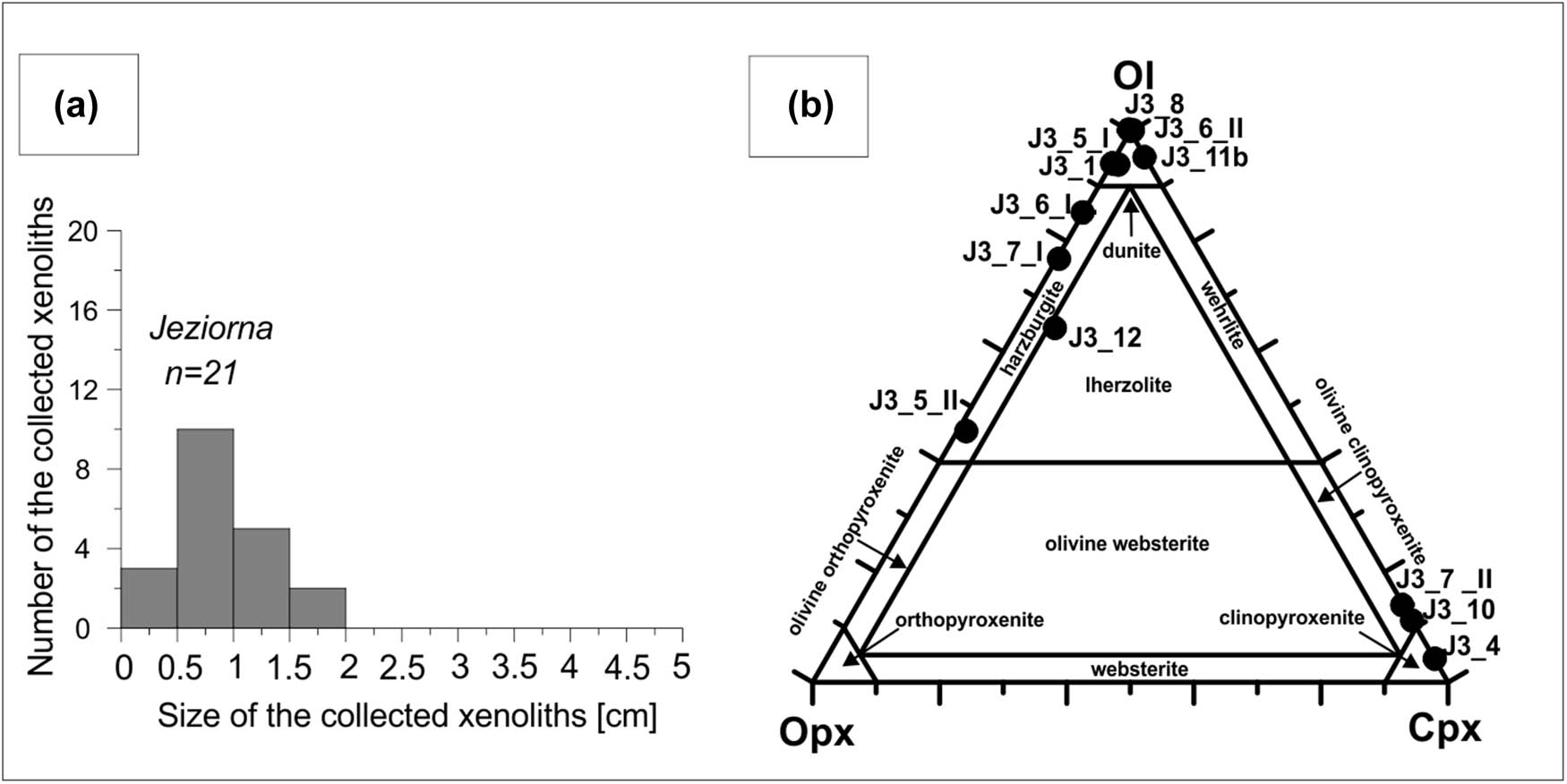
Figure 2
(a) Size distribution of collected xenoliths, and (b) petrographic classification of the studied xenoliths.
Table 2
Basic information about the studied xenolith samples.
| Xenolith name | Xenolith diameter (cm) | Macroscopic observation | Rock name | Rock texture | Olivine in Xenoliths (mm) | Orthopyroxene in xenoliths (mm) | Clinopyroxene in xenoliths (mm) | Melt pockets in xenoliths (mm) | Reaction rim between host rock and pyroxene (μm) | Diffusion rim in olivine (μm) | |
|---|---|---|---|---|---|---|---|---|---|---|---|
| 1 | J3_1 | 1.15 | Cumulate | Dunite | Protogranular | 0.38–1.77 | 0.28–1.31 | — | — | 114–283 | 68–75 |
| 2 | J3_4 | 1.1 | Clinopyroxenite | Clinopyroxenite | Porphyroclastic | 0.21–1.58 | 0.19–0.32 | 1.96–7.91 | 0.48–4.77 | 250–480 | — |
| 3 | J3_5_I | 1.1 | Cumulate | Dunite | Porphyroclastic | 0.22–2.94 | 0.57–1.79 | 0.18–1.28 | 1.29 | 52–232 | 36–58 |
| 4 | J3_5_II | 0.235 | — | Harzburgite | Protogranular | 0.13–1.14 | 0.63–1.38 | 1.76 | — | 179–672 | 20–52 |
| 5 | J3_6_I | 0.55 | Ultramafic xenolith | Harzburgite | Equigranular | 0.2–0.65 | 0.29–0.98 | 0.18–0.76 | 0.52–1.54 | 120–390 | — |
| 6 | J3_6_II | 0.12 | — | Dunite | Equigranular | 0.21–1.22 | — | — | — | — | 47–73 |
| 7 | J3_7_I | 0.65 | Ultramafic xenolith | Harzburgite | Equigranular | 0.16–1.33 | 0.29–0.70 | 0.410 | 0.51–0.94 | 150–830 | 18–138 |
| 8 | J3_7 _II | 0.15 | — | Olivine clinopyroxenite | Equigranular | 0.14–0.2 | — | 0.97–1.19 | 0.62 | — | — |
| 9 | J3_8 | 0.8 | Ultramafic xenolith | Dunite | Protogranular | 0.26–3.29 | — | — | 1.5 | 210–257 | 30–156 |
| 10 | J3_10 | 0.6 | Crustal xenolith | Olivine clinopyroxenite | Equigranular | 0.13–0.37 | — | 0.26–1.44 | 0.37 | — | 11–28 |
| 11 | J3_11b | 0.45 | Ultramafic xenolith | Dunite | Protogranular | 0.20–2.83 | — | 0.21–0.38 | — | — | 31–139 |
| 12 | J3_12 | 0.5 | Ultramafic xenolith | Lherzolite | Protogranular | 0.30–3.20 | 0.36–1.57 | 0.29–1.23 | 0.24–0.92 | 199–403 | 32–250 |
The percentage composition of individual minerals was determined using a self-developed semi-automated planimetric method of determining the surface area of individual minerals (Table 3), employing ESRI’s ArcGIS software (Nowak & Marciniak-Maliszewska, 2025). The assignment of individual minerals to the correct fields was conducted manually from digital scans of whole thin sections taken under polarised transmitted light using an Olympus ES-10 slide scanner (Figure 3). Size measurements of individual crystals were performed on scans of whole thin sections and BSE images using Zeiss AxioVision and Image J software (Table 2).
Table 3
Modal composition of minerals in the studied xenoliths based on planimetric analysis.
| Sample name | Ol (%) | Opx (%) | Cpx (%) | Amp (%) | Spl (%) | ‘Melt pockets’ (%) | ‘Secondary minerals’ (%) | Cpx- rim crystals (%) | |
|---|---|---|---|---|---|---|---|---|---|
| 1 | J3_1 | 54.3 | 3.3 | 0.0 | 0.0 | 0.0 | 0.0 | 42.1 | 0.3 |
| 2 | J3_4 | 3.6 | 0.0 | 81.7 | 0.0 | 0.0 | 5.8 | 0.0 | 9.0 |
| 3 | J3_5_I | 70.3 | 3.7 | 0.7 | 0.0 | 0.1 | 11.8 | 9.6 | 3.6 |
| 4 | J3_5_II | 29.4 | 34.1 | 0.8 | 0.0 | 0.0 | 0.9 | 0.0 | 34.8 |
| 5 | J3_6_I | 49.3 | 8.4 | 0.1 | 0.0 | 0.0 | 26.9 | 7.6 | 7.6 |
| 6 | J3_6_II | 96.1 | 0.0 | 0.0 | 0.0 | 0.0 | 3.9 | 0.0 | 0.0 |
| 7 | J3_7_I | 28.6 | 8.5 | 0.1 | 0.0 | 0.0 | 35.0 | 1.5 | 26.2 |
| 8 | J3_7 _II | 8.5 | 0.0 | 67.7 | 0.0 | 0.0 | 23.9 | 0.0 | 0.0 |
| 9 | J3_8 | 87.8 | 0.0 | 0.0 | 0.0 | 0.0 | 8.3 | 1.4 | 2.5 |
| 10 | J3_10 | 13.3 | 0.0 | 81.3 | 0.0 | 0.0 | 5.4 | 0.0 | 0.0 |
| 11 | J3_11b | 77.2 | 0.0 | 3.7 | 0.0 | 0.0 | 0.0 | 19.1 | 0.0 |
| 12 | J3_12 | 56.1 | 25.9 | 5.2 | 0.0 | 0.5 | 5.6 | 0.5 | 6.2 |
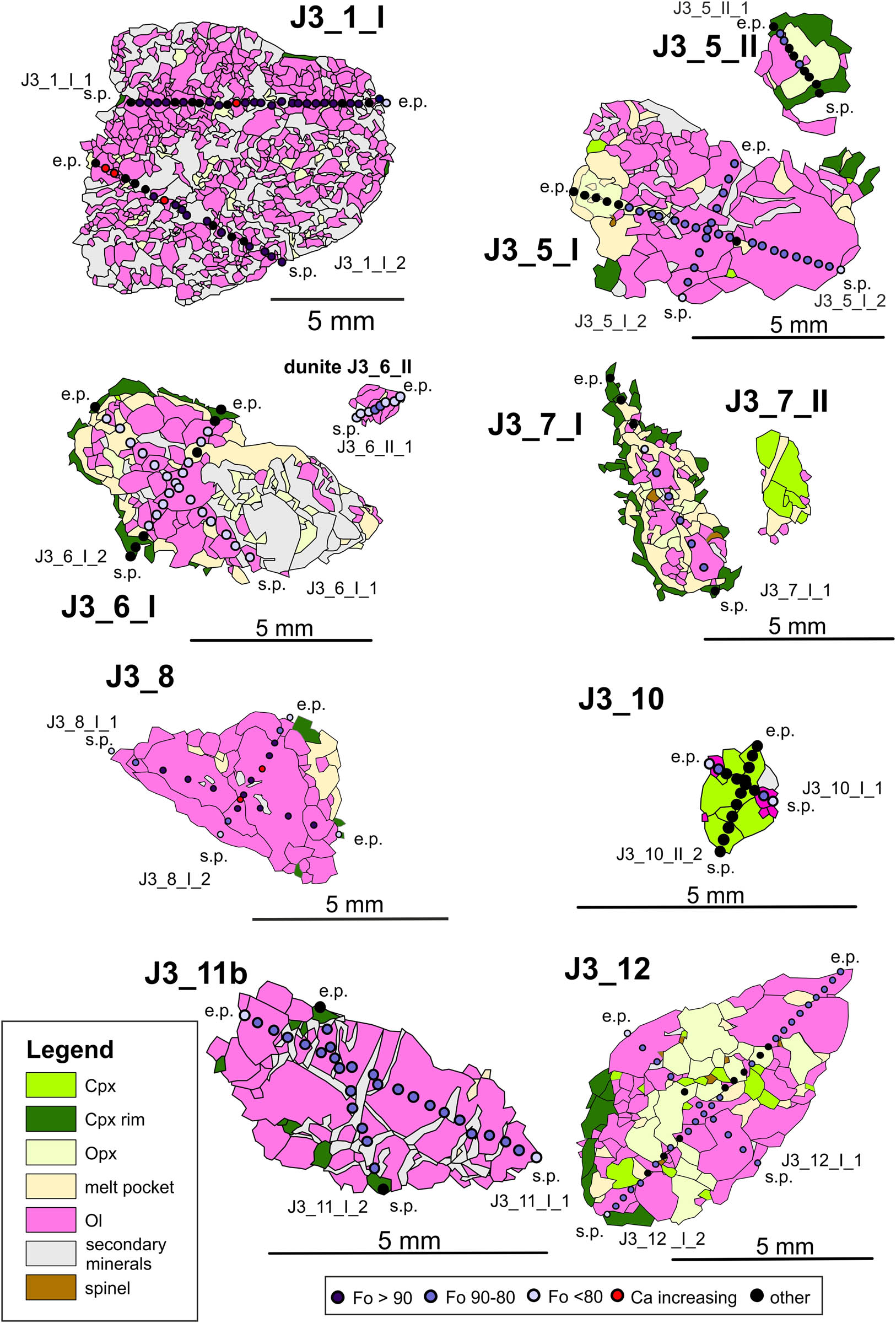
Figure 3
Maps of the studied xenoliths made in ArcGIS together with the research profiles, s.p. – starting point of the research profile, e.p. – ending point of the research profile. Other – analyses performed in minerals other than olivine.
The chemical composition of major elements in rock-forming minerals was investigated at the Laboratory of Electron Microscopy Microanalysis and X-Ray Diffraction, Faculty of Geology, University of Warsaw. The measurements were conducted using a Cameca SX-100 electron microprobe at an accelerating voltage of 15 kV and an intensity of 20 nA. The counting time was 20 s for the peak and 2 × 10 s for the background. The beam size was predominantly 5 μm. For the purpose of this study, a dedicated set of standards was established and applied consistently throughout all analyses; both natural and synthetic materials were used as standards (Standards, S1).
In total, 17 measurement profiles were made, covering from 8 to 30 points (Table 4), and 30 point analyses were made for sample J3_4. The length of the profiles ranged from 1.35 mm to 8.83 mm, and the interval between measurement points spanned 0.21 mm to 1.38 mm. In a single xenolith, one or two measurement profiles were made (Table 4). During the preparation of the profiles, a set of 13 standard elements (SiO2, MgO, Al2O, FeO, MnO, NiO, Cr2O3, TiO2, CaO, K2O, P2O5, Na2O, and V2O3) was used; the conversion into cations and Fe2+/Fe3+ separation according to the analysed mineral was performed using additional Excel sheets.
Table 4
Detailed information on research profiles.
| Thin-section No. | Xenolith ID | Number of the xenoliths | Xenolith size on the thin-section (cm) | Number of measurement profiles | Length of measurement profile (mm) | Distance between measurement points (mm) | Number of measurement points |
|---|---|---|---|---|---|---|---|
| Jeziorna | |||||||
| 1 | J3_1 | 1 | 1.0–1.3 | 1 | 9.55 | 0.33 | 30 |
| 2 | 2 | 7.98 | 0.44 | 20 | |||
| 2 | J3_4 | — | — | — | — | — | — |
| 3 | J3_5_I | 2 | 1 | 3.88 | 0.53 | 10 | |
| 2 | 7.51 | 0.33 | 25 | ||||
| J3_5_II | 1 | 2.22 | 0.30 | 10 | |||
| 4 | J3_6_I | 2 | 0.5–0.9 | 1 | 4.82 | 0.34 | 15 |
| 2 | 6.03 | 0.51 | 15 | ||||
| J3_6_II | 0.1–0.1 | 1 | 1.35 | 0.21 | 8 | ||
| 5 | J3_7_I | 2 | 0.2–0.7 | 1 | 6.72 | 0.80 | 10 |
| J3_7_II | — | — | — | — | — | — | |
| 6 | J3_ 8 | 1 | 0.4–0.7 | 1 | 6.39 | 0.73 | 10 |
| 2 | 3.62 | 0.44 | 10 | ||||
| 7 | J3_10 | 1 | 0.1–0.2 | 1 | 2.07 | 0.23 | 8 |
| 2 | 1.35 | 0.21 | 10 | ||||
| 8 | J3_11b | 1 | 0.3–0.6 | 1 | 5.95 | 0.37 | 20 |
| 2 | 3.58 | 0.42 | 10 | ||||
| 9 | J3_12 | 1 | 0.5–0.9 | 1 | 8.83 | 1.38 | 30 |
| 2 | 4.89 | 1.00 | 10 |
Based on petrographic observations, minerals were assigned to their respective occurrence sites (I) main minerals, (II) ‘melt pockets’, (III) ‘selvages’, a – peridotite, b – pyroxenite (e.g., main minerals: OlIa, OpxIa, CpxIa in peridotite; OIb, CpxIb in pyroxenite). This classification is described in the Results section and supported by the abbreviations table (Table 1).
Data on the chemical composition were obtained in 185 measurement points in olivines, 43 in clinopyroxenes, and 37 in orthopyroxenes. More than 95% of the analyses were performed on large, unweathered crystals, whereas the remaining ∼5% were conducted on small crystals situated between fractures, which likewise showed no evidence of weathering. At an early stage of data processing, a total of nine chemical analyses deviating from the stoichiometric composition of pyroxene were identified, and those analyses have been discarded. No olivine samples have been discarded. All olivine crystals presented in the figures are fresh and are not affected by alteration. No systematic investigations were carried out on minerals specifically associated with the ‘melt pocket’ regions, nor on spinel-group minerals and other secondary phases. This study focuses primarily on chemical analyses performed on olivines and, to a lesser degree, on analyses carried out on pyroxenes.
Statistical analyses (Q1, Q2, and Q3 determination) and graphical representations of chemical variability were performed using R scripts developed specifically for this study.
Following statistical and graphical assessment, a three-step subdivision of olivine chemical analyses was performed; the detailed procedure is presented below.
The subdivision procedure for olivine chemical analyses was as follows:
(1) Statistical partitioning: All 185 olivine analyses were first divided into quartiles within each xenolith, using the median (Q2) as the central reference point.
(2) Primary grouping (A, B, C): Median of Fo content of all the analyses within a xenolith is used to classify a xenolith to one of the three groups: Group A: Fo > 90%; Group B: Fo = 80–90%; Group C: Fo < 80%.
Note that assignment of a single analysis to the group is determined by the median of the Fo content of the xenolith; for example, an analysis having Fo content = 70% still belongs to group A, if the median of the analyses in its xenolith has Fo > 90%.
(3) Chemical subgroups1 (Aa, Ba, Ca; Ac, Bc, Cc; Ab, Bb, Cb): Within each group (A, B, and C), analyses meeting at least two of the following three criteria were classified as Aa, Ba, and Ca: <Q2Fo, Q2Fo–3%>, <Q2Ca, Q2Ca + 400 ppm>, <Q2Ni, Q2Ni–400 ppm>. Analyses where Fo decreases, and at least one of the following two criteria is met, are classified as Ac, Bc, and Cc: >Q2Ca + 400 ppm, <Q2Ni–400 ppm. Analyses that do not fit any of the above subgroups are assigned to subgroups Ab, Bb, and Cb. The three subgroups within each group (a, b, and c) are mutually exclusive, and together, they form a complete partition of the corresponding group A, B, or C (Table 5).
(4) Petrographic context subgroups2 (core, rim): Each analysis was also categorized based on its position within the crystal (core or rim).
(5) Additional subgroups1: Additional subgroups created from subgroups Ab, Bb, and Cb. The chemical analyses were assigned to tertiary subgroups based on microtextural context:
a) Bb1, Cb1 – rim analyses adjacent to Ca-bearing minerals.
b) Ab2, Bb2, Cb2 – analyses near secondary minerals.
c) Bb3, Cc3 – core analyses without visible contact with Ca-bearing minerals.
Subgroups Ab1 and Ab3 were not established because no analysis met the criteria.
Statistical analyses also included calculations of the percentage content of Groups, Subgroups1, and Subgroups2, which were later used in the Discussion and Table 5. The boundary conditions for defining groups and subgroups were determined based on the analysis of graphs prepared for individual samples (Graphs, S1), and thresholds of 3% for Fo and 400 ppm for Ca and Ni were established as the most appropriate criteria. These thresholds were particularly useful for distinguishing subtle compositional differences observed in samples from the Jeziorna locality.
4. Results
The xenoliths contain olivine (Ol), orthopyroxene (Opx), clinopyroxene (Cpx), spinel (Spl), ‘melt pockets’ (‘mp’), minerals that can be associated with weathering (‘secondary minerals’), and second-generation Cpx – so-called Cpx-rim crystals or ‘selvage’ (Table 3). All abbreviations appearing in the following description are defined in Table 1. Based on microscopic observations and semi-automatic planimetric studies, five rock types were distinguished: dunites (41.67%), lherzolites (8.33%), harzburgites (25%), olivine clinopyroxenites (16.67%), and clinopyroxenites (8.33%) (Figure 2b). Minerals such as amphibole, phlogopite, or apatite have not been identified. Using the classification of Mercier and Nicolas (1975), the studied peridotites show protogranular (55.5%), porphyroclastic (11.1%), and equigranular (33.3%) textures, while the studied pyroxenites are characterized by porphyroclastic (33.3%) and equigranular (66.6%) textures (Table 2).
The main minerals in peridotites are olivine (OlIa) and orthopyroxene (OpxIa). At the same time, pyroxenites are dominated by clinopyroxene (CpxIb) and a less frequent olivine (OlIb) (Table 3, Figure 4). The size of the individual crystals ranges from approx. 180 μm to max. 3 mm (sample J3_4 max. 8 mm), on average from about 1.0 to 1.5 mm (Table 2). The percentage content of the main minerals is different in individual samples (Table 3). The xenoliths also contain so-called ‘melt pockets’ (also known as fine-grade zones or intergranular aggregates, 0.24–4.77 mm in diameter). ‘Melt pockets’ differ in their mineral composition: in sample J3_1, the occurrence of mainly Cpx-IIa, spinel (Spl-IIa) and carbonate group minerals (Carb-IIa) was distinguished, while in samples J3_6_II and J3_12_I, the occurrence of feldspars (Fs-IIb), Cpx-IIb and spinel group minerals (Spl-IIb) can be identified in BSE images (Figure 4). Spinel (Spl-Ia) in the spaces between rock-forming minerals occur only in two samples: J3_7 and J3_12 (Figure 3). The group of minerals classified as ‘secondary minerals’ mainly included minerals that could be associated with weathering, in most samples their content did not exceed 2%, while in four samples (J3_1_I, J3_5_I, J3_6_I, J3_11b_I), it ranged from 9 to over 42% (Table 3). Microscopic observations indicate that secondary minerals occur predominantly within fractures between primary minerals, with fracture widths ranging from a few micrometres to over 200 micrometres. In six samples (the four listed above, as well as J3_5_II and J3_7_I), the fracture infill locally resembles iddingsite due to its rusty-brown coloration; however, it more likely represents pale beige to rusty-brown amorphous Si-silica with or without amorphous Fe(III) hydroxide. Backscattered electron (BSE) images show minerals resembling the serpentine group in two samples (J3_5_I and J3_11b), along with highly porous zones originally filled with amorphous phases and partially lost during thin-section preparation. Secondary minerals were not analysed in detail in this study.
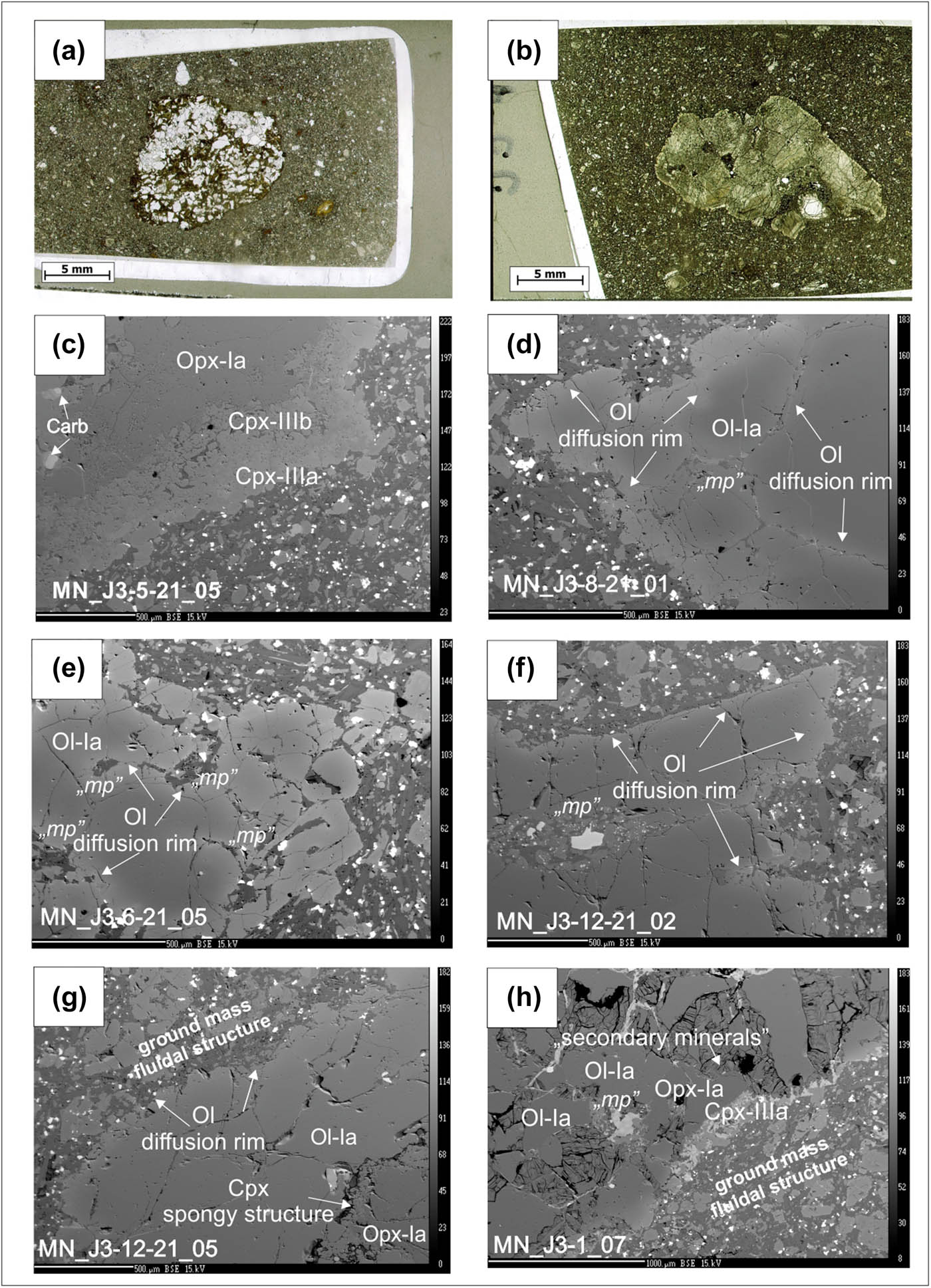
Figure 4
(a) Scan of sample J3-1, the largest of the studied xenoliths, showing degree of weathering changes, (b) Scan of sample J3_4 (Clinopyroxenite), BSE images showing (c) a ‘selvage’ on the xenolith-sample edge, (d) diffusion-rim zones occurring at the xenolith–volcanic rock edge and inside the xenolith near the cracks, (e) diffusion-rim zones that occur in olivine crystals and around the ‘mp’ changing the chemical composition of practically the entire sample J3-6-I, (f) diffusion-rim zones not covering the melt-pockets area in one of the larger xenoliths) J3-12, zone with Fo values (ca. 89) – darker BSE image, (g) diffusion-rim zone only on the xenolith edge in xenolith J3-12, area of the xenolith with lower Fo values (ca. 81) – lighter BSE image, and (h) secondary minerals with ‘selvage’ in sample J3-1.
The contact between the host volcanic rock and the xenoliths is not sharp. At the contact, changes in the brightness of olivine on the BSE images were observed linked to diffusion rims in the olivine (Figure 4), later-generation Cpx-rim crystals (‘selvage’, Cpx-IIIa and Cpx-IIIb, Figures 3 and 4), and xenoliths, as ‘melt pockets’ (Figures 3 and 4). In the larger samples (J3_1, J3_11b, J3_12), the host-rock shows a fluidized texture, as feldspar crystals ‘flow’ around the xenolith (Figure 4a and h).
Olivine (Ol-Ia, Ol-Ib) and orthopyroxene (Opx-Ia) show highly variable compositions (Fo 75–92, Opx, En Mg# 75–92, Al 0.04–0.12 a. pfu, Ca 0.12–0.40 a. pfu), between individual xenoliths and within them (Figures 5–7, Table S1). Cpx-Ib crystals (Di, Mg# 83–86) show smaller chemical variations. Although the chemical composition of Cpx-Ia could not be obtained, the limited number of analyses (n = 3) performed on melt pockets within Cpx-IIa reveals magnesium contents similar to those of the investigated xenoliths (Figure 7d).
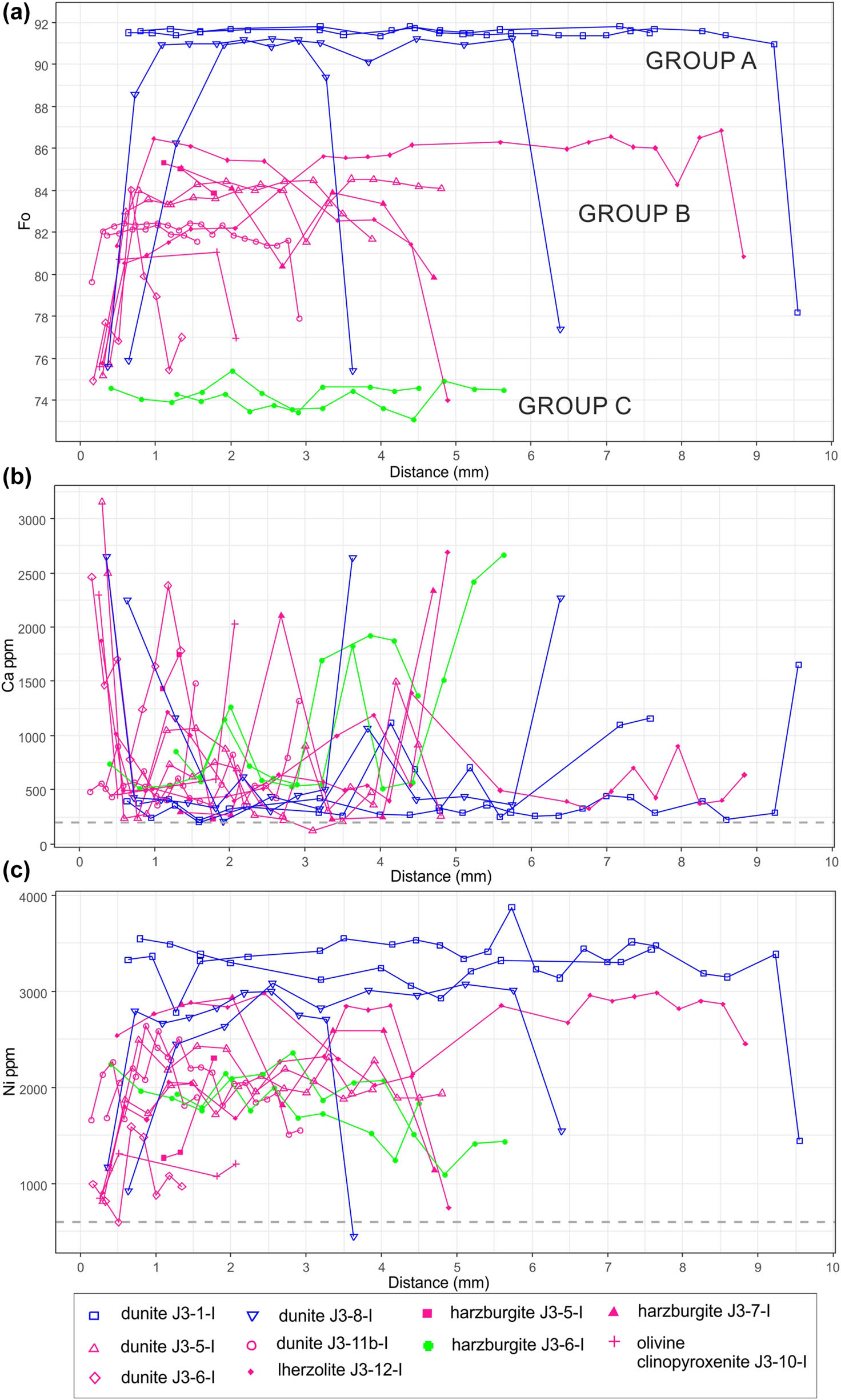
Figure 5
(a) Fluctuations of Fo content in olivine crystals along the research profiles, together with the division into groups A, B and C (sensu Matusiak-Małek et al., 2010, 2014, 2017a, 2017b); (b) fluctuations of Ca (ppm) content in olivine crystals along the research profiles, and (c) fluctuations of Ni (ppm) content in olivine crystals along the research profiles.
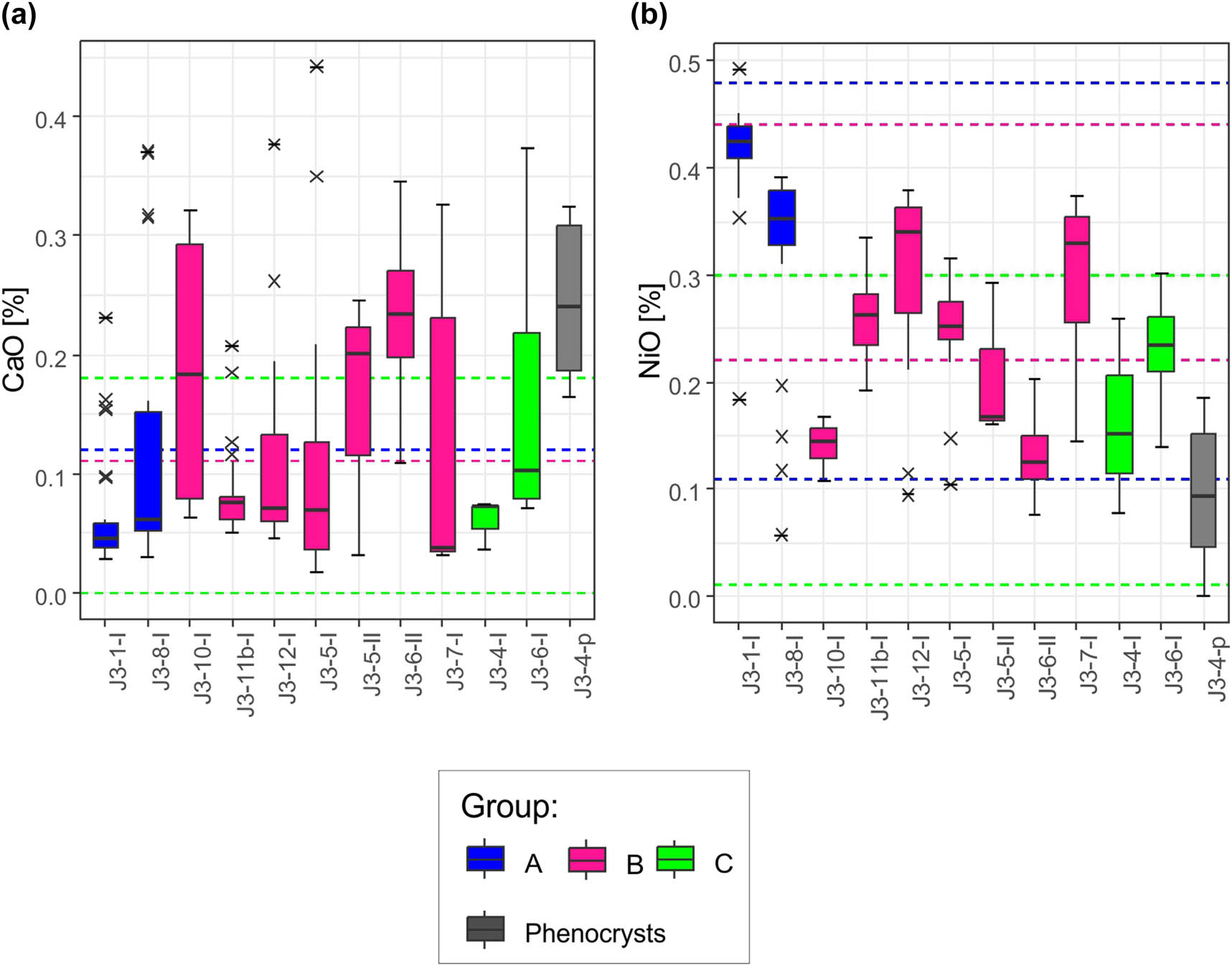
Figure 6
(a) Fluctuations of CaO (wt%) content in the tested samples, the dashed lines refer to the ranges recorded in other outcrops from Lower Silesia (Matusiak-Małek et al., 2014, 2017a, 2017b). (b) Fluctuations of NiO (wt%) content in the tested samples to the ranges recorded in outcrops from Lower Silesia (Mazurek et al., 2025).
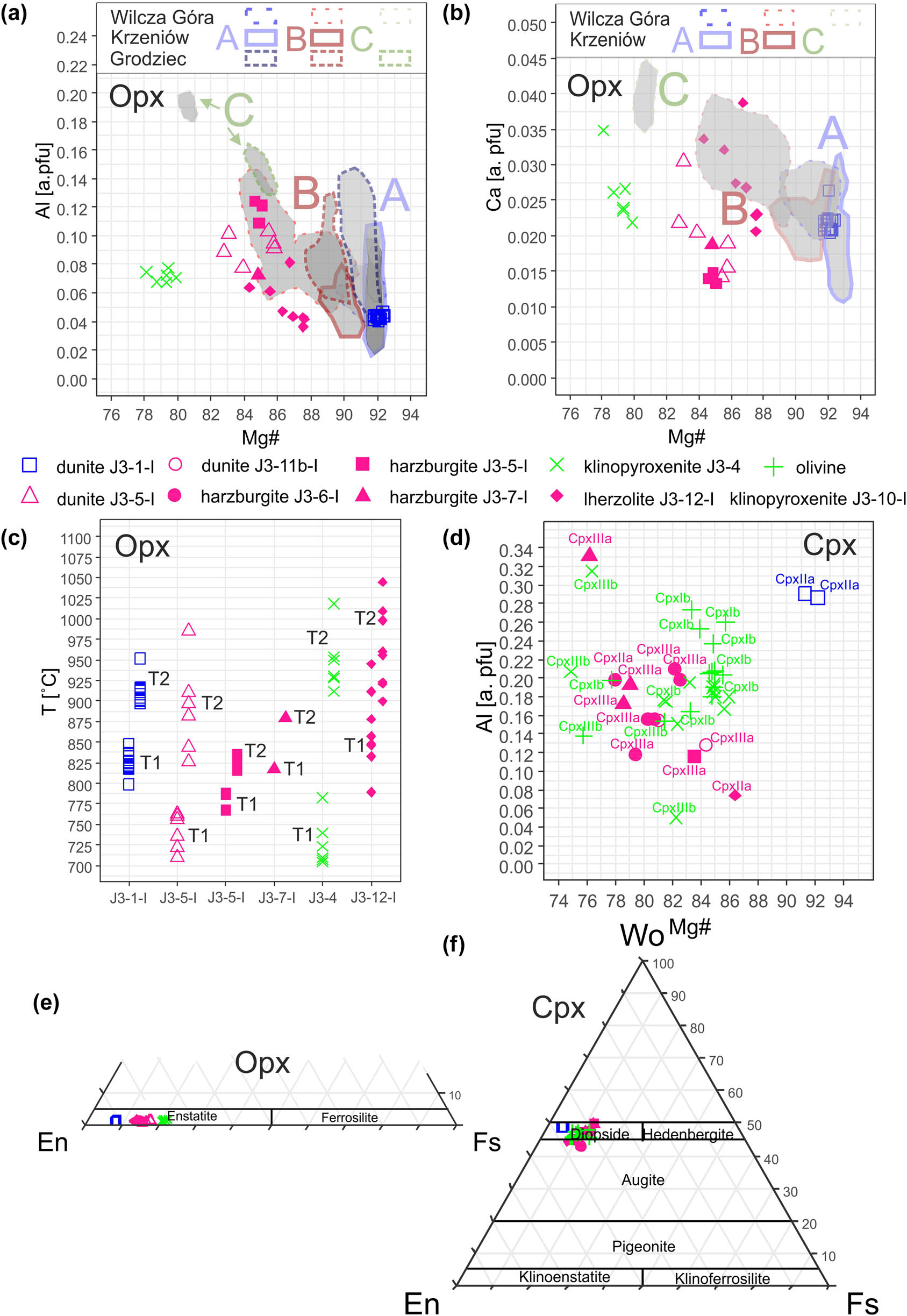
Figure 7
(a) Variations in Al content (a. pfu) versus magnesium number (#Mg) in the studied orthopyroxenes from Jeziorna, compared with samples from Krzeniów, Grodziec, and Wilcza Góra (Matusiak‑Małek et al., 2014, 2017a, 2017b). (b) Variations in Ca content (a. pfu) versus magnesium number (Mg#) in the studied orthopyroxenes from Jeziorna, compared with samples from Krzeniów and Wilcza Góra (Matusiak‑Małek et al., 2014, 2017b). (c) Temperatures calculated using the T1: Witt-Eickschen & Seck (1991) and T2: Brey & Köhler (1990) thermometers for orthopyroxenes. (d) Variations in Ca content (a. pfu) versus magnesium number (Mg#) in the studied clinopyroxenes from Jeziorna. (e) Classification diagram of orthopyroxenes from Jeziorna (after Morimoto et al., 1988). (f) Classification diagram of clinopyroxenes from Jeziorna (after Morimoto et al., 1988).
At the xenolith–volcanic rock contact, OpxIa/OpxIb crystallize Cpx crystals which have been classified as Cpx-IIIa and Cpx-IIIb (diopside, Mg# 75–85). Crystals of the Cpx IIIa type show a transition from an euhedral/subhedral texture to a spongy anhedral texture (Figure 4c). In the pyroxenite from sample J3_4, Cpx IIIb (diopside, Mg# 75–76) forms a recrystallized rim around the entire xenolith (Figure 4b). Temperatures were calculated from the chemical composition of orthopyroxenes using two orthopyroxene‑based thermometers (T1: Witt‑Eickschen & Seck, 1991; T2: Brey & Köhler, 1990). A pressure of 1.1 GPa was applied in the calculations, consistent with the approach used for the Wilcza Góra locality (Matusiak-Małek et al., 2017b). The resulting temperatures range between 707 and 1,007°C (Figure 7c), with systematically lower values obtained using the Witt‑Eickschen and Seck (1991) thermometer.
Using Fo content, the xenoliths in which the profiles were made were divided into three groups: A: Fo > 90%, B: Fo = 80–90%, and C: Fo < 80% (Discussion).
Of the ten xenoliths examined, two samples were classified as group A, seven as group B, and one as group C (Figure 5a). The pyroxenite sample J3_4, in which only single analyses and not full profiles were performed, is group C (Figure 5b and c). Statistical analysis of olivine compositions (Figure 6a and b) indicates that CaO and NiO concentrations are not normally distributed and show significant variability.
The greatest variations (33% of all analyses performed) in chemical composition occur in the Ol diffusion rim on the edges of the xenoliths (Subgroups Ac, Bc, Cc, Figure 5a, Table 5). Regardless of rock type and the primary content of Fo in olivine, in the diffusion rims, the Fo decreases to 74–82% (Figure 5a), while the Ni content decreases to approx. 2,000 ppm (Figure 5c, Graphs, S1). The Ca content, in turn, increases in the diffusion zones, to a maximum of 3,000 ppm (J3_5_II), and in most samples up to approximately 1,000–2,200 ppm (Figure 5b, Graphs, S1). The above pattern is broken by sample J3_12_I, which, in the absence of clear changes in the BSE image (Figure 4e and g), is characterized by a change in Fo content (from min. Fo = 81 to max. Fo = 87) along the profiles (Graphs, S1).
Table 5
Classification of chemical analyses of olivine (n = 185) according to geological processes that may have affected the studied xenoliths.
| Geological process | Regional variability among samples | Final-stage interactions | Other: analytical uncertainties | Other: weathering | Other: heating | ||
|---|---|---|---|---|---|---|---|
| Chemical composition of olivine (n = 185) | Group | Total analyses (n), Percentage of Group (%) | Geochemical composition Q2 Median (range Fo–3%, Ca + 400 ppm, Ni–400 ppm); (Aa, Ba, Ca) | Geochemical variation from Q2 (Fo decrease, Ca + 400 ppm, Ni–400 ppm) with diffusion rim in BSE image (Ac, Bc, Cc) | Geochemical variations from Q2 near Ca-bearing minerals (Ca + 400 ppm, Ni–400 ppm); (Bb1,Cb1) | Geochemical variations from Q2 near secondary minerals (Ca + 400 ppm, Ni–400 ppm); (Ab2, Bb2, Cb2) | Geochemical variations from Q2 (Ca + 400 ppm, Ni–400 ppm) – analyses without contact with Ca-bearing minerals (Bb3, Cb3) |
| Total number of analyses (n), Percentage (%) | A (Fo > 90) | 55, 29.7 | 43, 23.3 | 10, 5.5 | — | 2, 1.1 | — |
| Crystal core (n), percentage (%) | 21, 12.3 | 17, 9.2 | 4, 2.1 | — | — | — | |
| Crystal rim (n), percentage (%) | 34, 17.4 | 26, 14.1 | 6, 3.2 | — | 2, 1.1 | — | |
| Total number of analyses (n), percentage (%) | B (Fo 80–90) | 106, 57.3 | 68, 36.8 | 18, 9.7 | 8, 4.3 | 4, 2.2 | 8, 4.3 |
| Crystal core (n), percentage (%) | 50, 27.0 | 34, 18.4 | 8, 4.3 | — | — | 8, 4.3 | |
| Crystal rim (n), percentage (%) | 56, 30.3 | 34, 18.4 | 10, 5.4 | 8, 4.3 | 4, 2.2 | — | |
| Total number of analyses (n), percentage (%) | C (Fo < 80) | 24, 13.0 | 11, 6 | 5, 2.7 | 4, 2.1 | 2, 1.1 | 2, 1.1 |
| Crystal core (n), percentage (%) | 13, 7.1 | 9, 4.9 | 2, 1.1 | — | — | 2, 1.1 | |
| Crystal rim (n), percentage (%) | 11, 5.9 | 2, 1.1 | 3, 1.6 | 4, 2.1 | 2, 1.1 | — | |
Furthermore, in all profiles, local increases or decreases in Ca and Ni content were distinguished (16% of the analyses), without associated changes in the Fo content, which is described in detail in the discussion.
5. Discussion
Recent literature (Bromley et al., 2025; Kukuła et al., 2025) has highlighted the overlap of various processes influencing the chemical composition of xenoliths. Nevertheless, reconstructing individual stages remains essential for understanding their overall geochemical characteristics. Olivines from Jeziorna exhibit wide chemical variability, which cannot be explained solely by volcanic rock–xenolith interaction. A more complex interpretation is required, which considers the interaction between magma and xenoliths as one of several processes.
To assess the relative contribution of these factors, all 185 olivine analyses were divided into groups and subgroups (Methods, Table 5, Ol_data_short, S1), and the percentage contribution of each subgroup was calculated. The factors considered were:
– regional variability among the collected samples and the influence of cryptic metasomatism observed in nearby outcrops (Aa, Ba, and Ca),
– volcanic rock–xenolith interactions (Ac, Bc, and Cc),
– potential analytical errors (Bb1 and Cb1),
– weathering (Ab2, Bb2, and Cb2), and
– temperature increases (Ab3, Bb3, and Cb3) that may have affected the xenoliths.
5.1. Regional variability
The observed regional variability in peridotites from Jeziorna reflects multiple stages of mantle metasomatism that affected Lower Silesia. While this constitutes a complex mantle process, in the present study, it was addressed only briefly, with reference to the chemical composition of olivines.
Xenoliths from Jeziorna do not contain minerals that indicate modal metasomatism (e.g., amphiboles or phlogopites). In Lower Silesia, amphiboles are rare and have been found only in three outcrops (Wilcza Góra, Wzgórze Wołek and Lutynia), while phlogopites are even rarer and have so far been found only on Wzgórze Wołek and Ostrzyca (Matusiak-Małek et al., 2010, 2017b, 2019; Nowak, 2012). Nevertheless, xenoliths from other parts of Lower Silesia show manifestations of at least two events of cryptic metasomatism: (1) Si-metasomatism and (2) CO2-bearing metasomatism, which change the composition of peridotite depending on the distance from the metasomatizing medium (Matusiak-Małek et al., 2010; Matusiak-Małek et al., 2017; Mazurek et al., 2025; Nowak, 2012).
This phase of the study focused on evaluating how the chemical composition of Jeziorna samples corresponds to olivine chemistry in other exposures within a short distance. A classification into groups A (Fo > 90) and B (Fo < 90) based on Fo content in olivines was proposed for the Krzeniów locality by Matusiak Małek and co-authors in 2014 (Matusiak-Małek et al., 2014). Based on the rare earth element composition of clinopyroxene (Cpx), the authors further subdivided these groups into A0, A1, A1a, A1b, A1c, A2, and B. The classification was later expanded by the same research team to include an additional group C, based on data from the Wilcza Góra, Grodziec, and other exposures (Matusiak-Małek et al., 2017a, 2017b; Mazurek et al., 2025). A major limitation of the proposed classification is the shifting of group boundaries between different outcrops and the resulting overlap of subdivisions, primarily due to compositional variability among samples from individual localities (Figures 6 and 7). While the boundaries of group A (Fo > 90) in olivines are consistent across all exposures, the boundaries between groups B and C vary among individual occurrences (Matusiak‑Małek et al., 2014, 2017a, 2017b; Mazurek et al., 2025), and in the Grodziec locality, groups B and C show overlapping compositional ranges (B = Fo 85.17–86.17; C = Fo 78.60–86.60) (Matusiak‑Małek et al., 2017a). The overlap of subdivisions is even more visible in the case of orthopyroxene crystals (Figure 7a and b). Recently, a new division A, B, and C has been proposed, where groups A and B belong to peridotites (group A represents depleted peridotites, while group B represents metasomatized peridotites), while group C is associated with pyroxenites (Mazurek et al., 2025).
To ensure consistency with previously published data, the original classification into groups A, B, and C based on the forsterite (Fo) content of olivine was applied to the Jeziorna xenoliths (Figures 5a and 6). The classification can be applied to orthopyroxenes (Figure 7a and b), but could not be extended to clinopyroxenes because of the absence of data for the CpxIa group (Figure 7d). While the division of A (Fo > 90), B (Fo 90–80), and C (Fo < 80) is very clear in the case of the xenoliths from Jeziorna depending on their Fo particle content (Figures 5a, 6a and 8a), it does not completely agree with the division of groups A and B as peridotites and C as pyroxenites. A sample of harzburgite (J3-6-1) has Fo 75% (group C), and one pyroxenite J-3-10 belongs to (group B). While the Fo content in the first sample is puzzling, being the lowest Fo content recorded in peridotites from Lower Silesia, the second sample may be analogous to xenoliths from Grodziec and Wilcza Góra (Figure 6a and b).
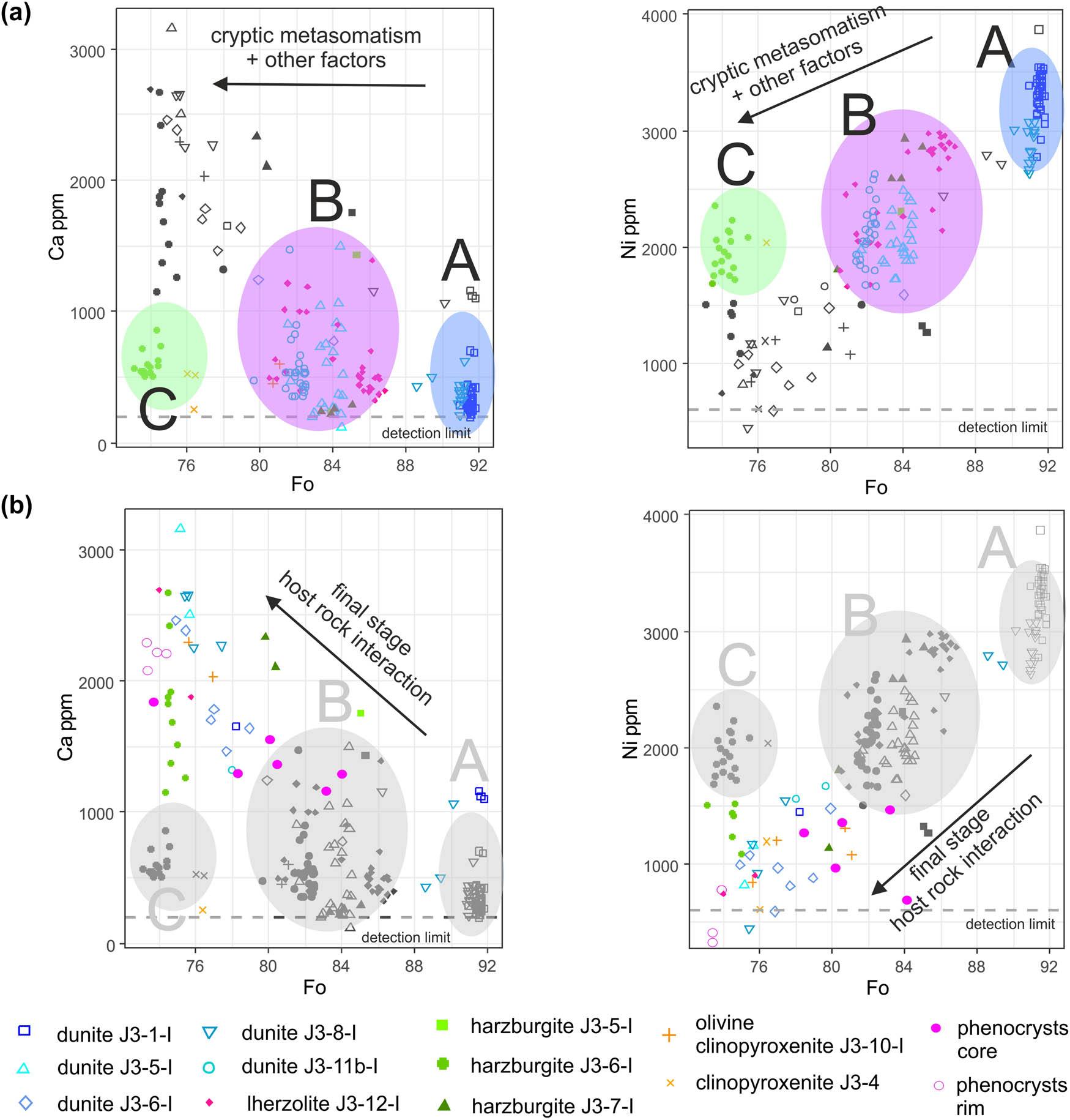
Figure 8
Division of the obtained data for olivine depending on the processes that may represent: (a) regional variability of xenoliths also related to metasomatic changes; (b) changes related to final stage host–rock interactions.
Focusing exclusively on the chemical data obtained for olivines (n = 185) and applying the subdivisions proposed by Matusiak‑Małek and co‑authors, the Jeziorna olivine dataset was filtered to isolate chemical analyses that may represent the composition of peridotites prior to their ascent to the surface. Olivine analyses meeting at least two of the following three criteria: 〈Q2Fo, Q2Fo − 3%〉, 〈Q2Ca, Q2Ca + 400 ppm〉, and 〈Q2Ni, Q2Ni − 400 ppm〉 were classified into subgroups Aa, Ba, and Ca. Analyses of olivines interpreted as representing depleted peridotite account for 23.3% of the entire dataset (Subgroup Aa). The subgroup reflecting solely cryptic metasomatism (Subgroup Ba) is the most numerous, comprising nearly 37% of all chemical analyses (Table 5). The chemical composition within this subgroup remains consistent irrespective of whether the analyses were performed at the crystal rim or core (Table 5; Ol_data_short, S1). In contrast, Subgroup Ca remains highly enigmatic and constitutes only about 6% of the analysed olivines (Ol_data_short, S1).
5.2. Other factors that may affect the chemical composition: temperature increase, weathering, and analytical factors
This group of chemical changes represents changes in Ca (>Q2Ca + 400 ppm) and Ni (<Q2Ni − 400 ppm) concentrations independent of each other and no changes in Fo content, not reflected in changes in the brightness of BSE images (Subgroups: Ab2, Bb1, Bb2, Bb3, Cb2, and Cb3, Methods). This is a group of chemical analyses comprising only 30 of 185 olivine analyses (16%), and it is particularly challenging to interpret. Unlike other changes, these occur mostly at the crystal edges (10% – 20 analyses), but also occur within olivine crystals (6% – 10 analyses).
The analytical factor was considered first. The fact that the presence of another Ca-containing mineral, such as clinopyroxene or carbonate, can affect the Ca content in an olivine crystal was noted some time ago (Dalton & Lane, 1996). Therefore, the positions of individual analyses were traced along the profiles (Figure 3), and it was found that 12 analyses (6.4%) were performed at the crystal rim, mainly adjacent to minerals containing Ca (Subgroup Bb1, Cb1, Table 5). For the remaining 18 analyses, this interpretation was insufficient.
Considering the degree of weathering observed in the samples – reaching up to 42% (Figure 4a and h, Table 3) – weathering appears to be the most straightforward explanation for the observed chemical changes. Previous studies suggest that olivine weathering, along with the mobilization of Ca and Ni, can occur rapidly (Ten Berg et al., 2012; Niles et al., 2017). Again, the positions of individual analyses were traced along the profiles (Figure 3), and it was found that eight analyses (4%) were performed at the crystal rim, mainly adjacent to secondary minerals (Subgroups Ab2, Bb2, and Cb2). However, the J3_1 sample, which exhibits the highest degree of weathering, has the fewest of such changes (two analyses, 1.1%, Table 5).
The interpretation of the 10 remaining analyses (5.4%) from groups Bb3 and Cc3, conducted within olivine crystals, is very difficult (Table 5). It is speculated that they may represent traces of crystal heating (Klügel, 1998; Shaw & Dingwell, 2007; Shaw et al., 2018), for example, in a shallow magma chamber, or as a result of the circulation of Cenozoic magmas in this area. Temperatures calculated for magma based on the whole‑rock composition of the Jeziorna basanite range from 1,220 to 1,300°C (Nowak, 2012), indicating an average temperature difference of approximately 200–600°C between the circulating magmas and the surrounding lithospheric mantle (Figure 7c).
Olivines undergo chemical changes during diffusion in a ‘stepwise’ manner, similar to cars occupying free spaces in a parking lot (Jollands et al., 2023). This could explain the sudden, step-like variations in Ca and Ni observed along the profiles (Graphs, S1). The mechanism of cation migration within olivines during weathering has not been thoroughly investigated (Ten Berg et al., 2012; Niles et al., 2017). Issues related to weathering and crystal heating, although highly interesting, were not the main focus of this study and require further research, including the application of complementary methods such as Raman spectroscopy and more thermobarometric calculations.
5.3. Changes in chemical composition associated with last host rock–xenolith interaction
In this study, the main objective was to determine whether the final-stage interactions could completely alter the chemical composition of the xenolith, and if not, to establish the extent of these modifications. The term ‘final-stage interactions’ is preferred over ‘host-rock metasomatism’ in order to distinguish this process from metasomatic events occurring within the Earth’s mantle. Such changes may occur both during the extrusion of xenoliths to the surface and within the volcanic neck as it cools. In the case of the Jeziorna rocks, it is currently not possible to determine with certainty when the interaction occurred.
Although the study was conducted in a 2D plane rather than in 3D, which was necessitated by the lack of an integrated technique combining X-ray microtomography and electron microprobe analysis, the changes associated with xenolith–host rock interaction are clearly distinguishable: a bright zone in the BSE image, characterized by a decrease in Fo and Ni content and a simultaneous increase in Ca, was identified in 33 chemical analyses, representing 18% of all analyses performed (Ac, Bc, and Cc). Irrespective of the initial xenolith composition (Aa, Ba, and Ca) or other chemical changes (Ab, Bb, and Cb), this process produces compositional modifications similar to those in phenocrysts (Figures 6 and 8b), making interpretation relatively simple.
Literature data suggest that the diffusion coefficients of Mg, Fe, Ni, and Ca are mutually correlated and that the observed changes may have occurred at temperatures ranging from approximately 1,265°C to 977°C (Jollands et al., 2023).
In the case of the Jeziorna xenoliths, the size of the diffusion rim in olivine appears to depend on two factors. The first is the crystallographic orientation of the olivine crystal walls on which the observations were made (Figure 4f), a pattern commonly reported in the literature (Costa et al., 2008; Jollands et al., 2023). The second factor is, in many cases, the overall size of the xenolith – with smaller xenoliths tending to exhibit larger area covered by diffusion rims (Table 2).
Previous observations (Klügel & Shaw, 2002; Marchev et al., 2017; Shaw & Dingwell, 2008) indicate that diffusion changes have a limited range, usually ranging from a few to several dozen microns in width. An exception are xenoliths from La Palma (Canary Islands) and Bulgaria, where diffusion rims reached several hundred microns (Klügel, 1998; Marchev et al., 2017), likely due to prolonged exposure to elevated temperatures.
The changes in chemical composition interpreted as a final volcanic rock–xenolith reaction at the edge of the xenoliths from Jeziorna, are clearly observed in BSE images up to 250 microns (Table 2). At the same time, the smallest peridotite xenoliths (J3_5_II and J3_6_II), in addition to the diffusion rim on the edge of the xenolith are characterized by having rims inside the xenolith around the melt pockets and cracks. The changes occurring inside the xenoliths reach a maximum of 80 μm (Figure 4e). This suggests, on the one hand, that smaller xenoliths (<0.25 cm) were more susceptible to infiltration by the host basanite within their internal structure, which may explain the greater extent of chemical changes observed in these samples. On the other hand, this feature may indicate that the thin section captured the uppermost part of the xenolith, where the xenolith–host rock boundary is visible and more exposed. Nevertheless, even in the smallest xenoliths (<0.25 cm), diffusion-related modifications remain limited to several tens of microns (up to ∼80 μm), which is surprising and contrary to the initial expectations during the planning of this study.
6. Conclusions
The tested samples from the Jeziorna occurrence can be divided into three groups based on Fo content in olivine: A, B, and C (similar to the classification proposed for Wilcza Góra, Grodziec, and Krzeniów; Matusiak-Małek et al., 2017a, 2017b). At the studied site, the current state of research is dominated by samples classified as type B – xenoliths showing traces of cryptic metasomatism.
The analysed olivine crystals also exhibit fluctuations in Ca and Ni content along the research profiles. These fluctuations are independent of each other and of Fo content. Their origin remains unclear and requires further investigation.
Final changes associated with xenolith – volcanic rock interaction are consistently marked by a distinct BSE image (diffusion rim) and chemically by a decrease in Fo content, an increase in Ca, and a decrease in Ni. These changes cannot be misinterpreted. They occur both at the xenolith margins and within the interior – particularly in xenoliths smaller than 0.25 cm in diameter.
Detailed analyses demonstrate that, despite their small size (<1.5 cm), xenoliths from Jeziorna provide reliable information for regional studies; however, additional research is still necessary.
Acknowledgements
The author would like to thank all the people whose help made it possible to write the above article. The research was financed by the National Science Centre (NCN) under the Miniatura 4 competition (project number: 2020/04/X/ST10/00542). The author used AI‑assisted support to refine the English language of the manuscript and to aid in the development of R scripts for statistical analysis and data visualisation. The author also wishes to express sincere gratitude to the two anonymous reviewers, whose thoughtful and constructive comments greatly improved the quality of the manuscript.
Author contributions
The author confirms that she was solely responsible for the conception of the study, data collection, analysis, and the writing and revision of the manuscript.
Conflicts of interest
The author declares no conflicts of interest.
Data availability statement
The datasets generated and analysed during the current study are available in the Supplementary Data file (S1.xlsx) provided with this article.
Supplementary data
Supplementary data to this article can be found online at https://doi.org/10.2478/mipo-2026-0002.