
Table 1.
A review of previous studies on using heavy minerals in soil sciences.
| Soil type | Heavy minerals studied | A scientific question targeted with heavy mineral analyses | References |
|---|---|---|---|
| Unaffected soils | |||
| Podzol | hornblende, hyperstene, magnetite, garnet | Susceptibility of different minerals to weathering | Matelski and Turk (1947) |
| Acid forest soil profiles (pH 4–5), galciofluvial substrate | apatite, titanite, hornblende, garnet, epidote, zircon | Documenting weathering trends | Lång (2000) |
| Pre-tsunami soils | pyroxene and amphibole group, opaque minerals | Soil erosion, provenance of detrital material | Jagodziński et al. (2012) |
| Entisols and Aridisols | non-opaque heavy minerals (zircon, tourmaline, rutile, garnet, sillimanite, and andalusite) | Provenance of detrital material | Sulieman et al. (2015) |
| Podzol | apatite, amphibole, epidote, hematite, hornblende, garnet, monazite, olivine, pyrite, pyroxene, titanite, zircon, rutile, and ilmenite | Determine if there is a significant contribution from these minerals to the surface geochemical signature, particularly radiogenic Pb of the soils | Carlson (2016) |
| Unspecified | zircon, magnetite, ilmenite, rutile and monazite | Mineral contribution to elevated contents of some elements in soils in ship-breaking yards | Khan et al. (2019) |
| Initial soils | transparent heavy-minerals | Documenting weathering patterns and pedogenetic processes and the addition of allochthonous material | Tangari et al. (2021) |
| Terra rosa represented by red palaeosol, red polygenetic soil, and two pedosedimentary complexes | epidote and amphibole groups | The provenance of initial soil material (origin of the parent material) | Razum et al. (2023) |
| Soils affected by mining and smelting | |||
| The rhizosphere of industrial soils near Zn–Pb mines and metallurgical plants (Poland) | Pb, Cd, Zn carbonates, As-Pb sulphosalts, polymineralic spherules | Identification of processes in the rhizosphere leading to alteration and formation of secondary metal-rich phases, the importance of plant-root exudation solutions is stressed | Cabała, Teper (2007) |
| Industrial soils near mining and smelting areas | Slag particles >1 mm in diameter | Establishing slag-derived dust as a main carrier of trace elements in studied soils | Chopin and Alloway (2007) |
| Soils close to major smelter centers at Coppercliff, Coniston, and Falconbridge in the Sudbury area, Canada | Spherical particles composed of magnetite, hematite, Fe-silicates, sulfides, spinels, delafossite, and cuprite or tenorite | Origin and potential alteration (e.g. dissolution rates and particle-soil interaction) of spherical particles | Lanteigne et al. (2012) |
| Soil adjacent to mining areas | Particulate matter such as Fe silicates, spinels, sulfides, NiO, and their weathering products | Distribution of metals and metalloids in particulate matter, their formation, weathering, and mobility in soils | Lanteigne et al. (2014) |
| Soils within the protection zone of copper smelter (Poland) | Diverse particles associated with mining and smelting | Detecting weathering reactions in the heavy particles, implications for metal mobility | Tyszka et al. (2016) |
| Four different forest and grassland soils (site for the long-term experiment) | Flue dust composed predominately of arsenolite As2O3 | Transformation of As-rich (>50 wt% As) copper smelter dust in the soil to understand As mobility and pollution risks | Jarošíková et al. (2018) |
| Soils developed on the slag heap after Zn–Pb smelting (Poland) | Diverse particles associated with Zn–Pb smelting | Estimating modal proportions of primary to secondary phases using automated electron microscopy | Pietranik et al. (2018) |
| Topsoils from hot semi-dry area (Namibia) | Diverse particles associated with mining and smelting | Automated SEM used to understand the fate/binding of metal (loids) in soils | Tuhý et al. (2020) |
| Biomass-rich savanna soils, semi-arid (Namibia) | Ferric oxides, arsenolite, metal arsenates, As apatite, enargite | Understanding temperatures of mineralogical transformations and potentially toxic elements remobilization under wildfire conditions (laboratory combustion experiment) | Tuhý et al. (2021) |
| Soils affected by Zn mining (Lanping Pb–Zn mine, China) | Cadmium-bearing sphalerite and smithsonite | Mobility and behavior of Cd and Zn derived from smithsonite and sphalerite and their transport mechanisms in soils | Li et al. (2022) |
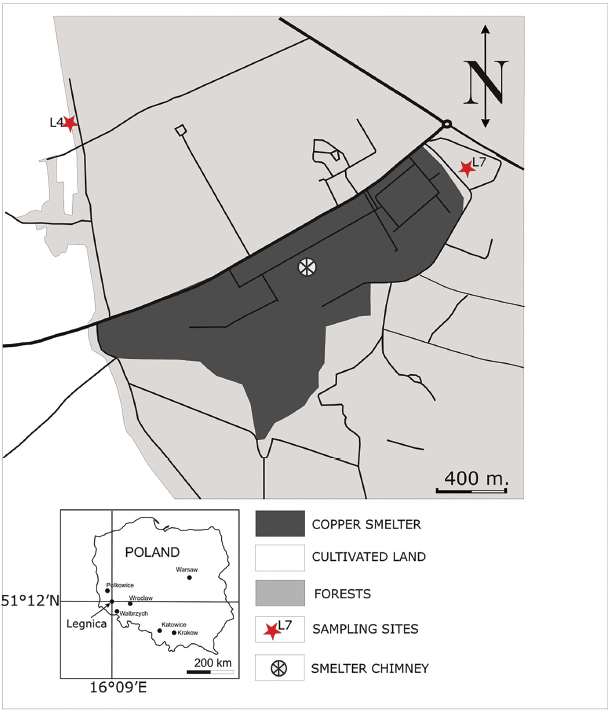
Figure 1.
Schematic map of the studied area with the sampling points indicated (modified after Tyszka et al., 2016).
Table 2.
Estimates of modal compositions of magnetic and non-magnetic fractions in two soil samples, based on analyses of approximately 300 individual particles. Modal proportions are based on particle counting (one EDX data point per particle, a dominating phase in the particle was chosen for multi-phase particles). The last row shows the number of particles in which potentially toxic elements (PTE) were detected by EDX (Cu, Pb, Zn, Ni, Co, V). The Fe-oxide, Fe-oxide-mix, olivine, and glass were often found in multi-phase particles, but the exact number of these was not estimated.
| L4 | L7 | |
|---|---|---|
| Non-magnetic | no. grains (percentage) | |
| Apatite | 93 (44%) | 5 (2%) |
| Rutile | 47 (22%) | 53 (17%) |
| Zircon | 41 (19%) | 94 (30%) |
| Garnet | 7 (3%) | 2 (1%) |
| Dolomite | 7 (3%) | 0 |
| Silicate glass | 6 (3%) | 12 (4%) |
| Pb-rich silicate glass | 4 (2%) | 0 |
| Sulfide | 4 (2%) | 12 (4%) |
| Sphene | 4 (2%) | 3 (1%) |
| Epidote | 0 | 65 (20%) |
| Fe oxide-mix | 0 | 27 (8%) |
| Al-oxide | 0 | 21 (6%) |
| Amphibole/pyroxene | 0 | 22 (7%) |
| Total number of grains | 213 | 316 |
| Magnetic | ||
| Ti-Fe phase | 52 (18%) | 32 (8%) |
| Fe oxide-mix | 51 (18%) | 104 (27%) |
| Fe oxide | 37 (13%) | 75 (19%) |
| epidote | 35 (12%) | 8 (2%) |
| Fe-Mn phase | 24 (8%) | 0 |
| garnet | 24 (8%) | 18 (5%) |
| silicate glass | 19 (7%) | 37 (10%) |
| olivine | 17 (6%) | 41 (11%) |
| amphibole/pyroxene | 15 (6%) | 40 (10%) |
| sulfide | 6 (2%) | 7 (2%) |
| chromite | 4 (1%) | 16 (4%) |
| Ca ferrite | 4 (1%) | 7 (2%) |
| Total number of grains | 288 | 385 |
| Phases with PTE | 20 (7%) | 46 (12%) |
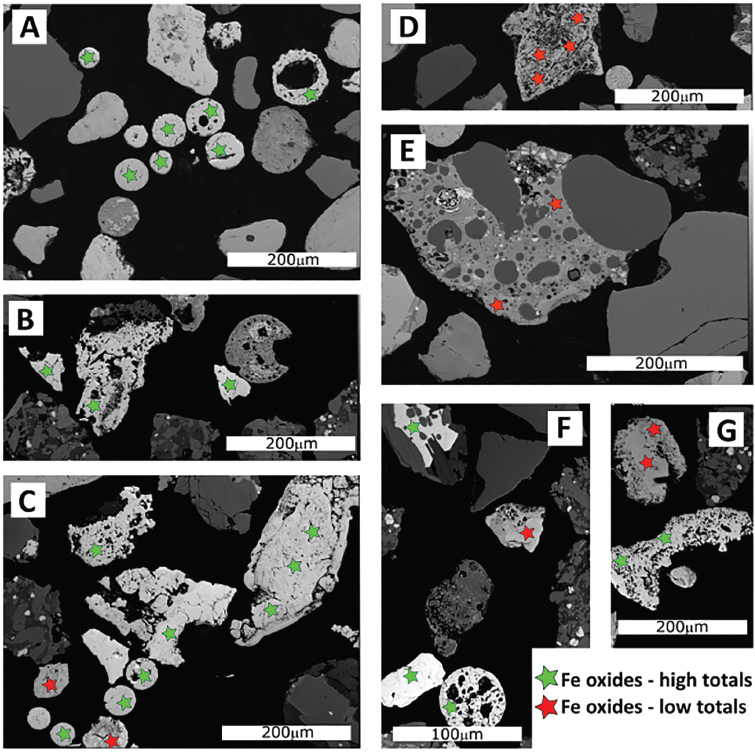
Figure 2.
Back-scattered electron images of two types of Fe oxides identified in this study. The two groups are identified based on their chemical composition and a distinct character of the groups is reflected by low and high totals of the electron microprobe analyses. These two groups are indicated in the Figure with different colors of the stars. (A) numerous spherical particles composed entirely of Fe-oxide with high totals; (B) small angular monomineralic fragments (i) and a larger porous particle (ii); (C) spherical particles (i), larger porous particles (ii) and anhedral, strongly porous grains (iii), (D) strongly porous grain with low total; (E) a Fe-rich glass-like material containing quartz grains; (F) a skeletal grain within a slag fragment (i), anhedral, strongly porous grains (ii), small angular monomineralic fragment (iii) and a spherical particle (iv); (G) larger porous particles.
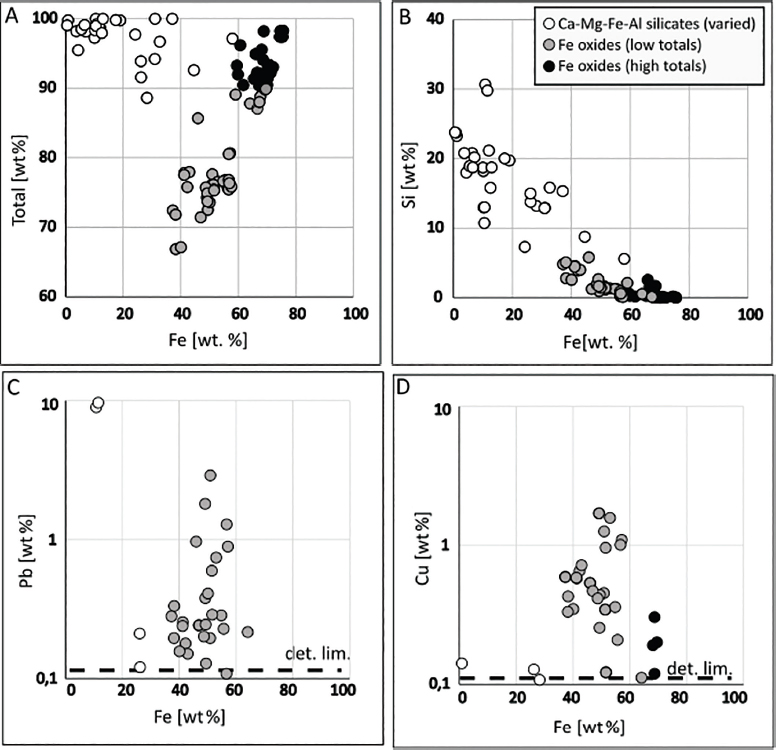
Figure 3.
Composition of two types of Fe oxides (low and high totals) and Fe-rich silicates. The detection limit of electron microprobe analyses is indicated (det.lim.), phases shown in (A,B) and not in (C,D) have Pb and Cu contents below the detection limit.
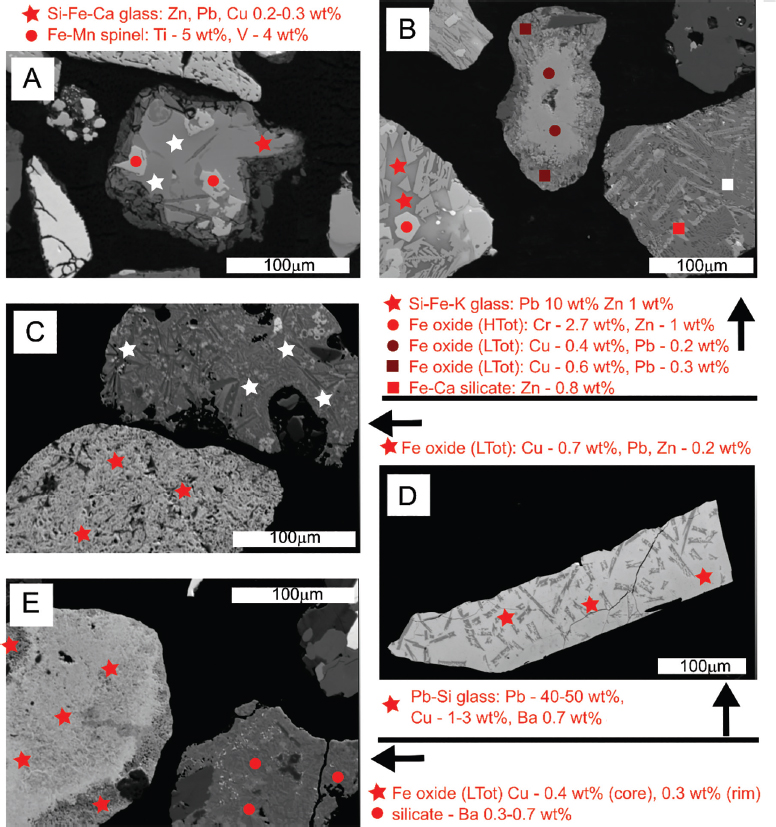
Figure 4.
Diverse slag fragments observed in the studied soils, the contents of chosen potentially toxic elements measured by electron micro-probe are indicated for each fragment. White symbols show places where such elements were below the detection limit. (A) slag dominated by glass containing euhedral spinels (lighter), and silicates (darker), weathering proceeds along rims and cracks, (B) two slag fragments containing glass and different phases, (i) not weathered, (ii) slightly weathered, the third fragment (iii) is strongly weathered and could represent slag or other anthropogenic material, (C) two slag fragments (i) slag showing extensive replacement by Fe-oxides, (ii) slightly weathered slag dominated by crystalline phases spinels and silicates, (D) unweathered slag dominated by Si-Pb glass containing skeletal crystals of Pb-poor silicate, (E) weathered slag fragmnents, (i) slag showing extensive replacement by Fe-oxides, (ii) slag dominated by Ba-silicates.
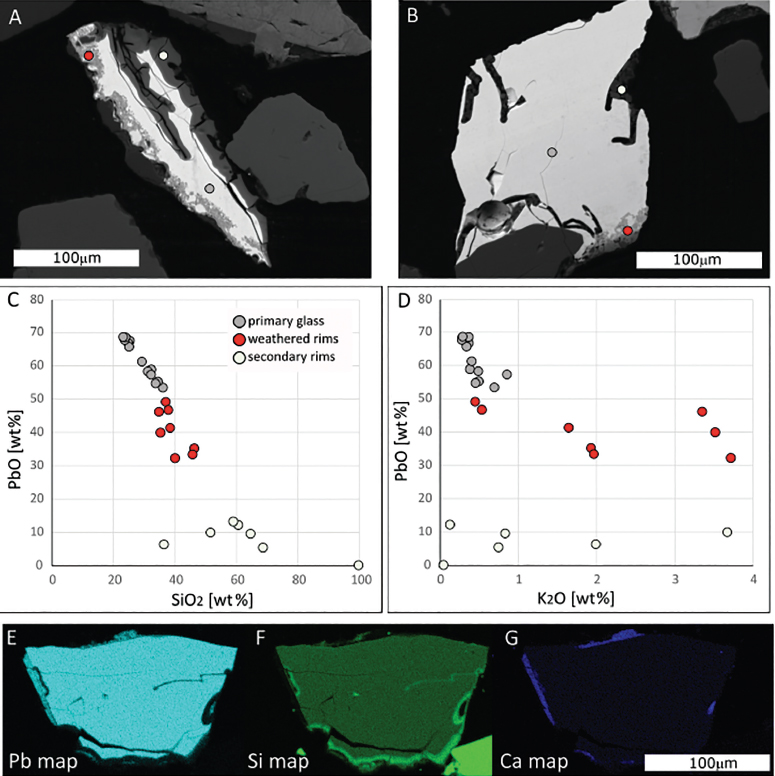
Figure 5.
(A,B) Back-scattered electron images of Pb-rich silicate glass showing weathered rims. (C,D) Electron microprobe analyses shown for all analyzed particles in this group, the analyses are divided into three groups based on the observed extent of weathering in BSE images. The analytical points belonging to each group are shown in (A,B). (E–G) EDX maps for Pb, Si, and Ca of a Pb-silicate glass particle. The relative color intensity scale shows the element-rich (bright) and element-deficient (dark) parts of particles.
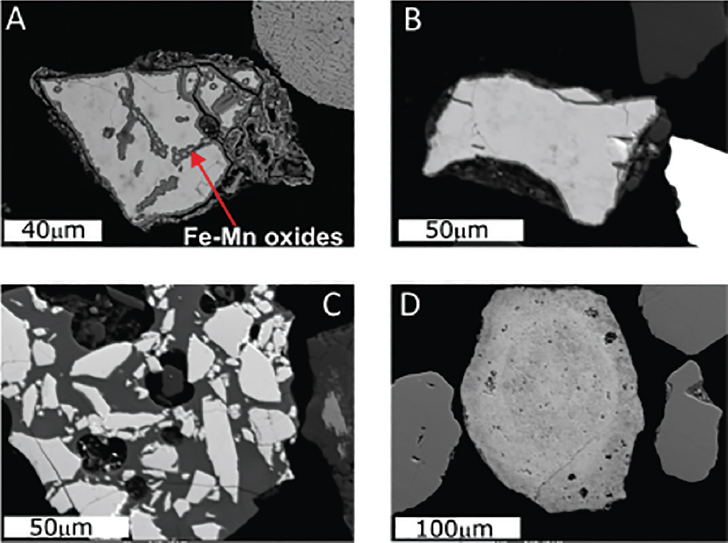
Figure 6.
Back-scattered electron images of minor phases occurring in the studied soils: (A) chalcopyrite with well-developed weathering features, the secondary products include Fe oxides with Mn and Co, and silicates, (B) chalcopyrite with thin weathered rim, (C) zircon breccia in Zr-rich glass, and (D) phosphate grain.