
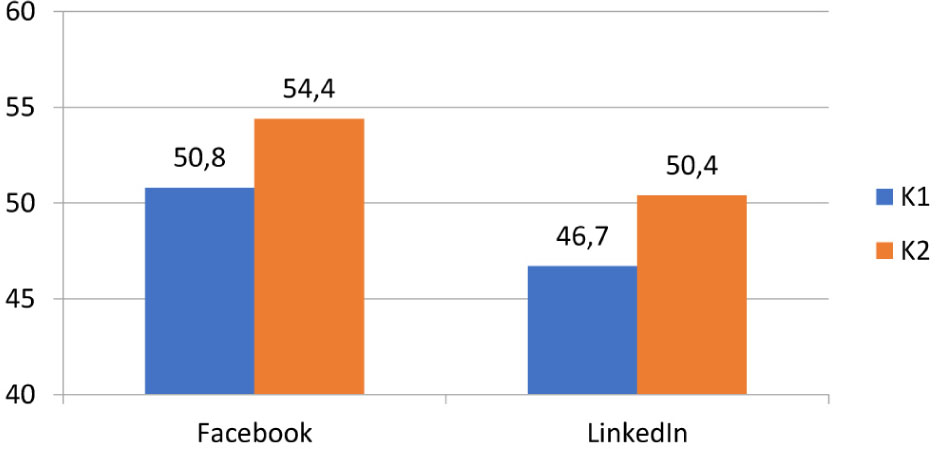
Figure 1.
Presence of company Facebook profile (n = 202) and LinkedIn profile (n = 203) versus affiliation with the analysed PR agency subject corpus (in %).
Source: Own study. PR, public relations.
Table 1.
Structure of K1 and K2 corpora—comparative analysis
| Indicators | K1 (agency name targeting the communications/PR area) | K2 (agency name unrelated to communications/PR area) | |
|---|---|---|---|
| Participation of the corpus in the unit of analysis | 40.2% | 59.8% | |
| Average number of words in the text | 125 | 119 | |
| Average number of characters in the text | 831 | 806 | |
| Titles of texts that were included in the corpus | About us | 64% | 40% |
| Company, About the company, Agency, About the agency | 10% | 16% | |
| Who we are | 7% | 7% | |
| No title 7 | 0% | 20% | |
| Company’s own name | 3% | 0% | |
| Different title, but analogous function 8 or different | 16% | 17% | |
Source: Own study. PR, public relations.
7 This category included texts that appeared immediately upon entering the Web site, without expanding the menu.
8 For K1: ‘operating philosophy’, ‘why us’, ’resume’, ‘us’, ‘get to know us’, ‘our strengths’, ‘our mission’, ‘what makes us different’, ‘mission and history’, ‘two words about us’; for K2: ‘what’s important’, ‘us’, ‘our story’, ‘welcome’, ‘this is us’, ‘our team’, ‘Hi!’, ‘from us’, ‘ideas’, ‘get to know us’, ‘why us’, ‘benefits of cooperation’.
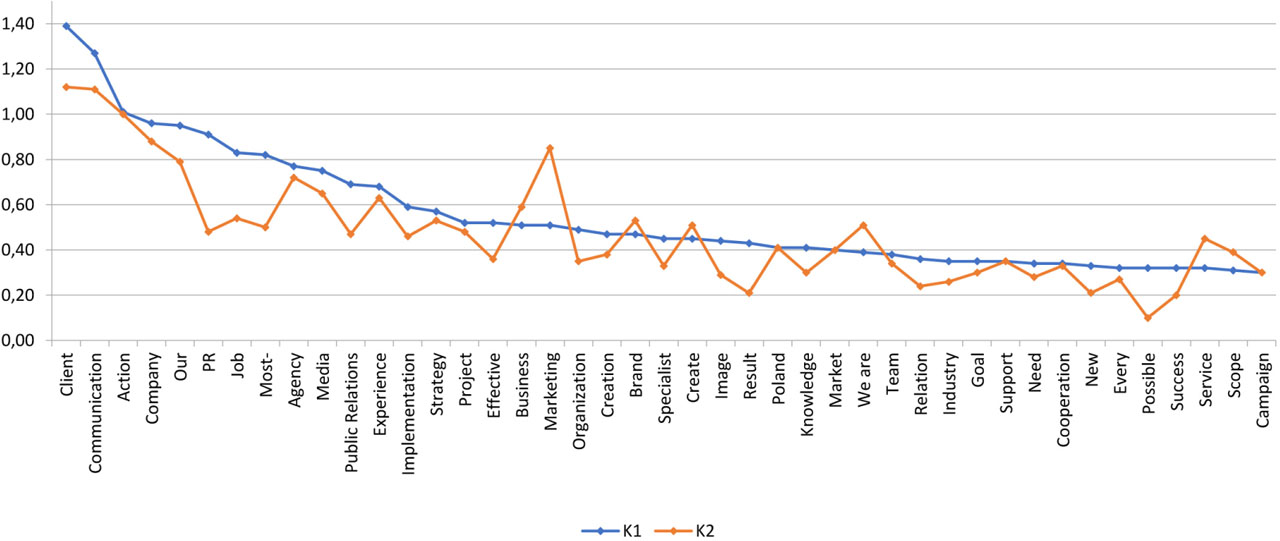
Figure 2.
Lexical structure of K1 and K2—most frequent lexemes (in %) 9.
Source: Own study.
Table 2.
Deviations in the structure of K1 and K2 corpora—comparative analysis
| No. | Lexem | Corpus K1 | Corpus K2 | Difference (%) K1–K2 | Interpretation | ||
|---|---|---|---|---|---|---|---|
| Word count | % of total | Word count | % of total | ||||
| 1 | PR | 182 | 0.91 | 114 | 0.48 | 0.43 | Lexems that are more common in K1 |
| 2 | Most- | 131 | 0.82 | 142 | 0.50 | 0.32 | |
| 3 | Job | 155 | 0.83 | 142 | 0.54 | 0.29 | |
| 4 | Client | 275 | 1.39 | 270 | 1.12 | 0.27 | |
| 5 | Result | 76 | 0.43 | 63 | 0.21 | 0.22 | |
| 6 | Possible | 57 | 0.32 | 26 | 0.10 | 0.22 | |
| 7 | PR | 137 | 0.69 | 112 | 0.47 | 0.22 | |
| 8 | Journalism | 39 | 0.23 | 19 | 0.06 | 0.17 | |
| 9 | Effective | 96 | 0.52 | 88 | 0.36 | 0.16 | |
| 10 | Communication | 241 | 1.27 | 274 | 1.11 | 0.16 | |
| 11 | Our | 187 | 0.95 | 188 | 0.79 | 0.16 | |
| 12 | Image | 83 | 0.44 | 71 | 0.29 | 0.15 | |
| 13 | Solve | 41 | 0.22 | 98 | 0.37 | 0.15 | Lexems that are more common in K2 |
| 14 | Advertisement | 23 | 0.16 | 89 | 0.37 | 0.21 | |
| 15 | Marketing | 95 | 0.51 | 206 | 0.85 | 0.34 | |
[i] Source: Own study. PR, public relations.