
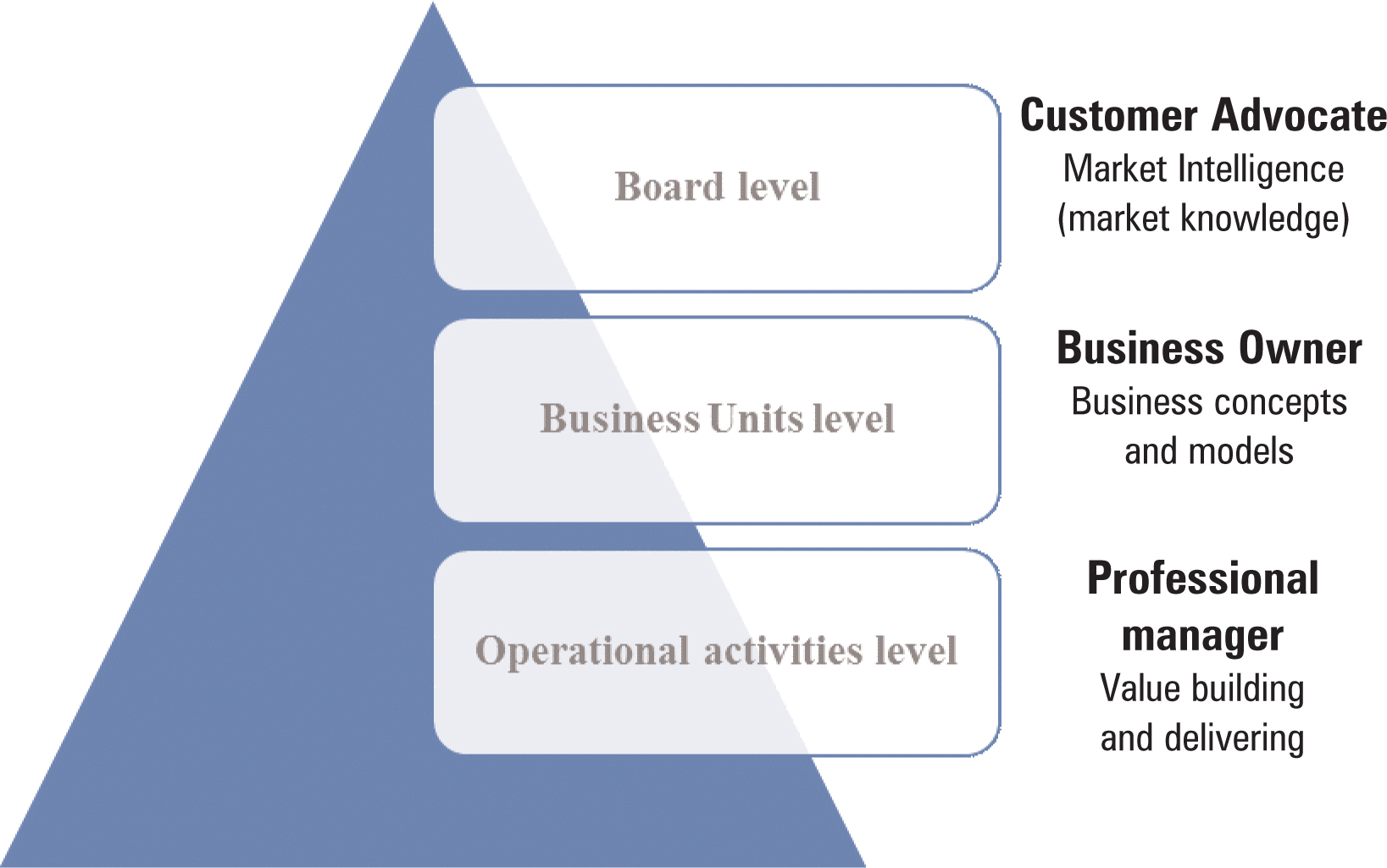
Figure 1.
The new role of marketing in resilient organisations
Source: Kozielski (2022). Rynkowy Due Diligence — pomiar odporności rynkowej organizacji, Wydawnictwo PWN, Warsaw.
Table 1.
Sample structure — organisation
| Company size | Source of revenue | Type of business relationships | |||
|---|---|---|---|---|---|
| Small (up to 49 employees) | 22.5% | Traditional channel | 71.9% | B2B | 56.2% |
| Medium (50–250 employees) | 22.5% | Digital channel | 16.9% | B2C | 23.6% |
| Large (over 250 employees) | 55.1% | Equivalent | 11.2% | Equivalent | 20.2% |
Table 2.
Sample structure — marketing manager
| Business experience | Position | Gender | |||
|---|---|---|---|---|---|
| Up to 10 years | 9.0% | CEO | 19.1% | Female | 58.4% |
| 10–15 years | 29.2% | Marketing Director | 42.7% | Male | 41.6% |
| 15–20 years | 34.8% | Middle management level | 38.2% | ||
| Over 20 years | 27.0% | ||||
Table 3.
Conditions in the business environment determining the functioning of an organisation on the Polish market (5-step scale)
| Economic recession in Poland | 4.30 |
| Rising operating costs | 4.28 |
| Decrease in customer incomes and demand | 4.06 |
| Russia’s war in Ukraine | 3.64 |
| Changes in customer behaviour | 3.46 |
| Actions of competitors | 3.27 |
| Price war | 3.16 |
| Too low a marketing budget (for our company/brand) | 3.15 |
| Changes in provisions of the law | 3.06 |
| Growing expectations of customers | 3.03 |
| New technologies | 2.71 |
| Dependence on intermediaries and business partners | 2.65 |
| Changes in the digital sphere and e-commerce sphere | 2.41 |
| Entry of new competitors onto the market | 2.32 |
| Lack of cooperation on the part of other departments of the company | 2.30 |
| Unethical actions of competitors | 2.21 |
| Lack of coherence in marketing activities | 2.16 |
| Dependence on marketing service providers | 2.01 |
Table 4.
Sources of organisational growth
| Expansion of the scale of operations (new markets) | 29.2% | Market strategy |
| Powerful brand | 25.8% | Market strategy |
| Relationships with business and trade partners | 24.7% | Market strategy |
| Innovativeness of the company | 23.6% | Organisational culture |
| Use of new technologies | 20.2% | Operational activities |
| Expansion of product portfolio | 20.2% | Operational activities |
| Expansion of activity on digital channels | 19.1% | Operational activities |
| Dedicated team | 15.7% | Organisational culture |
| Flexibility of operations | 15.7% | Organisational culture |
| Individualisation and customisation of actions | 14.6% | Market strategy |
| Quality of products | 14.6% | Operational activities |
| Customer experience management ability | 13.5% | Operational activities |
| Diversifications of activities | 10.1% | Market strategy |
| Effectiveness of sales activities | 10.1% | Operational activities |
| Increase in customer incomes and demand | 9.0% | Operational activities |
| Focus on the core business | 9.0% | Market strategy |
| Changes in customer behaviour | 7.9% | Operational activities |
| Knowledge of customers and understanding of actions of competitors | 7.9% | Organisational culture |
| Verification and reduction of operating costs | 5.6% | Operational activities |
| Weakness of competitors | 2.2% | Operational activities |
| Competing with low price | 1.1% | Operational activities |