
Introduction
Municipal bonds enable local government units (LGUs) to finance long-term capital projects such as infrastructure development, education, or public services, which are the foundation of regional development (Cropf & Wendel 1998; Daniłowska 2011). Poland, as a mature post-socialist economy, where LGUs have gained substantial fiscal autonomy and have become increasingly confident in utilising capital market instruments, offers a compelling case study in this field (Banaszewska 2023). In the Polish institutional context, municipal bonds function differently from those in mature markets such as the US. While bank loans remain the dominant financing source, bonds play a complementary role due to their superior flexibility. As noted by Frydrych (2020), local governments favour bonds primarily for their adaptable repayment schedules, including the possibility of grace periods in capital repayment, which is often difficult to negotiate in standard bank loan contracts. This feature makes them particularly useful for bridging liquidity gaps or securing the ‘own contribution’ required for EU-funded investment projects. However, the market structure is heavily skewed towards private placements. Martysz (2025) emphasises that the vast majority of these securities are not widely traded but are purchased directly by domestic commercial banks and held to maturity. Consequently, although legally classified as capital market instruments, they often function economically as distinct ‘quasi-loans’ tailored to specific local needs, characterised by low liquidity and floating interest rates indexed to WIBOR. Furthermore, the transparency of this market significantly improved after July 2019, following the introduction of the mandatory Register of Issuer Obligations (RIO) by the Central Securities Depository of Poland, which eliminated prior data fragmentation.
Consequently, based on the RIO data, the primary objective of this study is to identify the key economic and structural determinants of municipal bond issuance. The analysis focuses on identifying the specific factors that drive issuance scale and explaining variation in bond values across counties.
Preliminary graphical analysis, based on data from outstanding municipal bonds at the end of 2024 (Figure 1), clearly shows that the size of bond issues are not randomly distributed. On the contrary, they are highly concentrated in specific cities, primarily in more developed metropolitan regions. This observation raises a fundamental research question: Is the observed concentration the result of economic structures, or does it reflect the operation of spatial interaction mechanisms, such as the spillover effect?
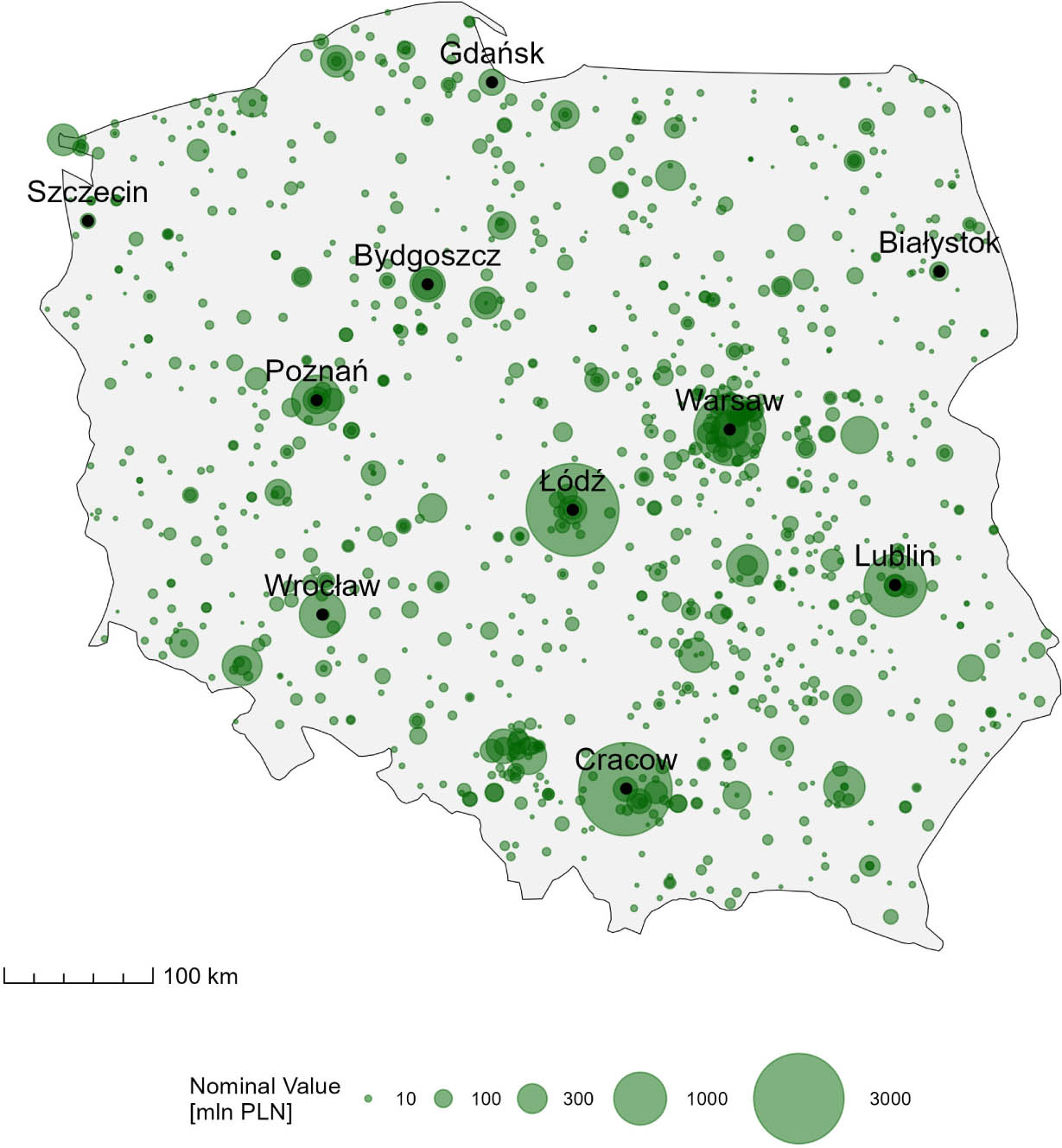
Figure 1.
Spatial distribution of municipal bonds in Poland – outstanding nominal value per single issuing entity as of the end of 2024
Source: Own elaboration based on the RIO database
Although there is a rich body of research on the overall indebtedness of territorial self-government units (including in Poland), this work is mainly based on aggregated data from the Central Statistical Office in Poland, which combines different forms of liabilities – bonds, bank loans, and other (Kopańska & Kopyt 2018; Banaszewska 2023). Such aggregation obscures important differences between various debt instruments, particularly between bonds and loans. The decision to issue bonds, rather than take out a bank loan, is indicative of higher financial sophistication, greater transparency, and the ability to engage a broader range of capital market participants (Daniels, Diro Ejara & Vijayakumar 2010).
This analysis overcomes this limitation by using a unique and up-to-date dataset derived from the Register of Issuer Obligations (RIO), maintained by the Central Securities Depository of Poland. These data, publicly available only since July 2019 (Martysz 2020), enable one of the first in-depth spatial analyses, focusing exclusively on municipal bonds, in the Polish literature. Moreover, the emergence of RIO has changed researchers' perceptions of the municipal bond market, which had previously been regarded as representing only a marginal share of the total non-government bond market (Frydrych 2020; Martysz 2025). This makes this research area even more important.
The literature identifies several factors that influence LGUs' decisions to incur debt. Key economic determinants include the region's economic condition (measured, for example, by GDP per capita or the unemployment rate) and the general financial situation of the LGU. Research indicates that larger and wealthier LGUs, with higher own revenues and a diversified economy, are more likely to issue bonds (Cropf & Wendel 1998). In addition, the high cost of servicing existing debt, while indicative of prior activity in debt markets, may also limit the ability to continue financing. Institutional and policy considerations are also important. Regulatory frameworks, such as Poland's debt-to-GDP limit (a uniform threshold for all LGUs), serve as a brake on excessive issuance (Banaszewska 2018).
The observed geographical concentration of the volume of outstanding municipal bonds activity also warrants consideration of theories that explain spatial interactions in this area. The most important of these are the spillover effects that occur through local networks, joint sectoral events (such as regional conferences or local government forums), the presence of financial advisors operating in several neighbouring entities in parallel, and imitation mechanisms within local government associations (Ferraresi, Migali & Rizzo 2018; Morais De Sousa 2022). Under such conditions, the success of one territorial unit, in terms of issuance, can trigger a demonstration effect, leading to a cascading spread of such financial practices in the region. Empirical studies often confirm the presence of positive spatial autocorrelation in local government debt levels – for example, in Germany (Borck et al. 2015) and Spain (Balaguer-Coll & Ivanova-Toneva 2019). Particularly relevant for Poland are the works of Banaszewska (2023), who, using Durbin's dynamic spatial model for general debt data, showed that an increase in per capita debt in neighbouring municipalities is associated with an increase in debt in the studied municipality. Furthermore, Kopanska and Kopyt (2018) identified clusters of high debt, particularly in wealthier parts of the country.
From a theoretical perspective, the observed geographical concentration of issuance activity necessitates grounding the analysis in financial geography and strategic interaction frameworks. First, following the core–periphery model (Wójcik 2013; Lai 2023), we posit that financial markets are not ‘spaceless’. Information asymmetry tends to increase with distance from the financial centre (Warsaw), raising transaction costs for peripheral issuers (Butler 2008). This justifies testing distance from Warsaw as a proxy for access to capital market infrastructure and specialised intermediaries. Second, the study builds on the theory of yardstick competition (Shleifer 1985; Bosch & Solé-Ollé 2007; Agovino, Marchesano & Musella 2024), which posits that local governments operate under a regime of relative performance evaluation. In the presence of information asymmetry, voters assess the competence of local authorities by comparing their fiscal and financial outcomes with those observed in neighbouring jurisdictions. As a result, local governments may exhibit spatially interdependent financial decisions, not necessarily due to direct coordination, but as a response to comparison-based political accountability. This theoretical framework justifies the application of spatial econometric diagnostics, including Moran's I, to examine whether municipal bond issuance displays statistically significant spatial dependence. Subsequent spatial modelling allows us to assess whether such dependence reflects genuine diffusion mechanisms (spillovers) or is primarily driven by similarities in local economic fundamentals.
Data and methodology
The study covers all 380 county-level units (poviats) in Poland, to which the aggregate value of municipal bond issuance in 2024 was assigned. Information on issue volumes was obtained from the Register of Issuer Obligations (RIO). This database provides access to both public and private issues of non-government debt securities in Poland. In the next step, using the Orbis database, the exact location, with geographic coordinates, was assigned to the individual LGUs or municipal enterprises with outstanding municipal bonds at the end of 2024. These data were then integrated with the socio-economic data of the Central Statistical Office (Local Data Bank) and the administrative boundary layer of counties (poviats), resulting in a unified database combining the characteristics of local finances (income, deficit, subsidies), demographic and development potential (population, urbanisation, foreign capital, investment in transport, and health infrastructure) and the level of active municipal bonds.
To deepen the analysis of the spatial determinants of municipal bond issuance in Poland, a variable reflecting the geographical distance of each county's region from Warsaw, the country's key financial centre, was included in the regression model. The values of this variable were determined based on the great-circle distance between the centroids of each region and the reference point located in the central part of Warsaw (52.2297°N, 21.0122°E). Distances between the centroids of county units and the centre of Warsaw were determined based on the Haversine formula, which takes into account the sphericity of the Earth (Su et al. 2024; Lin, Leung & Westerholm 2025). Crucially, distance is treated here, not merely as a physical measure, but as a proxy for information asymmetry and access to the capital market infrastructure. Following the core–periphery framework, we assume that proximity to Warsaw – the country's dominant financial hub – facilitates the flow of market information and strengthens business linkages necessary for successful bond issuance. The variable of the natural logarithm of the distance of the centroid of a given county from Warsaw was included in the model. To address issues of skewness and to stabilise variance, all other explanatory variables were transformed using the natural logarithm (Belsley 1988; Templeton & Brian Blank 2025).
Initially, a set of 27 explanatory variables was considered, including indicators of the fiscal health of LGUs, the level of economic activity, and selected demographic and infrastructure factors. To reduce the arbitrariness of predictor selection and minimise the risk of collinearity, a two-stage variable selection procedure was applied:
1) Multicollinearity was addressed through an iterative elimination procedure. In each step, the variable with the highest Variance Inflation Factor (VIF) was removed until all variables in the final model met the VIF ≤ 5 criterion (Shrestha 2020).
2) A stepwise selection was performed on the remaining variables to find the model with the lowest Akaike Information Criterion (AIC). This process determined the final subset of predictors for the OLS model (Yamashita, Yamashita & Kamimura 2007).
This two-stage process yielded the following six log-transformed explanatory variables:
1) Population (total population per county, included primarily to control for the scale effect),
2) Distance (distance from Warsaw in kilometres),
3) Debt service (share of debt service costs in total expenditure),
4) EU funds per capita,
5) PIT revenue (personal income tax revenue per capita),
6) Migration balance (net migration rate per 1,000 inhabitants).
All Variance Inflation Factor (VIF) values in the final specification were below 5.5 (ranging from 1.04 to 5.44), indicating no multicollinearity.
To identify the determinants of municipal bond issuance, we adopted a specific diagnostic procedure rooted in spatial econometrics literature (Elhorst 2010). The analytical process includes four steps:
A classical Ordinary Least Squares (OLS) regression was estimated using log-transformed variables to linearise relationships and reduce skewness.
To verify whether the phenomenon exhibits spatial dependence (e.g. spillover effects between neighbouring counties), we applied the Global Moran's I test to the residuals of the OLS model based on a queen-contiguity spatial weights matrix.
If Moran's I statistic proved significant (p-value < 0.05), we would extend the analysis to spatial specifications (Spatial Autoregressive – SAR, Spatial Error Model – SEM, Spatial Autoregressive Combined Model – SAC, or Spatial Durbin Model – SDM), using AIC and BIC criteria. Conversely, if the null hypothesis of no spatial autocorrelation was not rejected, the OLS model would be retained as the most parsimonious and unbiased estimator.
Regardless of the spatial specification, the final model was tested for heteroscedasticity using the Breusch–Pagan test. In the presence of heteroscedasticity, statistical inference was based on heteroscedasticity-consistent (HC1) robust standard errors to ensure the validity of t-tests and p-values.
Results
Aggregating individual-level issuance data to the county level (LAU-1) enables precise mapping of the dependent variable used in the econometric model. As illustrated in Figure 2, the spatial distribution of municipal debt is highly heterogeneous. The highest concentration of bond issuance is clearly visible in major regional capitals (voivodeship cities), such as Warsaw, Kraków, and Łódź, which act as key economic growth poles. In contrast, extensive areas comprising counties – particularly in the peripheral regions – remain completely inactive in the bond market. This distinct polarisation highlights a dual market structure: high issuance intensity in metropolitan centres versus a widespread reliance on alternative financing (most likely bank loans) in smaller, less urbanised units. This aggregated spatial structure constitutes the input for the subsequent regression analysis.
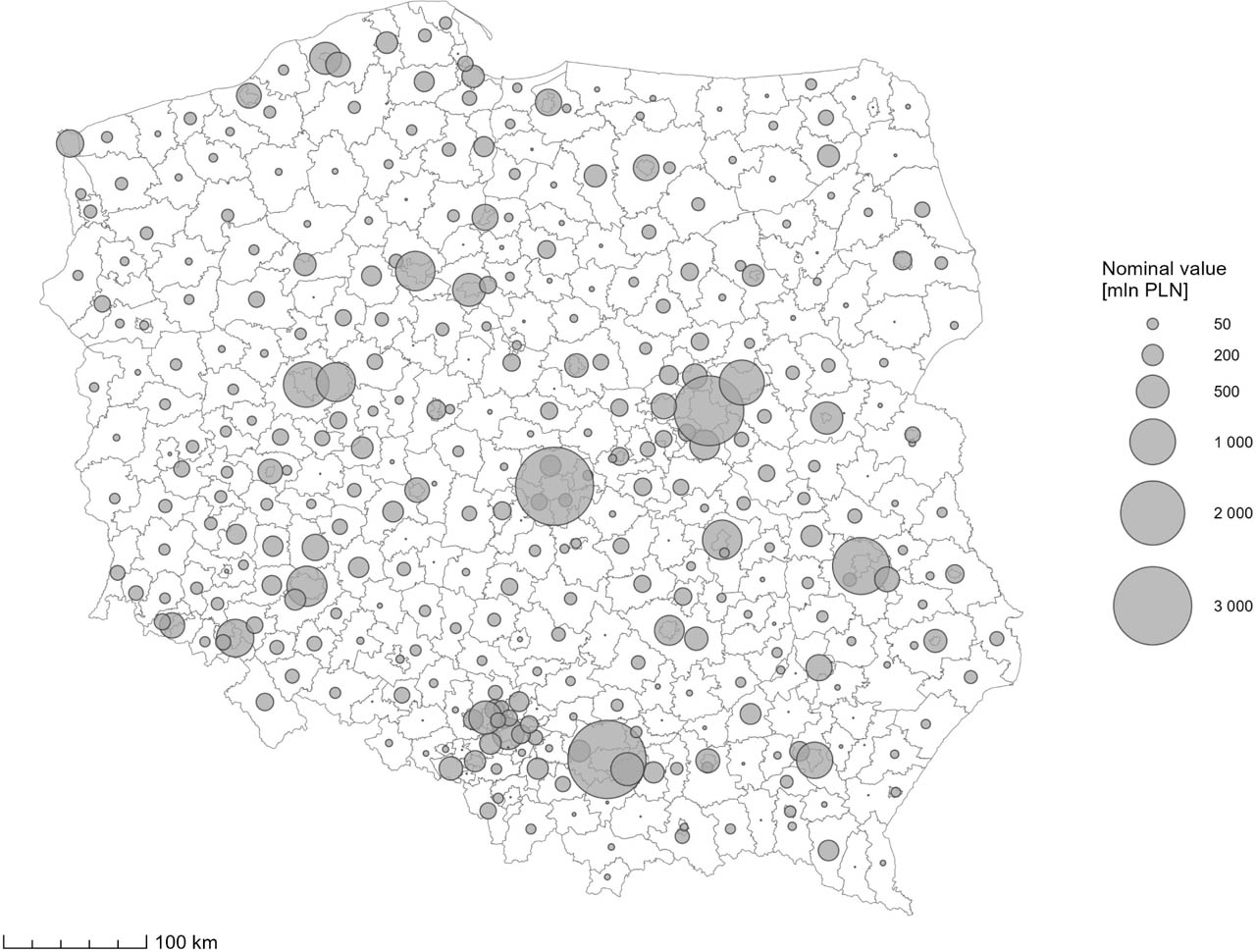
Figure 2.
Aggregated total value of municipal bonds outstanding per county as of the end of 2024
Source: Own elaboration
The diagnostic analysis of the OLS residuals revealed no evidence of spatial dependence. The Global Moran's I statistic was 0.025 with a corresponding p-value of 0.325, which is well above the significance threshold (p-value > 0.05). This result indicates that the spatial distribution of municipal bond issuance in Poland is driven primarily by local economic and structural determinants rather than by direct interactions or contagion effects between neighbouring counties. Consequently, the use of complex spatial models was deemed unnecessary, and the OLS specification was selected as the final model. However, the Breusch–Pagan test indicated the presence of heteroscedasticity (BP = 18.64, p-value < 0.01). To address this issue and ensure valid inference, all reported significance levels are based on robust standard errors (HC1).
The results of the robust OLS estimation are presented in Table 1. The model explains approximately 28.2% of the variance in bond issuance (R2 = 0.282) in a cross-sectional analysis at the highly granular county level (N = 380).
Table 1.
Results of OLS model estimation
| Variable | Coefficient | Robust Std. Error | t-student | p-value |
|---|---|---|---|---|
| Intercept | 4.923 | 2.881 | 1.71 | 0.088 |
| Population(log) | 0.831 | 0.351 | 2.37 | 0.018* |
| Distance(log) | −0.559 | 0.118 | −4.73 | < 0.001*** |
| Debt service(log) | 6.592 | 0.873 | 7.55 | < 0.001*** |
| EU funds(log) | −0.368 | 0.204 | −1.81 | 0.072 |
| PIT revenue(log) | −0.970 | 0.384 | −2.53 | 0.012* |
| Migration balance(log) | 0.173 | 0.056 | 3.09 | 0.002** |
The estimation results reveal distinct structural drivers of local debt issuance. The strongest positive impact was observed for debt service costs (p-value < 0.001), confirming that Polish counties actively utilise municipal bonds as a tool for liquidity management and debt rolling, effectively issuing new debt to service existing obligations. A highly significant negative relationship was found regarding the distance from Warsaw (p-value < 0.001). This empirical finding supports the core–periphery hypothesis, suggesting that proximity to the capital reduces information asymmetry and transaction costs, thereby facilitating access to the capital market for local governments located closer to the local financial centre (Warsaw). Interestingly, local wealth, proxied by PIT revenue per capita, acts as a negative determinant to issuance (p-value = 0.012). This indicates a substitution effect where wealthier counties, characterised by a higher tax base, prefer to finance expenditures through their own revenues, whereas units with lower fiscal capacity are more compelled to leverage market debt. Moreover, a positive migration balance is significantly associated with higher issuance (p-value = 0.002), likely reflecting investment pressure in growing communities where infrastructure needs that are driven by new residents exceed current budget capabilities. Finally, the inflow of EU funds was not statistically significant at the standard 0.05 level (p-value = 0.072). Although this result precludes drawing definitive conclusions, the observed negative coefficient aligns with theoretical intuition of a crowding-out effect, whereby the availability of non-repayable grants might otherwise substitute commercial debt financing.
Furthermore, a visual analysis of the OLS model residuals (Figure 3) provides graphical confirmation of the results from the Moran's I test, which showed no significant spatial autocorrelation. The distribution of model errors, where red regions denote underestimation of actual bond issuance and blue regions overestimation, has a random mosaic character. The absence of distinct geographic clusters with similar residuals suggests that the OLS model has accurately identified the key drivers of the dependent variable and that there are no omitted systematic spatial effects in the residuals. This validates the classical linear regression model as an adequate and well-suited analytical tool for this study.
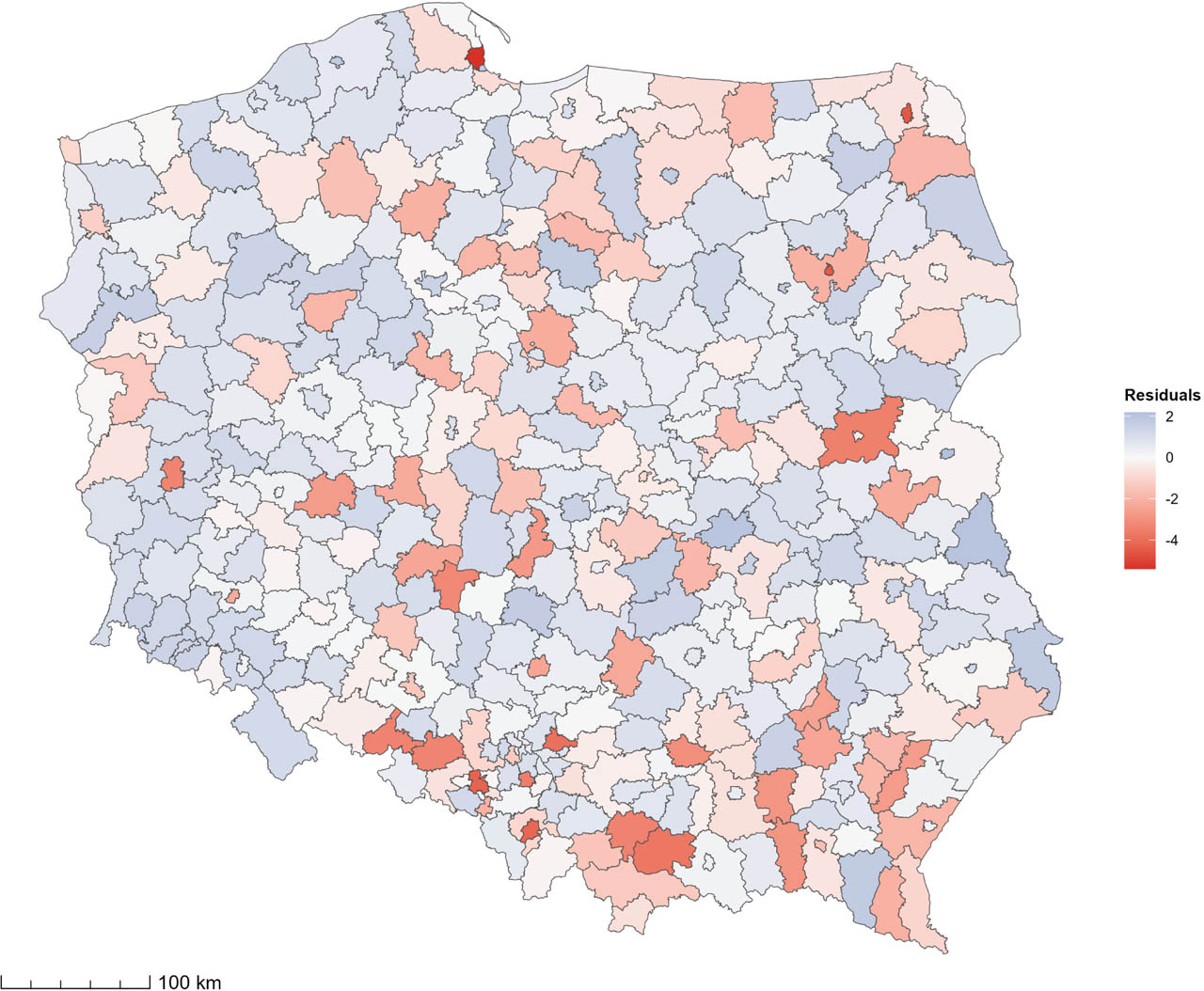
Figure 3.
Spatial distribution of residuals of the OLS model
Source: Own elaboration
Conclusion
The present study aimed to identify the key determinants affecting the geographically differentiated level of municipal bond issuance in Poland using a granular, county-level approach (N=380). The analysis showed that although preliminary data suggested an intense geographical concentration of issuance activity, the observed pattern is primarily explained by fundamental economic and demographic factors rather than by imitation or diffusion processes between neighbouring regions.
The diagnostic results provided a clear answer regarding the mechanism of spatial distribution. The Global Moran's I test for regression residuals proved statistically insignificant, leading to the rejection of the hypothesis that bond issuance is driven by direct diffusion or imitation processes between neighbouring regions. Consequently, the use of complex spatial models was deemed unjustified for this specific market segment. Instead, the observed geographical pattern is explained primarily by local structural and economic fundamentals, captured effectively by the Ordinary Least Squares (OLS) model with robust standard errors. The final model explained approximately 28.2% of the variation in municipal bond issuance, using highly granular cross-sectional data.
The estimation results highlight several distinct drivers of local debt policy. First, the strongest positive predictor was the cost of debt service. This strong relationship likely reflects a structural feedback loop, where high historical indebtedness compels local governments to actively utilise municipal bonds as a liquidity management tool for debt rolling purposes (refinancing existing obligations), rather than solely for new investment projects. Second, the study confirmed the existence of significant location-related barriers. The negative relationship with the distance from Warsaw supports the financial centre–periphery hypothesis, suggesting that proximity to the capital reduces information asymmetry and facilitates access to capital markets.
Furthermore, the analysis revealed an important substitution effect regarding local wealth. Counties with higher PIT revenue per capita are less likely to issue bonds, preferring to finance expenditures through their own budget surplus. In contrast, units with a positive migration balance tend to accumulate more debt, likely due to the investment pressure created by an influx of new residents. Finally, the inflow of EU funds proved to be statistically insignificant at the standard level (p-value > 0.05), though the negative sign of the coefficient points towards a weak crowding-out effect, where non-repayable grants may reduce the immediate need for market financing.
A limitation of the study is its cross-sectional design, which relies on data from a single year (2024). Specifically, the relationship between debt service costs and issuance levels should be interpreted with caution due to potential endogeneity; while high servicing costs drive the need for refinancing (new issuance), they are also a function of past debt accumulation. Future research should therefore focus on analysing panel data, which would enable the study of the dynamics of these relationships over time and a more comprehensive understanding of the causal relationships shaping the Polish municipal bond market.
Beyond the specific Polish context, this study offers a broader contribution to the international literature on sub-sovereign debt. While the dominant research stream – particularly regarding the US and Chinese markets – focuses primarily on yield spreads and credit risk pricing (Butler 2008), our analysis demonstrates the analytical value of mapping the ‘geography of issuance volume’. This highly granular approach was enabled by the Polish market's unique infrastructure, specifically the centralised Register of Issuer Obligations (RIO) maintained by the Central Securities Depository of Poland. Unlike decentralised Over the Counter (OTC) markets common in other jurisdictions, the Polish model allows for the precise geolocalisation of every bond series. Thus, the methodology presented here serves as a potential benchmark for other EU member states, demonstrating how centralised data registries can be leveraged to uncover spatial patterns of local indebtedness that remain invisible in aggregated statistics.