
Introduction
The morphodynamics of talus slopes on Earth is a commonly discussed topic in international literature (Caine 1969; Kotarba & Pech 2002; Otto & Saas 2006; Sæter 2008; Veilleux et al. 2020). There are studies referring to slope landforms and processes on Mars (Dundas et al. 2019; van Gasselt 2008; Grindrod et al. 2021; Ramsdale et al. 2019; Vijayan et al. 2022; Voelker et al. 2020) and the Moon (Bickel et al. 2019; Hovland & Mitchell 1973; Xiao et al. 2013). However, there are significant gaps in comparative analyses, which would allow similarities and differences between slope processes on different planets or moons to be found. As indicated in Changela et al. (2021), slopes and large rocks are attributes that are important in planning human landings on Mars. In our study, we developed information on slope processes on Mars, which may be of interest to planners of extraterrestrial missions. The aim of this work is to perform a comparative analysis of talus morphometry and mass-wasting processes on Earth and Mars using a method not previously employed.
The following data on talus slopes were collected: the angle of repose and information on the distribution of rock material on the talus slope. Based on the parameters of the talus slopes, an analysis of the orthophoto map, a Digital Elevation Model (DEM), photo interpretation and a review of the available literature, we draw conclusions about the type of transport along the slope. We show characteristic attributes of individual talus slopes and attempt to explain the diversity of talus slopes.
Location of research areas
The selection of research areas was dictated by the availability of relatively similar features of taluses on both planets shown on good quality images, and included: King George Island (KGI), Lanzarote (Canary Islands) and two Martian craters: Terra Sabaea and Dacono crater (Figure 1 A, B). KGI (coordinates of the midpoint of the talus slope selected: 62°14′10.1″S 58°29′38.1″W) was chosen due to its volcanic terrains and periglacial climate, which shows some similarities with conditions on Mars (Fernández-Martínez et al. 2021; Orgel et al. 2019; de Pablo et al. 2009; Molina et al. 2014). The common features of Lanzarote (coordinates of the midpoint of the talus slope: 29°03′45.9″N 13°29′11.8″W) and Mars are the presence of large amounts of volcanic ash (Christensen 1986; Muhs 2013; Thordarson et al. 2009) and very low rainfall on Lanzarote and no rainfall on Mars (Díaz et al. 2013; Nair & Unnikrishnan 2020).
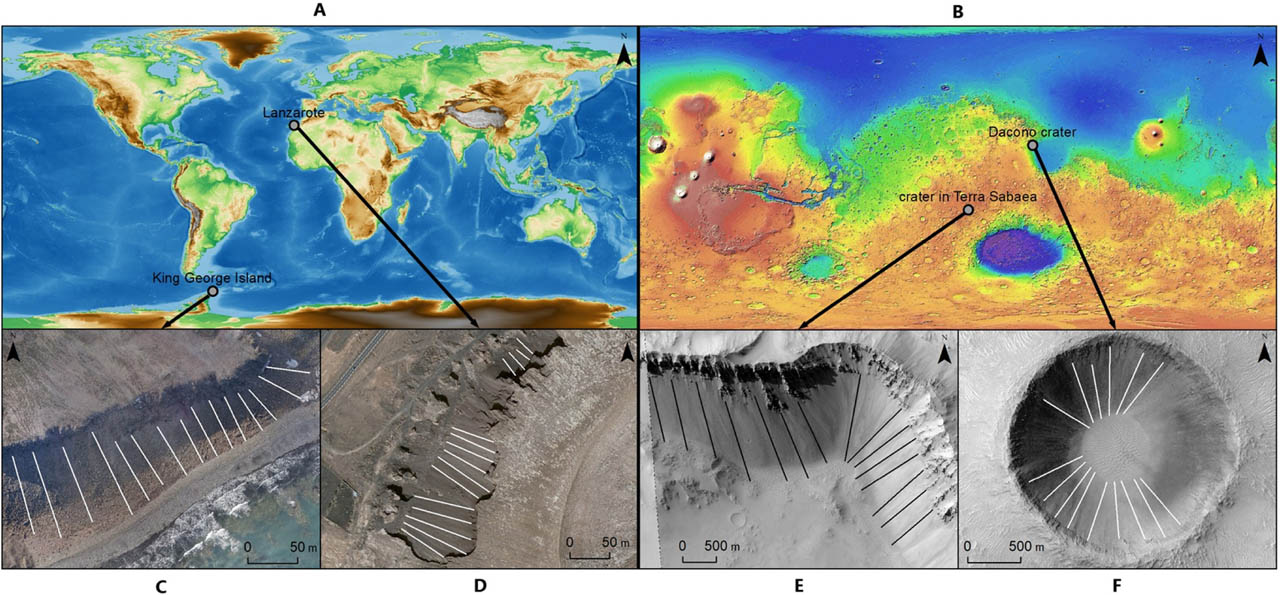
Figure 1.
Location of selected talus slopes on Earth (A) and Mars (B), with marked transects (white and black lines on lower insets) on King George Island (C), Lanzarote (D), Terra Sabaea crater (E) and Dacono crater (F)
Sources: World Relief Map (A); Mars HRSC-MOLA Colorized Shaded Relief (B); orthophoto, courtesy of Zmarz A. (C); Infraestructura de Datos Especiales (D); NASA/JPL/University of Arizona (E, F); edited in ArcMap 10.7.1
The selection of research areas on Mars was guided by data availability – a high-resolution orthophoto map and a DEM were necessary to carry out the analysis (Table 1). The crater on Terra Sabaea (coordinates of the crater's central point: 18°09′54.36″S, 41°30′0.40″E) has a diameter of 12 km and is presented in all nine photos from the High Resolution Imaging Science Experiment (HiRISE) camera (NASA/JPL-Caltech/UArizona 2022). This enabled an accurate analysis of the talus slope and observation of changes on the crater slopes in 2008–2019. The Dacono crater (coordinates of the crater's central point: 18°20′0.14″N, 77°57′0.63″E) has a diameter of 2.2 km and is located about 30 km east of the Perseverance rover landing site (NASA/JPL-Caltech/UArizona 2022). Therefore, knowledge about this area will probably expand dynamically and will allow for further discussion. According to our best knowledge, no studies, so far, have been dedicated to taluses in Terra Sabaea and Dacono craters.
Table 1.
Source of remote sensing images used in this work
| Image signature | Date image was taken | Resolution [m] | Study area |
|---|---|---|---|
| PSP_007966_1615_RED | 08.04.2008 | 0.50 | Terra Sabaea |
| ESP_024198_1615_RED | 25.09.2011 | 0.25 | Terra Sabaea |
| ESP_025055_1615_RED | 30.11.2011 | 0.50 | Terra Sabaea |
| ESP_025754_1615_RED | 24.01.2012 | 0.25 | Terra Sabaea |
| ESP_031200_1615_RED | 23.03.2013 | 0.25 | Terra Sabaea |
| ESP_031767_1615_RED | 06.05.2013 | 0.25 | Terra Sabaea |
| ESP_032334_1615_RED | 19.06.2013 | 0.50 | Terra Sabaea |
| ESP_032835_1615_RED | 29.07.2013 | 0.50 | Terra Sabaea |
| ESP_059248_1615_RED | 18.03.2019 | 0.25 | Terra Sabaea |
| ESP_026425_1500_RED | 16.03.2012 | 0.50 | Dacono crater |
Data and methods
To carry out the analysis, a high-resolution orthophoto map and a DEM of Martian and terrestrial research areas were necessary. However, due to the great diversity of locations, it was impossible to use data from one source in the same spatial resolution. The analysis of the talus slope on KGI was performed based on images made by A. Zmarz in 2016 (Zmarz et al. 2018) using an unmanned aerial vehicle (UAV). The orthophoto map resolution is 0.07 m and DEM resolution is 0.25 m. The analysis of the slope in Lanzarote was carried out based on materials downloaded from Infraestructura de Datos Especiales, Instituto Geográfico Nacional in Spain (Infraestructura de Datos Especiales 2022). The orthophoto map resolution is 0.16 m from the 2018 and DEM resolution is 2.50 m from 2015.
The photos used to analyse talus slopes on Mars were taken using the HiRISE camera on board the Mars Reconnaissance Orbiter space probe (NASA/JPL-Caltech/UArizona 2022). They were selected because they were of the highest resolution available: 0.25–0.50 m. A DEM was also used (resolution: 200 m), which was created based on data collected by the MOLA (Mars Orbiter Laser Altimeter) tool and stereoscopic photos taken by the High Resolution Stereo Camera (HRSC). All the images were taken between 08.04.2008 and 18.03.2019. Data from Mars were initially handled in JMARS 5 software and further analysis of all talus slopes was performed in ArcMap 10.7.1. This allowed for the adaptation of coordinate systems and materials to enable comparative analysis.
In each area, 15 transects were designated following the line of greatest slope from the base of the scarp to the foot of the slope (Figure 1 C–F). The distances between individual transects depended on their length and the author's interpretation of the slope morphology. Distances could change if the transect ran along an uneven slope with outcroppings of bedrock or was intersected by a water erosional trench. All visible boulders that stopped along each transect path were manually vectorized (Figure 2). Some 595 boulders were marked on the KGI talus slope, 265 on Lanzarote, 770 on Terra Sabaea and 504 in the Dacono crater.
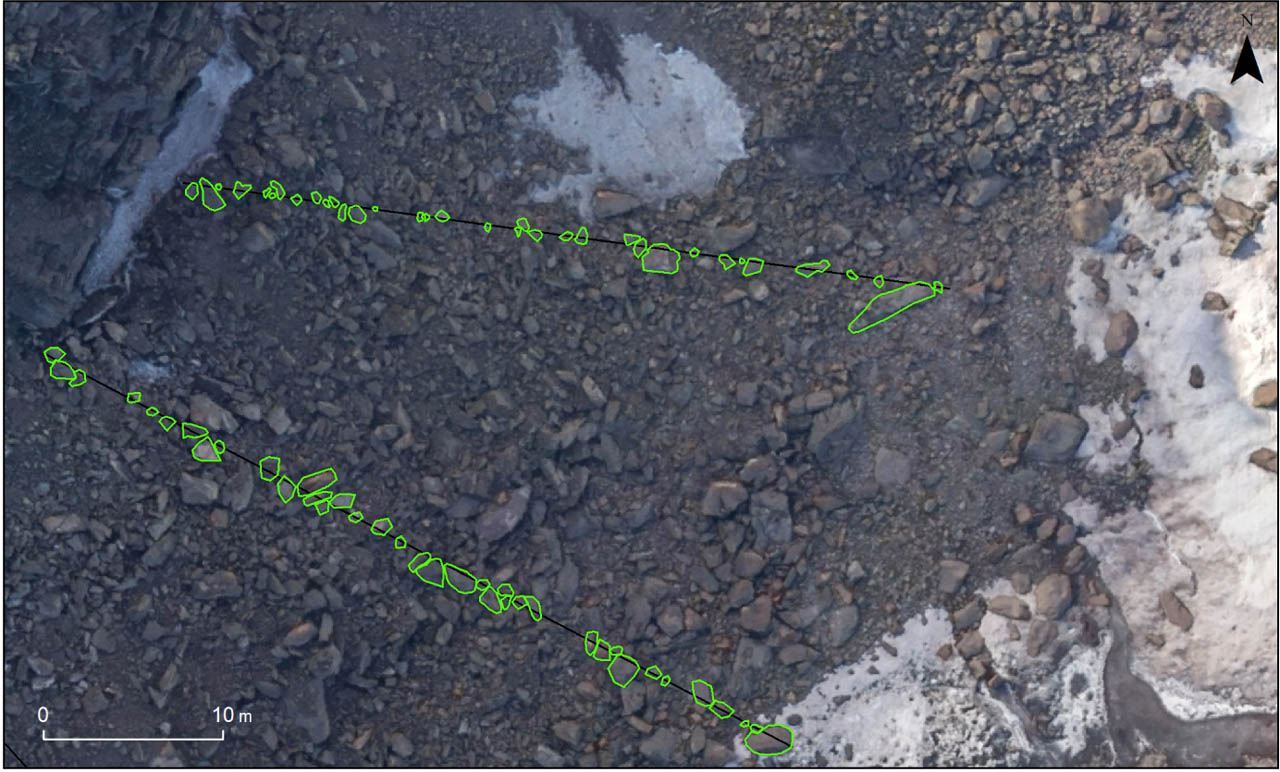
Figure 2.
Example transects on King George Island with marked boulders
Source: orthophoto, courtesy of Zmarz A.; edited in ArcMap 10.7.1
The geometry of the boulders was measured and described in the attribute table in ArcMap. Their area, circumference, length of the longer axis, and length of the shorter axis were taken into account. The elongation of the boulders was calculated as the ratio of the longer axis to the shorter one. In addition, the orientation of the longer axis relative to N was described. The difference between the orientation of a given transect and the longer axis of boulders along this transect was taken into account (Figure 3). The obtained orientation of the boulder relative to the transect was entered into the attribute table.
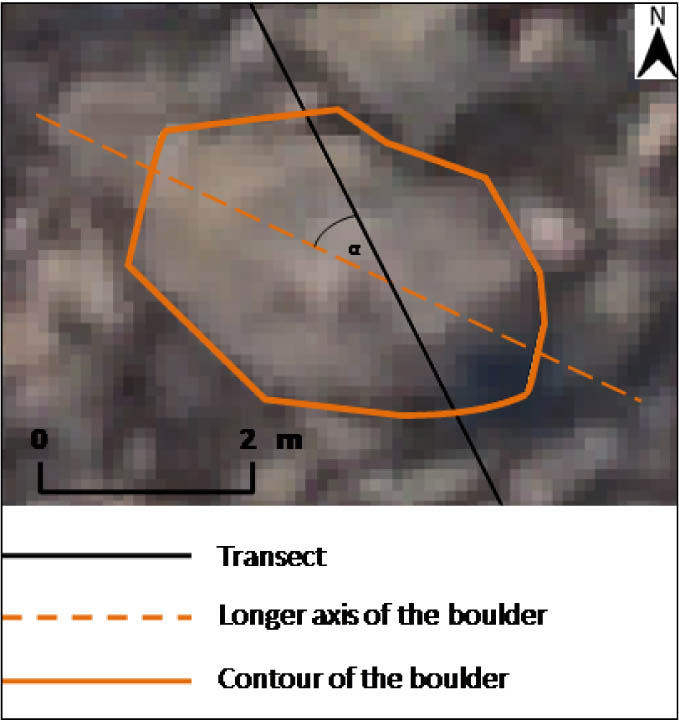
Figure 3.
An example of the difference (angle α) between the orientation of a given transect and the longer axis of boulders along this transect
Source: orthophoto, courtesy of Zmarz A.; edited in ArcMap 10.7.1
To determine the density of marked boulders in each area, the length of the transects was summed and divided by the number of marked boulders. This result determined the average density of marked boulders on each talus slope.
The distance of the upper edge of the boulder from the top of the transect was measured, and later converted into a percentage of the entire transect length. This allowed further comparison of the distribution of boulders on all transects regardless of their length.
Martian talus slopes are covered with a thick layer of dust. During transport, large boulders leave visible traces, imprinted in the surface layer of dust. By combining individual prints, it was possible to reconstruct the boulder's migration trajectory (Figure 4) and, in some cases, clearly mark the boulder that left the given track (Figure 5).
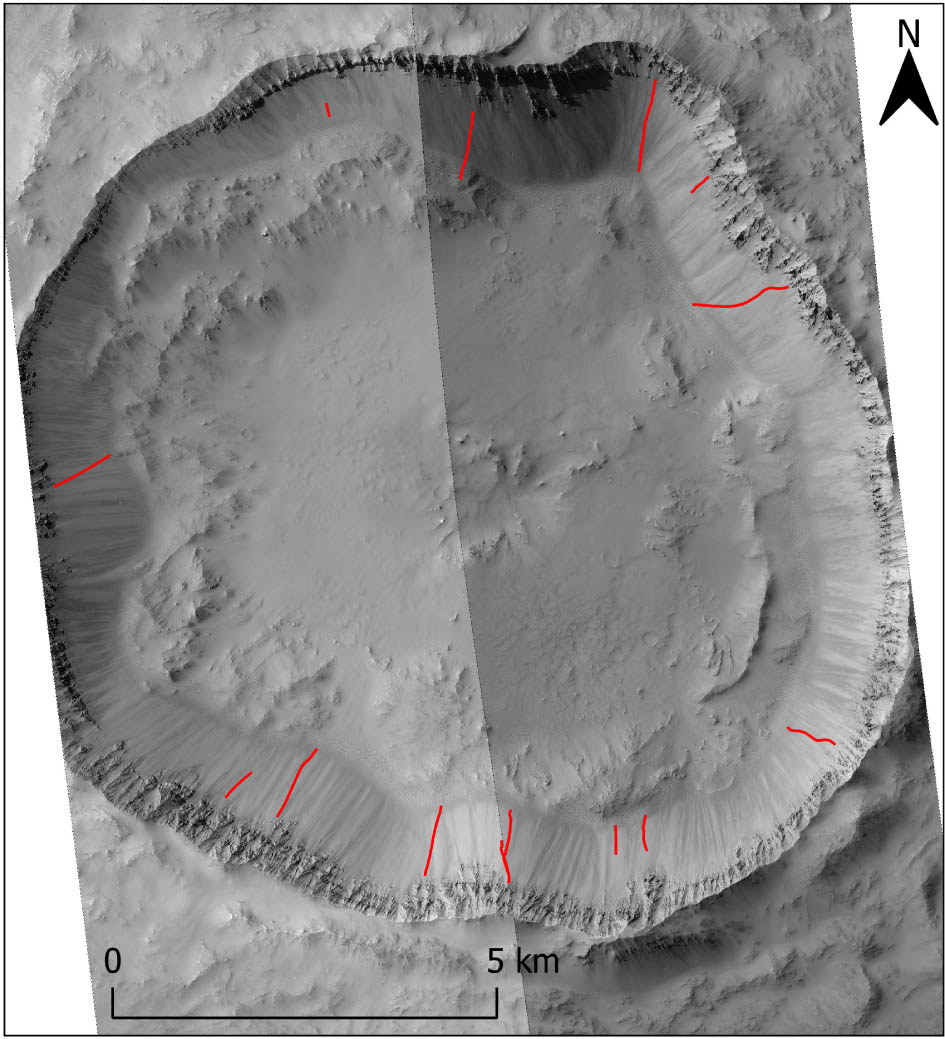
Figure 4.
An example of the reconstructed boulder's migration trajectories in the Terra Sabaea crater
Source: own study based on NASA/JPL/University of Arizona; HiRISE images: ESP_025055_1615_RED, ESP_032835_1615_RED
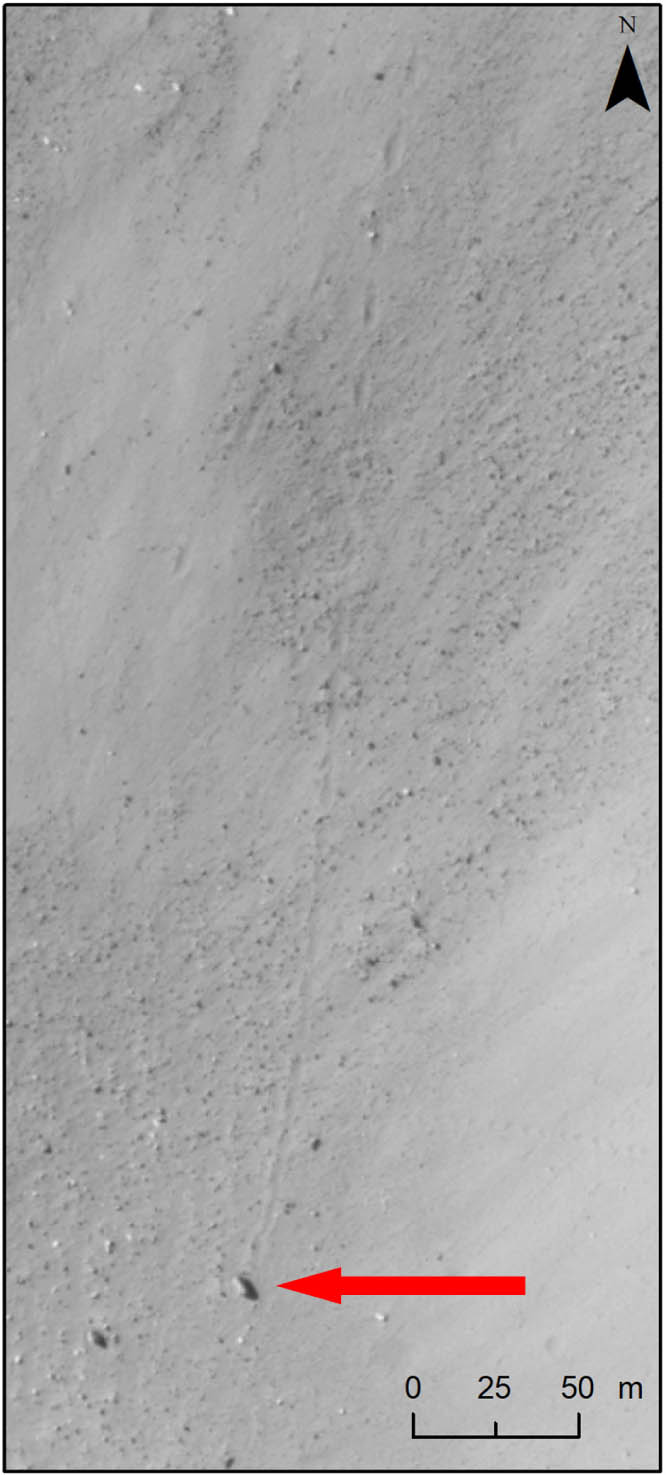
Figure 5.
The marked boulder with the trace it left during transport – example from the Terra Sabaea crater
Source: own study based on NASA/JPL/University of Arizona; HiRISE image ESP_025055_1615_RED
This study included only well-preserved, clear paths with identifiable boulders at their ends, which made it possible to mark each subsequent boulder trail. Such traces were described not only on the slope fragments where transects were marked but also on the talus slopes of the entire craters.
Results
Comparison of talus slopes on King George Island and Lanzarote Island
The analysis of talus slopes on Earth was based on higher-resolution data and more references to the literature in comparison to those of Mars. Knowledge about these areas is incomparably more complete, detailed, and reliable in comparison with the Martian sites. Therefore, information about the talus slopes on KGI and Lanzarote served as a reference for the interpretation of talus slopes on Mars.
Significant differences were found in the morphodynamics of the talus slopes on KGI and Lanzarote, resulting mainly from the geological structure and climate. The average height of the scarp on KGI is 33.5 m; on Lanzarote, it is 17.3 m. The higher the height of the scarp, the greater the speed of the boulders when reaching the dump at the base of the scarp, which affects the method of their further transport.
Using trigonometry, the average angle of repose was calculated. On the Lanzarote slope, it is 33.4°; on KGI, it is 28.0°. The difference is mainly caused by two factors. First, the grain size composition on both taluses varied significantly. On KGI, most of the material is gravel, boulders and blocks, and there are large pores between the grains that are not filled with finer material. The weight of an individual boulder is supported by other boulders at a few contact points only. Such a system is more unstable and a small change can activate mass movements on large areas. On the other hand, the talus deposit in Lanzarote is composed mainly of dust, with only a small admixture of boulders, and all large pores are filled with fine material. Boulders are therefore matrix-supported (logged more firmly) and the slope is more stable (Turner 1996).
The second factor influencing the angle of natural repose is humidity. The talus deposit on KGI is constantly irrigated – from frequent rainfall, long-lingering snowflakes and meltwater. This also contributes to the removal of fine fractions. On the other hand, there is little rainfall in Lanzarote, and there are no other water sources in the talus slope. Therefore, the water content in the talus deposit material is small and it does not wash out. Moreover, friction forces in dry deposit material are higher than in wet material.
The analysis of the angle between the longer axis of the boulders and the transect direction (Figure 6) showed that, on KGI, boulders are transported primarily by bouncing (saltation) or rolling. This can be deduced from the large number of boulders whose longest axis were at a wide angle with the slope line, which facilitates such a transportation mode. Despite the greater angle of the slope, slide transport prevails in Lanzarote. This was caused by the fine-grain cover, which slows down and cushions falling boulders.
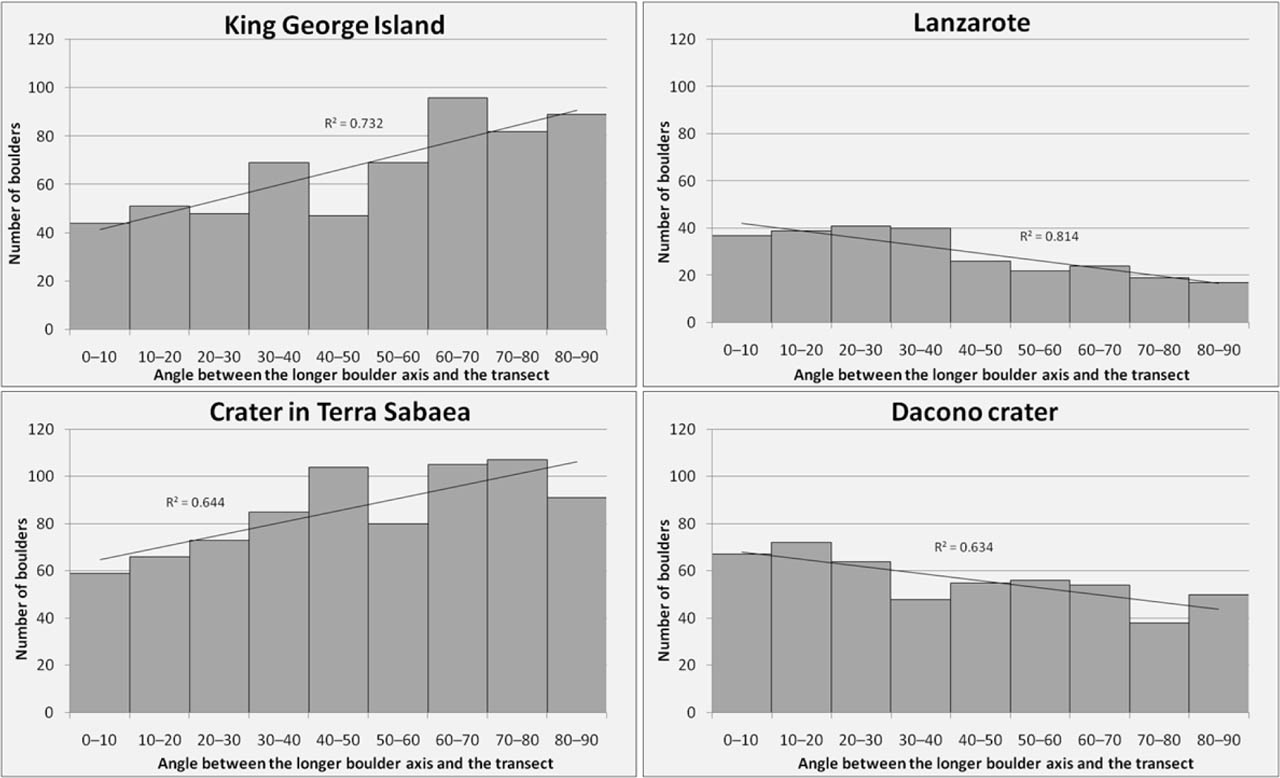
Figure 6.
Position of the longest axes (acute angles) of studied boulders versus directions of the transects on Earth and Mars
Source: own study
The distribution of boulders along the transects indicates that, on the Lanzarote talus slope, a significantly larger number of boulders stopped in the lower parts of the slope. On the other hand, on the KGI talus slope, the boulders were distributed more evenly along the transects (Figure 7). On Lanzarote, talus boulders were transported along a slope of undifferentiated structure, without natural obstacles, and stopped only in the lower part after the speed gradually decreased and the slope flattened. On the KGI talus slope, falling boulders often got stuck and stopped among other blocks along all parts of the transects.
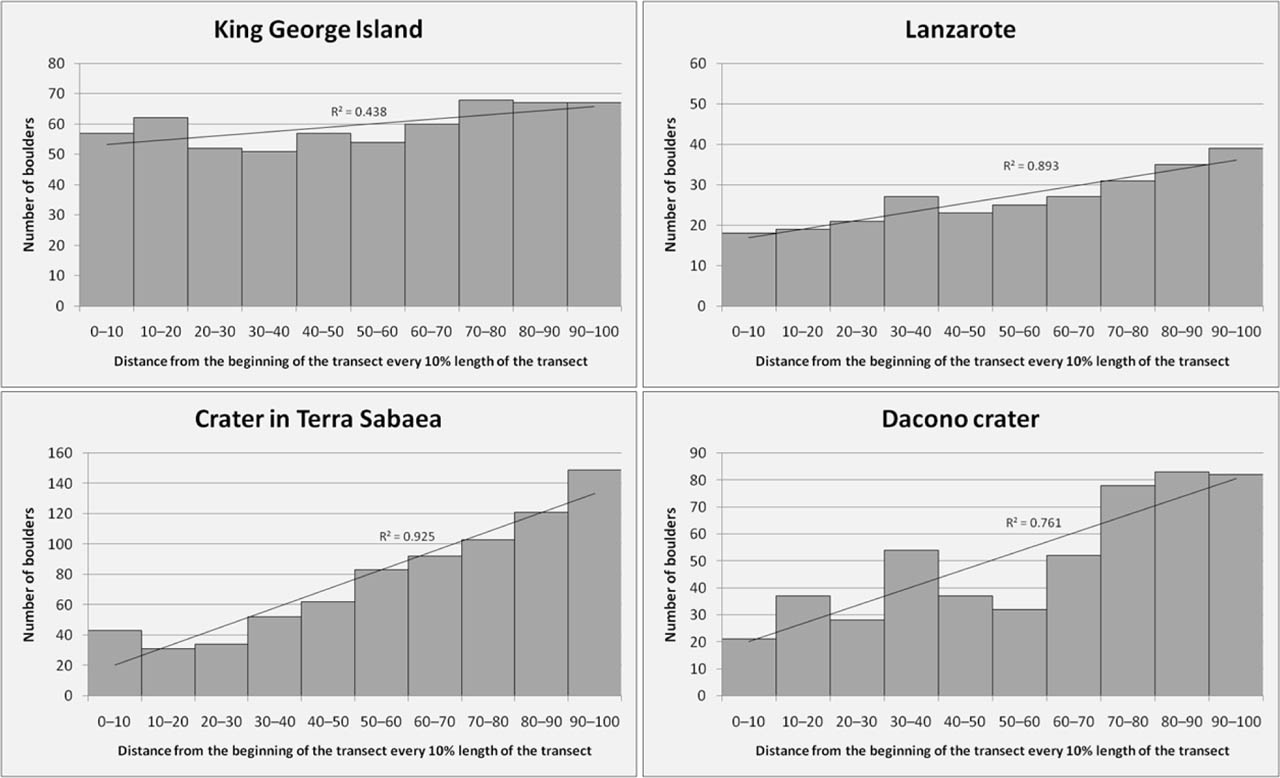
Figure 7.
The number of marked boulders along the transects in intervals of 10% of the transect length on the analysed talus slopes
Source: own study
Comparison of talus slopes in Terra Sabaea and Dacono craters
Both Martian talus slopes were analysed using photos of the same resolution, so it was possible to compare the sizes of the boulders more fully than those of the talus slopes on Earth.
The talus slope in the Terra Sabaea crater is much larger than the one in the Dacono crater. This applies both to the size of the talus slope and the height of the scarp above it. The average scarp height of the Terra Sabaea crater is 178.4 m; in the Dacono crater, it is just 54.9 m. This means that there is a large difference in the speed of the boulders that hit the talus slope and a greater predisposition to bouncing transport.
The average angle of natural repose in the Terra Sabaea crater is 24.7°; in the Dacono crater, it is 16.7°. Assuming no differences in material water content, this difference must be caused by geological features such as different bedrock, grain size and dust cover. Attention should also be paid to the density of boulders identified along transects on the Terra Sabaea talus slope (a boulder every 20.93 m) and on the talus slope in the Dacono crater (a boulder every 16.97 m). This means that, on the talus slope on Terra Sabaea, there are more boulders whose size allows them to be recognized on an orthophoto map. In the Terra Sabaea crater, boulders stopped on the slope, so that the angle between their longest axis and the transect is close to 90°. In the Dacono crater, it is up to 0°. The above data do not clearly determine the functioning of the talus slope, and their interpretation is less clear than for the talus slopes on Earth. Due to the lack of the number of trails, the type of transport determined by the angle that the boulders make with the transect was considered to be the leading information. It suggests that transport by bouncing predominates on the Terra Sabaea slope. This interpretation is also supported by numerous traces of bouncing boulders. On the other hand, in the Dacono crater, sliding transport predominates. The boulders stopped with their longer axis along the slope.
Comparison of talus slopes on Earth and Mars
Since talus slopes on Earth have been studied more thoroughly, they constitute a reference for comparison with talus slopes on Mars. The most noticeable difference is the lower angle of natural repose of the slopes on Mars. The factor that has a major impact on this is the moisture of the material. Comparing this property, the talus slopes on Mars resemble the slopes on Lanzarote more closely. Despite the low rainfall on Lanzarote and the lack of water reservoirs in the area, the material contains water, whereas the material on Mars is generally dry. Moisture in the fine dusty material increases cohesion and increases the angle of natural repose (PIG 2022). Therefore, this is one of the factors influencing the lower angle of the Martian talus slopes.
The completely dry, loose, dusty material on Mars has low friction between grains. This creates favourable conditions for filling material and transporting boulders. Therefore, the angle of natural repose on Mars is lower. In addition, a higher gravitational force on Earth causes stronger resistance of the interlocking boulders and, consequently, an increase in the angle of natural repose of the talus slope.
An important element of the functioning of talus slopes on Mars is their size. The slopes on Mars analysed in this work are much larger than those on Earth. The resolution of Martian images does not allow for the same analysis as for small forms on Earth. Taking into account lower atmospheric resistance (lower atmospheric pressure), longer transportation distances and lower gravitational acceleration, the dynamics of falling boulders is different. This difference is very visible on the slope in the Terra Sabaea crater. The scarp above the talus slope is definitely the highest. A boulder falling from its upper part may reach a higher speed when it contacts the slope. The visible effect of this is an increase in the number of marked boulders that penetrate the dust layer in the first 10% of the transect length. This speed allows the boulder to overcome small changes in terrain. This is also facilitated by the predominance of fine fractions over rocky ones – the boulder does not stop and does not get stuck between other boulders, and the transport takes place over a layer of dust. Many boulders stop far from the foot of the slope. The boulders furthest from the slope slowed down and stopped 400 m from its foot (Figure 8). The latter relationship is also visible on the talus slopes in the Dacono crater and on Lanzarote. Most boulders were marked in the lower parts of these slopes but their speed did not allow them to move significantly away from the foot of the talus slope. The elongation ratio on all four talus slopes is very similar and amounts to approximately 1.5. This proves that the shapes of the talus slopes are similar.
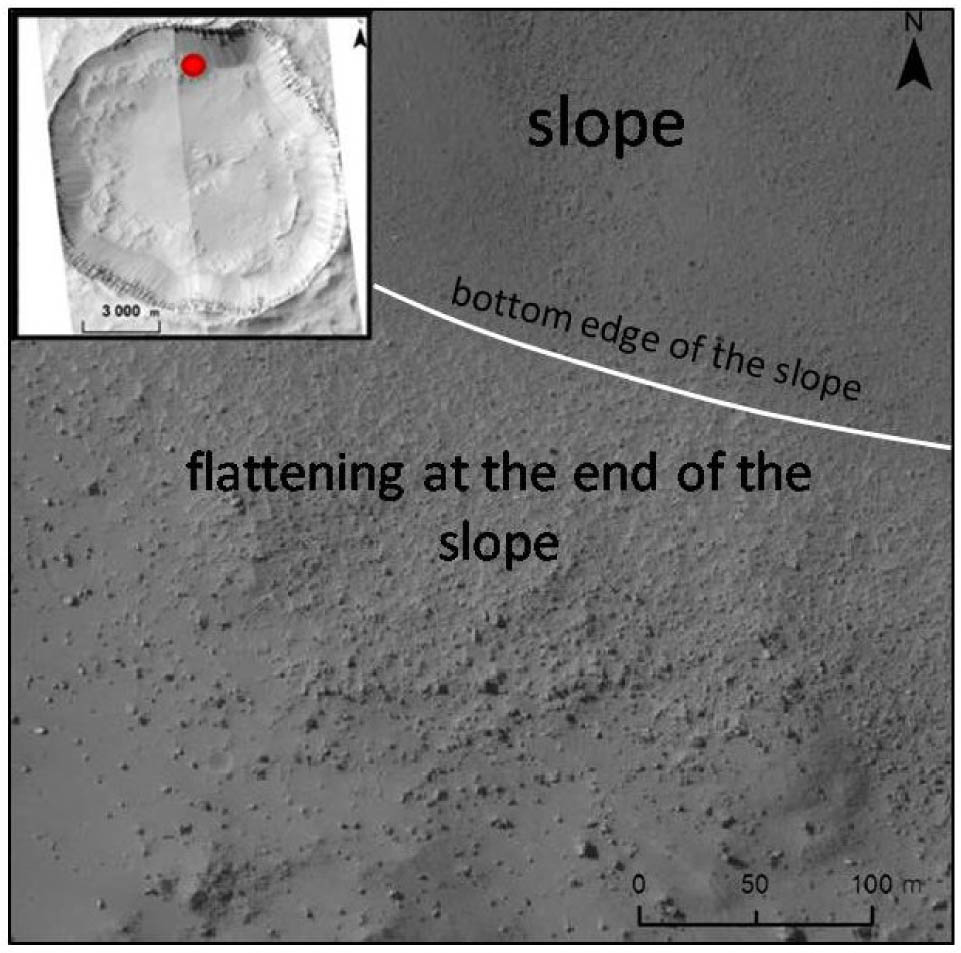
Figure 8.
The bottom edge of the slope and visible boulders at the flattening at the end of the slope in the Terra Sabaea crater
Source: own study based on NASA/JPL/University of Arizona; HiRISE image ESP_025055_1615_RED
Another important feature to discuss in the context of talus slopes on Earth and Mars is the covering of the slope with vegetation. On the KGI images, some scarce tundra vegetation is visible, such as lichens. On the Lanzarote images, several succulent plants are visible. They contribute to accelerating the rate of weathering of rocks and retaining moisture. Roots and water contained in plants strengthen cohesion and increase the stability of dusty talus slopes, and their lack contributes to a reduction in the natural angle of repose (Sidle et al. 1985).
The analysed slopes also differ in their development. On Earth, the slopes are relatively simple and not very diverse, while, on Mars, they have a more diverse structure. The slope in the Terra Sabaea crater, in particular, is rich in deep gullies and rock ribs. This indicates a less uniform supply of material to the talus slope. The largest supply of material is in the axis of the gullies. This is visible in the form of streaks at the mouth of the gullies. However, when describing the talus slope on KGI, it can be noted that, in its central part, there is solifluction material coming from the upper slope.
Boulder paths analysis on Mars
Based on the distance between individual prints, the type of transport can be concluded. It should be noted that boulders that bounce are most likely to leave traces. Slide and roll transport drives the boulder into the ground with less force. There was no relationship observed between the size of the boulders and the type of transport or the length of transport.
Analysis of the angle formed by the longer axis of the boulder with the direction of the slope showed that only four boulders at the end of the traces stopped at an angle of less than 45°. In the initial phase of transport, the boulders left very distant traces, and in the lower part they left very close traces. This means that, in the initial phase of transport, the boulders were transported by bouncing; then, they slowed down and slid down the slope. The remaining boulders stopped at an angle greater than 45°, which allows us to assume that they were transported by bouncing (saltation).
Analysing individual paths, differences in length between the bouncing marks of a given boulder can be noted. This may be related to local changes in the slope angle. Analysis of the path of a specific boulder provides information about its transport along the slope. First, large distances between marks indicate bouncing transport, and, therefore, a steeper slope. When the slope flattens out locally, rolling transport mode begins to dominate – the distances between the bouncing marks become closer or touch each other.
On most paths, a systematic decrease in the length of bouncing marks and in the length of transport along the slope is visible. The falling boulder gradually loses speed and the bounces are lower and more frequent.
There are three characteristic paths: initially, the distances between bouncing marks are very large; then, they decrease rapidly; they end with a series of very even, short traces. The boulders at the end of the transport stopped at an angle of less than 40°. In the initial phase of transport, they bounced down a steep slope and, then, when the slope flattened, sliding-rolling transport began (Figure 9).
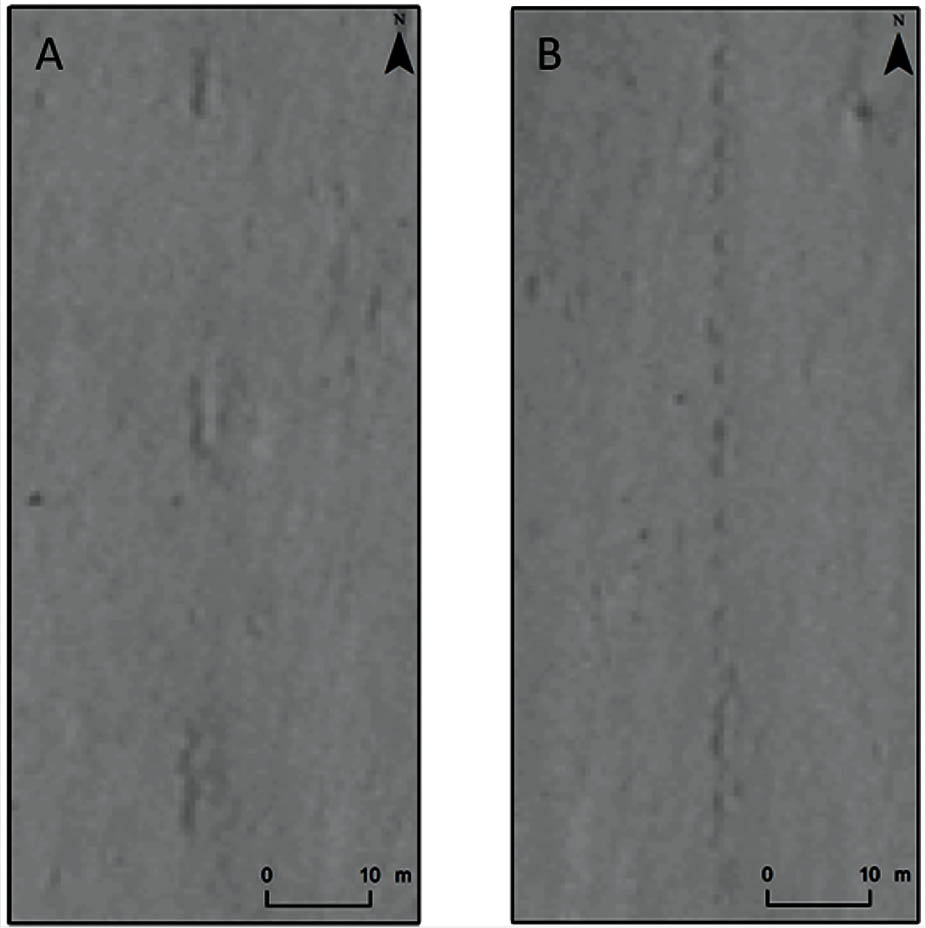
Figure 9.
Talus slope in the Terra Sabaea crater: A – trace of a boulder in the upper part of the slope; B – trace of the same boulder in the lower part of the slope
Source: own study based on NASA/JPL/University of Arizona; HiRISE image ESP_025055_1615_RED
Since the talus slope in the Terra Sabaea crater is illustrated in several photos (Table 1), it was possible to compare them to determine the frequency of boulder transport. However, no photo covers the entire crater – only parts of it. For this reason, different paths are shown in different photos. The oldest photo was taken on 8 April 2008; the newest one is from 18 March 2019. During the analysed period, no new paths appeared and none of the paths visible in older photos disappeared. This proves that no large boulder was transported downhill during that time. On the other hand, it is known that none of the existing traces were buried by other mass movements or aeolian processes. Slope and aeolian processes were, therefore, relatively inactive. Only one image of the Dacono crater is available – taken on 16 March 2012. Therefore, it is not possible to compare traces from different years.
The analysis of boulders below the talus slope allows for conclusions about the activity of slope processes. It is possible to determine the relative age of boulder transport based on the dunes located below the slope. As shown in Figure 10, many boulders are located on the surface of the dunes. This means that their transport took place after the formation of aeolian forms or that these processes co-occur. The relationship between boulders and dunes can also be interpreted as a deflation pavement that was exposed as a result of aeolian processes active after the accumulation of boulders. This is supported by the lack of traces of rolling boulders on the dune sand.
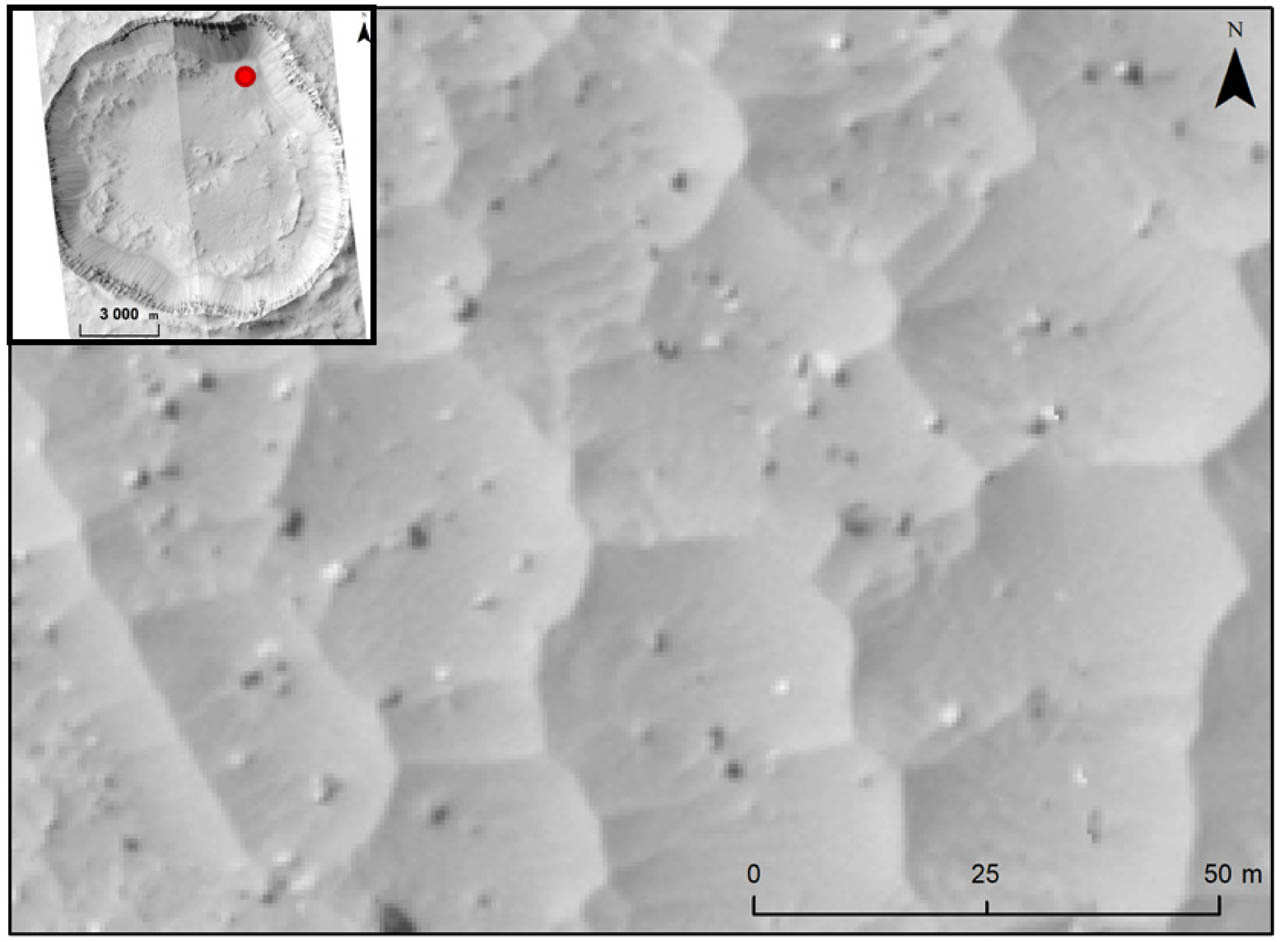
Figure 10.
Dunes with visible boulders at the foot of the slope in the Terra Sabaea crater
Source: own study based on NASA/JPL/University of Arizona; HiRISE image ESP_025055_1615_RED
Discussion
Evaluation of talus slope measurements
Due to the difficult access to KGI and the young age of the talus slopes, they are relatively little explored. Precise measurements were carried out for the modernization of the Polish Antarctic Station Henryk Arctowski. Field geological measurements of the surrounding talus slopes were made (Pietrzykowski et al. 2017). Among other things, the angle of natural repose was measured, which showed that it was in the range of 25–30°; the most representative angle was 28°. This demonstrates full compliance with the results of this work, which is solely based on remote sensing methods. The authors of the above study did not find any tendency for circular-cylindrical landslide displacements to occur on a slope with a natural angle of repose. They indicated heavy rainfall and snowmelt as the main cause of the increased transport of material along the talus slope (Pietrzykowski et al. 2017). Therefore, the conditions are favourable for the occurrence of debris flows. They probably also occur on the talus slope analysed in this study and modify its surface. However, no typical channels with side deposits and colluvium at the bottom of the flow were observed on the images.
Research on this topic is based mainly on photo interpretation; however, it is not focused only on talus slopes but on periglacial forms in general. Therefore, it does not thoroughly describe the morphodynamics of talus slopes. The main aspect discussed in the literature is the angle of slopes. Vieira and Ramos (2003) described talus slopes on Livingston Island. The specified range of the angle of repose was quite wide – between 25° and 50°. The average slope angle of the talus slopes described in this study was in the lower part of this range (28°). In turn, López-Martínez et al. (2016), when describing glacial oases in the South Shetland Islands, gave a narrower range of slope inclination: 25–45°. The investigated angle of natural repose on KGI was quite low, probably due to the high moisture content of the material on the slope and the relatively high content of fine material.
According to research conducted on Earth, the size of the talus material increases with the length of transport (Migoń 2006). This correlation was also observed on talus slopes on KGI and Lanzarote. When photointerpreting talus slopes, it was possible to determine only the granulometric fractions that were clearly visible on the orthophoto map – namely the largest ones. However, the analysis showed that the largest boulders are concentrated at the foot of the slope.
Talus slopes on Mars are not yet as well characterized as those on Earth but, because of the greater availability of data, more research is being done. Work has been carried out in various regions of Mars. Voelker et al. (2020) described the results of studies on the angle of natural repose in the Tharsis area. The analysis was carried out on the slopes of Olympus Mons, Ascraeus Mons and Arsia Mons. Talus slopes where divided into northern and southern exposure. In the first two areas, the angle of repose was approximately 29° and, on the slopes of Arsia Mons, it was significantly lower – approximately 20°. The slope in the Terra Sabaea crater analysed in this study is inclined at an average angle of 24.7°; in the Dacono crater, it is 16.7°. More gentle slopes may be related to different, weaker bedrock with a different mineralogical composition and a lower angle of internal friction (Voelker et al. 2020). On both of the slopes, on Arsia Mons and in the Dacono crater, the slopes with northern exposure were inclined at a greater angle. An important difference between the analysed areas is their height above the reference level. Olympus Mons (21,000 m above the Mars global datum; elevation 26,000 m), Ascraeus Mons (18,000 m above the Mars global datum; elevation 15,000 m) and Arsia Mons (16,000 m above the Mars global datum; elevation 9,000 m) are the highest peaks on Mars. However, the Terra Sabaea crater is located only 2,000 m above the Mars global datum, and the Dacono crater, 2,600 m above the Mars global datum. Such large differences in height are undoubtedly reflected in the climatic conditions and the functioning of the slopes.
Boulder path analyses on Mars
Falling boulder paths are also a common theme in modern literature. Sinha et al. (2020) recognized 63 boulder paths inside the Jezero crater – four of them were paths in the Dacono crater (one of these is described in this work and three did not meet the requirements set out in this work). All 63 paths were visible in photos over a period of approximately 12 years. It was also found that, regardless of the lighting conditions of the area in a given photo, the traces were clearly visible. This information is consistent with observations of traces in the crater on Terra Sabaea presented in this work. Sinha et al. (2020) noticed that the longest path was associated with a very large boulder. In this work, the longest path is also associated with the largest boulder, which stopped 240 m from the lower edge of the slope. The average angle of the slopes inside the Jezero crater, on which the paths were described, was 20°, while the average angle of inclination of the transects in the Dacono crater was determined in this study to be 16.7°. Both angles have much smaller values than those determined in the works of Kleinhans et al. (2011).
Kleinhans et al. (2011) proved that the static angle of internal friction of dry sand under reduced gravity showed an increase of 5° compared to terrestrial conditions. However, other analyses of slopes on Mars showed that talus slopes there are inclined at a smaller angle than their terrestrial counterparts, being about 20° (Brusnikin et al. 2016; Voelker et al. 2020). The reason for this phenomenon may be differences in humidity and vegetation cover.
Assessment of the effectiveness of the method
The advantage of the method applied in this work is a multi-aspect and thorough analysis of the morphodynamics of talus slopes. The study provides information on the angle of natural repose, the prevailing type of transport along the slope, the fractional structure of the talus slope and the activity of processes taking place on the slope. With the development of the method and the analysis of a larger research sample, it will be possible to learn even more precisely about the morphodynamics of talus slopes and to draw conclusions about the processes taking place there.
This work presents its application to talus slopes on Mars and Earth. However, it is possible to use it for any areas with available photos and a DEM. In this way, it is possible to easily analyse talus slopes on the Moon and, as data availability develops, on other planets.
The main disadvantage of this method is its accuracy being dependent on the resolution of available data. The poorer the quality of the photos, the narrower the range of fractional grain sizes covered by the analysis. However, the analysis never takes into account the full grain size, only the coarsest fractions. The analysis of a talus slope based on an orthophoto map made it possible to describe the boulders only on the basis of their upper surface, so it was impossible to fully understand the shape of the boulders.
As analysis is only possible in areas with available photos and a DEM, data availability is a limitation. It should be noted, however, that the availability of the above data is currently quite high and is growing faster with the development of Mars missions. The materials currently available allow for the analysis of large and diverse surfaces of Mars.
Conclusions
This work provides the first information about talus slopes in Terra Sabaea and Dacono craters and their morphodynamics, which is particularly valuable in relation to poorly developed studies of Martian taluses.
We analysed 595 boulders on the KGI talus slope, 265 boulders on Lanzarote, 770 boulders in the Terra Sabaea crater and 504 boulders in the Dacono crater. The angle of natural repose on the analysed talus slopes varies: on Earth, it is 28.0° (KGI) and 33.4° (Lanzarote), while, on Mars, taluses are inclined at a smaller angle: 16.7° (Dacono crater) and 24.7° (Terra Sabaea crater). Boulder density along the transects is much greater on Earth (one boulder every 1.7–3.33 m of transect) than on Mars (one boulder every 16.97–20.93 m of transect).
Slopes with predominant rolling transport were distinguished on KGI and in the Terra Sabaea crater; slide transport was observed on Lanzarote and in the Dacono crater. It has been shown that most boulders stop at the bottom of the slope and that the larger the boulder the greater the probability that it will be transported over a long distance. Based on the analysis of low vegetation (on Earth) and boulder paths and aeolian processes (on Mars), the talus slopes were assessed as active.
The created database of talus slopes made it possible to draw conclusions about their morphodynamics and indicate the characteristic features of each of them, as well as their subsequent comparison. The method used has been demonstrated to be highly effective.
Information about the analysed talus slope features and morphodynamics is particularly valuable in relation to talus slopes on Mars because contemporary knowledge about them is relatively poor and the information obtained, as a result of the study, is exceptionally valuable.
We only touched on selected aspects that could be described on the basis of the database created (data available upon request); many features and parameters obtained can be used for further interdisciplinary work. More detailed research may, for example, thoroughly discuss the topic of soil mechanics or focus on a selected aspect – fractional grain size, lithology, shape of grains, moisture content of the talus slope, age of forms, activity of mass movements or angle of natural repose.