
Introduction
In the knowledge-based economy, knowledge constitutes a strategic resource for value creation, growth, and organizational performance (Bergh et al., 2025). This shift has also heightened expectations of universities, which are now called upon to contribute more directly to economic development beyond their traditional missions (Wurth et al., 2024). The role of universities has thus gradually expanded beyond teaching and research to include a more direct contribution to economic and social development (Broström et al., 2021). This expansion reflects a “third mission” encompassing knowledge transfer, innovation, and societal engagement (Compagnucci & Spigarelli, 2020). In this context, entrepreneurship has become an important component of this expanded role, contributing to the rise of the entrepreneurial university model, which entails ongoing changes in universities’ strategies, organizational structures, resources, and relationships with their external environment (Garomssa, 2025).
This entrepreneurial orientation is reflected in various mechanisms designed to support entrepreneurial activity at different stages. Accordingly, universities have developed training programs, incubators, accelerators, support structures, and extracurricular activities. These initiatives are increasingly integrated into broader university entrepreneurial ecosystems (Correia et al., 2024; Cunningham et al., 2022). In addition to providing material resources and venture-creation support, these mechanisms serve as learning spaces in which students can gain entrepreneurial experience, interact with mentors and other entrepreneurs, and acquire knowledge and skills that are difficult to develop through traditional instruction alone (Metcalf et al., 2021; Pocek et al., 2022; Serpente et al., 2025).
These developments have increased the importance of entrepreneurship education, which helps students develop the knowledge, skills, and understanding needed to engage in entrepreneurial activity. A substantial body of research shows that entrepreneurship education encourages students to consider entrepreneurial careers (Nowiński et al., 2019) and strengthens their confidence in their entrepreneurial capabilities (Wu & Wu, 2008), thereby contributing to the formation of entrepreneurial intention (Martínez-Gregorio et al., 2021; Rauch & Hulsink, 2015; Zhang et al., 2019).
The literature indicates, however, that this influence varies considerably across studies. The magnitude of these effects depends on program design, pedagogical approaches, student characteristics, and the contexts in which entrepreneurship education is delivered (Hahn et al., 2017; Martin et al., 2013; Nabi et al., 2017). These variations partly reflect the diversity of learning outcomes associated with entrepreneurship education, including knowledge acquisition and the development of skills and capabilities that can be applied throughout the entrepreneurial process (Kozlinska et al., 2020; Martin et al., 2013; Nabi et al., 2017). Different pedagogical approaches may also produce different learning outcomes and effects (Lackéus, 2020; Lyu, Shepherd, & Lee, 2024).
Despite these variations, entrepreneurship education is often examined as a single construct, either as a direct predictor of entrepreneurial intention or through the antecedents of the Theory of Planned Behavior (TPB) (Dabbous & Boustani, 2023). Although this approach captures its overall influence, it obscures the specific contribution of each learning dimension. Evidence suggests, however, that these dimensions may affect entrepreneurial intention and its antecedents differently (Sun et al., 2017). A multidimensional perspective is therefore needed to determine how each dimension contributes to the formation of entrepreneurial intention.
This issue is particularly relevant in Algeria, where several recent reforms have sought to promote entrepreneurship in higher education. The “One Degree… One Startup” initiative encourages students to develop entrepreneurial projects (Belgoum & Benessalah, 2023), while university incubators and Entrepreneurship Development Centers (CDEs) have expanded entrepreneurship training and support (Ghezal & Benchouat, 2025). Despite these developments, the effects of the different dimensions of entrepreneurship education on students’ entrepreneurial intention and its antecedents remain understudied in the Algerian context.
Accordingly, this study examines how different dimensions of entrepreneurship education influence the antecedents of entrepreneurial intention among students in Algerian university incubators. By distinguishing the role of each dimension, the study provides a more precise understanding of how entrepreneurship education contributes to entrepreneurial intention.
The paper proceeds as follows. The next section presents the theoretical background and develops the research hypotheses. The methodology and empirical results are then presented, followed by a discussion of the findings. The paper concludes by outlining the study’s theoretical, research, societal, managerial, and educational implications, limitations, and directions for future research.
Literature review
Entrepreneurial intention has received considerable attention in the entrepreneurship literature and has been defined in several complementary ways. Ajzen (1991) describes intention as an individual’s willingness to devote attention and effort to a particular behavior or goal, with the intensity of that effort reflecting the strength of the intention. Entrepreneurial intention also refers to an individual’s self-acknowledged conviction and conscious plan to start a business in the future (Thompson, 2009). It is shaped by individuals’ values, needs, beliefs, and experiences, and is also influenced by the surrounding context (Vesalainen & Pihkala, 1999). Based on these definitions, entrepreneurial intention can be understood as the desire to start a business, influenced by individual and environmental factors that, when favorable, may result in entrepreneurial action (Merabet et al., 2022).
Despite the abundant literature on its determinants, two models dominate the analysis of entrepreneurial intention: Shapero and Sokol’s (1982) Entrepreneurial Event Model and Ajzen’s (1991) Theory of Planned Behavior (TPB). Shapero and Sokol’s model is based on perceived desirability, perceived feasibility, and the propensity to act. In contrast, the TPB explains intention through attitude toward the behavior, subjective norms, and perceived behavioral control.
In the present study, the TPB was adopted as the theoretical foundation because recent bibliometric analyses and literature reviews identify it as a predominant and empirically supported framework in entrepreneurial intention research, particularly among university students (Andrade & Carvalho, 2023; Gao & Qin, 2022). Moreover, its three core antecedents provide a robust framework for assessing how entrepreneurship education influences these factors and, consequently, entrepreneurial intention.
Entrepreneurship education: a multidimensional approach
Given the challenges of developing entrepreneurial competencies, entrepreneurship education has become a key tool for enhancing entrepreneurial knowledge, attitudes, and skills. According to Fayolle et al. (2006), entrepreneurship education refers to any form of education designed to develop entrepreneurial competencies through a variety of teaching methods for diverse groups of learners. The purpose of entrepreneurship education is not only to provide learners with the competencies required to start their own businesses, but also to strengthen their ability to recognize opportunities and transform ideas into viable business projects. As Fayolle and Klandt (2006) argue, effective entrepreneurship education should focus on learners’ behaviors, attitudes, and learning environment to foster the creation of new business ventures. These objectives suggest that entrepreneurship education extends beyond transmitting business knowledge and encompasses several distinct forms of learning. Recent studies similarly emphasize that entrepreneurship education involves different types of learning content, pedagogical approaches, and learning outcomes (Lyu et al., 2024; Maheshwari et al., 2023; Nájera-Sánchez et al., 2023).
To capture these forms of learning, Johannisson’s (1991) framework of entrepreneurial competences, grounded in an action perspective on entrepreneurship, distinguishes five knowledge dimensions: “Know-What,” “Know-Why,” “Know-Who,” “Know-How,” and “Know-When.” “Know-What” refers to declarative knowledge of business creation and management, including resource mobilization, marketing, financing, and risk management. “Know-Why” encompasses the values, motivations, and beliefs underlying entrepreneurial action. “Know-Who” concerns relational knowledge and access to social networks, mentors, and experienced entrepreneurs as sources of information, advice, and social resources. “Know-How” comprises practical and procedural entrepreneurial skills, including decision-making, leadership, problem-solving, and implementing entrepreneurial ideas. “Know-When” refers to the experience and judgment required to determine when entrepreneurial action should be undertaken.
These dimensions were later applied to entrepreneurship education programs (Hahn et al., 2017; Souitaris et al., 2007). Sun et al. (2017) adapted four of these dimensions—“Know-What,” “Know-Why,” “Know-Who,” and “Know-How”—as components of entrepreneurship education within a TPB-based model. Kassim et al. (2025) subsequently adopted the same four-component approach to examine their effects on the antecedents of entrepreneurial intention. The present study adopts the same operationalization and excludes “Know-When” because it is largely acquired through direct entrepreneurial experience and therefore falls outside the scope of the conceptual framework.
Hypothesis development and conceptual model
Johannisson’s model provides a theoretical foundation for analyzing entrepreneurship education as a multidimensional construct and examining how its dimensions influence the antecedents of entrepreneurial intention.
“Know-What” and the antecedents of entrepreneurial intention
Attitude toward entrepreneurship represents an individual’s positive or negative evaluation of starting a business. It reflects the perceived benefits, prestige, and satisfaction associated with starting a business, as well as the individual’s interest in doing so (Ajzen, 1991). “Know-What” encompasses declarative knowledge about venture creation, including entrepreneurial opportunities, constraints, project development, and the tools required to start a business. By clarifying what entrepreneurship entails, such knowledge can reduce cognitive uncertainty and enable students to assess its potential benefits and challenges more accurately. However, recent reviews show that the effects of entrepreneurship education vary across studies and contexts (Maheshwari et al., 2023; Nájera-Sánchez et al., 2023). While Karimi et al. (2012) found no significant effect of entrepreneurship education on attitude, Sun et al. (2017) suggested that the cognitive component of entrepreneurship education may positively influence the antecedents of entrepreneurial intention. From a TPB-based perspective, greater entrepreneurial knowledge is therefore expected to foster a more favorable attitude toward entrepreneurship.
Subjective norms refer to the perceived social pressure exerted by significant others, including family members, friends, teachers, and entrepreneurial role models (Ajzen, 1991). “Know-What” may strengthen these norms by enhancing the perceived legitimacy and social acceptability of entrepreneurship. Subjective norms may influence entrepreneurial intention indirectly through attitude and perceived behavioral control (Pham et al., 2023), while entrepreneurship education may primarily strengthen internal drivers such as attitude and self-efficacy (Shah et al., 2020). Nonetheless, a better understanding of entrepreneurship can make entrepreneurial projects appear more credible and socially acceptable (Sun et al., 2017). University support and interactions with teachers, mentors, role models, and peers may also reinforce normative beliefs (Bazan, 2022; Johannisson, 1991; Souitaris et al., 2007), particularly when entrepreneurial role models are perceived as credible and successful (Nessel et al., 2024). Moreover, Karimi et al. (2012) found a positive effect of entrepreneurship education on subjective norms, while longitudinal evidence suggests that these norms can increase following sustained educational exposure. However, the absence of a control group warrants cautious interpretation (Bahaw et al., 2024). Despite the variability of these findings, “Know-What” is expected to strengthen students’ perceptions of social approval for entrepreneurship.
Perceived behavioral control reflects individuals’ beliefs in their ability to start a business (Ajzen, 1991). It concerns confidence in their skills, ability to identify opportunities, command of necessary resources, and perceived ease or difficulty of venture creation. By expanding students’ knowledge of opportunities, business planning, finance, legal issues, and risk management, “Know-What” can clarify the steps and resources required for venture creation and make entrepreneurial action appear more manageable. Entrepreneurship education has been associated with stronger perceived behavioral control and entrepreneurial self-efficacy (Dabbous & Boustani, 2023; Su et al., 2021), with recent studies providing further evidence of positive effects on perceived behavioral control (Gera et al., 2024; Tsaknis et al., 2024). Accordingly, “Know-What” is expected to strengthen students’ perceived entrepreneurial capability. Accordingly, the following hypotheses are proposed:
H1.1: “Know-What” has a positive effect on attitude toward entrepreneurship.
H1.2: “Know-What” has a positive effect on subjective norms.
H1.3: “Know-What” has a positive effect on perceived behavioral control.
“Know-Why” and the antecedents of entrepreneurial intention
The “Know-Why” dimension reflects the motivations, values, and personal reasons that make entrepreneurship a desirable career choice. When entrepreneurship aligns with students’ needs for autonomy and personal achievement, they are more likely to develop a favorable attitude. This relationship is consistent with self-determination theory, which emphasizes autonomy, competence, and relatedness in fostering autonomous motivation (Ryan & Deci, 2000). Empirical studies similarly associate favorable entrepreneurial attitudes with autonomous motivation, basic psychological need satisfaction, entrepreneurial passion, personal values, and achievement motivation (Al-Jubari, 2019; Karimi, 2020; Karimi & Makreet, 2020; Li et al., 2022). Accordingly, “Know-Why” is expected to foster a more favorable attitude by strengthening entrepreneurial motivation and personal commitment.
“Know-Why” may also shape subjective norms by making social approval and encouragement more salient when entrepreneurship aligns with students’ motivations and aspirations. Autonomous motivation and basic psychological need satisfaction have been positively associated with subjective norms (Al-Jubari, 2019), while personal values have been linked to perceptions of social expectations regarding entrepreneurship (Karimi & Makreet, 2020). Thus, “Know-Why” is expected to strengthen subjective norms by increasing the importance students attach to approval from family, peers, teachers, and other important referents.
“Know-Why” may further influence perceived behavioral control by encouraging effort and persistence in entrepreneurial activities, thereby strengthening perceived capability. Autonomous motivation and basic psychological need satisfaction have been positively associated with perceived behavioral control (Al-Jubari, 2019). Personal values, particularly openness to change, have also been positively related to perceived behavioral control (Karimi & Makreet, 2020), while entrepreneurial passion has influenced entrepreneurial intention through perceived behavioral control (Karimi, 2020). Accordingly, “Know-Why” is expected to strengthen students’ perceived entrepreneurial capability. The following hypotheses are therefore proposed:
H2.1: “Know-Why” has a positive effect on attitude toward entrepreneurship.
H2.2: “Know-Why” has a positive effect on subjective norms.
H2.3: “Know-Why” has a positive effect on perceived behavioral control.
“Know-Who” and the antecedents of entrepreneurial intention
“Know-Who” concerns students’ relational resources, including mentors, peers, educators, entrepreneurs, professional networks, and support systems. These resources support entrepreneurial learning through information, advice, role models, and opportunities to validate ideas (Johannisson, 1991; Johannisson et al., 1998; Seet et al., 2018). By making entrepreneurial careers more concrete, accessible, and credible, “Know-Who” can foster a favorable attitude. University and social support, role-model exposure, and interaction with engaged educators have likewise been associated with favorable entrepreneurial attitudes (Gao & Zhao, 2026; Setiawan et al., 2022; Su et al., 2021; Udeozor et al., 2026). Students with supportive entrepreneurial networks are therefore expected to perceive entrepreneurship as a more attractive career option.
“Know-Who” may also strengthen subjective norms by shaping perceived social approval through interactions with mentors, entrepreneurial peers, role models, and support networks. Entrepreneurial role models have been shown to influence subjective norms positively (Karimi et al., 2014; Naranjo-Valencia et al., 2025), while social networks and university support have also been associated with stronger subjective norms (Bazan, 2022; Hassan et al., 2024; Mgueraman & El Abboubi, 2024). Thus, students embedded in networks that value entrepreneurship are expected to perceive it as more socially accepted and encouraged.
The relational dimension may further influence perceived behavioral control. Access to mentors, peers, educators, and support networks can provide information, advice, feedback, and resources that make entrepreneurial action appear more feasible. University and relational support have been positively associated with perceived behavioral control (Mgueraman & El Abboubi, 2024; Su et al., 2021; Tahir & Kutpudeen, 2023), while longitudinal evidence shows that family support can enhance students’ perceptions of control over entrepreneurial action (Yue et al., 2026). Such support is therefore expected to increase students’ confidence in pursuing entrepreneurship. The following hypotheses are therefore proposed:
H3.1: “Know-Who” has a positive effect on attitude toward entrepreneurship.
H3.2: “Know-Who” has a positive effect on subjective norms.
H3.3: “Know-Who” has a positive effect on perceived behavioral control.
“Know-How” and the antecedents of entrepreneurial intention
“Know-How” refers to the practical skills required to perform entrepreneurial tasks and translate ideas into action. Within the TPB framework, practical experience can foster a more favorable attitude by making entrepreneurship less abstract and easier to understand. Practice-oriented and experiential entrepreneurship education has been associated with favorable entrepreneurial attitudes (Boubker et al., 2022; Martínez-Gregorio et al., 2021; Padilla-Angulo et al., 2022; Udeozor et al., 2026). Accordingly, “Know-How” is expected to foster a more favorable attitude toward entrepreneurship.
“Know-How” may also influence subjective norms through experiential activities such as project work, teamwork, mentoring, and interactions with entrepreneurs. These activities occur in social settings where engagement with peers, educators, mentors, and other entrepreneurial actors makes entrepreneurial expectations and social approval more evident (Johannisson, 1991; Souitaris et al., 2007). Empirical studies similarly indicate that entrepreneurship education can strengthen subjective norms (Astuti & Solihin, 2024; Chaabane & Boujelbene, 2023; Nasri, 2025). Practical learning may reinforce this influence by connecting students with entrepreneurial environments in which the norms and values associated with venture creation are actively transmitted (Heuer & Liñán, 2013). Thus, “Know-How” is expected to strengthen students’ perceptions that significant others accept and value entrepreneurship.
“Know-How” is closely related to perceived behavioral control because practical learning allows students to make decisions, solve problems, and engage in entrepreneurial activities. These experiences can strengthen students’ beliefs in their ability to perform entrepreneurial tasks, making entrepreneurial action appear more feasible. Practical learning has been associated with stronger entrepreneurial self-efficacy and perceived behavioral control (Boubker et al., 2022; Mukesh et al., 2020; Nayak et al., 2024; Udeozor et al., 2026). Thus, “Know-How” is expected to strengthen students’ perceptions of their entrepreneurial capability. The following hypotheses are therefore proposed:
H4.1: “Know-How” has a positive effect on attitude toward entrepreneurship.
H4.2: “Know-How” has a positive effect on subjective norms.
H4.3: “Know-How” has a positive effect on perceived behavioral control.
The effect of attitude toward entrepreneurship on entrepreneurial intention
Within the TPB, individuals who view entrepreneurship as a desirable career are more likely to develop stronger entrepreneurial intentions (Ajzen, 1991, 2005). Empirical studies consistently identify attitude as an important predictor of entrepreneurial intention among university students in the United Kingdom and Spain (Liñán et al., 2013), China (Lihua, 2022; Su et al., 2021), Tunisia (Morched et al., 2021), and Algeria (Merabet et al., 2021). Evidence from diverse student populations further supports this positive relationship (Anjum et al., 2018; Nayak et al., 2024; Taneja et al., 2024). The following hypothesis is therefore proposed:
H5.1: Attitude toward entrepreneurship has a positive effect on entrepreneurial intention.
The effect of subjective norms on entrepreneurial intention
Empirical studies report a positive relationship between subjective norms and entrepreneurial intention. Anjum et al. (2018) found a positive association, while Lihua (2022) showed that support from family and friends, teachers’ views, and exposure to entrepreneurial role models strengthened subjective norms and, subsequently, entrepreneurial intention. Nayak et al. (2024) also identified subjective norms as an important predictor of entrepreneurial intention.
However, this relationship varies in strength and may operate indirectly. Pham et al. (2023) found that entrepreneurial self-efficacy and attitude sequentially mediated the effect of subjective norms on entrepreneurial intention, while Nessel et al. (2024) identified indirect effects through attitude and perceived behavioral control. Liñán et al. (2013) likewise found that subjective norms primarily operated through these antecedents, helping to explain variation in the direct relationship between subjective norms and entrepreneurial intention. This relationship may also depend on context, as TPB antecedents can have stronger effects in emerging than in developed economies (Nițu-Antonie & Feder, 2017). Accordingly, the following hypothesis is proposed:
H5.2: Subjective norms regarding entrepreneurship have a positive effect on entrepreneurial intention.
The effect of perceived behavioral control on entrepreneurial intention
Perceived behavioral control reflects individuals’ beliefs that performing a behavior is within their control. When they perceive that they possess the necessary capabilities and resources, their intention to act should be stronger (Ajzen, 1991). Empirical studies consistently identify perceived behavioral control as an important predictor of entrepreneurial intention (Lihua, 2022; Morched et al., 2021; Nayak et al., 2024; Su et al., 2021; Udeozor et al., 2026). Students who view entrepreneurship as feasible and believe they can manage entrepreneurial activities are therefore more likely to develop strong entrepreneurial intentions. The following hypothesis is proposed:
H5.3: Perceived behavioral control has a positive effect on entrepreneurial intention.
Figure 1 illustrates the conceptual model proposed in this study.
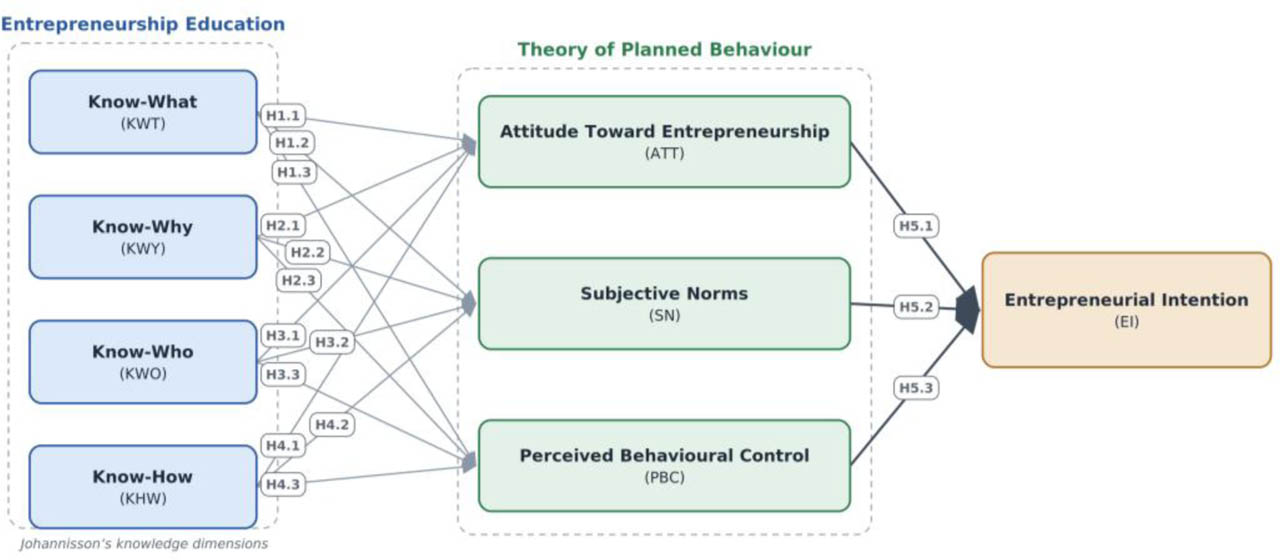
Figure 1.
Conceptual model of the study
Source: own processing
Method
This quantitative study used partial least squares structural equation modeling (PLS-SEM) to test the proposed relationships.
Sampling and data collection
The target population comprised students who had participated in entrepreneurship education programs offered by university incubators across Algeria. Convenience sampling was used to recruit undergraduate, master’s, and doctoral students from different academic disciplines and regions. We collected 404 questionnaires and retained 316 after excluding responses with missing or inconsistent data.
Measurement scales
All constructs were modeled reflectively and measured on a seven-point Likert scale ranging from “strongly disagree” to “strongly agree.” Based on Sun et al.’s (2017) adaptation of Johannisson’s (1991) framework, five items measured each dimension of entrepreneurship education. Attitude, subjective norms, perceived behavioral control, and entrepreneurial intention were measured using the scales of Ajzen (1991) and Liñán and Chen (2009), as detailed in Table 1. The questionnaire also collected sociodemographic information. Participation was voluntary, informed consent was obtained, and anonymity and confidentiality were assured.
Table 1.
Measurement scales
| Construct (code) | Block | Items | Scale |
|---|---|---|---|
| Know-What (KWT) | Entrepreneurship Education | 5 | 1–7 Likert |
| Know-Why (KWY) | Entrepreneurship Education | 5 | 1–7 Likert |
| Know-Who (KWO) | Entrepreneurship Education | 5 | 1–7 Likert |
| Know-How (KHW) | Entrepreneurship Education | 5 | 1–7 Likert |
| Attitude (ATT) | TPB | 5 | 1–7 Likert |
| Subjective Norms (SN) | TPB | 7 | 1–7 Likert |
| Perceived Behavioral Control | TPB | 8 | 1–7 Likert |
| Entrepreneurial Intention (EI) | TPB | 6 | 1–7 Likert |
Data analysis strategy
SmartPLS 4.1.1.8 was used to estimate the eight-construct, fifteen-path model. Following the standard two-step procedure, we first assessed indicator reliability, internal consistency, convergent validity, and discriminant validity. The structural model was then evaluated using VIF, R2, f2, and path coefficients. Statistical significance was assessed through bootstrapping with 5,000 subsamples.
Results
Sample characteristics
A total of 316 respondents participated in the study. As shown in Table 2, the sample consisted predominantly of women (62.7%) and respondents aged 15–24 years (72.8%). Most participants were single (91.5%). Regarding educational level, most were second-year master’s students (M2) (63.3%), followed by third-year bachelor’s (L3) students (18.7%).
Table 2.
Demographic profile of respondents (n = 316)
| Variable | Category | N | % |
|---|---|---|---|
| Gender | Male | 118 | 37.3 |
| Female | 198 | 62.7 | |
| Age | 15–24 years | 230 | 72.8 |
| 25–39 years | 77 | 24.4 | |
| 40–55 years | 8 | 2.5 | |
| Over 55 years | 1 | 0.3 | |
| Marital status | Single | 289 | 91.5 |
| Married | 25 | 7.9 | |
| Divorced/Separated | 2 | 0.6 | |
| Widowed | 0 | 0.0 | |
| Academic level | First-year Bachelor’s (L1) | 4 | 1.3 |
| Second-year Bachelor’s (L2) | 21 | 6.6 | |
| Third-year Bachelor’s (L3) | 59 | 18.7 | |
| First-year Master’s (M1) | 27 | 8.5 | |
| Second-year Master’s (M2) | 200 | 63.3 | |
| PhD candidate | 5 | 1.6 | |
| Field of study | Economics, Business and Management | 129 | 40.8 |
| Technology | 63 | 19.9 | |
| Natural and Life/Earth Sciences | 31 | 9.8 | |
| Humanities and Social Sciences | 28 | 8.9 | |
| Sciences | 22 | 7.0 | |
| Language and Literature | 18 | 5.7 | |
| Law and Political Science | 14 | 4.4 | |
| Medicine | 11 | 3.5 | |
| Total | 316 | 100.0 | |
In terms of field of study, the largest proportion of respondents came from Economics, Business and Management (40.8%), followed by Technology (19.9%). The remaining participants were distributed across Natural and Life/Earth Sciences (9.8%), Humanities and Social Sciences (8.9%), Sciences (7.0%), Language and Literature (5.7%), Law and Political Science (4.4%), and Medicine (3.5%).
Evaluation of the measurement model
Outer loadings
Indicator reliability was assessed using outer loadings. The initial results showed that ten items—ATT5, EI6, PBC5–PBC8, and SN4–SN7—had loadings below the recommended threshold of 0.70. The negatively worded items showed particularly low loadings. After removing these items, all retained indicators had loadings above 0.70, ranging from 0.704 to 0.910 (Table 3).
Table 3.
Outer loadings of the retained indicators
| Construct | Indicator | Outer loading |
|---|---|---|
| Attitude (ATT) | ATT1 | 0.859 |
| ATT2 | 0.904 | |
| ATT3 | 0.891 | |
| ATT4 | 0.704 | |
| Entrepreneurial Intention (EI) | EI1 | 0.832 |
| EI2 | 0.898 | |
| EI3 | 0.871 | |
| EI4 | 0.856 | |
| EI5 | 0.829 | |
| Know-What (KWT) | KWT1 | 0.809 |
| KWT2 | 0.880 | |
| KWT3 | 0.802 | |
| KWT4 | 0.856 | |
| KWT5 | 0.804 | |
| Know-Why (KWY) | KWY1 | 0.800 |
| KWY2 | 0.820 | |
| KWY3 | 0.809 | |
| KWY4 | 0.847 | |
| KWY5 | 0.856 | |
| Know-Who (KWO) | KWO1 | 0.825 |
| KWO2 | 0.860 | |
| KWO3 | 0.848 | |
| KWO4 | 0.780 | |
| KWO5 | 0.816 | |
| Know-How (KHW) | KHW1 | 0.852 |
| KHW2 | 0.889 | |
| KHW3 | 0.856 | |
| KHW4 | 0.812 | |
| KHW5 | 0.831 | |
| Perceived Behavioral Control (PBC) | PBC1 | 0.766 |
| PBC2 | 0.881 | |
| PBC3 | 0.883 | |
| PBC4 | 0.735 | |
| Subjective Norms (SN) | SN1 | 0.888 |
| SN2 | 0.899 | |
| SN3 | 0.910 |
Internal consistency and convergent validity
All constructs demonstrated satisfactory internal consistency, with Cronbach’s alpha values ranging from 0.838 to 0.910 and composite reliability values from 0.890 to 0.933. Convergent validity was also established, as AVE values ranged from 0.670 to 0.809 and therefore exceeded 0.50 (Fornell & Larcker, 1981) (Table 4).
Discriminant validity
Discriminant validity was assessed using the Fornell–Larcker criterion and the heterotrait–monotrait ratio of correlations (HTMT). The square root of each construct’s AVE exceeded its correlations with the other constructs (Table 5), and all HTMT values were below 0.85, with a maximum of 0.799 (Table 6). Discriminant validity was therefore established.
Structural model evaluation
VIF values ranged from 1.26 to 2.69, below the recommended threshold of 3.3, indicating no multicollinearity concerns (Table 7).
Table 7.
Collinearity of the internal model (VIF)
| Path | VIF | Path | VIF |
|---|---|---|---|
| KHW → ATT | 2.307 | KWY → ATT | 2.688 |
| KHW → PBC | 2.307 | KWY → PBC | 2.688 |
| KHW → SN | 2.307 | KWY → SN | 2.688 |
| KWT → ATT | 2.418 | ATT → EI | 1.543 |
| KWT → PBC | 2.418 | PBC → EI | 1.470 |
| KWT → SN | 2.418 | SN → EI | 1.259 |
| KWO → ATT/PBC/SN | 2.319 |
Coefficient of determination (R2) and effect size (f2)
The model explained 58.2% of the variance in entrepreneurial intention, 51.9% in attitude, 26.1% in perceived behavioral control, and 21.0% in subjective norms; these values were acceptable according to Hair et al. (2017) (Table 8). Using Cohen’s (1988) criteria, attitude had a large effect on entrepreneurial intention (f2 = 0.414), followed by perceived behavioral control (f2 = 0.124) and subjective norms (f2 = 0.024). Among the education dimensions, Know-Why had the largest effect on attitude (f2 = 0.112). In contrast, Know-How’s effects on attitude and perceived behavioral control and Know-Who’s effect on subjective norms were smaller. Know-What had negligible effects on all three antecedents (f2 ≤ 0.007) (Table 9).
Path coefficients and hypothesis tests
Bootstrapping with 5,000 subsamples showed that Know-Why positively influenced attitude (β = 0.380, p < 0.001) and perceived behavioral control (β = 0.227, p = 0.013). Similarly, Know-How positively influenced attitude (β = 0.328, p < 0.001) and perceived behavioral control (β = 0.309, p < 0.001). Know-Who positively influenced subjective norms (β = 0.369, p < 0.001) and attitude (β = 0.177, p = 0.008). Know-What had no significant effect on any antecedent; neither Know-Why nor Know-How significantly influenced subjective norms and Know-Who did not significantly influence perceived behavioral control.
All three TPB antecedents significantly influenced entrepreneurial intention. Attitude was the strongest predictor (β = 0.516, p < 0.001), followed by perceived behavioral control (β = 0.276, p < 0.001) and subjective norms (β = 0.113, p = 0.008) (Table 10).
Table 10.
Direct path coefficients (bootstrapping, 5,000 subsamples)
| Path | β (O) | Sample mean | Standard deviation | T statistics | p | 95% CI |
|---|---|---|---|---|---|---|
| ATT → EI | 0.516 | 0.519 | 0.052 | 9.878 | 0.000 | [0.418, 0.622] |
| PBC → EI | 0.276 | 0.274 | 0.053 | 5.229 | 0.000 | [0.167, 0.375] |
| SN → EI | 0.113 | 0.112 | 0.042 | 2.663 | 0.008 | [0.027, 0.196] |
| KWT → ATT | −0.090 | −0.088 | 0.068 | 1.321 | 0.186 | [−0.223, 0.042] |
| KWT → PBC | −0.055 | −0.053 | 0.083 | 0.654 | 0.513 | [−0.214, 0.112] |
| KWT → SN | −0.023 | −0.018 | 0.084 | 0.270 | 0.787 | [−0.181, 0.147] |
| KWY → ATT | 0.380 | 0.379 | 0.075 | 5.086 | <0.001 | [0.227, 0.525] |
| KWY → PBC | 0.227 | 0.227 | 0.092 | 2.480 | 0.013 | [0.044, 0.402] |
| KWY → SN | 0.156 | 0.151 | 0.104 | 1.494 | 0.135 | [−0.056, 0.348] |
| KWO → ATT | 0.177 | 0.179 | 0.067 | 2.644 | 0.008 | [0.052, 0.313] |
| KWO → PBC | 0.080 | 0.081 | 0.083 | 0.957 | 0.339 | [−0.083, 0.246] |
| KWO → SN | 0.369 | 0.373 | 0.089 | 4.127 | <0.001 | [0.201, 0.547] |
| KHW → ATT | 0.328 | 0.328 | 0.065 | 5.072 | <0.001 | [0.199, 0.456] |
| KHW → PBC | 0.309 | 0.308 | 0.074 | 4.165 | <0.001 | [0.167, 0.453] |
| KHW → SN | −0.027 | −0.031 | 0.089 | 0.304 | 0.761 | [−0.199, 0.143] |
Discussion
The findings confirm the relevance of the Theory of Planned Behavior (TPB) for explaining students’ entrepreneurial intention in Algeria. Consistent with previous research (Morched et al., 2021), attitude was the strongest predictor, followed by perceived behavioral control, while subjective norms had a weaker effect. By integrating the TPB with Johannisson’s model, this study shows that the dimensions of entrepreneurship education operate through distinct psychological mechanisms rather than exerting a uniform influence.
Know-Why had the strongest effect on attitude, suggesting that entrepreneurship becomes more attractive when students connect autonomy with personal fulfillment and success. This interpretation is consistent with self-determination theory (Ryan & Deci, 2000) and research showing that entrepreneurship education strengthens entrepreneurial desirability before intention develops (Subhadrammal et al., 2023; Yousaf et al., 2021). Know-How also strengthened attitude by allowing students to experience entrepreneurship through projects, simulations, and other practical activities (Khezzar, 2025; Nayak et al., 2024; Yang et al., 2021). Know-Who contributed more modestly by enhancing the visibility and legitimacy of entrepreneurial careers through contact with mentors, entrepreneurs, and peers (Amofah & Saladrigues, 2022; Nessel et al., 2024).
Perceived behavioral control was influenced primarily by Know-How, indicating that entrepreneurial feasibility is grounded largely in practical experience. Project management, decision-making, and problem-solving activities help students feel better prepared to act entrepreneurially (Nayak et al., 2024; Yang et al., 2021). Know-Why also strengthened perceived behavioral control, suggesting that motivation can enhance both entrepreneurial desirability and confidence in one’s capabilities (Al-Jubari, 2019; Karimi, 2020).
The nonsignificant paths further clarify these distinct mechanisms. Know-Why and Know-How did not influence subjective norms, suggesting that motivation and practical competence function primarily as individual resources and do not necessarily alter perceived social approval. In contrast, Know-Who directly strengthened subjective norms, consistent with the view that networks and mentorship make social support more visible. However, Know-Who did not influence perceived behavioral control, suggesting that access to contacts alone may not increase perceived capability unless it provides actionable resources or direct entrepreneurial experience. These findings distinguish relational exposure from the practical support required to strengthen perceived control. Know-What had no significant effect on any TPB antecedent. Declarative knowledge alone therefore appears insufficient to make entrepreneurship more attractive, socially acceptable, or feasible, consistent with evidence of weak or nonsignificant effects of content-based instruction (Amofah & Saladrigues, 2022; Wibowo & Khan, 2024). In Algeria, theoretical knowledge may remain too abstract when it is not combined with mentoring, prototyping, practical experience, or networking opportunities.
Overall, effective entrepreneurship education appears to depend less on the amount of knowledge transmitted than on integrated learning experiences combining motivation, practice, and social interaction. Johannisson’s multidimensional perspective thus extends the TPB by explaining how different educational dimensions shape the motivational, capability-related, and social foundations of entrepreneurial intention.
Conclusions
This study examined how the different dimensions of entrepreneurship education are associated with entrepreneurial intention among university students in Algeria by integrating Johannisson’s framework with the Theory of Planned Behavior. The findings show that entrepreneurship education should not be conceptualized as a unidimensional construct, since its dimensions are associated differently with the antecedents of entrepreneurial intention. More specifically, “Know-Why” and “Know-How” were positively associated with attitude and perceived behavioral control, whereas “Know-Who” was positively associated with attitude and subjective norms. By contrast, “Know-What” was not significantly associated with any of the three antecedents. Attitude emerged as the strongest predictor of entrepreneurial intention, followed by perceived behavioral control, while subjective norms had a weaker but significant association with intention.
These findings suggest that declarative knowledge alone is insufficient to foster favorable attitudes toward entrepreneurship, perceived entrepreneurial capability, or social approval. In the Algerian context, entrepreneurship education should therefore extend beyond knowledge transfer to foster student motivation, hands-on learning, and meaningful interactions with entrepreneurial actors.
Overall, the study offers theoretical, research, and societal implications, together with managerial and educational recommendations for designing more effective entrepreneurship education programs and strengthening their contribution to entrepreneurial intention.
Theoretical implications
Integrating Johannisson’s framework with the TPB provides a differentiated explanation of how entrepreneurship education relates to entrepreneurial intention by linking motivational, practical, and relational learning to distinct psychological mechanisms. This multidimensional perspective moves beyond treating entrepreneurship education as a uniform construct. It distinguishes declarative knowledge from the formation of entrepreneurial beliefs, as factual knowledge alone did not explain the TPB antecedents. The role of “Know-Who” further highlights the relational foundations of social approval. Evidence from Algerian university incubators also extends the combined framework to this specific institutional context.
Research implications
Future research should use longitudinal designs to determine whether entrepreneurial intentions translate into actual business creation. Comparisons across Algerian universities, countries, academic disciplines, and educational settings could clarify the influence of institutional context and the generalizability of the findings. Multilevel studies should examine how individual, educational, and institutional factors interact. Further research should also compare entrepreneurship education programs and test additional moderators and mediating mechanisms, including family background, access to finance, field of study, and institutional support.
Societal implications
The societal contribution of entrepreneurship education extends beyond business creation. Graduates entering salaried employment may use their initiative and the practical skills developed through entrepreneurship education to improve products, services, and work processes and to address organizational problems. These competencies may therefore contribute to employability, intrapreneurship, innovation, and self-employment. Stronger relationships among universities, entrepreneurs, businesses, and support institutions may also reinforce universities’ third mission and contribute to regional development. Policymakers can support these outcomes by improving access to finance, markets, infrastructure, and institutional support. They can also strengthen coordination within entrepreneurial ecosystems.
Managerial and educational implications
University administrators and incubator managers should allocate financial, human, and organizational resources across theoretical instruction, motivational development, practical learning, mentoring, and networking. They should recruit trainers who can support student projects, match mentors to students’ needs, establish lasting partnerships with entrepreneurs, alumni, businesses, and support organizations, and coordinate contributors across program stages. Regular feedback from students and partners should guide program delivery and resource allocation.
Educators and curriculum designers should align pedagogy with each learning dimension: “Know-Why” with motivation, autonomy, and aspirations; “Know-How” with projects, simulations, prototyping, and problem-solving; and “Know-Who” with interactions involving mentors, entrepreneurs, peers, and professional partners. “Know-What” should be retained but embedded in concrete legal, financial, marketing, and intellectual property decisions. Field observation, user interaction, and experimentation should support opportunity discovery, while theoretical tools should guide feasibility assessment, business-model development, and opportunity exploitation.
Limitations
This study has three limitations. It measures entrepreneurial intention rather than actual behavior; self-reported data may be affected by social desirability and common method bias; and convenience sampling, gender imbalance, and disciplinary variation limit the generalizability of the findings.