
Introduction
Social entrepreneurship reflects an endeavor of diverse forms consisting of business entities, nonprofit sectors, and governmental organizations that embrace action for crafting social value and are involved in innovative accomplishments, aligning with social needs and objectives (Austin et al., 2012). Managerial dynamics essentially play a tremendous role in bridging and transforming business ventures’ operational doctrine, shifting from mere profit to addressing social problems through organizational sustainability and, consequently, spreading the spark of benefits in society (Alvord et al., 2004). Social entrepreneurship cultivates social prosperity, eradicating social problems of poverty, improving the standard of living and well-being, eliminating social injustice, and preventing environmental degradation (Bansal et al., 2019; Seelos & Mair, 2005).
Moreover, social entrepreneurs, beyond their economic performance, engage in adequate dissemination of economic benefit to the social reform process, are involved in development programs, empower society, and preserve properties of cultural heritages, ultimately addressing social disparity and playing a vital role in uplifting social status (Korsgaard & Anderson, 2011; Monaco et al., 2026). Thus, the socially oriented doctrine of entrepreneurship and its pragmatic enactment became increasingly pivotal, which emphasizes the mitigation of social issues and fosters creativity, driving towards broader social entrepreneurial practices (Bruder, 2021; Klarin & Suseno, 2023; Passarelli et al., 2025).
Additionally, socially oriented ventures contribute to the optimum utilization of novel resources and are involved in the experimentation of unique approaches to social innovations while diagnosing social and existing economic and environmental constraints (Falcone et al., 2018; Hillman et al., 2018; Lashitew & Rosca, 2025). Therefore, it concentrates on profit with economic opportunity comprising a segment of social benefits (Nicholls, 2010) and is revealed as an important means to empower isolated and economically marginalized society (Young, 2006). Ultimately, it stands as the driver of social welfare and shifting norms, behavioral dimensions, and structure to enhance social well-being (Hietschold et al., 2023; Kruse et al., 2024; Raman et al., 2025).
Next, the exploration of social entrepreneurship through bibliometric analysis portrays the magnitude of investigation in the study themes that support architecting the existing scenario of the experiment and depicts the trajectory and future path for the research with quantitative analysis of scientific publications reflecting the managerial dynamics of social entrepreneurship in the knowledge economy, mapping the research landscape (Baraibar-Diez et al., 2020; Song et al., 2023). Therefore, the bibliometric study synthesizes the distinct forms of evidence and contributes to its structuring, depicting the vital role of managerial dynamics for social entrepreneurship, which extends a perpetual foundation in the knowledge economy. Similarly, bibliometric analysis, as a widely adopted method to discover and analyze numerous scientific datasets, enables understanding of the evolution of the social entrepreneurship theme, which establishes a reliable foundation in tracking the research direction (Donthu et al., 2021). However, several previous studies on the social entrepreneurship theme present heterogeneous outcomes and lack a clear foundation of a conceptual framework, with no consensus on their conclusion (Rey-Martí et al., 2016; Yernazarova & Spanov, 2025).
Therefore, this research attempts to analyze the social entrepreneurship field of study, which covers the time frame from 2001 to 2025, by accumulating the Scopus dataset to address the existing research gap. Moreover, this study aims to address the research questions: What is the research trend in the social entrepreneurship field? What are the prolific authors contributing to the research field? Which countries and affiliations mostly contributed to the research domain? What are highly impactful scientific papers and relevant sources? What are the most frequently occurring terms in the study domain? What are the most evolving themes in the study areas? Additionally, this research attempts to discover the scenario of the key term ‘social entrepreneurship’ with Scopus dataset analyses of twenty-five years of information through bibliometric analysis, which discovers the trajectory of the research using R, Biblioshiny, and VOSviewer software to develop the understanding of scientific publication and evolution of the themes.
This research paper is clustered into four subsequent sections. The first segment encompasses a literature review, which reveals the theoretical foundation of the research. The second part of this study comprises methods, data collection procedures, and the methodological part. Similarly, the third part of this research involves result clusters that exhibit the publication direction and trends in the areas of themes. Additionally, the sections on discussion, conclusion, implications, limitations, and future directions are included in the next part of this research work.
Literature review
Social entrepreneurship is considered an emerging model of business that integrates business objectives and social goals, crafting social values through innovative venture practices (Witkamp et al., 2011). Moreover, the concept of social entrepreneurship was embraced in European countries and the United States in the 1990s and gradually evolved as a sub-element of the entrepreneurship theme, which fundamentally integrates social aims to address social problems through innovative diagnosis methods (Lopes-Jr et al., 2026). Moreover, the term “social entrepreneurship” is used in several academic disciplines, comprising organizational theory, sociology, and studies of entrepreneurship, which focus on a multidisciplinary approach and embrace its concept from several sources (Kamaludin et al., 2024). Social entrepreneurship is fundamentally driven by a mission related to society and requires an innovative solution to meet the social objectives while struggling with constrained resources. The major components of social entrepreneurship contribute to confining the concept in a constructive path through accountability and social innovation that aligns with the value creation of society and empowers it to commence social enterprises (Dickel & Eckardt, 2021; Graikioti et al., 2022). Moreover, the behavioral decision theory explains that the decision-making process is determined by external and internal perceptions, which affect the way enterprises exist in society and navigate problems and challenges while promoting economic prosperity and supporting society (Surdu et al., 2021).
Research methods
Data collection
The research on social entrepreneurship areas was analyzed, embracing a total of 287 Scopus-based data sources that represent the study time from 2001 to 2025. This study involved the Scopus dataset, as this data reflects more reliability with a wide coverage of scientific manuscripts and offers clean data (Baas et al., 2020). The data selection criteria are based on the theme areas that represent “social entrepreneurship” as the main field that integrates other key terms with “social entrepreneurship” OR “social innovation” OR “social enterprise” OR “innovation management” OR “social entrepreneur” OR “entrepreneurial intention” OR “entrepreneurial education” OR “small business” as a base for data filtration. Moreover, ‘business, management, and accounting’ were the main subject areas. Data incorporated for the analysis was based on the article type of document with the final publication stage and published manuscript-based data only in the English language, including the journal source.
Methodology
The analysis of the Scopus data on the social entrepreneurship theme was conducted using main information through descriptive statistics, production of scientific papers in annuals, mean citation scores, plots representing three fields, nations with higher contributions with a larger number of publications, prolific authors with significant publications, sources with relevancy, and Bradford’s law. Similarly, the globally cited documents, locally cited papers, affiliations of relevancy, impact status of the sources through H-index, countries with significant production, and most cited countries were included in the analysis. Moreover, it encompassed the countries of the corresponding author, topics with trending sectors, words occurring most frequently, a map of thematic patterns, co-occurrence, authors' bibliographic coupling, and coupling of states, which were analyzed in this study. Further, data analysis embraced R biblioshiny software (Aria & Cuccurullo, 2017). Additionally, this analysis utilized the VOSviewer software for the analysis of the network of authors, countries, and occurrences of the key terms in the study areas.
Figure 1 depicts the search strategy of the Scopus dataset for the bibliometric analysis of social entrepreneurship. The initially collected data were filtered based on the subject area “Business, Management and Accounting”; time frame; types of documents, including articles; keywords; stage of publication; publication in the English language; and sources from the journal. Similarly, the data covers the time frame from 2001 to 2025. The keywords comprise “innovation,” “entrepreneurship,” “social entrepreneurship,” “social innovation,” “social enterprise,” “innovation management,” “social entrepreneur,” “entrepreneurial intention,” “entrepreneurial education,” and “small business.”
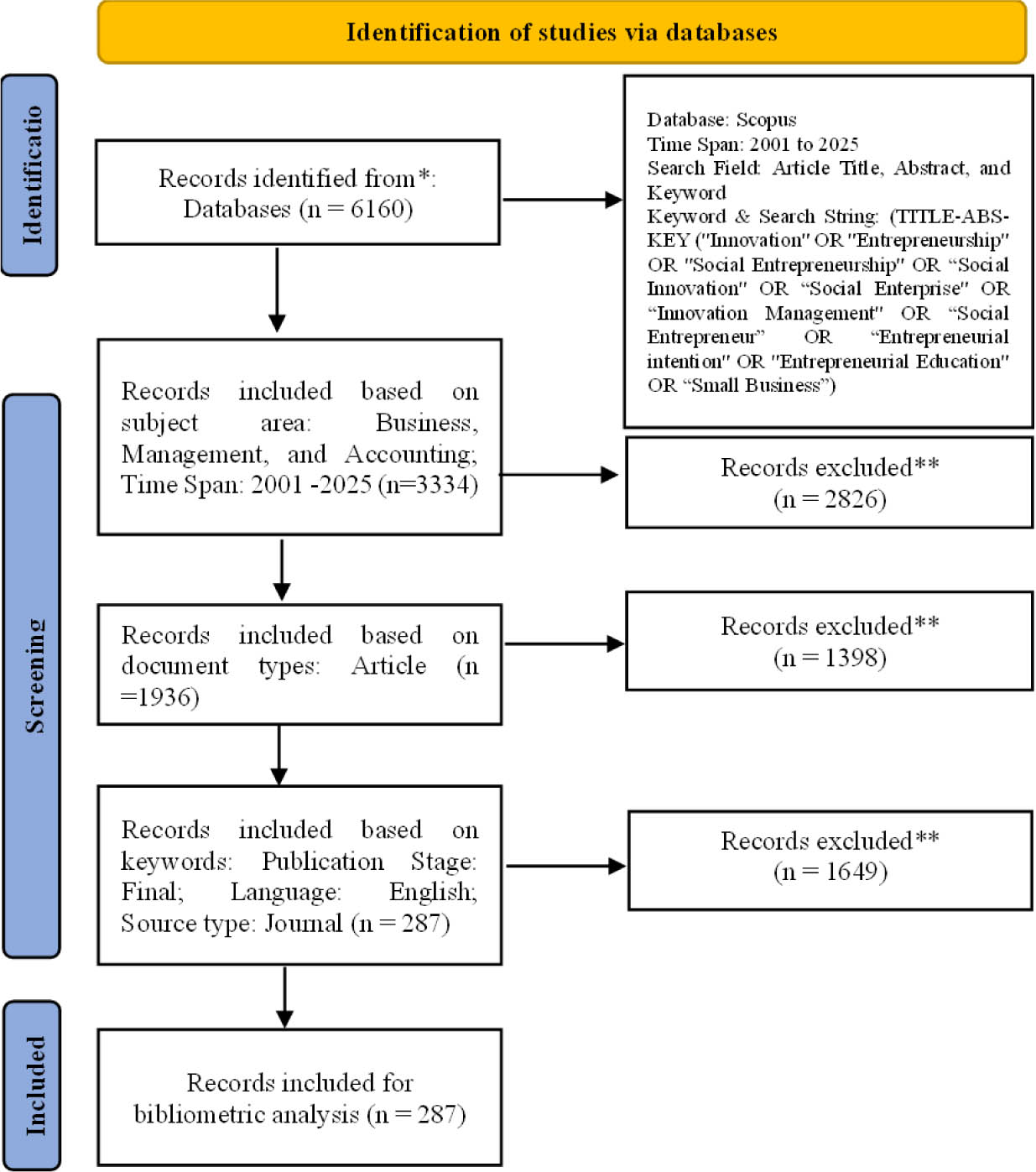
Figure 1.
Search strategy
Source: own processing
Results
The results section of this manuscript presents the output computed through RBiblioshiny and VOSviewer to scan the trajectory of social entrepreneurship research during the study period. Table 1 below exhibits the descriptive statistics, which comprise information on documents, sources, annual growth of the publication, key terms that occurred during the study period, information on research scholars involved in the investigation, and types of documents utilized for the analysis in the theme areas.
Table 1.
Descriptive statistics
| Description | Results |
|---|---|
| MAIN INFORMATION ABOUT DATA | |
| Timespan | 2001:2025 |
| Sources (Journals, Books, etc.) | 132 |
| Documents | 287 |
| Annual Growth Rate (%) | 12.53 |
| Document Average Age | 7.06 |
| Average citations per document | 54.03 |
| References | 2174 |
| DOCUMENT CONTENTS | |
| Keywords Plus (ID) | 533 |
| Author's Keywords (DE) | 849 |
| AUTHORS | |
| Authors | 558 |
| Authors of single-authored documents | 21 |
| AUTHORS' COLLABORATION | |
| Single-authored documents | 33 |
| Co-authors per document | 2.99 |
| International co-authorships (%) | 39.72 |
| DOCUMENT TYPES | |
| Article | 287 |
Table 1 shows the descriptive statistics. The social entrepreneurship research includes the Scopus dataset of 287 in total, which covers the time frame from 2001 to 2025. Similarly, it depicts the annual growth rate as 12.53%, with an average age of scientific documents at 7.06 years and an average citation rate of 54.03 per article, which totals 2,174 references for all documents. Moreover, the content of the document consists of keywords plus 533, with contributor keywords 849. The total number of scholars involved in the investigation is 558, of whom 21 are authors of single-authored documents. Moreover, the number of single-authored documents is 33; co-authors per document average 2.99; and international co-authorship is 39.72 percent.
Annual scientific production
The annual scientific production encompasses the yearly published research papers in the theme areas of ‘social entrepreneurship.' The time frame revealed in the study depicts from 2001 to 2025. Figure 2 below represents the output on annual scientific production, which reveals an escalation of scientific manuscripts, especially during 2010 to 2025. The publication trajectory in other periods depicts fluctuations in the number of research paper productions.
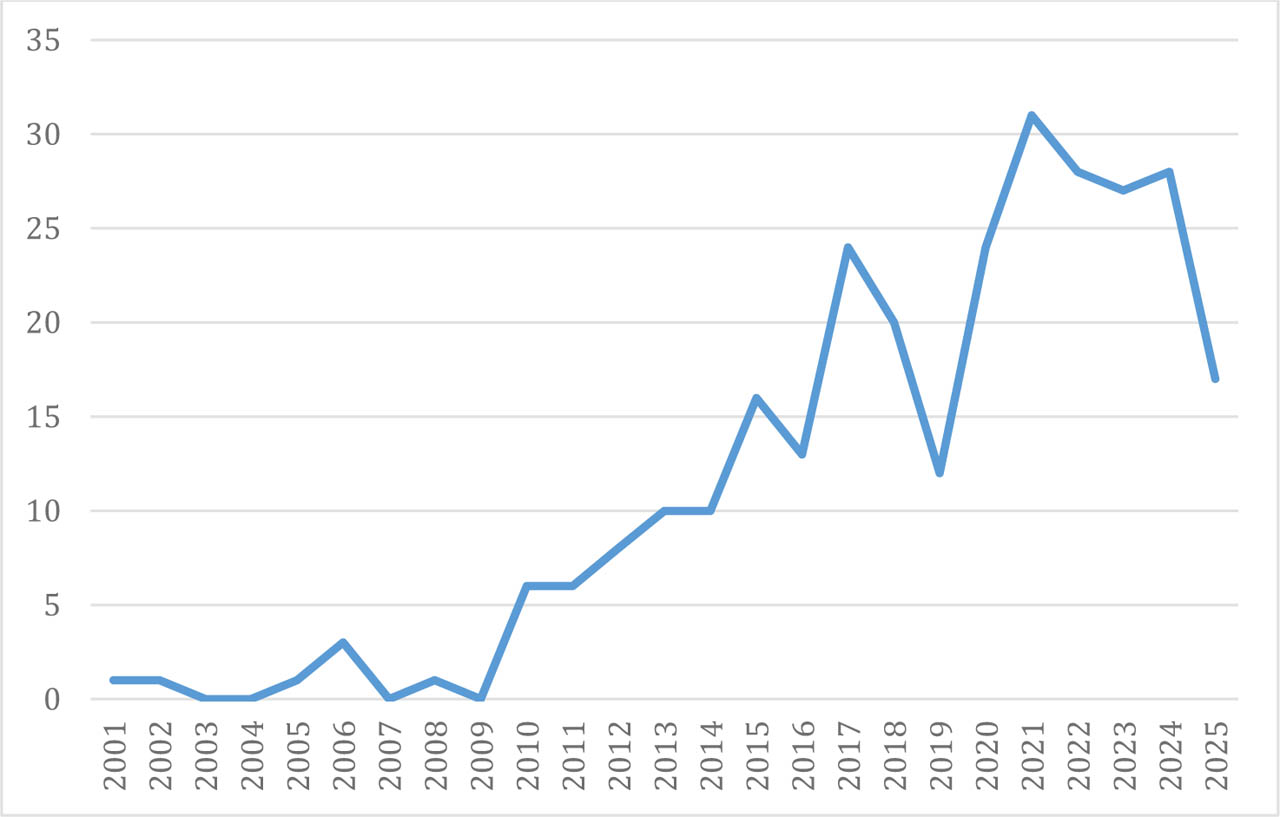
Figure 2.
Annual scientific production
Source: own processing
Figure 2 shows annual scientific production. The research trends in the field of “social entrepreneurship” cover the period from 2001 to 2025. Scientific production in the initial stage of the study demonstrates a lower number, starting with one article in 2001. However, the publication of research papers rose from 2010 with six articles and reached ten scientific documents in the years 2013 and 2014. Moreover, the production of articles remained at sixteen in 2015. The production rose to 24 papers in the year 2017 and moved to a rise with fluctuation, which shows the highest publication in 2022 and 2024 compared to other years' publications.
Table 2 represents the average citation per year. This result includes the citation status from 2001 to 2025. The total citation score per article, on average, remained highest in 2006 with 264 citations, followed by a score of 253 citations in 2005. Similarly, the average citation in the year-based citation score is highest in the year 2019, with a 23.03 average citation score, followed by a 12.57 mean citation score in 2006. Thus, the citation trends show fluctuations in direction throughout the study period.
Table 2.
Average citation per year
| Year | Mean TC per Article | N | Mean TC per Year | Citable Years |
|---|---|---|---|---|
| 2001 | 83.00 | 1 | 3.19 | 26 |
| 2002 | 40.00 | 1 | 1.60 | 25 |
| 2005 | 253.00 | 1 | 11.50 | 22 |
| 2006 | 264.00 | 3 | 12.57 | 21 |
| 2008 | 63.00 | 1 | 3.32 | 19 |
| 2010 | 68.33 | 6 | 4.02 | 17 |
| 2011 | 197.50 | 6 | 12.34 | 16 |
| 2012 | 105.88 | 8 | 7.06 | 15 |
| 2013 | 84.00 | 10 | 6.00 | 14 |
| 2014 | 113.30 | 10 | 8.72 | 13 |
| 2015 | 37.81 | 16 | 3.15 | 12 |
| 2016 | 80.23 | 13 | 7.29 | 11 |
| 2017 | 58.50 | 24 | 5.85 | 10 |
| 2018 | 53.05 | 20 | 5.89 | 9 |
| 2019 | 184.25 | 12 | 23.03 | 8 |
| 2020 | 23.38 | 24 | 3.34 | 7 |
| 2021 | 38.68 | 31 | 6.45 | 6 |
| 2022 | 36.00 | 28 | 7.20 | 5 |
| 2023 | 16.41 | 27 | 4.10 | 4 |
| 2024 | 9.39 | 28 | 3.13 | 3 |
| 2025 | 3.76 | 17 | 1.88 | 2 |
Three-field plot
The three-field plot mainly integrates three segments of the outcomes. In this result the document sources are the first cluster depicted in the left corner of the graph. All the contributing research scholars remain at the center of the graphic, and major keywords of the study themes are shown in the right vertical form of the following figure 3.
Figure 3 exhibits a three-field plot. This result consists of three dimensions of document sources, research scholars, and main keywords occurring in the theme “social entrepreneurship.” The leading sources include the “Journal of Technology Transfer” and the “International Journal of Entrepreneurial Behaviour and Research.” Similarly, the leading contributors as authors include Ratten V, Audretsch D, and others. Finally, the main key terms are “innovation,” “entrepreneurship,” “social entrepreneurship,” and “social innovation.”
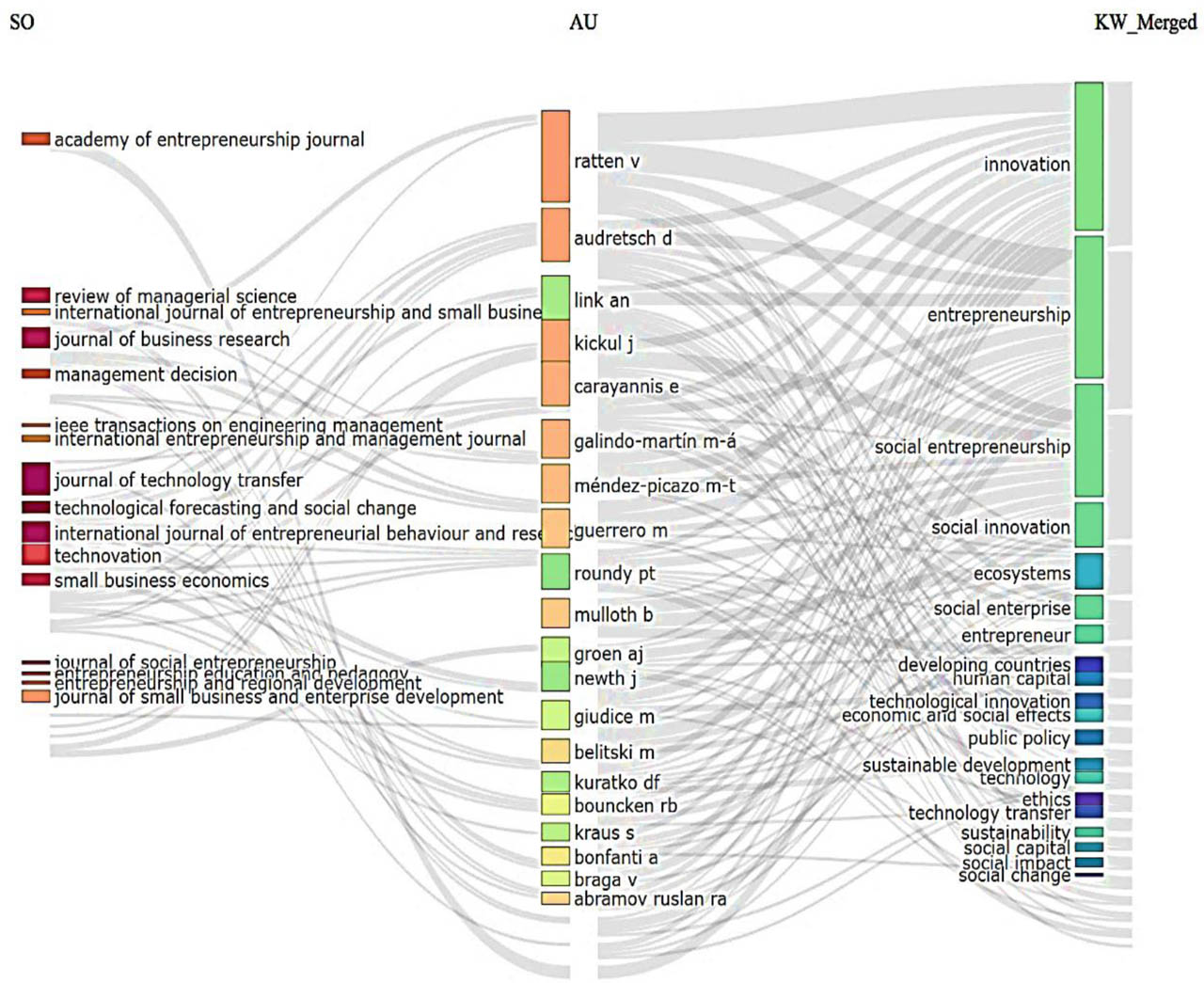
Figure 3.
Three-field plot
Source: own processing
Most relevant sources
These results on relevant sources comprise the leading sources that published in the field of “social entrepreneurship” themes during the investigation time. The sources are ranked in order based on the number of research documents, which contain ten major sources for the theme areas
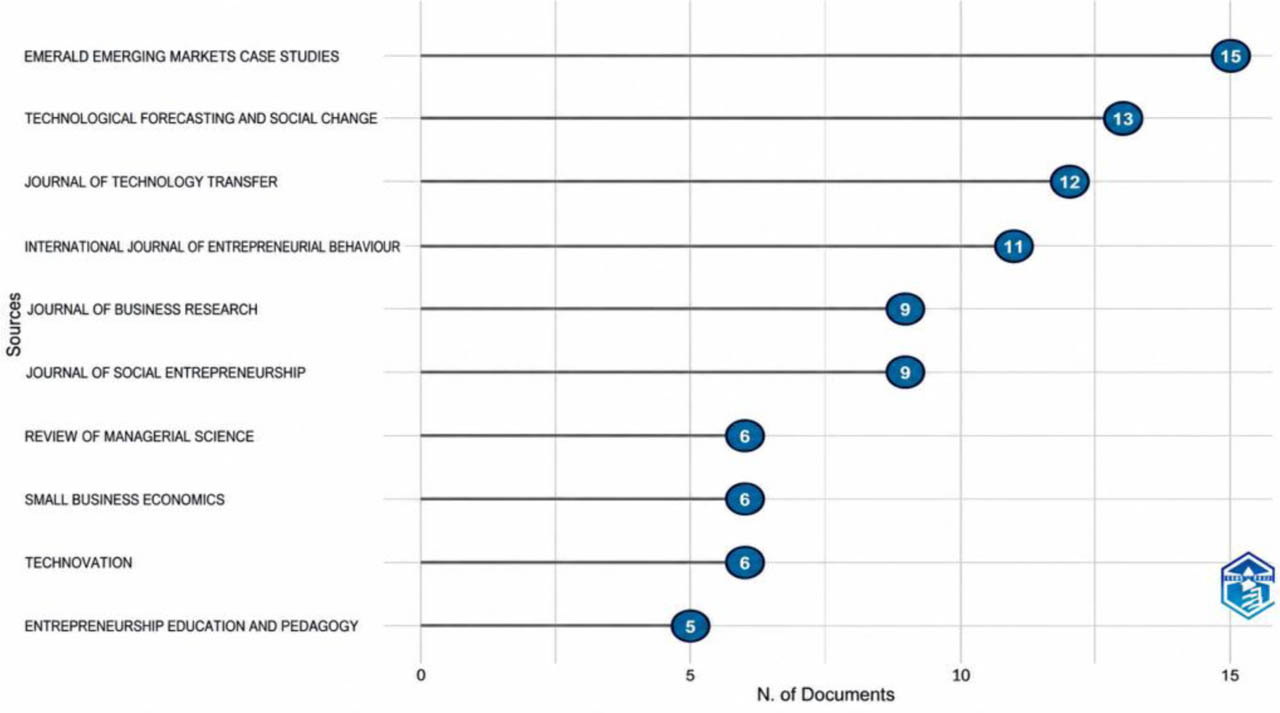
Figure 4.
Most relevant sources
Source: own processing
Figure 4 shows the relevant sources. This segment of the result includes the major ten sources, “Emerald Emerging Markets Case Studies,” in the first rank with fifteen documents, followed by “Technological Forecasting and Social Change,” which depicts 13 research articles. Similarly, “Journal of Technology Transfer” includes 12 papers, which ranks in the third position, and “International Journal of Entrepreneurial Behaviour and Research” remains in the fourth rank with 11 scientific works. Furthermore, “Journal of Business Research" and “Journal of Social Entrepreneurship" depict nine scientific works during the study period. Moreover, “Review of Managerial Science,” “Small Business Economics,” and “Technovation” consist of six documents for each source. Finally, “Entrepreneurship Education and Pedagogy" shows five papers in the research themes.
Table 3 shows the sources’ rank based on Bradford’s law, which comprises ten leading sources producing the academic papers during the investigation time in “social entrepreneurship” areas. The “Emerald Emerging Markets Case Studies” ranks in the first position, integrating fifteen academic works, and “Technological Forecasting and Social Change” follows with thirteen published works that rank in the second position. Additionally, “Journal of Technology Transfer” contains twelve with the third rank, and “International Journal of Entrepreneurial Behaviour and Research” has eleven papers with the fourth rank. Next, “Journal of Business Research”, and “Journal of Social Entrepreneurship” rank fifth and sixth, with nine publications from each source. Similarly, “Review of Managerial Science,” “Small Business Economics,” and “Technovation” reveal six works for each one of the sources ranking in seventh, eighth, and ninth positions. Next, “Entrepreneurship Education and Pedagogy” ranks in the tenth position with five research works.
Table 3.
Core sources by Bradford’s law
| Sources | Frequency | Bradford’s Law | |
|---|---|---|---|
| Rank | Zone | ||
| Emerald Emerging Markets Case Studies | 15 | 1 | Zone 1 |
| Technological Forecasting and Social Change | 13 | 2 | Zone 1 |
| Journal of Technology Transfer | 12 | 3 | Zone 1 |
| International Journal of Entrepreneurial Behaviour and Research | 11 | 4 | Zone 1 |
| Journal of Business Research | 9 | 5 | Zone 1 |
| Journal of Social Entrepreneurship | 9 | 6 | Zone 1 |
| Review of Managerial Science | 6 | 7 | Zone 1 |
| Small Business Economics | 6 | 8 | Zone 1 |
| Technovation | 6 | 9 | Zone 1 |
| Entrepreneurship Education and Pedagogy | 5 | 10 | Zone 1 |
Most relevant authors
The prolific contributors encompass highly published scholars in the “social entrepreneurship” sector from 2001 to 2025. This result involves the ten most prolific authors and their production. Authors are placed in order from the highest-contributing to the lowest-publishing one. The figure below (Figure 5) reveals the profile of scholars and the number of documents.
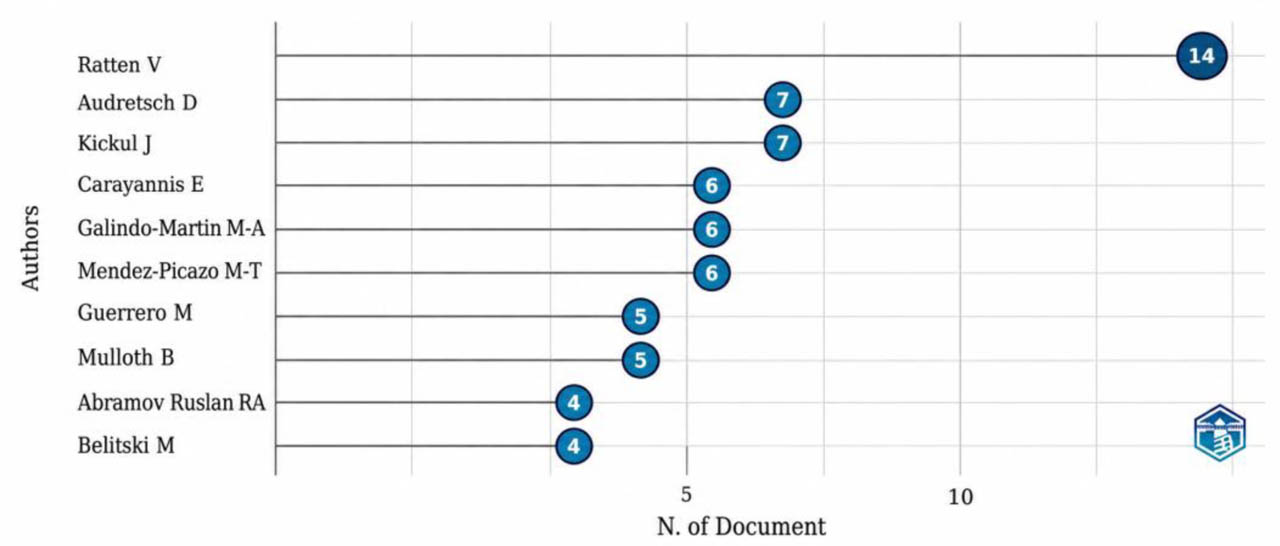
Figure 5.
Most relevant authors
Source: own processing
Figure 5 and Figure 6 show the most prolific authors and production over time. The scholars involved in the production in the “social entrepreneurship” field are placed on the basis of their production. Ratten V ranks first with fourteen publications, followed by Audretsch D and Kickul J with seven documents for each author. Similarly, Carayannis E, Galindo-Martin M-A, and Mendez-Picazo M-T consist of six articles for each contributor. Guerrero M and Mulloth B include five research papers each. Finally, Abramov Ruslan RA and Belitski M include four articles.
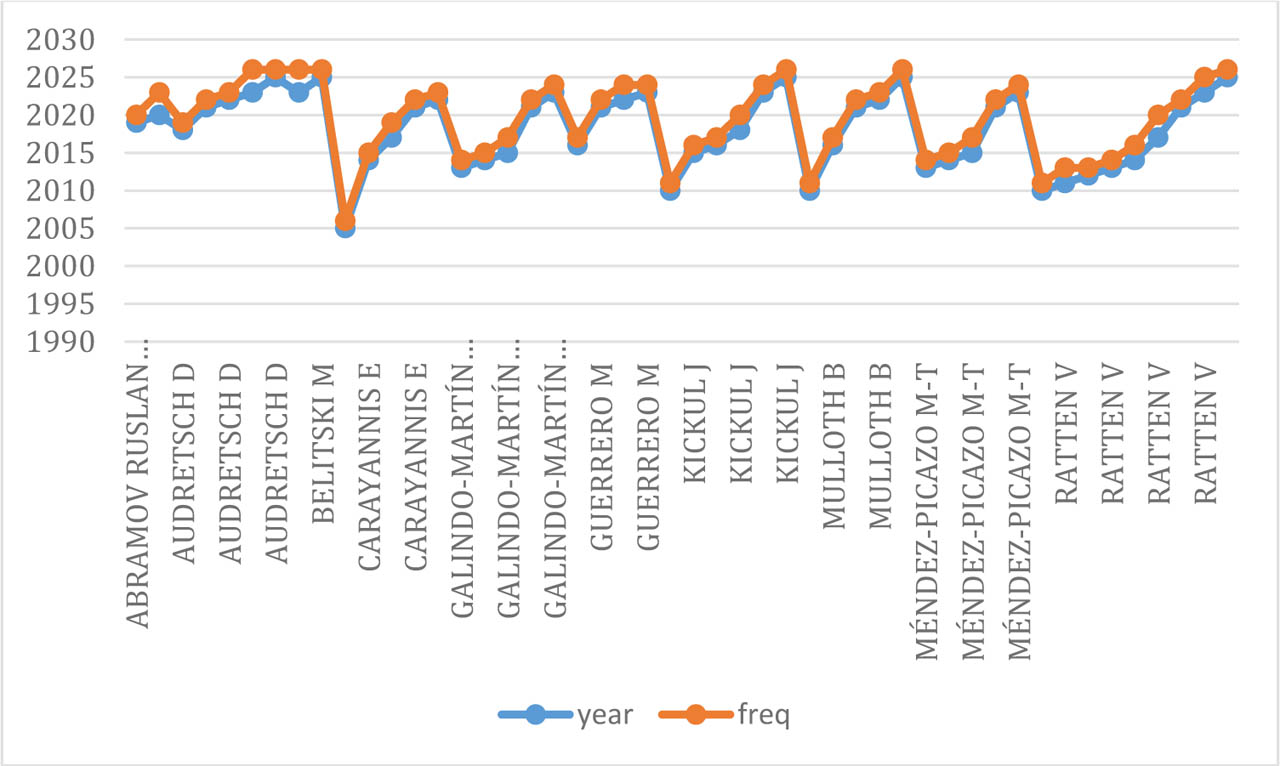
Figure 6.
Authors’ production over time
Source: own processing
Table 4 shows the most globally cited documents. Research work by Nambisan et al. (2019) on “The digital transformation of innovation and entrepreneurship: Progress, challenges and key themes” published in “Research Policy” comprises one thousand eight hundred and fourteen global citations throughout the research period, followed by Dacin et al. (2011) on the work of “Social Entrepreneurship: A Critique and Future Directions” published in “Organization Science” with a 1053 globally cited score. Similarly, the work by Bercovitz and Feldman (2006) on “Entrepreneurial Universities and Technology Transfer: A Conceptual Framework for Understanding Knowledge-Based Economic Development” published in “The Journal of Technology Transfer” shows 637 globally cited statuses; Guerrero et al. (2016) on “Entrepreneurial Universities: Emerging Models in the New Social and Economic Landscape" published in “Small Business Economics” contains 348 globally cited scores; and work by Galindo and Méndez (2014) on “Entrepreneurship, Economic Growth, and Innovation: Are Feedback Effects at Work?" published in “Journal of Business Research” depicts 344 citations at the global level.
Table 4.
Most global cited documents
| Authors | Articles | Citations | Journal |
|---|---|---|---|
| Nambisan et al. (2019) | The digital transformation of innovation and entrepreneurship: Progress, challenges and key themes | 1814 | Research Policy |
| Dacin et al. (2011) | Social Entrepreneurship: A critique and future directions | 1053 | Organization Science |
| Bercovitz and Feldman (2006) | Entpreprenerial universities and technology transfer: A Conceptual framework for understanding knowledge-based economic development | 637 | The Journal of Technology Transfer |
| Guerrero et al. (2016) | Entrepreneurial universities: Emerging models in the new social and economic landscape | 348 | Small Business Economics |
| Galindo and Méndez (2014) | Entrepreneurship, economic growth, and innovation: Are feedback effects at work? | 344 | Journal of Business Research |
| Hall et al. (2012) | Entrepreneurship and innovation at the base of the pyramid: A recipe for inclusive growth or social exclusion? | 334 | Journal of Management Studies |
| Bradley et al. (2012) | Capital is not enough: innovation in developing economies | 282 | Journal of Management Studies |
| Carayannis and Von Zedtwitz (2005) | Architecting gloCal (global–local), real-virtual incubator networks (G-RVINs) as catalysts and accelerators of entrepreneurship in transitioning and developing economies: Lessons learned and best practices from current development and business incubation practices. | 253 | Technovation |
| Scuotto et al. (2017) | The effect of social networking sites and absorptive capacity on SMES’ innovation performance | 247 | The Journal of Technology Transfer, |
| Agnete Alsos et al. (2013) | Gender and innovation: State of the art and a research agenda | 242 | International Journal of Gender and Entrepreneurship |
The paper by Hall et al. (2012) on “Entrepreneurship and Innovation at the Base of the Pyramid: A Recipe for Inclusive Growth or Social Exclusion?” depicted in “Journal of Management Studies” reveals 334 global citation statuses; Bradley et al. (2012) on “Capital Is Not Enough: Innovation in Developing Economies” published in “Journal of Management Studies” reveals a globally cited score of 282; and the publication by Carayannis and Von Zedtwitz (2005) on “Architecting gloCal (global–local), real-virtual incubator networks (G-RVINs) as catalysts and accelerators of entrepreneurship in transitioning and developing economies: Lessons learned and best practices from current development and business incubation practices,” published in “Technovation,” shows a 253 globally cited score. Scuotto et al. (2017), on “The effect of social networking sites and absorptive capacity on SMES’ innovation performance,” published in “The Journal of Technology Transfer,” reveals a 247 citation position at the global level, and work by Agnete Alsos et al. (2013) on “Gender and innovation: State of the art and a research agenda,” published in “International Journal of Gender and Entrepreneurship,” shows 242 global citation scores.
Most local cited documents
Most locally cited documents in these results comprise the highly locally cited authors and the local citation score of their documents. The documents are placed in the ranking from the highest-cited paper to the lowest-cited one. The table below contains the locally cited documents (Table 5).
Table 5.
Most local cited documents
| Authors | Articles | Citations | Journal |
| Bacq et al. (2015) | Bricolage in social entrepreneurship: how creative resource mobilization fosters greater social impact | 7 | The International Journal of Entrepreneurship and Innovation |
| Dacin et al. (2011) | Social entrepreneurship: A critique and future directions | 5 | Organization Science |
| Audretsch et al. (2022) | Emerging needs of social innovators and social innovation ecosystems | 2 | International Entrepreneurship and Management Journal |
| Bhatt and Altinay (2013) | How social capital is leveraged in social innovations under resource constraints?” | 2 | Management Decision |
| Agnete Alsos et al. (2013) | Gender and innovation: State of the art and a research agenda | 2 | International Journal of Gender and Entrepreneurship |
| Adomako and Nguyen (2024) | Responsible entrepreneurship, social innovation, and entrepreneurial performance: Does commitment to SDGs matter? | 1 | Business Strategy and the Environment |
| Bouncken and Kraus (2022) | Entrepreneurial ecosystems in an interconnected world: Emergence, governance and digitalization | 1 | Review of Managerial Science |
| do Adro et al. (2021) | Social entrepreneurship orientation and performance in non-profit organizations | 1 | International Entrepreneurship and Management Journal |
| Bodolica et al. (2021) | Extracurricular activities and social entrepreneurial leadership of graduating youth in universities from the Middle East | 1 | The International Journal of Management Education |
| Baier-Fuentes et al. (2021) | Does triple helix collaboration matter for the early internationalisation of technology-based firms in emerging Economies? | 1 | Technological Forecasting and Social Change |
Table 5 shows the locally cited documents. The publication by Bacq et al. (2015) on “Bricolage in Social Entrepreneurship: How Creative Resource Mobilization Fosters Greater Social Impact,” published in “The International Journal of Entrepreneurship and Innovation,” reflects seven local citation rankings in the first position, followed by Dacin et al. (2011), written on “Social Entrepreneurship: A Critique and Future Directions,” published in “Organization Science”; work by Audretsch et al. (2022) related to “Emerging needs of social innovators and social innovation ecosystems” revealed in “International Entrepreneurship and Management Journal”; and the paper by Bhatt and Altinay (2013) concerned with “How social capital is leveraged in social innovations under resource constraints?” exhibited in “Management Decision,” which contains one locally cited status for each author and document.
Similarly, work by Agnete Alsos et al. (2013) involving “Gender and innovation: State of the art and a research agenda” found on “International Journal of Gender and Entrepreneurship”, production by Adomako and Nguyen (2024) consisting of “Responsible entrepreneurship, social innovation, and entrepreneurial performance: Does commitment to SDGs matter?” appeared on “Business Strategy and the Environment”, research by Bouncken and Kraus (2022) related to “Entrepreneurial ecosystems in an interconnected world: Emergence, governance and digitalization” in the Journal of “Review of Managerial Science”, document by (do Adro et al., 2021) concerning “Social entrepreneurship orientation and performance in non-profit organizations” exhibited in “International Entrepreneurship and Management Journal”, research work by Bodolica et al. (2021) containing “Extracurricular activities and social entrepreneurial leadership of graduating youth in universities from the Middle East” in “The International Journal of Management Education”, and research by Baier-Fuentes et al. (2021) with “Does triple helix collaboration matter for the early internationalisation of technology-based firms in emerging Economies?” in “Technological Forecasting and Social Change” encompass one locally cited score for each scholar, and document during the study period.
Table 6 exhibits the most locally cited reference.
Table 6.
Most locally cited references
| Authors | References | Local citations | Journal |
|---|---|---|---|
| Austin et al. (2012) | Social and commercial entrepreneurship: Same, different, or both? | 53 | Revista de Administração |
| Bacq and Janssen (2011) | Social entrepreneurship: How creative resource mobilization fosters greater social impact | 22 | The International Journal of Entrepreneurship and Innovation |
| Alvord et al. (2004) | Social entrepreneurship and societal transformation: An exploratory study | 20 | The Journal of Applied Behavioral Science |
| Battilana and Lee (2014) | Advancing research on hybrid organizing—insights from the study of social enterprises | 13 | Academy of Management Annals |
| Battilana and Dorado (2010) | Building Sustainable Hybrid Organizations: The Case of Commercial Microfinance Organizations | 13 | Academy of Management Journal |
| Klein et al. (2012) | Strategic Entrepreneurship | 12 | SSRN Electronic Journal |
| Schiederig et al. (2012) | Green innovation in technology and innovation management—an exploratory literature review” in the journal | 11 | R&D Management |
| Baker and Nelson (2005) | Creating Something from Nothing: Resource Construction through Entrepreneurial Bricolage | 10 | Administrative Science Quarterly |
| Bornstein (2004) | How to change the world: Social entrepreneurs and the power of new ideas | 10 | Oxford University Press |
| Gephart (2004) | Qualitative research and the Academy of Management Journal | 8 | Academy of Management Journal |
The investigation in the area of “social entrepreneurship” is involved in these outcomes. The reference work by Austin et al. (2012), with the work on “Social and commercial entrepreneurship: Same, different, or both?” found in “Revista de Administração” demonstrates fifty-three local citations, followed by Bacq and Janssen (2011) on “Bricolage in Social Entrepreneurship: How Creative Resource Mobilization Fosters Greater Social Impact” found in “The International Journal of Entrepreneurship and Innovation,” with 22 local citations. Similarly, research by Alvord et al. (2004) in the reference of “Social Entrepreneurship and Societal Transformation: An Exploratory Study” published in “The Journal of Applied Behavioral Science” depicts a 20 local citation score.
Moreover, the document by Battilana & Lee (2014) titled “Advancing Research on Hybrid Organizing—Insights from the Study of Social Enterprises,” published in “Academy of Management Annals,” and work by Battilana and Dorado (2010) on the title “Building Sustainable Hybrid Organizations: The Case of Commercial Microfinance Organizations,” published in “Academy of Management Journal,” consist of 13 locally cited statuses. Additionally, research work referenced by Klein et al. (2012) on “Strategic Entrepreneurship” found in “SSRN Electronic Journal” represents 12 local citations, and work by Schiederig et al. (2012) on the scientific paper “Green innovation in technology and innovation management—an exploratory literature review” in the journal “R&D Management” reveals 11 locally cited positions. Next, the paper by Baker and Nelson (2005) on “Creating Something from Nothing: Resource Construction through Entrepreneurial Bricolage,” published in “Administrative Science Quarterly,” and work by Bornstein (2004) on “How to change the world: Social entrepreneurs and the power of new ideas,” published in “Oxford University Press,” include ten locally cited statuses for both references. Finally, the research work by Gephart (2004) on “Qualitative research and the Academy of Management Journal,” published in the “Academy of Management Journal,” reveals an eight local citation score.
Most relevant affiliations
Most relevant affiliations encompass the institutions that highly contributed to the field of “social entrepreneurship” during the study time. This outcome includes top-ten institutions linking with the study theme and publication of the scientific documents.
Figure 7 exhibits the most relevant affiliations. “La Trobe Business School” published ten research articles in “social entrepreneurship” areas, followed by “Universidade Da Beira Interior” with nine scientific documents. Similarly, “HSE University” consists of eight papers during the study period. Next, “Indiana University Bloomington,” “Universidad De Castilla-La Mancha”, and “University of Montreal” reveal seven documents from each affiliation. Additionally, “University of Tennessee at Chattanooga,” “University of Toronto,” and “Wageningen University and Research” comprise six scientific papers for each affiliation. Finally, the Institute for Systems and Computer Engineering comprises five research papers in the field of “social entrepreneurship” during the study period.
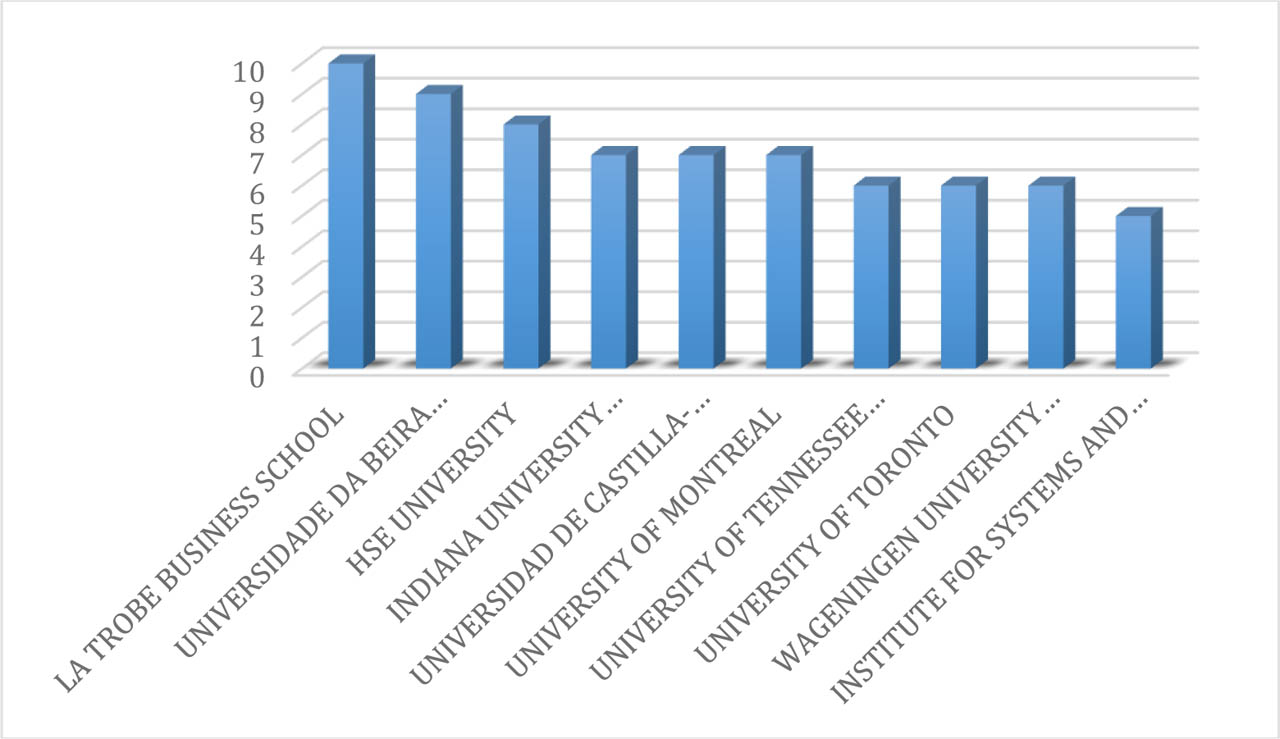
Figure 7.
Most relevant affiliations
Source: own processing
Table 7 demonstrates local impact by H-index for sources. This outcome represents the local impact assessed by the H-index. The source, “Journal of Technology Transfer,” indicates the highest local impact with an H-index of ten, as does “Technological Forecasting and Social Change”. Similarly, the “Journal of Business Research” comprises nine H-indexes. Next, “International Journal of Entrepreneurial Behaviour and Research” and “Journal of Social Entrepreneurship” reveal an H-index of seven for each source. Moreover, “Review of Managerial Science” and “Small Business Economics” depict an H-index of five for both sources. Finally, “Entrepreneurship Education and Pedagogy” exhibits an H-index of four.
Table 7.
Sources’ local impact by H index
| No. | Source | h_index | TC |
|---|---|---|---|
| 1 | Journal of Technology Transfer | 10 | 1209 |
| 2 | Technological Forecasting and Social Change | 10 | 808 |
| 3 | Journal of Business Research | 9 | 1103 |
| 4 | International Journal of Entrepreneurial Behaviour And Research | 7 | 305 |
| 5 | Journal of Social Entrepreneurship | 7 | 276 |
| 6 | Review of Managerial Science | 6 | 437 |
| 7 | Small Business Economics | 6 | 830 |
| 8 | Management Decision | 5 | 321 |
| 9 | Technovation | 5 | 431 |
| 10 | Entrepreneurship Education and Pedagogy | 4 | 136 |
Table 8 shows countries’ scientific production in the field of “social entrepreneurship” during the study period. This result includes the publication of the top twenty countries ranked in order from top publisher to the lowest. The “United States of America” published one hundred fifty-three scientific manuscripts, followed by the “United Kingdom” with 66 manuscripts. Similarly, “Italy” includes 48 papers, “Canada” 42, “Australia” 39, “Portugal” 36, and “Spain” 32 papers. Moreover, “France” and “India” represent 30 manuscripts for each country. Next, the “Netherlands” includes 20 articles. Additionally, the countries including “Malaysia,” “Germany,” “South Africa,” “Sweden,” “New Zealand,” “Brazil,” “Indonesia,” “Mexico,” “Ukraine,” and “Belgium” are placed in the eleventh to twentieth ranks on the basis of their production, in which the publication number ranges from a minimum of six publications to seventeen among these remaining top twenty countries.
Most cited countries
Most cited countries in this result include major countries with top citation scores, especially the ten countries. The result below represents the most cited countries:
Table 9 depicts the most cited countries. The “United States of America” comprises the five thousand three hundred and twenty-eight total and 113.40 average article citations, followed by “Canada” with 1525 total citations, including 127.10 mean article citation score. Similarly, “Spain” consists of 1327 citations and 120.60 average document citations, and “Australia” has 1064 citations with 50.70 average citation status. Moreover, the “United Kingdom” contains 1005 total citations and a 47.90 mean article citation score, and “Germany” has 540 total citations with 90 average citation status. Additionally, “Italy” consists of 436 total citations with 29.10 average citations, “New Zealand” 382 total citations with 63.70 average citations, “Portugal” 315 total citations with 26.20 average citations, and “India " 198 total citations with 15.20 average citations.
Table 9.
Most cited countries
| No. | Country | TC | Average article citations |
|---|---|---|---|
| 1 | USA | 5328 | 113.40 |
| 2 | Canada | 1525 | 127.10 |
| 3 | Spain | 1327 | 120.60 |
| 4 | Australia | 1064 | 50.70 |
| 5 | United Kingdom | 1005 | 47.90 |
| 6 | Germany | 540 | 90.00 |
| 7 | Italy | 436 | 29.10 |
| 8 | New Zealand | 382 | 63.70 |
| 9 | Portugal | 315 | 26.20 |
| 10 | India | 198 | 15.20 |
Figure 8 manifests the corresponding author’s countries. “United States of America” comprises forty-seven research articles, representing 16.40 percent of articles, followed by “Australia” and “United Kingdom” with 21 documents, which contain 7.30 percent of scientific production for both countries of corresponding author during the study period. Similarly, “Italy” depicts 15 papers with 5.20 percent of representation, and “India” has 13 documents with 4.50 percent of production. Moreover, “Canada” and “Portugal” integrate 12 scientific documents with 4.20 percent of representation, “Spain” 11 productions with 3.80 percent, and “South Africa” eight with 2.80 percent. Furthermore, “France,” “Germany,” “Netherlands,” and “New Zealand” contain six articles with 2.10 percent of the contribution. Additionally, “Malaysia,” “Mexico,” and “Sweden” include five research papers with a 1.70 percent contribution. Next, “Brazil” exhibits four papers with 1.40 percent, and “Lebanon” includes three, representing one percent of production. Finally, “Austria” and “Belgium” consist of two articles for each country, which represent 0.70 percent of production during the study period.
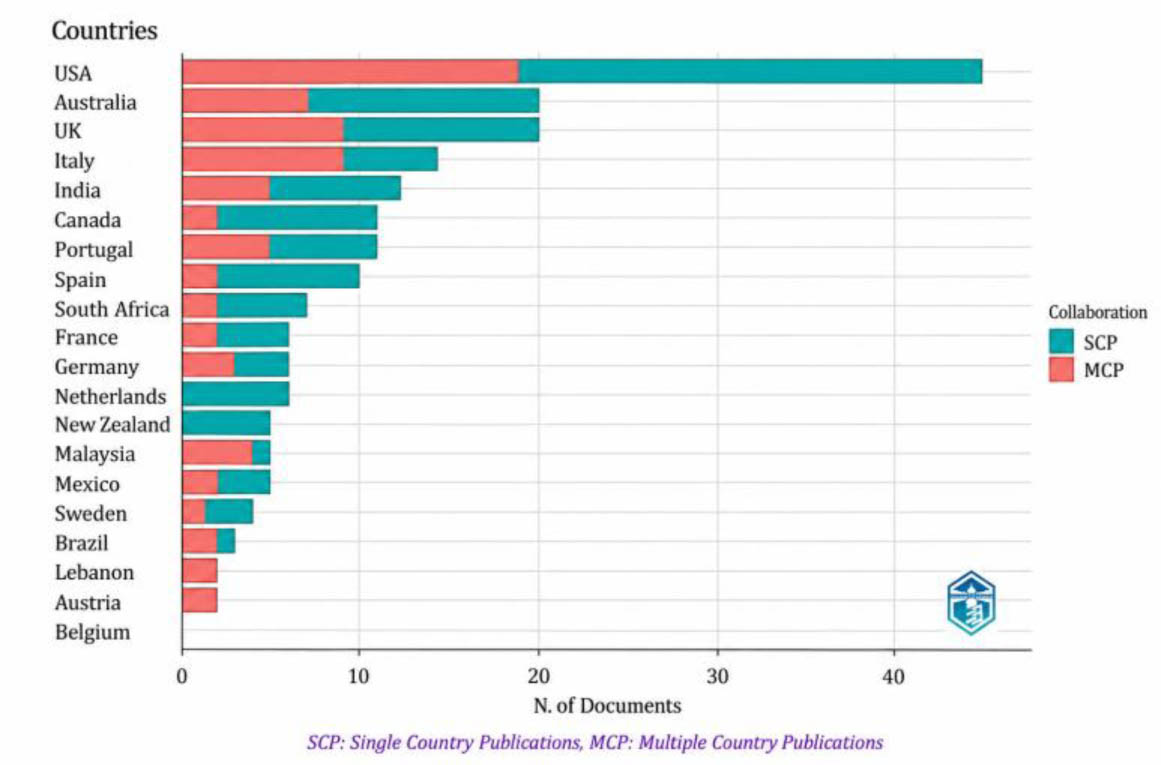
Figure 8.
Corresponding author’s countries
Source: own processing
Trend topics
The trend titles represent the major keywords in the field of “social entrepreneurship” mostly embraced during the study period. This outcome comprises twenty-seven leading keywords in the research themes. The graphical presentation below represents the trend topics.
Figure 9 reveals trend topics. The term “innovation” occurred most frequently, with a frequency of 125 from 2015 to 2023, as the leading term of the research themes, followed by the keyword “social entrepreneurship” with 107 frequency from the year 2017 to 2022. Moreover, the term “entrepreneurship” pursues the same occurrence 107 from the year 2015 to 2022, remaining as mostly occurring themes. Additionally, the term “social innovation” occurred 71 times during 2018 to 2023, “social enterprise” with 30 frequencies during 2017 to 2022, “entrepreneur” 25 frequencies during 2017 to 2024, and the term “social capital” reveals 11 frequencies from 2016 to 2022. Other terms, including “social change” and “entrepreneurial orientation,” depict below ten frequencies during the study period.
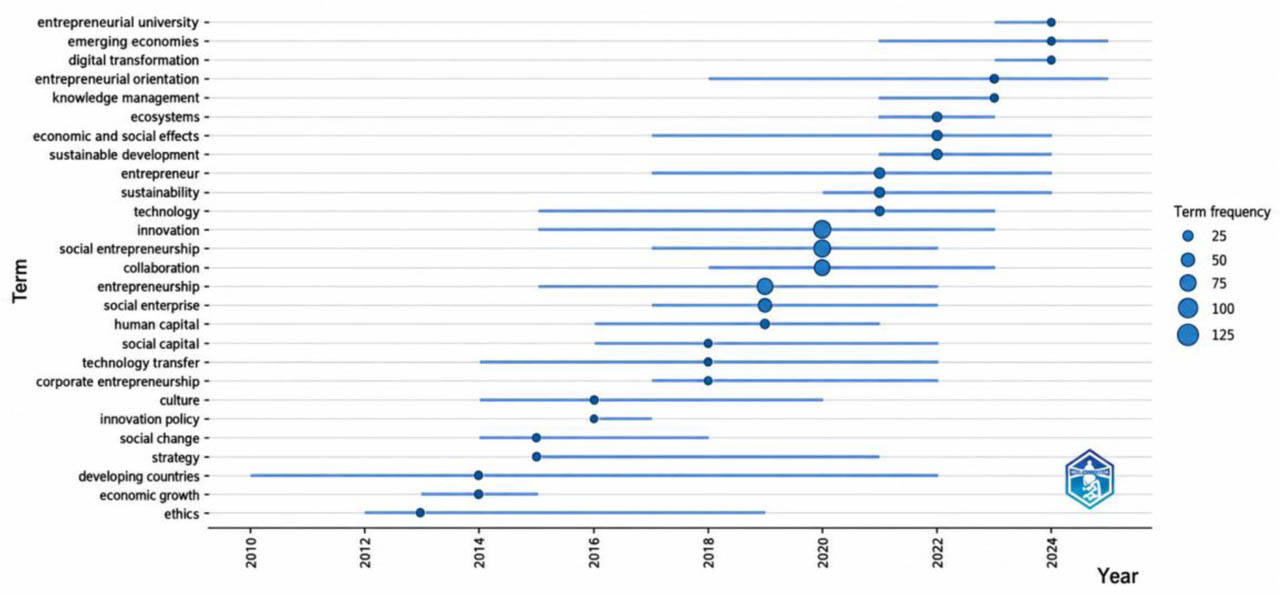
Figure 9.
Trend topics
Source: own processing
Most relevant words
The most occurring words encompass the leading keywords of the study area “social entrepreneurship”. These results contain ten leading and relevant words of the study field. The following graph includes the most relevant words.
Figure 10 represents the most relevant words. The vertical line of the graph includes all keywords, and the horizontal line of the figure comprises the occurrences of the words during the study period. The keyword “innovation” mostly occurred, with 125 occurrences, remaining at the top position, followed by “entrepreneurship” and “social entrepreneurship,” with 107 occurrences for both terms during the study time. Moreover, “social innovation” occurs 71 times, “social enterprise” 30, “entrepreneur” 25, “sustainability” 17, and “technology” 13 times. Finally, “economic and social effects” and “ecosystems” contain 12 occurrences during the study period
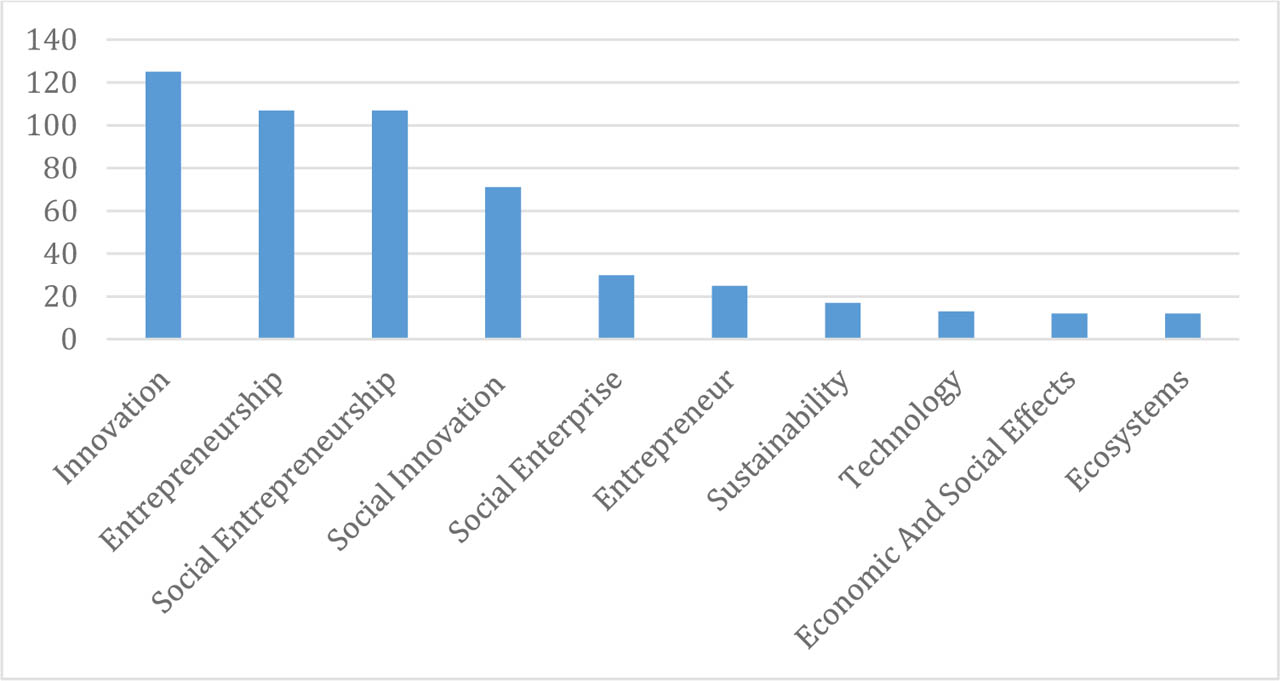
Figure 10.
Most relevant words
Source: own processing
Thematic map
The thematic map manifests four different quadrants, which consist of motor, basic, emerging or declining, and niche themes. Moreover, the vertical lines contain a degree of development or “density,” and the horizontal line contains a degree of relevance, or “centrality”.
Figure 11 exhibits a thematic map. This outcome comprises the four distinct clusters of “motor,” “basic,” “emerging,” and “niche” themes. The motor theme reveals the terms “entrepreneur,” “economic and social effects,” and “corporate entrepreneurship,” which represent the higher degree of relevance, or “centrality,” and a higher degree of development, or “density.” Similarly, the basic theme depicts a higher degree of relevance, or “centrality,” and a lower degree of development, or “density.” This quadrant consists of the key terms “social entrepreneurship,” “social innovation,” “social enterprise,” “innovation,” “entrepreneurship,” and others.
Additionally, the emerging or declining theme, which represents a low degree of relevance or “centrality” and a low degree of development or “density,” reveals the keywords “sustainable development” and “technological innovation.” Finally, the niche quadrant depicting a higher degree of development or “density” and a lower degree of relevance or “centrality” contains the terms “ethics,” “entrepreneurial orientation,” “learning,” and “innovation system.”
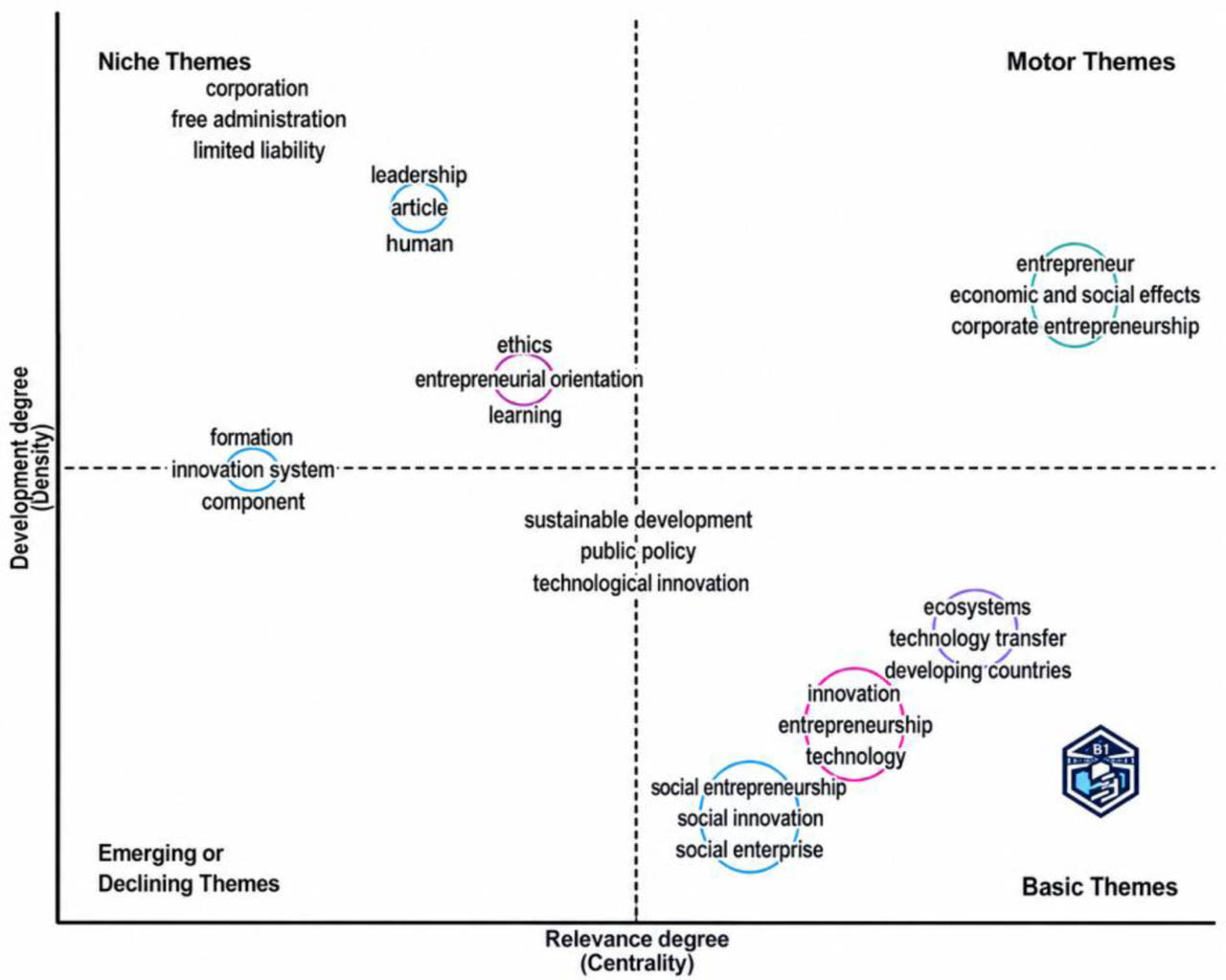
Figure 11.
Thematic map
Source: own processing
Co-occurrence network
The co-occurrence network encompasses the leading terms of the study area “social entrepreneurship,” which covers the period from 2001 to 2025. Figure 12 represents the co-occurrence network of the key terms that occurred in the field of study “social entrepreneurship.” The data selection for the analysis comprises a minimum number of occurrences of a keyword, three, and out of 1211 keywords, the data that met the threshold is merely 130 datasets. Moreover, the final selected data for the analysis of the co-occurrence network is 27 key terms in this study. Furthermore, this graphical figure reflects four distinct clusters with blue, green, red, and yellow colors.
Each cluster comprises the different recurring key terms of the study areas. Similarly, cluster one involves ten items revealing the terms “digital transformation,” “economic and social effect,” “ecosystems,” “entrepreneur,” “entrepreneurial ecosystem,” “knowledge management,” “social innovations,” “sustainable development,” “technological forecasting,” and “technological innovation.” Moreover, the second cluster involves nine items: “developing countries,” “economics,” “entrepreneurship,” “ethics,” “higher education,” “innovation,” “public policy,” “social change,” and “technology.” Next, the third cluster includes the four key terms “human capital,” “social capital,” “social impact,” and “technology transfer.” Finally, the fourth cluster includes four items with “social enterprise,” “social entrepreneurship,” “social innovation,” and “sustainability.”
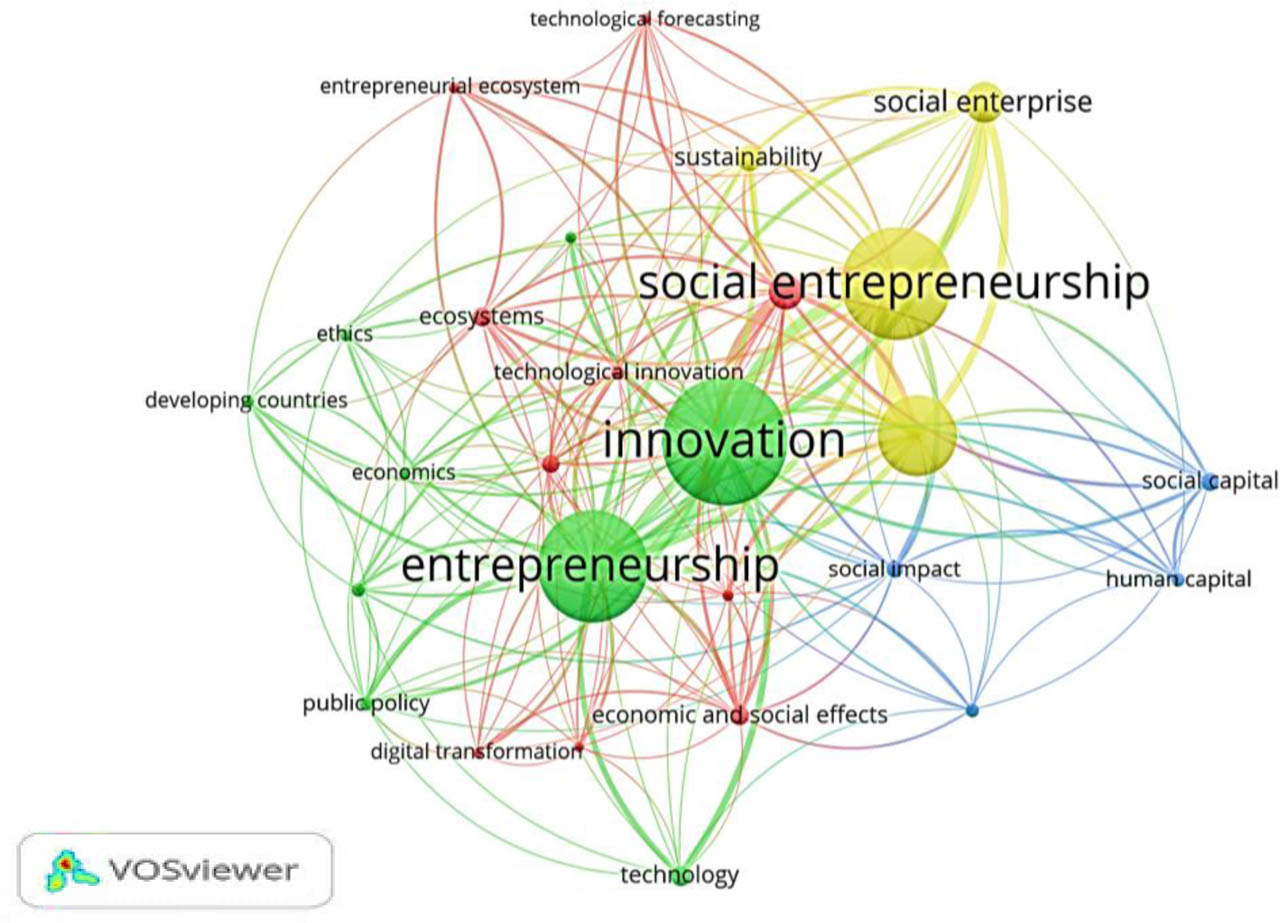
Figure 12.
Co-occurrence network
Source: own processing
Bibliographic coupling of authors
The bibliographic coupling of authors in the study contains authors and their network. These results include the authors in different clusters depicted with different color including green, red, yellow, and blue. Figure 13 reflects the bibliographic coupling of the authors.
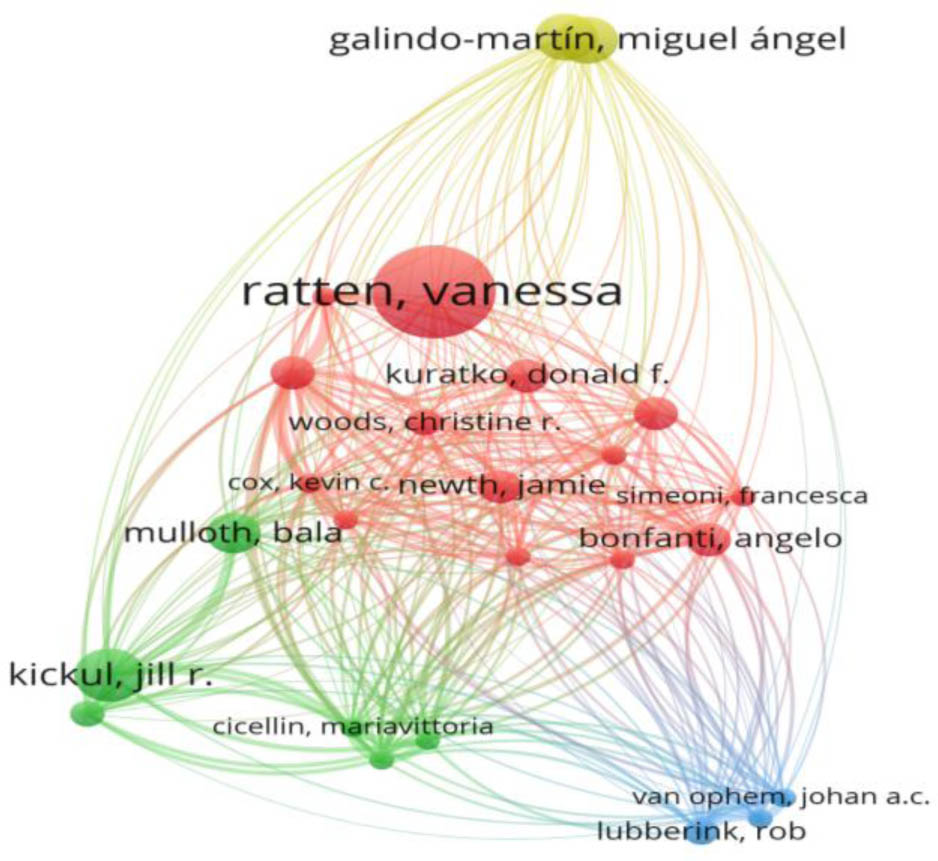
Figure 13.
Bibliographic coupling of authors
Source: own processing
The data selection criterion in the analysis includes “maximum number of authors per document” is 25, “minimum number of documents of an author” is two, and “minimum number of citations of an author” is one. Moreover, among the 558 research scholars, the threshold met number of authors involved was 187, and the final number of contributors included for the analysis of data comprises 25 authors. Furthermore, the coupling of authors represents four distinct clusters. The first cluster consists of fourteen authors: Bhatt, Punita Bjarsholm, Daniel Bonfanti, Angelo Bonnal, Michael Cox, Kevin C. Giudici, Alessandro Kuratko, Donald F. Lortie, Jason Newth, Jamie Ratten, Vanessa Roundy, Philip T. Simeoni, Francesca Weerawardena, Jay Woods, Christine R. Similarly, cluster two includes six authors Bacq, Sophie Cicellin, Mariavittoria Consiglio, Stefano Kickul, Jill R. Mulloth, Bala; and Scuotto, Adriana. Moreover, cluster three involves Lubberink, Rob Omta, Onno S.W.F.; and Van Ophem, Johan A.C. Finally, cluster four comprises the list of authors Galindo-Martin, Miguel Angel; and Mendez-Picazo, Maria Teresa, who contributed and published in the field of “social entrepreneurship.”
Bibliographic coupling of the country
The bibliographic coupling of the country involves the different nations that contributed to the areas of “social entrepreneurship” during the period from 2001 to 2025. These results integrate the highly contributing states and their network depicted by distinct color clusters. The graphical outcome below involves the coupling of the nations and network. Figure 14 exhibits the bibliographic coupling of the states. These outcomes integrate the several nations involved in the scientific production of academic research papers in the area of the “social entrepreneurship” sector.
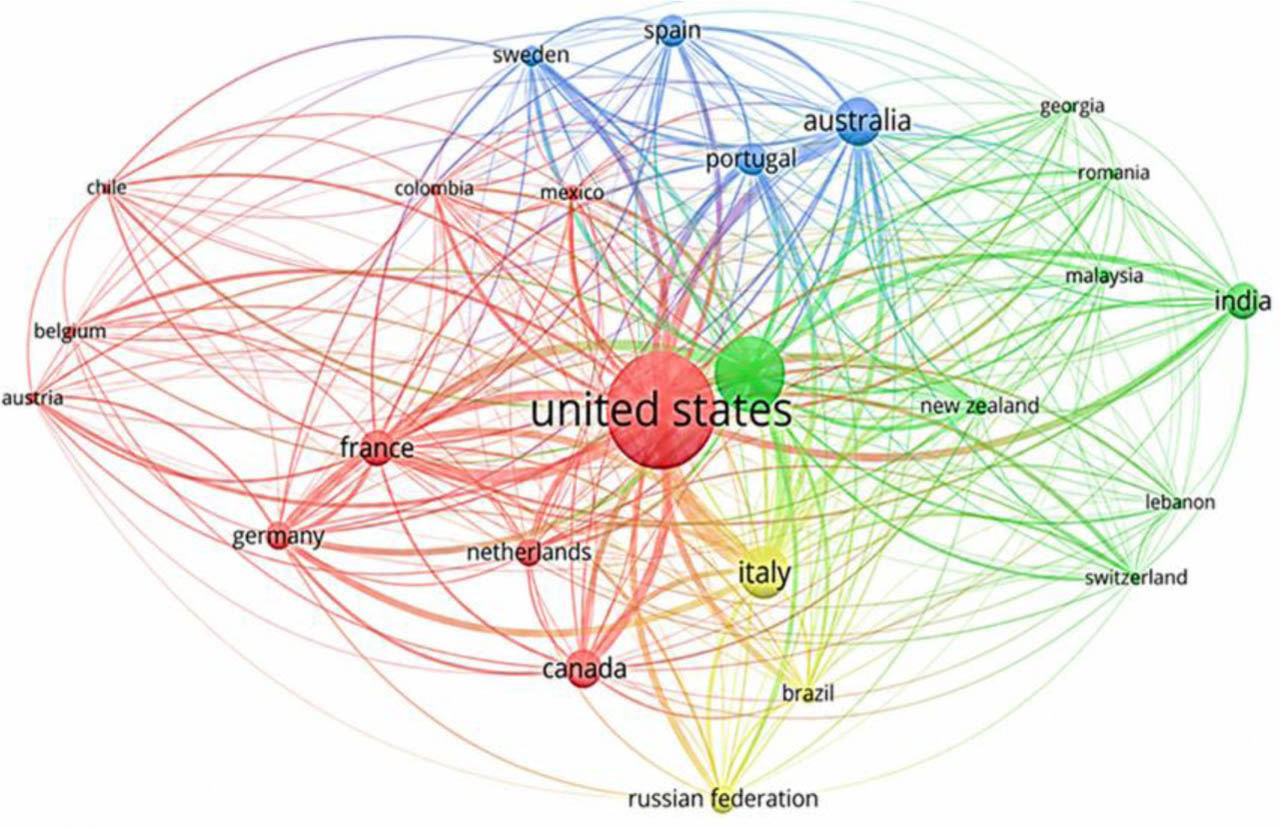
Figure 14.
Bibliographic coupling of the country
Source: own processing
The data selection procedure includes “minimum number of documents of a country,” which is one, and “minimum number of citations of a country” is one. Moreover, among the 59 states, all 59 met the threshold in this study. The final number of nations involved in the analysis is 25. Its outcomes include four distinct clusters depicted with four different colors: red, blue, green, and yellow. Cluster one integrates ten countries: ‘Austria,’ ‘Belgium,’ ‘Canada,’ ‘Chile,’ ‘Colombia,’ ‘France,’ ‘Germany,’ ‘Mexico,’ ‘the Netherlands,’ and ‘the United States’. Similarly, cluster two includes eight items of the nations ‘Georgia,’ ‘India,’ ‘Lebanon,’ ‘Malaysia,’ ‘New Zealand,’ ‘Romania,’ ‘Switzerland,’ and the United Kingdom. Next, the third cluster contains four items of nations: Australia,’ ‘Portugal,’ ‘Spain,’ and ‘Sweden’. Finally, the fourth cluster involves three items of the countries ‘Brazil,’ ‘Italy,’ and ‘Russian Federation’.
Discussion
The bibliometric analysis on social entrepreneurship analyzed the trajectory of research, which adopted the Scopus dataset of 287 for the analysis, covering the time frame from 2001 to 2025. The findings of the study revealed that an annual scientific production in the field of ‘social entrepreneurship’ rose rapidly from 2022 to 2024, and the average citation scores per article showed the highest score, 264 in 2006, followed by 253 in 2005.
The mean citation per year remained the highest at 23.03 in 2019. Similarly, results on three field plots revealed that the key terms ‘innovation’, ‘entrepreneurship,’ ‘social entrepreneurship’, and ‘social innovation’ as the leading keywords, which recurred most frequently during the study period. Further, it exhibited that research scholars heavily concentrated on these areas of research, with the production of more scientific documents. It showed growing interest of investigators considering social entrepreneurship as an emerging and rapidly expanding field of inquiry. Moreover, the prolific scholars in the study found ‘Ratten V’ and ‘Audretsch D’ who mostly contributed to the publication of the research documents in the ‘social entrepreneurship’ sector. Additionally, several sources were found related to the publication of a research manuscript that demonstrated ‘Emerald Emerging Markets Case Studies’ as a highly relevant source from Bradford’s law criteria-based outcomes. Among several manuscripts, the highest globally cited document was by Nambisan et al. (2019), entitled ‘The digital transformation of innovation and entrepreneurship: Progress, challenges and key themes,’ which was published in the journal of ‘Research Policy.’
Furthermore, the most locally cited paper by Bacq et al. (2015) related to the areas of research, “Bricolage in social entrepreneurship: How creative resource mobilization fosters greater social impact,” published in ‘The International Journal of Entrepreneurship and Innovation,' reflects seven local citation rankings in the first position, and the most locally cited reference by Austin et al. (2012), with the work on “Social and commercial entrepreneurship: Same, different, or both?” found in “Revista de Administração” demonstrates fifty-three local citations, making it the top leading one. Next, the affiliation with the most relevant one depicted ‘La Trobe Business School,’ which published ten research articles concerning the area of ‘social entrepreneurship.’
Further, the high-impact journal based on the local impact criteria revealed for the Journal of ‘Technology Transfer’, which exhibited the highest local impact with an H-index of ten, consisted of the ‘Technological Forecasting and Social Change’ Journal with an H-index of ten. The contributing states were several in the ‘social entrepreneurship’ areas; among these, the “United States of America” published one hundred fifty-three scientific manuscripts, which holds the top position in its publication. However, other countries across the globe were involved in the investigation, extending the emphasis towards the study theme during the study period, which included the list of nations based on bibliographic coupling of the countries ‘Austria,’ ‘Belgium,’ ‘Canada,’ ‘Chile,’ ‘Colombia,’ ‘France,’ ‘Germany,’ ‘Mexico,’ ‘Netherlands,’ ‘Georgia,’ ‘India,’ ‘Lebanon,’ ‘Malaysia,’ ‘New Zealand,’ ‘Romania,’ ‘Switzerland,’ and the United Kingdom. Similarly, the states of the corresponding author depicted from the “United States of America” included forty-seven research articles, representing 16.40 percent of articles published in the theme areas. The status of nations with the most cited status covered the ‘United States of America’, which showed five thousand three hundred and twenty-eight total citation positions and 113.40 average article citations.
Interestingly, the most frequent terms on the basis of trend topics were ‘innovation,’ which demonstrated one hundred twenty-five occurrences during 2015 to 2023, as the leading term of the research themes, followed secondly by the keyword “social entrepreneurship” with 107 frequencies in the years 2017 to 2022. Moreover, the term “entrepreneurship” pursued the same occurrence 107 from the year 2015 to 2022, remaining as one of the most occurring themes in which most of the investigators concentrated and adopted the terms for the study. Similarly, the most frequent keywords, co-occurrence network, and thematic-based outcome showed ‘innovation,’ ‘entrepreneurship,’ ‘social entrepreneurship,’ ‘social innovation,’ ‘social enterprise,’ ‘entrepreneur,’ ‘economic and social effects,’ ‘ecosystems,’ and ‘innovation’ as leading themes and terms mostly embraced by researchers.
Conclusion
The research on social entrepreneurship attempts to map the trajectory of research areas through bibliometric analysis and depicts the outcomes with Scopus sources. The results reveal a rising trajectory of the theme, which appears as rapidly intensifying with fluctuating average citation positions. Moreover, the outcome manifests that the terms ‘innovation,’ ‘entrepreneurship,’ ‘social entrepreneurship,’ ‘social innovation,’ ‘social enterprise,’ ‘entrepreneur,’ ‘sustainability,’ and ‘economic and social effects’ have been widely adopted by scholars. It concludes that the coverage of the research areas widely integrated by the investigator with rising interest that drives towards the entrepreneurial theme, especially the ‘social entrepreneurship’ sector, which suggests that this core set of frequently adopted terms occupies the entrepreneurial research field that represents two and a half decades of a growing landscape. Scholars with emphasis on these areas indicate that these themes stood as a central attraction for academics, in which numerous publications occupy an important place in the investigation. Moreover, the research in the theme areas depicts higher citation with global and local citation perspective and business sector institutions on social entrepreneurship and social entrepreneurship areas receive more citations and involve as relevant institutional entities exerting work on the theme. It equally concludes that diverse academic institutions are involved in the production of scientific papers in the theme areas with heavy emphasis over the decades. Additionally, several diverse geographical locations and countries are involved in the production of scientific manuscripts. It concludes that the focus on study themes tremendously spread throughout the global sphere, equally participating with immense contribution to the ‘social entrepreneurship’ areas. It shows that the scientific investigation revolves around the entrepreneurship of the social sector.
Implications
The implications of the study reveal that the outcomes of this study contribute to the existing theoretical foundations of managerial dynamics of social entrepreneurship in the knowledge economy. The bibliometric exploration on the theme areas systematizes the diverse and heavily fragmented research body and demonstrates relevant intellectual structure in the theme areas. Next, the exploration of social entrepreneurship through a bibliometric lens manifests a ground for understanding the paradigm shift in entrepreneurial areas embracing the doctrine of social entrepreneurship. Therefore, the social entrepreneurship research extends the foundation of understanding, paradigm shift, and the trajectory, especially in the knowledge economy. Further, the results of this research could contribute to the wider group of research investigators to extend further investigation, and the academic community could gain an understanding of the social entrepreneurship landscape. Further, these outcomes contribute to the existing evidence synthesizing the outcomes from the bibliometric study.
Limitations and future directions
This study contains several limitations that need to be acknowledged. This research relies merely on the Scopus dataset, which excludes manuscripts published in other sources such as Web of Science, Dimensions, Lens.org, Google Scholar, and OpenAlex data. However, utilization of the Scopus dataset ensures quality and consistency but may exclude context-based publications and limit the coverage of the study. Similarly, this research includes manuscripts published in the English language, comprising journal articles only. It excludes other broader coverage of research papers published in other languages. Further, this study covers the documents only from the subject areas related to business, management, and accounting and excludes the manuscripts published in other subject areas. The findings are mainly based on bibliometric analysis, which exhibits numeric and quantitative trajectories of the research publication and citation networks and offers constrained qualitative insight. Therefore, future studies can take place addressing these limitations through bibliometric analysis integrating important data from other sources: Web of Science, Google Scholar, and others. Next, exploration of qualitative insight can take place in future studies. Further, the coverage of manuscripts published in other languages in future studies can add more evidence.