
Introduction
In management science, innovation is integral to the long-term success of contemporary organizations, leading to increased interest in elucidating the various factors that affect organizational innovation (Naranjo-Valencia et al., 2016). Kede Ndouna and Tsafack Nanfosso (2024) argue that “innovation is the grassroots of firm growth because it leads to economies of scale, improves productivity, and increases sales, which bring benefits (production of goods or services, distribution, marketing etc.) to enterprises that can integrate innovation effectively” (p. 561). Meanwhile, studies have shown that there are five main factors that affect an organization’s ability to innovate, namely the creation of opportunities; leadership; organizational culture and change; learning; and networking and relationship development (Alawamleh et al., 2023; Olanipekun & Genty, 2025).
Newman et al. (2020) highlighted the need to examine and explore the influence of cultural and institutional factors on the development of innovation climate, calling for empirical advancement in future research, especially at the organizational level. The scholars argued that, by investigating the influence of cultural dimensions, researchers may also investigate whether levels of institutional development predict the existence of innovation climate. According to Quimbo and Sulabo (2014), organizational culture is a significant element in influencing an organization’s ability to achieve innovation success. This is because cultural features are one of the factors that support innovation and create the required climate for the organization to innovate. According to Alas et al. (2012), there are clear connections between organizational culture and innovation climate through the implementation of new ideas.
Organizational culture has a variety of elements that can help or hinder an organization’s ability to innovate, and an innovation culture must be properly aligned to the organizational setting (Ahmed, 1998, p. 39). In literature, there is evidence that organizational culture and innovation climate are correlated (Alas et al., 2012; Anderson et al., 2014; Newman et al., 2020; Shanker et al., 2017), but very few empirical studies exist to link the organizational culture to innovation climate especially using the Competing Values Framework (CVF). This is despite the fact that CVF is a useful tool to assess the culture of an organization and to know if one organization’s culture differs from that of another organization. Thus, CVF comprises competing positive tensions in both horizontal and vertical axes of the organizational structure (DeGraff, n.d.).
Pragmatically, the expectation to innovate arises as a driver of economic performance. However, the African Critical Technical Skills Report (African Capacity Building Foundation, 2016) highlighted weaknesses in science and technology in Namibian organizations. The report scores Namibia 2.86 out of a maximum of 7 in science and technology. This low score highlights a shortcoming in Namibia’s quest to cultivate an innovation climate, further demonstrating a lack of institutional dedication to scientific and technological innovation, and commercialization (Hangula et al., 2020). By implication, technology and technical advancements are crucial components of innovation since they boost productivity and have a big impact on economic growth. Higher educational attainment, transfer of technology, innovation, and economic development are necessary to overcome global and complex concerns. Therefore, higher education should strengthen abilities and expertise, which have an impact on the economy. As a result, productivity, innovativeness, efficiency, creativity, and engagement of employees are significant in the framework of organizational culture.
Although international scholarship links organizational culture to innovation climate, empirical investigations using CVF remain limited, especially at organizational level. This paucity of evidence is especially pronounced in Namibia, where documented weaknesses in science and technology underscore the need for innovation. Yet, systematic empirical studies on organizational culture and innovation climate remain scarce, particularly within higher education institutions. The decision to focus on a university setting was driven by the fact that universities, through research, are drivers of innovation (Bayuo et al., 2020). The study specifically looks at the organizational culture types as identified by Cameron and Quinn (2011). Therefore, the specific objective of this study is as follows: to evaluate the influence of organizational culture on innovation climate at a Namibian university
Literature review
This section discusses some of the previous studies on organizational culture and innovation climate conceptually, theoretically and empirically, and develops a framework for the study.
Organizational culture
Organizational culture is one of the key tools at the disposal of organizational leaders to sustain organizational viability in the wake of significant uncertainty related to the innovation climate (Wang et al., 2021, p. 1121). Developing a universally accepted definition of organizational culture has proven to be a difficult task for business management academics and practitioners. This is because there was no agreement among anthropologists on what culture connotes.
Ifenowo and Genty (2025) initially proclaimed organizational culture to be the most complex organizational aspect to conceptualize. Schein (1985) further illustrated three cognitive levels of what he defined organizational culture to be. At the most visible level Schein identified cultural artefacts, which are visible processes and organizational structures. He further identified espoused values, which refer to strategies and philosophies, and the third level of culture with those basic underlying assumptions such as perceptions, beliefs, feelings and thoughts. Schein further emphasized culture as a paradigm to be most effective if it aids in a better understanding of intricate features of life in groups, organizations and occupations.
Gorzelany et al. (2021) defined organizational culture as “the collective programming of the mind which separates the individuals of one group or category of individuals from another” (p. 5). Serpa (2016) defined organizational culture as a shared way of thinking, being, and behaving in a collective and coordinated manner. Cameron et al. (2003) further hypothesized culture to be enduring and slow to change and relating that to basic qualities of an organization (p. 51). Loisch (2007) highlights the characteristics of organizational culture to be a collective effort as it is assumed that cultures are not created in silos, but because of collective actions. Every employee who belongs to a culture believes what the group believes in and acts accordingly.
Wang et al. (2021) defined organizational culture as shared philosophies, values, ideologies, beliefs, expectations, and a myriad of norms in organizations. This is because most, if not all, organizations have something distinctive in the nature of their functions, and it is through that distinctiveness that they set themselves apart from their competitors. According to Maseko (2017), organizational culture is “a company’s orientation toward its team members, which forms the basic rules that guide employees’ behavioral patterns which are then developed and understood within an organization” (p. 3). Therefore, every employee who belongs to a culture believes what the group believes in and acts accordingly. These researchers further elaborated organizational culture to be emotional and historic because the organizational cultural phenomena are linked to an organization’s history (Ifenowo & Genty, 2025; Maseko, 2017; Zhu & Engels, 2014).
Symbolism and dynamics are also two aspects of organizational culture. While culture may be linked to an organization’s history, it is not static but rather dynamic. Several factors influence organizational cultural change. The final characteristic of organizational culture is diffusion, which is presumed to be that the more complex an organization’s circumstances are, the more diluted the elements of organizational culture will become (Maseko, 2017; Zhu & Engels, 2014). Shayah and Zehou (2019) posited that organizational culture is the complex set of ideologies, commitments, traditions, and values that are shared all over the organization and that influences how the organization manages its total performance becoming a potential source of advantage, advance, and innovation.
In literature the types of organizational culture have been viewed differently by scholars and authors, but their typology is based on their different ideas. Therefore, every organization has its own unique combinations to explain workplace culture, but the most acceptable typology of organizational culture was championed by Cameron and Quinn (2011) in their proposed model called the Competing Values Framework (CVF). The CVF model is a tool to assess the culture of an organization and highlights four culture types that can be used for the assessment, namely Clan, Adhocracy, Market and Hierarchical cultures (Cameron & Quinn, 2011; DeGraff, n.d.).
The Clan culture is often characterized by morale, tradition, loyalty, commitment, teamwork, collaboration, participation and consensus, and individual development (Adelekan, 2016; Cameron & Quinn, 2011). This culture type promotes unity and eliminates barriers that can institute flat structure in the organization. Clan culture embraces mentorship relationships development, knowledge exchange where executives ask for feedback and ideas from employees. Further, Adhocracy is characterized as a dynamic, entrepreneurial, innovative and creative workplace culture (Adelekan, 2016; Cameron & Quinn, 2011). This is the culture that questions the current norm in the organization and embraces changes such as creativity. Although this type of culture is prone to making mistakes in the organization, it quickly gains knowledge by adjusting accordingly. Confidence and inventiveness are highly prized in this culture which also encourages and celebrates great ideas from every employee.
A market culture is regarded as a result-oriented workplace culture that emphasizes winning, competition, an escalating share price and market leadership (Adelekan, 2016; Cameron & Quinn, 2011). This is the most combative of all organizational culture types because goal achievement and results drive workplace motivation. Although the organizational cultures of Clan and Adhocracy are more tolerant of change, market culture is typical of large and well-established enterprises. One of its benefits is achieving targets and sometimes surpassing expectations. In what concerns Hierarchy culture, it is characterized by a formalized, structured workplace along with procedures and well-defined processes for running a smooth organization (Adelekan, 2016; Cameron & Quinn, 2011). In this type of culture, job roles and positions are demarcated, and there is a clear line of command from top-down leadership. The culture is therefore quite formal in nature and highly structured. One of the benefits of having a hierarchy culture in place is that everyone in the organization works together more efficiently, and everything is well organized on the basis of established rules.
Innovation climate
There has been limited consensus on how to define and measure innovation climate because of its broad global conceptualizations, and several definitions have been proffered by researchers (Gorzelany et al., 2021; Newman et al., 2020). However, scholars generally tap into the same phenomenon: employees’ perception of an environment conducive to innovation. Newman et al. (2020) argued that innovation climate differs from creative climate because the latter consists of individual thought processes and intellectual activity aimed at generating new insights, ideas or solutions to problems, whereas innovation climate goes beyond this by focusing on the adoption, exploitation and successful implementation of these ideas, insights, and solutions.
A complex organizational culture has a link to innovation climate in organizations (Alas et al., 2012). Newman et al. (2020) state that an organization’s innovation climate is described at the level of encouragement and support it grants its employees to take initiative in trying new things. Adjoining hereto Naranjo Valencia et al. (2010) proclaim that the firms that innovate have a greater capacity for adaptation and they reiterate the importance of an agreement in literature about the importance organizational culture serves in innovation (Higgins & McAllaster, 2002; Lau & Ngo, 2004; Lee & Chang, 2007). An innovation climate focuses on the properties of a group that not only supports the development of new insights, ideas, and solutions but also their adoption, exploitation, and implementation (Newman et al., 2020). Therefore, innovation climate refers to shared perceptions at the team or organizational level regarding the extent to which team or organizational processes encourage and enable innovation.
Schumpeter (2000) made fundamental contributions to the idea of innovation and its significance in economic progress through changes and developments. He believed that essential inventions happened in cycles and that prosperity was fueled by it. Many definitions of innovation are available in literature, and many are based on Schumpeter’s famous ideas. According to Naranjo-Valencia et al. (2011), organizational culture is a clear predictor of an organization’s innovation strategy. As a result, it is obvious to conclude that organizational culture has a significant impact on innovation and the success it generates. The importance of organizational culture as a leadership component, encouraging creativity, fostering partnerships and promoting entrepreneurship deems necessary and cannot be overstated.
Gorzelany et al. (2021) argued that the core cultural attitudes that encourage innovation include a future-focused outlook, adapting to change, an eagerness to take calculated risks, trying new things, inventiveness, mutual trust and support, and tolerance for mistakes. Therefore, a vision, aspiring to challenge oneself, and objectives related to innovation are essential ingredients for introducing innovation, thus promoting an environment where working is enjoyable. Other components include freedom to act, empowerment, and support for current ideas, as well as the openness for discussion of current ideas.
In general, reviewed literature calls for innovation that necessitates flexibility, adaptability, and direction by those in charge of organizations, i.e., leadership. Despite being complex and ambiguous, Gorzelany et al. (2021) argued that corporate culture has a critical impact on innovation management. As a result, culture is a term that describes the ideas that underpin organizational ideals. Thus, conceptualizing this statement, Furst-Bowe and Bauer (2007), emphasize that innovation should become a natural part of the culture, creativity, and daily operations of institutions of higher learning, as innovation draws on the accumulated expertise of all faculty and staff members. Following this, Naranjo-Valencia et al. (2011) reiterate the facts on the significance assigned to culture as a catalyst for innovation.
Strictly speaking, innovation climate is the internal work environment in which innovation is supported and incentivized. That is, it is the employee’s perception of the work environment that influences their behaviors and attitudes towards creativity, new ideas, and insights. Innovation climate in the literature has been measured by many components such as Team Climate Inventory (Anderson & West, 1998), the Climate for Innovation Scale (Scott & Bruce, 1994), and other scales developed and utilized by a number of researchers. But Team Climate Inventory (TCI) has been the most widely used scale to measure innovation climate at the team and organizational level (Newman et al., 2020).
Theoretical framework
The Competing Values Framework (CVF)
A model on organizational culture was proposed by Cameron and Quinn (2011). This model is built on two basic dimensions (see below Figure), an internal, person-centred dimension and an exterior, organizational-focused dimension. Furthermore, the dimensions of stability and control are contrasted with the dimensions of flexibility and change.
The Competing Values Framework (CVF) is used to assess organizational culture for this objective. The theory looks at the four culture types illustrated below and at what they represent in the CVF. Clan culture is marked by the characteristics of a family-type organization. Typified in the Organizational Culture Assessment Instrument (OCAI), Clan Culture fosters a conducive working environment. Adhocracy culture is the type most responsive to the hyper-chaotic, ever-accelerating conditions that characterize organizational work in the 21st century. The mission of the Adhocracy culture is to promote adaptability, flexibility and innovation in situations characterized by uncertainty, complexity and sensory overload. According to the OCAI’s assessment, Adhocracy Culture fosters a dynamic, aspirational, and inventive work environment.
Market Culture is centered on the writings of Ouchi (1984) and Williamson (1975) as cited by Wikén (1984) and others who argued for a different set of procedures to serve as the cornerstones of organizational efficiency. This culture focuses on an organization that operates as if it were a market, with a focus on the outside environment rather than inside matters. According to the OCAI, a Market Culture in an organization puts emphasis on results. Hierarchy culture marks the keys to success as clear lines of authority, decision-making, established norms and procedures, accountability and control mechanisms. Functions and tasks are integrated, uniformly coordinated and maintained, and jobs are kept under control. The OCAI defines Hierarchical Culture as having a defined and well-organized work environment.
Based on the existing literature, the researchers conclude that organizations should focus on the important aspects of their organizational culture to achieve the best innovation climate resulting in organizational outcomes. In conclusion, the expression of Clan, Market and Adhocracy cultural types that emerge in reaction to circumstances in an organization’s internal and external environment reflects an organizational culture envisaging a positive innovation climate, whereas the Hierarchical culture type emerges negatively in the relationship between organizational culture and innovation climate (Alas et al., 2012).
As depicted in the descriptors below for the different culture types, under the heading of the definition of organizational culture, the following is only a short summary of what each culture type represents in the CVF. The Clan Culture type is marked by part-taking, collaborative efforts and clear communication. The Adhocracy Culture type dominates by an innovative climate, transformation, creativity and fosters a positive emotional climate as its core values. The Market Cultural type is influenced and driven by goals, strong competitive endeavors and finally, the Hierarchy Cultural type is influenced by effectiveness, efficiency, control and consistency (Cameron & Quinn, 2011).
A solid foundation was considered necessary for determining organizational culture at the university. The Competing Values Framework (Figure 1) is the theoretical model on which the OCAI is based and is extensively used in this research to organize and explain a wide range of organizational events. The university is currently standing on a precipice, caught in the struggle of hanging on to the organizational culture of the old regime while its new leader has not yet had time to instill his values, launch his initiatives or cement his ideals, beliefs and assumptions within the organization. This has placed employees in a conundrum of either blindly accepting the status quo and moving with the winds of change or, alternatively, objecting and facing the consequences thereof.
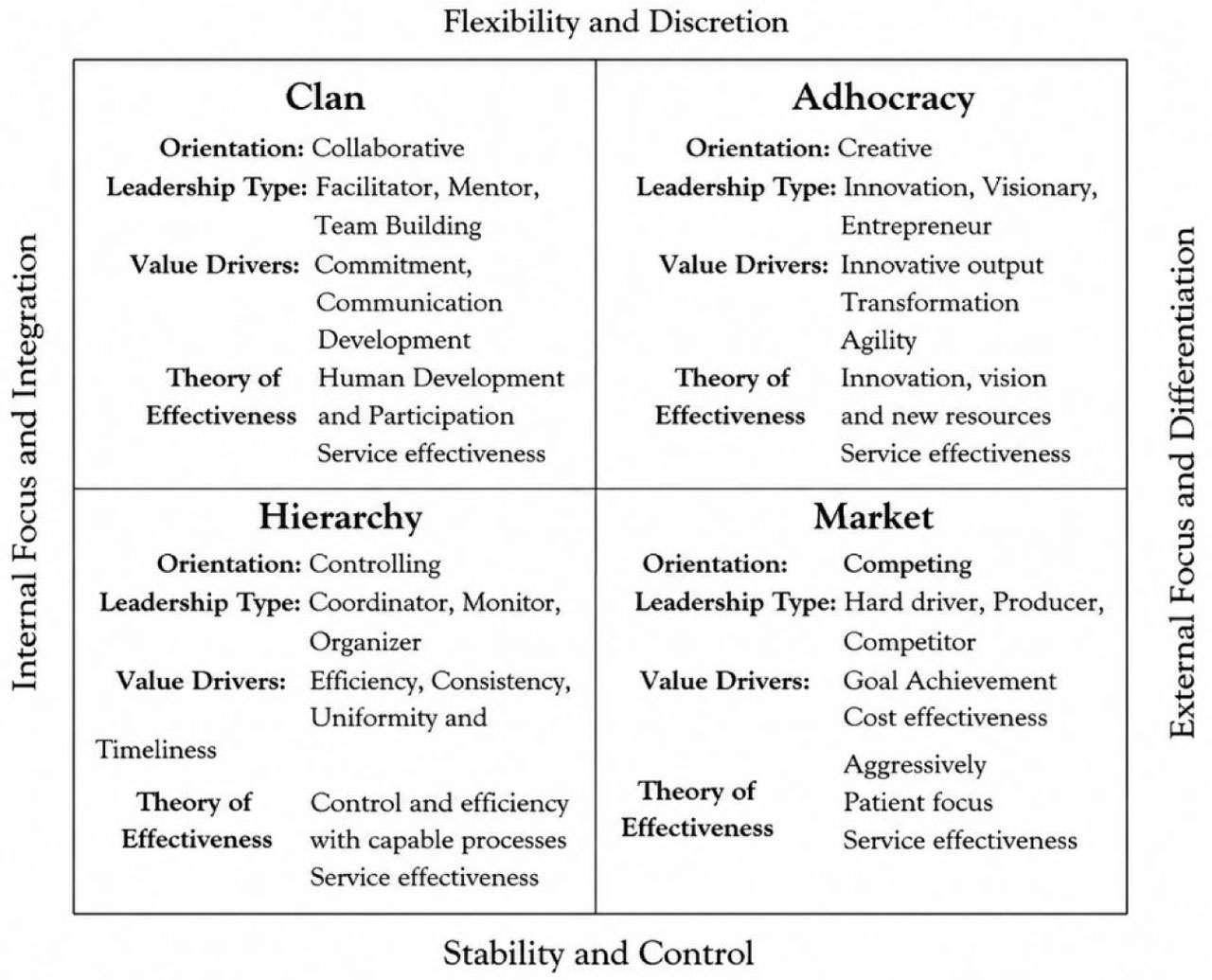
Figure 1.
Competing Value Framework
Source: adopted from Cameron and Quinn (2011)
Empirical review
According to Ahmed (1998), organizational culture is in some ways a reflection of organizational climate but operates at a deeper level. While an organization’s practices and regulations may reflect its climate, organizational culture cannot be seen at that level since it only exists as a set of beliefs that guide how people react to their surroundings. Ahmed continues by stating that cultures cannot be studied in isolation and that choosing one form of culture and advocating it as the solution to an organization’s lack of creativity just serves to exacerbate errors. This viewpoint validates the climate-for-innovation paradigm as a useful complement to organizational culture and innovation climate research, thus suggesting organizational culture to be an important driver of innovation climate.
As alluded to in the writings above, the literature review provided foundations for the type of organizational culture that emphasizes innovation climate and that is geared towards innovative pursuits. The basics of innovative cultural pursuits highlight the need for future orientation, risk-taking, creativity, openness and trust, vision, experimentation, and a belief in action. It is also recommended to grant people autonomy, empower them and promote freedom in idea generation, as well as the ability to discuss these ideas openly and without prejudice.
Universities worldwide face numerous challenges such as disruptive technologies, changes in student requirements, reduced funding, an increase in expectations of research and development with the focus on resource cutting, efficiency and effectiveness that change the external and internal sphere of management within universities (Gorzelany et al., 2021). This present research identified and attempted to investigate the influence of organizational culture on innovation management in higher education institutions, proposing a way to foster university organizational culture that will promote innovation climate.
Gorzelany et al. (2021) further testify to the basic cultural attitudes fostering innovative activities requiring a specific type of organizational culture. It is, therefore, imperative to note and acknowledge organizational culture as indispensable to innovation climate. According to Alas et al. (2012), an organization’s innovation climate is determined by how much support and encouragement it gives its employees to take the initiative and consider novel ideas. Wang et al. (2021) make a case for the importance of understanding the factors that influence an organization’s capacity for innovation and being critical of both academic and business perspectives. Thus, strong organizational cultures that reward long-term success while tolerating short-term failure are essential for fostering innovation.
Loisch (2007) views organizational culture as a collective construct, arguing that it does not emerge in isolation but rather develops through shared actions and interactions among organizational members. Several scholars found that organizational culture and performance are closely related, giving a clear assessment of how organizational culture influences an organization’s economic performance, either favorably or unfavorably (Kotter & Heskett, 1992; Marcoulides & Heck, 1993). Schein (1985) and O’Reilly et al. (1991) argued that one should investigate several cultural elements, identify the sub-unit cultures, shared dominant qualities, and aggregate them when studying organizational culture. This multi-dimensional view can be utilized to make an approximation of the organizational culture as a whole (Cameron & Quinn, 2011).
Abby and Dickson (1983) studied the culture of innovative development and research units and discovered that it was defined by rewards for excellent performance and by the company’s willingness to experiment with new ideas. The innovation climate questionnaire established by Scott and Bruce (1994) captures employees’ impressions of the organization’s innovation climate and is the most widely used measure of organizational innovation climate. The questionnaire was used to determine organizational culture as a predictor of innovation climate, while emphasizing two main components of the path model to support innovation climate and resource supply (Scott & Bruce, 1994). In summary, literature shows that a supportive organizational culture is required for a vibrant, constructive innovation climate, and that managing and/or aligning the organizational culture could lead to a strengthened innovation climate.
Various studies such as Naranjo Valencia et al. (2010), Naranjo-Valencia et al. (2011), Hartnell et al. (2011) and Büschgens et al. (2013) accepted the Hierarchical Culture type to be the most significant impediment to fostering innovative culture in organizations. Moreover, several studies have shown that culture plays a critical role in cultivating an innovative climate (Alawamleh et al., 2023; DeGraff, n.d.; Naranjo-Valencia et al., 2016). According to Tesluk et al. (1997), the fundamental elements of culture have two effects on innovation. Firstly, employees can determine whether creative and innovative behaviors are a part of the organization’s strategy through socializing and coordinating. Secondly, throughout the same time frame, the organization can create values through its activities, policies, and processes that promote creativity and innovation, which will enhance its capacity for innovation.
Several authors emphasize that clan and adhocracy cultures are more conducive to innovation because they foster collaboration, flexibility, creativity and proactive change. In contrast, market and hierarchy cultures emphasize control, stability, formalized procedures and performance targets, which may either hinder or selectively enable innovation depending on how they are enacted in specific organizational contexts (Cameron & Quinn, 2011; Martins & Terblanche, 2003; Valentin & Călin, 2024). This body of evidence provides a theoretical justification for examining the different influences of each culture type on innovation climate in the Namibian university context. On this basis, the study’s hypotheses are derived directly from these empirically supported associations between culture types and innovation climate. Based on the empirical literature reviewed, this study therefore proposes the following hypotheses:
H01: Organizational culture does not influence innovation climate at the university.
H02: Hierarchy Culture type does not influence innovation climate at the university.
H03: Adhocracy Culture type does not influence innovation climate at the university.
H04: Clan Culture type does not influence innovation climate at the university.
H05: Market Culture type does not influence innovation climate at the university.
Based on these research assumptions, the following model was proposed (Figure 2).
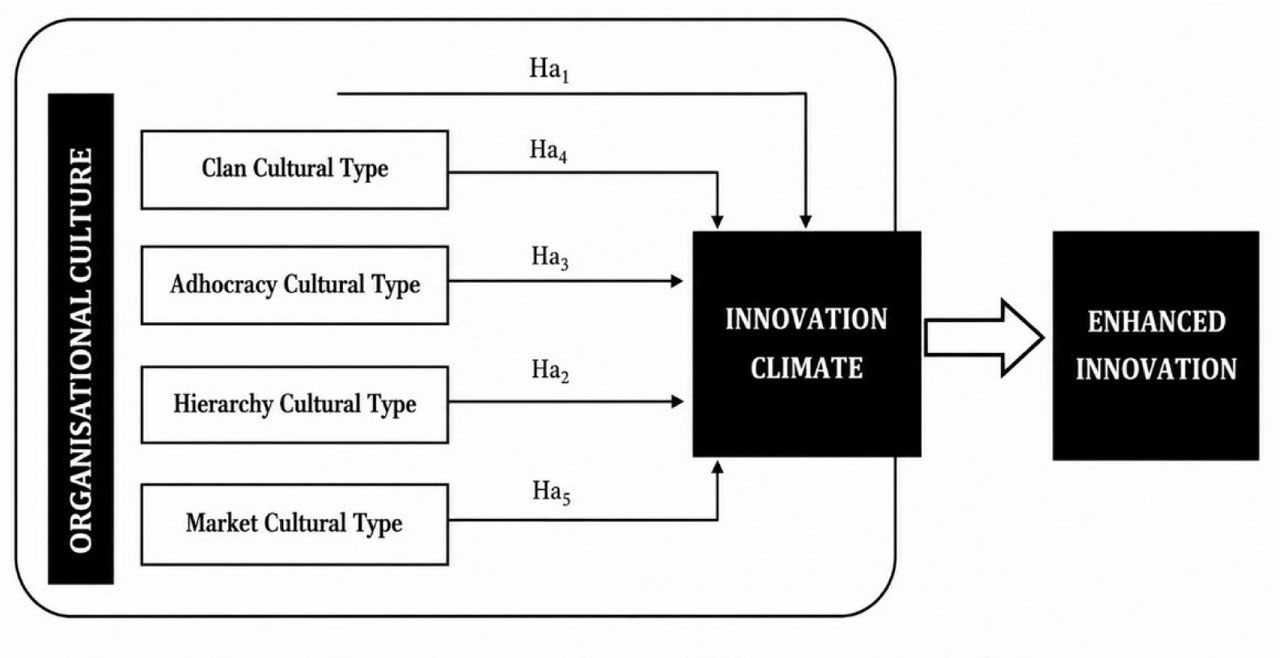
Figure 2.
Proposed conceptual framework linking organizational culture types, innovation climate, and enhanced innovation.
Source: own processing
Conceptual Framework
Studies on universities and knowledge-intensive organizations show that digitalization strategies such as learning management systems (Thilagam & Barathi, 2025), data analytics (Zou et al., 2025), and virtual collaboration platforms (Asrifan et al., 2025) reshape work practices and expectations, thereby requiring cultures that support agility, experimentation and continuous learning to maintain a positive innovation climate. In this sense, digital transformation is not only a technological trajectory but also a cultural change process that can either enable or erode innovation, depending on prevailing norms around risk-taking, autonomy and knowledge sharing (Newman et al., 2020). Evidence from African and other emerging-economy contexts suggests that institutional capacity, science and technology readiness, and critical skills shortages interact with organizational culture to influence the development and sustainment of innovative climates (Odei & Soukal, 2026). In the Namibian context, existing weaknesses in science and technology, as well as limited research funding, imply that universities must cultivate cultural configurations that actively compensate for structural constraints through collaboration, knowledge sharing and support for initiative.
Research methodology
This study adopted a pragmatic philosophy, which allows the researchers to develop objective knowledge about the relationship between organizational culture and innovation climate through logical reasoning and empirical evaluation of data. Quantitative research, as explained by Cresswell (2014), invokes pragmatic perspectives and includes true experiments, correlational studies, and quasi-experiments, including single-subject experiments. This quantitative study seeks to answer research questions on organizational culture and innovation climate while simultaneously establishing and testing the corresponding hypotheses.
The research population for this study constituted 979 employees, namely, administrators and academics at the university. The selection of the population was based on their ability to provide informed responses. For this study, the researchers used stratified random sampling. If the population from which a sample is to be taken does not consist of a unified group, stratified sampling is then used to generate a representative sample (Kothari, 2004). The population was split into several subpopulations that were each more homogeneous than the entire population (these subpopulations were referred to as “strata”) and then items from each stratum were chosen to create a sample. The researchers also took respondents’ relevant characteristics into consideration when determining the sample size for this research study.
The stratified sampling formula used is as follows: Total Sample Size/Entire Population x Population of Subgroups was used to produce the number of respondents in this study. University statistics indicate that the institution has an employee population of 978 staff members. Two hundred and fifty-eight (258) were targeted for this exercise and 100 responded. An online survey instrument was created on Jotform, and the link was distributed to employees by email, as most of them had not yet resumed full-time office duties. Before the commencement of each academic year, academics at the university tend to have minimal on-campus office use, with many preferring to telework.
Data was collected using both primary and secondary sources. A questionnaire containing both closed and open-ended questions was used to collect primary data, while secondary source data was gathered through a review of the extant literature. Questionnaires were informed by the Organizational Culture Assessment Tool, and the twenty-six-item innovation climate scale (Scott & Bruce, 1994), which included both open- and closed-ended questions to establish organizational climate.
Instruments employed in this study were on-line questionnaires specifically formulated to diagnose organizational culture according to the OCAI, the CVF and the twenty-two-item Innovation Scale developed by Scott and Bruce (1994) to capture employees’ perceptions of the organizational innovation climate. To derive conclusions and distributions from the built questionnaire, this study used basic descriptive statistics to explain the quantitative data. Data gathering for this study was facilitated through standardized tools in order to ensure the authenticity, accuracy and reliability of the information collected. As questionnaire responses were collected, the researchers verified that the responses adequately addressed the research objectives.
A multiple linear regression model was used for this study. In this model, innovation climate served as the dependent variable, while the four organizational culture types derived from the CVF (Hierarchy, Adhocracy, Clan, and Market cultures) were specified as independent variables. The general form of the model can be expressed as:
where Y denotes innovation climate, X1–X4 denote the four culture types (Hierarchy, Adhocracy, Clan, and Market, respectively), β0 is the intercept, β1–β4 are the regression coefficients, and ε is the error term.Findings
The Pearson correlation assesses whether there is statistical evidence for a linear relationship between the same pairs of variables in the population, as measured by the population correlation coefficient, ρ (“rho”). The relationship between the dependent and independent variables was investigated using multiple linear regression analysis.
The null hypothesis (H01) proposes that the prevailing organizational culture does not influence innovation climate at the university. According to the regression coefficient (B), for each one-unit increase in organizational culture, the model predicted a significant corresponding increase in innovation climate, controlling for the other variables (Table 1).
Table 1.
Summary showing organizational cultures and innovation climate in the university
| S/N | Innovation Climate | Mean | Standard deviation | R-Square | Standardized coefficient | B | F | Sig (p-value) |
|---|---|---|---|---|---|---|---|---|
| 1 | Hierarchical culture | 49.16 | 10.8 | .148 | .734 | 23.14 | 5.5 | .001 |
| 2. | Adhocracy culture | 49.17 | 17.86 | .138 | .819 | 307.500 | 3.792 | .000 |
| 3 | Clan culture | 49.17 | 13.36 | .082 | 1.7 | 641.85 | 3.224 | .094 |
| 4 | Market culture | 49.01 | 8.14 | .145 | 13.69 | 195.84 | 9.005 | .693 |
The analysis indicates that organizational culture has a statistically significant, positive association with innovation climate at the university. The multiple regression results show that organizational culture explains 14.8% of the variance in innovation climate (R2 = 0.148), suggesting that while culture is an important determinant, additional organizational and contextual factors also contribute to the innovation climate. The unstandardized coefficient (B = 0.734) for overall organizational culture implies that a one-unit increase in the culture score is associated with a 0.734-unit increase in innovation climate, confirming the first alternative hypothesis that organizational culture positively influences innovation climate. This result provides support to confirm Hypothesis H01. The model includes the innovation variable, the increase in score of the Hierarchy Culture type with a standard mean which proved to be the most dominant culture type at the university.
The alternative hypothesis (H02) was excluded from the model as it does not significantly contribute to innovation climate at the institution. However, H03: Adhocracy Culture type does not influence innovation climate at the university. The Adhocracy Culture type scored the highest of all the organizational culture types at the university with a standard mean of 17.86 overall. As indicated in the results above, where p < 0.05, the population correlation coefficient differs significantly from zero, indicating that a correlation exists, with a p-value of less than 0.001 for inhibitors of innovation climate. It is thus conclusive to say that this result supports the null hypothesis that the Adhocracy culture type does not significantly influence innovation climate at the university.
Hypothesis H04: Clan Culture type does not influence innovation climate at the university. The Clan Culture type excludes the formal rules and procedures of hierarchies or the competitive profit centrality of markets, thus is held together by loyalty and tradition and commitment is high. Clan culture emphasizes the long-term benefit of individual development, with high cohesion and morale being important, and with success defined in terms of an internal climate and concern for people; it is concluded to influence innovation climate (B = 1.7, p > 0.001).
Hypothesis H05: Market Culture type does not influence innovation climate at the university. Market culture was statistically insignificant, as indicated in the table; nevertheless, the R-squared of 0.145 indicates meaning that 14.5% of the variance in innovation climate is explained by Market culture.
Discussion of findings
The OCAI results indicate that Hierarchical culture is dominant at the university, signaling a formalized and highly structured work environment in which procedures and rules govern daily activities. This dominance of Hierarchy culture is theoretically consistent with the CVF’s assumption that stability, control and formalization can discourage experimentation and risk-taking, thereby constraining a climate that is supportive of innovation. However, the modest explanatory power of organizational culture (R2 = 0.148) suggests that, while culture is a statistically significant predictor of innovation climate, a substantial proportion of variance remains unexplained, pointing to additional organizational and institutional factors beyond culture alone. This nuance is often underemphasized in the literature, which tends to foreground culture as a primary driver of innovation without sufficiently interrogating its relative contribution vis-à-vis other antecedents.
Prior studies (e.g., Alawamleh et al., 2023; Lau & Ngo, 2004; Martins & Terblanche, 2003; McAllaster, 2003; Naranjo-Valencia et al., 2016) conceptualize Hierarchy culture as inherently control-oriented and inward-looking, thereby inhibiting innovation through the suppression of autonomy, experimentation and risk-taking. The present findings partially reinforce this view, as the dominance of Hierarchy coincides with a relatively weak innovation climate. However, the positive and significant regression coefficient for Hierarchy also indicates that, in this context, formalization may provide a minimal but necessary structure for coordinated innovative efforts rather than purely constraining them. This ambivalence challenges overly dichotomous portrayals of Hierarchy as uniformly detrimental and suggests that, in resource-constrained higher education settings, some degree of procedural stability may be a prerequisite for sustained innovation (Bayuo et al., 2020; Kede Ndouna & Tsafack Nanfosso, 2024).
Thus, this study’s finding raises an important contextual question: to what extent does the Namibian higher education environment, characterized by limited funding and weak national science and technology capacity, require a baseline of hierarchical coordination before more flexible, adhocratic practices can take root? Existing CVF based studies rarely interrogate how macro-level institutional constraints condition the effects of culture types on innovation climate (DeGraff, n.d.). This question was answered in the present study.
Adhocracy culture recorded the highest mean score among the four culture types yet was statistically excluded from the model as a non-significant predictor of innovation climate. This apparent disconnect between descriptive prominence and explanatory insignificance invites a more critical interpretation. It may indicate that adhocratic values are symbolically espoused in policy documents and strategic rhetoric but are not yet sufficiently institutionalized in day-to-day practices to shape employees’ perceptions of the innovation climate (Gorzelany et al., 2021). In other words, the university may exhibit what could be termed “decoupled Adhocracy”, in which formal discourse stresses flexibility, creativity and risk-taking while actual behavioral routines remain largely hierarchical (Hangula et al., 2020). This decoupling is consistent with institutional theory arguments about the gap between formal structures and enacted practices in public sector organizations, but it is insufficiently addressed in most CVF-based empirical studies. As emphasized in DeGraff (n.d.) and Naranjo-Valencia et al. (2016), the focus of the CVF is related to people and their behaviors, emphasizing the role of organizational culture as a factor that can stimulate, restrain or enhance innovation.
The results for Clan and Market cultures are more equivocal. Clan culture, typically associated with trust, cohesion and internal focus, shows a weak and statistically marginal relationship with innovation climate (B = 1.7, p > 0.001), suggesting that a supportive, people-oriented atmosphere alone is not sufficient to drive innovation in this setting. Similarly, Market culture explains a comparable proportion of variance to hierarchy (R2 = 0.145) but is statistically insignificant, which implies that performance and competition-oriented values may not straightforwardly translate into an enhanced innovation climate in a public university environment where market pressures are muted and bureaucratic constraints are strong (Wang et al., 2021; Newman et al., 2020). Taken together, these patterns complicate the often-repeated claim that Clan and Market cultures are inherently more innovation-friendly than Hierarchy. Rather, their effects appear contingent on sectoral logics (public vs. private), resource conditions and the degree of alignment between cultural values and organizational incentives. Therefore, Clan, Market and Hierarchy culture types inhibit innovation climate as also opined by Naranjo-Valencia et al. (2016) and Bayuo et al. (2020).
Extant meta-analytic and empirical work generally concludes that Adhocracy is positively associated with innovation, whereas Hierarchy tends to inhibit innovative outcomes (Noone et al., 2024; Xu et al., 2023). The present study partly corroborates this pattern by highlighting Adhocracy as the most conceptually conducive culture for fostering innovation in higher education; yet the empirical dominance of Hierarchy and the limited variance explained by culture alone underscore the need to refine such generalizations. In particular, the Namibian case demonstrates that in contexts with weak national innovation systems and constrained resources, the interplay between culture types may be more complex, with hierarchical structures simultaneously enabling coordination and constraining exploratory behavior. University leaders should therefore deliberately rebalance cultural emphasis by introducing elements of Adhocracy (flexibility, external orientation, and entrepreneurial behaviors) into existing structures.
The study indicates that innovation climate is sensitive to how culture is enacted through rewards, recognition, and support for new ideas. University HR policies should therefore move beyond compliance-oriented appraisal systems and integrate innovation-related criteria, such as knowledge sharing, participation in interdisciplinary projects, curriculum or process innovations, and engagement with external partners. In the Namibian context, this alignment also strengthens the university’s contribution to national innovation and skills agendas by translating cultural insights into concrete policy levers.
Conclusion and recommendations
Organizational culture and innovation climate are two important aspects that contribute to economic sustainability, organizational growth and business continuity. In order for this to happen, it is important to consider the organizational culture to assist with the process of strategically aligning goals and objectives with a strategy to reach a specific target. In this instance, it was to determine the influence of organizational culture on innovation climate. Institutions of higher learning need the right organizational culture as a key element to enhance innovation climate. For this study, the CVF was employed, and the implications below are evident at the university.
The descriptive statistics from the OCAI and the CVF show that, with a mean of 49.16%, the Hierarchy organizational culture type proved to be dominant at the university. Employees perceive the university to be a formal and structured place in which to work. The university is governed by relatively clear and well-designed business processes. The identified dominant organizational culture, which is of Hierarchical type, emphasizes environments that are secure, where projects and processes are integrated and synchronized. In addition, uniformity in goods and services is maintained, and employees and jobs are under control. This leaves little room for innovation or enhancing an innovative culture through rules, systems, and procedures.
The research also identified Adhocracy culture as the best predictor of innovation culture in organizations and concluded that this culture mediates the influence of certain organizational culture types on innovation climate. The research further motivates the Adhocracy Culture type as promoting flexibility and change and that it is also externally oriented. Leaders within an Adhocracy Culture strive to be market leaders and actively promote dynamic operations and change. Key values in an Adhocracy culture are entrepreneurship, creativity and risk-taking, which are essential for promoting and influencing innovation climate within organizations (Kede Ndouna & Tsafack Nanfosso, 2024; Naranjo-Valencia et al., 2016; Newman et al., 2020). There is a positive association between innovation climate and an organizational emphasis on human development, high trust, openness and participation. However, weak innovation management has an impact on research financing, training, and collaboration, causing a lack of research integration, technological development, technology transfer, and entrepreneurship, as well as a lack of global collaboration with research institutes (Hangula et al., 2020; Namibia University of Science and Technology, 2021).
Overall, the findings indicate that the current dominance of Hierarchy culture at the university is misaligned with the strategic imperative to strengthen innovation climate, particularly considering national deficits in science, technology and innovation capacity. While a certain level of formalization remains necessary, the over-reliance on rules, procedures and stability leaves limited space for the experimentation, cross-boundary collaboration and risk-taking that are central to an innovation-oriented environment. Consequently, culture-change initiatives should not merely advocate a generic move towards Adhocracy but should deliberately target the specific hierarchical practices that most directly inhibit innovation — such as rigid approval processes, risk-averse leadership behaviors and the absence of incentives for experimentation — while preserving those elements of structure that support reliable operations. In practical terms, this entails redesigning reward systems to recognize innovative efforts, creating protected spaces for experimentation, and equipping leaders at multiple levels with the skills to balance compliance expectations with support for creative problem-solving.
Limitation of the study and directions for future research
The study thus contributes to the organizational culture–innovation literature by shifting the focus from identifying a single “optimal” culture type towards emphasizing the dynamic tension between stability-oriented (Hierarchy) and change-oriented (Adhocracy) values in shaping innovation climate in emerging-economy higher education institutions.
Although the study provided valuable insights, it is not without its limitations. First, the study focused on one Namibian institution; as a result, the findings may not be generalizable to other organizations or contexts. Future studies may involve more organizations, or replicate this study using organizations from different industries, to enable stakeholders to compare results. Furthermore, the quantitative nature of the study means that the study could not explore context-specific variables that may have an influence on organizational culture and innovation. Future studies may adopt qualitative designs to unearth context-specific issues that may be relevant to organizational culture and innovation, particularly given the underdevelopment of this research domain in the Namibian context.