
Introduction
The relationship between the concepts of perceived psychological contract breach and counterproductive work behavior (CWB) among employees has attracted significant attention in organizational psychology and human resource management research (Aqil et al., 2023). Psychological contract refers to unwritten implicit expectations and obligations that exist between individuals and organizations, influencing their attitudes, behaviors and outcomes in the workplace (Kumarika Perera et al., 2017). However, breaches of this contract, whether perceived or actual, can lead to detrimental outcomes such as decreased job satisfaction, lowered organizational commitment, and counterproductive work behavior. While psychological contract breach occurs when employees perceive that their organization has failed to fulfil its promises or obligations (Gray, 2018), counterproductive work behavior encompasses a spectrum of employee actions considered detrimental to the functioning, reputation and success of the organization.
Among the factors influencing the relationship between psychological contract breach and counterproductive work behavior, revenge appears to have emerged as a mediator (Griep et al., 2018). Revenge, defined as the desire to retaliate against perceived injustices or wrongdoings, holds the potential to exacerbate the negative consequences of psychological contract breach by driving hostile attitudes and behaviors within the workplace (Akgunduz et al., 2024). Despite this claim, the mediating role of revenge in the context of the relationship between perceived psychological contract breach and counterproductive work behavior remains underexplored, particularly within academic settings. The academic environment, which is often characterized by intellectual rigor and hierarchical structures, provides an ideal environment for investigating the complex interplay between perceived psychological contract breach, revenge, and counterproductive work behavior. In this context, academics face a multitude of pressures, ranging from publishing demands and tenure requirements to administrative burdens and resource constraints (Naidoo-Chetty & du Plessis, 2021). Consequently, any disruptions to their psychological contracts may induce strong emotional responses, including the urge for betrayal, resentment and the eventual desire for revenge.
The psychological contract breach and CWB literature is replete with related studies including the impact of psychological contract breach and CWB mediated by organizational trust and work engagement (Aqil et al., 2023); the relationship between psychological contract breach and CWB in social enterprise between paid and volunteer employees (Griep et al., 2020); psychological contract breach and service innovation behavior: psychological capital as a mediator (Kim et al., 2018); psychological contract breach and enterprise CWB: mediating effect of organizational cynicism and work alleviation (Li & Chen, 2018); mediating model of CWB, organizational justice, organizational embeddedness and psychological ownership (Mehmood et al., 2023). In a more closely related study conducted in South Africa, Botha and Steyn (2020) investigated psychological contract breach and innovative work behavior, and Makara and Chipunza (2025) interrogated how revenge mediates the relationship between psychological contract breach and CWB among administrative staff of a higher education institution. However, with regard to the mediating role of revenge in the relationship between psychological contract breach and CWB in Ghana, hardly any study has been conducted, particularly with a focus on academics in higher education institutions. This gap conveys the originality of this study. In part, the study attempts to understand how psychological contract breach explains CWB at both the individual and organizational focus level. It also attempts to understand how the feeling of revenge mediates the relationship between psychological contract breach and CWB.
The quest to understand the mediating role of revenge in the relationship between psychological contract breach and CWB seeks to advance both theoretical knowledge and practical implications or interventions towards promoting a harmonious and productive work environment in the context of academia. On a theoretical level, it will shed light on the underlying mechanisms through which perceived psychological contract breach translates into CWB, offering valuable insights into the complex dynamics of workplace behaviors. From a practical perspective, identifying revenge as a mediator opens avenues for targeted interventions aimed at mitigating its detrimental effects, enhancing a good working environment. The study thus seeks to bridge this gap in the literature by investigating the mediating role of revenge in the relationship between perceived psychological contract breach and counterproductive work behavior among academics of higher institutions of learning in Ghana. After building a theoretical argument through the Social Exchange Theory, the paper shifts to the review of literature and hypotheses development. The paper then explains the methodological approaches including research participants and settings, measurements and procedures.
Social Exchange Theory: theoretical basis
The Social Exchange Theory predominantly developed by Homans (1961) has its assumptions rooted in the behavioral interactions of individual actors with fundamental emphasis on social behavior including power, conformity, leadership and justice. Homans’s (1961) theoretical propositions are neatly grounded in the belief that there are no events that happen in a social group that cannot be explained by exchange and conditions. For Homans (1961), social exchange is defined as the exchange of activity (whether in tangible or intangible terms) which yields either rewards or costs between two or more individuals. A psychological contract is considered as an exchange between two people in the context of work relations (employer and employee) (Cropanzano & Mitchell, 2005). The feeling of psychological contract breach is anchored on the perception that injustice, abuse of power, non-conformity to employment terms and poor leadership have occurred, which consequently provokes CWB. To understand the correlation between psychological contract breach and CWB in line with the exchange of trust between the employer and employee as individuals in a social exchange, the study employs revenge as a mediating variable.
The Social Exchange Theory is crucial in this study for explaining how revenge mediates the relationship between psychological contract breach and CWB. For instance, the terms of reference and exchange of relationship that exist between the management and academics are strongly guided by social contracts of trust and fairness in the discharge of their respective responsibilities. A perceived or noticeable breach in this contractual relationship is considered as a recipe for negative feelings and attitudes that contradict the existing cordial work relationship. Available literature (Ahmad et al., 2023; Lu et al., 2018) has reinforced the consequence of contract breach as negative emotions and withdrawal from the work relationship. While this has been established, we argue that revenge can explain this breach in a more nuanced way, thus refining or contributing to the Social Exchange Theory framework.
Although the Social Exchange Theory has been relevant in explaining the dynamics and interplay in social behavior and exchange relationships, the theory is not without its limitations. First, the theory has been critiqued for reducing complex interactions to a collection of estimates, thus considered too simplistic (Lind, 1995). Second, critics argue that the assumptions are Western-laden with emphasis on individualism, while neglecting the importance of interdependence culture (Ahmad et al., 2023). With the upsurge in the influence of globalization, it is important to consider how the theory explains different cultures in the social exchange discourse, rather than relying solely on individualism (Cropanzano & Mitchell, 2005).
Literature review and hypotheses development
Psychological contract breach and feeling of revenge
Employees who perceive that their employer has failed to honor its obligations to them, described as a psychological contract breach, may react in ways that will harm the organization (Bordia et al., 2017). In the circumstance that the breach is perceived as significant enough, the employees, in diverse ways, may seek revenge against the organization by indulging in workplace antisocial behaviors intended to ruin the fortunes of the organization (Sharif et al., 2017). Several triggers of revenge-seeking at the workplace, including status and power derogation (undermining employee status), rule violation (breaking of established norms and rules) and goal obstruction (obstruction of the attainment of anticipated goals) have been identified (Osgood, 2017; Şantaş et al., 2018).
Gerlsma and Lugtmeyer (2018) reported, consistent with retaliatory and revenge theories, that revenge follows a path involving violated expectations, and that the most common response triggered by psychological contract breach perceptions is the feeling of revenge. Kraak et al. (2017) substantiated this assertion when they found that once there is a perception of breach and blame is apportioned, the stimulus for revenge develops. The findings above suggest that academics might undergo some intention-deduction processes following any perceptions of psychological contract breach to decide whether their institutions should be held accountable for the sentiments they hold or otherwise. Thus, academics might develop heightened feelings of violations and might probably take revenge or retaliate if they find the institution responsible for their predicaments.
Rousseau et al. (2018) posited that the target of employee revenge, in any form, is mostly the source of the perceived psychological contract breach. Earlier studies, such as Huang et al. (2018) and Bani-Melhem et al. (2020), similarly demonstrated that retaliatory or revengeful attitudes because of employee perception of psychological contract breach could either be directed at individuals within the organization or at the organization itself, depending on the perceived sources of the psychological contract breach. Academics who perceive that their institutions have reneged on the fulfilment of their obligations to them might react in ways targeted at harming the institution by reducing their contributions to the success of the institution. Such academics might seek revenge against the institution by engaging in various forms of workplace antisocial behaviors intended to ruin its fortunes. These views are formalized in the hypothesis that:
H1: Psychological contract breach positively influences feelings of revenge.
Psychological contract breach and counterproductive work behavior
The failure of organizations to keep their promises and obligations in an employer-employee relationship constitutes perceived psychological contract breach (Mmamel et al., 2021). According to Protsiuk (2019), any perception of failure in the fulfilment of an aspect or the whole of the employer’s obligations to its employees is referred to as psychological contract breach. Azeem et al. (2020) observed that employees experience psychological contract breach when they feel that the organization has failed to deliver on its obligations in a work relationship. Counterproductive work behavior refers to any voluntary act by a party in an employment relationship considered detrimental and contrary to the legitimate goals and objectives of the organization (Lubbadeh, 2021). Counterproductive work behavior is viewed as any ill-conceived act aimed at violating accepted organizational norms, values and practices that run contrary to the genuine interests of the organization (Griep et al., 2020). Further, any act perpetrated by a party in a work relationship which potentially violates, runs contrary to, or harms the legitimate interests of the business, its clientele or other associates is referred to as counterproductive work behavior (Rousseau et al., 2018).
Ma and Liu (2019) identified two distinct dimensions of the concept of counterproductive work behavior, namely (i) counterproductive work behavior organization focus (CWB-O) and (ii) counterproductive work behavior individual focus (CWB-I). Ma and Liu noted that whereas CWB-O refers to organizational deviant acts or antisocial workplace behaviors principally targeted at the organization, CWB-I refers to interpersonal deviant acts or antisocial workplace behaviors targeted at individual members of the organization. The explicit dimension of counterproductive work behavior thus reflects whether the deviance is directed at the organization or at members of the organization (Carpenter et al., 2021). The current study therefore applies the two-way dimension of the construct, that is, CWB-O and CWB-I, considering that most of the instances of counterproductive work behavior identify with either of the two. Given that the two classifications are widely accepted, this framework is applicable to academics in institutions of higher learning in Ghana. The academics who live with the perception of psychological contract breach might engage in counterproductive work behaviors focusing on individuals or on the institution itself as a coping strategy. In this regard, the following hypothesis is proposed:
H2: Psychological contract breach relates positively with individual and organizational counterproductive work behavior (CWB-I and CWB-O).
Feeling of revenge and counterproductive work behavior
Welander et al. (2017) observed that employees, when aggrieved at work, may experience varied levels of disappointment, anger and frustration, which could motivate their desire to take revenge against the source of their displeasure, by engaging in different forms of counterproductive work behaviors in response (Perera et al., 2018). In a similar vein, Rousseau et al. (2018) posited that the target of employee revenge, in any form, is mostly the source responsible for their disappointment. Carpenter et al. (2021) observed that counterproductive work behavior within the organization is a manifestation of revenge cognitions of employees. In the work of Javed et al. (2019), it was found that, on the principle of exchange and reciprocity, organizations needed to repay positive deeds with positive deeds, and that if employees receive or perceive harm, they might reciprocate in a comparable fashion, and counterproductive work behavior will be the result.
This view above is conceptually connected with the ‘Just World Theory’ of Lerner (1991), which propounded that employees believe in retributive justice and that deviants or offenders in the employee-employer relationship must pay appropriately or be punished in the like manner for their transgressions (Vargas-Salfate et al., 2018). Ishaq and Shamsher (2016) showed that revengeful acts are responses to certain organizational situations linked to issues such as goal obstruction, attack on employee status and power or violation of promises, resulting in counterproductive work behavior. Bani-Melhem et al. (2020) observed that feelings of anger and the tendency to retaliate or revenge, whether directed at the organization or individuals within the organization, are normally well-calculated, well-thought-out courses of action and mostly preceded by a strong zeal or desire to harm or hurt the wrongdoer.
For the current study, it could be suggested that academics who are aggrieved due to commissions or omissions attributable to their employer might conceive some cognitive motivational intents of revenge to settle scores with the ‘wrongdoer’ (the employer). It is thus apparent, in these discussions, that revenge cognitions of academics preceded their enactment of behaviors targeted at harming the institution. Under the circumstances, retaliatory feelings or revenge cognitions mediate the perception of psychological contract breach and counterproductive work behaviors (Witten, 2019). Academics are, thus, most likely to adopt the strategy of retaliation or revenge against their respective institutions by engaging in acts of counterproductive work behavior as a means of dealing with perceived imbalances. In this regard, it is proposed that:
H3: Feelings of revenge will positively influence individual and organizational focus counterproductive work behavior (CWB-I and CWB-O).
Kraak et al. (2017) observed that employees, at the perception of psychological contract breach situations at work, may experience varied levels of disappointment, anger and frustration, which could motivate their desire to take revenge against the organization, by engaging in different forms of counterproductive work behaviors in response. A previous study focused on the relationship between psychological contract breach and counterproductive work behaviors in social enterprises and indicated that revenge feelings or retaliation appeared to be the mediator in the relationship between psychological contract breach and counterproductive work behaviors within the organization (Griep & Vantilborgh, 2018). Hence, it was hypothesized that:
H4: Feelings of revenge will mediate the relationship between psychological contract breach and counterproductive work behavior focused on both individual academic staff and the institution.
Based on these hypotheses, the following model was elaborated (Figure 1).
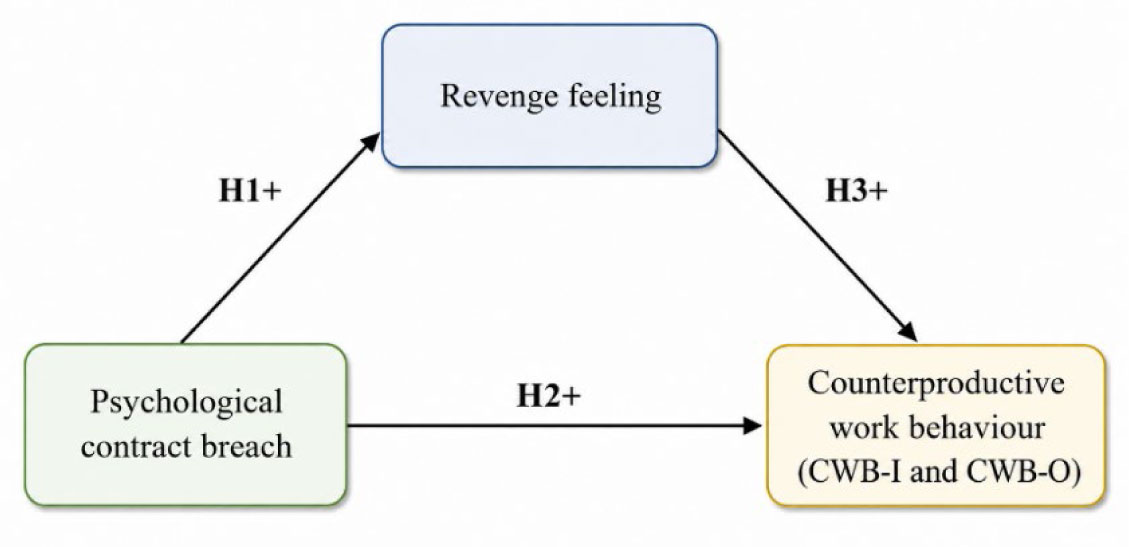
Figure 1.
Conceptual model
Source: own processing
Research methodology
Participants and settings
A total of 716 academics were surveyed in selected Technical Universities in Ghana. Survey research design allows for the representation of a sample population to generalize (Kapur, 2018). The survey design is justified since all the academics in the selected Technical Universities cannot be sampled for this study. Hence, the survey sample for generalization is appropriately justified. The study used closed-ended questions to collect the data. The items for each factor were adopted from the sources and, where necessary, modified to fit the current study. Table 1 shows that the majority, representing 41.3%, were within the age group of 36 to 45 years.
Table 1.
Participants’ demographics
| Demographics | Category | Frequency | Percentage |
|---|---|---|---|
| Age | 24–35 | 220 | 30.7 |
| 36–45 | 296 | 41.3 | |
| 46–55 | 161 | 22.5 | |
| >56 | 39 | 5.4 | |
| Gender | Male | 449 | 62.7 |
| Female | 267 | 37.3 | |
| Marital Status | Married | 419 | 58.5 |
| Never married | 238 | 33.2 | |
| Divorced | 53 | 7.4 | |
| Widowed | 6 | 8 | |
| Education | Bachelor/Diploma | 227 | 31.7 |
| Master’s | 314 | 43.9 | |
| PhD | 170 | 23.7 | |
| Postdoctoral | 5 | 7 | |
| Rank | Assistant Lecturer | 150 | 20.9 |
| Lecturer | 159 | 22.2 | |
| Senior Lecturer | 78 | 10.9 | |
| Professor | 27 | 3.8 | |
| Administrative | 302 | 42.2 | |
| Income | ≤2000 | 43 | 6.0 |
| 2000–4000 | 178 | 24.9 | |
| 4000–6000 | 220 | 30.7 | |
| 6000–8000 | 172 | 24.0 | |
| >8000 | 103 | 14.4 | |
| Nationality | Ghanaian | 688 | 96.1 |
| Others | 28 | 3.9 |
The results also revealed that the majority were male, representing 62.7%. Of the respondents, 58.5% were married and 33.2% were single. The majority, with 43.9%, had a master’s degree as their highest qualification. Most of the respondents represented by 42.2% held administrative roles. Most of the participants, representing 30.7%, were earning a monthly income between Four Thousand Ghana Cedis (GH¢4,000.00) and Six Thousand Ghana Cedis (GH¢6,000.00).
Measurement
All the items were rated on a 4-point Likert scale, ranging from 1-strongly disagree to 4-strongly agree. The respondents were requested to select suitable responses by indicating the extent to which they observe a particular statement to be expressive of a given situation in focus. Explicitly, the following scales and their conforming previous Cronbach Alpha values were used.
Psychological contract breach was measured with a global breach scale with 5-items taken from Kim et al. (2018). An example of the item is ‘My employer has broken many of its promises to me even though I have upheld my side of the deal’. Three out of the 5-items were reversed to reflect positive scenarios. For instance, ‘So far my employer has not kept all the promises made during recruitment’ was reframed to be ‘Almost all the promises made by my employer during recruitment have been kept so far’. The reported alpha of the adapted scale is 0.86 (Kim et al., 2018).
Further, Revenge feeling was measured using seven (7) validated items used by Uzun (2018). Example items on the scale are: ‘I have to take revenge to be happy’ and ‘I feel uneasy when I cannot get revenge.’ The reported reliability of the scale is 0.76 (Uzun, 2018).
Counterproductive work behavior was measured with the 10-Item Short Version Scale developed by Spector et al. (2010) and used by Arkan (2016). The 10-item scale has 5 organization-focused items (e.g., ‘Purposely wasted your employer’s materials/supplies’) and 5 individual-focused items as sub-scales (e.g., ‘Insulted someone about their job performance’). Previous reliability alpha (α) values for the organizational-focused and individual-focused items were 0.668 and 0.801 respectively (Arkan, 2016).
Data collection and procedure
The questionnaire was pre-tested on 95 academics in an analogous institution to examine the content validity of the items prior to the collection of final data for the study. The respondents were required to provide an assessment on whether the items in the instrument covered all the key variables of the study, and whether the instructions and items were easily understood. The feedback from the pilot test provided the basis for a revision of the items to improve clarity and readability in addressing the objective of the study. The refined questionnaire was then used to collect the final data for the study. The introductory part of the questionnaire laid emphasis on answering all items to avoid the incident of missing data in the final data set. Data collection was done in phases to lessen common method variance. Common Method Variance refers to the variance attributable to the measurement method rather than to the construct of interest (Henseler, 2017). Owing to the busy schedules of the target respondents, the questionnaires were administered through a drop-and-pick-later approach, allowing the respondents to focus on their normal work schedules and responsibilities while attending to the questionnaire at their own pace and convenience within a two-week timeframe.
Data analysis
IBM SPSS and Analysis of Moment Structures (AMOS) 22.0 were used to analyze the data. Two steps were adopted in addressing the research objectives. Confirmatory Factor Analysis (CFA) was first employed to verify the measurement structure of the underlying factors (Makransky et al., 2017) and assess the reliability and validity of the constructs (Isah et al., 2023). The validity and reliability estimates indicate how well the observed variables represent the latent factors. The internal consistency of the valid items was checked using construct reliability. This captures the extent to which the items represent the underlying latent construct, based on estimates of model parameters. Squared Multiple Correlations (SMC), Standardized Factor Loading (SFL), and Composite Reliability (CR) were used to further examine the internal reliability for each construct. The convergent and discriminant validity of all the constructs was checked using Average Variance Extracted (AVE) and the Square Root of AVE. Discriminant validity demonstrates the extent to which the constructs in a model are different (Isah et al., 2023). In the second step, Structural Equation Modelling (SEM) was employed to test the hypothesized relationships between the independent variables and outcome variables.
Three classifications of model fits including Absolute Fit (AF), Incremental Fit (IF), and Parsimonious Fit (PF) are usually applied in evaluating the fitness indexes of the measurement scale. Thus, for each of the steps (DiStefano et al., 2018), the minimum value of discrepancy function Chi-Square, Comparative Fit Index (CFI), Degrees of Freedom (DF), Normed Fit Index (NFI) and the Root Mean Squared Error of Approximation (RMSEA) were reported. SEM was adopted for the following reasons: SEM can handle multidimensional relationships among latent variables, where certain constructs may be hypothetical or unobserved (Hair et al., 2017). Another reason for the use of SEM is its suitability for large data sets (Melchers & Beck, 2018), as is the case in the current study, with a sample size of 716 respondents.
Ethical considerations
Permission was sought and obtained from authorities of each of the selected institutions to conduct the study. The study was approved by the Faculty of Management Science Research Committee with reference number FMSEC211119. Consent of the academics who participated in the study was solicited (that is, informed consent) at the time of dropping the questionnaires. Designed consent forms were signed by each respondent and handed over to the researcher. Respondents were carefully briefed on the rationale and objectives of the study. In addition, the participants’ right of refusal and withdrawal (DiStefano et al., 2018) at any stage of the study without any enforceable obligations was emphasized by the researcher. The confidentiality and anonymity of the respondents were strictly maintained throughout the data collection and reporting stages.
Results and discussion
Multicollinearity
Following the data screening and normality test, an assessment was carried out to examine multicollinearity in the dataset (Table 2).
Table 2.
Multicollinearity test
| Independent variables | Collinearity statistics | Collinearity statistics |
|---|---|---|
| Tolerance | VIF | |
| Psychological Contract Breach (PCB) | 0.931 | 1.075 |
| Revenge feeling (RF) | 0.595 | 1.680 |
According to Pallant (2020), multicollinearity refers to high correlation between two or more variables. The value of tolerance greater than 0.10 and VIF value less than 3.0 suggest no multicollinearity concerns. Given that all the independent constructs had VIF values less than 3.0 and tolerance values exceeding 0.10 (see Table 2), it was concluded that there was no multicollinearity in the dataset.
Construct reliability and validity
The CFA is performed by putting together all latent constructs at the same time in one measurement model to achieve all-inclusive model fitness and further verify the reliability, convergent and discriminant validity of the various constructs. The counterproductive work behavior has two sub-constructs: organizational and individual focused. These constructs were treated in the CFA model as a second-order construct (see Figure 2) to examine how the observed variables measure each of the dimensions and, by extension, how the dimensions represent the main construct. It was observed that the fit indices of the CFA model were poor and the items CWB 1 and CWB2 loadings were low. Therefore, these items were deleted. After model modification, the fitness indices were improved above the recommended value, suggesting that the items were acceptable for further analysis.
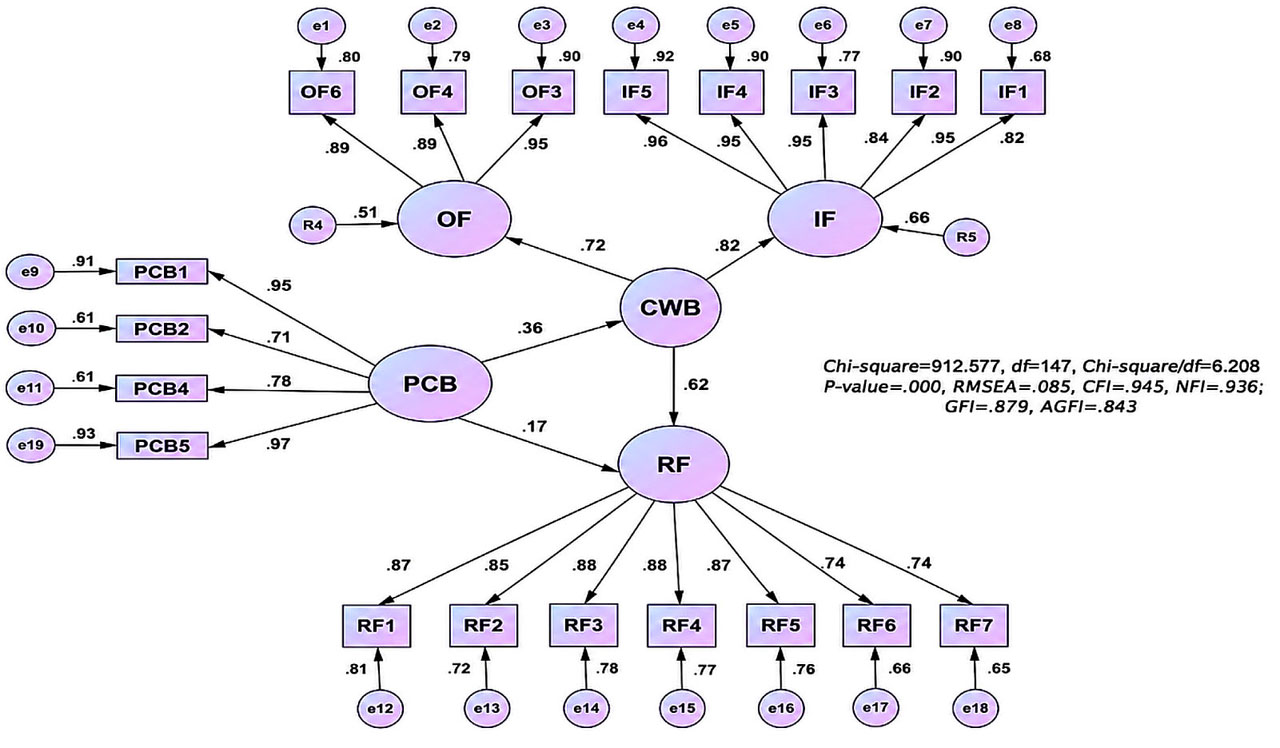
Figure 2.
Confirmatory factor analysis
Source: own processing
The results in Table 3 show the modified confirmatory factor analysis of the constructs. Studies have shown that a value of Cronbach’s alpha or CR above 0.70 indicates good internal consistency and reliability of the items measuring the construct (Kline, 2023; Mohajan, 2017). As indicated, the Cronbach’s Alpha and composite reliability of all the constructs were above 0.70. These results suggest that the items consistently measured the underlying construct, indicating a reliable measurement model. Factor loadings were further used to measure the strength of the relationships between each item and the corresponding constructs. These should typically exceed 0.40 to ensure that the items are adequately measuring the construct (Kline, 2023). The factor loadings of the items were all significant at the p< 0.001 level and ranged from 0.715 to 0.966, suggesting that the level of association between the scale items and their corresponding latent variables was good.
Table 3.
Confirmatory factor analysis
| Constructs | Items | Paths | Constructs codes | Factor loadings | Squared multiple correlations | Cronbach alpha (α) |
|---|---|---|---|---|---|---|
| Psychological contract breach | PCB1 | <--- | PCB | 0.954 | 0.911 | 0.949 |
| PCB2 | <--- | PCB | 0.715 | 0.511 | ||
| PCB4 | <--- | PCB | 0.783 | 0.613 | ||
| PCB5 | <--- | PCB | 0.966 | 0.932 | ||
| Revenge feeling | RF1 | <--- | RF | 0.872 | 0.760 | 0.968 |
| RF2 | <--- | RF | 0.848 | 0.719 | ||
| RF3 | <--- | RF | 0.881 | 0.777 | ||
| RF4 | <--- | RF | 0.880 | 0.774 | ||
| RF5 | <--- | RF | 0.874 | 0.764 | ||
| RF6 | <--- | RF | 0.739 | 0.546 | ||
| RF7 | <--- | RF | 0.743 | 0.552 | ||
| Counterproductive work behavior | OF | <--- | CWB | 0.716 | 0.513 | 0.911 |
| Individual focus | IF | <--- | CWB | 0.815 | 0.664 | 0.986 |
| IF1 | <--- | IF | 0.823 | 0.678 | ||
| IF2 | <--- | IF | 0.949 | 0.900 | ||
| IF3 | <--- | IF | 0.845 | 0.713 | ||
| IF4 | <--- | IF | 0.947 | 0.897 | ||
| IF5 | <--- | IF | 0.961 | 0.923 | ||
| Organizational focus | OF3 | <--- | OF | 0.947 | 0.897 | 0.974 |
| OF4 | <--- | OF | 0.888 | 0.788 | ||
| OF5 | <--- | OF | 0.893 | 0.798 |
Squared Multiple Correlation (SMC) of a good observed variable should be more than 0.50 although an SMC of 0.30 shows an acceptable indicator variable (Hailu et al., 2016). The results in Table 3 show that the SMCs of all the items of the latent constructs were significant at p < 0.001 and ranged from 0.51 to 0.93. These results suggest that the items were reliable and acceptable for further analysis (Mohajan, 2017).
Discriminant and convergent validity
Convergent Validity was further assessed to determine the degree to which the items within a construct were positively related and measured by the same underlying concept. An Average Variance Extracted (AVE) was used to determine the convergent validity. AVE represents the amount of variance captured by the construct relative to the measurement error. AVE values should ideally be above 0.50 to indicate good convergent validity. The results in Table 4 show that the AVE values for each construct were all above the recommended threshold of ≥ 0.5 (Hair et al., 2017), which suggests that the items were convergent and valid indicators of the underlying construct.
Discriminant Validity was finally evaluated by comparing the AVE of each construct with the squared correlation between the constructs. The AVE of a construct should be greater than the squared correlation between that construct and other constructs in the model (Janadari et al., 2016). The result shows that the square roots of the average variances extracted for each construct were all greater than the correlation coefficients with other constructs, suggesting that the constructs had a good discriminant validity. This means that the constructs were distinct and not highly correlated with each other.
Structural model testing
The hypotheses of the conceptual model as shown in Figure 3 were tested to examine how psychological contract breach and revenge feeling account for the occurrence of counterproductive work behavior among academics. It further examines the mediating role of revenge feeling in the relationship between psychological contract breach and counterproductive work behavior.
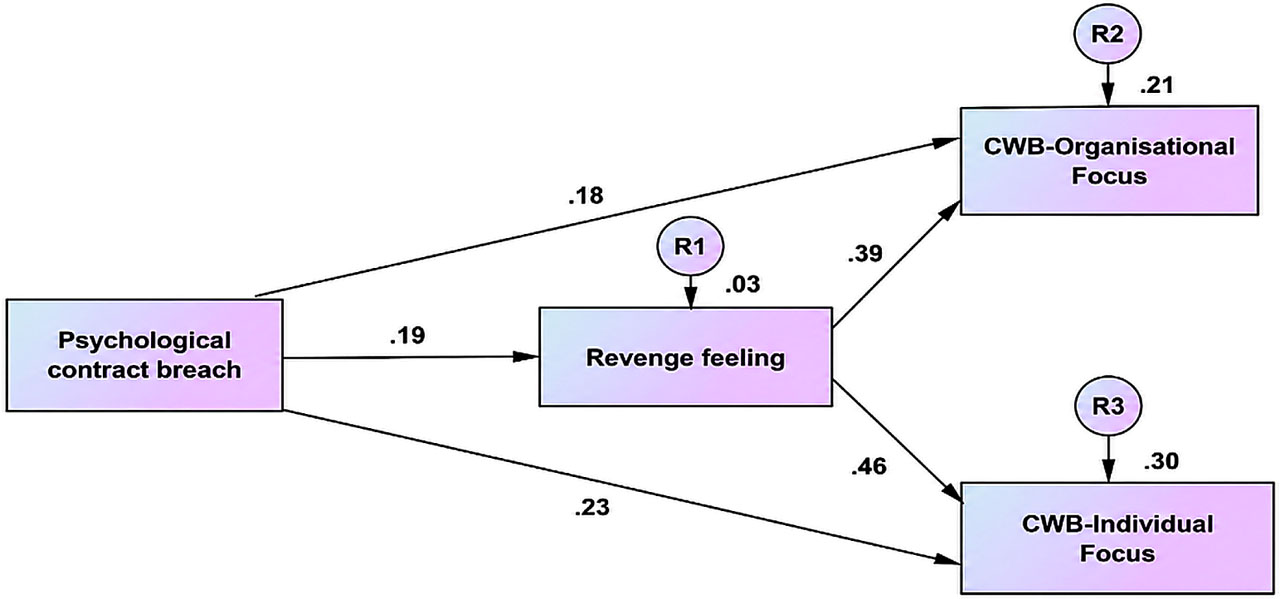
Figure 3.
Structural model
Source: own processing
A p-value <0.05 denotes a statistically significant relationship between constructs, while the p-value >0.05 indicates that the relationship between the constructs is not statistically significant, hence, the null hypothesis is true. The result of the analysis of the data in this study shows that all the hypotheses were accepted, as shown in Table 5.
Table 5.
Estimated effects result
| Hypotheses | Model pathways | Estimated effects | p-value | Comments | ||||
|---|---|---|---|---|---|---|---|---|
| Direct effects | ||||||||
| H1 | PCB ▼ | RF | 0.186 | 0.000 | Hypothesis accepted | |||
| H2 | PCB ▼ | CWB-I | 0.226 | 0.000 | Hypothesis accepted | |||
| PCB ▼ | CWB-O | 0.184 | 0.000 | |||||
| H3 | RF ▼ | CWB-I | 0.458 | 0.000 | Hypothesis accepted | |||
| RF ▼ | CWB-F | 0.389 | 0.000 | |||||
| Indirect effects | ||||||||
| H4 | PCB | ▼ RF | ▼ CWB-I | 0.085 | 0.01 | Partial mediation | ||
| PCB | ▼ RF | ▼ CWB-O | 0.072 | 0.01 | Partial mediation | |||
| Total effects | ||||||||
| RF | ▼ CWB-I | 0.311 | 0.000 | |||||
| RF | ▼ CWB-O | 0.256 | 0.000 | |||||
Psychological contract breach and revenge feeling
The results in Table 5 established a significant relationship between psychological contract breach and feeling of revenge. This significant relationship supports hypothesis H1 as proposed. This means that an increase in psychological contract breach perceptions results in revenge feelings among academics. Previous studies have indicated that employees who perceive that their employer has failed to honor its obligations to them may react in ways that would harm the organization. For instance, Kraak et al. (2017) substantiated this assertion when they found that the feeling of revenge developed once there was a perception of breach of contract. Huang et al. (2018) and Bani-Melhem et al. (2020) also demonstrated that revengeful attitudes are exhibited because of employees’ perception of psychological contract breach. According to Zhao et al. (2018), covert revenge is most popular among lower-status employees who cannot afford to engage in overt revenge for fear of the risk of counter-revenge. For this reason, it is possible to state that revenge expressions among academics of institutions of higher learning may either be covert or overt, depending on the status level of the academics. Conversely, issues of psychological contract breach and other forms of unmet expectations may be addressed with alternative strategies like strong organizational ethics and culture (Li & Chen, 2018).
Psychological contract breach and counterproductive work behavior
The results in Table 5 show that psychological contract breach has a significant effect on counterproductive work behaviors (CWB-I and CWB-O), which supports the hypothesis H2 as proposed. The results, in line with previous studies, suggest that when there is a breach in the psychological contract (when employees perceive their employer as having failed in the fulfilment of its obligations), it leads to an increase in counterproductive work behaviors (Botha & Steyn, 2020; Protsiuk, 2019) among academics. Counterproductive work behavior encompasses actions that harm the organization or its members (Mehmood et al., 2023). The study of Ma et al. (2019) indicated that when workers experience a high level of psychological contract breach, they may intentionally cause harm in retaliation by engaging in CWB-O and CWB-I. The result of the current study shows that there is a notable significant relationship between psychological contract breach and individual as well as organizational focused CWB. This suggests that the breach is associated with occurrences of counterproductive work behaviors aimed at undermining individuals or their institutions. The positive relationship between psychological contract breach and individual-focused counterproductive work behavior suggests that when academics feel their expectations from the organization are not met, they may respond with behaviors such as verbal abuse of supervisors and interpersonal conflicts that primarily affect individuals within the institutions.
Regarding the organization-focused counterproductive work behavior, the findings imply that perceived psychological contract breach is likely to lead academics to engage in behaviors such as lateness and absenteeism, intentional damage to institutional property, misuse of resources, sabotage, theft and spreading of rumors within the workplace that may directly harm the institution. In an earlier study on counterproductive work behavior of permanent and contract workers in China, Ma et al. (2019) confirmed that the impact of psychological contract breach on CWB-I is higher than on CWB-O. This means that when academics perceive psychological contract breach, they are likely to engage in detrimental behaviors that may focus more on individual members of their institutions than on the institutions themselves. These findings support the Social Exchange Theory assumption on the question of trust and breach of social relationship.
Feeling of revenge and counterproductive work behavior
The results in Table 5, further show that feeling of revenge was found to be positively related to both individual (β = 0.35) and organizational (β = 0.35) focused counterproductive work behaviors, which supports hypothesis H3 of the proposed conceptual framework. The finding suggests that when academics experience a strong sense of revenge, they might be motivated to engage in counterproductive work behavior as a means of seeking personal satisfaction or justice (Eisenstadt & Geddes, 2018). Eisenstadt and Geddes (2018) noted that the feeling of revenge reflects a desire to seek retribution or retaliation against others perceived to have wronged or harmed the individual. The result supports the view of Griep and Vantilborgh (2018) that counterproductive work behavior within an organization is a manifestation of revenge cognitions of employees. Jackson et al.’s (2019) position also supports the finding that the resultant harmful actions of revenge or retaliation are organizational counterproductive work behaviors (CWB-O), such as fraud and absenteeism, and interpersonal counterproductive work behaviors (CWB-I) such as harassment and verbal abuse. This could mean that when academics are unable to retaliate towards their institutions, they will refocus their target for revenge towards members of the institution as best fit substitutes for the institution (Wang et al., 2018).
Indirect effect on counterproductive work behavior
The results in Table 5 indicate that psychological contract breach has an indirect significant effect on both individual and organizational focused counterproductive work behavior among academics in institutions of higher learning, with revenge feelings partially mediating this relationship, which supports hypothesis H4. This finding supports the assertion that revenge feelings appeared to be the mediator in the relationship between psychological contract breach and counterproductive work behavior (Griep & Vantilborgh, 2018) in both dimensional focuses of the organization and individual. This means that psychological contract breach not only directly affects the counterproductive work behavior of academics but also indirectly affects individual and organizational counterproductive work behavior through revenge feelings.
The findings support the observation that perception of psychological contract breach at work may motivate the desire to take revenge against the organization, by engaging in different forms of counterproductive work behaviors in response (Kraak et al., 2017; Welander et al., 2017). It is important to note that while revenge feeling is an important mechanism through which psychological contract breach affects counterproductive work behavior of academics, it does not fully account for these relationships. There may be other factors that contribute to counterproductive work behavior among academics in higher institutions of learning, which need to be investigated in a future study.
Model evaluation
The structural model in Figure 3 indicates that the significant effect of PCB and revenge feeling explained 30% (R2 = 0.30) and 21% (R2 = 0.21) of the variance in the individual and organization focus counterproductive work behavior respectively. The model generated yielded a χ2 (chi-square) of 940.050, with the degrees of freedom and p-values less than 0.001. It shows that the model fits the data well. However, because the Chi-Square statistic is very sensitive to sample size, it was more appropriate to consider other fit measures: CMIN/DF, RMSEA, CFI, NFI, GFI, and AGFI. The model had CMIN/DF of 4.483 with GFI and AGFI of 0.880 and 0.843 respectively, which were within the recommended value of 0.80 or above. The values for CFI and NFI were 0.943 and 0.934, which were above 0.90 as the recommended value. The root mean square error of approximation (RMSEA) was 0.065, which was within the recommended range of 0.05 to 0.08, indicating a close fit between the model and the data in relation to the degrees of freedom (Hair et al., 2017). This means that the results from the model developed were valid and reliable.
Conclusions
The psychological contract between individuals and organizations influences attitudes, behaviors, and outcomes in the workplace. However, psychological contract breach can lead to detrimental outcomes such as counterproductive work behaviors (CWBs). Counterproductive work behavior (CWB) is detrimental to the functioning and reputation of organizations. Psychological contract breach can lead to revenge and has the potential to heighten hostile attitudes and behaviors within the workplace. However, evidence on revenge as a mediator in the relationship between perceived PCB and CWB is missing in the available literature, particularly within academic settings. Therefore, the study has contributed to extant literature by investigating the mediating role of revenge in the relationship between perceived PCB and CWB among academics in higher institutions of learning.
The findings from the study provide valuable insights into the complex interplay between psychological contract breach (PCB), revenge feelings, and counterproductive work behaviors (CWB). Specifically, the results established a positive and significant relationship between PCB and revenge. Furthermore, the PCB and revenge feeling had a positive significant effect on both individual- and organization-focused counterproductive work behaviors (CWB-I and CWB-O). Revenge partially mediates the relationship between PCB and both CWB-I and CWB-O. Consistently, the effect of revenge feeling and PCB on CWB-I is greater than on CWB-O. Based on the findings, practical implications are discussed below.
Research implications
To address counterproductive work behavior driven by psychological contract breach and feelings of revenge among academics, institutions of higher learning can strengthen psychological contracts, thereby reduce feelings of revenge and foster a more positive work environment. This can be done by ensuring that promises made during recruitment and throughout the employment relationship are realistic and achievable. Institutions of higher learning must develop and implement consistent policies regarding promotion, workload, and career development to reduce perceptions of unfairness and breach in expectations. Management of higher education institutions also needs to implement conflict resolution mechanisms, ensuring clear and confidential grievance procedures through which academics can report breaches and seek redress without fear of retaliation.
Employees should be encouraged to freely discuss unmet expectations with management of higher institutions of learning, to foster a transparent and open environment. This intervention can be enhanced by periodically reviewing and updating employment contracts to ensure clarity and mutual understanding of roles, responsibilities, and benefits. Organizational policies must be applied consistently and fairly to all employees to prevent perceptions of favoritism or injustice. The involvement of academics in decision-making processes, especially those that directly impact their work and conditions, is paramount for enhancing academics’ sense of ownership and commitment. Lastly, the study has implications for managerial dynamics in managing psychological contract breach that could provoke academics’ counterproductive work behavior. With the unceasing change dynamics that characterize today’s world of work, higher education institutions must carefully leverage these changes for managing psychological contract breach for positive organizational outcomes that can dissuade academics from engaging in revenge tactics.
Limitations and future research
The independent variables included in the study explain 21% and 30% of the variance in organizational- and individual-focused CWB, which suggests that there are other variables that could also contribute to the explanation of variance in CWB. Future research should explore additional factors to increase the variance explained in counterproductive work behaviors. Moderating effects on CWB were not examined; therefore, future studies could investigate how organizational culture moderates the impact of PCB on revenge feelings and, subsequently, on CWB. Additionally, studies can also investigate how cultural values and norms influence revenge feelings and CWB in response to PCB. Leadership style, which can influence employees’ feelings and behavior at work, was not included in the model. Therefore, examining the role of leadership styles in shaping employees’ perceptions of PCB, revenge feelings, and CWB across different organizational settings is recommended. These research areas can inform the development of more effective interventions and organizational practices to promote academic well-being and work output in higher education settings.