
Introduction
Although market-oriented strategies have long been regarded as an important driver of organizational success, empirical evidence regarding their impact on sales outcomes remains inconclusive (Tangus & Omar, 2017). A number of studies suggest that firms that actively monitor customer needs, track competitor activities, and respond to market changes tend to achieve stronger sales performance (Grinstein, 2008). The ability to generate and utilize market intelligence enables organizations to adapt their marketing strategies more effectively, thereby supporting sales growth and expansion of market share (Hendar et al., 2020; Sutanto et al., 2024). However, other studies report that market orientation does not always translate into higher sales performance, and in some contexts the relationship appears weak or insignificant (Hendiarto & Musthafa, 2023; Jamaludin et al., 2022). These mixed findings suggest that market knowledge alone may be insufficient to generate superior sales outcomes unless firms possess mechanisms capable of transforming market insights into competitive offerings and strategic market actions (Yang & Tsai, 2019).
One mechanism that may explain this relationship is product innovation. Insights into evolving customer preferences and market dynamics enable firms to develop new products or enhance existing offerings that better align with consumer needs (Najafi-Tavani et al., 2016). Through innovation, firms can strengthen product differentiation and create offerings that provide greater value to customers, thereby increasing the attractiveness of their products in competitive markets (Calantone et al., 2002). Importantly, product innovation may also open opportunities for firms to reach new customer segments or enter previously untapped geographic markets. Such expansion of market coverage allows firms to broaden their customer base and generate additional sales opportunities (Gnizy, 2019). By extending their presence into new segments and markets, firms can reduce dependence on existing customers while strengthening their potential to achieve sustained sales growth (Zhang et al., 2025).
Despite these insights, prior research has largely examined the relationships among market orientation, innovation, and performance in isolation, or has treated innovation primarily as a direct mediator between market orientation and organizational outcomes (Reyes-Gómez et al., 2025). Consequently, limited attention has been given to the broader strategic pathway through which market knowledge stimulates product innovation that subsequently enables firms to expand their market reach and ultimately enhance sales performance (Amoasi et al., 2024). This limitation is important because firms rarely achieve superior sales outcomes through a single capability; instead, performance often emerges from a sequence of interconnected strategic processes (Homburg & Wielgos, 2022).
Understanding this mechanism is therefore important for both theory and practice. From a theoretical perspective, examining the sequential process linking market knowledge, product innovation, and market expansion provides a more comprehensive explanation of how firms convert market-based insights into tangible sales outcomes (Gunawan & Listiyani, 2025). From a managerial standpoint, identifying this mechanism offers practical guidance for firms seeking to transform market intelligence into effective innovation strategies and broader market reach, thereby improving their ability to generate sustainable sales growth. To address this gap, the present study proposes and empirically tests a sequential mechanism linking market orientation, product innovation, market expansion, and sales performance in the context of SMEs operating in digital food delivery platforms. Unlike prior studies that primarily focus on direct or single-mediator relationships, this study emphasizes how these strategic capabilities interact in an integrated process. In addition, this study considers the possibility that market expansion may not always lead to improved performance and may even reduce sales outcomes when not supported by sufficient internal capabilities. This perspective is grounded in the Resource-Based View, which posits that competitive advantage and performance arise from a firm’s ability to strategically deploy valuable and difficult-to-imitate resources and capabilities (Barney, 1991).
Literature review and hypotheses development
Resource-Based View theory
Resource-Based View (RBV) posits that sustainable competitive advantage arises from firms’ ability to utilize valuable, rare, inimitable, and non-substitutable resources and capabilities. These resources include organizational knowledge, marketing capabilities, and innovation capacity that enable firms to respond effectively to market opportunities and achieve superior performance (Barney, 1991). From this perspective, strategic capabilities such as market orientation and product innovation are considered critical internal resources that allow firms to develop competitive advantage and improve business outcomes (Zhou et al., 2009). Firms that successfully leverage these capabilities are more likely to expand their market reach and enhance sales performance in competitive environments.
Market orientation represents a strategic capability that enables firms to collect, disseminate, and respond to market intelligence regarding customer needs and competitor actions (Rodríguez-Pinto et al., 2011). Through this process, organizations gain valuable insights that support strategic decision-making and the development of superior products and services (Salmi et al., 2024). Empirical studies indicate that firms with strong market orientation tend to achieve higher innovation capability because they are better able to translate market knowledge into product development activities and strategic initiatives (Lee & Yoo, 2021). Consequently, market-oriented firms are more capable of identifying emerging opportunities and adapting their offerings to evolving market demands.
Product innovation is another strategic capability emphasized in RBV because it allows firms to transform knowledge and resources into value-creating products. Innovative products enhance differentiation, increase customer value, and strengthen a firm’s competitive position in the marketplace (Aljanabi, 2022). Prior research demonstrates that product innovation mediates the relationship between market orientation and organizational performance by converting market knowledge into tangible market offerings that attract new customers and increase market penetration (Mailani et al., 2024).
Furthermore, innovation capability often leads to market expansion because firms can introduce new products into new geographic areas or customer segments (Shi & Zailani, 2025). Firms with superior innovation capabilities are more likely to exploit emerging opportunities and expand their presence in different markets, thereby increasing market share and revenue potential (Moreira et al., 2024). Ultimately, the integration of market orientation, product innovation, and market expansion strengthens a firm’s ability to improve sales performance and sustain long-term competitiveness. Within the RBV framework, these capabilities function as strategic resources that collectively enable firms to achieve superior business performance in dynamic markets (D’Oria et al., 2021).
Market orientation and market expansion
Market orientation reflects a firm’s capability to generate and utilize market intelligence to identify emerging opportunities and respond to environmental changes. Rooted in foundational perspectives such as Narver and Slater (1999), market-oriented firms are characterized by their ability to understand customer needs, monitor competitors, and coordinate internal resources to support strategic actions. Building on this foundation, recent studies suggest that firms that continuously monitor customer needs and competitor actions are better able to recognize underserved segments and potential geographic markets, thereby facilitating expansion beyond existing customer bases (Cho et al., 2023). Market-oriented organizations develop superior sensing capabilities that reduce uncertainty when entering new markets and support strategic decision-making related to market growth (Bellégo & Enache, 2026).
Empirical evidence further indicates that responsiveness to market information enhances firms’ ability to adapt marketing strategies, distribution channels, and positioning required for successful expansion (Robinson & Lundstrom, 2003). Customer-oriented learning enables firms to identify unmet demand and broaden market coverage (Ameer & Ayomi, 2014), while competitor orientation helps firms recognize strategic gaps that can be exploited through expansion into new niches (Anh Tu et al., 2020). In addition, market intelligence has been shown to strengthen opportunity recognition and encourage firms to pursue diversification and entry into new markets (Rundh, 2023), ultimately supporting the alignment of organizational resources with expansion strategies (Nwabekee et al., 2024).
However, despite the generally positive view, the relationship between market orientation and market expansion may not always be straightforward. While market knowledge enhances opportunity recognition, the effectiveness of expansion strategies may depend on the firm’s ability to translate this knowledge into actionable capabilities. In resource-constrained contexts, firms may face challenges in executing expansion strategies effectively, suggesting that market orientation alone may not guarantee successful expansion outcomes. Therefore, market orientation is expected to facilitate market expansion.
H1: Market orientation positively affects market expansion.
Market orientation and product innovation
Market orientation plays a central role in stimulating product innovation, as market knowledge provides critical insights into evolving customer preferences and competitive dynamics (Thongsri & Chang, 2019). Grounded in foundational perspectives such as Narver et al. (1998), market-oriented firms are characterized by their ability to generate, disseminate, and respond to market intelligence, which serves as a key input for innovation activities. Firms that systematically gather and disseminate market intelligence are better able to translate customer feedback into new product ideas and continuous improvements (Sapand et al., 2022). Customer orientation enhances the understanding of both expressed and latent needs, encouraging firms to develop products that better align with market expectations (Akhtar et al., 2021).
In addition, market-oriented firms promote cross-functional coordination, enabling the integration of knowledge across departments and accelerating innovation processes (Vokoun & Píchová, 2020). Exposure to changing market conditions further motivates experimentation and product differentiation, thereby strengthening innovation outcomes (Aydin, 2021). Competitor intelligence also plays an important role by encouraging firms to develop superior value propositions rather than merely imitating rivals. Empirical studies, particularly in emerging market contexts, confirm that market orientation enhances organizational learning and innovation capability (Alhakimi & Mahmoud, 2020), while continuous interaction with customers reduces uncertainty in product development and improves innovation effectiveness (Ramírez-Solis et al., 2022). However, despite the generally positive relationship, the effectiveness of market orientation in driving product innovation may depend on the firm’s ability to internalize and utilize market knowledge effectively. In some cases, firms may possess access to market information but lack the internal processes or resources required to convert these insights into tangible innovations. This suggests that market orientation alone may not automatically lead to innovation outcomes unless supported by adequate organizational capabilities. Consequently, market orientation functions as a key organizational capability that facilitates the transformation of market insights into product innovation (Fakhreddin & Foroudi, 2022; Verhees & Meulenberg, 2004).
H2: Market orientation positively affects product innovation.
Product innovation and market expansion
Product innovation plays a crucial role in enabling firms to expand their market reach by creating offerings that attract new customers and support entry into previously untapped markets. From a strategic perspective, innovation represents a key capability that allows firms to develop differentiated value propositions and respond to changing customer preferences, thereby strengthening their competitive positioning (Bortoluzzi et al., 2018). By introducing new or improved products, firms can address diverse consumer needs and adapt their offerings to different market contexts, facilitating expansion into new segments and geographic areas (López & Oliver, 2023).
In addition, innovation enhances organizational flexibility, enabling firms to adjust product features, pricing structures, and value propositions to suit heterogeneous market demands (Yani et al., 2023). Empirical evidence suggests that firms with strong innovation capabilities are more likely to pursue market diversification strategies, as product novelty increases customer interest and reduces perceived barriers to market entry (Khalikussabir & Sudarmiatin, 2024). Innovation also supports differentiation, allowing firms to access new distribution channels and establish relationships with previously unreached customer groups (Osano, 2019). In dynamic and competitive environments, innovative firms are better positioned to exploit emerging opportunities and expand beyond their existing markets (My Thi Thi & Tran Phu Do, 2024), while innovation-driven differentiation reduces reliance on price competition and enables firms to compete based on superior value (Kobusingye et al., 2025).
However, the relationship between product innovation and market expansion may not always be linear. While innovation creates opportunities for expansion, the success of such strategies depends on the firm’s ability to align innovative offerings with the specific characteristics of new markets. In some cases, product innovation may not automatically lead to successful expansion if firms lack adequate market knowledge, distribution capabilities, or strategic alignment. This suggests that innovation alone may be insufficient to ensure expansion outcomes without complementary capabilities that support market entry and adaptation (Teece et al., 1997). Through these mechanisms, product innovation functions as a strategic capability that facilitates market expansion and supports long-term growth (Lawson & Samson, 2001).
H3: Product innovation positively affects market expansion.
Market expansion and sales performance
Market expansion represents a strategic effort by firms to increase their customer base through entry into new geographic areas or customer segments, which can contribute to improved sales performance (Gunawan, 2024). From a strategic perspective, expansion enables firms to access additional sources of demand and diversify revenue streams, thereby reducing dependence on existing customers and stabilizing sales outcomes (Lee & Yang, 1990). Empirical research suggests that firms pursuing market expansion benefit from increased market coverage, which enhances sales growth opportunities and strengthens competitive positioning (Tangus & Omar, 2017).
By reaching broader customer groups, firms can achieve higher sales volumes and improve market penetration, particularly when expansion strategies are aligned with market needs and supported by adequate organizational capabilities (Mas-Ruiz et al., 2002). Market expansion may also allow firms to exploit economies of scale and improve resource utilization, contributing to greater efficiency and stronger sales outcomes (Wegwu & Benstowe, 2025). In addition, exposure to diverse market conditions can stimulate organizational learning and enhance firms’ ability to generate sustained sales growth over time (Rubio-Andrés et al., 2024). Expansion into new segments further increases brand visibility and customer acquisition, both of which are critical drivers of sales performance in competitive environments (Bang & Joshi, 2010). As a result, firms that successfully broaden their market scope are more capable of increasing transaction frequency and overall revenue generation (Jost, 2024).
However, the relationship between market expansion and sales performance may not always be uniformly positive. While expansion provides opportunities for growth, it may also introduce operational complexity, resource strain, and increased coordination costs, particularly in firms with limited capabilities. In such cases, expansion efforts may not immediately translate into improved performance and may even lead to inefficiencies if not supported by adequate resources and strategic alignment (Vermeulen & Barkema, 2002). This suggests that the effectiveness of market expansion is contingent upon the firm’s ability to manage and integrate expansion activities effectively. Consequently, market expansion serves as an important strategic pathway through which firms translate growth initiatives into sales performance outcomes.
H4: Market expansion positively affects sales performance.
Product innovation and sales performance
Product innovation is widely recognized as a key driver of sales performance because it enables firms to deliver superior value and maintain competitiveness in dynamic markets (Li & Lin, 2015). By introducing new or improved products, firms can better satisfy evolving customer needs, thereby increasing customer attraction and purchase intentions (Salfore et al., 2023). Innovative products enhance differentiation, allowing firms to distinguish their offerings from competitors and reduce reliance on price-based competition, which ultimately improves sales outcomes (López-Paredes et al., 2025).
Empirical studies further demonstrate that firms with strong innovation capabilities tend to achieve higher sales growth, as they are able to continuously refresh their product portfolios and sustain market relevance (Bogetoft et al., 2024). Product innovation also strengthens perceived customer value, encouraging repeat purchases and expanding demand over time (Bustinza et al., 2019). In highly competitive environments, innovation enables firms to respond more effectively to technological changes and shifting consumer preferences, thereby supporting revenue generation and market success (Agustia et al., 2022). Moreover, innovative firms are better positioned to capture emerging opportunities and convert them into commercial outcomes, leading to improved sales performance (Puspajati & Ali, 2025). Innovation-driven differentiation also contributes to enhanced firm reputation and brand attractiveness, which further supports customer acquisition and increased sales volumes.
However, the relationship between product innovation and sales performance may not always be uniformly positive. While innovation can create value, it may also involve significant costs, risks, and uncertainties related to product development and market acceptance. In some cases, innovative products may fail to meet customer expectations or may not be effectively commercialized, limiting their impact on sales outcomes. This suggests that the performance benefits of innovation depend on the firm’s ability to successfully implement, position, and deliver innovative offerings in the market (Roper & Bourke, 2022). Through these mechanisms, product innovation functions as a strategic capability that contributes to superior sales performance and sustained growth.
H5: Product innovation positively affects sales performance.
Based on these hypotheses, a conceptual model was developed (Figure 1).
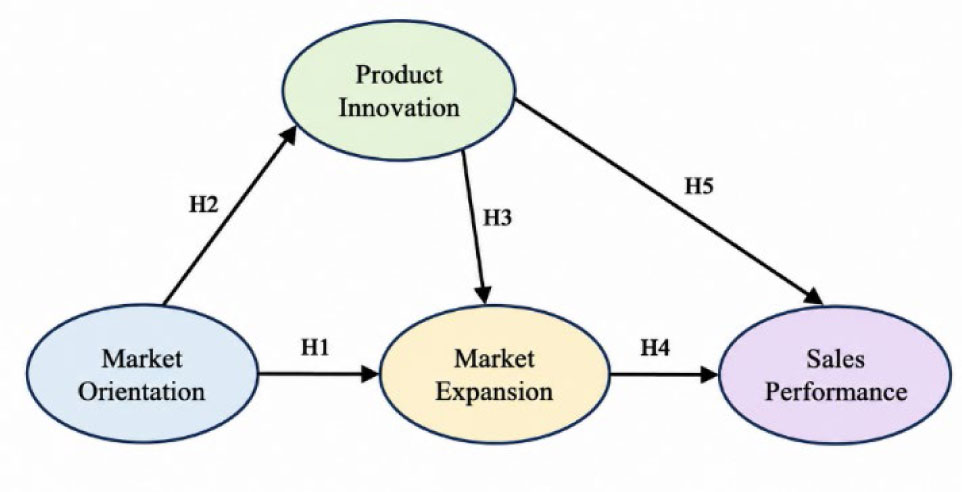
Figure 1.
Conceptual framework of the study
Source: own processing
Methodology
This study adopted the positivist research paradigm, which posits that reality is objective, quantifiable, and exists independently of human interpretation (Masuku, 2024). In alignment with this philosophical stance, structured online questionnaires were employed to reduce researcher bias and enhance objectivity in data collection. A quantitative research approach was adopted to measure constructs empirically and to test hypothesized relationships among work-related stress, work-related well-being, and work roles. The study further applied an explanatory correlational research design to explore both direct and mediating relationships among variables and to statistically infer potential causal links. The target population consisted of engineering professionals working at Ghana’s two main seaports namely Tema and Takoradi with a total population of 572 personnel. Using the Macorr sample size calculator, a minimum sample of 230 respondents was determined to ensure statistical adequacy. A simple random sampling technique was employed to guarantee that every member of the population had an equal chance of selection, thereby strengthening the representativeness of the sample. Respondents were drawn from an established sampling frame using a random number generator, ensuring fairness and objectivity in participant selection.
Questionnaire was used for data collection. The questionnaire consisted of four sections measuring demographics and three latent variables: work-related well-being, workrelated stress, and work role. Section A captured respondents’ demographics, including age, gender, education, department, and years of engineering experience at Tema and Takoradi ports. Section B of the questionnaire measured work-related well-being categorized under three sub-dimensions namely: work-life balance (4-items), occupational well-being (5-items) and physical well-being (4-items). The items used for measuring work-related well-being were adapted from questionnaires such as the Warwick-Edinburg Mental Wellbeing Scale (WEMWBS) (Tennant et al., 2007) and the Copenhagen Psychosocial Questionnaire (COPSOQ) (Nuebling & Hasselhorn, 2010). Section C of the questionnaire measured work-related stress among engineering professionals with four (4) sub-dimensions namely: job demands (4-items), low job autonomy (4-items), role conflict ambiguity (4-items) and lack of social support (4-items). Questionnaire items for measuring work-related stress were adapted from the Job Stress Survey (JSS) (Spielberger & Reheiser, 2020). Section D of the questionnaire measured work role which had three sub-dimensions namely: role clarity (4-items), role autonomy (4-items) and role independence (3 items). Questionnaire items for measuring work role were adapted from the Job Diagnostic Survey (JDS) (Hackman & Oldham,1975). Questionnaires for measuring each of the variables with their respective sub-dimensions were measured on a six-point Likert scale, where 1= strongly disagree, 2= disagree, 3= slightly disagree, 4= slightly agree, 5= agree, 6= strongly agree.
Data collection was carried out online using Google Forms over a three-month period. To enhance participation and improve the response rate, periodic email reminders were sent to prospective respondents. Upon completion of data collection, the dataset was cleaned and validated to ensure accuracy and completeness; responses with substantial missing values, inconsistencies, or incomplete information were excluded from further analysis. The validated data were coded and entered into the Statistical Package for the Social Sciences (SPSS) version 28 for initial descriptive analysis. Subsequently, the cleaned dataset was exported to SmartPLS for Partial Least Squares Structural Equation Modelling (PLS-SEM). This analytical approach was employed to examine both the direct and mediating effects among the variables including work-related conditions, work-related stress, work-related well-being, and work role within the context of engineering professionals at Ghana’s seaports.
Empirical results
Demographics results
The respondent profile shows that the majority of respondents are female (54%), while the remaining are male. In terms of education level, most respondents hold a bachelor’s degree (53%), followed by those with a high school education (39%) and a master’s degree (8%). Based on business experience, the largest group of respondents has been running their business for less than 4 years (53%), followed by those with 5–7 years of experience (33%), and those with more than 8 years of experience (14%). This demographic composition provides an overview of the characteristics of respondents involved in the study.
Measurement model assessment
The measurement model was assessed to evaluate indicator reliability, internal consistency reliability, and convergent validity. As presented in Table 1, all measurement items demonstrated satisfactory factor loadings, while the composite reliability and average variance extracted (AVE) values exceeded the recommended cutoff levels, indicating adequate reliability and convergent validity of the constructs.
Table 1.
Reliability and convergent validity of the constructs
| Constructs | Loadings | AVE | Cronbach’s Alpha | Composite reliability |
|---|---|---|---|---|
| Market Orientation | 0.818 | 0.890 | 0.931 | |
| MO1: Customer preferences are regularly considered when deciding what products to offer (Talaja et al., 2017) | 0.900 | |||
| MO2: Information about competitors is used when planning products or services (Narver & Slater, 1999) | 0.919 | |||
| MO3: Feedback from customers is used to improve products or services (Talaja et al., 2017) | 0.908 | |||
| Product Innovation | 0.826 | 0.895 | 0.934 | |
| PI1: New menu items or products are introduced periodically (Parichatnon et al., 2025) | 0.873 | |||
| PI2: Existing menus are modified or improved to offer something different (Parichatnon et al., 2025) | 0.901 | |||
| PI3: New ideas are applied to create unique food or beverage offerings (Calantone et al., 2002) | 0.889 | |||
| Market Expansion | 0.788 | 0.866 | 0.918 | |
| ME1: Efforts are made to reach customers in new areas or locations (Gerhardt et al., 2022) | 0.919 | |||
| ME2: New customer groups are targeted beyond the usual buyers (Gerhardt et al., 2022) | 0.986 | |||
| ME3: Additional sales channels are used to reach more customers (Gerhardt et al., 2022) | 0.900 | |||
| Sales Performance | 0.803 | 0.884 | 0.924 | |
| SP1: The number of units sold has increased (Shapiro & Gómez, 2014) | 0.909 | |||
| SP2: Our sales revenue keeps growing (Shapiro & Gómez, 2014) | 0.885 | |||
| SP3: More customers choose our products over competitors (Shapiro & Gómez, 2014) | 0.894 |
Table 2 reports the results of the discriminant validity assessment using the Heterotrait–Monotrait ratio (HTMT). All HTMT values among the constructs are below the recommended threshold of 0.90, indicating satisfactory discriminant validity. This finding suggests that each construct represents a distinct conceptual domain and captures unique aspects of the proposed research model. The results confirm that market orientation, product innovation, market expansion, and sales performance are empirically distinguishable constructs, supporting the adequacy of the measurement model for subsequent structural analysis.
Table 3 presents the collinearity assessment results based on variance inflation factor (VIF) values for the structural model. All VIF values range between 1.000 and 1.347, which are well below the critical threshold of 5.0. These results indicate the absence of multicollinearity issues among the predictor constructs, suggesting that the independent variables do not exhibit excessive correlation that could bias the estimation of path coefficients. Therefore, collinearity does not pose a concern, and the structural relationships in the model can be interpreted reliably.
Table 3.
Collinearity assessment (VIF)
| Path | VIF |
|---|---|
| Market Expansion ➔ Sales Performance | 1.139 |
| Market Orientation ➔ Market Expansion | 1.347 |
| Market Orientation ➔ Product Innovation | 1.000 |
| Product Innovation ➔ Market Expansion | 1.347 |
| Product Innovation ➔ Sales Performance | 1.138 |
Bootstrapping procedures were used to evaluate the significance of the hypothesized relationships, and the results are presented in Table 4.
Table 4.
Path coefficients
| Path | Path coefficient | T-statistics | P-values |
|---|---|---|---|
| Market Expansion ➔ Sales Performance | −0.347 | 5.056 | 0.000 |
| Market Orientation ➔ Market Expansion | 0.265 | 2.730 | 0.007 |
| Market Orientation ➔ Product Innovation | 0.508 | 7.784 | 0.000 |
| Product Innovation ➔ Market Expansion | 0.214 | 2.478 | 0.014 |
| Product Innovation ➔ Sales Performance | 0.547 | 9.383 | 0.000 |
The results indicate that market orientation significantly influences market expansion (t = 2.730, p = 0.007) and product innovation (t = 7.784, p < 0.001). Product innovation also shows a significant effect on market expansion (t = 2.478, p = 0.014) and sales performance (t = 9.383, p < 0.001). Furthermore, market expansion significantly affects sales performance (t = 5.056, p < 0.001). Overall, most hypothesized relationships are supported, except H4, as market expansion shows a significant negative effect on sales performance.
Table 5 presents the coefficient of determination (R2) values for the endogenous constructs in the proposed model. The findings show that market orientation accounts for 25.8% of the variance in product innovation. Furthermore, market orientation and product innovation jointly explain 17.4% of the variance in market expansion. The model also explains 28.8% of the variance in sales performance through the combined effects of product innovation and market expansion. These results indicate that the proposed model demonstrates moderate predictive capability in explaining innovation activities, market expansion efforts, and sales performance among F&B SMEs.
Table 5.
Coefficient of determination (R2)
| Endogenous variable | R2 |
|---|---|
| Market Expansion | 0.174 |
| Product Innovation | 0.258 |
| Sales Performance | 0.288 |
To assess potential common method bias, Harman’s single-factor test was conducted (Table 6).
As presented in Table 6, the first factor accounted for 39.93% of the total variance, with a cumulative variance of 39.93%, which is below the recommended threshold of 50%. This result indicates that common method bias is not a serious concern in this study.
Discussions
Capability–performance misalignment
The findings reveal contrasting effects between market expansion and product innovation on sales performance. Market expansion shows a negative and significant effect on sales performance, indicating that increasing market reach does not necessarily improve firm outcomes. The statistical significance of this relationship suggests that the observed pattern is systematic rather than incidental, meaning that higher levels of expansion are consistently associated with lower sales performance among SMEs. Therefore, H4, which proposed a positive relationship between market expansion and sales performance, is rejected. In contrast, product innovation demonstrates a positive and significant effect on sales performance, supporting H5 and highlighting innovation as a key driver of firm success.
The negative impact of market expansion suggests that expanding into broader markets may introduce challenges that offset potential benefits. Although expansion increases exposure to new customers and enhances market presence, it simultaneously intensifies competitive pressure and operational demands. Firms entering wider markets must compete with a larger number of rivals, adjust pricing strategies, and invest more resources in promotion and customer acquisition. These conditions can reduce profitability and weaken the ability of increased sales volume to translate into improved performance outcomes. As a result, expansion may generate growth in reach without proportional improvements in economic returns. Additionally, market expansion can increase organizational complexity. Broader market coverage often requires higher coordination, faster operational responsiveness, and consistent service quality across a wider customer base. For SMEs with limited managerial capacity and operational resources, these additional demands may exceed internal capabilities, creating inefficiencies and performance strain. Consequently, expansion may shift managerial attention toward operational survival rather than strategic value creation, thereby limiting its contribution to sales performance.
In contrast, product innovation strengthens firms’ ability to compete by enhancing the value offered to customers. Innovation enables firms to refine or develop offerings that better match evolving market preferences, allowing them to differentiate themselves beyond price competition. Rather than merely increasing exposure, innovation improves the firm’s competitive position within the market by creating unique value propositions that attract and retain customers. This capability helps firms convert market opportunities into tangible outcomes, leading to improved sales performance.
From the perspective of the Resource-Based View (RBV), the contrasting results between expansion and innovation provide important theoretical insight. RBV posits that competitive advantage arises not simply from accessing external opportunities but from the firm’s internal capabilities to exploit those opportunities effectively. In this study, market expansion represents an external opportunity that enlarges the scope of competition, whereas product innovation reflects an internal capability that enables firms to capture value within that competitive environment. Expansion alone increases exposure to market forces but does not guarantee performance improvement when firms lack sufficient resources, routines, or adaptive capabilities. Furthermore, RBV suggests that performance outcomes depend on the alignment between external strategies and internal resource configurations. When SMEs expand markets without strengthening innovation capabilities, they may experience diminishing returns because increased market complexity amplifies resource constraints. Conversely, firms that invest in innovation develop valuable and difficult-to-imitate capabilities that enhance differentiation and customer value, allowing them to benefit from market opportunities more effectively. Thus, innovation acts as a mechanism that transforms market access into sustainable performance advantages.
Overall, the findings indicate that performance improvement among SMEs is driven less by the breadth of market expansion and more by the firm’s capability to create and deliver superior value. Market expansion may open opportunities, but product innovation determines whether those opportunities can be successfully converted into sales performance. This integrated perspective highlights that growth strategies must be supported by internal capability development, reinforcing the RBV argument that sustainable performance depends on how firms leverage their resources rather than merely where they compete.
Knowledge–capability transformation
The findings indicate that market orientation has a positive and significant effect on market expansion, supporting H1. However, the relatively weaker strength of this relationship compared to other structural paths suggests that market orientation is not the primary driver of market expansion. This result implies that an organization’s ability to understand customer needs and market dynamics does not automatically translate into expansion strategies. While market knowledge enables firms to identify opportunities, the realization of expansion depends largely on the availability of organizational resources and operational readiness.
Conceptually, market expansion decisions are influenced not only by market insights but also by the organization’s capacity to manage risks, scale operations, and maintain consistent quality as market coverage increases. Expansion requires greater coordination, resource allocation, and operational control, making organizations with less developed capabilities more cautious in extending their market reach. This condition explains why the relationship between market orientation and market expansion remains significant yet comparatively weak.
The limited strength of this relationship may also reflect organizations that are still in earlier stages of development. Younger organizations often remain in phases of building routines, structures, and resource bases, meaning that although they possess strong market awareness, their ability to transform such insights into large-scale strategic expansion may not yet be fully developed. From a Resource-Based View (RBV) perspective, strategic capabilities evolve gradually through organizational learning and accumulated experience rather than emerging instantly. Consequently, market orientation at earlier stages of organizational development is more likely to manifest through adaptive product-level responses rather than broader strategic actions such as market expansion.
Consistent with this argument, the results show that market orientation has a stronger positive and significant effect on product innovation, supporting H2. This finding suggests that market orientation is more effectively translated into innovation activities than into direct expansion strategies. Interactions with customers and continuous monitoring of market changes provide organizations with relevant knowledge that facilitates product refinement, development, and improvement. In this sense, market orientation functions as a learning mechanism that stimulates value creation through innovation.
Interpreted through the Resource-Based View framework, market orientation can be understood as a knowledge-based resource that must be transformed into strategic capabilities before generating broader performance outcomes. Product innovation represents the capability through which market insights are converted into customer value. The findings therefore reinforce the argument that competitive advantage depends not merely on understanding markets but on the organization’s ability to transform market knowledge into valuable and difficult-to-imitate innovations. Accordingly, the influence of market orientation on growth strategies and performance operates primarily through internal capability transformation rather than through direct effects alone.
Innovation and the limits of expansion
The findings indicate that product innovation has a positive and significant effect on market expansion, supporting H3. However, the relatively modest strength of this relationship suggests that product innovation is not the primary driver of market expansion. This result implies that although innovation contributes to an organization’s ability to reach broader markets, its influence on expansion tends to be indirect and contingent upon additional strategic conditions.
Conceptually, product innovation often functions initially as a mechanism for enhancing value within existing markets rather than directly enabling entry into new ones. Organizations frequently utilize innovation to improve product quality, refine features in response to customer preferences, or strengthen differentiation from competitors. The immediate outcome of such efforts is typically an improved competitive position and increased attractiveness of offerings within current customer segments. Consequently, innovation tends to support market deepening rather than market broadening, which helps explain why its effect on market expansion remains positive yet relatively limited. Furthermore, market expansion represents a strategic decision that requires a combination of organizational capabilities beyond innovation alone. While innovation enhances product competitiveness, expansion into new markets demands operational readiness, distribution capacity, and coordination capabilities that allow firms to manage increased complexity. Without these complementary capabilities, innovative products are more likely to reinforce performance within existing markets than to stimulate aggressive expansion efforts. This condition explains why the relationship between product innovation and market expansion is statistically significant but comparatively weaker than other structural relationships in the model.
From a Resource-Based View (RBV) perspective, these findings highlight the importance of capability complementarity. Product innovation represents an internal capability that enables organizations to generate value through the recombination of knowledge and resources. However, market expansion requires additional capabilities related to scaling operations and managing external market complexity. Innovation therefore provides growth potential, but the realization of expansion depends on the organization’s ability to integrate multiple resources and capabilities simultaneously. In the absence of such integration, the benefits of innovation are more likely to manifest as improved competitiveness rather than broader market reach.
An RBV-based interpretation suggests that these findings highlight the importance of capability complementarity in shaping expansion outcomes. Product innovation represents an internal capability that enables organizations to generate value through the recombination of knowledge and resources. However, market expansion requires additional capabilities associated with operational scaling and the management of external market complexity. Innovation therefore creates growth potential, yet the realization of expansion depends on the organization’s ability to integrate multiple resources and capabilities simultaneously. In the absence of such integration, the benefits of innovation are more likely to be reflected in enhanced competitiveness within existing markets rather than in broader market reach. Overall, these findings suggest that product innovation serves as an important competitive foundation but not sufficient for market expansion. Expansion emerges from a broader strategic transformation that requires alignment between innovation capabilities and organizational readiness to manage increased market complexity. Thus, innovation creates opportunities for growth, while successful expansion depends on the organization’s capacity to mobilize and coordinate resources beyond innovation itself.
Conclusions
This study aimed to explain the strategic mechanism linking market orientation, product innovation, market expansion, and sales performance within the Resource-Based View (RBV) framework. The findings indicate that market orientation functions primarily as a knowledge-based resource that encourages organizations to pursue innovation and explore broader market opportunities. However, the relatively limited influence of market orientation on market expansion suggests that understanding market dynamics alone does not automatically translate into expansion decisions.
The results further demonstrate that product innovation serves as a key strategic capability that consistently enhances sales performance by enabling organizations to create superior customer value and strengthen competitive positioning. In contrast, market expansion does not necessarily lead to improved sales performance and may even generate unfavorable outcomes when expansion efforts are not supported by adequate internal capabilities.
From a theoretical perspective, this study contributes to RBV literature by showing that organizational performance is shaped not merely by the ability to identify market opportunities but by the capability to transform market knowledge into value-creating resources. Accordingly, successful growth strategies depend on the alignment between external opportunities and internal capability development, emphasizing that sustainable performance arises from capability integration rather than expansion alone.
Theoretical implications
This study advances the Resource-Based View (RBV) by clarifying how market-based knowledge is transformed into organizational performance through a sequence of capability development rather than direct effects. The findings position market orientation primarily as a knowledge-generating resource whose value emerges only when translated into internal capabilities, particularly product innovation. By empirically demonstrating a sequential pathway linking market orientation, innovation, and expansion, this study extends prior research that has typically examined these relationships in isolation. The results suggest that firm performance is better understood as an outcome of interconnected strategic processes, supporting the RBV argument that competitive advantage arises from capability transformation rather than resource possession alone.
Furthermore, the study contributes theoretically by revealing the boundary conditions of growth strategies within the RBV framework. The negative performance implication of market expansion indicates that external opportunity exploitation does not automatically lead to superior outcomes when internal capabilities are insufficiently aligned. This insight highlights the distinction between opportunity access and value creation, where innovation functions as a capability that enables firms to capture value, while expansion primarily increases exposure to competitive complexity. Consequently, the findings refine RBV by emphasizing capability alignment and integration as central mechanisms through which sustainable performance is achieved.
Practical implications
First, before pursuing market expansion, managers should ensure that their firms possess sufficient operational capacity to support increased demand. This includes evaluating production limits, workforce readiness, and delivery capability, particularly when operating through digital platforms. Managers are advised to implement gradual expansion strategies, such as entering one new area or segment at a time, while continuously monitoring key performance indicators such as order fulfillment time, customer satisfaction ratings, and cost efficiency. Establishing standardized operating procedures and regularly reviewing performance metrics can help prevent expansion from creating operational inefficiencies that may negatively affect sales performance.
Second, to maximize the effectiveness of market orientation, managers should translate market insights into structured decision-making processes. Customer data from digital platforms (e.g., purchase frequency, customer reviews, and location data) should be systematically analyzed to identify high-potential market segments. Before executing large-scale expansion, managers are encouraged to conduct pilot testing in selected target areas and evaluate performance outcomes, such as sales growth and customer acquisition rates. This approach allows firms to reduce uncertainty and ensure that expansion decisions are based on validated market opportunities rather than assumptions.
Third, product innovation should be strategically aligned with the needs of new target markets. Managers should develop specific product variants tailored to the preferences of different customer segments, such as adjusting portion sizes, pricing strategies, or menu offerings. In addition, small-scale product trials should be conducted to assess market acceptance before full commercialization. Integrating innovation efforts with promotional strategies, such as digital marketing campaigns and platform-based visibility tools, can further enhance the effectiveness of new product introductions and support successful market expansion.
Limitations and suggestions for future research
This study has several limitations that provide directions for future research. First, the focus on F&B SMEs operating through digital delivery platforms limits generalizability to other industries and organizational contexts. Future studies should examine whether the proposed capability transformation mechanism holds across different sectors, firm sizes, or levels of technological intensity. Second, cross-sectional design restricts the ability to capture the dynamic evolution of capabilities over time; longitudinal research is therefore needed to better understand how market orientation, innovation, and expansion codevelop and influence performance trajectories.
Additionally, the moderate explanatory power of the model suggests that other organizational capabilities may shape performance outcomes. Future research could incorporate complementary factors such as digital capability, operational scalability, or entrepreneurial orientation, as well as explore moderating variables like competitive intensity or managerial experience. Employing mixed methods or comparative approaches may also provide deeper insights into how firms strategically align internal capabilities with growth initiatives under varying environmental conditions.