
Introduction
These days, organizations all across the world are dealing with environmental problems, including climate change and the loss of natural resources. The organizational evaluation depends not only on financial performance but also on environmental performance and social responsibility, which are the main indicators for surviving in the market and enhancing competitive advantage. Organizations recognize that sustainability is not merely an ethical choice, but a strategic imperative driven by heightened stakeholder pressure, government regulations, and growing public awareness. As a result, organizations seek to integrate environmental goals into their main strategies to ensure alignment with the demands of the new green economy. The prospect of green HRM practices is still rather new (Freire & Pieta, 2022; Ren et al., 2018). Nonetheless, the goals of reducing carbon emissions and resource waste through responsible behavior have gained prominence in academic discourse (Moin et al., 2021), emphasizing that these organizational aims can only be realized through employee dedication (Freire & Pieta, 2022; Moin et al., 2021; Ren et al., 2018). Green HRM practices may also be defined as an organization’s dedication to adopting eco-friendly approaches, including assessing an applicant’s pro-environmental values during recruitment and selection, as well as in training, performance assessments, and promotions (Renwick et al., 2013). This would lead to hiring people who understand, support, and promote green practices, which would keep the strategy going in all its parts, including training, development, recruiting, evaluation, and pay.
Research shows that the workforce is more likely to identify with green management techniques when they believe these activities benefit them, the organization, the environment, and society. In this context, green HRM yields outcomes beyond ecological advantages and facilitates the attainment of environmental objectives (Freire & Pieta, 2022; Moin et al., 2021), such as OCB. This concept refers to selfless and polite actions (Saeed et al., 2024) that the formal reward system (Bies, 1989) does not directly or publicly acknowledge. Currently, OCB is a focal point for organizations because it is linked to favorable outcomes (Han & Fan, 2025). Our research adheres to the ‘target-based’ framework in delineating the idea of OCB, therefore including the features suggested by Organ (1988) and positing that the concept enhances the efficacy of organizational environmental management (Saeed et al., 2024). In our research, the term OCB refers to voluntary and civic behaviors that help the organization achieve its objectives and enhance its sustainability (Freire & Pieta, 2022).
Organizational identity is a phenomenon linked to the sense of employee unity within and beyond the workplace, aimed at achieving sustainable organizational goals through effectiveness and competence (Song & Yu, 2018). Organizational identification (OI) is the psychological connection that a person has with their organization. It is the level of connection and alignment that employees feel with the organization’s values, goals, and identity. When individuals feel that they are part of the organization, they are more likely to help it in ways that are not part of their official work duties. Implementing GHRM practices that promote environmental sustainability may improve workplace culture and signal the organization’s commitment to green initiatives (Saeed et al., 2024). Consequently, employees may feel more connected to the workplace since they view it as aligning with their values of sustainability and responsibility to society. Employers may appear to care about their workforce’s beliefs and well-being and to be genuinely committed to protecting the environment by using GHRM practices. Because of this, employees are more likely to feel supported and appreciated by the organization, which will strengthen their sense of OI (Han & Fan, 2025).
HEIs are recognized throughout the world as key drivers of sustainable development, but face difficulty in translating environmental policies into concrete employee behavior (Jameel et al., 2021). Although universities are actively implementing technical green solutions, i.e., energy-efficient infrastructure and waste recycling systems, research results show that these measures are usually ineffective due to a lack of employee engagement and voluntary participation. The question is: how can universities go beyond having so-called green policies to actually change employee behavior?
Although the literature on GHRM is growing, the psychological processes linking HR practices and staff behavior remain a black box. In particular, the importance of OI, the degree to which employees identify themselves with the properties of their organization, is still a controversial issue on both theoretical and practical levels. Although the Social Identity Theory implies that a preference for a green organizational image should result in identification and, consequently, voluntary behavior, the empirical evidence is contradictory. Chaudhary (2019) found that OI fully mediates the relationship between GHRM and green behavior, whereas Freire and Pieta (2022) stated that it is insufficient to drive citizenship behavior without additional facilitating conditions. Moreover, research on these dynamics is highly limited, particularly regarding the investigation of this process in developing countries, especially in the Middle East. In the Iraqi education system, where institutions are progressively being pressed to implement sustainable practices, there is almost no empirical evidence on how green organizational identity relates to the practices of academic and administrative staff (Jameel et al., 2021). In this research, we attempt to fill this gap by examining the hypothesis that institutionalizing a Green Identity through GHRM activities can effectively motivate university employees in Iraq to adopt voluntary environmental behavior.
This research aims to empirically investigate the effects of GHRM practices on the voluntary environmental behaviors of academic and administrative employees in Iraqi Higher Education Institutions. Based on the “Social Identity Theory”, the study does not directly rely on relational models. Instead, it aims to test the black box of psychological processes, namely, whether OI mediates the relationship between GHRM and Green OCB. The study addresses both gaps in the theoretical literature on the role of identity in motivating pro-environmental behavior. It offers practical implications for creating a sustainable organizational culture within the Iraqi academic field by situating this discussion within a developing-country framework.
Literature review
Theory and hypothesis development
Henri Tajfel and John Turner developed “Social Identity Theory” (SIT) in the 1970s. It aims to understand how people view and relate to social groups, as well as the contribution that group memberships make to their identities. The concept is that individuals will classify themselves and others into social groups based on shared attributes such as race, ethnicity, nationality, religion, gender, and other factors (Tajfel & Turner, 1979). SIT contributes significantly to explaining a variety of social phenomena, including stereotyping, in-group and out-group processes, and intergroup conflicts. It describes the strength of people’s attitudes, behavior, and contacts within group processes and social cohesiveness. According to the concept underlying social identity theory, once organizations develop a common culture of green sustainability and strive to achieve shared objectives for enhancing it, this influences how individuals behave and their commitment to environmental protection (Tajfel, 1974). This will be based on the extent to which they associate themselves with the organization and the extent to which they believe the organization supports them.
It has been posited that identification is related to the psychological integration of an individual with another person or group, including adopting the interests of that person or group (Freire & Pieta, 2022; Han & Fan, 2025; Saeed et al., 2024). Studies have differentiated between personal and social identification, with the former defined as an association with an individual and the latter as an association with a collective (e.g., an organization) (Chaudhary, 2019; Freire & Pieta, 2022).
GHRM and Green OCB
The concept of GHRM originated in the 1990s and gained popularity in the 2000s. The green wave has made HR’s job easier by enabling more accurate estimates, especially in companies using GHRM (Yong et al., 2020). The rise in environmental consciousness has led to the emergence of GHRM as a distinct field (Anwar et al., 2020). Yong et al. (2020) investigated how GHRM practices may help companies align their commercial strategy with environmental considerations. Green training also gives employees the tools they need to address environmental issues and makes the organization’s operations more sustainable. Some people view GHRM practices and ideas as a set of rules, standards, and tactics that encourage employees to operate in socially responsible, environmentally friendly, and resource-efficient ways (Agarwal et al., 2024). Green HRM is a term that came up when people management techniques were put in place to make companies more sustainable by encouraging employees to utilize resources in a way that is good for the environment (Renwick et al., 2013). This will provide staff with additional opportunities to exchange useful information and experiences on how to address environmental concerns.
GHRM is a new method of thinking about and doing business that uses the idea of “green” to manage employees. Its goal is to achieve the primary objective of business environmental management by using “green” management methods (Agarwal et al., 2024; Liu et al., 2021; Yong et al., 2020). GHRM is a set of practices that work together and complement each other. These practices include green hiring, green training, green performance evaluation, and green rewards. The goal is to instill green values, knowledge, and skills in staff and encourage them to engage in corporate social responsibility activities. In the end, this will improve the organization’s environmental performance (Chaudhary, 2019; Song & Yu, 2018). Numerous authors contend that GHRM is essential for the effective implementation of green strategies and environmental management practices (Han & Fan, 2025; Renwick et al., 2013; Saeed et al., 2024). It focuses on how HRM may help businesses avoid and regulate pollution and safeguard the environment (Liu et al., 2021). Consequently, GHRM has lately emerged as a salient issue in corporate environmental management. OCB encompasses actions and behaviors not specifically outlined in individual job descriptions; nonetheless, they assist a group or organization, improving its effectiveness and productivity (Gheribi, 2017). GHRM activities, including delivering green training, setting sustainability targets, and acknowledging environmental achievements, may directly influence employees’ likelihood to engage in OCB (Chaudhary, 2019; Gheribi, 2017).
The staff will be more likely to demonstrate OCB when they believe that their organization appreciates and promotes environmentally responsible behavior (Saeed et al., 2024). The staff’s values, social relations, workplace interactions, and personal perceptions are reported to be the main forces driving social behavior and motivating staff to participate in the development and execution of green policies and programs (Liu et al., 2021). Aligning performance reviews with sustainability goals can help employees feel more committed to the company. These firms use green rating scales to monitor how well their staff are doing at being green, encourage green activities, offer green training opportunities, praise and pay people for doing green things, and set up green compensation and incentive systems (Agarwal et al., 2024; Liu et al., 2021; Saeed et al., 2024).
Saeed et al. (2024) indicated in the study conducted in the telecommunication sector in Pakistan that GHRM has a significant impact on OCB. Similarly, a study conducted among manufacturing enterprises in China showed that GHRM has a significant impact on OCB (Liu et al., 2021). Another study reported that GHRM has a significant impact on OCB in the context of higher education (Agarwal et al., 2024).
H1: GHRM positively influences employees’ Green OCB.
Green HRM and Organizational Identification
Green HRM strives to implement policies that foster the development of environmental skills and give staff the opportunity to participate in “green” activities aligned with environmental sustainability (Saeed et al., 2024). These measures not only enhance the business’s outward image (Chaudhary, 2019), but they also foster a stronger sense of identification with the business (Freire & Gonçalves, 2021). Individuals increase their psychological attachment to the business and see their job as more important when they learn about the environment and take part in green initiatives. This leads to higher organizational identification (Chaudhary, 2019). The SIT indicates that individuals are more inclined to identify with an organization if they believe it has a strong reputation (Tajfel, 1974) and a favorable image (Ashforth & Mael, 1989). In this way, individuals who are part of a well-known organization with a good reputation for the environment rate the organization’s performance positively. This, in turn, creates a feeling of belonging and, eventually, OI (Freire & Pieta, 2022). The business may improve individual identification with it by using GHRM practices. This might lead to greater employee commitment and more environmentally friendly activities.
Other individuals argue that HRM methods can change how employees see things (Kehoe & Wright, 2013). According to SIT, individuals choose to align themselves with organizations that possess a positive reputation, thereby enhancing their self-esteem. GHRM’s focus on ideas like protecting the environment and being sustainable helps the organization’s social reputation and word of mouth (Cao et al., 2023; Liu et al., 2021). This motivates employees to seek employment with reputable organizations, thereby enhancing their self-esteem. GHRM methods include providing staff with green training and encouraging them to develop green ideas. This helps individuals do more green things and change their behavior to be greener (Cao et al., 2023). The heightened psychological awareness and engagement of employees in environmentally friendly actions and behaviors further enhance their organizational identification. When GHRM is connected to OI, participating in green activities within GHRM changes how individuals perceive and feel about their work (Irani et al., 2022). Dynamic assessment, which changes the workforce’s OI and leads to better OI, may make employees feel that their work is more rewarding.
Several studies have confirmed that GHRM has significantly improved OI; a study conducted among hotel employees in China indicated that GHRM has a significant impact on OI (Cao et al., 2023); similar findings were reported among employees of Portuguese companies (Freire & Pieta, 2022), and by Saeed et al. (2024) among employees in the telecommunications sector.
H2: GHRM positively influences employees’ OI.
Organizational Identification and OCB
“Organizational identification” is defined as a process by which workers assimilate the organization’s beliefs and objectives, therefore adopting them as their own (Freire & Pieta, 2022). The SIT posits that social identity is founded on cognitive recognition of organizational membership and the emotional significance of aligning with the organization’s beliefs and objectives. High organizational identification may result in a close relationship with and alignment with the organization’s goals and requirements (Luo et al., 2025). This kind of alignment makes individuals more inclined to work with the organization and make sacrifices for it (Han & Fan, 2025). They prioritize the needs of the business over their own and make job-related judgments based on what is best for the organization (Saeed et al., 2024). Also, highly identified employees will be more willing to contribute to the organization through monetary gifts and to influence others to join and participate in activities such as events (Freire & Pieta, 2022). Organizational identification can lead to many benefits for both people and businesses.
Research shows that individuals who feel more connected to their workplace are more likely to behave and think in ways that extend beyond their job (Han & Fan, 2025) and benefit the business in the long run (Luo et al., 2025; Saeed et al., 2024). Thus, it may be asserted that employees with a heightened feeling of organizational identity are more inclined to exceed expectations to secure the long-term sustainability of their firm. While this is going on, scientific research shows that employees’ sense of connection to the business is related to how they engage in socially responsible acts. By fostering a stronger sense of organizational identification, socially responsible HRM activities, for instance, can increase employee involvement in OCB (Luo et al., 2025). Employees’ perceptions of prominent and trustworthy organizations may satisfy their desire for purpose and selfesteem, thereby positively affecting their OI (Cao et al., 2023; Han & Fan, 2025).
Several previous studies indicated that OI significantly impacts OCB. A study conducted among faculty members in China showed that OI improves and significantly impacts OCB (Luo et al., 2025). Similarly, Cao et al. (2023) indicated in their study conducted in the transportation sector in China that OI has a significant impact on OCB. Another study in the tourism sector has reported similar results: OI has a significant impact on OCB (Han & Fan, 2025).
H3: OI positively influences employees’ Green OCB.
The mediating role of Organizational Identification in the relationship between Green HRM and Green OCB
The theory of Social Identity suggests that personnel cultivate a strong affiliation with the organization when they believe the organization has a highly valued and desirable image (Tajfel & Turner, 1979). These internal stakeholders will always admire an organization that shows real concern for the environment. As a result, the adoption of Green HRM practices promotes the overall organizational external image and, thus, increases the levels of employees’ internal Organizational Identification.
Aguinis and Glavas (2013) further indicate that staff members can strongly connect with responsible businesses when their employment gives them the chance to do something important and meaningful to them. According to Ashforth et al. (2008), this identification is positively associated with behaviors that encourage the organization’s sustainability, such as OCB. If this line of thinking is applied, Green HRM may lead to increased organizational identification among employees. Consequently, a strong identification with the business leads staff to demonstrate helpful behaviors that are beyond the expectations associated with their roles (Freire & Pieta, 2022).
According to Chaudhary (2019), staff with high organizational identification prioritize organizational goals over personal ambitions. So, organizational identity is a complex concept that encompasses a sense of unity among employees, both inside and outside the business, to achieve its goals through efficiency and skill (Song & Yu, 2018). “Green HRM practices” are a key way for staff to demonstrate their dedication to the environment and their workplace, leading to better environmental management and sustainability, as well as building the brand’s reputation and establishing its identity (Saeed et al., 2024). GHRM initiatives effectively and efficiently improve corporate strategy and promote sustainability. GHRM positively influences OCB through organizational identification, ultimately transforming green behavior into OCB (Saeed et al., 2024).
Nonetheless, there is a substantial gap in empirical research that specifically examines and validates the mediating role of OI in the link between green HRM practices and workers’ OCB. There has been mixed empirical evidence. Chaudhary (2019) found that OI mediated the relationship between GHRM and task-related green behavior. Conversely, the findings of another study by Freire and Pieta (2022) were contradictory; identification alone was not sufficient to promote voluntary green behavior unless job satisfaction was present.
Despite these contradictory outcomes, the theoretical majority suggests that green HRM positively affects green OCB, as it helps translate employees’ green identity into practice. At this point, empirical research has not been conducted that specifically validates this mediating role in the Iraqi context.
H4: OI mediates the relationship between Green HRM and Green OCB.
Based on the research hypotheses, a conceptual model was proposed (Figure 1).
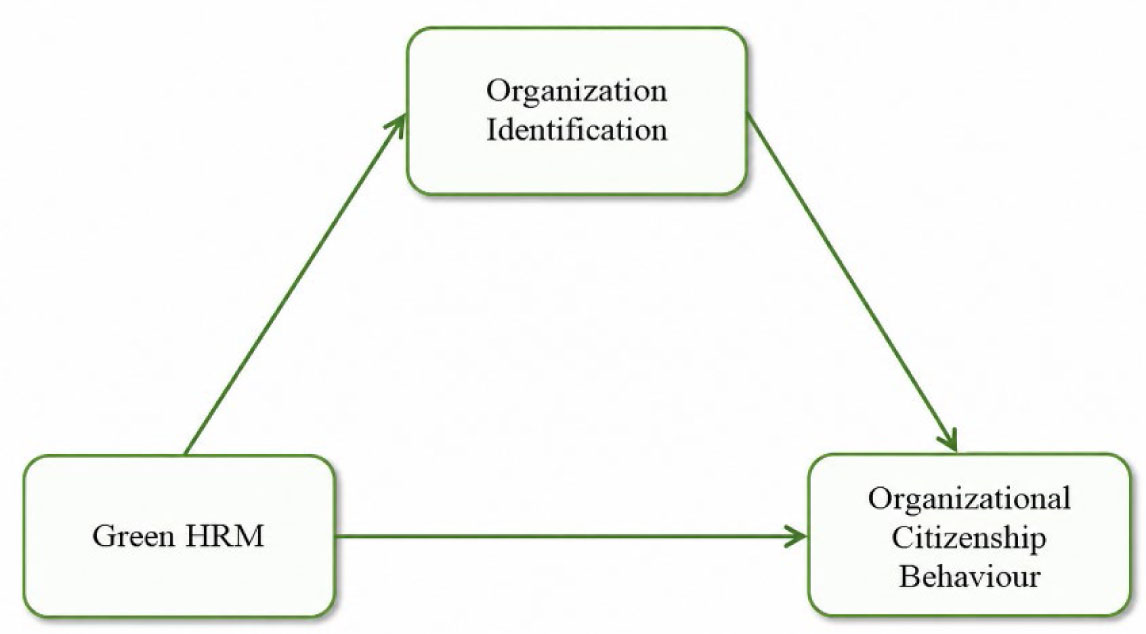
Figure 1.
Proposed model
Source: own processing
Methodology
Research design
This paper uses quantitative research design, employing a deductive approach to verify the hypothesized relationship among GHRM, Organizational Identification, and Green OCB. The data were collected through a cross-sectional survey, which involved the target population at a point in time. The design is suitable for testing the causal relationship and mediating processes suggested in the theoretical model.
Population and sampling
The population of this study comprises the academic and administrative employees of the University of Anbar and the University of Babylon. The choice of these institutions was based on their top rankings in the UI GreenMetric World University Rankings in Iraq, which is research setting that has developed environmental programs. A priori power analysis was performed using the G*Power 3.1.9.7 software. The parameters were adjusted to a medium effect size of 0.15 (f 2), significance level of 0.05, and statistical power (1-β) of 0.95, and the two predictors (Green HRM and Organizational Identification). The analysis showed that the minimum sample size should be 107 respondents. Nevertheless, to address potential nonresponse and data loss, and to ensure a solid analysis using PLS-SEM, 300 questionnaires were sent (150 to each university).
Data collection procedures
Data was gathered through an online, self-administered, structured questionnaire on Google Forms. This approach was selected due to its efficiency, affordability, and ability to reach respondents across various university campuses. The connection to the questionnaire was sent via email to academic and administrative employees using the official university email. The original English scales were translated into Arabic using the “back-translation method” to ensure translation validity (Brislin, 1986). The online form began with an informed consent section that outlined the study’s academic purpose, assured the anonymity and confidentiality of all responses, and made it clear that participation was voluntary. To maintain the desired number of respondents, the link was distributed to a specific group of 300 potential respondents (150 per university), and after one week, reminders were sent to increase the response rate.
Out of 300 online questionnaires, 200 were valid and complete and used for the final analysis. The effective response rate of 66.7% is very satisfactory for this type of research setting.
Measures
Multi-item scales based on the existing literature were used to measure all the constructs. All of the items were evaluated using a “5-point Likert scale with the range of 1 (Strongly Disagree) to 5 (Strongly Agree)”.
GHRM was assessed on a 6-item scale based on Freire and Pieta (2022). It measures employees’ perceptions of the organization’s green practices; sample items include ‘My university offers training on green issues’ and ‘My performance appraisal has environmental goals.’ Further, organizational identification was measured using the 6-item scale developed by Freire and Pieta (2022), a gold-standard instrument in social identity research. Sample items include ‘When someone criticizes my university, it feels like a personal affront’ and ‘I am highly interested in others’ perceptions of my university.’
Green OCB:
Voluntary green behaviors were measured using the 6-item Green OCB scale developed by Freire and Pieta (2022). The scale captures eco-initiatives such as ‘I volunteer to perform environmental actions in my day-to-day working activities’ and ‘I promote more environmentally friendly behaviors among my colleagues.’
Data analysis strategy
The data were processed using SEM in SmartPLS 4. PLS-SEM was selected because it is highly effective for testing complex mediation models and performs well with the nonnormal data distributions that are prevalent in social science studies. The analysis followed two phases. Measurement Model Assessment: To test reliability “(Cronbach’s Alpha, Composite Reliability)” and validity (“Convergent and Discriminant validity”). Structural Model Assessment: To test direct hypotheses and the mediating effect of Organizational Identification with bootstrapping (5,000 resamples).
Data analysis and results
Demographic profile
The demographic analysis as presented in Table 1 demonstrates that the study population is well represented. Gender wise, the sample was mostly male (62%), which is representative of the overall gender composition of the Iraqi population working in the public sector, but a large number of female employees (38%) were also represented. In terms of age, most respondents were middle-aged, with 39% aged 31–40 years and 28% aged 41–50 years, indicating a mature workforce with a stable career path.
Table 1.
Demographic profile of respondents (N=200)
| Variable | Category | Frequency (N) | Percentage (%) |
|---|---|---|---|
| Gender | Male | 124 | 62.0% |
| Female | 76 | 38.0% | |
| Age | 20–30 Years | 34 | 17.0% |
| 31–40 Years | 78 | 39.0% | |
| 41–50 Years | 56 | 28.0% | |
| Above 50 Years | 32 | 16.0% | |
| Education | Bachelor | 44 | 22.0% |
| Master | 72 | 36.0% | |
| PhD | 84 | 42.0% | |
| Job Position | Academic Staff | 136 | 68.0% |
| Administrative Staff | 64 | 32.0% | |
| Experience | Less than 5 Years | 48 | 24.0% |
| 5–10 Years | 82 | 41.0% | |
| More than 10 Years | 70 | 35.0% | |
| University | University of Anbar | 100 | 50.0% |
| University of Babylon | 100 | 50.0% |
The education level of the respondents was quite high, as would be expected in the higher education sector. A large majority of respondents held postgraduate degrees, with 42% holding a PhD and 36% a master’s degree. This educational profile means that respondents had the intellectual background to grasp the concepts of sustainability and Green HRM in the questionnaire clearly.
Regarding job position, the sample included 68% academic staff and 32% administrative staff, providing a balanced picture of the impact that green practices have on teaching and operational positions. Moreover, respondents had substantial work experience, with 76% having over 5 years (41% with 5–10 years and 35% with more than 10 years). This implies that the participants are familiar with organizational culture and policies of their respective universities. Lastly, the sample was balanced (50–50) between the University of Anbar and the University of Babylon, so that the findings are not biased toward either institution (Table 1).
SEM was used to analyze the data through the SmartPLS 4 software. The choice of PLSSEM in this study was due to the fact that it is more appropriate in exploring research as well as complex models with mediation and also has high levels of statistical power even when the sample size is small. The analysis was conducted according to the recommendations of Hair et al. (2019) in two steps: (1) measurement model (validity and reliability) and (2) structural model (hypothesis testing).
Assessment of the measurement model
In order to ascertain the quality of the data, we tested the reliability and validity of the constructs. Table 2 and Figure 2 indicate that the factor loadings of all items are above the recommended level of 0.708 (Hair et al., 2019), except for GHRM4, which was removed.
Table 2.
Construct reliability and validity
| Construct | Items | Factor loading | Cronbach’s Alpha | CR | AVE | VIF |
|---|---|---|---|---|---|---|
| Green HRM | GHRM1 | 0.777 | 0.900 | 0.901 | 0.715 | 1.732 |
| GHRM2 | 0.853 | 2.918 | ||||
| GHRM3 | 0.875 | 3.098 | ||||
| GHRM5 | 0.879 | 3.225 | ||||
| GHRM6 | 0.841 | 2.923 | ||||
| Green OCB | OCB1 | 0.792 | 0.872 | 0.884 | 0.661 | 1.894 |
| OCB2 | 0.864 | 2.675 | ||||
| OCB3 | 0.771 | 2.181 | ||||
| OCB4 | 0.766 | 2.300 | ||||
| OCB6 | 0.866 | 2.586 | ||||
| Organizational identification | OI1 | 0.718 | 0.832 | 0.834 | 0.544 | 1.968 |
| OI2 | 0.764 | 2.808 | ||||
| OI3 | 0.726 | 1.946 | ||||
| OI4 | 0.764 | 2.336 | ||||
| OI5 | 0.706 | 2.034 | ||||
| OI6 | 0.744 | 2.270 |
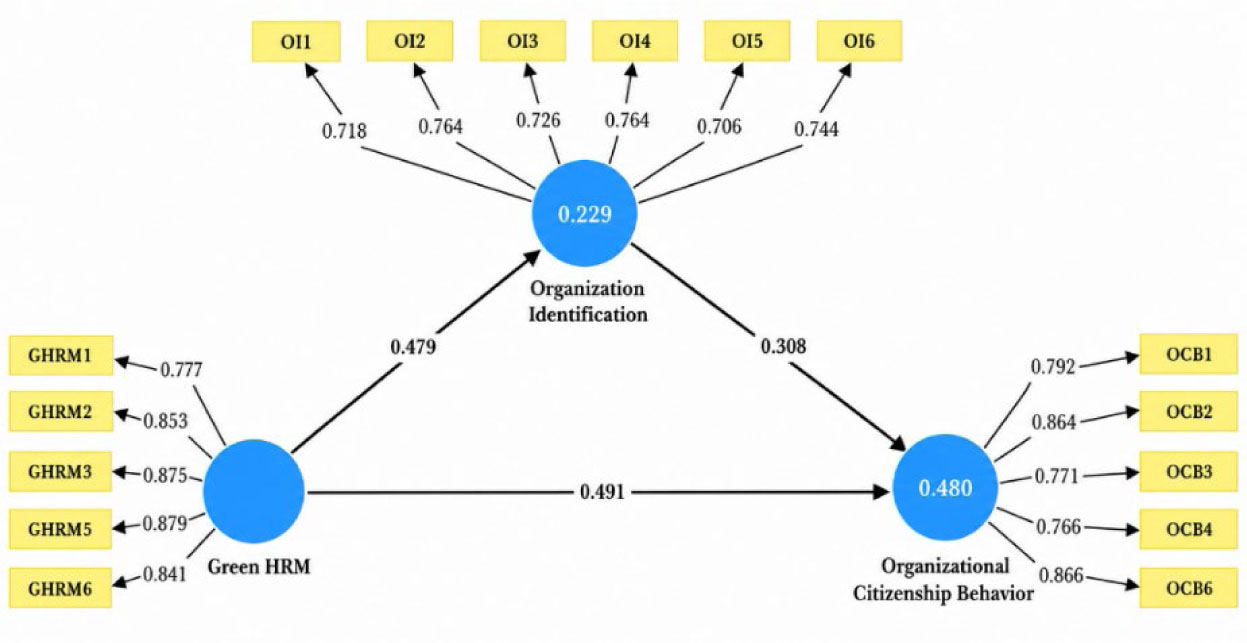
Figure 2.
Measurement model
Source: own processing
This implies that the indicators share a high degree of variance with the constructs. Internal consistency reliability was also established since all constructs had “Cronbach’s Alpha and Composite Reliability (CR)” values higher than 0.70. Moreover, the “Average Variance Extracted” (AVE) of all variables was more than 0.50, as recommended by (Hair et al., 2019), which indicated that there was sufficient convergent validity.
We used the “Fornell-Larcker Criterion” in order to make sure that every construct is empirically different. Table 3 shows that the square root of the AVE of each construct (the diagonal values are bolded) is greater than the correlation with any other construct (the off-diagonal values), thus demonstrating discriminant validity.
Table 3.
Fornell-Larcker criterion
| Variables | Green HRM | OCB | Organizational identification |
|---|---|---|---|
| Green HRM | 0.846 | ||
| OCB | 0.638 | 0.813 | |
| Organizational identification | 0.479 | 0.543 | 0.737 |
Although the Fornell-Larcker criterion is popular, recent studies indicate that it may not be effective in identifying an absence of discriminant validity in typical research contexts (Henseler et al., 2015). Thus, the “Heterotrait-Monotrait Ratio of Correlations (HTMT)” was also used in the present research as a stronger criterion. Since Table 4 shows that all HTMT values are below the conservative value of 0.85, we can conclude that the constructs are empirically different. Moreover, the bootstrapping-based confidence intervals did not contain the value of 1.0, which is a clear indication of discriminant validity.
Assessment of the structural model
The structural model was tested after the validation of the measurement model to test the hypotheses proposed.
To begin with, the “Variance Inflation Factor” (VIF) was used to check the problem of collinearity. All VIF values reported in Table 1 were below the threshold of 5.0, except for OCB5, which was removed. The remaining VIF values ranged between 1.732 and 3.225, indicating no multicollinearity problems. The coefficient of determination (R2) as depicted in Figure 2 was used to determine the predictive power of the model. The model captured 23% of the variance in Organizational Identification and 48% of the variance in Green OCB, which represents moderate to substantial explanatory power.
Hypothesis testing (direct effects)
“Bootstrapping with 5,000 subsamples was done to test the significance of the path coefficients”. According to Table 5 and Figure 3, Green HRM had a significant positive effect on Green OCB, with a T-value of 7.965 >1.96 and P-value 0.000 <0.05, which supports H1. Also, Green HRM had a considerable impact on Organizational Identification, with a T-value of 8.168 >1.96 and a P-value of 0.000 <0.05, which supports H2. In addition, Organizational Identification had a significant positive impact on Green OCB, with a Tvalue of 4.924 >1.96 and a P-value of 0.000 <0.05, which validates H3.
Table 5.
Structural model results (direct effects)
| Path | Sample mean | Standard deviation | T statistics | P values | Result |
|---|---|---|---|---|---|
| Green HRM -> OCB | 0.489 | 0.062 | 7.965 | 0.000 | Supported |
| Green HRM -> Organizational identification | 0.483 | 0.059 | 8.168 | 0.000 | Supported |
| Organizational identification - > OCB | 0.312 | 0.062 | 4.924 | 0.000 | Supported |
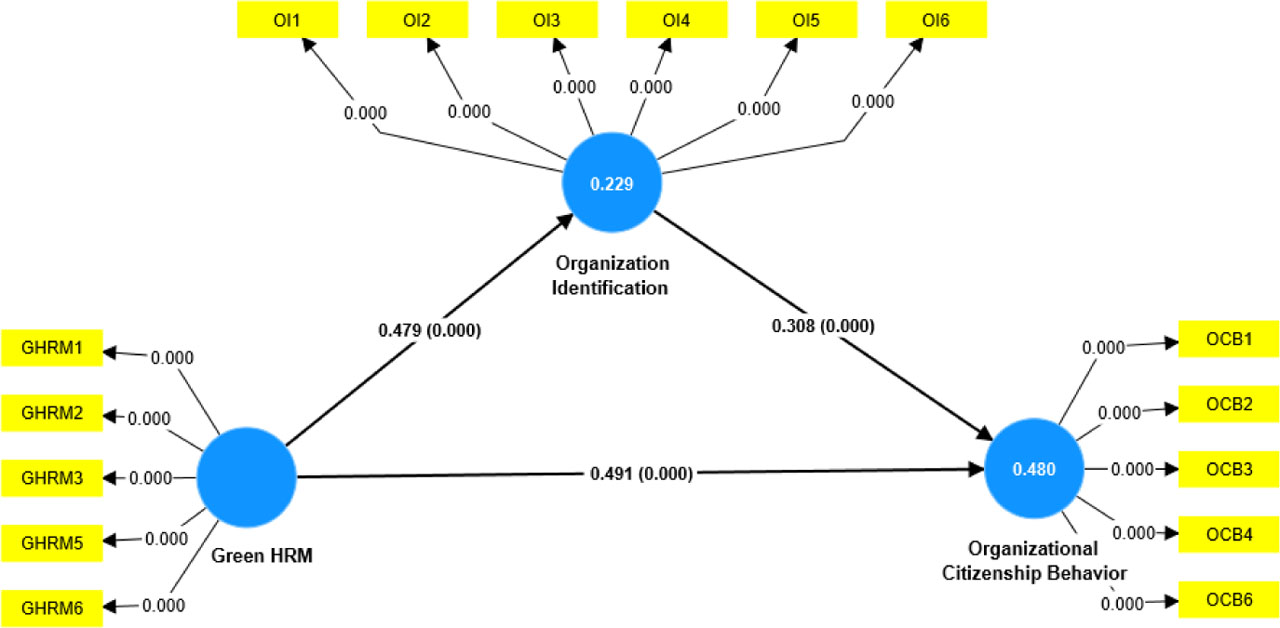
Figure 3.
Structural model
Source: own processing
Mediation analysis
In order to test the mediating effect of OI (H4), the study examined the specific indirect effects (Table 6).
Table 6.
Mediation analysis
| Path | Sample mean | Standard deviation | T statistics | P values | Result |
|---|---|---|---|---|---|
| Green HRM -> Organizational identification -> OCB | 0.151 | 0.038 | 3.896 | 0.000 | Supported |
The indirect relationship between Green HRM and Green OCB via Organizational Identification, as indicated in Table 6, was statistically significant, with a T-value of 3.896 >1.96 and a P-value of 0.000 <0.05. The fact that both the direct and indirect effects are substantial means that there is a partial mediation effect. Thus, H4 is supported.
Discussion
The main aim of the research was to investigate how GHRM affects Green OCB of academic and administrative employees in higher education institutions in Iraq, where Organizational Identification was used as an intermediate variable. Based on the “Social Identity Theory”, the outcomes of the “structural equation modeling (PLS-SEM)” confirmed all the hypotheses made. These results provide new empirical data based on the Middle Eastern setting, confirming that translating green organizational values into voluntary employee behavior can be achieved through the psychological process of identification.
The first hypothesis, that GHRM practices have a positive impact on Green OCB, was supported. The implication of this finding is that, in cases where Iraqi universities adopt green practices, including hiring environmentally aware personnel, offering them green training, and basing appraisal on environmental objectives, employees will tend to participate in voluntary environmentally friendly practices. This is consistent with the results of Agarwal et al. (2024), Liu et al. (2021) and Saeed et al. (2024),, who reported similar results in different sectors. The outcome validates that formal HR systems signal to employees that environmental sustainability is a fundamental organizational value and clarify the behavioral expectations needed to support these objectives.
The second hypothesis, which posited a positive influence of GHRM on Organizational Identification, was also supported, in line with prior studies (Cao et al., 2023; Saeed et al., 2024). This means that green initiatives are not merely operational tools but strategic branding instruments that enhance the organization’s prestige. In line with the SIT, employees who feel that their university is socially responsible and ethical will develop better self-esteem, which will result in a greater sense of belonging and pride. This observation supports Freire and Pieta (2022), who also identified the existence of a considerable association between green practices and employee identification in ISO 14001-certified firms. This implies that, in the context of Iraqi higher education, sustainability initiatives can be a potent instrument of institutional loyalty.
The third hypothesis, which proposed a positive effect of Organizational Identification on Green OCB, was supported. This is an important finding because it contradicts some recent studies while aligning with others. For example, Freire and Pieta (2022) found that Organizational Identification did not contribute to Green OCB, arguing that identification was not sufficient without job satisfaction. Nevertheless, the findings of the current study coincide with Chaudhary (2019) and Liu et al. (2021), who proved that strong identification is one of the leading factors contributing to extra-role behavior. One of the reasons that could have led to this deviation is the cultural setting; in the Iraqi academic system, employees place a high value on the university’s social standing and reputation. Thus, when individuals experience a profound sense of affiliation with their workplace, they absorb the achievements and failures of their institution and are willing to go out of their way (such as by saving energy or minimizing waste) to preserve the good image of the university.
Lastly, the findings supported the fourth hypothesis that OI mediates the relationship between GHRM and Green OCB, consistent with results reported by Saeed et al. (2024) and Chaudhary (2019). This finding helps resolve the ‘black box’ problem in GHRM research. It indicates that GHRM practices do not produce green behavior merely through compliance or rule enforcement, but indirectly, by changing the psychological attachment of the employees to the organization. By signaling a commitment to the environment, GHRM creates a Green Organizational Identity which employees subsequently internalize as part of their own social identity. As a result, they engage in environmentally friendly behavior not because they are obligated to, but because they are consistent with who they are as members of the university. This supports the relevance of SIT for explaining sustainable practices in the Iraqi public sector.
Implications of the study
The results of this research have several important implications, both for the scholarly literature on sustainable management and for the actual policies of higher education institutions in developing countries.
Theoretical implications
First, the research contributes to the literature of GHRM by offering empirical data on the Iraqi higher education sector, an area that has received minimal representation in the research literature across the world. Although the majority of previous research has focused on manufacturing sectors in developed or rapidly developing economies, this study confirms the relevance of GHRM models in the state sector of a developing economy in the Middle East. It shows that green management practices are not only applicable to industrial companies but also in academia to facilitate behavior change.
Second, the research contributes greatly to the use of the SIT in environmental management. By confirming the mediating role of OI, this research helps open the ‘black box’ of how HR practices shape employee behavior. It gives empirical evidence to the argument that GHRM practices are signaling mechanisms that increase the prestige of the organization and, in turn, enhance employees’ psychological commitment to it. This contrasts with the recent findings of Freire and Pieta (2022), who suggested that identification may not be sufficient to influence behavior in the absence of job satisfaction. In our study, we confirm that the feeling of oneness and pride in the university is a strong individual motivator of voluntary green behavior in the Iraqi academic setting.
Practical implications
This paper can provide practical recommendations on how to enhance environmental performance and university rankings (including the UI GreenMetric World University Rankings). University leaders should recognize that Green HRM is not merely a compliance exercise but a means of building institutional identity. The management ought to take the initiative to inform the staff on their environmental performance and ratings. Academic staff develop a stronger Organizational Identification when they view their university as a Green Leader, which in turn promotes voluntary helping behavior (Green OCB).
Recruitment of new faculty and staff should incorporate environmental criteria into the hiring process. It is easier to develop a green culture by hiring people who already appreciate sustainability. Moreover, Green Training programmes should be mandatory not only for maintenance personnel but also for academic faculty, who should learn how to minimize resource use in laboratories and classrooms.
Green OCB cannot be enforced; however, it can be promoted. Universities should introduce Green Reward Systems (non-monetary rewards, awards, or certificates) for departments or individuals that propose innovative sustainability solutions. This strengthens the “Green Identity” and makes others do the same. Given the demonstrated relationship between Organizational identification and Behavior, management should draw on the prestige of the university to motivate engagement. Energy-saving and waste-minimization campaigns should be framed not as rules but as responsibilities of proud members of a leading university.
This study reports important findings about present-day managerial trends. It proposes a shift from the traditional approach—heavy on compliance and light on managerial discretion—to a more dynamic, identity-forming style of leadership. However, to truly achieve sustainability, management cannot solely rely on top-down directives or rigid policies. Rather, managers and HR professionals must play a role in building a ‘green Organizational Identity’ which in turn will connect with employees’ personal and social values. In practice, this means that managers must integrate environmental considerations into every aspect of their work, not only in policy documents but also in their daily management practices, continuous performance reviews, and personal recognition programs. Moreover, by using the social identity-based psychological processes, managers can develop a dynamic and self-sustaining culture in which ecofriendly behaviors (Green OCB) develop naturally.
Conclusions
This paper examined the psychological processes through which GHRM practices influence the voluntary environmental behaviors of academic and administrative staff in Iraqi higher education institutions. Drawing on SIT, the study addresses an important gap in the literature on how employees internalize green organizational values in a developing-country setting.
The empirical findings give strong evidence that GHRM practices—including green recruitment, training, and performance appraisal—are not merely administrative instruments but important strategic signals of an organization’s commitment to sustainability. In turn, these signals foster a stronger OI and cultivate a strong sense of pride and belonging. More importantly, the research shows that this sense of identification acts as a mediating factor: employees engage in Green OCB not because regulation requires it, but because it is part of who they are as members of a responsible and ethical organization.
To sum up, this study shows that in order to attain their sustainability objectives and increase their ratings in the world ranking (e.g., UI GreenMetric), Iraqi universities should not focus only on infrastructure and technology. The path to a sustainable campus lies in fostering a Green Identity among staff. By involving employees as stakeholders in the sustainability process and cultivating a culture of shared environmental values, universities can unlock the voluntary, extra-role behaviors needed to address the urgent environmental challenges of the 21st century.