
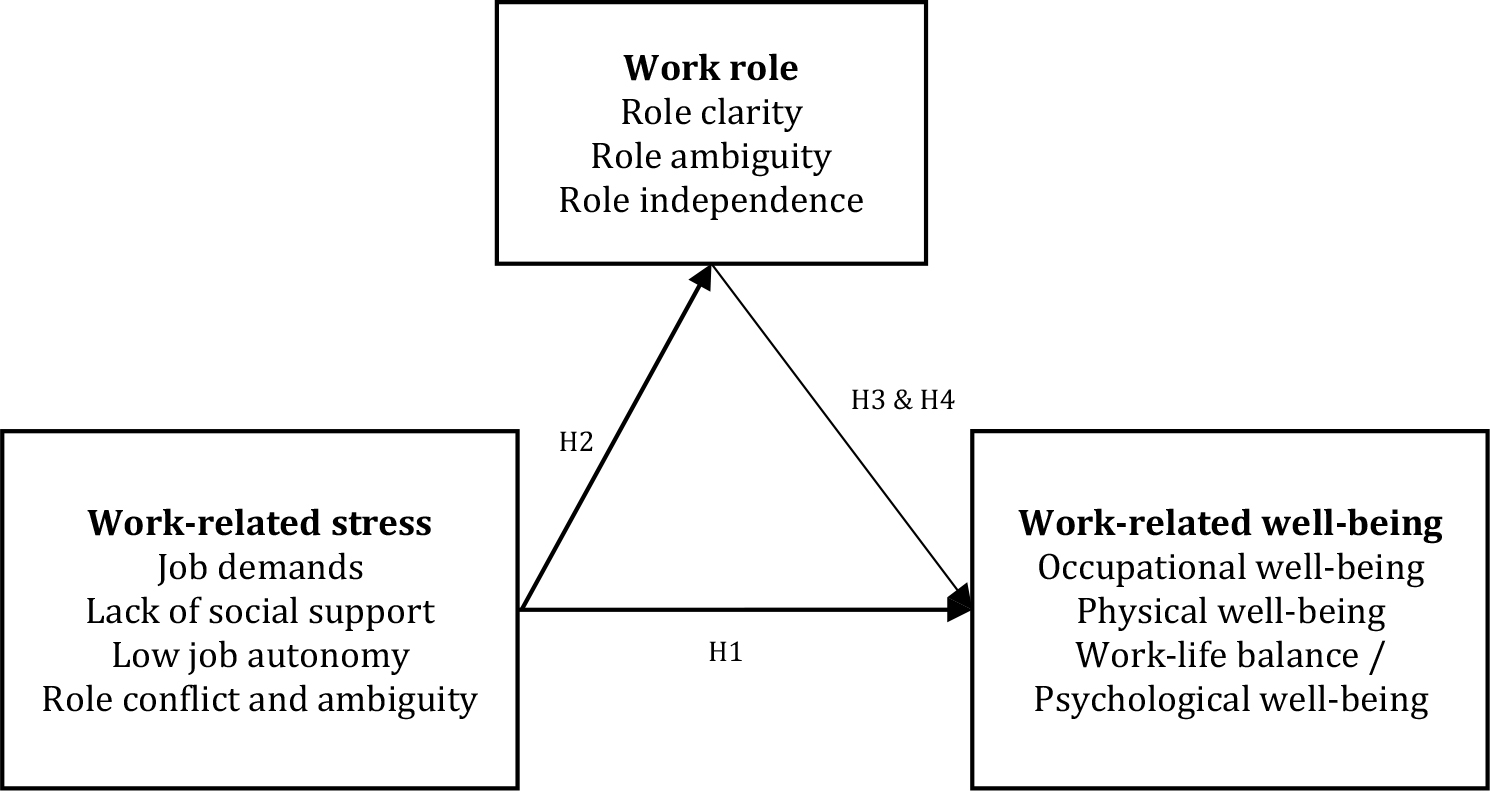
Figure 1.
Conceptual framework of the study
Source: own processing
Table 1.
Demographic characteristics
| Variable | Options | Frequency | Percentage |
|---|---|---|---|
| Age range | Below 30 years | 44 | 19.3% |
| 30-40 years | 104 | 45.6% | |
| 41-50 years | 65 | 28.5% | |
| More than 50 years | 15 | 6.6% | |
| Gender | Male | 219 | 96.1% |
| Female | 9 | 3.9% | |
| Highest educational level | Diploma/HND | 76 | 33.3% |
| Bachelors | 98 | 43.0% | |
| Masters | 26 | 11.4% | |
| PhD | 0 | 0.0% | |
| Other | 28 | 12.3% | |
| Working experience in engineering | Up to 5 years | 131 | 57.5% |
| 6-10 years | 38 | 16.7% | |
| 11-20 years | 31 | 13.6% | |
| 21-30 years | 27 | 11.8% | |
| 31-40 years | 1 | 0.4% |
Table 2.
Construct validity
| Work-related well-being | Factor loadings |
|---|---|
| Occupational well-being | 0.857 |
| Physical well-being | 0.682 |
| Work-life balance well-being | 0.701 |
| Work-related stress | Factor loadings |
| Job demands | 0.696 |
| Lack of social support | 0.801 |
| Low job autonomy | 0.881 |
| Role conflict and ambiguity | 0.840 |
| Work role | Factor loadings |
| Role ambiguity | 0.851 |
| Role clarity | 0.838 |
| Role independence | 0.748 |
Table 3.
R-square
| Variable | R-square | R-square adjusted |
|---|---|---|
| Work role | 0.057 | 0.053 |
| Work-related well-being | 0.285 | 0.279 |
Table 4.
F-square
| Variable | F-square |
|---|---|
| Work-related stress -> Work role | 0.061 |
| Work-related stress -> Work-related well-being | 0.002 |
| Work role -> Work-related well-being | 0.379 |
Table 5.
Reliability and convergent validity
| Variable | Cronbach’s Alpha | Composite reliability (rho_a) | Composite reliability (rho_c) | Average variance extracted (AVE) |
|---|---|---|---|---|
| Work role | 0.748 | 0.774 | 0.854 | 0.662 |
| Work-related stress | 0.828 | 0.883 | 0.882 | 0.652 |
| Work-related well-being | 0.841 | 0.848 | 0.883 | 0.560 |
Table 6.
Discriminant validity using HTMT
| Variable | Heterotrait-Monotrait ratio (HTMT) |
|---|---|
| Work-related stress <-> Work role | 0.265 |
| Work-related well-being <-> Work role | 0.783 |
| Work-related well-being <-> Work-related stress | 0.182 |
Table 7.
Collinearity statistics using VIF
| Variable | VIF |
|---|---|
| Job demands | 1.578 |
| Lack of social support | 1.776 |
| Low job autonomy | 1.997 |
| Occupational well-being | 2.445 |
| Physical well-being | 1.638 |
| Psychological well-being | 1.651 |
| Role ambiguity | 1.638 |
| Role clarity | 1.447 |
| Role conflict and ambiguity | 1.773 |
| Role independence | 1.467 |
| Work life balance | 1.570 |
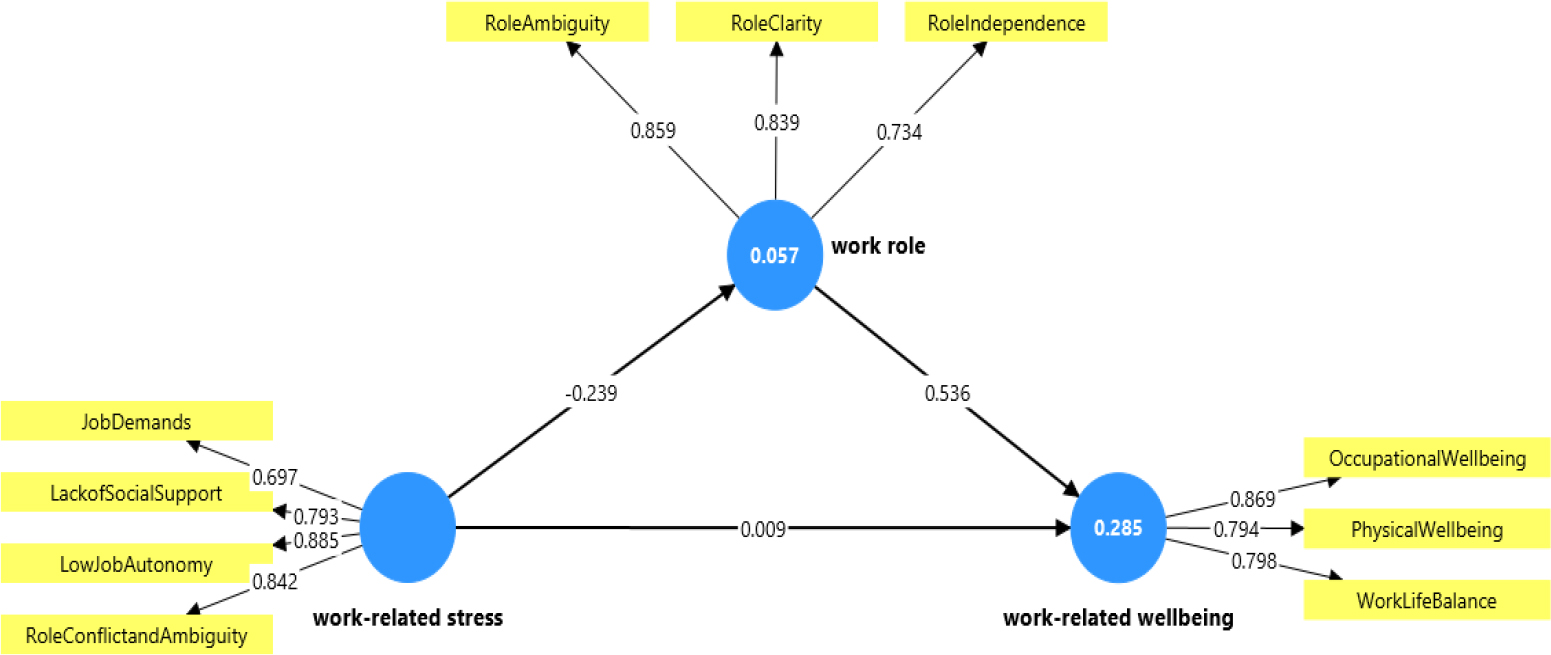
Figure 2.
Structural Equation Modelling for direct and mediating effects among work-related conditions, work-related stress, work-related well-being, and work role
Source: own processing
Table 8.
Direct and mediating effects
| Hypotheses | β-value | t-statistics | p-values | Decision |
|---|---|---|---|---|
| H1: Work-related stress -> Work-related well-being | 0.009 | 0.123 | 0.902 | Not supported |
| H2: Work-related stress -> Work role | -0.239 | 3.781 | 0.000 | Supported |
| H3: Work role -> Work-related well-being | 0.536 | 11.777 | 0.000 | Supported |
| H4: Work-related stress -> Work role -> Work-related well-being | -0.128 | 3.507 | 0.000 | Supported |