
Introduction
This study is part of a larger study that investigates relationships among work-related conditions, work-related stress, work-related well-being, work role, and personal resilience among engineering professionals in Ghana’s seaports. The strategic importance of seaports to national competitiveness makes the well-being of engineering professionals in port environments a critical priority for economic resilience and workforce sustainability (Boyke et al., 2025; Caliskan, 2022). Modern ports operate as highly mechanised, technology-driven systems that require engineers to maintain sophisticated equipment and ensure operational continuity under intense performance pressures (Su et al., 2024). In such demanding industrial settings, work-related stress frequently emerges from high workloads, time pressure, and physical hazards, which affect morale, psychological health, and output quality (Clonch et al., 2025). Research indicates that unmanaged workplace stress fuels burnout, errors, absenteeism, and safety incidents, ultimately negatively affecting employee well-being (Clement & Nathan, 2024; Saud & Rice, 2024).
In high-risk industrial environments such as seaports, prolonged exposure to operational strain elevates psychological fatigue and heightens the likelihood of stress-induced illness, further diminishing well-being and performance outcomes (Yaakub et al., 2024). Studies suggest that engineering personnel frequently report emotional exhaustion, job dissatisfaction, and disengagement when faced with persistent stressors and limited recovery opportunities, illustrating the link between work environment conditions and indicators of diminished well-being (Oldenburg et al., 2021; Reck et al., 2025).
Additionally, the integration of automation and digital technologies in port operations has intensified cognitive demands, requiring engineers to multitask and manage technological complexities, further amplifying stress levels and emotional strain, which negatively affect employee well-being (Oladeinde, 2025; Zou et al., 2025). With global trade expansion intensifying shipping activity (Yeo, 2024), ports in emerging economies like Ghana must safeguard the well-being of engineering staff to maintain operational excellence and sustain national logistics competitiveness. This study argues that understanding how work-related stress influences engineers’ well-being within the seaport sector in Ghana has both practical and scholarly significance, informing organizational policy, employee retention strategies, and occupational health reforms aligned with modern human capital needs.
Research increasingly recognizes that work role dynamics, particularly role autonomy, role independence, and role clarity, shape how individuals interpret job demands and experience stress within professional settings (O’Rourke, 2021). Studies have indicated that unclear or conflicting role expectations heighten psychological strain (Maden-Eyiusta, 2021; Tang & Vandenberghe, 2021), whereas adequate role clarity enhances coping capacity and mitigates the effects of stress on well-being (Li & Griffin, 2022; Thomson et al., 2021). In technical work environments such as ports, engineers often juggle multiple responsibilities, including maintenance planning, real-time mechanical troubleshooting, compliance monitoring, and crisis management, contributing to role conflict and overload (Bagirov et al., 2021). Work role, therefore, functions as a crucial mediating factor, influencing the pathway between work-related stress experiences and employee well-being outcomes (Dodanwala et al., 2022). Thus, in circumstances where roles are clearly defined and workload is manageable, employees tend to report higher well-being and stronger psychological resilience (Wood et al., 2020). In contrast, ambiguous or excessive role demands heighten vulnerability to stress and burnout (Shin et al., 2020).
Despite the critical role of engineering professionals in Ghana’s seaport industry (Baafi, 2024), empirical research examining the direct and mediating relationships between work-related stress, work-related well-being, and work role remains limited. While occupational health studies in Ghana have examined safety practices among general port workers (Mintah-Benyin, 2022), research on engineers, whose technical tasks and stress profiles differ significantly from those of other port roles, remains limited. Moreover, empirical inquiry into the mediating influence of work role on the relationships between work-related stress and work-related well-being among engineering professionals in Ghana’s seaport industry is largely unexplored, creating a research gap. Although literature highlights the role of work role as a mediating mechanism in the relationships between work-related stress and well-being (Akkoç et al., 2021; Cheung & Li, 2023; Wang et al., 2023), the Ghanaian seaport engineering context remains unexplored empirically, creating a research gap. This study, therefore, fills a critical research gap by investigating how work-related stress affects well-being among engineering professionals in Ghana’s seaport industry, while examining the influence of work role on such relationships. Thus, the findings of this study will contribute context-specific evidence to inform occupational health policies, human resource interventions, and engineering workforce wellness strategies in Ghana’s seaport sector.
Literature review
Theoretical framework
The Job Demand-Control-Support (JDCS) theory, originally proposed by Robert Karasek in the late 1970s and early 1980s, provides a comprehensive lens for examining how job characteristics influence employee stress, health, and performance (Häusser et al., 2010). The model asserts that three key elements, namely job demands, job control, and social support, jointly determine occupational strain and well-being. Job demands encompass workload, time pressures, cognitive challenges, and emotional strain inherent in work tasks (Meyer & Hünefeld, 2018). When these demands outweigh employees’ abilities to cope, stress and strain increase significantly (Rantanen et al., 2021). These demands may be quantitative, such as high task volume, or qualitative, such as task complexity (Broetje et al., 2020).
Job control refers to the extent to which employees exercise decision-making authority and autonomy over how tasks are executed (Asif et al., 2018). Higher job control enables individuals to regulate their work and better manage demanding situations, enhancing satisfaction and reducing stress (Gerich & Weber, 2020; Nasution et al., 2023). Social support, the third JDCS dimension, reflects emotional, informational, and instrumental assistance from peers, supervisors, and the organization (Portoghese et al., 2020). Supportive work environments buffer the negative effects of high job demands and limited control, reducing burnout and fostering resilience (Jessiman-Perreault et al., 2021).
The Job Demand Control Support (JDCS) theory provides a robust framework for examining relationships among work-related stress, work-related well-being, and work role by integrating the interaction between job demands, control, and social support in predicting strain and adaptive outcomes. The model elucidates how excessive job demands increase stress, while control and social support foster coping mechanisms that enhance well-being. Importantly, work roles function as a mediating mechanism through which stress influences well-being, as roles determine the degree of autonomy, engagement, and resilience individuals experience in demanding work environments.
Work-related well-being
Work-related well-being refers to the overall quality of an employee’s experience at work, encompassing physical and psychological health, emotional stability, social relationships, job satisfaction, and the ability to balance work and personal life (Khalid et al., 2024). It reflects how effectively individuals thrive within their occupational environment, maintaining positive functioning and fulfilment (Lomas, 2019; Nübling et al., 2010). This study conceptualized work-related well-being into three sub-dimensions, namely occupational well-being, physical well-being, and work-life balance. Physical well-being concerns maintaining bodily health and safety at work (Wang et al., 2023), particularly in hazardous environments and demanding physical tasks. Occupational well-being reflects job satisfaction, professional fulfilment, and perceived competence (Bautista et al., 2023), influenced in ports by workload intensity and technical autonomy. Work-life balance concerns the effective management of professional and personal responsibilities (Bhat et al., 2023), which is vital, as engineers often face long hours and rotating shifts at Ghana’s seaports.
Work-related stress
Work-related stress refers to the psychological and physiological responses that occur when job demands exceed an individual’s capacity to cope, threatening well-being and performance (Yuan et al., 2023). Work-related stress arises from organisational pressures, environmental challenges, and interpersonal demands that strain employees’ mental and emotional resources (Lemke et al., 2023). Job demands involve workload, time pressure, and complex tasks that require sustained effort (Bakker et al., 2023). For engineering professionals in Ghana’s seaports, high cargo traffic, urgent maintenance schedules, and safety-critical operations heighten stress levels. Lack of social support is associated with insufficient assistance from supervisors or colleagues, reducing coping capacity and increasing emotional strain (Jolidon et al., 2024). In seaport settings, limited peer or managerial support during crisis operations can intensify stress. Low autonomy refers to restricted decision-making power, which undermines control and increases tension (Frank & Otterbring, 2024). Engineers at seaports may experience stress when strict hierarchical procedures delay urgent technical decisions. Role conflict and ambiguity arise when job expectations are unclear or conflicting (Maden-Eyiusta, 2021), which is common in dynamic port environments where engineers manage multidisciplinary tasks under changing directives.
Work role
Work role refers to the set of responsibilities, expectations, and behaviours associated with an individual’s position within an organisation, shaping how tasks are understood and performed (Belbin & Brown, 2022). Effective work role clarity supports performance, reduces stress, and fosters professional confidence (Hasibuan et al., 2025). Role clarity refers to a clear understanding of duties, expectations, and performance standards (Orgambídez & Almeida, 2020). For engineering professionals in Ghana’s seaports, clarity in technical procedures, maintenance protocols, and emergency responsibilities enables efficient operations and prevents costly maritime disruptions. Role ambiguity arises when job expectations and responsibilities are unclear, leading to confusion and decreased performance (Blake, 2020). In dynamic port environments, unclear reporting lines or shifting operational directives may heighten stress. Role independence refers to the degree of autonomy and discretion employees have in executing tasks (Tingo & Mseti, 2022). For port engineers, decision-making independence supports timely problem-solving during equipment faults, safety checks, and vessel-handling operations.
Empirical studies have established a clear link between work-related stress and work-related well-being (Priya et al., 2023). High levels of work-related stress often have a detrimental impact on employees’ emotional, physical, and psychological health, leading to a decline in overall work-related well-being (Priya et al., 2023). Research has shown that workplace stress leads to negative emotional outcomes, such as anxiety and depression (Brunner et al., 2019). Brunner et al. (2019) further attest that when employees face persistent stress, their emotional well-being deteriorates, affecting their ability to focus and perform tasks efficiently. Studies indicate that work-related stress increases absenteeism and reduces productivity, placing additional strain on organizations (Jim et al., 2024). Jim et al. (2024) further indicate that work-related stress negatively affects job satisfaction and employee commitment. A study by Kheswa (2019) found that when stress levels are high, employees are more likely to experience burnout and reduced motivation, leading to lower work-related well-being. Based on studies conducted by Brunner et al. (2019), Kheswa (2019), Priya et al. (2023), and Jim et al. (2024), the study hypothesizes that:
H1: Work-related stress has a significant negative effect on work-related well-being among engineering professionals in Ghana’s seaports.
Work-related stress and work role
Work-related stress has been empirically shown to negatively affect employees’ work roles by impairing role clarity, autonomy, and independence, ultimately constraining performance and well-being (Lange & Kayser, 2022). Elevated stress conditions often distort employees’ understanding of job expectations, thereby diminishing role clarity and increasing ambiguity in task execution (Bakar et al., 2021). Empirical evidence further indicates that heightened stress reduces employees’ decision-making latitude and control over work processes, resulting in diminished role autonomy and increased susceptibility to burnout, particularly in high-pressure occupational settings (Zhang & He, 2022). Work-related stress also weakens role independence by eroding self-efficacy and limiting employees’ ability to perform tasks autonomously, thereby negatively affecting task efficiency and psychological functioning (Karimikia et al., 2021). Studies in diverse organizational contexts, including emerging-economy environments, demonstrate that unclear work roles and restricted autonomy intensify stress responses and contribute to declines in job satisfaction and organizational commitment (Han et al., 2025). Based on studies conducted by Karimikia et al. (2021), Zhang and He (2022), Lange and Kayser (2022), Bakar et al. (2021), and Han et al. (2025), the study hypothesizes that:
H2: There is a significant negative relationship between work-related stress and work role among engineering professionals in Ghana’s seaports.
Work role and work-related well-being
Empirical studies consistently demonstrate that role clarity, role autonomy, and role independence are fundamental drivers of employee work-related well-being (Emre & De Spiegeleare, 2021). Clear and well-structured job roles reduce ambiguity and uncertainty, enabling employees to perform tasks with confidence and psychological security, ultimately supporting greater well-being (Bakar et al., 2021; Han et al., 2025). Beyond clarity of expectations, the capacity to exercise discretion and self-direction in work activities further strengthens employee well-being. Role autonomy has been shown to enhance employees’ sense of control, intrinsic motivation, and emotional stability at work, thereby reducing stress and fostering positive affective states (Fürstenberg et al., 2021; Lange & Kayser, 2022). Moreover, employees who demonstrate role independence, as reflected in self-efficacy and the ability to make work-related decisions without excessive oversight, report higher levels of engagement and satisfaction, reinforcing the protective effect of independent functioning on psychological well-being (Brandmo et al., 2021; Emre & De Spiegeleare, 2021). Based on studies conducted by Han et al. (2025), Bakar et al. (2021), Lange and Kayser (2022), Fürstenberg et al. (2021), and Brandmo et al. (2021), the study hypothesizes that:
H3: There is a significant positive relationship between work role and work-related well-being among engineering professionals in Ghana’s seaports.
Mediating effect of work role
Batse (2025) revealed that social support embedded within work roles serves as a buffering mechanism, helping employees manage job stress more effectively and maintain psychological stability. When strong interpersonal networks and collegial relationships characterize work roles, they promote emotional security and enhance overall well-being (Batse, 2025). Cheung and Li (2023) further emphasized that supervisory support and structured training reduce stress and foster job satisfaction. Similarly, Wang, Khan, et al. (2023) explained, through the Job Demands-Resources (JD-R) model, that work roles influence the balance between demands and resources, shaping how stress translates into engagement and, ultimately, well-being. In healthcare contexts, Akkoç et al. (2021) showed that unclear role expectations and excessive workload contribute to burnout, demonstrating that poorly defined work roles amplify stress and erode well-being. Gerhardt et al. (2021) confirmed, through a meta-analysis, that social stressors related to role interactions directly impair employee health. Based on studies conducted by Cheung and Li (2023), Wang, Khan, et al. (2023), Akkoç et al. (2021), Gerhardt et al. (2021), and Batse (2025), the study hypothesizes that:
H4: Work role mediates the relationship between work-related stress and work-related well-being among engineering professionals in Ghana’s seaports.
Conceptual framework
This study hypothesized three (d) direct relationships (H1-H3) and one (1) mediating relationship among work-related stress, work role, and work-related well-being among engineering professionals in Ghana. The hypotheses proposed in this conceptual framework were grounded in the empirical literature (Figure 1).
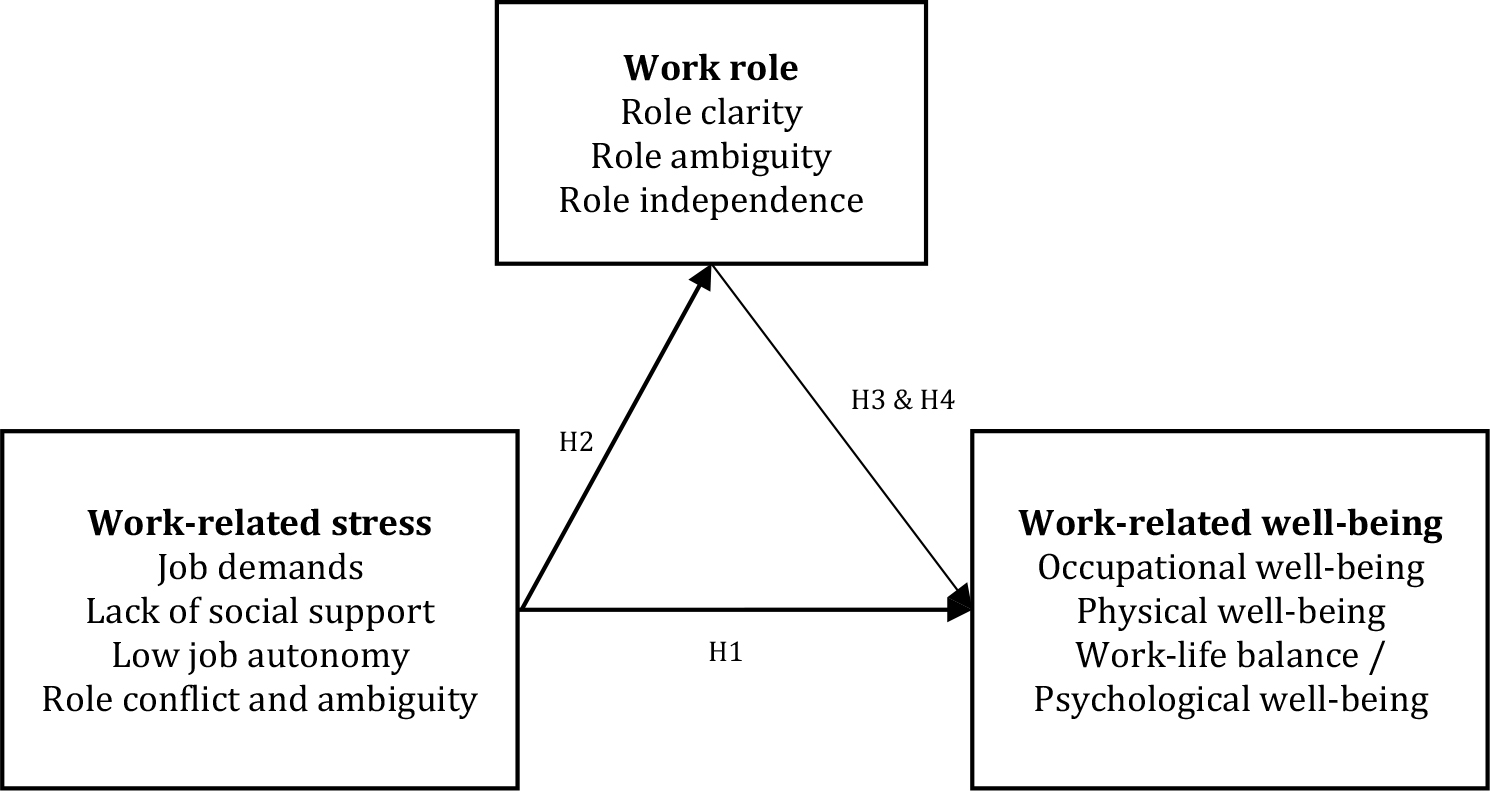
Figure 1.
Conceptual framework of the study
Source: own processing
Methodology
This study adopted the positivist research paradigm, which posits that reality is objective, quantifiable, and exists independently of human interpretation (Masuku, 2024). In alignment with this philosophical stance, structured online questionnaires were employed to reduce researcher bias and enhance objectivity in data collection. A quantitative research approach was adopted to measure constructs empirically and test hypothesized relationships among work-related stress, work-related well-being, and work roles. The study further employed an explanatory correlational research design to examine direct and mediating relationships among variables and to infer potential causal links statistically. The target population consisted of engineering professionals working at Ghana’s two main seaports, namely Tema and Takoradi, with a total of 572 personnel. Using the Macorr sample size calculator, a minimum sample of 230 respondents was determined to ensure statistical adequacy. A simple random sampling technique was employed to guarantee that every member of the population had an equal chance of selection, thereby strengthening the representativeness of the sample. Respondents were drawn from an established sampling frame using a random number generator, ensuring fairness and objectivity in participant selection.
A questionnaire was used to collect data. The questionnaire consisted of four sections measuring demographics and three latent variables: work-related well-being, work-related stress, and work role. Section A captured respondents’ demographics, including age, gender, education, department, and years of engineering experience at Tema and Takoradi ports. Section B of the questionnaire measured work-related well-being, categorized into three sub-dimensions: work-life balance (4 items), occupational well-being (5 items), and physical well-being (4 items). The items used to measure work-related well-being were adapted from questionnaires such as the Warwick-Edinburgh Mental Well-Being Scale (WEMWBS) (Tennant et al., 2007) and the Copenhagen Psychosocial Questionnaire (COPSOQ) (Nuebling & Hasselhorn, 2010). Section C of the questionnaire measured work-related stress among engineering professionals, with four (4) sub-dimensions: job demands (4 items), low job autonomy (4 items), role conflict and ambiguity (4 items), and lack of social support (4 items). Questionnaire items for measuring work-related stress were adapted from the Job Stress Survey (JSS) (Spielberger & Reheiser, 2020). Section D of the questionnaire measured work role, which had three sub-dimensions: role clarity (4 items), role autonomy (4 items), and role independence (3 items). Questionnaire items for measuring work role were adapted from the Job Diagnostic Survey (JDS) (Hackman & Oldham,1975). Questionnaires for measuring each variable, with its respective sub-dimensions, were administered on a six-point Likert scale, where 1 = strongly disagree, 2 = disagree, 3 = slightly disagree, 4 = slightly agree, 5 = agree, 6 = strongly agree.
Data collection was conducted online via Google Forms over three months. To enhance participation and improve the response rate, periodic email reminders were sent to prospective respondents. Upon completion of data collection, the dataset was cleaned and validated to ensure accuracy and completeness; responses with substantial missing values, inconsistencies, or incomplete information were excluded from further analysis. The validated data were coded and entered into the Statistical Package for the Social Sciences (SPSS) version 28 for initial descriptive analysis. Subsequently, the cleaned dataset was exported to SmartPLS for Partial Least Squares Structural Equation Modelling (PLS-SEM). This analytical approach was employed to examine both direct and mediating effects among the variables, including work-related conditions, work-related stress, work-related well-being, and work role, within the context of engineering professionals at Ghana’s seaports.
Results
Demographic data
Table 1 presents the demographic characteristics of the study respondents. The sample consisted of participants across four age categories, with the largest proportion (45.6%) aged 30-40 years, followed by 28.5% aged 41-50 years, and 19.3% below 30 years. Only 6.6% were over 50 years old, reflecting a predominantly middle-aged workforce, consistent with the professional experience typically associated with engineering roles. The gender composition of the respondents was markedly imbalanced, with 96.1% male and 3.9% female, underscoring the ongoing gender disparity in the engineering profession and highlighting the need for initiatives to enhance female representation in the sector.
Table 1.
Demographic characteristics
| Variable | Options | Frequency | Percentage |
|---|---|---|---|
| Age range | Below 30 years | 44 | 19.3% |
| 30-40 years | 104 | 45.6% | |
| 41-50 years | 65 | 28.5% | |
| More than 50 years | 15 | 6.6% | |
| Gender | Male | 219 | 96.1% |
| Female | 9 | 3.9% | |
| Highest educational level | Diploma/HND | 76 | 33.3% |
| Bachelors | 98 | 43.0% | |
| Masters | 26 | 11.4% | |
| PhD | 0 | 0.0% | |
| Other | 28 | 12.3% | |
| Working experience in engineering | Up to 5 years | 131 | 57.5% |
| 6-10 years | 38 | 16.7% | |
| 11-20 years | 31 | 13.6% | |
| 21-30 years | 27 | 11.8% | |
| 31-40 years | 1 | 0.4% |
In terms of educational attainment, most respondents held a bachelor’s degree (43.0%), followed by those with a Diploma or Higher National Diploma (33.3%). A smaller proportion (11.4%) held a master’s degree, and none reported holding a PhD. Additionally, 12.3% indicated possession of other professional certifications. Regarding work experience, more than half of the respondents (57.5%) had up to 5 years of engineering experience, while 16.7% had 6-10 years, 13.6% had 11-20 years, and 11.8% had 21-30 years. Only 0.4% had over 30 years of experience, suggesting that Ghana’s seaport workforce is largely composed of early-career engineering professionals.
Construct validity
Construct validity refers to the extent to which measurement items accurately represent and measure the theoretical construct they are intended to assess (Flake et al., 2022). In SEM, strong construct validity is evidenced when item loadings are sufficiently high, indicating that indicators reliably reflect their respective latent variables (Flake et al., 2022). In Table 2, most factor loadings exceed the acceptable threshold of 0.70, demonstrating satisfactory construct validity. Work-related conditions show strong loadings, especially for support systems culture (0.841) and workload culture (0.832). Work-related stress indicators such as low job autonomy (0.881) and role conflict/ambiguity (0.840) demonstrate high reliability. Work role items, including role ambiguity (0.851) and role clarity (0.838), also load strongly. Though a few well-being indicators fall slightly below 0.70 (e.g., physical well-being at 0.682), they remain acceptable, indicating overall strong construct validity across constructs.
Table 2.
Construct validity
| Work-related well-being | Factor loadings |
|---|---|
| Occupational well-being | 0.857 |
| Physical well-being | 0.682 |
| Work-life balance well-being | 0.701 |
| Work-related stress | Factor loadings |
| Job demands | 0.696 |
| Lack of social support | 0.801 |
| Low job autonomy | 0.881 |
| Role conflict and ambiguity | 0.840 |
| Work role | Factor loadings |
| Role ambiguity | 0.851 |
| Role clarity | 0.838 |
| Role independence | 0.748 |
R-Square
The R-square (R2) value denotes the proportion of variance in the dependent variable explained by its independent variables (Hayes, 2021). Within the context of Structural Equation Modeling (SEM), a higher R2 value reflects greater explanatory power of the model. The adjusted R-square further refines this measure by considering the number of predictors in the model, thereby providing a more precise estimate of explanatory strength in complex models (Hayes, 2021). In this study, work-related stress accounted for 28.5% of the variance in work-related well-being (R2 = 0.285), indicating a moderate explanatory influence. Additionally, work role explained 5.7% of the variance in work-related well-being, suggesting a comparatively weaker but notable contribution to the model’s explanatory capacity (Table 3).
Effect size (F-square)
F-square (effect size) measures the magnitude of the impact of an independent variable on a dependent variable in SEM (Purwanto & Sudargini, 2021). It complements R2 by showing how much an exogenous construct contributes to the explanatory power of an endogenous construct (Purwanto & Sudargini, 2021). Common thresholds are 0.02 (small), 0.15 (medium), and 0.35 (large). In this model, the effect of work-related stress on work role (f2 = 0.061) is small, showing limited influence. The effect of work-related stress on work-related well-being (f2 = 0.002) is negligible, suggesting minimal direct impact. Conversely, the effect of work role on work-related well-being (f2 = 0.379) is large, indicating that work role is a strong determinant of employees’ well-being. In contrast, work-related stress contributes weakly within the model (Table 4).
Reliability and convergent validity
Reliability refers to the consistency and internal stability of measurement items in their representation of a construct (Cheung et al., 2024). Common indicators include Cronbach’s alpha and composite reliability, where values above 0.70 indicate acceptable reliability (Haji-Othman & Yusuff, 2022). Convergent validity assesses whether items measuring the same construct are highly correlated and typically requires an AVE (Average Variance Extracted) of 0.50 or above (Cheung et al., 2024). According to Table 5, all constructs meet acceptable reliability standards, with Cronbach’s alpha values ranging from 0.748 to 0.875, indicating strong internal consistency. Composite reliability values exceed 0.88 across constructs, further confirming reliability. AVE values range from 0.560 to 0.662, which surpasses the 0.50 threshold, indicating sufficient convergent validity. Overall, the results confirm that the measurement model demonstrates reliable and valid constructs for work role, work-related stress, work-related conditions, and work-related well-being.
Discriminant validity using HTMT
Discriminant validity assesses the degree to which a construct is truly distinct from other constructs in a model (Roemer et al., 2021). Using the HTMT (Heterotrait-Monotrait ratio) criterion, discriminant validity is established when HTMT values fall below the recommended threshold of 0.85 (strict criterion) or 0.90 (lenient criterion), indicating that constructs do not excessively overlap (Roemer et al., 2021). In Table 6, it can be deduced that all HTMT values range from 0.182 to 0.783, remaining well below 0.85, confirming strong discriminant validity. This indicates that work-related conditions, work role, work-related stress, and work-related well-being are empirically distinct constructs.
Collinearity statistics
Collinearity statistics assess the extent to which predictor variables are highly correlated with one another (Kalnins & Praitis Hill, 2025). In PLS-SEM, the Variance Inflation Factor (VIF) is used to detect multicollinearity among predictors. Acceptable thresholds are typically VIF < 5 (lenient) or VIF < 3.3 (strict), with lower values indicating minimal collinearity issues (Kalnins & Praitis Hill, 2025). In this model, all VIF values range from 1.447 to 2.445, well below the conservative cutoff of 3.3. This demonstrates that none of the indicators suffer from multicollinearity and each variable contributes uniquely to its construct (Table 7).
Table 7.
Collinearity statistics using VIF
| Variable | VIF |
|---|---|
| Job demands | 1.578 |
| Lack of social support | 1.776 |
| Low job autonomy | 1.997 |
| Occupational well-being | 2.445 |
| Physical well-being | 1.638 |
| Psychological well-being | 1.651 |
| Role ambiguity | 1.638 |
| Role clarity | 1.447 |
| Role conflict and ambiguity | 1.773 |
| Role independence | 1.467 |
| Work life balance | 1.570 |
Direct and mediating effects
The structural model assessment is illustrated in Figure 2 and Table 8.
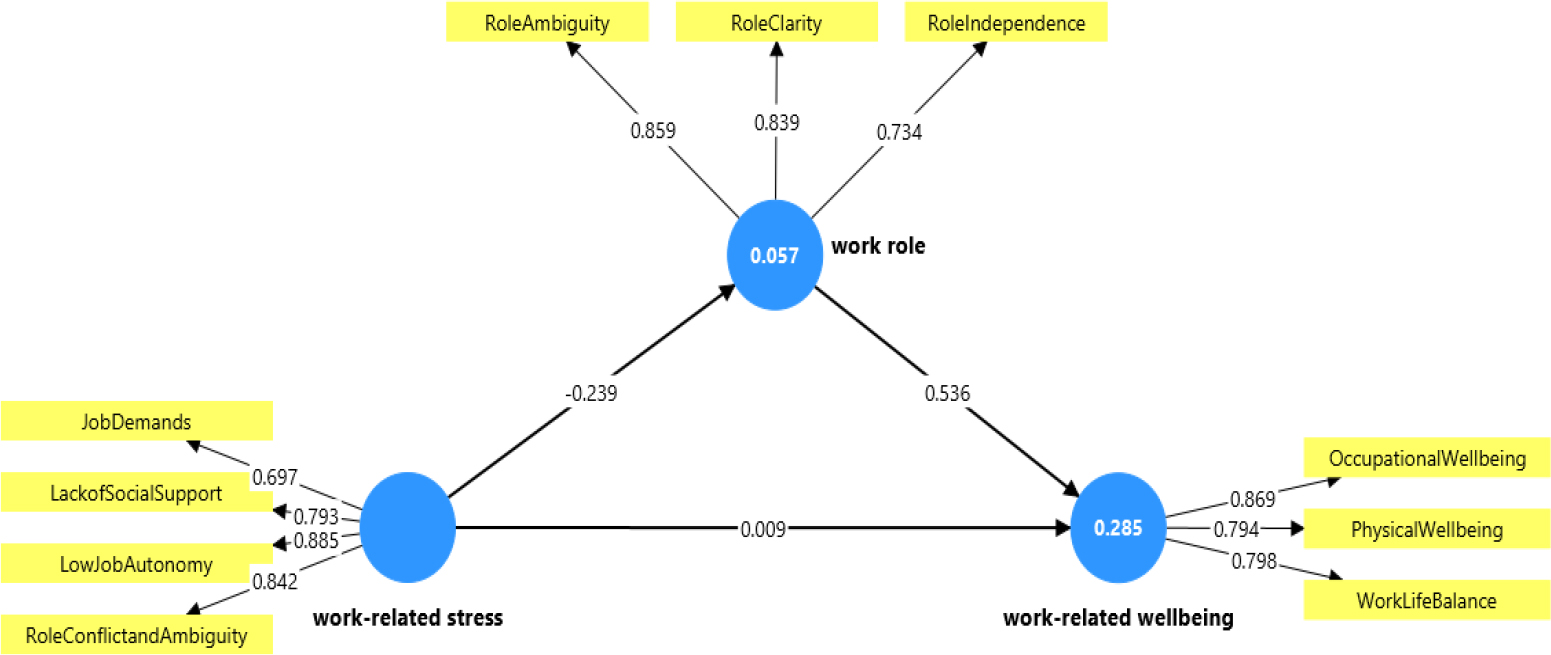
Figure 2.
Structural Equation Modelling for direct and mediating effects among work-related conditions, work-related stress, work-related well-being, and work role
Source: own processing
Table 8.
Direct and mediating effects
| Hypotheses | β-value | t-statistics | p-values | Decision |
|---|---|---|---|---|
| H1: Work-related stress -> Work-related well-being | 0.009 | 0.123 | 0.902 | Not supported |
| H2: Work-related stress -> Work role | -0.239 | 3.781 | 0.000 | Supported |
| H3: Work role -> Work-related well-being | 0.536 | 11.777 | 0.000 | Supported |
| H4: Work-related stress -> Work role -> Work-related well-being | -0.128 | 3.507 | 0.000 | Supported |
The results revealed that a non-significant positive relationship exists between work-related stress and work-related well-being (β = 0.009, p>0.05); Hypothesis 1 was not supported. Additionally, a significant negative relationship emerged between work-related stress and work role (β = -0.239, p < 0.001); Hypothesis 2 was supported. Work role demonstrated a significant positive effect on work-related well-being (β = 0.536, p < 0.05); Hypothesis 3 was supported. The study also found that work role negatively mediated the relationship between work-related stress and work-related well-being (β = -0.128, p < 0.05). Hypothesis 4 was therefore supported.
Discussions
The positive but insignificant relationship between work-related stress and well-being contrasts with the literature, which consistently links high stress to reduced emotional, physical, and psychological health (Priya et al., 2023). Studies show stress triggers anxiety, depression, and reduced job performance (Brunner et al., 2019) and increases absenteeism and productivity loss (Jim et al., 2024). Kheswa (2019) also notes that chronic stress leads to burnout and diminished motivation. However, the insignificant effect observed in this study may suggest that engineering professionals in Ghana’s seaports have developed coping mechanisms or resilience through prolonged exposure to high-pressure environments and reliance on established safety and teamwork systems. Within the JDCS framework, high job control and social support can buffer the effects of stress, meaning engineers with autonomy in decision-making and supportive supervisors may be shielded from its negative impact. Thus, while stress exists, strong resources may weaken its influence on well-being in this context.
The significant negative relationship between work-related stress and work role is consistent with existing research showing that elevated stress reduces employees’ role clarity, autonomy, and confidence in performing tasks. Bakar et al. (2021) highlight that stress distorts job expectations, increasing ambiguity, while Zhang and He (2022) and Lange and Kayser (2022) confirm that high stress reduces decision-making latitude and self-efficacy, thereby limiting role autonomy and independent functioning. Further, Zaheer et al. (2024) and Han et al. (2025) show that unclear roles and diminished autonomy worsen stress responses and reduce commitment. Within Ghana’s seaports, engineering professionals operate under demanding conditions involving heavy machinery, tight operational timelines, and safety risks; excessive stress may impair their judgment, reduce initiative, and undermine confidence in performing technical duties, thereby undermining efficient role execution. The JDCS theory explains this result by asserting that high job demands without corresponding control and support intensify strain, thereby weakening role clarity and autonomy.
The positive and significant effect of work role on work-related well-being aligns closely with existing literature, indicating that role clarity, autonomy, and independence enhance employees’ psychological and emotional health. Han et al. (2025) and Bakar et al. (2021) emphasize that well-defined roles reduce ambiguity and uncertainty, enabling employees to perform with confidence and emotional security, which elevates well-being. Research also confirms that job autonomy fosters intrinsic motivation and emotional stability while reducing stress (Fürstenberg et al., 2021; Lange & Kayser, 2022). Similarly, Brandmo et al. (2021) and Emre and De Spiegeleare (2021) demonstrate that role independence boosts engagement and satisfaction by strengthening self-efficacy and decision-making capacity. For engineering professionals in Ghana’s seaports, having clear technical mandates, authority to make operational decisions, and the ability to work independently in safety-critical environments strongly supports mental resilience and morale. The JDCS theory justifies this outcome by positing that high job control and well-structured roles buffer stress and enhance psychological well-being, particularly in demanding engineering contexts.
The finding that work role negatively mediated the relationship between work-related stress and well-being aligns with existing research showing that stress undermines role clarity, autonomy, and independence, which in turn diminishes well-being. Batse (2025) notes that supportive, well-defined roles buffer stress effects, whereas weak role structures heighten strain and reduce psychological stability. Cheung and Li (2023) further emphasize that supportive supervision and structured development reduce stress and enhance job satisfaction. Akkoç et al. (2021) and Gerhardt et al. (2021) show that unclear roles and social stressors intensify burnout and impair health. In Ghana’s seaports, engineering professionals rely on clear technical duties, autonomy, and supportive team structures to manage complex tasks; stress that disrupts these role elements harms well-being. The JDCS theory reinforces this result by asserting that high demands without sufficient control and social support erode employee functioning and psychological health.
Conclusions
The study concludes that promoting employee well-being and effective role performance in Ghana’s seaport engineering sector requires a deliberate, integrated approach to organizational management, employee support, and job design. It establishes that well-being among engineering professionals is not solely dependent on the absence of stress, but on the presence of enabling work structures that enhance autonomy, clarity, and supportive relationships.
The study also concludes that occupational resilience in high-demand environments such as seaports is a function of strong internal and external resources. Engineers who operate within clearly defined roles, supported by participatory leadership and access to technical and emotional resources, are more likely to maintain stability, engagement, and productivity even under pressure. Furthermore, the study also concludes that effective management of work-related challenges requires a shift from reactive stress management to proactive well-being enhancement. This involves cultivating organizational cultures that value employee input, ensure equitable workload distribution, and provide continuous professional development opportunities.
Finally, the study concludes that sustaining psychological and occupational well-being among engineers in Ghana’s seaports is achievable through holistic policies that integrate health promotion, employee empowerment, and structural support systems. Such initiatives will not only strengthen individual resilience but also enhance operational efficiency, safety compliance, and long-term organizational sustainability within the maritime engineering context.
Theoretical and practical implications
The findings of this study yield several theoretical implications that extend the understanding and application of the Job Demand Control Support (JDCS) theory within the context of engineering professionals working in Ghana’s seaports.
Firstly, the results reinforce the JDCS proposition that job demands, control, and social support jointly determine occupational strain and well-being. The significant negative relationship between work-related stress and work role confirms that high demands without adequate control impair role clarity, autonomy, and confidence. This supports the theoretical view that the imbalance between demands and resources is a primary driver of occupational strain.
Secondly, the significant positive relationship between work role and work-related well-being provides empirical validation for the buffering hypothesis of the JDCS model. It highlights that well-structured roles, autonomy, and supportive work environments enhance psychological resilience, motivation, and well-being. The finding supports the theory’s assumption that job control functions as a protective resource, fostering employees’ adaptive capacity and self-regulation, particularly in high-pressure, technical work contexts.
Finally, the mediating effect of work role between work-related stress and well-being advances JDCS theory by positioning work role as an internal resource mechanism that transmits the effects of stress on employee outcomes. This indicates that employees’ perceived control and role clarity serve as psychological filters through which stress influences well-being.
The findings of this study yield several practical implications that are essential for improving the working conditions, psychological well-being, and overall performance of engineering professionals in Ghana’s seaports.
Firstly, the non-significant positive relationship between work-related stress and work-related well-being implies that, despite working in high-pressure environments, engineers have developed resilience through experience, teamwork, and autonomy. Practically, this calls for seaport authorities to institutionalize structured employee wellness and resilience programs that build on these coping strengths. Regular stress management workshops, peer-support initiatives, and access to counselling services should be implemented to help engineers sustain their physical, occupational, and psychological well-being under demanding operational conditions.
Secondly, the significant negative relationship between work-related stress and work role indicates that excessive job demands, such as tight maintenance deadlines, handling heavy machinery, and safety pressures, undermine engineers’ clarity, confidence, and task autonomy. Therefore, management should adopt strategic workload distribution and role management systems that reduce overload and ambiguity. Periodic job reviews, improved communication between supervisors and engineers, and clear delegation of authority will enhance performance, accountability, and role stability.
Thirdly, the significant positive relationship between work role and work-related well-being underscores that well-defined technical roles, decision-making freedom, and empowerment directly enhance engineers’ motivation and morale. Seaport organizations should thus strengthen participatory leadership structures, encourage shared decision-making, and establish recognition systems that reward initiative, innovation, and technical excellence. This will reinforce engineers’ sense of control and belonging, improving job satisfaction and well-being.
Lastly, the mediating role of work role between work-related stress and well-being highlights that structured roles can serve as an internal buffer against stress. Management should therefore prioritize comprehensive role design and support mechanisms, including mentorship programs, professional development opportunities, and collaborative engineering teams. These measures will enhance engineers’ confidence, promote adaptability, and reduce the detrimental effects of operational stress.
Recommendations
Based on the findings and conclusions, the study recommends the following practical actions to enhance occupational well-being, role performance, and organizational efficiency among engineering professionals in Ghana’s seaports. On the one hand, it is recommended that seaport management adopt a comprehensive employee well-being strategy that integrates health promotion, stress management, and resilience-building programs into organizational policy. Regular wellness assessments, peer-support networks, and counselling services should be institutionalized to help engineers cope effectively with operational pressures and maintain sustained productivity.
On the other hand, supervisors and line managers should strengthen role communication and workload management practices. Clear job descriptions, participatory decision-making, and consistent feedback mechanisms should be prioritized to reduce role ambiguity and enhance confidence in performance. Effective supervisory engagement will promote clarity, accountability, and coordination across engineering units, particularly during complex maintenance and safety operations. Moreover, the Human Resource Department should develop structured professional development and mentorship frameworks tailored to engineering personnel. Targeted training in leadership, technical upskilling, and interpersonal competencies can improve role mastery, motivation, and long-term occupational resilience, fostering a more adaptive workforce in dynamic seaport environments.
Additionally, senior engineers and technical supervisors should take a proactive mentoring role in guiding less-experienced professionals. Through on-the-job coaching, technical collaboration, and knowledge transfer, senior professionals can help younger engineers navigate operational stressors, strengthen competence, and cultivate teamwork and confidence in high-risk environments.
Finally, policymakers and regulatory bodies, particularly the Ghana Ports and Harbours Authority, should ensure that occupational health and safety regulations explicitly incorporate psychological well-being standards. Enforcing compliance with employee welfare and mental health policies will promote safer, more sustainable work conditions and demonstrate institutional commitment to holistic worker welfare.
Limitations and direction for future studies
This study has several noteworthy limitations. First, its cross-sectional design constrains the ability to infer causal relationships, as data were collected at a single point in time, preventing the establishment of temporal sequencing among variables. Second, the study relied solely on a quantitative research approach, which, although effective in identifying statistical relationships between variables, does not provide the in-depth contextual understanding necessary to explain why these relationships exist. Incorporating qualitative methods, such as interviews or focus groups, into future research could yield richer insights into the underlying experiences and mechanisms that influence work-related stress and well-being. Third, the study’s focus on engineering professionals in Ghana’s seaports limits the generalizability of the findings to other occupational or industrial contexts, where the dynamics of work-related stress and well-being may differ.
Future research should consider adopting longitudinal designs to better understand how work-related conditions, stress, and role characteristics evolve and influence well-being among seaport professionals. Expanding the scope beyond engineering roles to include other critical occupational groups within maritime operations would enhance understanding of sector-wide workplace dynamics. Additionally, integrating qualitative approaches, such as interviews or focus groups, could provide deeper perspectives on lived experiences and contextual challenges in port environments. Finally, future studies may also examine additional moderating or mediating variables, such as leadership styles, safety climate, organizational culture, and personal resilience, to uncover broader mechanisms influencing employee well-being.