
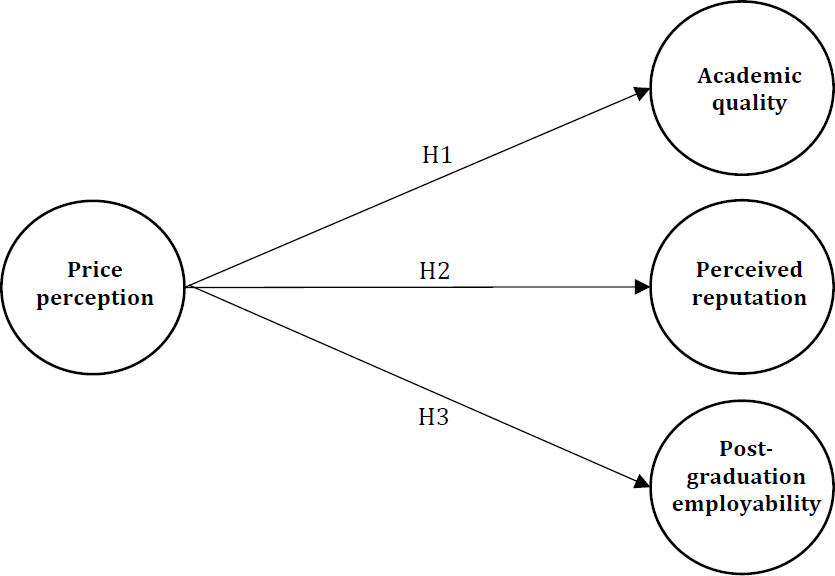
Figure 1.
Research conceptual model
Source: own processing
Table 1.
Measurement scales
| Variable | Source | Item |
|---|---|---|
| Perception of tuition fees | Chang and Wildt (1994) | The cost of my studies causes me stress. |
| I feel guilty about spending so much on my education. | ||
| The amount of tuition fees affects my satisfaction with the education. | ||
| I am concerned about financing my studies due to the cost. | ||
| The costs associated with my studies make me feel that access to education is reserved for the elite. | ||
| Perceived teaching quality | Kember et al. (2000) | The instructors are well-prepared and organised for the courses. |
| The instructors can communicate the content clearly. | ||
| The instructors encourage active student participation. | ||
| The teaching methods used are varied and adapted to students’ needs. | ||
| Perceived institutional reputation | Fombrun (1996) | This institution is known for the quality of its teaching. |
| The institution is well-regarded in its academic field. | ||
| This institution is considered a leader in higher education. | ||
| Perceived employability | Fugate et al. (2004) | I believe the skills acquired during my studies will help me find a job. |
| I am confident in my ability to adapt my skills to the demands of the job market. | ||
| I am confident in my job prospects after graduation. | ||
| I believe I will be able to find a job related to my field of study. |
Table 2.
Demographic characteristics of the sample
| Demographic variable | Item | Frequency | Percentage (%) |
|---|---|---|---|
| Gender | Female | 369 | 53% |
| Male | 322 | 47% | |
| Age | 18 to 24 years | 331 | 47% |
| 25 to 34 years | 279 | 40% | |
| 35 to 44 years | 69 | 9% | |
| 45 to 54 years | 8 | 2% | |
| 55 to 64 years | 4 | 1% | |
| Field of study | Exact and Technical Sciences | 56 | 8,5% |
| Humanities and Social Sciences | 50 | 7,5% | |
| Business and Economics | 52 | 7,5% | |
| Law and Political Science | 60 | 8,5% | |
| Medicine and Health | 50 | 7,5% | |
| Engineering and Technology | 48 | 6% | |
| Education Sciences | 52 | 7,5% | |
| Arts and Letters | 53 | 7,5% | |
| Agricultural Sciences and Techniques | 56 | 8,5% | |
| Pharmacy and Pharmaceutical Sciences | 49 | 7,5% | |
| Architecture and Urban Planning | 53 | 7,5% | |
| Languages and Foreign Cultures | 52 | 7,5% | |
| Fundamental and Applied Sciences | 60 | 8,5% | |
| Degree obtained | Baccalaureate | 162 | 24% |
| Bac+2 (Associate Degree) | 229 | 33% | |
| Bac+3 (Bachelor’s Degree) | 243 | 35% | |
| Bac+5 (Master’s Degree) | 57 | 8% | |
| Bac+8 (Doctorate) | 0 | 0% |
Table 3.
Principal component analysis of perception of tuition fees
| Item | Value |
|---|---|
| Kaiser-Meyer-Olkin (KMO) Index | 0.852 |
| Bartlett’s Test of Sphericity | 1219.222 |
| Degrees of Freedom (df) | 10 |
| Significance (Sig.) | 0.000 |
| Cronbach’s Alpha (α) | α = 0.838 |
Table 4.
Principal component analysis of academic Quality
| Item | Value |
|---|---|
| Kaiser-Meyer-Olkin (KMO) Index | 0.806 |
| Bartlett’s Test of Sphericity | 924.982 |
| Degrees of Freedom (df) | 6 |
| Significance (Sig.) | 0.000 |
| Cronbach’s Alpha (α) | α = 0.820 |
Table 5.
Principal component analysis of institutional reputation
| Item | Value |
|---|---|
| Kaiser-Meyer-Olkin (KMO) Index | 0.708 |
| Bartlett’s Test of Sphericity | 631.310 |
| Degrees of Freedom (df) | 3 |
| Significance (Sig.) | 0.000 |
| Cronbach’s Alpha (α) | α = 0.797 |
Table 6.
Principal component analysis of post-graduation employability
| Item | Value |
|---|---|
| Kaiser-Meyer-Olkin (KMO) Index | 0.828 |
| Bartlett’s Test of Sphericity | 1380.861 |
| Degrees of Freedom (df) | 6 |
| Significance (Sig.) | 0.000 |
| Cronbach’s Alpha (α) | α = 0.873 |
Table 7.
Pearson correlation between the perception of tuition fees and academic quality
| Variables | Value |
|---|---|
| Pearson Correlation | 0.872 |
| Sig. (Two-Tailed) | 0.000 |
| N | 691 |
Table 8.
Pearson correlation between the perception of tuition fees and institutional reputation
| Variables | Value |
|---|---|
| Pearson Correlation | 0.831 |
| Sig. (Two-Tailed) | 0.000 |
| N | 691 |
Table 9.
Pearson correlation between the perception of tuition fees and post-graduation employability
| Variables | Value |
|---|---|
| Pearson Correlation | 0.614 |
| Sig. (Two-Tailed) | 0.000 |
| N | 691 |
Table 10.
Collinearity statistics
| Variables | VIF (Variance inflation factor) |
|---|---|
| Academic quality | 2.548 |
| Institutional reputation | 2.376 |
| Post-graduation employability | 1.849 |
Table 11.
Summary of the models
Table 12.
Regression coefficients
| Model | Unstandardized coefficients (B) | Standardised coefficients (Beta) | t | Sig. | Collinearity statistics | ||
|---|---|---|---|---|---|---|---|
| B | Std. Error | Beta | Tolerance | VIF | |||
| (Constant) | 0.167 | 0.083 | - | 2.012 | 0.045 | - | - |
| Academic quality | 0.393 | 0.034 | 0.344 | 11.416 | 0.000 | 0.392 | 2.548 |
| Institution’s reputation | 0.498 | 0.027 | 0.540 | 18.533 | 0.000 | 0.421 | 2.376 |
| Post-graduation employability | 0.053 | 0.023 | 0.059 | 2.303 | 0.022 | 0.541 | 1.849 |
Table 13.
Hypothesis test results
| Hypothesis | Conclusion |
|---|---|
| H1: The tuition fee significantly influences the perceived academic quality. | Confirmed |
| H2: The tuition fee significantly influences the perceived reputation of the institution | Confirmed |
| H3: The tuition fee significantly influences the perception of post-graduation employability. | Confirmed |