
Introduction
The higher education sector plays a pivotal role in shaping individuals’ knowledge and skills while contributing significantly to the growth and development of societies worldwide (Iskandar et al., 2024). In today’s rapidly changing economic landscape, the value of higher education is increasingly tied to how well it can equip students with the skills required to succeed in the knowledge economy (Ahmad et al., 2024). Higher education institutions are central to this process, acting as both centres of learning and hubs of innovation (Kim et al., 2023). With globalisation and technological advancements rapidly transforming the world of work, it is essential to assess how students perceive the value of higher education and what factors influence their decisions to invest in such an education (Wu & Corpus, 2023). In Morocco, as in many parts of the world, the cost of education is a growing concern. Tuition fees for higher education are often seen as a major financial burden, and students face difficult decisions about which institution to choose, based on both the quality of education and the costs associated with it. The perception of the price of education, specifically the psychological pricing tactics used by institutions, can have a profound impact on students’ evaluations of the academic offerings (Taylor et al., 2025). Psychological pricing refers to the strategies employed by institutions to set tuition fees that evoke certain emotional responses in students, influencing their decisions regarding the perceived value of the education provided.
This research aims to explore the impact of psychological pricing on students’ perceptions of the value of higher education programs in Morocco. Specifically, the study examines how perceived tuition fees influence students’ assessments of academic quality, institutional reputation, and post-graduation employability. This study is particularly relevant given the context of Morocco, where economic constraints and perceptions of value are unique compared to wealthier countries. By focusing on these aspects, this study hopes to contribute to the understanding of the broader effects of pricing strategies on student satisfaction and institutional choice in an emerging economy. While prior studies have focused on the influence of tuition fees (Zeithaml, 1988) and pricing strategies in consumer markets (Monroe, 2003), little attention has been given to psychological pricing within the context of higher education. This study adds value by integrating psychological pricing strategies, such as price endings, into the discussion of perceived value in education. It offers practical insights for institutions, helping them align their pricing strategies with student expectations and improve overall satisfaction.
The research questions driving this study centre on understanding how students’ perceptions of tuition fees impact their evaluations of the education they receive. Do higher fees signal better academic quality or institutional prestige? How do these perceptions affect students’ expectations for future employment? These questions are crucial for both higher education institutions and policymakers who must balance the costs of education with the perceived value of that education. This study also investigates the gap in existing literature regarding the role of psychological pricing within the context of higher education, particularly in a developing country like Morocco. Although psychological pricing has been widely studied in consumer goods and services, its implications for higher education remain underexplored. This gap is significant as it leaves a large space for universities and other higher education institutions to improve their pricing strategies, marketing communications, and student engagement, with an eye on enhancing their reputation and perceived value.
The research objectives of this study are twofold: First, it aims to determine how students’ perceptions of tuition fees influence their assessments of academic quality, institutional reputation, and their career prospects post-graduation. The study aims to thoroughly analyse the impact of psychological pricing strategies on how students perceive the value of programs offered by higher education institutions in Morocco. More specifically, the study aims to understand how these strategies influence not only students’ choices but also their perceptions of intangible aspects associated with education, such as perceived value and the emotional expectations linked to investing in education. The goal is to determine to what extent psychological prices can affect the perception of the fairness of tuition fees, the image of institutions, and overall student satisfaction. In an environment where tuition fees represent a major investment, this study also seeks to assess students’ sensitivity to price variations and understand whether these variations are perceived as signals of quality or devaluation. A second objective is to explore the role of psychological pricing as a strategic tool used by institutions to shape students’ perceptions and ultimately attract more students to their programs. Understanding the relationship between pricing strategies and students’ perceptions can provide valuable insights for higher education institutions seeking to optimise their enrolment strategies. This research seeks to determine whether prices perceived as advantageous are associated with better student satisfaction relative to their initial expectations, or conversely, if lower prices lead to negative perceptions, even when the quality of education is comparable.
The methodology employed in this study is quantitative, relying on survey data collected from 691 students attending various higher education institutions across Morocco. The data analysis includes multiple regression models to assess the relationships between the independent variables (academic quality, institutional reputation, and post-graduation employability) and the dependent variable (students’ perception of the value of their education). Pearson correlation tests are also used to explore the strength and direction of relationships between these variables.
The structure of the manuscript follows a logical sequence: after this introduction, a comprehensive literature review on psychological pricing and its application in education is provided. Next, the research methodology is explained in detail, followed by the presentation of the results derived from the statistical analyses. The paper concludes with a discussion of the findings, offering practical recommendations for higher education institutions and suggesting potential areas for future research.
Literature review
Price psychology
In a knowledge-based economy, human capital is not only defined by technical qualifications but also by cognitive, emotional, and social abilities that enable individuals to learn, adapt, and innovate (Becker, 1993). Maritime education, as a subsystem for human capital formation, requires cadets to transform academic knowledge into practical competencies during onboard training. This transformation involves knowledge acquisition, psychological adaptation, and behavioural engagement, key mechanisms through which mental health and engagement contribute to cadet performance (Zhenjing et al., 2022).
Recent studies indicate that the success of maritime institutions depends on their ability to foster psychologically resilient and motivated cadets (Lucas et al., 2021; Nittari et al., 2024). From a management dynamics perspective, the integration of mental health and engagement represents an organisational investment in human resources that supports productivity, innovation, and safety at sea (Bakker & Demerouti, 2017).
Mental health and cadet performance
Price psychology is a study topic that explores how consumers react to and perceive the prices of products or services and how these perceptions influence their purchasing decisions. According to Monroe (2003), price psychology refers to the study of the mechanisms through which price affects the perceived value of a product, thus influencing consumer behaviour. Monroe further explains that this concept examines strategies such as using prices “just below” round numbers (e.g., 9.99 DH instead of 10 DH) to induce a perception of higher value. On the other hand, Wang et al. (2025) define price psychology as the study of the effects of prices on consumers’ perceptions of quality and value, emphasising that consumers are often influenced by emotional and cognitive factors when evaluating prices. Wang et al. (2025) and Ariely (2008) go even further by explaining that prices impact not only the perception of quality but also consumers’ expectations and emotions, thereby enhancing the threshold effect, where small differences in price can create large perceptions of value differences. The threshold effect refers to consumers’ perception that a price just below a round number is seen as significantly lower, even though the difference is minimal. Wijaya and Rahayu (2025) explain that consumers are influenced by prices ending in “9”, such as 9.99 DH instead of 10 DH, which creates the perception of a lower price. Thomas and Morwitz (2005) showed that consumers tend to perceive these prices as bargains, which encourages them to make a purchase.
Hamilton (2023) and Gourville and Soman (1998) add that the threshold effect creates emotional expectations, reinforcing the idea that these prices are discounts. Finally, Lichtenstein et al. (1988) demonstrated that such prices are perceived as “special offers,” thus altering purchasing behaviour. The Prestige Effect refers to the perception that high prices are associated with better quality or exclusive products or services. Das et al. (2024) and Monroe (2003) argue that, in certain contexts, a higher price can signal higher value, especially in sectors where perceived quality is paramount, such as in education. Vigneron and Johnson (2017) explain that high prices often play a symbolic role, signalling status and exclusivity, making a product or service more desirable. Kalyva et al. (2024) and Kapferer and Bastien (2009) reinforce this idea, noting that in the luxury sector, the prestige effect helps maintain the brand’s image as a high-end product. The anchoring effect refers to the tendency of consumers to rely on an initial piece of information (the anchor) to make decisions, even if that information is biased or irrational. Tversky and Kahneman (1974), the pioneers of this theory, explain that anchoring occurs when consumers use an initial price as a reference point to evaluate the value of a product or service. Song and Ma (2024) and Chapman and Johnson (1999) demonstrate that individuals are influenced by the first price they encounter, even if that price is arbitrary. For example, when a higher price is initially displayed by a higher education institution, followed by a discount, students may perceive the offer as more advantageous, even if the discount is not substantial. According to Waszczuk (2024) and Ariely (2008), anchoring can be used to manipulate price perceptions by setting an initially high price and then introducing a “reduced” price, thereby creating the perception of a better deal.
Perception of value
Price psychology influences the perception of the value of products or services, particularly when prices are slightly below round numbers (e.g., 9.99 DH instead of 10 DH). Monroe (2003) explains that this strategy creates a perception of better value for the consumer, as they perceive a psychological saving, even though the price difference is minimal. Furthermore, Grewal et al. (2017) highlight that this perception of value directly influences purchasing decisions, as consumers are more likely to buy products they consider offering a good value for money, especially in the education sector, where tuition fees are often perceived as a significant investment. Another major effect of price psychology is its influence on the perception of the quality of a product or service. Dzulhijatussarah and Defrizal (2024) and Lichtenstein et al. (1988) indicate that consumers often associate a higher price with superior quality. In an educational context, a higher price may be perceived as a guarantee of quality, enhancing the attractiveness of certain higher education institutions. Conversely, prices that are deemed too low may lead to a negative perception of the quality of the offered programs, as consumers may question the competence or academic level associated with a price perceived as “too low.”
The perception of price fairness is another important dimension affected by price psychology. Tan et al. (2025) and Ariely (2008) explain that consumers have a strong preference for prices that are perceived as fair or reasonable. When psychological pricing is applied, such as prices ending in “9”, consumers often perceive these prices as the result of a genuine and fair discount. In the education sector, institutions can use this technique to create a sense of fairness, where students believe they are receiving good value for money, which can increase their satisfaction and loyalty. Psychological pricing also affects consumers’ emotions, thereby influencing their decision-making process. Grewal et al. (2017) note that prices perceived as more advantageous (e.g., 9.99 DH instead of 10 DH) generate a positive emotional response, activating feelings of satisfaction and optimism. Utama et al. (2025) argue that these emotions play a crucial role in the purchasing decision, as they lead consumers to feel good about their choices. In education, these emotions are particularly important, as enrolment in a higher education institution represents both an emotional and financial investment. A price perceived as “reasonable” or “on sale” can therefore facilitate decision-making, especially for students and their families.
Perceived value in the educational context
Perceived value is a central concept in understanding consumer behaviour, including in the higher education sector (Narayanaswamy et al., 2024). Zeithaml (1988) defines it as the overall evaluation an individual makes of the utility of a product or service based on what is received (benefits) and what is given (sacrifices). In the educational context, this can include the quality of instruction, future career opportunities, the cost of education, as well as the time and effort invested. Holbrook (1999) expands this concept by identifying several dimensions of perceived value beyond functional utility: emotional value (pleasure or satisfaction), social value (image or social recognition), and symbolic value (identity, prestige). When applied to higher education, these dimensions help explain why a student might perceive one program as more valuable than another, even at a similar price.
Academic quality in higher education is often perceived as a key indicator of the value of the programs offered, and its connection to price psychology is complex. Several studies have shown that higher prices are frequently associated with a perception of better academic quality (Bietenbeck et al., 2023), particularly in areas where quality is difficult to assess objectively. Academic quality refers to the perceived effectiveness of educational programs and the resources offered by an institution, including the quality of teaching, curriculum design, academic support services, and overall student experience. It encompasses various dimensions, such as the qualifications of faculty members, the rigour of academic programs, and the availability of opportunities for student engagement and development (Harvey & Green, 1993). For instance, Zeithaml (1988) argues that consumers, including students, associate higher prices with superior perceived value, especially in sectors where quality is intangible, such as education. Similarly, Kapferer and Bastien (2009) highlights that high prices in prestigious contexts, such as higher education, can reinforce the prestige effect, making the institution appear as a guarantee of quality and reputation (Allen et al., 2025). Conversely, low psychological prices, often used to attract students, may induce negative perceptions of quality, as students may associate these prices with less prestigious or lower-quality programs (Lichtenstein et al., 1988; Monroe, 2003). Thus, the relationship between price and academic quality is deeply influenced by how prices are presented and perceived, impacting students’ decisions and the valuation of programs.
High prices are often perceived as an indicator of prestige and academic quality, thereby enhancing the reputation of an institution. Indeed, according to Monroe (2003), high tuition fees can be associated with superior perceived value, contributing to the institution’s image as a leader in its field, offering high-quality programs, and attracting students who value this aspect of education. This perception is based on the idea that high prices signal the presence of quality educational resources, renowned faculty, and a prestigious academic network. An institution’s reputation refers to the public perception of an educational institution’s status, credibility, and prestige (Fombrun & Van Riel, 1997). It is shaped by factors such as academic performance, the success of its graduates, the quality of its research, and its impact on society. According to Fombrun (1996), an institution’s reputation is a crucial intangible asset that influences its ability to attract students, faculty, and funding. Zeithaml (1988) states that, in contexts where the quality of education is difficult to measure, students may tend to interpret low psychological prices as a sign of weak reputation. Thus, pricing strategies, particularly the use of psychological pricing, play a crucial role in how higher education institutions shape and preserve their academic reputation, thereby influencing students’ perceptions of the value of the programs offered.
In the context of higher education, the variable of post-graduation employability is a key factor in the perception of the value of programs. Post-graduation employability refers to the ability of graduates to secure employment and successfully transition into the workforce after completing their studies. It is influenced by various factors, including the relevance of the academic program to industry needs, the development of practical skills, and access to professional networks and internships. According to Fugate et al. (2004), employability is not only about the acquisition of academic qualifications but also involves personal characteristics such as adaptability, work experience, and the ability to align one’s skills with market demands.
Students seek programs that not only offer good academic quality but also ensure successful professional integration after graduation. High psychological prices are often perceived as an indicator of investment in the employability of graduates, particularly through partnerships with companies, quality internship programs, or an extensive professional network. Grewal et al. (2017) state that higher prices can enhance the perception of better professional preparation, as they are often associated with institutions that have strong connections to the job market. Indeed, a high price may suggest that the institution invests in resources to facilitate graduates’ integration into the professional world. Stiving and Winer (1997) note that lower psychological prices can lead to a perception of lack of added value, particularly regarding career counselling services and internship opportunities, two crucial elements for entry into the job market.
Development of research hypotheses and conceptual model
High psychological prices are perceived as a sign of better academic quality, as students associate higher fees with more competitive training programs, superior educational resources, and a strong academic network. Authors such as Monroe (2003) and Zeithaml (1988) suggest that high prices enhance the perception of prestige and high quality. Conversely, low psychological prices may be perceived as an indicator of lower quality, as they are often associated with less well-equipped programs and lower expectations regarding academic value (Lichtenstein et al., 1988). A conceptual model is presented in Figure 1.
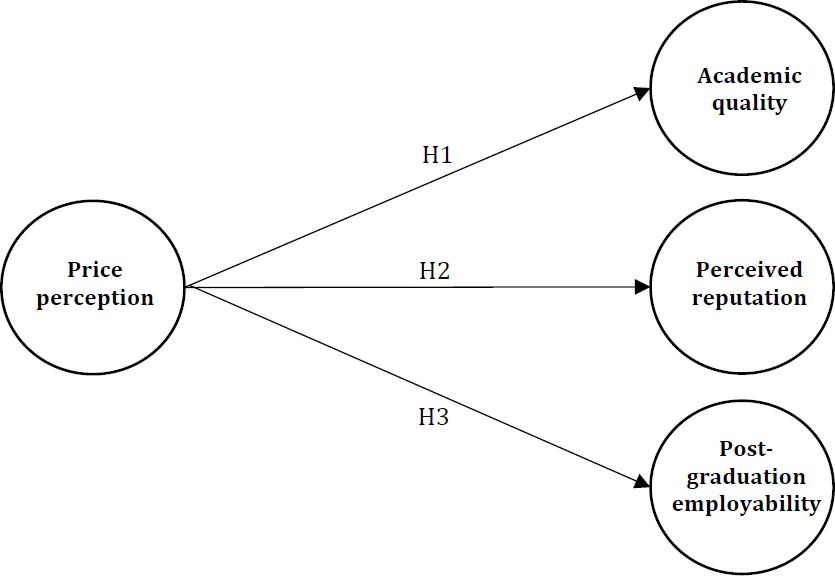
Figure 1.
Research conceptual model
Source: own processing
H1: The tuition fee significantly influences the perceived academic quality.
High prices are associated with a better institutional reputation, as they are perceived as a guarantee of prestige and high-quality education. Kapferer and Bastien (2009) and Monroe (2003) show that higher prices are often seen as an indicator of exclusive positioning and attract students seeking a recognised education. Conversely, low prices can harm an institution’s reputation, as they are perceived as a marketing strategy aimed at attracting students, often at the expense of the perceived quality of the education (Zeithaml, 1988).
H2: The tuition fee significantly influences the perceived reputation of the institution.
High psychological prices are perceived as an indicator of better post-graduation employability, as they are often associated with an investment in students’ professional integration through internships and partnerships with companies. Grewal et al. (2017) and Stiving and Winer (1997) argue that high fees enhance the perception of professional preparation, while low prices may be perceived as a lack of investment in employment support, thereby reducing career opportunities for graduates (Ariely, 2008).
H3: The tuition fee significantly influences the perception of post-graduation employability.
Methodology
Research approach and setting
The approach of this study is quantitative, as it aims to measure the impact of the pricing psychology used by higher education institutions in Morocco on the perception of the value of the programs offered. This approach was chosen to collect specific and objective data on students’ perceptions, allowing for an in-depth statistical analysis of the results. The goal is to gather measurable data and perform statistical tests to examine the relationships between various variables, such as perceptions of academic quality, reputation, and post-graduation employability, based on the pricing strategies applied by the institutions.
The research setting is within the context of higher education institutions in Morocco, which include both public universities and private schools. The study was conducted across several academic institutions in various regions of Morocco to ensure a representative coverage of the different types of institutions and student profiles. The research setting was chosen based on the availability of student samples willing to participate in the study, with easy access through online surveys and individual interviews at the different institutions.
Data collection and sampling method
The data collection method for this study relies on the use of a structured questionnaire administered to students enrolled in higher education institutions in Morocco. The questionnaire was designed to gather information on students’ perceptions of the proposed tuition fees and their impact on the perceived value of the programs, specifically focusing on three main areas: academic quality, institutional reputation, and post-graduation employability. The questionnaire was distributed online via Google Forms, allowing for a wide sample of students from different geographical regions of Morocco. The content of the questionnaire consists of several sections: the first section collects demographic information (age, gender, institution, study program, etc.), followed by questions about the tuition fees and their impact on students’ perceptions. One section is dedicated to perceived academic quality, another to institutional reputation, and the last to post-graduation employability. The students responded to closed-ended questions using a 7-point Likert scale, measuring their level of agreement with statements regarding these various aspects. To ensure the validity of the questionnaire, it was validated by a panel of experts, including education professionals and marketing specialists. A pilot test was also conducted to adjust the questions and verify their clarity for respondents. The questionnaire was then distributed to a sample of students from both public and private institutions, and data collection took place over a four -week period, with regular reminders to maximise participation. Upon completion of the data collection, the data will be extracted and prepared for analysis. A quality check of the data will be performed, including the identification and removal of inconsistent or incomplete responses.
The sampling for this study was carried out using a non-probabilistic convenience sampling method, as the goal is to analyse students’ perceptions within the specific context of higher education institutions in Morocco. The sample was formed based on the availability of participants, targeting students enrolled in various universities and higher education schools representing a variety of academic programs (bachelor’s, master’s, etc.). This method allows for obtaining a diversity of viewpoints while being pragmatic and suited to the time and resource constraints. The main criterion for inclusion in the sample is that the participant must be a student enrolled in a Moroccan higher education institution. Furthermore, the sample should reflect a balanced distribution across different levels of study (undergraduate, graduate, etc.) and various academic fields (humanities, social sciences, business administration, etc.), to ensure that the study’s results are representative of the general perceptions of students in higher education. The number of students included in the sample is 691 participants, which should allow for meaningful analysis and a detailed exploration of perceptions related to tuition fees, teaching quality, institutional reputation, and post-graduation employability. This number is considered sufficient to obtain reliable results while staying within the available resources for the study.
Measurement scale
To measure the different variables in this study, several validated measurement scales from the literature were adopted as described in Table 1.
Table 1.
Measurement scales
| Variable | Source | Item |
|---|---|---|
| Perception of tuition fees | Chang and Wildt (1994) | The cost of my studies causes me stress. |
| I feel guilty about spending so much on my education. | ||
| The amount of tuition fees affects my satisfaction with the education. | ||
| I am concerned about financing my studies due to the cost. | ||
| The costs associated with my studies make me feel that access to education is reserved for the elite. | ||
| Perceived teaching quality | Kember et al. (2000) | The instructors are well-prepared and organised for the courses. |
| The instructors can communicate the content clearly. | ||
| The instructors encourage active student participation. | ||
| The teaching methods used are varied and adapted to students’ needs. | ||
| Perceived institutional reputation | Fombrun (1996) | This institution is known for the quality of its teaching. |
| The institution is well-regarded in its academic field. | ||
| This institution is considered a leader in higher education. | ||
| Perceived employability | Fugate et al. (2004) | I believe the skills acquired during my studies will help me find a job. |
| I am confident in my ability to adapt my skills to the demands of the job market. | ||
| I am confident in my job prospects after graduation. | ||
| I believe I will be able to find a job related to my field of study. |
Each key dimension of students’ perception was assessed through specific items that reflect distinct aspects of their academic experience and perceptions regarding costs, teaching quality, institutional reputation, and post-graduation employability. Tuition fees were measured using the scale proposed by Chang and Wildt (1994), which evaluates the impact of the cost of education on students’ satisfaction and perceptions. Teaching quality was assessed using Kember et al.’s (2000) scale, which measures the effectiveness and organisation of teaching methods. The institution’s reputation was quantified using Fombrun’s (1996) Reputation Scale, specifically focused on the institution’s perception in terms of academic prestige. Finally, the perception of employability was measured using the scale developed by Fugate et al. (2004), which evaluates students’ confidence in their employment prospects after graduation.
Data analysis method
The analysis of the data collected in this study will be conducted in several stages using the IBP SPSS 27 software to address the research objectives and validate the measurement scales used.
First, the validation of the measurement scales will be carried out through reliability and validity analyses. The reliability of the scales will be evaluated using Cronbach’s alpha coefficient (a), which measures the internal consistency of each scale. An alpha coefficient greater than 0.7 will be considered acceptable to ensure the consistency of items within each dimension (Nunnally, 1978). Regarding content validity, this will be confirmed by a group of experts in the field of higher education, who will assess the relevance of the items with respect to the theoretical dimensions. Construct validity will be verified through an exploratory factor analysis (EFA) to ensure that the items measure the factors they are intended to represent. A factor loading threshold of 0.40 or higher will be considered acceptable for scale validity (Tabachnick & Fidell, 2013). As part of the scale validation, a principal component analysis (PCA) was executed, using the KMO (Kaiser-Meyer-Olkin) test and the Bartlett test to assess the suitability of the data for factor analysis. The KMO test measures the adequacy of the sample, while the Bartlett test checks the significance of correlations between the variables.
Once the scales were validated, the data analysis followed a structured process to explore the relationships between the variables. First, a collinearity test was conducted to ensure the independence of the explanatory variables in the regression model. Then, multiple linear regression was performed to evaluate the simultaneous impact of academic quality, institutional reputation, and post-graduation employability on students’ perceptions of tuition fees. In parallel, Pearson correlation tests were used to examine the bilateral relationships between each independent variable and the dependent variable, allowing for the identification of the closest and most significant links. This methodological approach thus provides a comprehensive analysis of the interactions and relative effects of the different dimensions studied on the perception of psychological pricing in higher education.
Results
Sample analysis
The study sample, as shown in Table 2, consists of 691 students, with a slight majority of women (53%) compared to men (47%). The majority of participants are young, with 47% aged 18 to 24 years and 40% aged 25 to 34 years, while older age groups are underrepresented. The fields of study are diverse, with the most represented programs being Law and Political Science, Exact and Technical Sciences, Fundamental and Applied Sciences, and Agricultural Sciences and Techniques (approximately 8.5% each), ensuring a broad coverage of academic disciplines. Regarding the level of education, the majority have a Bac+2 (33%) or Bac+3 (35%), followed by Bac (24%), with a minority holding a Bac+5 (8%) and no one with a Bac+8. Thus, the sample primarily reflects young adults in initial or post-secondary education, providing a representative basis to analyse their perceptions of tuition fees, academic quality, reputation, and employability.
Table 2.
Demographic characteristics of the sample
| Demographic variable | Item | Frequency | Percentage (%) |
|---|---|---|---|
| Gender | Female | 369 | 53% |
| Male | 322 | 47% | |
| Age | 18 to 24 years | 331 | 47% |
| 25 to 34 years | 279 | 40% | |
| 35 to 44 years | 69 | 9% | |
| 45 to 54 years | 8 | 2% | |
| 55 to 64 years | 4 | 1% | |
| Field of study | Exact and Technical Sciences | 56 | 8,5% |
| Humanities and Social Sciences | 50 | 7,5% | |
| Business and Economics | 52 | 7,5% | |
| Law and Political Science | 60 | 8,5% | |
| Medicine and Health | 50 | 7,5% | |
| Engineering and Technology | 48 | 6% | |
| Education Sciences | 52 | 7,5% | |
| Arts and Letters | 53 | 7,5% | |
| Agricultural Sciences and Techniques | 56 | 8,5% | |
| Pharmacy and Pharmaceutical Sciences | 49 | 7,5% | |
| Architecture and Urban Planning | 53 | 7,5% | |
| Languages and Foreign Cultures | 52 | 7,5% | |
| Fundamental and Applied Sciences | 60 | 8,5% | |
| Degree obtained | Baccalaureate | 162 | 24% |
| Bac+2 (Associate Degree) | 229 | 33% | |
| Bac+3 (Bachelor’s Degree) | 243 | 35% | |
| Bac+5 (Master’s Degree) | 57 | 8% | |
| Bac+8 (Doctorate) | 0 | 0% |
Validation of the measurement scale
The results of the analysis of the perception of tuition fees, presented in Table 3, show that the Kaiser-Meyer-Olkin (KMO) index is 0.852, which indicates that the sample is suitable for factor analysis. A KMO value greater than 0.8 is considered very good, suggesting that the measured variables are well correlated and that applying factor analysis is appropriate. The Bartlett’s test of sphericity gives a chi-squared value of 1219.222 with 10 degrees of freedom and a significance of p < 0.001, which allows for rejecting the null hypothesis that the variables are uncorrelated. This confirms that the correlation matrix is sufficiently significant to justify performing factor analysis. Finally, Cronbach’s alpha is 0.838, which reflects good internal consistency of the scale used. An alpha greater than 0.7 indicates that the items of the scale reliably and consistently measure the same dimension.
Table 3.
Principal component analysis of perception of tuition fees
| Item | Value |
|---|---|
| Kaiser-Meyer-Olkin (KMO) Index | 0.852 |
| Bartlett’s Test of Sphericity | 1219.222 |
| Degrees of Freedom (df) | 10 |
| Significance (Sig.) | 0.000 |
| Cronbach’s Alpha (α) | α = 0.838 |
The results of the principal component analysis of academic quality, presented in Table 4, reveal that the Kaiser-Meyer-Olkin (KMO) index is 0.806, indicating that the sample is suitable for factor analysis. A KMO value greater than 0.8 is considered very good, suggesting that the variables are sufficiently correlated and that applying factor analysis is appropriate. The Bartlett’s test of sphericity shows a chi-squared value of 924.982 with 6 degrees of freedom and a significance of p < 0.001, which allows for rejecting the null hypothesis that the variables are uncorrelated, thereby confirming that the correlation matrix is significantly different from the identity matrix. Finally, Cronbach’s alpha is 0.820, indicating good internal consistency of the scale. An alpha value greater than 0.7 shows that the items reliably and consistently measure the dimension of academic quality.
Table 4.
Principal component analysis of academic Quality
| Item | Value |
|---|---|
| Kaiser-Meyer-Olkin (KMO) Index | 0.806 |
| Bartlett’s Test of Sphericity | 924.982 |
| Degrees of Freedom (df) | 6 |
| Significance (Sig.) | 0.000 |
| Cronbach’s Alpha (α) | α = 0.820 |
The results of the principal component analysis of institutional reputation, presented in Table 5, show a Kaiser-Meyer-Olkin (KMO) index of 0.708, which is considered acceptable for factor analysis. A KMO value greater than 0.7 indicates that the sample is sufficiently suited for factor analysis, suggesting that the measured variables are well correlated. The Bartlett’s test of sphericity gives a chi-squared value of 631.310 with 3 degrees of freedom and a significance of p < 0.001, allowing the rejection of the null hypothesis that the variables are uncorrelated. This confirms that the correlation matrix is significantly different from the identity matrix, making factor analysis appropriate. Finally, Cronbach’s alpha of 0.797 indicates good internal consistency of the scale, showing that the items reliably measure the institutional reputation dimension. An alpha value greater than 0.7 is considered acceptable, thus confirming the reliability of the scale used.
Table 5.
Principal component analysis of institutional reputation
| Item | Value |
|---|---|
| Kaiser-Meyer-Olkin (KMO) Index | 0.708 |
| Bartlett’s Test of Sphericity | 631.310 |
| Degrees of Freedom (df) | 3 |
| Significance (Sig.) | 0.000 |
| Cronbach’s Alpha (α) | α = 0.797 |
The results of the principal component analysis of post-graduation employability show a Kaiser-Meyer-Olkin (KMO) index of 0.828, indicating excellent sample adequacy for factor analysis (see Table 6). A KMO value greater than 0.8 is considered very good, suggesting that the variables are sufficiently correlated and that factor analysis is appropriate. The Bartlett’s test of sphericity yields a chi-squared value of 1380.861 with 6 degrees of freedom and a significance of p < 0.001, allowing the rejection of the null hypothesis that the variables are uncorrelated. This result confirms that the correlation matrix is significantly different from the identity matrix, validating the factor analysis. Finally, Cronbach’s alpha of 0.873 indicates excellent internal consistency of the scale, with an alpha well above the 0.7 threshold, confirming that the items reliably measure the postgraduation employability dimension.
Pearson correlation test
Table 7 presents the Pearson correlation between the perception of tuition fees and academic quality. The Pearson correlation coefficient is 0.872, indicating a strong positive correlation between these two variables. This suggests that as the perception of tuition fees increases, the perception of academic quality tends to increase as well. This positive relationship implies that students who perceive higher fees are more likely to view the academic quality of the program more favorably, which could reflect the idea that higher fees are associated with better quality education. The significance test (Sig.) shows a p-value of < 0.001, indicating that this correlation is highly statistically significant.
Table 7.
Pearson correlation between the perception of tuition fees and academic quality
| Variables | Value |
|---|---|
| Pearson Correlation | 0.872 |
| Sig. (Two-Tailed) | 0.000 |
| N | 691 |
Table 8 presents the Pearson correlation between the perception of tuition fees and institutional reputation. The Pearson correlation is 0.831, indicating a strong positive correlation between these two variables. This suggests that as the perception of tuition fees increases, the perception of institutional reputation also tends to increase. In other words, students who consider tuition fees to be high tend to associate these fees with a higher reputation of the institution. This can be interpreted as a sign that higher fees are perceived as a guarantee of prestige and quality, thereby enhancing the institution’s image. The significance test (Sig.) shows a p-value of < 0.001, meaning that the correlation is highly significant and not due to chance.
Table 8.
Pearson correlation between the perception of tuition fees and institutional reputation
| Variables | Value |
|---|---|
| Pearson Correlation | 0.831 |
| Sig. (Two-Tailed) | 0.000 |
| N | 691 |
Table 9 presents the Pearson correlation between the perception of tuition fees and postgraduation employability. The Pearson correlation is 0.614, indicating a moderate positive correlation between these two variables. This suggests that while the relationship between tuition fee perceptions and post-graduation employability expectations is positive, it is weaker than the one observed with academic quality or institutional reputation. In other words, a higher perception of tuition fees is associated with a more positive perception of post-graduation employability, but the strength of this relationship is weaker, which could indicate that other factors also influence students’ perceptions of their employability after graduation. The significance test (Sig.) shows a p-value of < 0.001, indicating that the correlation is highly significant and that it is unlikely this relationship is due to chance.
Collinearity test
The collinearity test presents the Variance Inflation Factor (VIF) for each variable included in the regression model. The results show that the VIF for academic quality is 2.548, for institutional reputation is 2.376, and for post-graduation employability is 1.849 (see Table 10). These values are well below the critical threshold of 5 (or 10), indicating that there is no issue of high collinearity among the independent variables. In other words, the variables are not strongly correlated with each other, which allows for a reliable interpretation of the regression model results without the risk of distortion due to multicollinearity. These results confirm that the measured variables are independent of each other, enhancing the validity of the analyses conducted.
Multiple linear regression
Table 11 presents the results of the multiple linear regression tests for the three proposed models. Each model evaluates the impact of different independent variables on the dependent variable, while adjusting the parameters to measure the model’s fit quality. In Model 1, which includes only academic quality as a predictive variable, the R value is 0.782, indicating a strong correlation between academic quality and the dependent variable. The R-squared is 0.612, meaning that 61.2% of the variance in the dependent variable is explained by academic quality. The standard error of the estimate is 0.886, and the F-test significance is p < 0.001, indicating that the model is highly significant.
Table 11.
Summary of the models
| Model | R | R-squared | Adjusted R-squared | Standard error | F-test significance (p) |
|---|---|---|---|---|---|
| Model 1 | 0.782a | 0.612 | 0.612 | 0.886 | 0.000 |
| Model 2 | 0.868b | 0.753 | 0.752 | 0.708 | 0.000 |
| Model 3 | 0.869c | 0.755 | 0.753 | 0.706 | 0.000 |
In Model 2, the addition of institutional reputation slightly improves the results. The R value increases to 0.868, and the R-squared rises to 0.753, meaning that the model now explains 75.3% of the variance in the dependent variable. This shows that institutional reputation also contributes significantly to explaining the dependent variable, while maintaining a lower standard error of 0.708, compared to Model 1.
Model 3 includes post-graduation employability as a third predictive variable. The R value reaches 0.869, and the R-squared is 0.755, meaning that the model explains 75.5% of the variance in the dependent variable. Although the addition of this variable only results in a marginal improvement in R-squared, the model remains highly significant with a p < 0.001.
All three models demonstrate a good explanatory capacity of the independent variables on the dependent variable, with the most robust model being the one that includes academic quality, institutional reputation, and post-graduation employability. The F-tests indicate that these models are statistically significant, validating their relevance in explaining student perceptions.
Table 12 presents the results of the multiple linear regression, including the unstandardized coefficients, standardised coefficients (Beta), collinearity statistics, as well as the t and p-values for each independent variable. The unstandardized coefficients show the impact of each independent variable on the dependent variable.
Table 12.
Regression coefficients
| Model | Unstandardized coefficients (B) | Standardised coefficients (Beta) | t | Sig. | Collinearity statistics | ||
|---|---|---|---|---|---|---|---|
| B | Std. Error | Beta | Tolerance | VIF | |||
| (Constant) | 0.167 | 0.083 | - | 2.012 | 0.045 | - | - |
| Academic quality | 0.393 | 0.034 | 0.344 | 11.416 | 0.000 | 0.392 | 2.548 |
| Institution’s reputation | 0.498 | 0.027 | 0.540 | 18.533 | 0.000 | 0.421 | 2.376 |
| Post-graduation employability | 0.053 | 0.023 | 0.059 | 2.303 | 0.022 | 0.541 | 1.849 |
Academic quality has an unstandardized coefficient of 0.393, meaning that a one-unit increase in academic quality results in a 0.393-unit increase in the dependent variable. The standardised Beta coefficient for academic quality is 0.344, indicating a moderate positive relationship between this variable and the dependent variable. The t-test for academic quality is 11.416, with a p-value < 0.001, showing that this variable has a highly significant impact on the dependent variable. Regarding institutional reputation, the unstandardized coefficient is 0.498, suggesting that this variable has a greater effect than academic quality, with a 0.498 unit increase in the dependent variable for each unit of change in institutional reputation. The standardised Beta coefficient of 0.540 shows a stronger relationship between institutional reputation and the dependent variable, and the t-test of 18.533 with a p-value < 0.001 confirms that this variable is also highly significant. For post-graduation employability, the unstandardized coefficient is 0.053, indicating that its effect is weaker, with a 0.053 unit increase in the dependent variable for each unit of change in post-graduation employability. The standardised Beta coefficient of 0.059 suggests that the impact of this variable on the dependent variable is relatively small but still positive. The t-test for employability is 2.303, with a p-value of 0.022, indicating that post-graduation employability has a statistically significant impact, though weaker than the other variables.
Discussion of the findings
The results of this study show significant links between the perception of tuition fees, academic quality, institutional reputation, and post-graduation employability, thus validating the hypotheses formulated in the literature review (see Table 13).
Table 13.
Hypothesis test results
| Hypothesis | Conclusion |
|---|---|
| H1: The tuition fee significantly influences the perceived academic quality. | Confirmed |
| H2: The tuition fee significantly influences the perceived reputation of the institution | Confirmed |
| H3: The tuition fee significantly influences the perception of post-graduation employability. | Confirmed |
The study demonstrates that students who perceive tuition fees as high tend to associate these fees with better academic quality and a stronger institutional reputation. This perception may be linked to a cognitive bias, where higher prices are seen as a guarantee of prestige, quality, and exclusivity, which is observed in sectors such as luxury and education. This confirms the work of Monroe (2003) and Ariely (2008), who showed that consumers, including students, tend to associate higher prices with superior quality, even though this association is sometimes subjective and not based on objective performance criteria. Recent empirical work supports this outcome. For instance, Kim et al. (2023) shows that students’ momentary cost perceptions are connected to broader value perceptions, suggesting that tuition price indeed influences perceived quality and value. Moreover, the study of university tuition and student outcomes in 2025 found that increased fees can prompt greater academic effort, which may reinforce students’ perception of program rigour. Thus, psychological pricing seems to function as a signal not only of cost, but of institutional investment in quality, which students appear to interpret accordingly.
On the other hand, while post-graduation employability is also influenced by the perception of tuition fees, the impact is less pronounced. This can be interpreted in two ways. First, students may perceive the fee as an indication of academic quality, but other factors, such as practical experience or professional networks, may play a more significant role in their employability. In fact, employability depends not only on tuition fees but also on the acquisition of practical skills and access to internships or professional opportunities, which are not necessarily linked to the cost of studies. This interpretation aligns with the ideas of Grewal et al. (2017) and Stiving and Winer (1997), who showed that fees can influence students’ expectations regarding employability, but other contextual and structural factors play a major role.
The results of this study highlight the importance of pricing strategies in the higher education sector. Psychological pricing is not just a cost factor for students, but also a means for institutions to influence the perceived value of their academic offerings. Institutions must understand that high prices are not only a way to generate revenue but also influence how students perceive their education and reputation. This could encourage institutions to think more deeply about how they communicate tuition fees. For example, an increase in tuition fees could be perceived positively if accompanied by clear communication regarding improvements in academic quality, professional partnerships, or post-graduation career opportunities. Pavlov and Katsamakas (2024) demonstrate that competition among institutions can drive tuition escalation as part of a reputation-enhancement cycle, underscoring our interpretation that price functions as a status cue. Moreover, the Higher Education Policy Institute and The Policy Institute at King’s College London study (2025) found widespread misunderstandings among students and the public about tuition, value, and institutional reputation, reinforcing the idea that pricing cues significantly influence perceptions. In sum, tuition pricing plays a dual role: one of revenue, and one of symbolic signalling.
However, it is also essential to diversify the pricing offer and add value. Employability is a central factor for many students, and institutions should invest not only in academic quality but also in practical training, internships, and professional networks. Institutions that successfully balance the perception of academic value (through justified pricing and transparent communication) and employability (by offering concrete opportunities in the job market) are likely to have a competitive advantage. Psychological pricing plays a fundamental role in the perception of academic value and institutional reputation, but its impact on post-graduation employability remains secondary. Therefore, institutions must not only justify their tuition fees with quality offerings but also meet students’ expectations regarding professional return on investment. This is consistent with recent research by Ahmad et al. (2024) which found that high tuition may correlate with poorer academic performance and fewer career options, indicating that price alone does not guarantee better employability outcomes. Additionally, the 2025 white paper on tuition fees and outcomes found that increased tuition may motivate greater academic effort but has only small quantitative effects on outcomes and may discourage enrolment in certain fields for low-income students. Therefore, while pricing influences employability perceptions, institutions need to complement it with tangible career support and resources to fully align student expectations with actual employability.
Conclusions
This study explored the significant impact of psychological pricing on students’ perceptions of academic quality, institutional reputation, and post-graduation employability. By examining the relationships between these factors, we found that while psychological pricing had a significant influence on academic quality and institutional reputation, its effect on post-graduation employability was more moderate but still notable. This study’s findings provide an in-depth understanding of how students make decisions regarding their higher education institutions, with pricing serving as an influential factor in shaping these perceptions.
From a theoretical standpoint, this research contributes to the existing body of knowledge on the perceived value of education by introducing psychological pricing as a critical dimension. It expands on the conceptual model of perceived value by highlighting the interplay between psychological pricing and other key variables such as academic quality, institutional reputation, and employability. The study suggests that students view tuition fees not only as a financial burden but also as signals of the academic prestige and professional opportunities associated with an institution. This expanded view of the decision-making process enhances our understanding of how students assess the value of their education and highlights the role of price in shaping their perceptions of quality and reputation.
In terms of practical implications, the findings underscore the importance of pricing strategies for higher education institutions. By strategically setting tuition fees, institutions can influence how students perceive the value of their education, their future employability, and the overall prestige of the institution. Our study suggests that higher education leaders should not merely view pricing as a tool to generate revenue but also as a means to enhance the institution’s image and attract students. Institutions that can align their tuition pricing with high-quality teaching, strong reputations, and post-graduation employability will likely experience increased demand from prospective students. Furthermore, while psychological pricing plays a significant role in shaping students’ perceptions, institutions need to consider other factors that influence employability, such as career services, internships, and professional networks. The study highlights the need for institutions to invest not only in the quality of education but also in creating robust career development opportunities to ensure that their graduates are well-prepared for the job market.
From a policy perspective, the study highlights the importance of addressing affordability while maintaining perceived value. Future research could investigate how financial aid programs, work-study opportunities, or tuition discounting models impact students’ overall perception of education quality and their decision-making process when selecting institutions. Additionally, the inclusion of global comparisons could help assess the universal applicability of psychological pricing strategies in higher education across different cultural and economic contexts.
Lastly, exploring the psychological mechanisms behind students’ perception of tuition fees, such as trust in institutional messaging or cognitive biases related to pricing, would further enrich our understanding of the role pricing plays in higher education decisions. Expanding this research to include longitudinal data and a larger, more diverse sample of students could provide more comprehensive insights into how pricing strategies impact students over time, offering a more dynamic perspective on their decision-making processes. However, this study does have limitations. One key limitation is the lack of inclusion of moderating and mediating variables in the theoretical model. Future research should address this gap by exploring how socio-economic status, cultural background, and personal financial situations might moderate or mediate the relationship between tuition fees and students’ perceptions of education quality and employability. For instance, students from wealthier backgrounds may be less sensitive to tuition costs and might perceive higher fees as an indicator of higher quality, while students from lower socio-economic backgrounds might be more affected by the financial burden of tuition, leading them to perceive lower-value education. Moreover, a mediating variable such as access to internships, job placements, and networking opportunities could provide deeper insight into how tuition fees influence post-graduation employability. Future research should investigate how these factors mediate the relationship between tuition pricing and employability, as higher fees might allow institutions to invest in career services, internship programs, and stronger professional networks that directly affect graduates’ employability. Additionally, metacognitive factors the way students process and evaluate the relationship between tuition fees and the quality of education, could influence their long-term perception of educational value. Looking forward, future studies could adopt a longitudinal approach to better understand how students’ perceptions evolve throughout their academic journey. Long-term data would allow researchers to track how pricing impacts students’ perceptions of quality, reputation, and employability at different stages of their education. Additionally, further exploration of the socio-economic variables affecting the relationship between tuition fees and perceived value would add depth to the understanding of how pricing influences students’ decisions.
In conclusion, while the study highlights the importance of psychological pricing in shaping students’ perceptions of education, it also points to the need for a broader perspective that incorporates additional factors like career development and socio-economic influences. By refining the pricing strategies and aligning them with students’ expectations of quality and employability, higher education institutions can ensure they provide value for money while maintaining a competitive edge in a rapidly evolving educational landscape.