
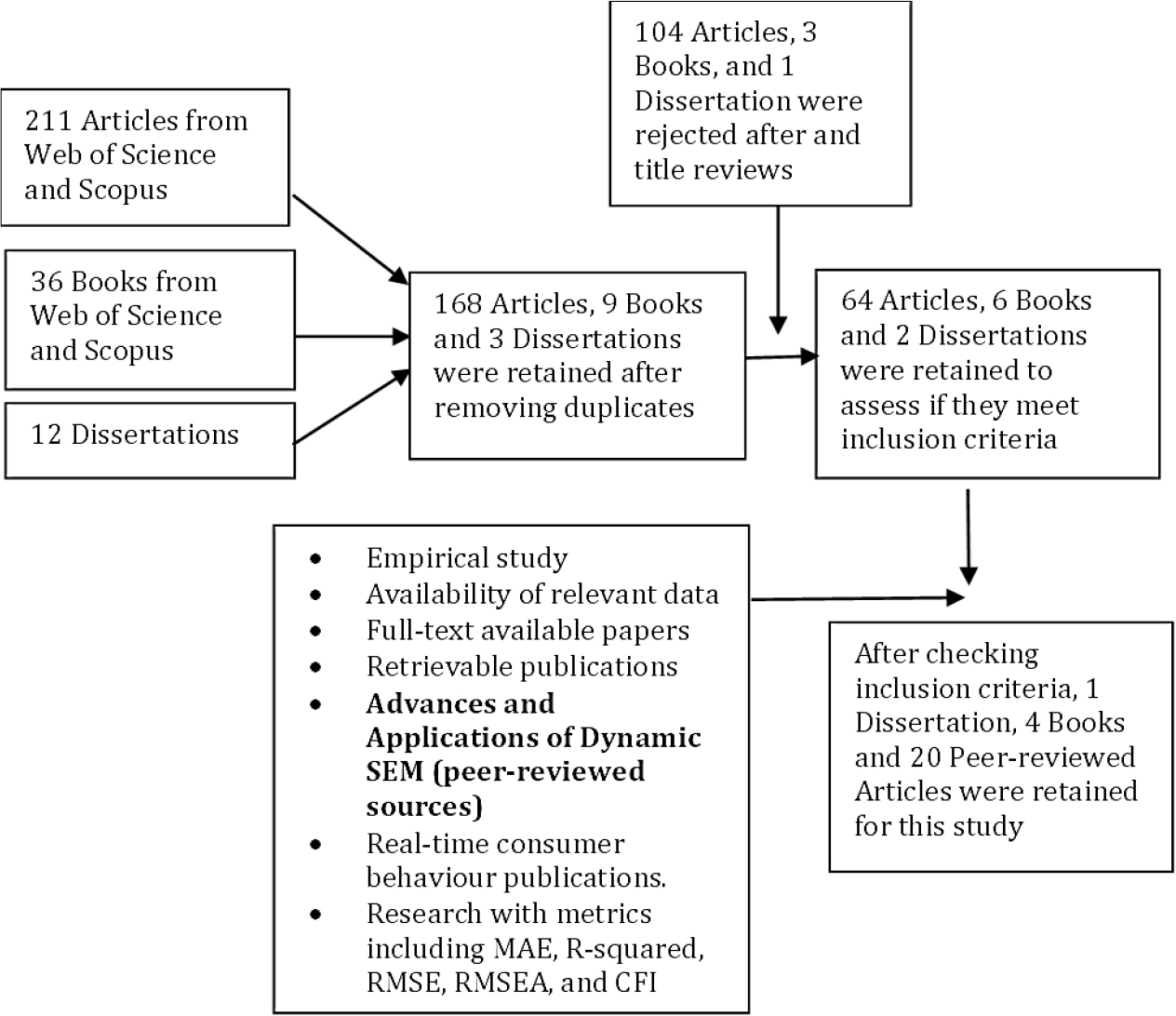
Figure 1.
Established inclusion criteria
Source: own processing
Table 1.
A Comparative framework of traditional and dynamic SEM
| Aspect | Traditional SEM | Dynamic SEM |
|---|---|---|
| Introduction | It focuses on analysing static relationships between latent variables by assessing covariance structures (Westland, 2015). | Dynamic SEM integrates temporal dynamics, modelling the evolution of consumer behaviours over time (Hamaker et al., 2021). |
| Key Advances and Applications | Explore static theoretical models in consumer preferences and behaviour to offer relatively stable insights over time (Ghasemy et al., 2020). | Pioneering real-time analysis of consumer behaviour, providing immediate feedback and adaptable marketing strategies (Kronemann, 2022). |
| Methodological Foundations | Evaluate fixed and static theoretical relationships among variables based on both path analysis and factor analysis (Ghasemy et al., 2020). | Utilises dynamic factor models, latent growth models, and state-space models to monitor real-time behavioural changes (McNeish & Hamaker, 2020). |
| Data Sources | Primarily relies on cross-sectional or longitudinal data, capturing static behavioural snapshots (Iskamto & Gunawan, 2023). | Requires high-frequency, real-time data from digital platforms such as e-commerce and social media (Tao et al., 2022). |
| Temporal Scope | Primarily retrospective, focusing on historical data or pre-set intervals for analysis (McNeish & Hamaker, 2020). | Offers predictive modelling, forecasting future consumer behaviours based on past and real-time data (Bolton et al., 2018). |
| Model Flexibility | Rigid model structure; most effective for environments with consistent and predictable behaviour patterns (Ghasemy et al., 2020). | Highly flexible, allowing for the adaptation of models in response to rapidly changing consumer behaviours (Hamaker et al., 2021). |
| Real-time Data Adaptation | Unable to handle real-time data, limiting its use in fast-paced, evolving environments (Iskamto & Gunawan, 2023). | Built to process and react to real-time data, it is ideal for dynamic, fast-changing markets (Tao et al., 2022). |
| Time Sensitivity | Best suited for analysing long-term trends; lacks real-time responsiveness (McNeish & Hamaker, 2020). | Highly time-sensitive, capable of providing continuous, real-time analysis and feedback (Kwasnicka et al., 2019). |
| Research Fit | Ideal for studies focusing on stable, long-term relationships and testing theoretical models with static data (Westland, 2015). | Best for research requiring real-time behaviour tracking, especially in dynamic industries (Bolton et al., 2018). |
| Software and Tools | Supported by tools like AMOS, LISREL, and EQS, which are suited for traditional, static data analysis (Hu & Lovrich, 2020). | Requires advanced software like Mplus and OpenMx to handle complex, dynamic data sets in real-time (Hu & Lovrich, 2020). |
| Real-World Applicability | Limited effectiveness in industries like e-commerce and social media, where consumer behaviours change rapidly (Mehedintu & Soava, 2022). | Highly applicable in digital marketing, app development, and other industries where consumer preferences shift quickly (Kronemann, 2022). |
| Applications in Marketing Research | Commonly used for analysing stable, long-term consumer patterns and testing fixed hypotheses (Uju & Arizal, 2023). | Used extensively in real-time marketing to adjust campaigns dynamically based on evolving consumer behaviours (Kronemann, 2022). |
| Key Advantages | Well-suited for analysing stable relationships, useful for theoretical model testing and validation (Westland, 2015). | Excels in tracking fast-changing behaviours, providing actionable insights in real-time for adaptive marketing strategies (Hamaker et al., 2021). |
| Limitations | They cannot easily adapt to rapid behavioural changes and are limited to retrospective analysis (Sharma et al., 2024). | Computationally intensive, requiring sophisticated algorithms and large data sets for optimal performance (Bolton et al., 2018). |
| Conclusion and Future Directions | Remains valuable for static analysis, though less effective for dynamic, evolving behaviours (Ghasemy et al., 2020). | Expected to lead future research in real-time behaviour analysis, with potential for further advancements in computational techniques (Hamaker et al., 2021). |
| Recommendations for Future Research | Suggests incorporating dynamic elements to enhance relevance and application in fast-changing environments (Xu et al., 2020). | Calls for further refinement in computational methods and interdisciplinary research to overcome challenges (Kim et al., 2022). |
Table 2.
Comparative analysis of performance metrics for traditional SEM and dynamic SEM models
| Metric/Index | Traditional SEM | Dynamic SEM | References |
|---|---|---|---|
| Mean Absolute Error (MAE) | Higher MAE values, indicating less accuracy in prediction (e.g., > 0.10) | Lower MAE values (e.g., < 0.05), reflecting better accuracy in capturing changes | Browne & Cudeck (1992); Zhu, Raquel, & Aryadoust (2020) |
| Root Mean Squared Error (RMSE) | Higher RMSE (e.g., > 0.10), may not effectively capture short-term changes. | Lower RMSE (e.g., < 0.05), particularly effective in predicting short-term fluctuations | Browne & Cudeck (1992); Zhu, Raquel, & Aryadoust (2020) |
| R-squared (R2) | Generally lower (e.g., < 0.50), indicating less explained variance | Typically, higher (e.g., > 0.70), indicating a better model fit to data | Schumacker & Lomax (2010); Zhu, Raquel, & Aryadoust (2020) |
| Chi-square (χ2) | Sensitive to sample size; often shows significant values (e.g., p < 0.05) | Also, sensitive but typically shows lower values with better fit | Zhu, Raquel, & Aryadoust (2020) |
| Goodness-of-Fit Index (GFI) | Values often < 0.90, indicating poorer fit | Values > 0.90; indicating good fit to the data | Bolton et al. (2018); Zhu, Raquel, & Aryadoust (2020) |
| Adjusted Goodness-of-Fit Index (AGFI) | Values often < 0.90 | Values > 0.90; indicating better fit when adjusting for parsimony | Bolton, et al., (2018); Zhu, Raquel, & Aryadoust (2020) |
| Comparative Fit Index (CFI) | Often < 0.90, indicating suboptimal fit | Values > 0.90; indicating strong model-data fit | Kruschke (2015); Zhu, Raquel, & Aryadoust (2020) |
| Root Mean Square Error of Approximation (RMSEA) | Values often > 0.08, indicating poor fit | Values < 0.05; indicating a well-fitting model | Browne & Cudeck, (1992); Zhu, Raquel, & Aryadoust (2020) |
| Standardised Root Mean Square Residual (SRMR) | Often lacks consistency, higher values (e.g., > 0.10) | Typically, lower (e.g., < 0.08), reflecting the standardised difference between observed and predicted correlations | Kronemann, (2022); Mehedintu & Soava (2022); Zhu, Raquel, & Aryadoust (2020) |
| Akaike Information Criterion (AIC) | Generally higher AIC values (e.g., > 100), indicating a less optimal model | Lower AIC values (e.g., < 80), reflecting a better-quality model | Zhu, Raquel, & Aryadoust (2020) |
| Bayesian Information Criterion (BIC) | Higher BIC values (e.g., > 100), less effective in model selection | Lower BIC values (e.g., < 80), indicating a more reliable model | Kruschke (2015); Zhu, Raquel, & Aryadoust (2020) |