
Introduction
The justification for conducting this study stems from the existing limitations when employing traditional Structural Equation Modelling (SEM). SEM normally depends on static data and usually captures rapid shifts in consumer behaviour (Hamaker, Asparouhov, & Muthén, 2021; Thorson, Andrews III, Essington, & Large, 2024). The emergence of the big data era has also stressed these limitations more, hence the need for much more advanced methods and approaches to tackle existing dynamic challenges. This study aims to fill an existing gap by examining dynamic SEM, which typically integrates time when analysing data, and therefore offering a more accurate understanding of temporal dimensions and real-time consumer behaviour dynamics. It evaluates recent advancements in dynamic SEM, examines its effectiveness in capturing real-time interactions, and contrasts it with traditional SEM methods to showcase how dynamic SEM provides a richer perspective on evolving consumer behaviours.
The SEM has gained widespread acceptance in marketing research for its capability to comprehensively test theories and concepts (Ghasemy et al., 2020; Westland, 2015). Researchers prefer SEM because of its capacity to simultaneously analyse multiple variables and their relationships, and thus, it is more useful in complex models (Hair & Alamer, 2022). The emergence of the big data era has transformed consumer behaviour analysis, pressing the need for more advanced analytical methods able to address the complexities of modern data contexts. Big data means a massive volume of structured and unstructured data that is produced at high velocity from multiple sources, including transactions, sensors, social media, and devices. These data can be in the form of text, video, images, and audio, and they usually use advanced technologies and algorithms during the analysis. Big data offer unparalleled insights into consumer behaviour via extensive data from various sources, including e-commerce platforms, social media, and mobile applications, facilitating businesses to make highly informed decisions (Juju & Arizal, 2023; Mehedintu & Soava, 2022). The use of advanced technologies and algorithms to analyse the big data in real time provides marketers with unique opportunities to know the variation of consumer behaviour and preferences with high precision.
Conventional SEM has been considered as a primary tool for analysing complex relationships among static variables via covariance structures, latent variables and error terms (Fan et al., 2016). Dynamic SEM can model complex causal relationships and rigorously test conceptual and theoretical frameworks through incorporating both factor path analysis and analysis (Mueller & Hancock, 2018; Westland, 2015). Despite its robustness, traditional SEM is designed to analyse the static data and thus faces challenges in addressing the dynamic nature of real-time consumer behaviours because it does not fully capture the fast shift in consumer behaviours. Consumer behaviour may shift rapidly in response to instantaneous marketing stimuli like advertising, product packaging, branding, promotions, product features and flash sales (Iskamto & Gunawan, 2023; Sharma et al., 2024). Thus, conventional SEM methods may fail to capture these rapid and immediate changes. As a result, they may lead to major inaccuracies in adequately understanding and predicting consumer behaviour, and therefore, there is a need for dynamic SEM models that integrate temporal dimensions into the data and metrics analysis.
Although the importance of dynamic SEM has been continuously growing in the era of big data, it has received relatively little investigation on the analysis of real-time consumer preferences and behaviours (Andriamiarana, Kilian, Kelava, & Brandt, 2023; McNeish & Hamaker, 2020; Thorson, Andrews III, Essington, & Large, 2024). In addition, the utilisation of dynamic SEM for analysing real-time consumer behaviour remains inadequately explored, particularly in relation to integration of current advancements with real-time data (Liu, Bai, & Elsworth, 2024; Wairimu, 2023). To address the existing research gap, this study rigorously examines dynamic SEM for real-time consumer behaviour analysis, an underexplored yet rapidly growing area of critical importance. The study examines modern dynamic SEM methodological innovations, approaches, and developments by analysing their usage in real-time consumer behaviour and interactions. The study also compares the traditional SEM and dynamic SEM approaches and methodologies.
Literature review
Overview of traditional SEM
The traditional SEM has historically been an essential method for analysing the complex relationships among variables by using covariance matrices to estimate parameters and validating theoretical models (Yu, Zaza, Schuberth, & Henseler, 2021). The traditional SEM methods are valuable for examining both direct and indirect effects observed when testing theoretical frameworks. For example, they are effective in analysing static relationships within established theoretical constructs and thus become potential in understanding how marketing strategies impact customer retention. However, the static nature of traditional SEM limits its ability to capture temporal dimensions of consumer behaviour (McNeish & Hamaker, 2020). Traditional SEM depends much on aggregated data collected at fixed intervals, which are likely to obscure the dynamic shifts in consumer behaviour and interactions. Consumer behaviour is always dynamic over time and never static. Research has revealed that consumer preferences may swiftly change over time in response to technological advancements, shift in cultural factors, social factors, personal factors, psychological factors, economic factors, change in marketing campaigns, social media influencers, peer influence, seasonal changes and innovations in product design. As a result, the static data approach may fail to accurately reflect these rapid transitions (Thakkar, 2020). Thus, to manage these weaknesses, much more advanced methodologies and approaches are required to address the temporal dynamics and offer ample information on how behaviours evolve in real-time.
Overview of dynamic SEM
Dynamic SEM offers a crucial advancement in data analysis by incorporating time as a variable to handle static and temporal behavioural changes (Hamaker, Asparouhov, & Muthén, 2021). The model enables researchers to accommodate changes and interactions when analysing data and therefore enables researchers to get rich and accurate information over time. The approach has Latent Growth Modelling (LGM) feature that analyses changes of consumer behaviour over time on issues related to trajectories of change, individual differences, predictors of change, longitudinal data, hypotheses testing and handling missing data (Zhang et al., 2024). It therefore facilitates understanding consumer behaviour by identifying and analysing short-term and long-term trends, understanding variability in consumer behaviour, predicting future behaviour, evaluating interventions, and optimising resource allocation. LGM has been employed to analyse consumer satisfaction over time and giving information on how satisfaction levels fluctuate with each interaction or service encounter (Zhi & Ha, 2024). While LGM assists in analysing individual growth patterns in customer satisfaction and their relationship with service touchpoints, State Space Models improve the said analysis by capturing temporal data and dynamic interactions over time (Andriamiarana, Kilian, Kelava, & Brandt, 2023; Westland, 2015). In a similar vein, Autoregressive (AR) Models play an important role in dynamic SEM by examining how past variable values influence its recent state. AR models are used for forecasting time-series, understanding temporal dependencies, simplifying complex data analysis, identifying patterns and trends in historical data, improving prediction accuracy and handling seasonal data patterns (Thorson, Andrews III, Essington, & Large, 2024).
Innovations and recent developments
Modern innovations have substantially expanded dynamic SEM applications, especially through incorporating dynamic SEM with big data technologies such as Big SEM, Bayesian inference, machine learning algorithms, signal-to-noise rational analysis, and missing data techniques (Liu, Bai, & Elsworth, 2024). Since dynamic SEM has ability to leverage high-frequency data from digital platforms such as e-commerce (e.g. Amazon, eBay, Alibaba, Shopify, Walmart, Etsy, Best Buy, Costco, Target, Zappos) and social media (e.g., Facebook, Instagram, X, LinkedIn, TikTok, Snapchat, Pinterest, Reddit, WeChat, WhatsApp), its application has been significantly broadened over time. Analysing real-time consumer interactions on social media can offer several advantages for businesses and marketers including enabling businesses to get immediate feedback, enhanced customer engagement, trend identification, crisis management, competitor analysis, data-driven decision making, personalised marketing, improved product development and increased sales and conversions (Juju & Arizal, 2023; Nayyar, 2022; Westland, 2015). For example, analysing real-time consumer interactions on social media enables more accurate modelling of consumer behaviour dynamics and immediate responses to marketing stimuli. use rich data sources, collect timely insights, get enhanced data quality, collect diverse data types, get large sample sizes, social media platforms, conduct sentiment analysis, track user behaviour over time, geospatial analysis (users geotag their posts), and developing predictive models to forecast future trends and behaviours.
The capabilities of dynamic SEM have also been enhanced by the advancements of its estimation techniques. For example, the application of Bayesian methods and machine learning algorithms has enhanced the accuracy of parameter estimation (Pazo, Gerassis, Araújo, Antunes, & Rigueira, 2024). Bayesian methods utilise prior distributions and update estimates, hence providing a flexible approach to modelling complex systems (Kim, Lee, Shin, Kim, & Cha, 2022). Bayesian methods offer significant advantages in managing large datasets and complex models, thus providing more robust insights into dynamic processes. In addition, development of advanced software tools has enabled the adoption and implementation of dynamic SEM. Modern software packages such as Mplus and LISREL have functionalities that are tailored for dynamic SEM, making it easier to analyse real-time data (Hamaker, Asparouhov, & Muthén, 2021). The previously stated tools provide user-friendly interfaces and advanced features when handling high-frequency data and complex temporal modelling, such that those features support the application of dynamic SEM techniques across various contexts. Thus, contrary to traditional SEM, dynamic SEM signifies a significant evolution because of its enhanced capabilities for modelling temporal dynamics and delivering deeper insights into the evolution of consumer behaviour in response to various stimuli. The next section covers the application of dynamic SEM models.
Advances and application of dynamic SEM models
Dynamic SEM has arisen as a groundbreaking strategy for practically and accurately analysing intensive and complex longitudinal data. The dynamic SEM provides unparalleled precision in capturing intra-individual changes and real-time temporal dynamics. The model significantly improves ecological validity by mitigating retrospective biases and tapping into the real-time data through using advanced technologies and approaches, including Ecological Momentary Assessment and Experience Sampling Method. In addition, the robustness and reliability of dynamic SEM are strengthened by integrating Bayesian methods for estimation in its model, hence facilitating researchers to draw more generalisable and accurate conclusions. The integration of big data technologies, including machine learning algorithms and cloud computing platforms, has significantly advanced the model (Andriamiarana, Kilian, Kelava, & Brandt, 2023). Consequently, they enhance the capability of dynamic SEM in analysing high-frequency, complex, and large-scale datasets from digital platforms like social media and ecommerce. The key benefits of the said integration include real-time monitoring and automated analysis, more precise and reliable results, scalability due to virtually unlimited computational resources, enhanced collaboration among researchers, cost-effectiveness, dynamic analysis, and enhanced visualisation techniques (Hamaker, Asparouhov, & Muthén, 2021). As a result, these innovations help researchers capture complex and complicated temporal patterns and trends that cannot be handled by traditional SEM, which relies on static data.
Dynamic SEM can analyse longitudinal data, handle time-varying effects, address predictive analytics, manage big data, update dynamic model and handle complex interactions. Hence, it helps to analyse and give a deeper understanding of how consumer behaviour evolves with time. Dynamic SEM parameter estimation techniques have been significantly improved, resulting in enhanced accuracy and efficiency due to the application of Bayesian methods and machine learning algorithms (Kim, Lee, Shin, Kim, & Cha, 2022). Bayesian methods leverage prior distributions and constantly update estimates based on fresh data. In that case, it handles valuable and large datasets as well as complex models and substantially yields more reliable insights into dynamic processes.
Dynamic SEM has also been supported by the development of advanced software tools like LISREL and Mplus. The platforms provide user-friendly interfaces and have specialised functionalities designed to handle relatively high-frequency data and complex temporal modelling and hence facilitate the application of dynamic SEM across diverse contexts (Kim, Lee, Shin, Kim, & Cha, 2022). Dynamic SEM integrates temporal elements and therefore allows for adeptly modelling consumer choices, moods, attitudes, and emotional states over time and how they significantly influence evolving consumer behaviour, which of course the traditional SEM relying on static data could not capture. A key application of this approach is Customer Journey Mapping, where businesses track and analyse consumer interactions across multiple touchpoints, from initial awareness and need recognition to post-purchase evaluations (Juju & Arizal, 2023). By mapping these interactions, businesses gain insights into how early online engagements influence in-store visits and how different digital marketing channels collectively shape brand perception. Identifying the most impactful touchpoints helps businesses develop more effective and targeted marketing strategies to enhance customer satisfaction and loyalty.
Researchers and scholars (Andriamiarana, Kilian, Kelava, & Brandt, 2023; Hamaker, Asparouhov, & Muthén, 2021; Liu, Bai, & Elsworth, 2024; McNeish & Hamaker, 2020; Pazo, Gerassis, Araújo, Antunes, & Rigueira, 2024; Zhi & Ha, 2024) have revealed several advantages when analysing consumer preferences, behaviour, and interactions data using dynamic SEM. First, it can capture temporal dynamics and real-time data and thus enable researchers and businesses to have up-to-date information, deeply understand how consumer behaviour and preferences change over time and respond quickly with correct countermeasures. Second, dynamic SEM handles multilevel data from timepoints, individuals, and households, hence offering a deeper understanding of consumer behaviour and leading to more accurate and robust and actionable insights. Third, dynamic SEM leads to improved accuracy because of the integration of latent and covariate variables. Fourth, the flexibility of dynamic SEM makes it possible to adapt various research designs and data types and therefore capacitate them as versatile tools in consumer behaviour research. Fifth, dynamic SEM assists in recognising the individual-level patterns and changes over time. This helps to design more effective personalised marketing strategies by meeting individual consumer needs and, therefore, enhancing customer satisfaction, retention, and loyalty. Moreover, because of its enhanced predictive power, dynamic SEM captures dynamic consumer behaviour that results in the enhancement of predictive power and improved informed decision-making on various aspects, including product development, customer engagement, and the formulation of workable and best marketing strategies.
Benefits and challenges of dynamic SEM
Dynamic SEM is more advantageous than traditional SEM because it relies on enhanced accuracy in capturing consumer behaviour dynamics. Dynamic SEM integrates temporal elements and therefore allows for adeptly modelling consumer choices, moods, attitudes, and emotional states over time. The dynamic SEM models offer a more accurate understanding of how consumer attitudes and behaviours evolve over time by incorporating temporal dimensions. For instance, the dynamic SEM tracks how customer satisfaction changes over time and correlates these changes with diverse service interactions and hence facilitates businesses to attend consumer needs more effectively (Bolton et al., 2018; Xu et al., 2020). Dynamic SEM is also extensively employed in consumer choice studies, facilitating the construction of latent variables and elucidating the complex interrelationships among various determinants of consumer decisions. This capacity to capture subtle behavioural dynamics makes dynamic SEM an invaluable tool in advancing our understanding of consumer psychology. The increase in dynamic SEM’ s accuracy in analysing real-time data and predicting future consumer behaviour helps in giving more enhanced informed decisions, formulate the best business strategies, and optimise marketing strategies and resource allocation. In that way, it enhances more decision-making based on figures and facts. Also, through predictive analytics, Dynamic SEM facilitates businesses in anticipating trends in shifts in consumer behaviour (Kronemann, 2022). Therefore, it is the business's responsibility to proactively assess and refine existing business strategies and improve them accordingly depending on the context.
However, changing consumer behaviours, fluctuating market conditions, continuous optimisation of ongoing campaigns, and efficient allocation of resources are among the challenges facing the use of dynamic SEM (Xu, DeShon, & Dishop, 2020). Furthermore, data quality may be interrupted when using dynamic SEM because of several reasons such as inaccurate data sources, data integration issues, human error, inconsistent data standards, incomplete data, technical issues major concern, and noisy when using real-time data from digital (Kruschke, 2015; Zhu, Raquel, & Aryadoust, 2020). Consequently, this can lead to ineffective audience targeting, low click-through rates, reduced conversion rates, inaccurate performance metrics, misallocated budgets, decreased customer trust, wasted resources and compliance issues. Poor data quality can, however, be reduced through implementing data validation, regular data audits, standard data formats, improved data integration, automating data cleaning, training and education, and consistently monitoring data quality (Hamaker, Asparouhov, & Muthén, 2021).
The computational complexity linked to dynamic SEM when dealing with high-frequency data and large datasets can be improved through using adequate computational resources and advanced statistical software (Hamaker, Asparouhov, & Muthén, 2021). Moreover, to ensure the reliability and validity of data, precise preprocessing and cleaning of data are required (Westland, 2015). It is strongly recommended that the computational demands are effectively managed to ensure optimal model performance. Ensuring the stability and replicability of parameter estimates is paramount for the validity of findings and enhancing the credibility of the research. Furthermore, implementation and interpretation of dynamic SEM frameworks and models need a high level of statistical researchers and expertise and a deep understanding of statistical techniques and modelling approaches when using dynamic SEM. Training and development of researchers and experts in statistical methodologies is eventually essential to enhance accuracy when specifying models, estimating parameters, and interpreting the findings (Hamaker, Asparouhov, & Muthén, 2021).
Materials and methods
A rigorous evaluation of peer-reviewed consumer behaviour publications and research reports was done to collect information from SEM methods and approaches for comparison purposes. The focus was traditional and dynamic SEM methodological approaches, practical applications and advancements. Studies related to consumer behaviour were evaluated. The essence was to address how to handle temporal dynamics, datasets scalability, and establish practical relevance for analysing real-time consumer behaviour, particularly focusing on comparative evaluation of theoretical foundations, and methodological robustness. Prior to critical literature review, inclusion and exclusion criteria were clearly established as illustrated in Figure 1. One of the inclusion criteria was to select empirical studies which had relevant data and retrievable information. Thus, only retrievable and accessible publications from reputable online databases such as Web of Science and Scopus were downloaded, documented and considered for utilisation in this study. The research included studies based on real-time marketing analytics and consumer behaviour, especially those which employed performance metrics such as Mean Absolute Error (MAE), Root Mean Square Error (RMSE), R-squared (R2), Comparative Fit Index (CFI), or Root Mean Square Error of Approximation (RMSEA). Only research published between 2010 and 2024 was considered relevant for this study to ensure the inclusion of recent advancements and contemporary applications of dynamic SEM.
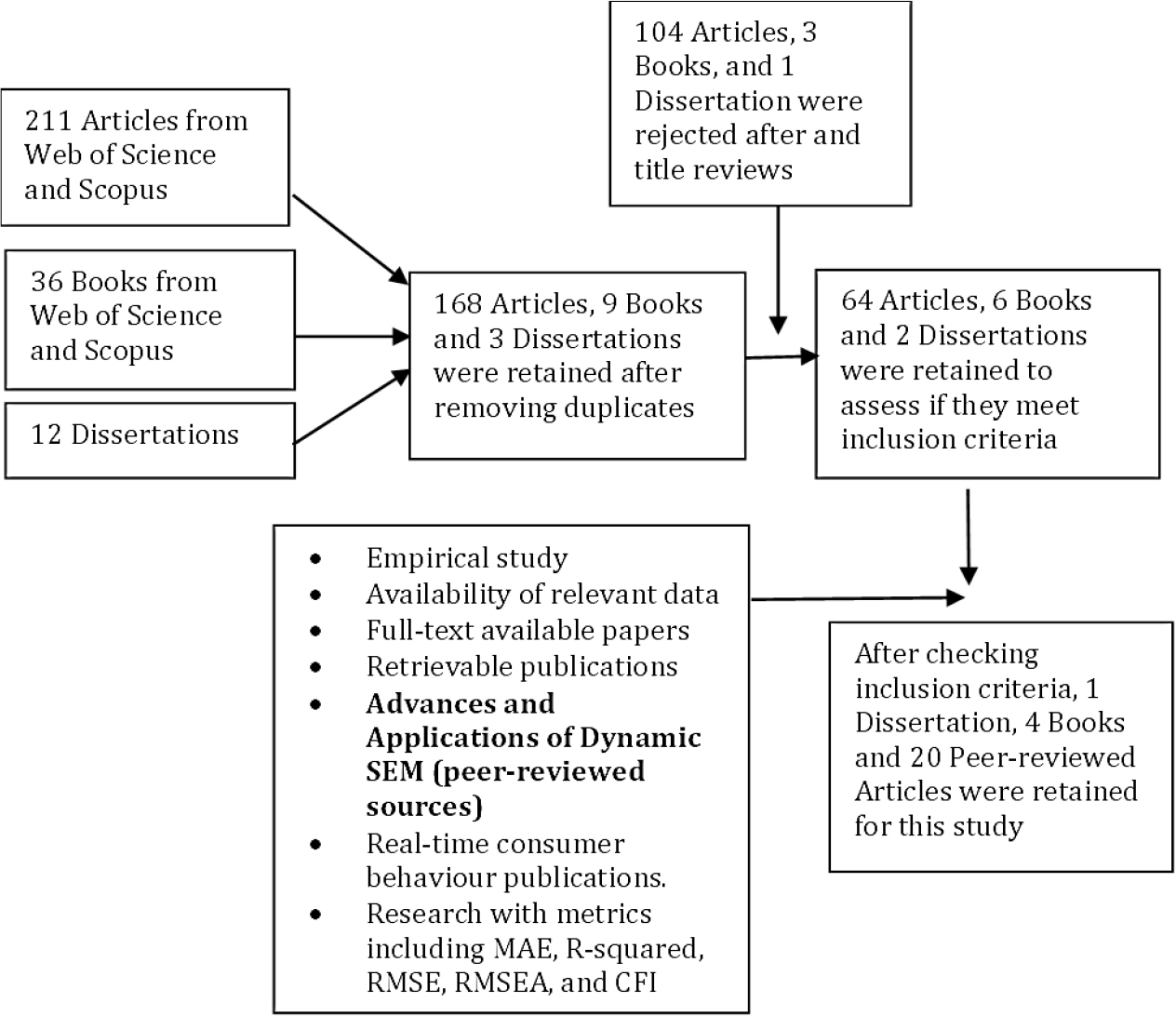
Figure 1.
Established inclusion criteria
Source: own processing
The first objective of this study is to assess recent advancements in dynamic SEM by evaluating academic sources to understand current innovations such as time-varying parameters and time-lagged effects that strengthen its analysis of complex temporal data.
The findings were synthesised by establishing recent innovations like fusion of time-varying parameters and Bayesian estimation techniques. To improve the research rigor, an intensive literature review was conducted to synthesise the findings, common innovations such as time-varying parameters were identified, Bayesian estimation techniques were secured, categorised, evaluated and integrated into a cohesive summary to capture current progress in dynamic SEM. Furthermore, objective two evaluated real-world applications of dynamic SEM in analysing consumer behaviour. Objective three compared dynamic SEM and traditional SEM analysis methods. The findings were synthesised by comparing theoretical foundations and performance metrics of both methods to reveal strengths and limitations of each approach. The performance metrics compared to assess how well each method fits real-time data include MAE, RMSE, R-squared values, RAMSEA, and CFI (see Figure 1).
Results and discussion
Comparison of dynamic SEM with traditional SEM
Traditional SEM has been a cornerstone of analysing complex relationships among variables for a long time. It utilises covariance matrices to estimate parameters and validate theoretical models, focusing predominantly on static relationships among observed and latent variables (Yu, Zaza, Schuberth, & Henseler, 2021). This approach is adept at assessing theoretical frameworks and static relationships, such as evaluating the impact of marketing strategies on brand loyalty within well-defined constructs. However, it predominantly relies on static and aggregated data collected at discrete intervals, potentially obscuring dynamic shifts in consumer interactions and failing to capture the temporal dimensions of behaviour (McNeish & Hamaker, 2020). For instance, consumer preferences may rapidly evolve in response to new marketing campaigns or seasonal changes, which the static data approach of traditional SEM might not accurately reflect (Thakkar, 2020).
In contrast, dynamic SEM represents a significant advancement by incorporating time as a variable, allowing it to address the limitations of traditional SEM. Dynamic SEM enables researchers to model changes and interactions over time, providing a more detailed and accurate view of how variables evolve and influence each other. A key innovation within dynamic SEM is Latent Growth Modelling (LGM), which focuses on tracking individual trajectories of change and identifying factors that influence these trajectories (Zhang et al., 2024). For example, LGM has been utilised to analyse consumer satisfaction over time, revealing how satisfaction levels fluctuate with each interaction or service encounter (Zhi & Ha, 2024). This approach allows researchers to understand how individual growth patterns in satisfaction correlate with various service touchpoints, offering valuable insights into long-term consumer behaviour.
Another significant advancement in dynamic SEM is the use of State Space Models, which capture temporal dependencies and dynamic interactions by accounting for latent state changes over time (Andriamiarana, Kilian, Kelava, & Brandt, 2023). These models are particularly effective in scenarios where consumer behaviour exhibits substantial variability. For example, State Space Models have been employed to study how past engagement with marketing content affects current consumer behaviour and future interactions (Westland, 2015). This modelling approach provides a framework to understand how latent states evolve and interact, offering a detailed perspective on temporal dynamics. Autoregressive (AR) Models also play a crucial role in dynamic SEM by examining how past values of a variable influence its current state. These models are valuable for understanding serial dependencies in time series data, such as how prior marketing exposures shape current consumer attitudes and behaviours (Thorson, Andrews III, Essington, & Large, 2024). By analysing the temporal effects of marketing activities, Autoregressive Models enable more precise predictions of future behaviour based on historical data, enhancing the understanding of the long-term impacts of marketing strategies. The following section presents the findings on the strengths and limitations of dynamic SEM.
Strengths and limitations of dynamic SEM
The dynamic SEM offers considerable advantages over traditional SEM, particularly in its ability to handle and model temporal dynamics with precision. Unlike traditional SEM, which relies on aggregated data collected at discrete intervals, dynamic SEM integrates time as a fundamental variable, allowing it to capture the continuous and evolving nature of consumer behaviour (Hamaker, Asparouhov, & Muthén, 2021). This capability is crucial for understanding how variables such as consumer attitudes or brand loyalty shift over time in response to ongoing marketing efforts or seasonal promotions. For instance, dynamic SEM can effectively model the gradual changes in consumer sentiment or loyalty resulting from sustained marketing campaigns, offering a more nuanced perspective than static models, which may obscure these subtle but significant shifts. Furthermore, dynamic SEM excels in adapting to rapidly changing environments, a significant advantage in the fast-paced digital landscape. As consumer behaviour and market conditions can fluctuate quickly, traditional SEM often struggles to keep pace, resulting in outdated or imprecise insights (Bolton et al., 2018). Dynamic SEM, however, is designed to handle high-frequency data and adjust to evolving conditions, making it particularly effective for analysing real-time data from digital platforms such as social media and e-commerce sites. For example, dynamic SEM can track real-time changes in customer sentiment, allowing businesses to adapt their marketing strategies promptly and gain a competitive edge by making timely, data-driven decisions (Napontun & Pimchainoi, 2023). This capability is supported by empirical research, such as that by Hamaker, Asparouhov, and Muthén (2021) and Zhi and Ha (2024), which demonstrates the practical benefits of dynamic SEM in analysing real-time consumer responses to digital marketing campaigns.
Despite its strengths, dynamic SEM is not without limitations. One notable challenge is its inherent complexity, which necessitates sophisticated modelling techniques and substantial computational resources. Implementing dynamic SEM involves intricate parameter estimation and model fitting, requiring advanced statistical expertise and powerful computing capabilities (Hamaker, Asparouhov, & Muthén, 2021). This complexity can hinder its adoption, particularly among researchers or practitioners who may lack the necessary resources or specialised knowledge. Studies such as those by Xu et al. (2020) highlight these technical challenges, emphasising the need for extensive expertise to effectively utilise dynamic SEM models. Another significant limitation is the data requirements for dynamic SEM. These models depend on high-frequency, high-quality data to function optimally, which can be both resource-intensive and logistically challenging to collect and manage.
The accuracy and effectiveness of dynamic SEM are contingent upon the availability of continuous data streams to capture temporal changes and interactions accurately (Ghasemy, Teeroovengadum, Becker, & Ringle, 2020). Inadequate data quality or infrequent data collection can undermine the reliability of dynamic SEM results (Bolton et al., 2018). The labour-intensive nature of meticulous data management practices, including preprocessing and cleaning, adds to the complexity of using dynamic SEM. Research by Wairimu (2023) further illustrates that the effectiveness of dynamic SEM is closely linked to the robustness of the data utilised, underscoring the need for rigorous data management to fully leverage the model’ s capabilities. To maximise the benefits of dynamic SEM and address existing challenges, researchers should consider the subsequent recommendations.
Further development of dynamic SEM techniques is essential for advancing the field. Continuous exploration and innovation are necessary to address current limitations and expand the applicability of dynamic SEM. Researchers should focus on refining existing models and developing new methodologies to improve the accuracy and efficiency of dynamic SEM. For example, integrating dynamic SEM with advanced machine learning algorithms could enhance parameter estimation and data analysis capabilities (Hamaker, Asparouhov, & Muthén, 2021). Additionally, researchers should investigate the potential of incorporating diverse data sources, such as sensor data or geo-location information, to provide richer insights into consumer behaviour (Nayyar, 2022). Ongoing development in these areas will contribute to overcoming existing challenges and advancing the field' s theoretical and practical applications. Cross-Disciplinary Collaboration is also crucial for advancing dynamic SEM.
The complexity of dynamic SEM models often requires expertise from various disciplines, including statistics, data science, and computational methods (Hidayat-ur-Rehman & Alsolamy, 2023). Collaborating with experts in these fields can enhance model development and application. For instance, partnerships with data scientists can facilitate the creation of sophisticated algorithms for analysing high-frequency data, while collaboration with computational experts can support the development of robust software tools for dynamic SEM (Hamaker, Asparouhov, & Muthén, 2021). Such cross-disciplinary efforts can address challenges related to data quality, computational complexity, and model interpretation, leading to more innovative and effective solutions. By fostering collaboration between researchers, data scientists, and technologists, the field of dynamic SEM can benefit from a broader range of expertise and perspectives, ultimately leading to more impactful research outcomes. Lastly, educational initiatives should be developed to increase awareness and understanding of dynamic SEM.
Comprehensive training programs and resources can equip researchers and practitioners with the necessary skills to effectively utilise dynamic SEM models (Thorson, Andrews III, Essington, & Large, 2024). In summary, dynamic SEM offers substantial practical benefits for marketing, including enhanced targeting and optimised strategy adjustments. To fully leverage these benefits, researchers should focus on advancing dynamic SEM techniques and fostering cross-disciplinary collaborations. These efforts will not only improve the theoretical and practical contributions of dynamic SEM but also ensure its continued relevance and effectiveness in analysing and predicting complex temporal phenomena.
Table 1 summarises a comparative framework of traditional and dynamic SEM and recommendations for future research. The table further illustrates how dynamic SEM models shift in consumer behaviour through temporal variables, enabling real-time marketing strategy adjustments and showing the need for high-quality, high-frequency data, thus offering its superiority over traditional models.
Table 1.
A Comparative framework of traditional and dynamic SEM
| Aspect | Traditional SEM | Dynamic SEM |
|---|---|---|
| Introduction | It focuses on analysing static relationships between latent variables by assessing covariance structures (Westland, 2015). | Dynamic SEM integrates temporal dynamics, modelling the evolution of consumer behaviours over time (Hamaker et al., 2021). |
| Key Advances and Applications | Explore static theoretical models in consumer preferences and behaviour to offer relatively stable insights over time (Ghasemy et al., 2020). | Pioneering real-time analysis of consumer behaviour, providing immediate feedback and adaptable marketing strategies (Kronemann, 2022). |
| Methodological Foundations | Evaluate fixed and static theoretical relationships among variables based on both path analysis and factor analysis (Ghasemy et al., 2020). | Utilises dynamic factor models, latent growth models, and state-space models to monitor real-time behavioural changes (McNeish & Hamaker, 2020). |
| Data Sources | Primarily relies on cross-sectional or longitudinal data, capturing static behavioural snapshots (Iskamto & Gunawan, 2023). | Requires high-frequency, real-time data from digital platforms such as e-commerce and social media (Tao et al., 2022). |
| Temporal Scope | Primarily retrospective, focusing on historical data or pre-set intervals for analysis (McNeish & Hamaker, 2020). | Offers predictive modelling, forecasting future consumer behaviours based on past and real-time data (Bolton et al., 2018). |
| Model Flexibility | Rigid model structure; most effective for environments with consistent and predictable behaviour patterns (Ghasemy et al., 2020). | Highly flexible, allowing for the adaptation of models in response to rapidly changing consumer behaviours (Hamaker et al., 2021). |
| Real-time Data Adaptation | Unable to handle real-time data, limiting its use in fast-paced, evolving environments (Iskamto & Gunawan, 2023). | Built to process and react to real-time data, it is ideal for dynamic, fast-changing markets (Tao et al., 2022). |
| Time Sensitivity | Best suited for analysing long-term trends; lacks real-time responsiveness (McNeish & Hamaker, 2020). | Highly time-sensitive, capable of providing continuous, real-time analysis and feedback (Kwasnicka et al., 2019). |
| Research Fit | Ideal for studies focusing on stable, long-term relationships and testing theoretical models with static data (Westland, 2015). | Best for research requiring real-time behaviour tracking, especially in dynamic industries (Bolton et al., 2018). |
| Software and Tools | Supported by tools like AMOS, LISREL, and EQS, which are suited for traditional, static data analysis (Hu & Lovrich, 2020). | Requires advanced software like Mplus and OpenMx to handle complex, dynamic data sets in real-time (Hu & Lovrich, 2020). |
| Real-World Applicability | Limited effectiveness in industries like e-commerce and social media, where consumer behaviours change rapidly (Mehedintu & Soava, 2022). | Highly applicable in digital marketing, app development, and other industries where consumer preferences shift quickly (Kronemann, 2022). |
| Applications in Marketing Research | Commonly used for analysing stable, long-term consumer patterns and testing fixed hypotheses (Uju & Arizal, 2023). | Used extensively in real-time marketing to adjust campaigns dynamically based on evolving consumer behaviours (Kronemann, 2022). |
| Key Advantages | Well-suited for analysing stable relationships, useful for theoretical model testing and validation (Westland, 2015). | Excels in tracking fast-changing behaviours, providing actionable insights in real-time for adaptive marketing strategies (Hamaker et al., 2021). |
| Limitations | They cannot easily adapt to rapid behavioural changes and are limited to retrospective analysis (Sharma et al., 2024). | Computationally intensive, requiring sophisticated algorithms and large data sets for optimal performance (Bolton et al., 2018). |
| Conclusion and Future Directions | Remains valuable for static analysis, though less effective for dynamic, evolving behaviours (Ghasemy et al., 2020). | Expected to lead future research in real-time behaviour analysis, with potential for further advancements in computational techniques (Hamaker et al., 2021). |
| Recommendations for Future Research | Suggests incorporating dynamic elements to enhance relevance and application in fast-changing environments (Xu et al., 2020). | Calls for further refinement in computational methods and interdisciplinary research to overcome challenges (Kim et al., 2022). |
Objective three intended to compare traditional SEM models and dynamic SEM approaches, highlighting their effectiveness in capturing complex data structures. Dynamic SEM typically demonstrates superior performance, with lower MAE and Root RMSE values, especially in predicting short-term shifts in preferences and behaviour. Dynamic SEM achieves higher R-squared values and better fit indices, including Goodness-of-Fit Index (GFI), Adjusted Goodness-of-Fit Index (AGFI), and Comparative Fit Index (CFI). Also, residual-based indices like Standardized Root Mean Square Residual (SRMR) and RMSEA favour dynamic SEM. Generally, this comparative analysis emphasises the strengths and limitations of both traditional SEM and dynamic SEM methodologies as indicated in Table 2.
Table 2.
Comparative analysis of performance metrics for traditional SEM and dynamic SEM models
| Metric/Index | Traditional SEM | Dynamic SEM | References |
|---|---|---|---|
| Mean Absolute Error (MAE) | Higher MAE values, indicating less accuracy in prediction (e.g., > 0.10) | Lower MAE values (e.g., < 0.05), reflecting better accuracy in capturing changes | Browne & Cudeck (1992); Zhu, Raquel, & Aryadoust (2020) |
| Root Mean Squared Error (RMSE) | Higher RMSE (e.g., > 0.10), may not effectively capture short-term changes. | Lower RMSE (e.g., < 0.05), particularly effective in predicting short-term fluctuations | Browne & Cudeck (1992); Zhu, Raquel, & Aryadoust (2020) |
| R-squared (R2) | Generally lower (e.g., < 0.50), indicating less explained variance | Typically, higher (e.g., > 0.70), indicating a better model fit to data | Schumacker & Lomax (2010); Zhu, Raquel, & Aryadoust (2020) |
| Chi-square (χ2) | Sensitive to sample size; often shows significant values (e.g., p < 0.05) | Also, sensitive but typically shows lower values with better fit | Zhu, Raquel, & Aryadoust (2020) |
| Goodness-of-Fit Index (GFI) | Values often < 0.90, indicating poorer fit | Values > 0.90; indicating good fit to the data | Bolton et al. (2018); Zhu, Raquel, & Aryadoust (2020) |
| Adjusted Goodness-of-Fit Index (AGFI) | Values often < 0.90 | Values > 0.90; indicating better fit when adjusting for parsimony | Bolton, et al., (2018); Zhu, Raquel, & Aryadoust (2020) |
| Comparative Fit Index (CFI) | Often < 0.90, indicating suboptimal fit | Values > 0.90; indicating strong model-data fit | Kruschke (2015); Zhu, Raquel, & Aryadoust (2020) |
| Root Mean Square Error of Approximation (RMSEA) | Values often > 0.08, indicating poor fit | Values < 0.05; indicating a well-fitting model | Browne & Cudeck, (1992); Zhu, Raquel, & Aryadoust (2020) |
| Standardised Root Mean Square Residual (SRMR) | Often lacks consistency, higher values (e.g., > 0.10) | Typically, lower (e.g., < 0.08), reflecting the standardised difference between observed and predicted correlations | Kronemann, (2022); Mehedintu & Soava (2022); Zhu, Raquel, & Aryadoust (2020) |
| Akaike Information Criterion (AIC) | Generally higher AIC values (e.g., > 100), indicating a less optimal model | Lower AIC values (e.g., < 80), reflecting a better-quality model | Zhu, Raquel, & Aryadoust (2020) |
| Bayesian Information Criterion (BIC) | Higher BIC values (e.g., > 100), less effective in model selection | Lower BIC values (e.g., < 80), indicating a more reliable model | Kruschke (2015); Zhu, Raquel, & Aryadoust (2020) |
The numerical figures shown in Table 2 communicate distinct meanings relating to the performance of two modelling methodologies. Dynamic SEM shows a significance threshold of less than 0.05. This indicates a higher degree of accuracy in dynamic SEM estimations when contrasted to traditional SEM that usually shows a threshold greater than 0.10. This distinction showcases the enhanced reliability of dynamic SEM. Moreover, the R-squared (R2) values depict the superiority of dynamic SEM. Dynamic SEM with numerical values exceeding 0.70 has a more robust ability to elucidate variance within the data. Conversely, traditional SEM reflects lesser explanatory power. The evaluation of model fit metrics adds more advantages for dynamic SEM. The GFI and AGFI support dynamic SEM, indicating values above 0.90. Alternatively, traditional SEM does not achieve the standard with values less than 0.90. Likewise, the CFI displays strong model fit for dynamic SEM which practically exceeds 0.90 while traditional SEM highlight a suboptimal fit with values less than 0.90. Furthermore, RMSEA confirms the findings with dynamic SEM generate lower values that are less than 0.05, indicating a well-fitting model as compared to traditional SEM. The latter exceeds an acceptable cutoff point of 0.08. Eventually, both AIC and BIC propose that dynamic SEM exhibits a more optimal modelling solution with lower values of less than 80 compared to traditional SEM, which usually exceeds 100. The results underscore the significance of using dynamic SEM in research for accurate modelling and understanding of variable interactions. Consequently, it helps researchers to get reliable information and make proper informed decisions.
Conclusions, implications and recommendations
Conclusions
This study consisted of three objectives. Objective one assessed recent advancements in dynamic SEM by evaluating academic sources to understand current innovations such as time-varying parameters and time-lagged effects that strengthen its analysis of complex temporal data. The findings for this objective show that dynamic SEM has arisen as a groundbreaking strategy in analysing the complex, temporal and real-time data because it has been integrated with advanced modern methods and approaches such as Ecological Momentary Assessment and Experience Sampling Method, Bayesian methods for estimation, machine learning algorithms and cloud computing platforms. Consequently, these methods enhance the capability of dynamic SEM in practically and accurately analysing high-frequency, complex, and large-scale datasets from digital platforms like social media and e-commerce. As a result, these innovations help researchers capture complex and complicated temporal patterns and trends that cannot be handled by traditional SEM, which relies on static data. Objective two evaluated real-world applications of dynamic SEM in analysing consumer behaviour. The findings for this objective indicate that dynamic SEM practically and accurately analyse the intensive and complex longitudinal data. The dynamic SEM provides unparalleled precision in capturing intra-individual changes and real-time temporal dynamics. The model significantly improves ecological validity by mitigating retrospective biases and tapping into the real-time data through using advanced technologies and approaches. Consequently, dynamic SEM can analyse high-frequency, complex, and large-scale datasets from digital platforms. Also, dynamic SEM facilitates researchers to capture complex and complicated temporal patterns and trends that cannot be handled by traditional SEM, which relies on static data. Dynamic SEM integrates temporal elements and therefore allows for adeptly modelling consumer choices, moods, attitudes, and emotional states over time. Dynamic SEM can analyse longitudinal data, handle time-varying effects, address predictive analytics, manage big data, update dynamic models and handle complex interactions. Hence, it helps to analyse and give a deeper understanding of how consumer behaviour evolves with time.
Objective three compared dynamic SEM and traditional SEM analysis methods. The results obtained from the comparative analysis show that dynamic SEM provides significant improvements by offering a more accurate reflection of evolving consumer interactions and preferences. Performance metrics such as MAE, RMS, and CFI confirm that dynamic SEM enhance model fit and predictive precision. Dynamic SEM models usually achieve higher than 0.95 CFI values and thus generate reductions in RMSE and MAE values by 20% as compared to traditional SEM. This confirms the robustness of the model capacity to track temporal changes in consumer behaviour with relatively greater accuracy. The metrics underscore the utility of dynamic SEM in applications needing high temporal sensitivity and real-time analysis. Therefore, dynamic SEM substantially and significantly outperforms traditional SEM since it enhances the understanding of real-time consumer behaviour and interactions through effectively capturing temporal variations in consumer behaviour and interactions.
Implications
Theoretically, the obtained findings enhance consumer behaviour analysis by incorporating temporal dynamics into SEM. Consequently, the study offers an upgraded framework for understanding the change of consumer behaviour over time. The dynamic SEM approaches overcome the limitations of static models by offering a more detailed and refined comprehension of fluctuations in consumer behaviour over time. Practically, the adaptability of dynamic SEM to data collection and analysis from frequent behavioural change offers researchers high-resolution insights into behavioural change and trends. Validation techniques, including cross-validation and time series analysis, strengthen the dynamic SEM’ s robustness and thus confirm that the obtained insights are both precise and timely. Managerially, the preciseness, high temporal sensitivity and real-time analysis of dynamic SEM enables the organisations to get proper information for informed decision making. As a result, organisations can implement targeted and adaptable marketing strategies by leveraging real-time data to enhance personalisation, refine real-time campaigns and maximise relevance with target audiences. This in turn leads to improved and increased conversion rates, engagement, return on investment and organisational agility.
Recommendations
Despite dynamic SEM having several strengths, it has several challenges in its practical application. Since using a dynamic SEM model requires significant resources due to its high-frequency data requirements and computational demands. It may limit broader application and adoption, especially in resource-constrained contexts and settings. Future study may investigate solutions that are likely to enhance the scalability of the model. Future research may fuse machine learning and most current artificial intelligence to streamline data processing and manage complexity. Collaboration between data science and computational statistics professionals is important in advancing the model' s applicability, improving efficiency, and broadening its accessibility across industries. Further research can be conducted across diverse sectors, investigating novel data sources to validate the adaptability and efficacy of dynamic SEM. Integrating dynamic SEM with other much more advanced analytical methods such as neural networks can offer a more holistic understanding of dynamism in consumer behaviour. Consequently, advancements in dynamic SEM extend its theoretical and practical contributions by providing a more solid foundation for real-time adaptive strategies in consumer behaviour studies.