
Table 1
The reaction of four Phalaenopsis species to D. dadantii inoculation
| Species | 6 HPI | 12 HPI | 18 HPI | ||||||
|---|---|---|---|---|---|---|---|---|---|
| SrSD (mm) | DS (%) | RC | SrSD (mm) | DS (%) | RC | SrSD (mm) | DS (%) | RC | |
| P. amboinensis | 0.5 ± 0.1d | 7 ± 0.0 | R | 0.6 ± 0.5d | 7 ± 0.1 | R | 1.3 ± 0.8c | 20 ± 0.1 | R |
| P. pantherina | 2.7 ± 1.3c | 30 ± 0.1 | MR | 4.4 ± 3.2c | 50 ± 0.4 | MS | 7.9 ± 7.1b | 70 ± 0.5 | S |
| P. schilleriana | 4.4 ± 0.6b | 50 ± 0.0 | MS | 10.1 ± 2.5b | 93 ± 0.2 | VS | 15.4 ± 4.7a | 100 ± 0.2 | VS |
| P. amabilis | 7.9 ± 0.4a | 83 ± 0.1 | VS | 14.3 ± 1.4a | 100 ± 0.0 | VS | 20.0 ± 1.5a | 100 ± 0.0 | VS |
[i] The leaf cuts were inoculated with D. dadantii suspension (OD600 = 0.2, 6 × 10⁶ CFU) and incubated in covered plastic boxes with a base of wet tissue paper (humidity of 75%). The soft-rot symptom diameter was measured at 6 to 18 hours post-inoculation (HPI). The number within a column followed by the same letter means non-significantly different at Tukey test (p = 0.05). SrSD – soft-rot symptom diameter, DS – disease severity, and RC – resistant class (R – resistant, MR – moderate resistant, MS – moderate, S – susceptible, VS – very susceptible)
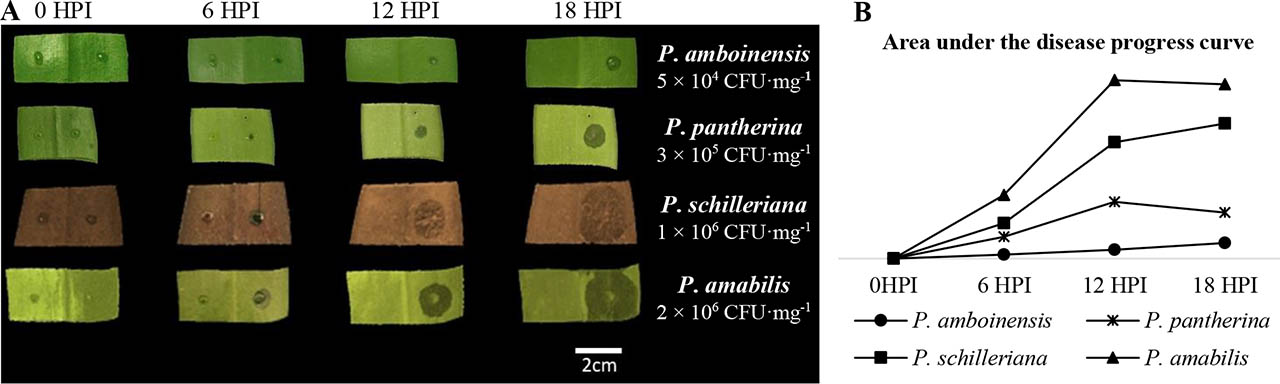
Figure 1
The development of soft-rot disease symptoms among four species: (A) SrSD on infected leaves at 0–18 hours post-inoculation (HPI), D. dadantii colony-forming units (CFU) in infected leaves at 18 HPI, (B) the area under disease progress curve in four Phalaenopsis species at various HPI
Table 2
POD, PAL, and SA content in P. amabilis and P. amboinensis 12 hours post-inoculation
| Resistance level to dadantii D. | Treatment | POD (unit·min−1·mg−1 protein × 10−4) | PAL (unit·min−1·mg−1 protein × 10−4) | SA (ppm of fresh sample) |
|---|---|---|---|---|
| very susceptible | P. amabilis non-inoculated | 15.30 ± 6.93a | 12.20 ± 1.60a | 5.26 ± 0.22a |
| P. amabilis inoculated | 14.96 ± 11.78a | 10.78 ± 7.59a | 5.32 ± 0.46a | |
| resistant | P. amboinensis non-inoculated | 2.35 ± 0.22b | 1.54 ± 0.16b | 12.56 ± 2.83b |
| P. amboinensis inoculated | 1.64 ± 0.83b | 1.26 ± 0.44b | 12.88 ± 2.14b |
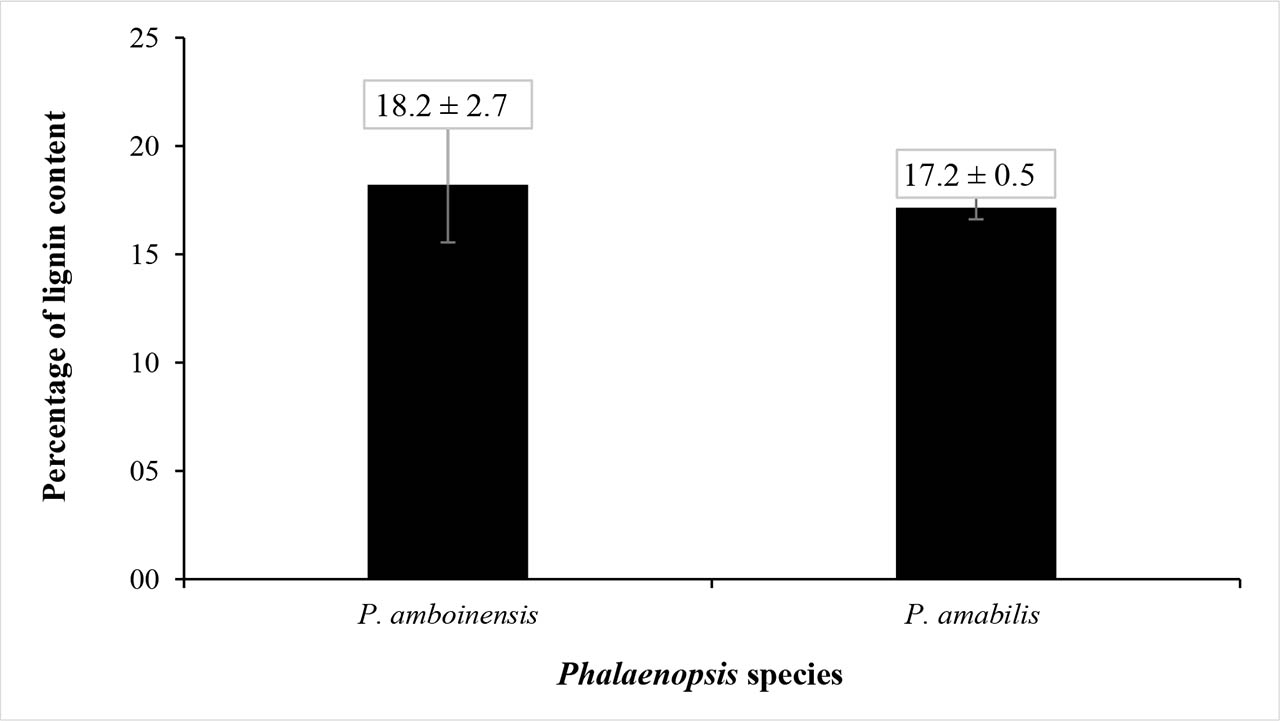
Figure 2
Percentage of lignin content in dry weight of Phalaenopsis species resistant (P. amboinensis) and very susceptible (P. amabilis) of D. dadantii at 12 HPI. There is no significant difference between the two species based on the Student’s T-test