
Table 1
Nematode species and accession numbers in the GenBank database
| Nematode species | Accession numbers | |||
|---|---|---|---|---|
| 18S (18SnF-18SnR) | 28S (D2–D3) | 28S (391a-501) | ITS (ITSUniF-Nxy22) | |
| Helicotylenchus microlobus Perry in Perry et al., 1959 | PQ180325 | PQ182781 | PQ180364 | |
| Mesocriconema nebraskense Olson et al,. 2017 | PV836695 | PV836848 | PV836870 | |
| Meloidogyne naasi Franklin, 1965 | PV837466 | PV837516 | PV837500 | |
Table 2
Morphometrics of females of Helicotylenchus microlobus population in the present study compared to those previously reported
| Character | Present study | Subbotin et al. (2015) CA,USA/CD740 | Yan et al. (2017) | Mwamula et al.(2020a) Korea/KB-5 |
|---|---|---|---|---|
| n | 10 | 12 | 15 | 12 |
| L | 728.8 ± 98.9 (574.7–838.2) | 739 ± 44.5 (657.0–795.0) | 708.5 (600.0–812.0) | 732.5 ± 31.1 (680.0–792.9) |
| a | 23.6 ± 1.6 (20.9–25.2) | 26.6 ± 1.1 (24.8–28.5) | 25.0 (21.4–27.1) | 25.6 ± 0.9 (24.4–26.9) |
| b | 5.1 ± 0.6 (4.1–5.9) | 5.2 ± 0.2 (4.7–5.5) | 5.0 (4.4–5.7) | 5.9 ± 0.3 (5.4–6.4) |
| c | 34.8 ± 2.9 (29.7–37.5) | 34.8 ± 2.0 (32.1–38.9) | 35.4 (30.2–41.7) | 37.7 ± 3.1 (31.9–42.9) |
| c’ | 1.3 ± 0.2 (1.1–1.6) | 1.3 ± 0.1 (1.2–1.5) | 1.3 (1.0–1.6) | 1.2 ± 0.1 (1.1–1.3) |
| V | 66.0 ± 2.7 (62.6–69.3) | 62.6 ± 1.4 (60.4–64.8) | 61.8 (60.0–63.7) | 60.5 ± 1.1 (58.6–62.0) |
| Stylet length | 26.0 ± 1.1 (24.6–27.6) | 28.9 ± 0.7 (27.5–30.0) | 27.6 (26.0–29.0) | 25.2 ± 0.8 (24.1–26.6) |
| Stylet conus length | 11.1 ± 0.5 (10.3–11.8) | 13.2 ± 0.4 (12.5–14.0) | — | 11.0 ± 0.6 (10.1–11.9) |
| DGO | 13.3 ± 0.7 (12.3–14.1) | — | — | 10.9 ± 0.8 (9.7–12.0) |
| Pharynx length | 142.8 ± 9.5 (133.3–156.5) | 140 ± 6.0 (125–145) | 142.5 (130.0–152.0) | 123.6 ± 3.9 (117.6–128.3) |
| Lip diameter | 5.9 ± 0.5 (5.1–6.3) | 6.5 ± 0.2 (6.0–7.0) | — | 6.9 ± 0.4 (6.3–7.8) |
| Lip height | 4.5 ± 0.2 (4.2–4.7) | 4.2 ± 0.4 (4.0–5.0) | — | 4.1 ± 0.3 (3.7–4.6) |
| Maximum body diameter (vulval body diameter) | 30.8 ± 2.8 (25.5–33.3) | 27.8 ± 1.2 (26.0– 30.0) | 27.3 (25.0–33.0) | 28.6 ± 0.8 (27.3–29.6) |
| Anal body diameter | 16.1 ± 1.8 (13.8–18.0) | 16.0 ± 1.0 (15.0–17.5) | 15.8 (14.0–17.5) | 16.0 ± 1.0 (14.6–17.9) |
| Tail length | 21.0 ± 2.9 (15.7–23.8) | 21.3 ± 1.7 (19.0–23.0) | 20.3 (15.0–25.0) | 19.5 ± 1.8 (16.9–23.2) |
| Excretory pore from anterior end | 119.0 ± 11.2 (102.6–130.5) | 128 ± 6.3 (114–138) | — | 116.5 ± 5.2 (109.3–127.4) |
| Median bulb (Metacorpus) diameter | 13.2 ± 1.8 (10.6–14.9) | — | — | — |
| Tail annuli number | 10.2 ± 0.8 (8.0–12.0) | 10.8 ± 1.3 (9–13) | 11.6 (10.0–14.0) | 9.7 ± 0.5 (9.0–10.0) |
| MB | 56.7 ± 4.5 (48.6–61.4) | — | — | 55.5 ± 2.2 (51.4–58.6) |
| Ventral peg length | 5.0 ± 1.6 (3.3–7.4) | — | — | 3.9 ± 0.9 (2.2–5.3) |
All measurements are in μm and in the format: mean ± s.d. (Range).
Note: n = number of specimens on which measurements are based; L = overall body length; V = % distance of vulva from anterior relative to body length; a = body length / greatest body diameter; b = body length/pharynx length; c = body length/tail length; c' = tail length/tail diameter at anus; DGO = dorsal gland opening; MB = % distance of center of the middle esophageal bulb from anterior relative to esophageal length.

Figure 1
Morphology of adult female of Helicotylenchus microlobus in lateral view. (a and c) Entire body (v arrow refers to vulva); (b) Lateral incisures (i arrow refers to incisures); (d and e) Anterior body (ep arrow refers to excretory pore; dgo arrow refers to dorsal gland opening); (f–h) Lip and stylet (lr arrow refers to lip ring); (i–l) Tails (a arrow refers to anus); (m) Phasmid (ph arrow refers to phasmid); (n and o) Lateral incisures at tail (i arrow refers to incisures). (Scale bars: a, c = 50 μm; d, e = 20 μm; b, f–n = 10 μm).
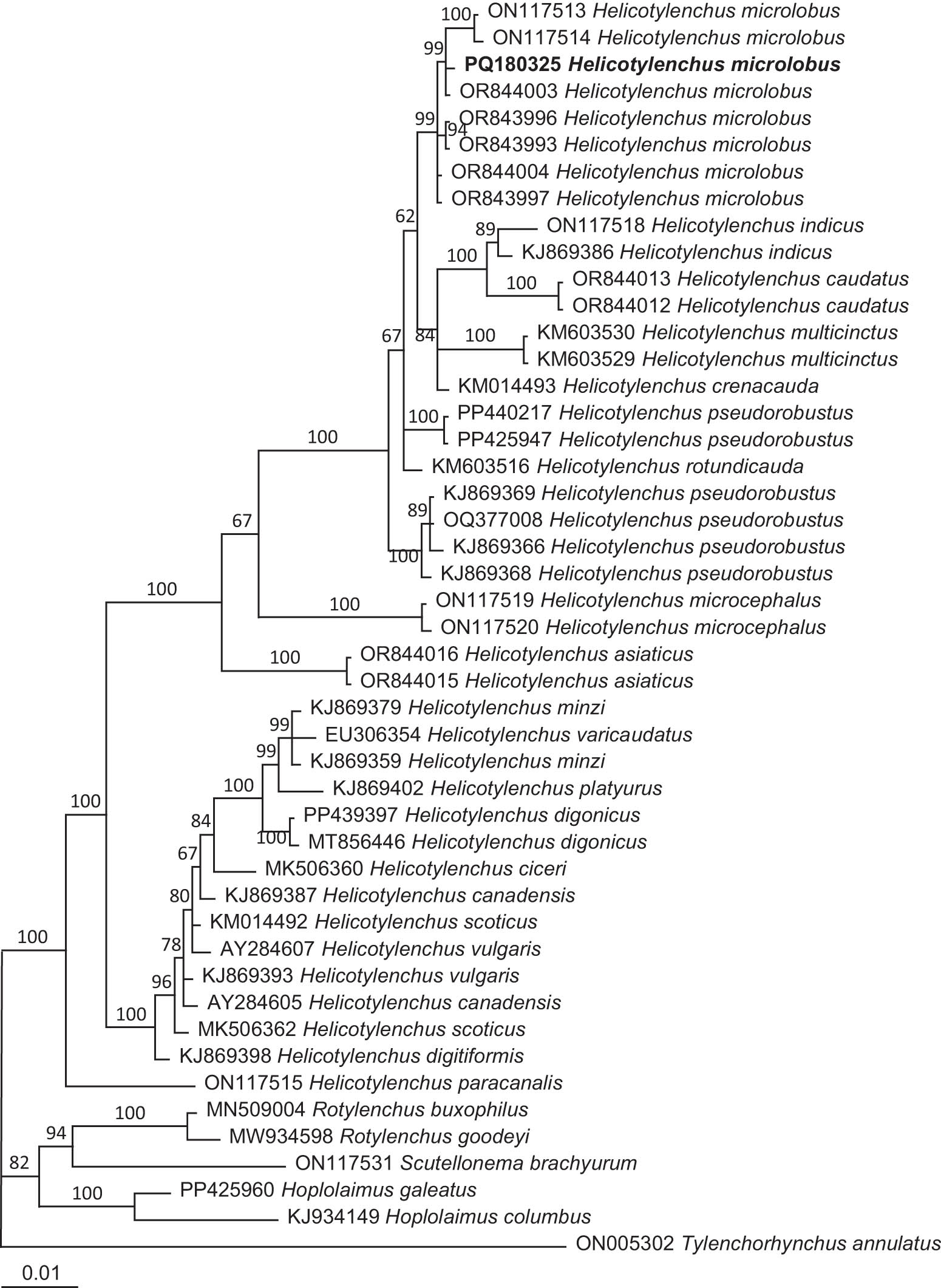
Figure 2
The 10001st Bayesian tree inferred from 18S (18SnF-18SnR) under the TrN + I + G model (lnL = 5160.3901; freqA = 0.2421; freqC = 0.2327; freqG = 0.2760; freqT = 0.2492; R(a) = 1.0000; R(b) = 1.8595; R(c) = 1.0000; R(d) = 1.0000; R(e) = 5.4087; R(f) = 1.0000; Pinvar = 0.6310; Shape = 0.5326). Posterior probability values exceeding 50% are given on appropriate clades. The species in the present study are in bold font.
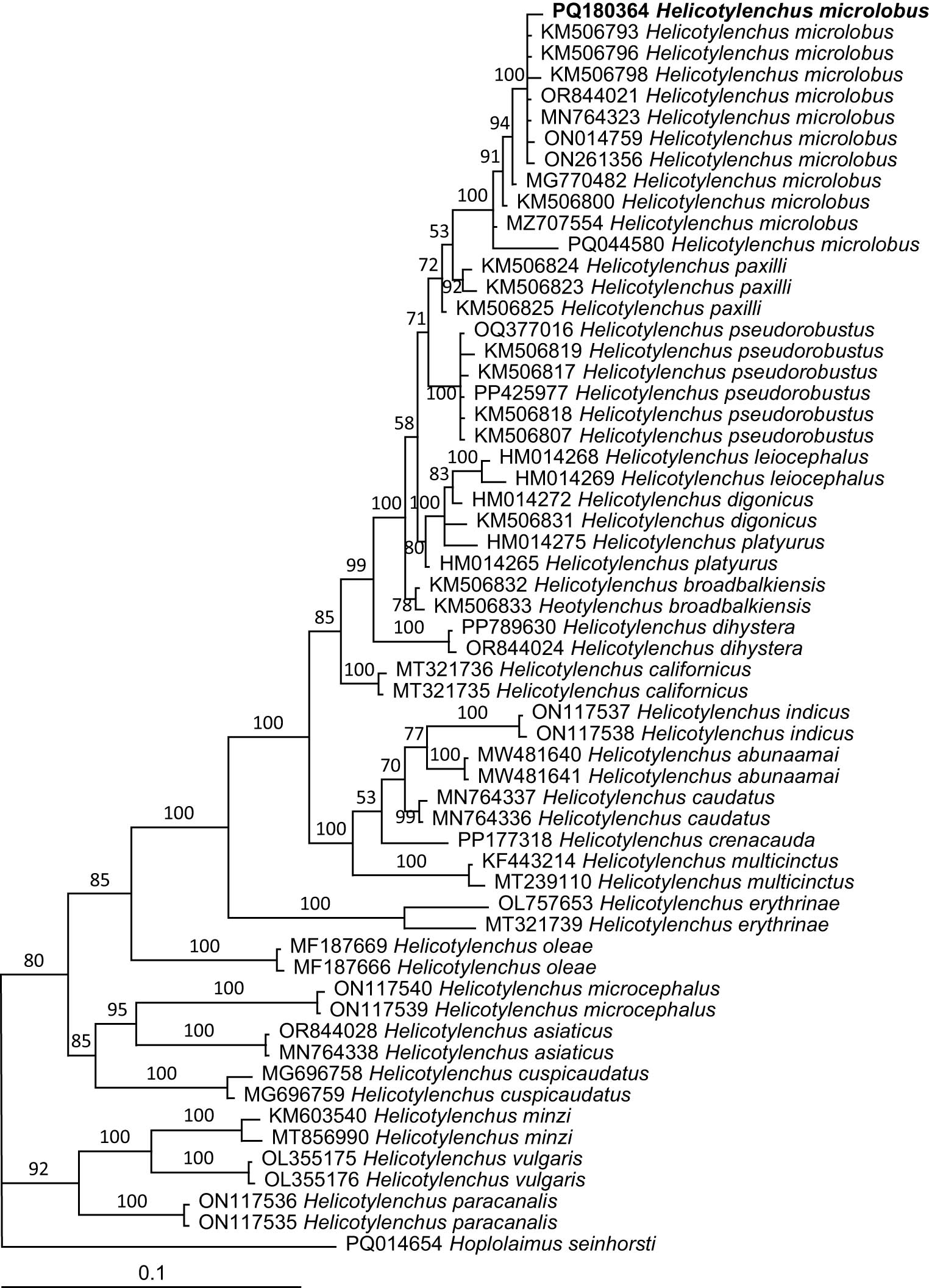
Figure 3
The 10001st Bayesian tree inferred from 28S (391a-501) under the GTR + I + G model (lnL = 4835.0967; freqA = 0.1954; freqC = 0.2466; freqG = 0.3460; freqT = 0.2120; R(a) = 0.3511; R(b) = 1.1538; R(c) = 0.8357; R(d) = 0.3199; R(e) = 3.7157; R(f) = 1.0000; Pinvar = 0.3895; Shape = 0.9532). Posterior probability values exceeding 50% are given on appropriate clades. The species in the present study is in bold font.
Table 3
Morphometrics of females of Mesocriconema nebraskense population in the present study compared to those previously reported
| Character | Present study | Olson et al. (2017) | Yan et al. (2018) | Mwamula et al.(2020b) KP11 |
|---|---|---|---|---|
| n | 10 | 74 | 10 | 14 |
| L | 521.0 ± 72.3 (440.0–648.0) | 508.0 ± 44.5 (393.0–606.0) | 546.6 ± 64.0 (425.0–627.0) | 549.0 ± 38.4 (505.0–609.0) |
| a | 13.0 ± 2.3 (8.9–15.1) | 12.7 ± 1.5 (9.2–15.3) | 10.7 ± 1.5 (8.5–13.6) | 12.4 ± 0.7 (11.3–13.7) |
| b | 3.4 ± 0.5 (2.8–4.3) | 4.4 ± 0.5 (3.6–7.2) | 4.4 ± 0.7 (3.9–4.8) | 4.5 ± 0.3 (4.1–4.9) |
| c | 19.8 ± 4.4 (15.4–27.3) | — | 20.0 ± 2.5 (16.1–25.0) | 18.8 ± 1.7 (16.6–21.7) |
| c’ | 1.0 ± 0.2 (0.8–1.3) | — | — | 1.0 ± 0.1 (0.9–1.2) |
| V | 92.8 ± 1.3 (91.3–94.6) | 93.3 ± 0.9 (90.6–96.0) | 91.7 ± 0.6 (90.7–92.8) | 91.8 ± 0.8 (90.6–92.7) |
| Stylet length | 53.1 ± 2.7 (50.5–56.9) | 52.6 ± 2.7 (45.0–59.0) | — | 54.2 ± 2.2 (51.2–57.7) |
| Pharynx length | 153.6 ± 22.2 (114.3–182.1) | 117.0 ± 10.2 (73.0–135.0) | 124.3 ± 8.8 (110.0–140.0) | 123.0 ± 4.5 (112.0–129.0) |
| Maximum body diameter (vulval body diameter) | 40.7 ± 6.8 (35.0–53.3) | 32.1 ± 2.8 (25.0–39.0) | 39.4 ± 3.0 (33.0–40.0) | 33.8 ± 1.9 (31.2–36.7) |
| Anal body diameter | 27.3 ± 3.0 (22.6–31.2) | — | 29.5 ± 2.8 (25.0–33.0) | 28.7 ± 2.0 (25.0–32.0) |
| Tail length | 27.2 ± 6.4 (18.0–37.7) | — | — | 29.3 ± 2.3 (25.6–32.1) |
| Excretory pore from anterior end | 125.7 ± 12.2 (112.6–138.5) | — | — | 129.0 ± 6.1 (115.0–137.0) |
| R | 92.2 ± 4.4 (87.0–98.0) | 102.9 ± 6.1 (84.0–113.0) | 105.0 ± 6.0 (98.0–118.0) | 96.6 ± 2.5 (94.0–103.0) |
| R st | 11.8 ± 0.8 (11.0–13.0) | — | — | 13.3 ± 0.5 (13.0–14.0) |
| R oes | 26.0 ± 1.0 (25.0–27.0) | — | — | 24.5 ± 0.9 (23.0–26.0) |
| R ex | 24.8 ± 1.7 (23.0–27.0) | 28.0 ± 1.5 (24.0–31.0) | 28.3 ± 1.3 (26.0–32.0) | 25.7 ± 1.0 (24.0–27.0) |
| R an | 5.0 ± 0.7 (4.0–6.0) | — | 5.1 ± 0.3 (5.0–6.0) | 5.1 ± 0.3 (5.0–6.0) |
| R v | 7.8 ± 0.4 (7.0–8.0) | 7.8 ± 1.0 (6.0–11.0) | 9.0 ± 0.7 (8.0–10.0) | 7.5 ± 0.9 (6.0–9.0) |
| R van | 2.0 ± 0.1 (2.0–3.0) | — | — | 2.1 ± 0.3 (2.0–3.0) |
All measurements are in μm and in the format: mean ± s.d. (Range).
Note: n = number of specimens on which measurements are based; L = overall body length; V = % distance of vulva from anterior relative to body length; a = body length / greatest body diameter; b = body length/pharynx length; c = body length/tail length; c' = tail length/tail diameter at anus; R = ring number of body cuticle; R st = ring number from anterior to base of stylet base; R ex = ring number from anterior to excretory pore; R oes = ring number from anterior to base of esophageal glands; R v = ring number from vulva to tail end; R an = ring number from anus to tail end; R van = ring number between vulva and anus.
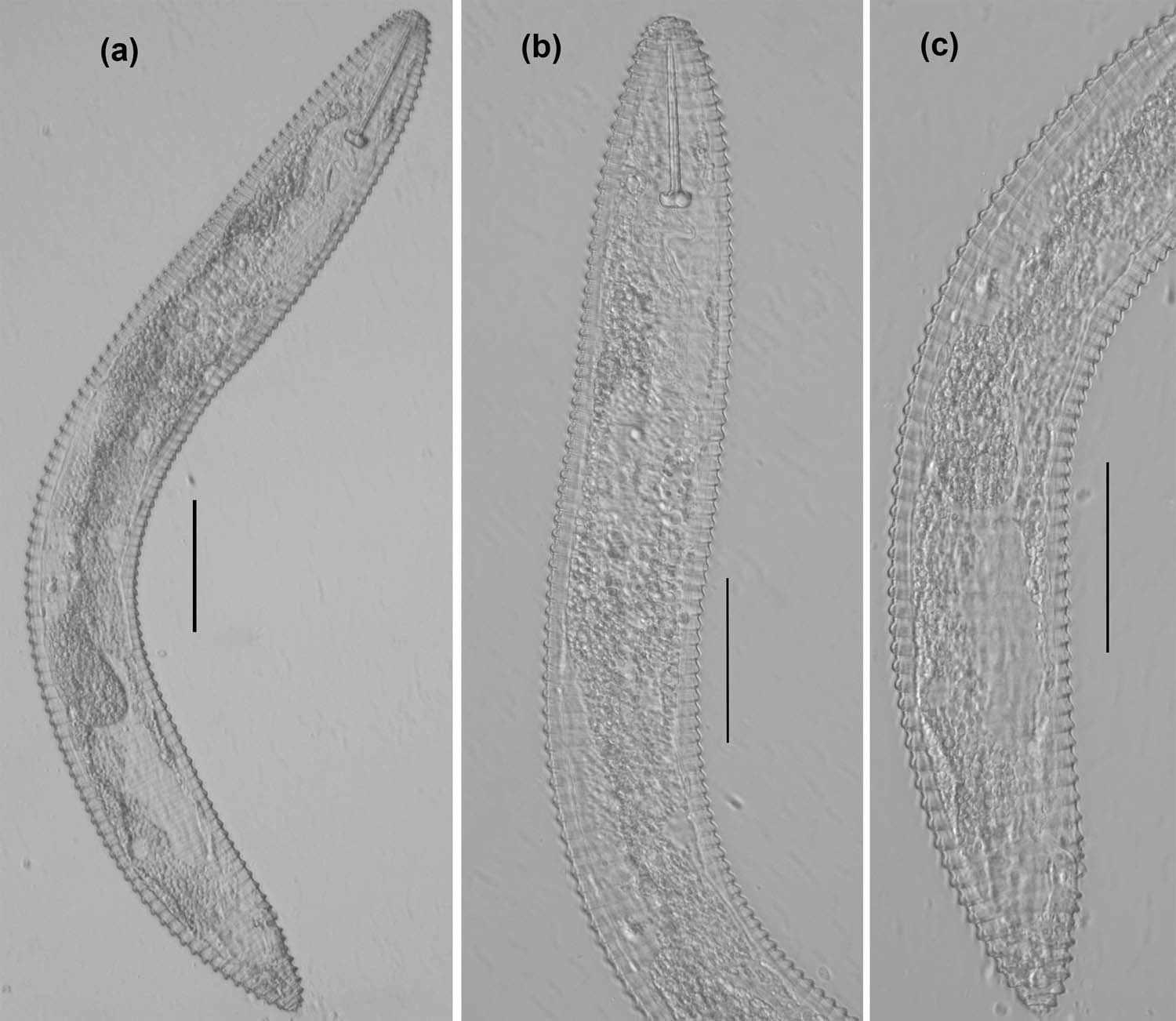
Figure 4
Morphology of adult female of Mesocriconema nebraskense in lateral view. (a) Entire body; (b) anterior body; (c) tail. (Scale bars: a, b, and c = 50 μm).
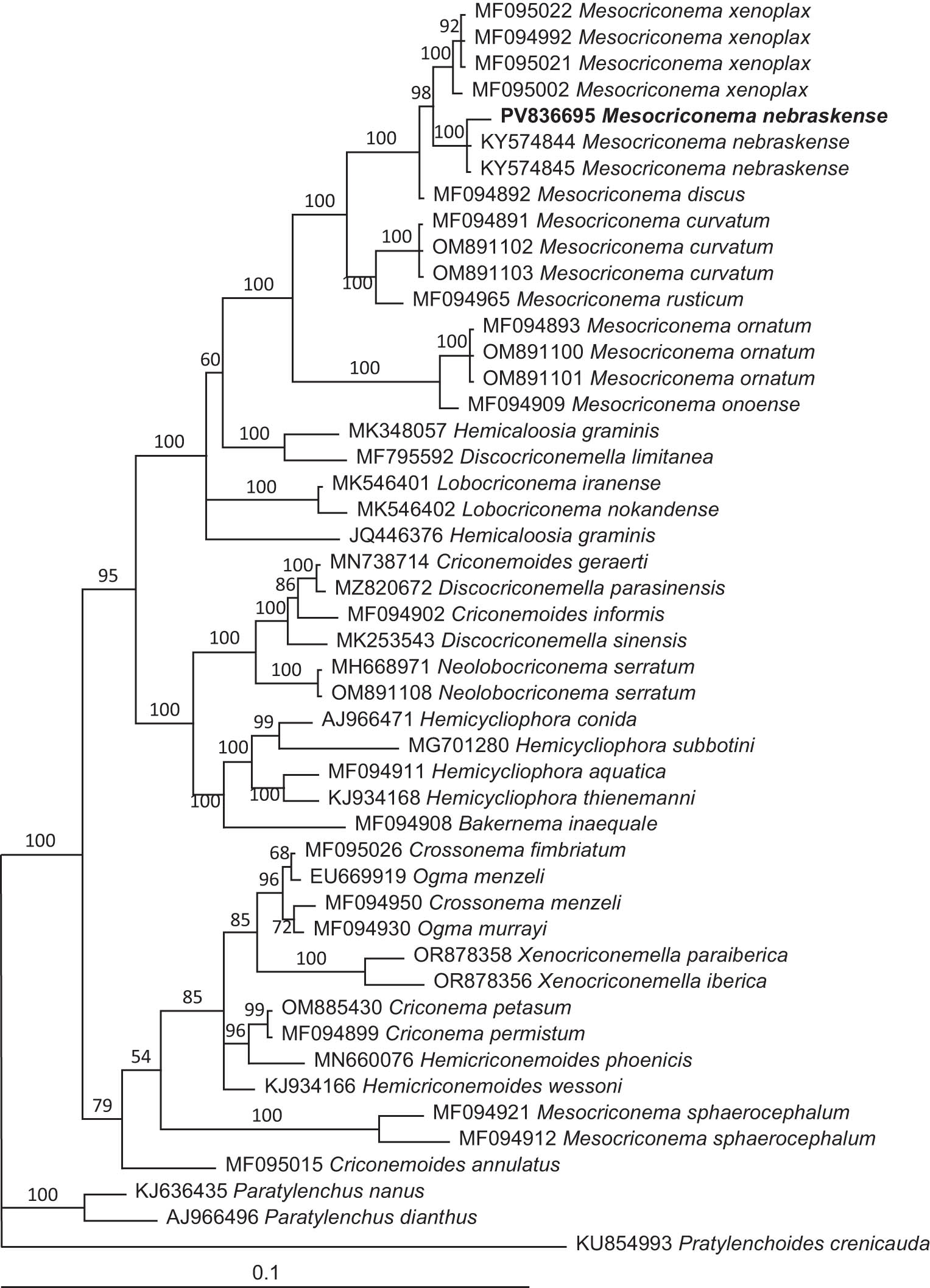
Figure 5
The 10001st Bayesian tree inferred from 18S (18SnF-18SnR) under the GTR + I + G model (lnL = 5450.7681; freqA = 0.2387; freqC = 0.2329; freqG = 0.2919; freqT = 0.2364; R(a) = 1.4422; R(b) = 1.9376; R(c) = 1.1322; R(d) = 0.8133; R(e) = 5.2563; R(f) = 1; Pinvar = 0.6346; Shape = 0.5039). Posterior probability values exceeding 50% are given on appropriate clades. The new species is in bold font.
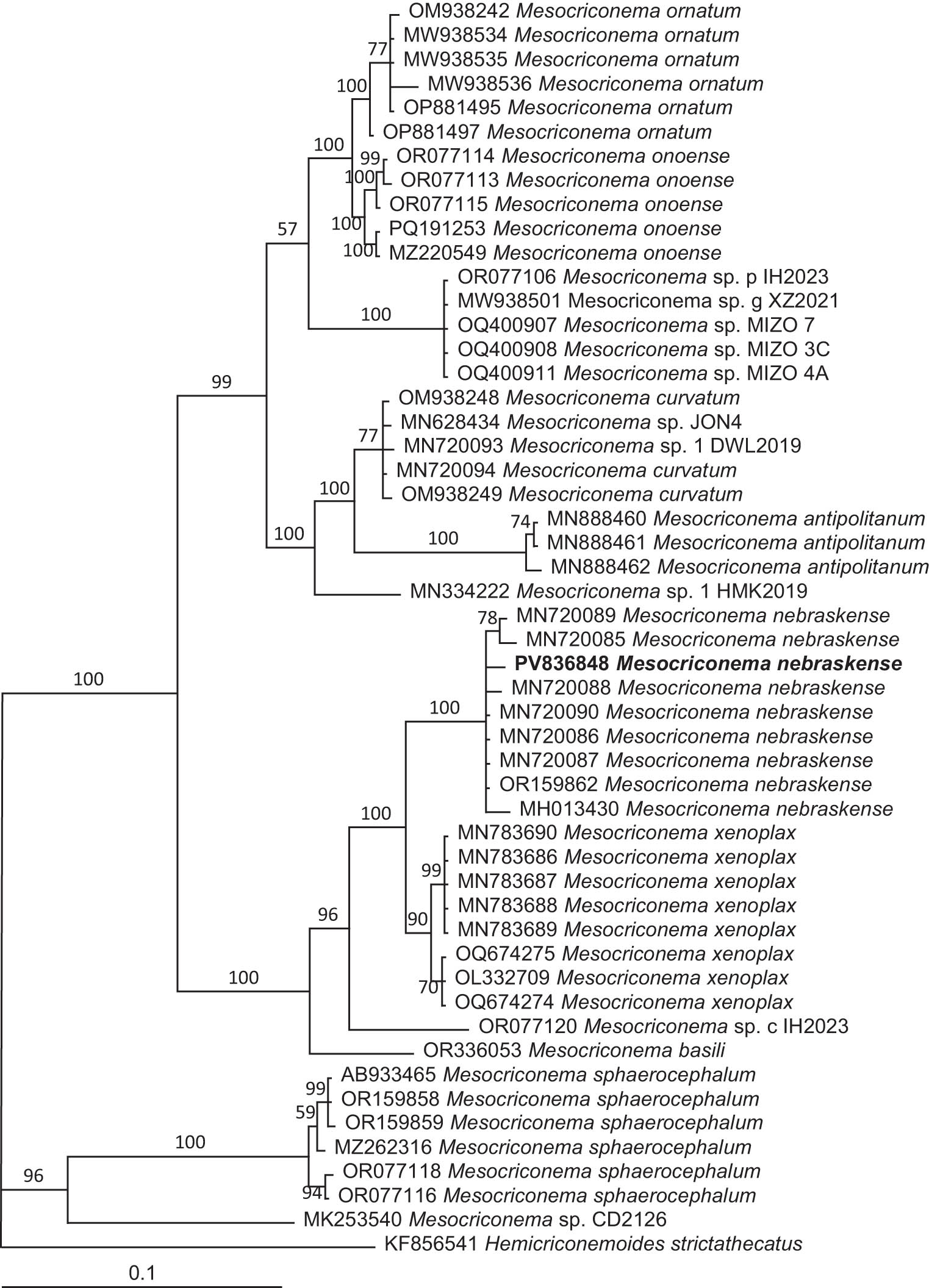
Figure 6
The 10001st Bayesian tree inferred from 28S (391a-501) under the GTR + I + G model (lnL = 3901.4785; freqA = 0.2053; freqC = 0.2451; freqG = 0.3232; freqT = 0.2264; R(a) = 0.7006; R(b) = 1.5219; R(c) = 1.0384; R(d) = 0.5155; R(e) = 4.8247; R(f) = 1; and Pinvar = 0.2547; Shape = 0.6466). Posterior probability values exceeding 50% are given on appropriate clades. The new species is in bold font.
Table 4
Morphometrics of second-stage juveniles and males of Meloidogyne naasi population in the present study compared to those previously reported
| Character | Second-stage juveniles (J2) | Males | |||||
|---|---|---|---|---|---|---|---|
| Present study | Zeng et al. (2012a) | Skantar et al. (2023) | Vieira dos Santos et al. (2020) | Franklin (1965) | Present study | Franklin (1965) | |
| n | 10 | 12 | 30 | 17 | 25 | 10 | 25 |
| L | 459.7 ± 18.1 (443.0–479.0) | 431.9 ± 13.4 (414.6–449.6) | 427.9 ± 16.7 (390.0–460.0) | 457.3 (440.6–478.2) | 435.0 (418.0–465.0) | 1073.8 ± 110.0 (960.0–1210.0) | 1184 (860.0–1316.0) |
| a | 31.6 ± 0.9 (30.6–32.2) | 28.8 ± 1.0 (27.5–30.1) | 35.6 ± 2.2 (32.2–40.9) | 29.6 (27.8–32.6) | 28.0 (25.0–32.0) | 40.1 ± 0.5 (36.9–40.6) | 40 (32.0–48.0) |
| c | 9.0 ± 0.7 (8.2–9.4) | 8.0 ± 0.2 (7.9–8.4) | 6.1 ± 0.4 (4.9–6.8) | 5.5 (5.2–5.8) | 6.2 | 107.9 ± 16.6 (96.0–126.9) | — |
| c’ | 5.9 ± 0.3 (5.6–6.1) | 6.1 ± 0.2 (5.7–6.2) | — | — | — | 0.6 ± 0.1 (0.5–0.7) | — |
| Stylet length | 11.1 ± 0.8 (10.6–12.0) | 11.1 ± 0.6 (10.2–11.5) | 12.1 ± 0.6 (11.0–13.0) | 14.4 (13.6–15.2) | 14.0 (13.0–15.0) | 16.3 ± 1.3 (15.0–18.0) | 18.0 (16.0–19.0) |
| DGO | 2.7 ± 0.3 (2.5–3.0) | — | — | — | 3.0 2.0–2.3 | 2.5 ± 0.6 (2.0–3.0) | 3.0 2.0–4.0 |
| Lip diameter | 5.5 ± 0.4 (5.1–5.8) | 5.4 ± 0.2 (5.2–5.6) | — | — | — | — | — |
| Lip height | 2.4 ± 0.1 (2.3–2.5) | 2.3 ± 0.2 (2.1–2.7) | — | — | — | — | — |
| Metacorpus length | 9.5 ± 0.3 (9.2–9.8) | 10.0 ± 0.4 (9.3–10.4) | – | — | — | — | — |
| Metacorpus diameter | 7.6 ± 0.7(6.5–8.4) | 7.2 ± 0.3(6.8–7.6) | — | — | — | — | — |
| Maximum body diameter | 14.6 ± 0.4 (14.2–15.0) | 15.0 ± 0.3 (14.5–15.4) | 16.2 (15.0–17.5) | 15.5 (14.5–16.7) | 15.0 ± 1.0 (14.0–17.5) | 27.5 ± 4.0 (24.0–33.0) | 30.0 (23.0–34.0) |
| Anal body diameter | 8.7 ± 0.4 (8.4–9.1) | 8.9 ± 0.5 (8.4–9.6) | 10.3 ± 0.9 (9.0–12.0) | — | 11.0 (9.0–13.0) | 16.5 ± 1.3 (15.0–18.0) | — |
| Tail length | 51.4 ± 2.7 (48.8–54.2) | 53.9 ± 1.9 (52.2–57.1) | 70.3 ± 5.0 (62.0–80.0) | 82.8 (76.4–89.9) | 70.0 (52.0–78.0) | 9.5 ± 1.3 (8.0–11.0) | — |
| Hyaline tail terminus length | 21.8 ± 1.4 (20.0–23.2) | 22.1 ± 1.8 (20.2–24.4) | 21.4 ± 2.2 (17.0–26.0) | 26.6 (23.2–32.0) | — | — | — |
All measurements are in μm and in the format: mean ± s.d. (Range).
Note: n = number of specimens on which measurements are based; L = overall body length; a = body length / greatest body diameter; c = body length/tail length; c' = tail length/tail diameter at anus; DGO =dorsal gland opening.
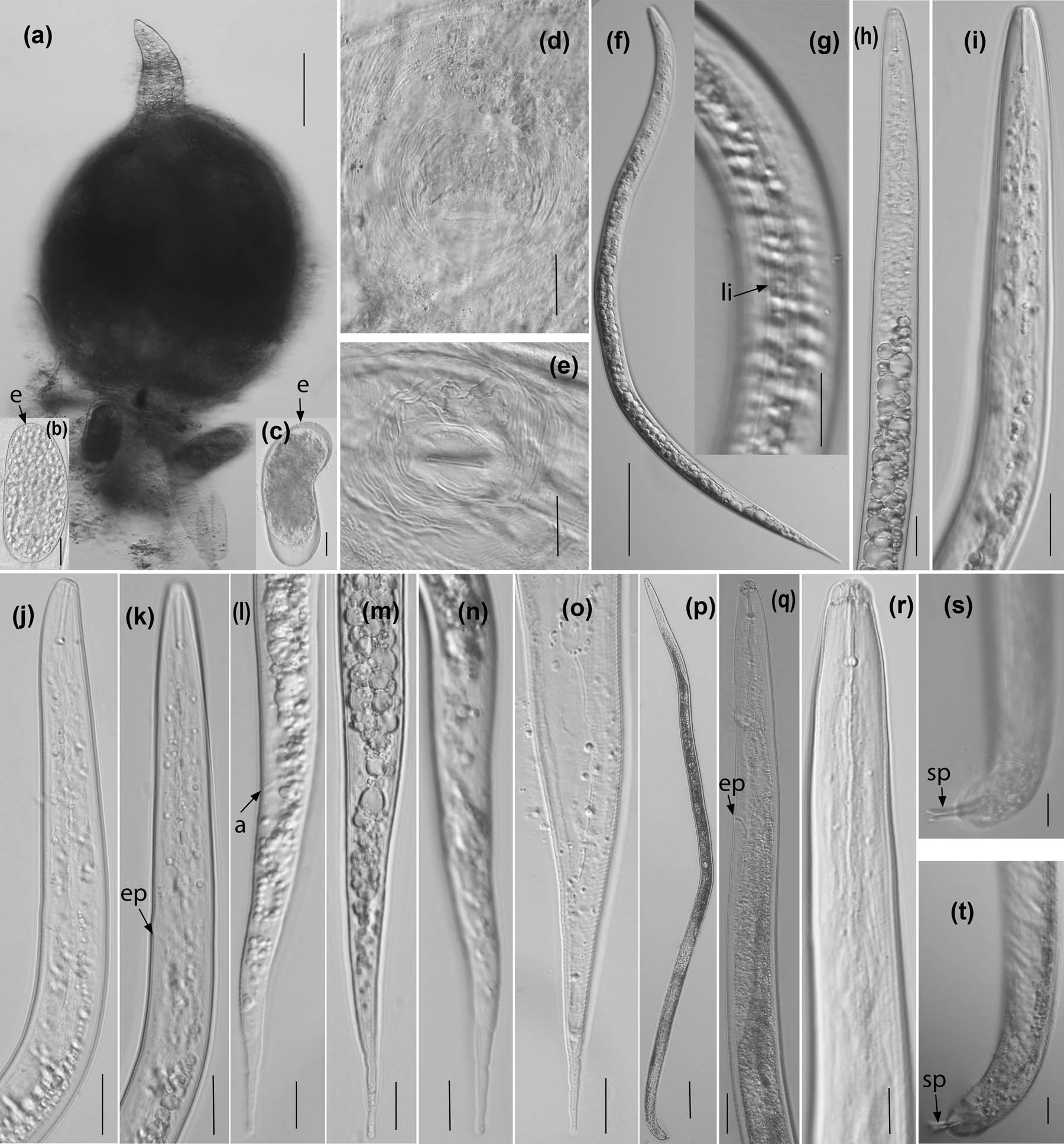
Figure 7
Morphological characteristics of adult female, second-stage juvenile and male of Meloidogyne naasi. (a) Adult female entire body; (b, c) eggs (e arrow refers to egg); (d, e) Perineal patterns; (f) Entire body of second-stage juvenile; (g) Lateral incisures (li arrow refers to lateral incisures); (h–k) Anterior body of second-stage juvenile (ep arrow refers to excretory pore); (l–o) Tails of second-stage juvenile (a arrow refers to anus); (p) Male entire body; (q, r) Anterior body of male (ep arrow refers to excretory pore); (s, t) Tails (sp arrow refers to spicule). (Scale bars: a, f, p = 50 μm; d, e, q = 20 μm; b, c, g–o, r–t = 10 μm).
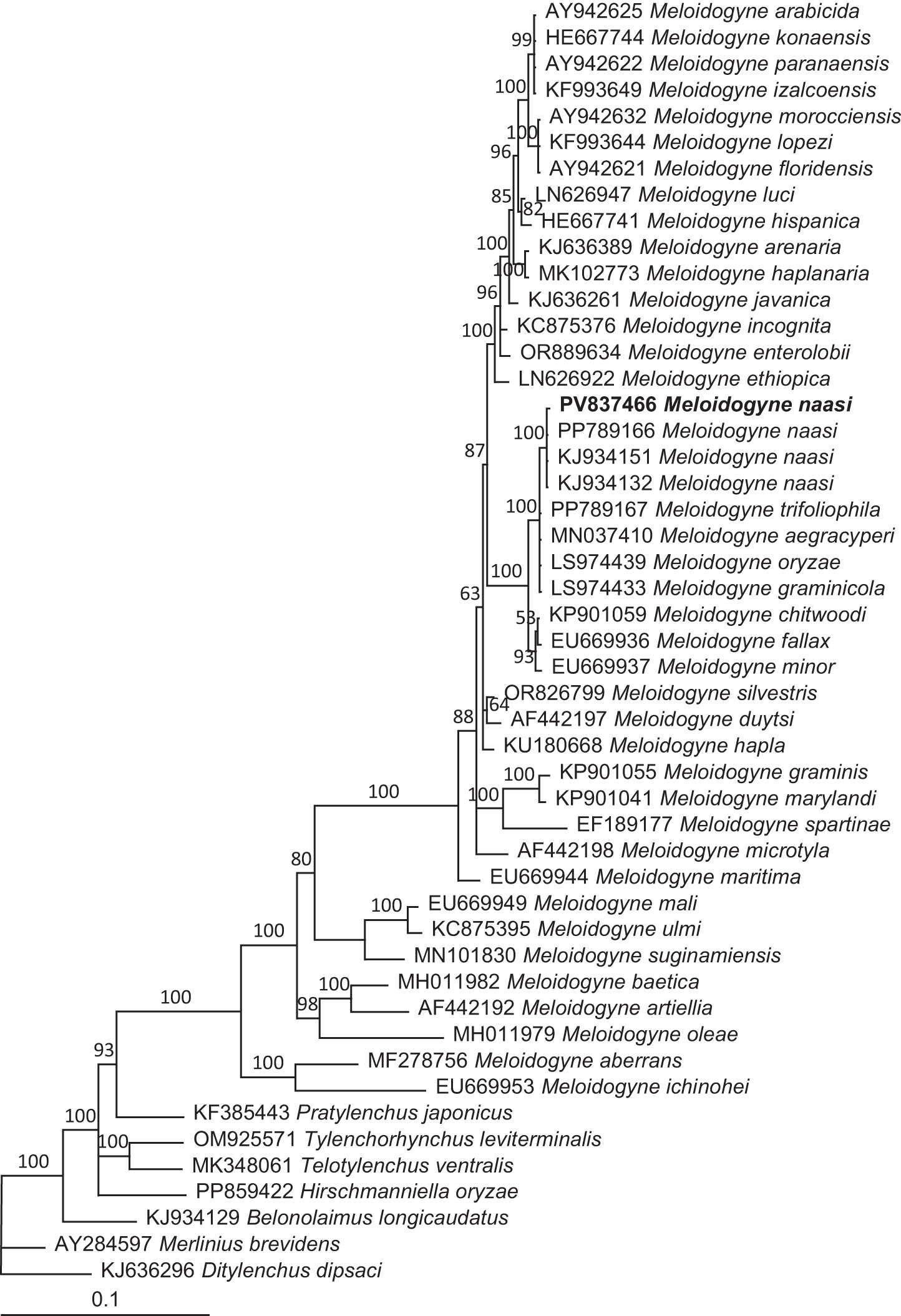
Figure 8
The 10001st Bayesian tree inferred from 18S (18SnF-18SnR) under the GTR + I + G model (lnL = 7594.7705; freqA = 0.2481; freqC = 0.2096; freqG = 0.2740; freqT = 0.2682; R(a) = 1.5624; R(b) = 3.9107; R(c) = 2.0659; R(d) = 0.7165; R(e) = 6.1229; R(f) = 1; Pinvar = 0.5052; Shape = 0.4464). Posterior probability values exceeding 50% are given on appropriate clades. The new species is in bold font.

Figure 9
The 10001st Bayesian tree inferred from 28S (301a-501) under the TVM + I + G model (lnL = 6104.6665; freqA = 0.2429; freqC = 0.2162; freqG = 0.1898; freqT = 0.2701; R(a) = 0.2972; R(b) = 0.6776; R(c) = 3.3131; R(d) = 1.6141; R(e) = 3.3131; R(f) = 1; Pinvar = 0.2429; and Shape = 0.7659). Posterior probability values exceeding 50% are given on appropriate clades. The new species is in bold font.