
The reniform nematode (Rotylenchulus reniformis) is prevalent in the southeastern United States (Faske et al. 2024). Two major crops in this region, soybean (Glycine max) and cotton (Gossypium hirsutum), are among the more than 300 plant species parasitized by this nematode (Robinson et al., 1997). In response to a change in commodity prices, soybean production in the region has increased to include land formerly planted to cotton, and much of the new soybean acreage is on fields infested with reniform nematode. Damage on soybean includes incomplete pod filling and stunting (McGawley & Overstreet, 1999). Soybean losses to reniform nematode in the U.S. have been estimated at 345,000 metric tons for the period 2015 through 2019 (Bradley et al., 2021).
Management options to control reniform nematode include nematicides (Mueller, 2011; Faske & Hurd, 2015), crop rotation (Gaur & Perry, 1991; McGawley & Overstreet, 1999), and use of resistant cultivars (Roberts, 1992; McGawley & Overstreet, 1999). Of these, only host plant resistance allows production of a soybean crop in infested fields without the need for costly and dangerous chemicals. Because the bulk of U.S. soybean production occurs in northern states where the reniform nematode is not a problem, work to develop new sources of resistance to this pathogen falls to breeding programs in the southern region of the country. Resistant germplasms were identified based on reduced nematode reproduction in greenhouse trials lasting approximately 2 (Melo et al., 2013) to 3 (Davis et al., 1998; Robbins et al., 2016, 2017; Klepaldo et al., 2018; Usovsky et al., 2022) months. However, most breeding programs focus on resistance to soybean cyst nematode (Heterodera glycines), with less attention on other economically important nematodes such as southern root-knot nematode (Meloidogyne incognita) and reniform nematode.
Overall suppression of the reniform nematode population is the goal of all management strategies, including host plant resistance. However, there is little specific information on how plant resistance impacts the nematode. It could suppress the nematode population by deterring infection, or it might have some impact on nematode development or reproduction after a successful infection has been established. A study by Stetina (2015) documented both fewer reniform nematode infections and slower nematode development on resistant Pima cotton (Gossypium barbadense) lines GB 713 and TX 110, with the results suggesting that unique or additional loci might be functioning to give GB 713 a higher level of resistance than TX 110. Egg production by individual nematodes was not influenced by host plant resistance status, with nematodes infecting the resistant lines producing similar amounts of eggs as those infecting the susceptible control.
Three soybean lines with resistance to reniform nematode were selected for this study. All three lines are being used in the authors’ soybean breeding program to develop germplasm with improved resistance to reniform nematode. PI 404166 is a small, black-seeded accession from China maintained in the national soybean germplasm collection that we identified as resistant to the reniform nematode in previous tests (Stetina et al., 2014). PI 404166 also has resistance to soybean cyst nematode (Heterodera glycines; SCN) (https://npgsweb.ars-grin.gov/gringlobal/accessiondetail? id = 1304540). JTN-5203 is a USDA Agricultural Research Service germplasm release with resistance to SCN and reniform nematode. It has SCN-resistance sources PI 88788, Peking, and PI 437654 in its pedigree (Arelli et al., 2015). Line 02011-126-1-1-5-1-1 (hereafter 02011-126) is a breeding line from our program. Its pedigree is “Bolivar” x PI 567516C, with both parents having resistance to SCN (Tyler & Young, 2004; https://npgsweb.ars-grin.gov/gringlobal/accessiondetail? id = 1500909). PI 567516C has very small greenish brown seed, but multiple studies (Arelli et al., 2009; Vuong et al., 2010) have indicated that its SCN resistance is novel. Line 02011-126 has larger yellow seed and reniform nematode resistance. The impact of these three diverse lines on post-infection nematode development and fecundity has not been characterized, which was the objective of this research. Preliminary reports have been published (Stetina et al., 2019 and https://mssoy.org/sites/default/files/documents/33-2016-stetina-ren-nem-final-report.pdf).
1. Materials and methods
Development and fecundity of reniform nematode were evaluated in three growth chamber experiments on resistant soybean lines 02011-126, JTN-5203, and PI 404166, and the susceptible control “Braxton.” The day length was 16 h, and the temperature was held constant at 28°C. Seeds were planted into containers (Ray Leach SL-10 Cone-tainer, Stuewe & Sons, Inc., Tangent, OR) containing 120 cm3 of a steam-pasteurized soil mixture composed of one part sandy loam soil and two parts sand. Five hundred reniform nematodes (mixed vermiform life stages) suspended in 1 mL of water were added to the soil in each container upon stand establishment by pipetting the suspension into a 5 cm deep hole made near the plant stem; then the hole was filled with additional pasteurized soil mix. One-week old plants were inoculated with the Mississippi reniform nematode isolate RR04 (Arias et al., 2009), derived from a single egg mass collected from cotton and maintained in greenhouse culture on “Rutgers” tomato (Solanum lycopersicum). An elutriation-centrifugation method was used to prepare the inoculums. Briefly, 2 months after inoculation, the infested soil ran through the elutriator with 25-mesh/400-mesh sieves. The contents in 400-mesh sieve were washed into a container with tap water, centrifuged at 2,000 rpm (536 g) for 5 min. The supernatants were decanted, and the pellets were resuspended with 50% sucrose. After centrifuging at 1,500 rpm (303 g) for 1 min, the supernatants were poured through a 400-mesh sieve. The contents were rinsed thoroughly with tap water then washed with a small volume of reverse osmosis water into a clean beaker to collect nematodes. Nematodes were counted under a microscope and adjusted to 500 nematodes per milliliter for inoculation.
A completely randomized design was used for each experiment. Each experiment was conducted two times, and data from both trials were combined for final analysis after confirming that there were no significant interactions between trials and soybean lines. At each sampling date, there were 10 replications, and data from each sampling date were analyzed independently. Nematode counts were transformed [log10(x + 1)] prior to analysis of variance (ANOVA) using SAS statistical software (SAS Institute Inc., Cary, NC) to normalize data. Differences of least squares means (P ≤ 0.05) were used to compare mean values when ANOVA identified significant differences among lines. Patterns of nematode development also were examined based on developmental cohorts. The percentage of the nematode population in each developmental stage was calculated and graphed to visualize changes in the predominant developmental stage on each soybean genotype over time.
Fifty plants of each soybean line were established to assess reniform nematode development early in the infection cycle. Root infection was measured on 10 individual plants of each line at 2 days intervals through day 10. Plant roots were separated from plant shoots at the soil line, and the roots were stained with red food coloring using published protocols (Thies et al., 2002). Root-associated nematodes in each of four developmental stages were counted at ×200 magnification: vermiform (attached but not yet beginning to swell), swelling (enlargement of body but not yet assuming the kidney shape characteristic of this species), reniform (kidney-shaped female with no egg mass), or gravid (kidney-shaped female with associated egg mass). After counting, roots were allowed to drain on paper towels to remove excess water, and fresh weights were recorded. Counts were expressed as females per gram of fresh root tissue.
Forty plants of each soybean line were evaluated to assess reniform nematode development late in the infection cycle. The same test establishment, inoculation, and root infection measurements as described for assessment of the early stages of development were used. However, assessment of nematode development on roots was measured on 10 individual plants of each genotype at 5 days intervals from day 15 through day 30.
At 25 and 30 days after inoculation (DAI), egg production by individual females was measured. At each sampling interval, all the gravid females (<50) from each resistant line and 50 randomly selected gravid females from the susceptible control were hand-picked from the roots from the late infection cycle experiment. A single gravid female was crushed under a cover slip on a glass slide to disperse the gelatinous matrix surrounding the eggs, and the number of eggs per female was recorded.
2. Results
Table 1 summarizes reniform nematode development early in the infection cycle. At 2 DAI, vermiform nematodes infected the susceptible cultivar Braxton; nematodes were not observed on the resistant lines until 4 DAI, at that time, over 80% Braxton plants were infected. Swelling nematodes were seen on all four genotypes at 4 DAI, and the reniform stage of development had been reached on JTN-5203 and PI 404166. By 8 DAI, gravid females were observed on all genotypes, with significantly higher numbers on Braxton than on the resistant lines. At each sampling interval, the susceptible control Braxton and two resistant lines PI 404166 and JTN-5203 had similar root weights, while the root weights of line 02011-126 was less than 50% of other lines. When all developmental stages were considered together, the susceptible and resistant genotypes could be distinguished from each other as early as 8 DAI. Among the three resistant lines, PI 404166 had significantly less (2.4) nematodes at all stages than JTN-5203 (9.9) and Braxton (10.0) at 10 DAI.
Table 1
Number of reniform nematodes in four developmental stages (vermiform, swelling, reniform, gravid) and total number of nematodes per gram of root on susceptible (Braxton) and resistant (JTN-5203, 02011-126, and PI 404166) soybean in growth chamber tests at 2 days intervals during the first 10 DAI
| Developmental stage | Soybean genotype | 2 DAI | 4 DAI | 6 DAI | 8 DAI | 10 DAI | |||||
|---|---|---|---|---|---|---|---|---|---|---|---|
| Vermiform | Braxton | 0.1 | 0.4 | 0.6 | 0.2 | 0.0 | - & | ||||
| JTN-5203 | 0.0 | 0.3 | 0.6 | 0.0 | 0.0 | - | |||||
| PI 404166 | 0.0 | 0.7 | 1.1 | 0.0 | 0.0 | - | |||||
| 02011-126* | 0.0 | 0.2 | 0.6 | 0.1 | 0.0 | - | |||||
| Swelling | Braxton | 0.0 | - & | 1.3 | b | 4.8 | 2.0 | 0.7 | b | ||
| JTN-5203 | 0.0 | - | 1.4 | b | 7.6 | 1.8 | 3.0 | a | |||
| PI 404166 | 0.0 | - | 5.4 | a | 4.8 | 2.1 | 0.7 | b | |||
| 02011-126* | 0.0 | - | 1.2 | b | 4.3 | 3.2 | 2.5 | a | |||
| Reniform | Braxton | 0.0 | - & | 0.0 | 0.6 | 5.7 | a | 4.1 | |||
| JTN-5203 | 0.0 | - | 0.1 | 0.8 | 1.0 | b | 3.6 | ||||
| PI 404166 | 0.0 | - | 0.1 | 0.5 | 1.6 | b | 1.4 | ||||
| 02011-126* | 0.0 | - | 0.0 | 0.4 | 0.9 | b | 1.7 | ||||
| Gravid | Braxton | 0.0 | - & | 0.0 | - & | 0.0 | - & | 2.5 | a | 4.1 | a |
| JTN-5203 | 0.0 | - | 0.0 | - | 0.0 | - | 0.2 | b | 1.6 | ab | |
| PI 404166 | 0.0 | - | 0.0 | - | 0.0 | - | 0.4 | b | 0.6 | b | |
| 02011-126* | 0.0 | - | 0.0 | - | 0.0 | - | 0.1 | b | 1.0 | b | |
| All stages combined | Braxton | 0.1 | 1.6 | b | 7.1 | 14.3 | a | 10.0 | a | ||
| JTN-5203 | 0.0 | 1.9 | b | 9.9 | 4.3 | b | 9.9 | a | |||
| PI 404166 | 0.0 | 6.5 | a | 7.0 | 5.3 | b | 2.4 | b | |||
| 02011-126* | 0.0 | 1.5 | b | 6.7 | 5.4 | b | 5.2 | ab | |||
Within each developmental stage and interval, mean values (20 plants; pooled data from two tests) followed by the same letter are not significantly different (differences of least squares means, P ≤ 0.05).
The nematode developmental stages later in the infection cycle are summarized in Table 2. All nematodes had progressed beyond the vermiform stage of development at this point. When all developmental stages were combined, the susceptible and resistant genotypes could be distinguished from each other at all intervals from 15 to 30 DAI. There were no significant differences among the three resistant genotypes based on total nematode counts or the number of nematodes in any specific life stage during this interval, although the nematodes on PI 404166 were numerically lower.
Table 2
Number of reniform nematodes in three developmental stages (swelling, reniform, gravid) and total number of nematodes per gram of root on susceptible (Braxton) and resistant (JTN-5203, 02011-126, and PI 404166) soybean in growth chamber tests at 5 days intervals from 15 to 30 DAI
| Developmental stage | Soybean genotype | 15 DAI | 20 DAI | 25 DAI | 30 DAI | ||||
|---|---|---|---|---|---|---|---|---|---|
| Swelling | Braxton | 1.0 | 0.4 | 0.1 | b | 0.3 | a | ||
| JTN-5203 | 1.0 | 0.2 | 0.2 | b | 0.0 | b | |||
| PI 404166 | 0.4 | 0.1 | 0.0 | b | 0.0 | b | |||
| 02011-126* | 2.5 | 0.3 | 0.6 | a | 0.1 | b | |||
| Reniform | Braxton | 2.4 | 1.5 | a | 0.5 | 1.5 | a | ||
| JTN-5203 | 1.0 | 0.3 | b | 0.2 | 0.1 | b | |||
| PI 404166 | 0.7 | 0.1 | b | 0.1 | 0.2 | b | |||
| 02011-126* | 1.5 | 0.2 | b | 0.2 | 0.1 | b | |||
| Gravid | Braxton | 9.8 | a | 6.1 | a | 5.8 | a | 3.7 | a |
| JTN-5203 | 2.0 | b | 0.4 | b | 0.2 | b | 0.2 | b | |
| PI 404166 | 0.9 | b | 0.1 | b | 0.1 | b | 0.1 | b | |
| 02011-126* | 0.5 | b | 0.3 | b | 0.2 | b | 0.5 | b | |
| All stages combined | Braxton | 13.7 | a | 8.2 | a | 6.4 | a | 5.6 | a |
| JTN-5203 | 3.9 | b | 0.7 | b | 0.5 | b | 0.3 | b | |
| PI 404166 | 1.9 | b | 0.2 | b | 0.2 | b | 0.2 | b | |
| 02011-126* | 4.3 | b | 0.7 | b | 0.9 | b | 0.6 | b | |
Because the infection levels on susceptible and resistant soybean lines differed, patterns of population development also were examined on a percentage basis. The proportions of the nematode population in each developmental stage are shown in Figures 1 and 2. Early in the infection cycle (Figure 1), the nematode population composition at 4 and 6 DAI was similar on all four genotypes. Fewer nematodes had reached the reniform and gravid stages of development on 02011-126 than on the other genotypes at 8 DAI, and this pattern held true at 10 DAI. Almost 50% of the nematode population on the susceptible cultivar Braxton was producing eggs at 10 DAI, but only 20–25% of the nematode population had reached the gravid stage on the resistant genotypes. Differences in the developmental cohorts also were evident later in the infection cycle (Figure 2). Approximately 70–90% of the population consisted of gravid nematodes on the susceptible cultivar Braxton. In contrast, 02011-126 maintained approximately 45–60% of nematodes in the swelling phase of development at 15, 20, and 25 DAI. Fewer nematodes were in the reniform and gravid cohorts on 02011-126 than on resistant genotypes JTN-5203 and PI 404166, suggesting that one factor contributing to the resistance in 02011-126 could be delayed development.
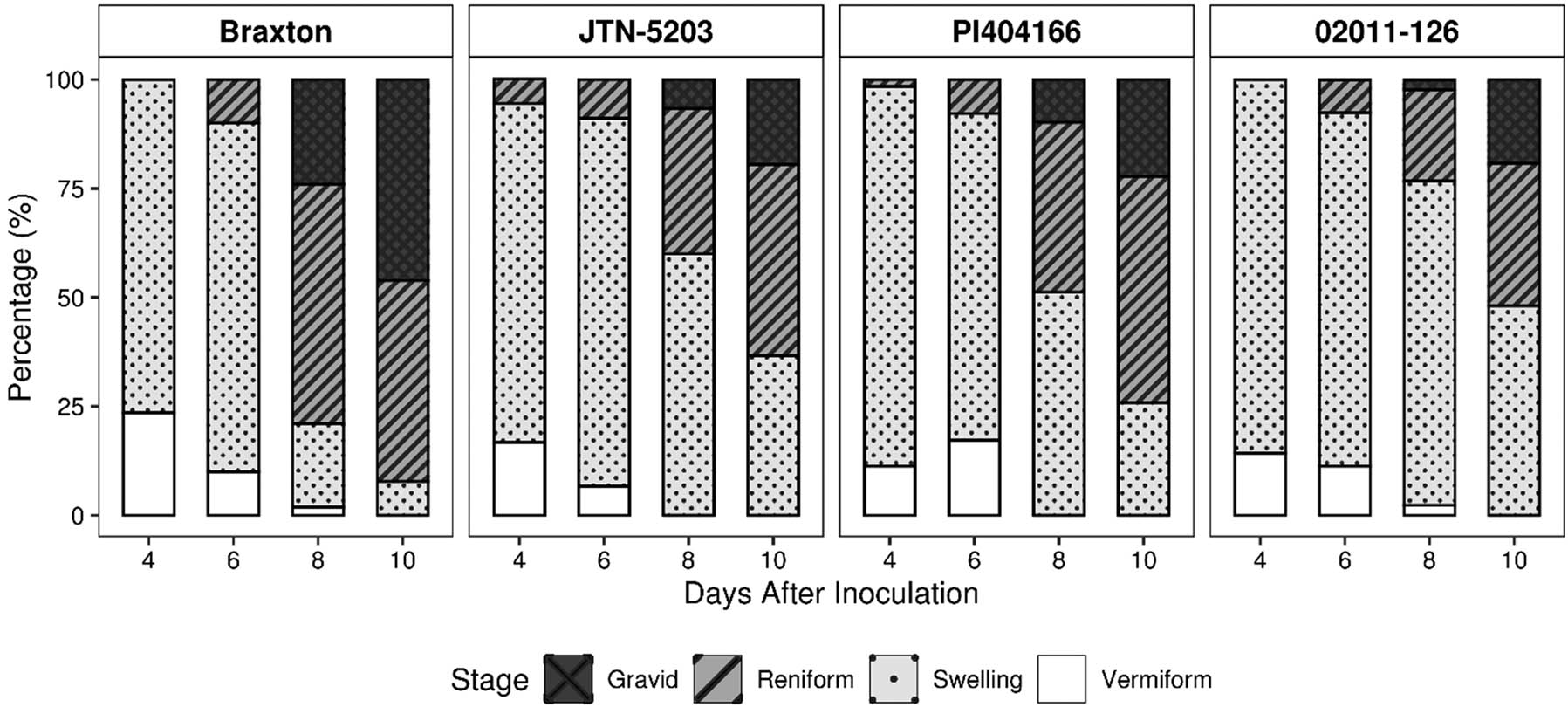
Figure 1
Proportion of the reniform nematode population in four developmental cohorts ranging from vermiform (immature) to gravid (mature) (Y-axis) at 2 days intervals from 4 to 10 DAI (X-axis) on susceptible soybean cultivar Braxton and the resistant soybean genotypes 02011-126-1-1-5-1-1 (0211-126), JTN-5203, and PI 404166.
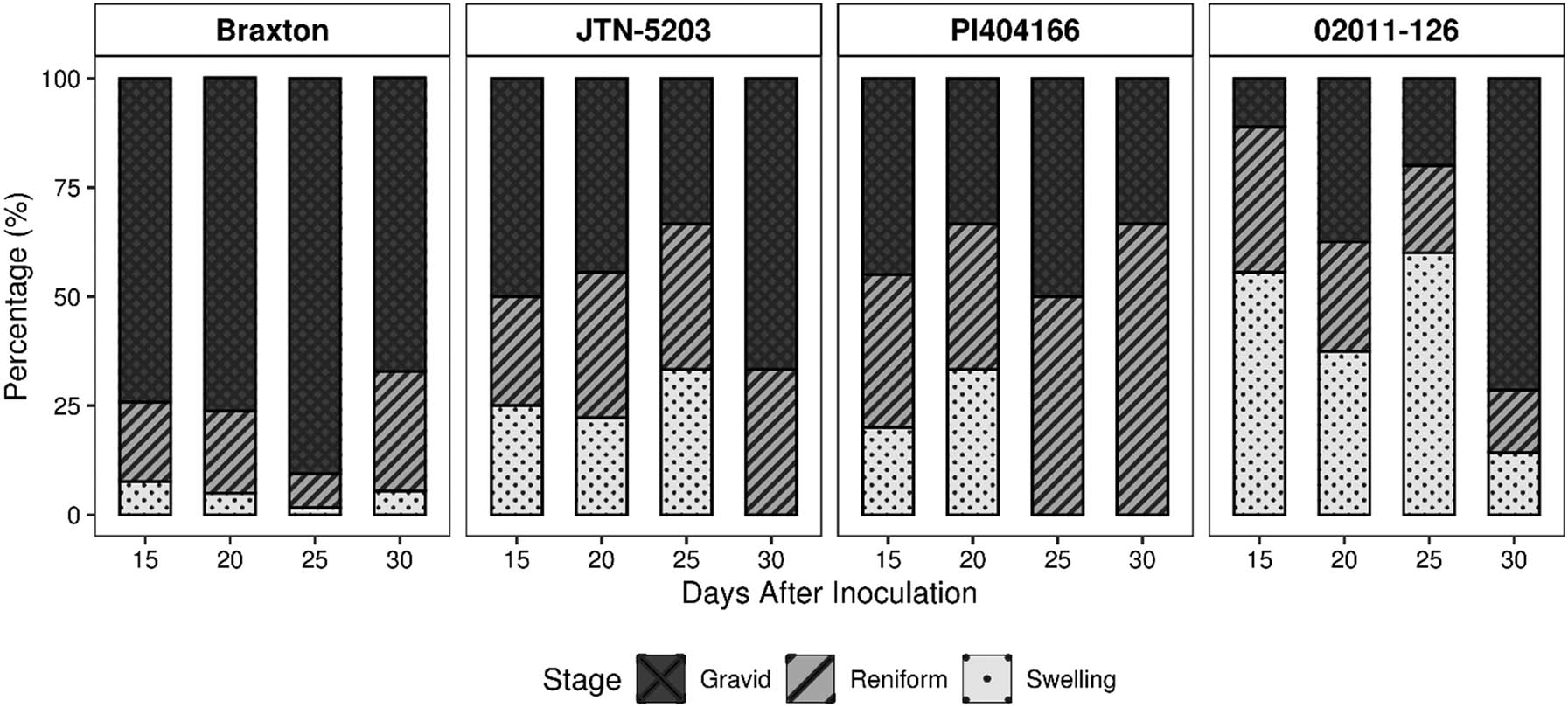
Figure 2
Proportion of the reniform nematode population in three developmental cohorts ranging from swelling (immature) to gravid (mature) (Y-axis) at 5 days intervals from 15 to 30 DAI (X-axis) on susceptible soybean cultivar Braxton and the resistant soybean genotypes 02011-126-1-1-5-1-1 (02011-126), JTN-5203, and PI 404166; none of the nematodes observed were in the vermiform stage of development on any genotype during this later stage of the infection cycle.
At 25 and 30 DAI, both the mean and maximum number of eggs per female were at least twice as high on the susceptible cultivar Braxton as on any of the resistant lines (Table 3). All resistant soybean genotypes had significantly fewer eggs per egg mass than was observed on the susceptible cultivar Braxton, suggesting that the resistance sources examined herein limit reniform nematode fecundity within the first 30 DAI. Alternatively, reduced egg production could be linked to delayed development in a resistant background wherein a longer time is needed to produce eggs.
Table 3
Reniform nematode egg production on susceptible (Braxton) and resistant (JTN-5203, 02011-126, and PI 404166) soybean in two growth chamber tests
| 25 DAI | 30 DAI | ||||||||
|---|---|---|---|---|---|---|---|---|---|
| Eggs per egg mass | Eggs per egg mass | ||||||||
| Test | Soybean line | Number of egg masses counted | Mean value | Max$ | Min& | Number of egg masses counted | Mean value | Max$ | Min& |
| 1 | Braxton | 50 | 28.4a | 99 | 0 | 50 | 35.7a | 217 | 3 |
| JTN-5203 | 45 | 9.2b | 50 | 0 | 37 | 4.1b | 51 | 0 | |
| PI 404166 | 32 | 6.2b | 26 | 0 | 4 | 7.1b | 20 | 0 | |
| 02011-126* | 13 | 9.2b | 40 | 0 | 10 | 2.3b | 17 | 0 | |
| 2 | Braxton | 50 | 38.5a | 136 | 3 | 50 | 56.2a | 181 | 3 |
| JTN-5203 | 6 | 2.1c | 21 | 0 | 8 | 1.3b | 6 | 0 | |
| PI 404166 | 1 | 3.0bc | - | - | 1 | 10.0ab | - | - | |
| 02011-126* | 8 | 9.4b | 20 | 2 | 16 | 4.8b | 16 | 0 | |
3. Discussion
In these soybean lines, all three modes of population suppression were evident: fewer infections, delayed development, and reduced egg production. When compared to the susceptible cultivar Braxton, root infection on the three resistant lines was slightly delayed (1 or 2 days). All three resistant genotypes had fewer nematodes infecting the roots as compared to the susceptible cultivar Braxton. Delayed nematode development was noted as early as 8 DAI, with 50% of the population composed of gravid females on the susceptible cultivar Braxton as compared with just 20–25% of the population laying eggs on the three resistant lines. In addition, resistant breeding line 02011-126 maintained a high percentage of nematodes in the swelling phase of development late into the infection cycle, while PI 404166 had the lowest level of gravid nematodes at 30 DAI. This is the first formal report of impacts of resistance on the reniform nematode life cycle in these lines.
The greatly delayed development of reniform nematode in 02011-126 suggests that this line (resistance sources derived from PI 567516C and from PI 88788 through Bolivar) has different or additional mechanisms contributing to reniform nematode resistance as compared to JTN-5203 (resistance sources from PI 88788 through cultivar Caviness and from cultivar Anand, which derived resistance from PI 437654 and Peking through cultivar Hartwig) and PI 404166. Further, the results showing that the resistance mechanism(s) in 02011-126 may function differently from the other resistance sources examined indicate that there may be future opportunities to either combine different types of resistance or rotate between them to achieve greater suppression of the reniform nematode population and prolong the utility of each type of resistance.
Resistance mechanisms in the three soybean lines examined reduced the number of eggs per female, a phenomenon that was not seen when resistance in two Gossypium barbadense accessions was previously characterized (Stetina, 2015). The second generation of nematodes produced on resistant genotypes were not tested to determine if they were better adapted at infecting, developing, and reproducing on these resistance sources. Soybean cyst nematode populations have shifted in response to the resistance widely deployed from PI 88788 to favor individuals who are more adept at utilizing plants with this source of resistance (Niblack, 2005). A similar scenario may develop for reniform nematode, as resistance is identified and deployed, which underscores the need for multiple and varied sources of resistance in an effective management program.
Pyramided resistance to reniform nematode derived from multiple sources may have been achieved in recently released germplasms JTN-5316 and JTN-5516 (Fritz et al., 2021). These two lines are resistant to both SCN and reniform nematode, but it is not clear from which source(s) their resistance to reniform nematode is derived. They have both Hartwig (Peking and PI 437654) resistance from cultivar Fowler and the unique SCN resistance from PI 567516C, but their derived source(s) for resistance to reniform nematode are not indicated. In addition, a third line in the Fritz et al. (2021) registration article, JTN-5416, is moderately susceptible to reniform nematode, while fully resistant to SCN. Hence, it is not clear if the reniform resistance in JTN-5316 and JTN-55-16 are derived from PI 567516C, Peking, PI 437654, or some combination. Likewise, it is not known if resistance in line 02011-126 is derived from PI 88788 through Bolivar, or PI 567516C, or both. More work needs to be done with these lines to determine their value for managing reniform nematode field populations.
Acknowledgements
Mention of trade names or commercial products in this publication is solely for the purpose of providing specific information and does not imply recommendation or endorsement by the USDA. The findings and conclusions in this publication are those of the authors and should not be construed to represent any official USDA or U.S. Government determination or policy. USDA is an equal opportunity provider and employer. The authors thank Dr. Alemu Mengistu, Dr. Patricia Donald, and Dr. Nacer Bellaloui for comments and suggestions on an earlier draft of this manuscript.
Funding information
Funding for this project was provided by the Mississippi Soybean Promotion Board (project 33-2016) and by the U.S. Department of Agriculture (USDA), Agricultural Research Service (projects 6066-22000-094-000D and 6066-21220-014-000D).
Author contributions
SRS: conceptualization, funding acquisition, investigation, data collection, statistical analysis, writing the first draft; JRS and JDR: conceptualization, review and editing; CF: data analysis, review and editing.
Conflict of interest statement
Authors state no conflict of interest.