
Oriental fruit moth (OFM) Grapholita molesta (Lepidoptera: Tortricidae) and codling moth (CM), Cydia pomonella (Lepidoptera: Tortricidae), are major pests of temperate fruit trees. Grapholita molesta has become a serious pest of peaches, nectarines, apricots, and apples (Rothschild and Vickers, 1991). Grapholita molesta causes 3–5% losses in peach and apple crops, mainly during the planting and harvesting of orchards (Negrisoli et al., 2013). The insects overwinter as mature larvae in cocoons. In spring, larvae pupate, and adults emerge, and lay eggs on new, young leaves. First-generation larvae tunnel into shoots, causing wilting. Later larval generations feed and tunnel into developing fruits (Negrisoli et al., 2013), and pupae are typically found in protected areas such as bark crevices or orchard debris. Moths are difficult to control because they have several generations (typically 4–6) throughout the growing season and have developed resistance to organophosphate insecticides with cross resistance to carbamates (Kanga et al., 1997).
Cydia pomonella is a severe pest of pome fruits worldwide, causing direct losses by reducing the quality of fruit (Grig-McGuffin et al., (2015)). The adult females of C. pomonella lay their eggs on the surface of fruits after insect emergence. Hatching larvae begin feeding by boring into the fruit and forming galleries inside seed chamber (Kuyulu and Genç, 2019). This alters the shape of the fruit and causes premature fall (Danelski et al., 2017; Husain et al., 2018). Fifth instar larvae take refuge in cryptic habitats, such as under loose bark or in tree pruning wounds, where they spin a cocoon and develop into pupae then emerge as an adult moth in the spring (Lacey et al., 2006).
Because of the intensive use of insecticides, C. pomonella has developed resistance to many classes of insecticides, additionally creating a challenge with residues on fruits that sometimes exceed maximum residue levels (Doemoetoerova et al., 2006; Reyes et al., 2007; Szpyrka et al., 2013; Ju et al., 2021; Toptanci et al., 2021). Overreliance on chemical insecticides has led to several health and environmental problems (Sánchez-Bayo, 2012). The withdrawal of primary chemicals that were once used for fruit pest control, and the increased demand for more sustainable production, has led to the search for biological alternatives (Lacey and Unruh, 2005; Odendaal et al., 2016a, 2016b; Jaffe et al., 2018).
Among alternative control tactics for G. molesta and C. pomonella, entomopathogenic nematodes (EPNs) (Steinernema spp. and Heterorhabditis spp.) have attracted great attention due to their biocontrol efficacy and eco-friendly properties (Koppenhöfer et al., 2020). Infective juveniles (IJs) of EPNs, the only free-living stage, are applied to the target site using standard agricultural equipment (Shapiro-Ilan and Lewis, 2024). Once IJs encounter a host, they penetrate the hemocoel via natural body openings or the insect cuticle (Lacey and Georgis, 2012). The IJs initiate the infection process by releasing their symbiotic bacteria (Xenorhabdus belongs to genus Steinernema and Photorhabdus belongs to genus Heterorhabditis) into insect hemolymph. The mutualistic bacteria multiply rapidly and serve as a nutrition source for the IJs along with host tissues. The host generally dies from toxemia or septicemia within 48 h after infection (Boemare and Akhurst, 2006). Once nutrients within the insect cadaver are depleted (following 1–3 nematode generations), new IJs emerge to search for new hosts to infect (Shapiro-Ilan et al., 2017).
EPNs belonging to genus Steinernema have been reported as natural antagonists of C. pomonella (Peters, 1996). Their efficacy as bio-control agents against C. pomonella larvae has already been tested in the laboratory, field (Kaya et al., 1984; Nachtigall and Dickler, 1992; Lacey et al., 2000; Unruh and Lacey, 2001; Odendaal et al., 2016a; Yağci et al., 2021; Gümüşsoy et al., 2022). and fruit bins (Lacey and Chauvin, 1999; Cossentine et al., 2002; Lacey et al., 2005; Odendaal et al., 2016b). Steinernema feltiae and Steinernema carpocapsae have been reported as the most effective, reaching up to 90% reduction in diapausing larvae (Unruh and Lacey, 2001; Lacey et al., 2005; Curto et al., 2008; Peters et al., 2008). Species of the genus Heterorhabditis have also been proven effective under field conditions (Odendaal et al., 2016a; San-Blas et al., 2019; Ahmad et al., 2020; Yağci et al., 2021; Gümüşsoy et al., 2022) and in fruit bins (Odendaal et al., 2016b). The virulence of different EPN species against G. molesta larvae has also been demonstrated in laboratory and fruit bin assays (Riga et al., 2006).
Previously, most studies have been focused on C. pomonella and G. molesta larvae and pre-pupae (Lacey et al., 2005; Peters et al., 2008; Negrisoli et al., 2013). For example, exposure to 17 different EPN strains at concentrations of 6 to 60 IJs/cm2 caused 68–88% mortality in G. molesta pre-pupae in laboratory (Negrisoli et al., 2013). However, the efficacy of EPNs against C. pomonella pupae has been investigated only in a few studies (Lacey et al., 2005; Navaneethan et al., 2010), a critical knowledge gap remains for G. molesta pupae, for which no literature is available. In this context, the present study was focused on the potential of controlling G. molesta and C. pomonella pupae with EPNs. Specifically, the objective was to determine the relative ability of commercially available EPN species to infect and kill G. molesta and C. pomonella pupae in the laboratory. Cryptic habitats, such as those employed by G. molesta and C. pomonella for their pupation (i.e., under loose bark, in litter at the base of trees, in nearby woodpiles and fruit bins), may also provide favorable environmental conditions for EPNs. EPNs may provide an effective biological control option during this period as they eliminate pests while safeguarding the orchard’s natural beneficial populations (Lacey and Shapiro-Ilan, 2003; Pringle et al., 2003). Furthermore, the duration of nonfeeding, largely immobile stages (pre-pupae and pupae) is often extended compared to earlier developmental instars. This prolonged developmental period significantly broadens the temporal window of opportunity for EPNs, to locate, penetrate, and successfully parasitize the host.
1. Materials and methods
Insect source: Grapholita molesta and C. pomonella pupae were tested in this experiment obtained from the entomological laboratory at Pennsylvania State University, Fruit Research and Extension Center (Biglerville, PA).
Last instar Galleria mellonella (Lepidoptera: Pyralidae) used in this experiment to culture the nematodes were obtained from Southeastern insectaries, Inc. (Perry, GA).
Entomopathogenic nematodes: The IJs used in all bioassays were lab-reared and sourced from USDA-ARS Southeastern Fruit and Tree Nut Research laboratory, Byron Georgia. All nematode species tested in this experiment are available commercially.
Nematode culture: The nematodes were cultured in parallel in vivo at 25°C in the last instars of commercially obtained G. mellonella based on methods described by Hazir et al. (2022). Briefly, IJs were collected from cadavers using a White trap (White, 1927). This method involved placing G. mellonella larvae that were infected with EPNs into a 60 × 15 mm Petri plate lined with moistened filter paper. This Petri plate was placed inside of a 90 × 15 mm Petri plate filled with 30–40 ml of water, which the IJs would migrate to upon emergence. IJs were collected from the water every day to prevent high mortality due to lack of oxygen. All the emerged IJs were stored at 14°C until use (no later than two weeks post-harvest).
Virulence Bioassay: In round 1, we tested S. carpocapsae (All Strain), S. feltiae (SN), and Heterorhabditis bacteriophora (VS) against G. molesta and C. pomonella. The bioassay was conducted in the laboratory; arenas consisted of Petri plates (60 mm) lined with 55 mm filter paper (Cytiva WhatmanTM 1). Petri plates were inoculated with 350 µl of S. carpocapsae, S. feltiae, and H. bacteriophora at a rate of 5000 IJs/insect (based on the results of a preliminary dose–response test, (“unpubl. Data”)). The control group received only water (350 µl). Seven G. molesta or C. pomonella pupae were added to each Petri plate and sealed with parafilm. Petri plates were placed in an incubator at 25°C and checked daily for up to 3 days for mortality. Mortality was assessed through gentle prodding with soft forceps; if no movement was observed, the insect was considered dead. There were three replicates per treatment, and the experiment was repeated over time.
Based on the results of the round 1, S. carpocapsae was considered as the standard. In round 2, S. carpocapsae was further tested with three other strains of EPNs: Steinernema riobrave (355), Steinernema glaseri (VS), and Heterorhabditis indica (HOM1). The bioassay arena and parameters were the same as round 1. There were three replicates per treatment, and the experiment was repeated overtime.
Statistical analysis: Data from all experiments were analyzed using a generalized linear model comparing treatment and control group. A Student–Newman–Keuls (SNK) post hoc test was employed for pairwise comparisons of group means at the 0.05 significance level. All statistical analyses were conducted using SAS, 2011.
2. Results
In round 1, all the tested EPN species were pathogenic toward G. molesta and C. pomonella pupae. In the case of C. pomonella pupae, at 2 and 3 days postinoculation (dpi), significant differences were detected among the treatments (F = 28.22, df = 3.24, P < 0.0001), (F = 11.76, df = 3.24, P < 0.0001) for 2 and 3 dpi, respectively. All treatments caused mortality compared to control. Steinernema carpocapsae and S. feltiae were highly effective against C. pomonella pupae at 2 dpi but there was no difference among EPN species at 3 dpi (Figure 1). For G. molesta, at 2 and 3 dpi, there was also a significant difference observed among the treatments (F = 39.18, df = 3.24, P < 0.0001), (F = 83.53, df = 3.24, P < 0.0001) for 2 and 3 dpi, respectively. No control mortality was observed. Steinernema carpocapsae caused higher G. molesta pupal mortality than S. feltiae and H. bacteriophora (Figure 2).
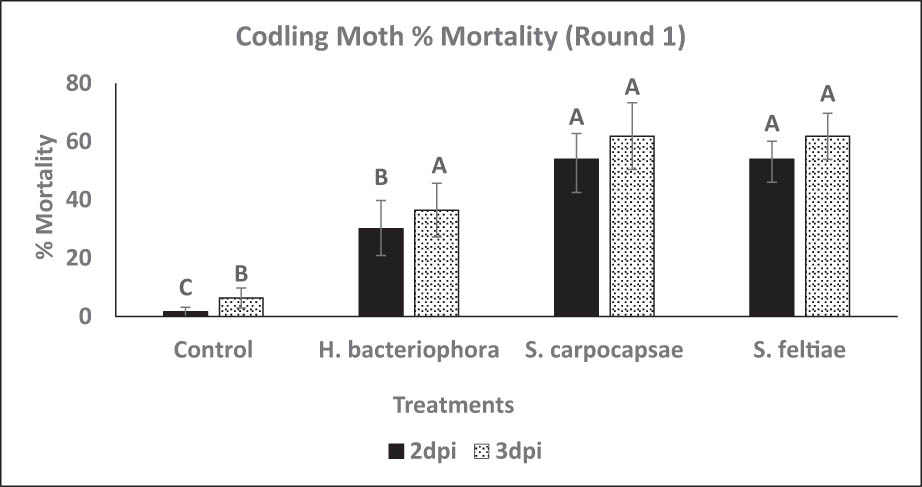
Figure 1
Mean (±standard error) percent codling moth (CM) pupal mortality at 2 and 3 days post treatment in round 1. Treatments included Steinernema carpocapsae, Steinernema feltiae, and Heterorhabditis bacteriophora and a water only control with seven CM pupae per replication. Different letters above bars indicate statistical differences among treatments within each time posttreatment (SNK test, alpha = 0.05).
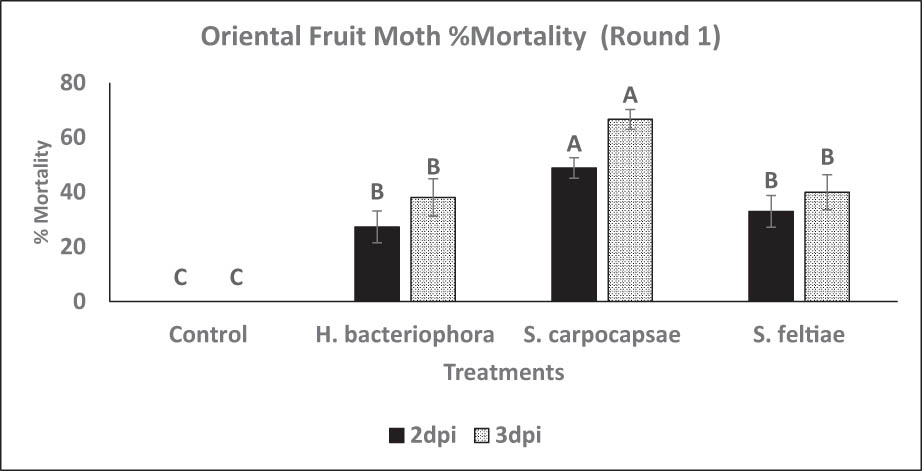
Figure 2
Mean (±standard error) percent Oriental fruit moth (OFM) pupal mortality at 2 and 3 days posttreatment in round 1. Treatments included Steinernema carpocapsae, Steinernema feltiae, and Heterorhabditis bacteriophora and a water only control with seven OFM pupae per replication. Different letters above bars indicate statistical differences among treatments within each time posttreatment (SNK test, alpha = 0.05).
In round 2, all the tested EPNs were effective against G. molesta and C. pomonella pupae. For C. pomonella pupae, at 2 and 3 dpi, significant differences among the treatments were detected (F = 15.93, df = 4.20, P < 0.0001), (F = 32.63, df = 4.20, P < 0.0001) for 2 and 3 dpi, respectively. All EPNs caused pupal mortality relative to control. The highest pupal mortality was observed in S. carpocapsae treatments compared with other treatments. S. carpocapsae was not different from H. indica but higher than the others at 2 dpi, while S. carpocapsae showed higher mortality than S. riobrave but no other differences among EPNs at 3 dpi (Figure 3). For G. molesta, at 2 and 3 dpi, there were also significant differences among the treatments (F = 28.52, df = 4.20, P < 0.0001), (F = 88.38, df = 4.20, P < 0.0001) for 2 and 3 dpi, respectively. Pupal mortality was higher in all EPN treatments relative to the control (control mortality was zero). The highest pupal mortality was observed for S. carpocapsae treatments, and lowest pupal mortality was observed with S. glaseri, while S. riobrave and H. indica were intermediate (Figure 4).
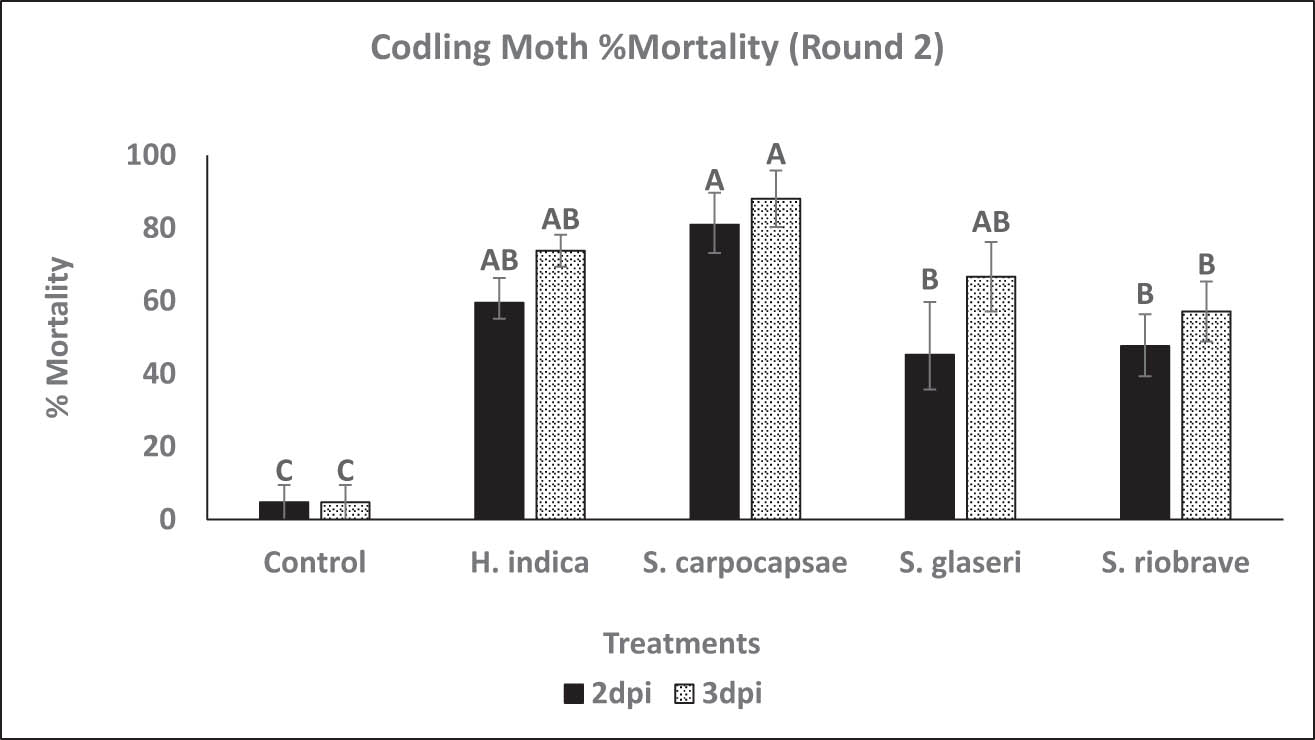
Figure 3
Mean (±standard error) percent codling moth (CM) pupal mortality at 2 and 3 days posttreatment in round 2. Treatments included Steinernema carpocapsae, Steinernema riobrave, Steinernema glaseri, and Heterorhabditis indica and a water only control with seven CM pupae per replication. Different letters above bars indicate statistical differences among treatments within each time posttreatment (SNK test, alpha = 0.05).
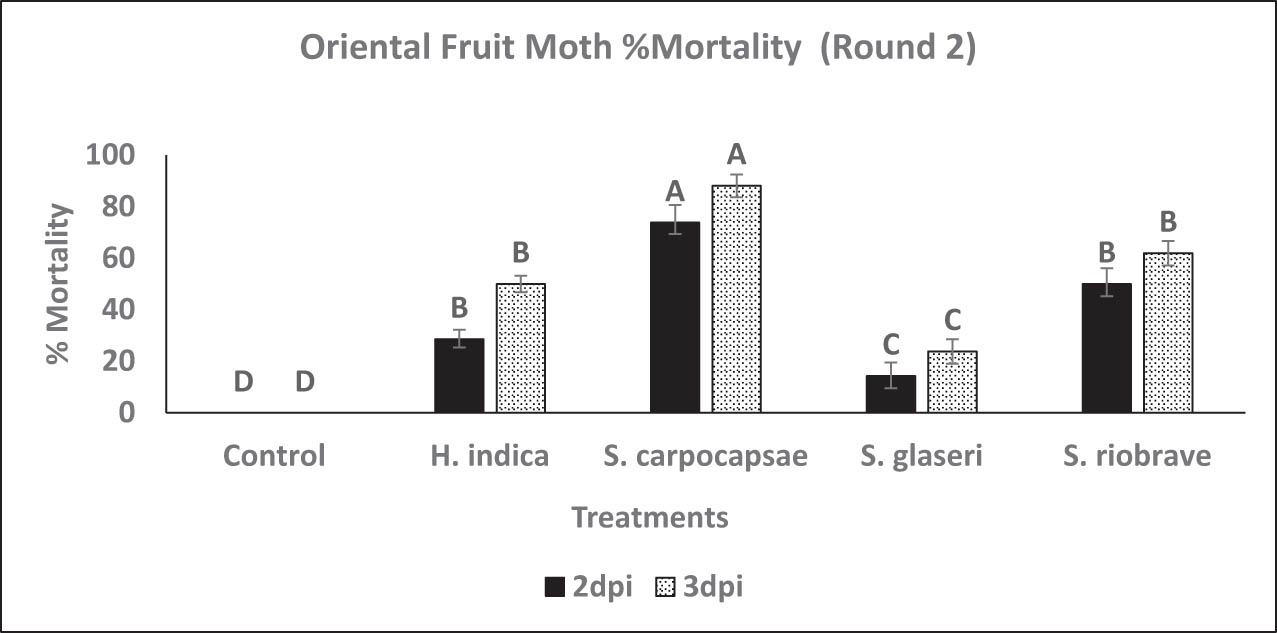
Figure 4
Mean (±standard error) percent Oriental fruit moth (OFM) pupal mortality at 2 and 3 days posttreatment in round 2. Treatments included Steinernema carpocapsae, Steinernema riobrave, Steinernema glaseri, and Heterorhabditis indica and a water only control with seven OFM pupae per replication. Different letters above bars indicate statistical differences among treatments within each time posttreatment (SNK test, alpha = 0.05).
Overall, the results indicate that S. carpocapsae is most virulent nematode against G. molesta and C. pomonella pupae.
3. Discussion
Previous studies have investigated EPNs against last instar larvae and pre-pupae of G. molesta and C. pomonella (Lacey et al., 2005; Riga et al., 2006; Yağci et al., 2021; Gümüşsoy et al., 2022). This study is the first to investigate EPN efficacy against pupae of G. molesta and C. pomonella as an effective alternative for controlling these pests. Our results indicate that all tested EPN species were virulent against G. molesta and C. pomonella pupae. Our findings are consistent with prior studies (Unruh and Lacey, 2001; Lacey et al., 2005; Curto et al., 2008; Peters et al., 2008). In round one, S. carpocapsae and S. feltiae were highly effective against C. pomonella pupae. Other authors reported that S. carpocapsae and S. feltiae were highly virulent to diapausing larvae of C. pomonella (Unruh and Lacey, 2001; Lacey et al., 2005; Curto et al., 2008; Peters et al., 2008). Cossentine et al. (2002) observed high efficacy of S. carpocapsae against C. pomonella larvae in fruit bin assays. In round 2, S. carpocapsae was most effective against C. pomonella pupae followed by H. indica, S. glaseri, and S. riobrave. Lacey and Unruh (1998) conducted a study with S. carpocapsae, S. riobrave, and H. bacteriophora and reported that the most effective species was S. carpocapsae with 99% mortality in C. pomonella larvae.
Our findings indicate that S. carpocapsae was highly virulent against G. molesta pupae over all tested EPN species in both rounds of tests. Only a few studies have been conducted to assess the effectiveness of EPNs in the control of G. molesta larvae. In the laboratory, S. carpocapsae, S. feltiae, S. riobrave, and Heterorhabditis marelatus caused mortality of 63%, 87.8%, 75.6%, and 67.1%, respectively, of the pre-pupal larvae G. molesta (Riga et al., 2006). In another study by Negrisoli et al. (2013), Steinernema rarum and Heterorhabditis bacteriophora were the most effective against pre-pupae of G. molesta in both laboratory and field conditions.
The relative susceptibility of pupae to EPNs compared with other stages varies depending on host species and assay conditions. Lacey et al. (2005) reported that pupae of C. pomonella are less susceptible than cocooned last instars, when the insects were exposed to S. carpocapsae at 25°C in perforated cardboard strips treated with 10 IJs/cm2 fixed to tree trunks in the field. In another study, Navaneethan et al. (2010) defined that the favorable environmental conditions to perform the nematodes against the cocooned larvae as C. pomonella were (exposed to 5, 10, 20, 40, and 80 S. feltiae IJs/larva) more susceptible than non-cocooned larvae, while the susceptibility of pupae was low. Unlike active larvae, pupae typically have highly modified or permanently closed spiracles to minimize water loss. The anal and genital openings are tightly compressed or sealed with waxy/sclerotized cuticular plugs during the pupal stage, presenting no obvious opening for EPNs to squeeze through. During the pupal stage, the insect is well protected by its exoskeleton, which functions as a barrier for EPNs penetration (Navaneethan et al., 2010). Using high dose rates of EPNs as in this study could be useful for controlling pupal stages of G. molesta and C. pomonella. Studies in different environments are warranted.
Both species, G. molesta and C. pomonella primarily overwinter as the last instar larvae in protected, sheltered spots on or near the host tree, such as under loose bark scales, in soil, or within debris and leaf litter at the tree’s base. Pupae may prove to be appropriate stages to target in early fall or spring using S. carpocapsae IJs suspensions. Previously, Curto et al. (2008) showed that S. carpocapsae and S. feltiae were effective against C. pomonella larvae overwintering in tree trunks after spray applications of nematode to the trunk. Natural infections of cocooned C. pomonella larvae with S. carpocapsae have been reported in Europe and North America when larvae are located near the base of trees and close to the soil (Dutky and Hough, 1955; Poinar, 1991; Vega et al., 2000). It is possible that reducing initial spring emergence of G. molesta and C. pomonella could effectively suppress later population density, thereby facilitating a significant reduction in chemical control measures. Placing corrugated cardboard bands around tree trunks (Kaya et al., 1984; Lacey et al., 2005) provides a place to pupate that can be easily destroyed with EPN applications. Field trials are needed to determine the effects of EPN on G. molesta and C. pomonella pupae under various orchard conditions, using this nematode species and rates. Novel formulations have been shown to enhance aboveground EPN applications and should be investigated as well (Wu et al., 2023).
Acknowledgement
We thank Stacy Byrd and Laura Mellott for technical assistance.
Funding information
This research received grant from Specialty Crop Research Initiative (SCRI) Project # 6042-30400-001-000-D.
Author contributions
Sehrish Gulzar: writing – original draft preparation, writing – review and editing, data curation, formal analysis and performed research; Cleveland Ivey: writing – review and editing, develop protocols, performed research; Tracy Leskey: writing – review and editing; Grzegorz Krawczyk: writing – review and editing, insect resources; David Shapiro-Ilan: Conceptualization, supervision, research design and methodology, writing – review and editing.
Conflict of interest statement
The authors declare no conflict of interest.
Data availability statement
The original contributions presented in this study are included in the article. The supporting data is restricted from public release by USDA policy. Further inquiries can be directed to the corresponding author.