
1. Introduction
Plant-parasitic nematodes (PPN) are among the most significant constraints on agricultural production worldwide, yet their impact is frequently underestimated because symptoms are largely concealed belowground and often attributed to other stresses. Root damage reduces water and nutrient uptake, depresses yield, and lowers marketability in crops where cosmetic standards are stringent. The cumulative economic burden is measured in the tens of billions of U.S. dollars each year, and the distribution of those losses is uneven. Smallholder farmers in low- and middle-income countries bear a large share of this burden. Export-oriented sectors are also impacted where the presence of quarantine pests triggers market restrictions (Kruus, 2012).
Several drivers amplify this problem (Figure 1). Intensification shortens rotations and extends the period each year during which roots remain available to nematodes. The movement of seed, slips, nursery plants, and soil on equipment is continuous and global. These movements provide recurrent opportunities for long-distance spread. Agronomic practices can create habitats that favour PPN, for instance in coarse-textured soils with low organic matter where plant tolerance is reduced. Climate change accelerates these dynamics. Warming shortens generation times, increases the reproductive rate of warm-adapted species, and expands their potential range. Temperature-sensitive resistances are particularly vulnerable. The Mi‑1 gene in tomato is a well-known example that fails under sustained heat above about 28°C (Marques de Carvalho et al., 2015). In parallel, plant health systems must reconcile the need for pest exclusion with the imperative to avoid unnecessarily trade-restrictive measures (Kantor et al., 2024). Scientific evidence and proportionate responses are essential to maintain credibility and to protect market access.
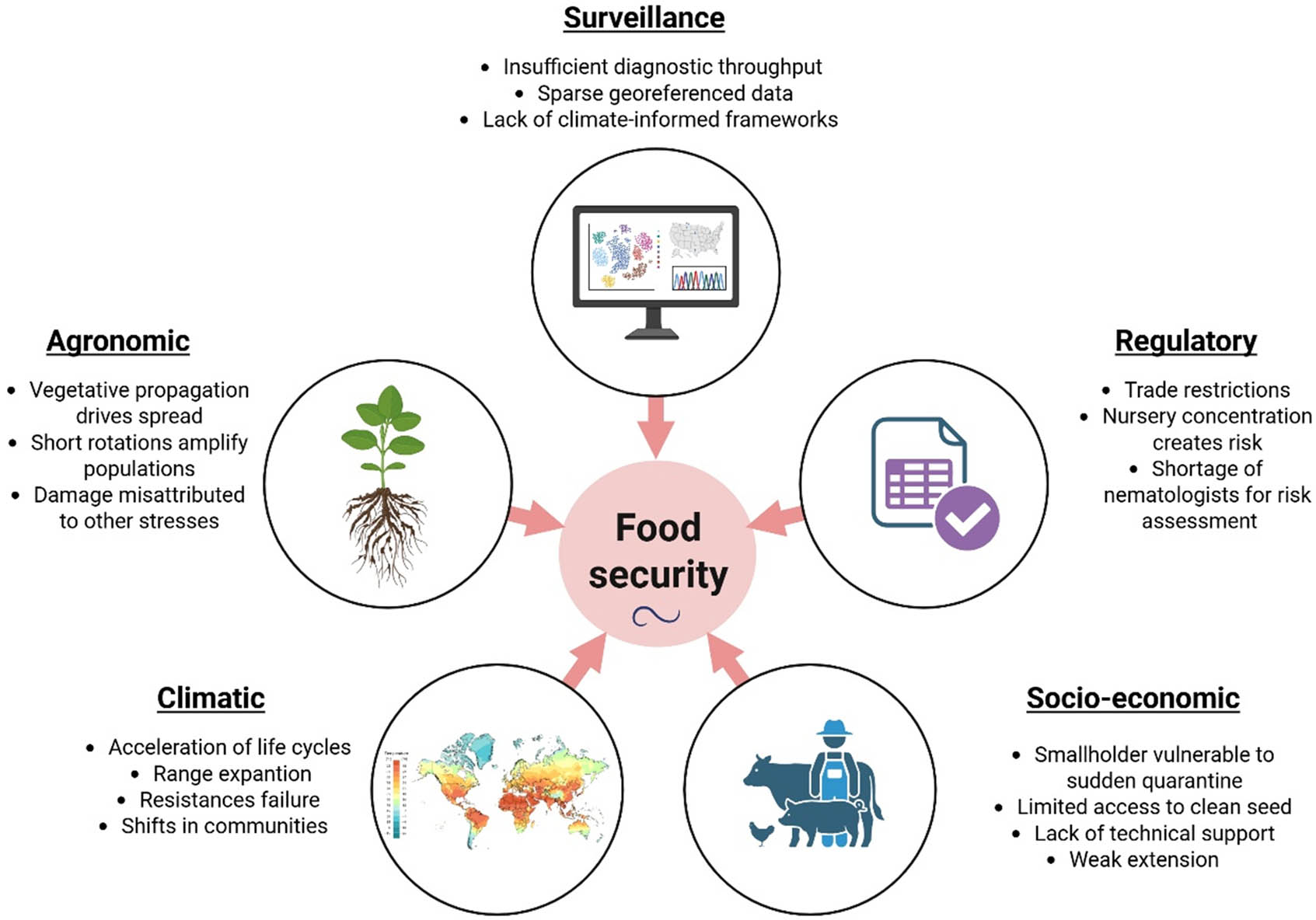
Figure 1
Challenges posed by plant-parasitic nematodes on global food security and trade in a changing world. Created with BioRender.
The four perspectives presented in this proceedings converge on the need to invest in climate-informed surveillance, high-throughput diagnostics, and clean seed and nursery systems (Figure 2). They also support the case for risk-proportionate quarantine linked to trade, and for extension that works through trusted intermediaries and reaches farm workers in the languages they use. These themes are consistent with the organisation for economic co-operation and development - co-operative research programme (OECD-CRP) programme’s emphasis on managing natural capital, strengthening resilience to multiple risks, and moving innovations into policy and practice (OECD, 2024). The rest of the article develops the evidence and draws implications for research, extension, and regulation.
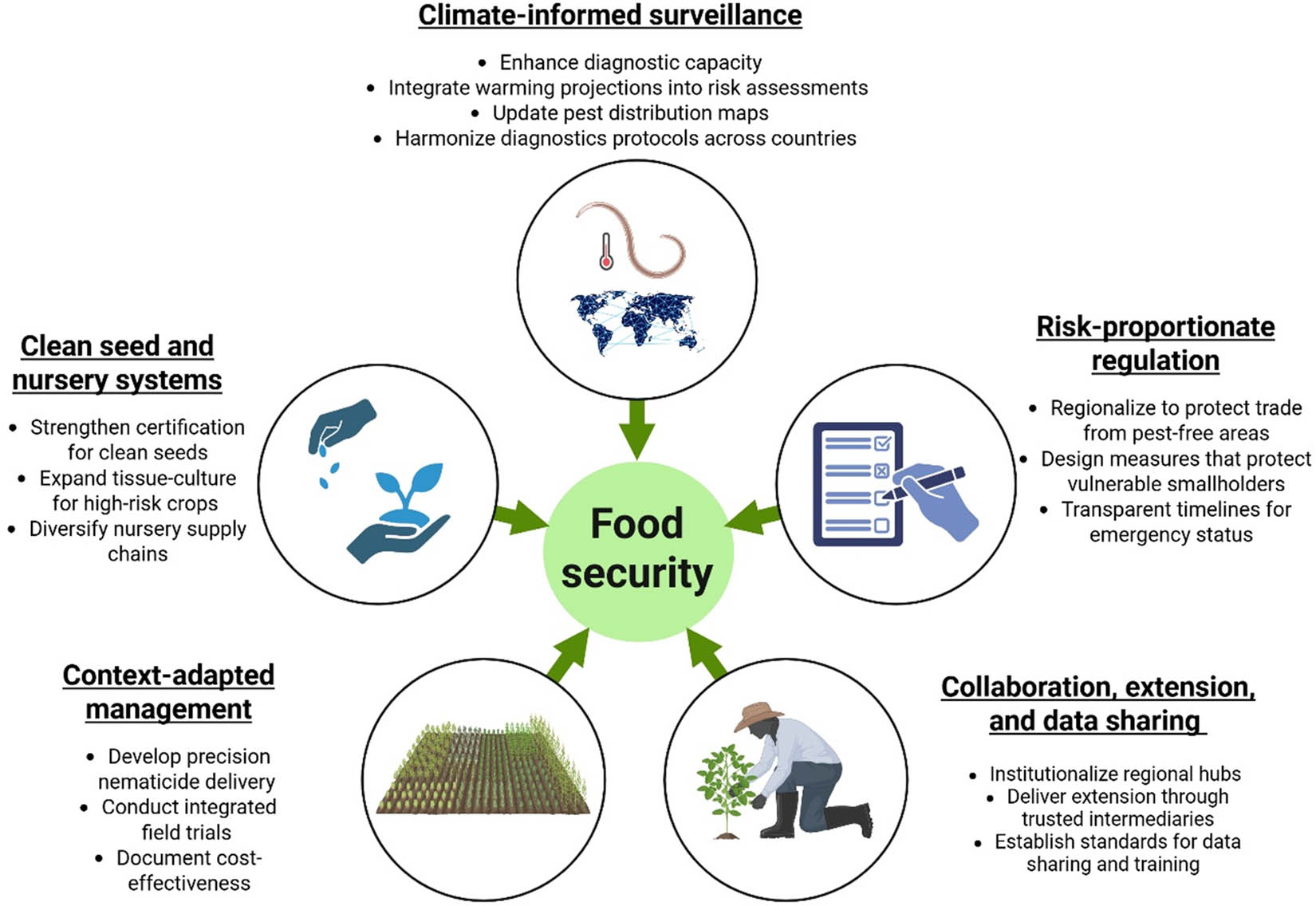
Figure 2
Strategic priorities for reducing the impact of plant-parasitic nematodes on global food security and trade. Created with BioRender.
2. Food security and the role of nematodes in sub‑Saharan Africa
Smallholder and emerging commercial agriculture in sub-Saharan Africa operate within highly diverse and constrained production systems shaped by variability in soils, climate, market access, and land tenure arrangements (Vanlauwe et al., 2014). These systems are characterized by small plot sizes, limited input use, and heavy reliance on informal seed and planting material exchange. Alongside this, peri-urban and commercial units are increasingly intensifying production, creating a mosaic of management practices and cropping sequences within the same landscapes. Within this heterogeneity, PPN represent a chronic but under-recognized cause of yield loss across annual and perennial crops (Sikora et al., 2018). Their impacts are often overlooked because symptoms are below-ground, non-specific, or mistakenly attributed to nutrient deficiencies or drought stress. Despite their documented economic importance, nematode management remains weakly integrated into regional crop protection strategies, extension messaging, and seed system governance frameworks (Coyne et al., 2018).
This gap is particularly concerning given the importance of nematode-susceptible crops, such as potato, banana, coffee, yam, and vegetables to food security, income generation, and nutrition across Africa. Losses manifest not only as reduced yields but also as quality defects that limit marketability, especially in root and tuber crops (Karuri, 2022). The central questions addressed here are therefore: (i) why nematode problems persist across diverse agro-ecologies and farming systems, (ii) which intervention points are most effective under smallholder constraints, and (iii) how scalable solutions can be embedded within existing seed, input, and institutional systems without imposing unrealistic management models on farmers.
Evidence from work in West and East Africa consistently shows that the movement of infected planting material through informal seed systems represents a primary source of nematode infestation (Coyne et al., 2018). Vegetatively propagated crops, including potato seed tubers, banana suckers, yam setts, as well as soil-grown vegetable seedlings, are particularly vulnerable to this pathway of introduction (Tenkouano et al., 2006). Once nematodes are introduced into a field, populations are difficult to suppress due to limited rotation options, overlapping host ranges among common crops, and restricted access to diagnostics and clean seed. In many cases, farmers unknowingly reintroduce nematodes season after season by recycling infected planting material.
Across multiple crops, yield and quality losses are closely linked to root damage caused by major nematode genera, including Meloidogyne, Globodera, Radopholus, Pratylenchus, and Scutellonema (Sikora et al., 2018). Damage by the root-knot nematodes Meloidogyne incognita and M. javanica is pervasive among a broad range of crops, with M. enterolobii, which overcomes commonly deployed resistance in vegetables with population increases over time. In yam, Scutellonema bradys and other lesion nematodes reduce tuber quality and yield. Nematode infection of banana feeder roots results in loss of function, leading to plant toppling. In coffee, root systems degraded by nematodes translate into poor growth and reduced cherry load. Potato cyst nematodes (PCN) reduce tuber number and size in highland potato systems. PPN degrade feeder roots, which disrupts water and nutrient uptake, resulting in reduced vigour, poor nutrient use efficiency, and increased susceptibility to drought stress and lodging. These impacts are cumulative over seasons, particularly in perennial systems, where nematode populations build up over time.
Two intervention domains emerge as both effective and feasible under smallholder conditions (Figure 2). First, clean seed and nursery health consistently reduce primary inoculum and delay or prevent field infestation. Certified seed systems, tissue-cultured planting materials, treated seed pieces, and screenhouse seedling production substantially lower nematode pressure across multiple crops by preventing the introduction of nematodes at planting (Talwana et al., 2016). Evidence from potato, banana, yam, and vegetable systems shows that starting with nematode-free or treated planting material leads to healthier root systems, improved crop establishment, and reduced need for remedial control measures later in the season. Second, targeted micro-dosing of nematicides using localized delivery systems at planting enables effective suppression at ultra-low doses. Technologies using biodegradable carriers, such as banana fibre, provide a gradual release of active ingredients in the root zone, lowering total chemical inputs thus reducing environmental risk and cost (Ochola et al., 2022). Farmers can adopt this method even where crop rotations remain limited, resistance is unreliable or unavailable and budgets are tight. It should not be seen as a replacement for clean seed or resistance but as a complementary option that reduces early infection pressure during crop establishment and when used alongside clean planting material.
Effective nematode management in sub-Saharan Africa should prioritize prevention by focusing on clean seed systems, nursery hygiene, and targeted input delivery that fit the realities of smallholder farming, where access to diagnostics, nematicides, and technical support is often limited. Achieving sustained adoption requires strong institutional support through regional hubs that integrate research, diagnostics, training, and extension. For example, the NemAfrica platform, a collaboration between the International Institute of Tropical Agriculture (IITA) and the International Centre of Insect Physiology and Ecology (icipe), strengthens national capacity through diagnostics, technology validation, farmer and extension training, and partnerships with universities, industry, and mass media to improve awareness and outreach. As climate change accelerates nematode reproduction, expands the range of damaging species, and reduces the effectiveness of temperature-sensitive resistance, prevention, surveillance, and seed system regulation must become increasingly proactive and climate-informed to protect agricultural productivity (Marques de Carvalho et al., 2015; Dutta & Phani, 2023).
3. Global soil nematode abundance under current and future climate scenarios
Belowground microbial communities govern many processes that sustain plant growth, influence soil fertility and nutrient cycling (Paul, 2015), and nematodes are central actors in these communities. By grazing on microbes, preying on one another, and feeding on roots, their abundance and the relative contribution of trophic groups influence nutrient turnover and plant health (van den Hoogen et al., 2019). Despite their importance, a coherent global biogeographic description of soil nematode distribution has only recently begun to emerge. By linking nematode abundance and trophic structure to environmental variables, the effort assembled a global dataset and uses machine learning to build predictive maps (van den Hoogen et al., 2019), thereby providing spatially explicit estimates of nematode abundance and functional composition. These maps provide a baseline for future comparison of nematode diversity and abundance and allow for climate‑informed risk assessment.
The dataset contains over 6,700 georeferenced samples from all continents and includes soil nematode abundance counts from all major trophic groups: bacterivores, fungivores, herbivores, omnivores, and predators. These observational data are combined with environmental predictors to construct a correlational training dataset for modelling. Predictors include climatic variables such as mean annual temperature and precipitation. Soil properties are represented by soil organic carbon, pH, cation exchange capacity, and texture. Vegetation is summarized with satellite‑derived indices such as NDVI and EVI. Topography and land use provide further context. Random forest models are then trained to relate observed nematode abundances and trophic proportions to this suite of predictors, and the resulting models are applied globally to produce maps at one-kilometre resolution.
Total soil nematode abundance is predicted to be highest in subarctic regions and boreal forests. The lowest densities are predicted in deserts and in regions with Mediterranean climates. These patterns are primarily driven by the distribution of belowground carbon and microbial biomass and also reflect the effect of cooler temperatures and soil moisture on the accumulation of organic matter. Across models, a nonlinear relationship of nematodes with mean annual temperature can be observed. Increases toward approximately 14°C are associated with higher predicted nematode abundance, whereas higher temperatures tend to result in lower predicted values. In particular, herbivorous nematodes show stronger temperature responses than predators. Consistent with these results, soil organic carbon is a dominant predictor in all models, supporting the use of nematodes as indicators of soil health and carbon cycling.
The analysis extends to future climates by replacing current climate predictors with mid-century (i.e., 2050–2070) projections while holding other predictors constant. While this approach cannot represent future agricultural management it isolates the first-order effects of climate on nematode distributions. The projections suggest that substantial regional shifts in abundance are likely in Northern Europe, Russia, and Alaska. Such shifts would alter trophic structure and potentially change the balance between herbivory and predation. From an applied perspective, these results can inform future plant health surveillance priorities, indicating that regions crossing thermal thresholds should be monitored closely. Areas where herbivore groups are predicted to increase should be candidates for more intensive sampling.
The significance of this work lies in its integration of disparate datasets into a consistent global spatial representation, thereby enabling the inclusion of soil organisms such as nematodes into Earth system models where belowground biological processes are currently represented only implicitly or at coarse resolution, and where explicit representation of biological drivers can improve predictions of biogeochemical responses to climate change (Lennon et al., 2024). In addition, the resulting maps provide a quantitative baseline for agricultural risk assessment. At the same time, several limitations and opportunities for improvement remain. Sampling should be expanded in regions where data are sparse, especially in Africa and South America, to improve coverage and reduce uncertainty. Agricultural systems should be represented more explicitly, with predictors for rotations, irrigation, and soil amendments, which would align the maps more tightly with the needs of plant health agencies that must make decisions in managed landscapes.
4. Nematodes escaped! Responding to invasive plant‑parasitic nematodes
Meloidogyne enterolobii has become a major threat in regions where sweet potato is an important crop. Yet, it also affects tobacco, soybean, cotton, and vegetables, leading to significant yield losses (Philbrick et al., 2020). The damage is severe, and resistance that is effective in managing other root‑knot nematode species often fails when challenged with M. enterolobii (Castagnone-Sereno, 2012). An effective response to this nematode requires early detection, proportionate quarantine actions, communication tailored to producers, and a place to conduct research without exposing growers to additional risk. A recent episode in North Carolina shows how such a response can be organized.
The first confirmed detection of M. enterolobii in North Carolina occurred in 2011 (Ye et al., 2013). Heavily galled cotton and soybean plants were submitted to the North Carolina Department of Agriculture and Consumer Services (NCDA&CS) Nematode Assay Laboratory and were initially identified as M. incognita. Yet follow up DNA sequencing later revealed that the species was M. enterolobii (Ye et al., 2013). Because of North Carolina’s leading industry in generating sweet potato planting material (seed roots and slips) and the risk of movement of the nematode on this planting material, the NCDA&CS quickly designed an interior quarantine that addressed this pathway of dissemination. Under the interior quarantine, sweet potato seed roots and slips shipped to outside of North Carolina were subject to inspection and certification. Fresh market sweet potatoes for consumption were not restricted, and ornamental sweet potato production and greenhouse tobacco transplants grown in sterile media were also exempt (North Carolina Department of Agriculture and Consumer Services, Plant Industry Division 2020). These early directives mattered because they align with the biology of M. enterolobii, where the goal is to intercept potentially infected propagative material that can sustain and introduce populations in new locations. Exemptions for commodities that do not carry viable inoculum reduce the economic burden and increase compliance.
Communication was intensive and sustained. The NC State Extension worked with the NCDA&CS and commodity boards to increase farmer awareness and deliver management information through existing channels. Winter commodity production meetings drew large audiences. Field days during the growing season showcased management tactics and provided opportunities to discuss farmer concerns. Training sessions were organized for extension agents on how to identify M. enterolobii symptoms and respond to infection, who in turn trained others within their counties and districts. To aid in farm worker education and comprehension, informational materials were prepared in both Spanish and English. Bi-lingual posters were placed in packing houses where workers are likely to see affected sweet potato roots during sorting and packing. Short videos and a website maintained by NC State Extension explained symptoms and practices that reduce spread.
Following instituting certification requirements and increasing awareness and communication, the focus turned to research on advanced management practices. A quarantined M. enterolobii nursery field research site was established at the Border Belt Tobacco Research Station in Whiteville, NC to allow field experiments to be conducted under containment. This facility solved several challenges to conducting management studies on this nematode. On‑farm trials (i.e., conducting experiments in farmer owned and managed commercial fields) are frequently subject to spatial variability in nematode density, making the evaluation of treatment impact and success challenging. They are also complicated by farmer-defined rotation plans and harvest schedules that may conflict with experimental designs. The quarantine nursery allowed researchers to inoculate trials with M. enterolobii, and evaluate treatments in a “real world,” field context. The M. enterolobii nursery research site has hosted nematode management experiments in crop rotation, fumigants, non‑fumigant nematicides, and crop genetic resistance. Yields and nematode counts can be measured with adequate replication, nematode pressure, and optimal times for the experiments. Results could be communicated with more confidence because they were not confounded by the noise of commercial fields.
Occurrence and distribution of M. enterolobii within the state of North Carolina were mapped by NCDA&CS personnel and NC State University researchers. Molecular diagnostics (PCR with species-specific primers) were used to confirm the species. As of 2025, the distribution of M. enterolobii covered at least 16 counties, primarily in the central Coastal Plains region where soils are sandy and sweet potato production is concentrated. This map helped target outreach and monitoring.
The response in North Carolina to M. enterolobii illustrates how a state can act quickly, proportionately, and in concert with numerous agencies. The interior quarantine targeted an important pathway of dissemination. Communication worked through trusted NCDA&CS and NC State Extension intermediaries and was crafted for the audiences that needed to act. The quarantined M. enterolobii nursery created a versatile space for research so that growers could receive evidence-based management recommendations. Because M. enterolobii has a broad host range and reproduces on many weed species, eradication is unlikely. Long‑term management remains the realistic aim. The success of the long-term management of M. enterolobii in North Carolina depends on building a biosecurity culture, maintaining surveillance, and deploying integrated tactics in ways that farmers can afford. However, two areas need further development. Diagnostic throughput at state and university nematode laboratories must keep pace with sample loads and provide timely results for decision making. Additionally, economic analysis of losses and of the returns on specific management practices would help further refine advice and motivate adoption.
5. Regulation, quarantine, and impact on trade: A South American perspective
South American agriculture plays a critical role in global supply chains for potatoes, bananas, coffee, cocoa, grapes, and vegetables. These industries are vulnerable to quarantine-significant PPN, requiring national plant protection organizations (NPPOs) to implement phytosanitary measures that are science-based, proportionate to risk, and consistent with international standards (IPPC Secretariat, 2016a). At the same time, these measures must minimize unnecessary disruptions to trade. Chile’s experience managing PCN and responding to an emerging outbreak of Aphelenchoides fragariae in strawberries provides valuable lessons for the region.
Chile manages PCN through a regionalization strategy that protects both plant health and international market access. Regulatory resolutions designate areas as either pest-free or regulated. Seed potato exports are permitted from pest-free zones when certification requirements are met, while areas with confirmed PCN infestations are subject to containment, suppression, or eradication measures. This system relies on continuous surveillance, seasonal sampling and inspections, and regular updates to distribution maps as new detections occur. By restricting regulations only to affected areas, regionalization avoids unnecessary nationwide trade restrictions that would otherwise penalize producers in pest-free regions. It also provides a strong incentive for growers and local authorities to maintain pest-free status through ongoing monitoring and vigilance (Servicio Agrícola y Ganadero, 2016).
A separate phytosanitary emergency emerged in 2022 following the detection of A. fragariae in strawberry production. The outbreak was first identified through reports from growers and later confirmed at a major nursery that supplied most of Chile’s strawberry planting material. In response, the NPPO immediately quarantined suspect plant material, expanded sampling efforts, and declared a national phytosanitary emergency. Laboratory diagnostic capacity was rapidly increased, allowing approximately 30,000 samples to be processed between 2022 and 2025. Surveys confirmed the nematode in most production regions, and additional hosts, including ornamental plants, were identified in southern Chile. Growers with infested production fields were permitted to complete one growing season under strict phytosanitary conditions, preventing an abrupt loss of income. In contrast, infected nursery stock was destroyed because nursery plants represented the primary pathway for long-distance spread (Servicio Agrícola y Ganadero, 2022).
Socioeconomic considerations strongly influenced the response. Many strawberry producers are small family-owned or Indigenous farms cultivating only 1–5 ha and relying primarily on local markets and government support programmes. The concentration of strawberry plant production within a single nursery created a significant vulnerability. Restrictions on plant movement resulted in shortages of certified planting material and increased prices, disproportionately affecting small-scale growers. Consequently, emergency measures remained in place for 3 years while long-term regulatory approaches were developed. During this period, the NPPO announced that A. fragariae would transition from emergency status to a regulated nursery pest with clearly defined compliance requirements. This phased approach provided growers and nurseries time to invest in improved sanitation practices, diagnostic testing, and certification systems. Communication with growers, industry representatives, and international nematology experts was essential for explaining the scientific basis for regulatory decisions, particularly given the limited availability of trained nematologists across much of Latin America (del Prado Vera, 2022). During the response, pesticide use recommendations were also reviewed, and field management practices were refined to reduce further spread.
Chile’s experience demonstrates that risk-based regulation can successfully protect plant health while preserving agricultural trade. Regionalization is effective when supported by reliable diagnostics, continuous surveillance, and timely regulatory updates. Emergency response frameworks must also be capable of rapidly expanding diagnostic capacity while considering the uneven economic impacts of regulatory actions across different grower groups. The strawberry outbreak further highlighted the risks associated with concentrating nursery production within a limited number of facilities. Greater diversification of nursery systems, coupled with stronger certification programmes, can substantially reduce this vulnerability. Finally, establishing transparent pathways for transitioning from emergency response to long-term regulated pest management provides regulatory certainty for both industry and trading partners.
Looking ahead, two priorities deserve greater regional attention. First, diagnostic protocols and surveillance data should be harmonized among NPPOs to strengthen pest risk assessments and facilitate mutual recognition of phytosanitary systems (IPPC Secretariat, 2016b). Second, nursery production systems should be made more resilient through diversification, enhanced certification standards, and contingency planning to better withstand future pest incursions and other disruptions (Plant Health Australia, 2010).
6. Discussion
The four contributions in this session highlight vulnerabilities that recur across geographies and market structures (Figure 1). They also identify strategies that are feasible within real constraints (Figure 2). The first vulnerability is the invisibility of nematode damage until harvest or until perennials exhibit advanced decline. This invisibility delays action and leads to chronic losses. The most effective countermeasure is proper nematode diagnostic and clean planting material. Formal seed systems, certified nurseries, and sanitation of vegetative propagules reduce primary inoculum. The African examples show that treated yam seed pieces and tissue‑cultured bananas make a measurable difference. Chile’s use of regionalization shows how certified seed potatoes can move from free zones while regulated zones work to suppress foci. North Carolina’s quarantine targeted seed roots and slips because these pathways are biologically and economically important. The same logic applies to many crops where vegetative propagation is central to production systems.
The second vulnerability arises from climate change. Warming accelerates nematode life cycles and allows warm‑adapted species to migrate into temperate zones. The mapping work provides a useful framework here. It shows where herbivore groups are likely to gain dominance and where soil carbon and temperature interact to structure communities. These insights can be translated into surveillance priorities. Plant health services can focus resources where thresholds are being crossed. Diagnostics also need to evolve. High‑throughput assays that produce results quickly are needed at ports, at nurseries, and within state laboratories. The technical quality of assays and the training of diagnosticians must keep pace with demand.
The third set of lessons concerns integrated management. In many African contexts, rotations are constrained and budgets are tight. Precision placement of small nematicide doses can offer a form of targeted suppression that does not depend on large inputs. Awareness campaigns that work through radio, television, and demonstration plots help farmers identify problems and learn practices that reduce spread. In North Carolina, integrated trials at a quarantined nursery produced evidence that is reliable enough to base advice on. Field days and winter meetings carried that advice to producer communities. The strawberry emergency in Chile made it possible to expedite authorization of chemical use, train small farmers in biosecurity measures, and increase diagnostic capacity. Meanwhile, nurseries improved the sanitary quality of their plants. Each case demonstrates how management packages have to be matched to context.
The fourth theme is regulation and trade. International rules require measures that are based on science and proportionate to risk. Regionalization for PCN in Chile shows how risk can be managed without preventing trade from pest‑free areas. An interior quarantine in a U.S. state shows how the same principle can operate domestically. A plant health emergency shows how the surge capacity of diagnostic laboratories determines how quickly a country can understand the scope of a problem. In each case, communication matters. Producers comply more readily when rules are explained. Smallholders need measures that do not destroy their income overnight. Nurseries must be held to high standards because they sit at the centre of plant movement.
The final theme is collaboration. No service can do all of this alone. Regional consortiums of universities, national programmes, and private actors multiply capacity. They also provide continuity when staff move or when budgets are cut. The OECD‑CRP emphasis on collaboration is therefore well aligned with what is needed on the ground. Two broad recommendations follow. Invest in clean seed systems and in high‑throughput diagnostics integrated with climate‑aware surveillance. Build regulatory frameworks that keep trade open from pest‑free areas while managing risk in foci. These recommendations are feasible and are consistent with international obligations.
7. Recommendations
7.1. Practical agenda for research and policy emerges from the evidence presented here
Make surveillance climate-informed and strengthen plant health systems. Surveillance should become climate‑informed. Plant health services need to integrate projections of warming into their risk assessments and use these assessments to set sampling priorities (IPPC Secretariat, 2019). Seed and nursery systems should be strengthened. This strengthening includes certification rules that are predictable, diagnostic workflows that are validated, and contingency plans for plant supply shocks. Clean seed programmes for potato, banana, coffee, and strawberry offer large returns because they address the problem at the point of introduction.
Enhance diagnostic capacity and demonstrate integrated management. Diagnostics must be capable of handling surge loads and must deliver results that are credible and timely. Protocols should be harmonized across regions to support mutual recognition and cooperative response. Integrated management needs further testing and demonstration in contexts where rotations are limited and budgets are small. Micro‑dosed placement of nematicides and other targeted tools are promising. The cost‑effectiveness of each practice should be documented to motivate adoption.
Maintain proportionate, flexible regulation to protect plant health and trade. Regulation should remain proportionate to risk. Regionalization and regulated non‑quarantine pest approaches can balance plant health protection and trade. Emergency measures should be designed to protect vulnerable producers from catastrophic loss while still interrupting the pathways that matter.
Invest in extension, collaboration, and data sharing. Extension must be resourced to carry messages through channels that farmers trust, including commodity boards and cooperatives, and must reach workers in the languages they use. Collaboration should be institutionalized through regional hubs that link universities, national services, CGIAR centres, and industry. Data sharing and joint training should be the norm.
Acknowledgements
The authors would like to thank the OECD-CRP for funding this symposium, as well as the PROCINORTE Plant Health Task Force for facilitating the event and generously providing the online broadcasting platform and simultaneous translation. The authors also thank Agriculture and Agri-Food Canada. Finally, this synthesis manuscript would not have been possible without the exceptional contributions of the presenters and all participants.
Funding information
Authors state no funding involved.
Author contributions
All authors contributed to the writing and editing of this manuscript.
Conflict of interest statement
Authors state no conflict of interest.