
1. Introduction
Plant-parasitic nematodes (PPN) are among the most economically damaging pests of agricultural crops worldwide, causing substantial yield losses across diverse production systems. Considerable advances have been made in nematode diagnostics, host resistance, biological control, and integrated management. However, the successful implementation of these technologies remains uneven across regions and cropping systems. In many cases, the limitation is not the absence of technical solutions, but rather the absence of policies, partnerships, extension systems, and institutional capacity needed to support their adoption (Figure 1). Extension, defined here as agricultural outreach, education, and technology transfer programs, plays a central role in translating research into practice. As climate change, global trade, and production intensification continue to alter nematode distribution and risk, there is increasing need for coordinated approaches that connect research, regulation, education, and stakeholder engagement. Sustained reductions in the impact of plant-parasitic nematodes therefore depend as much on institutional design as on laboratory innovation.
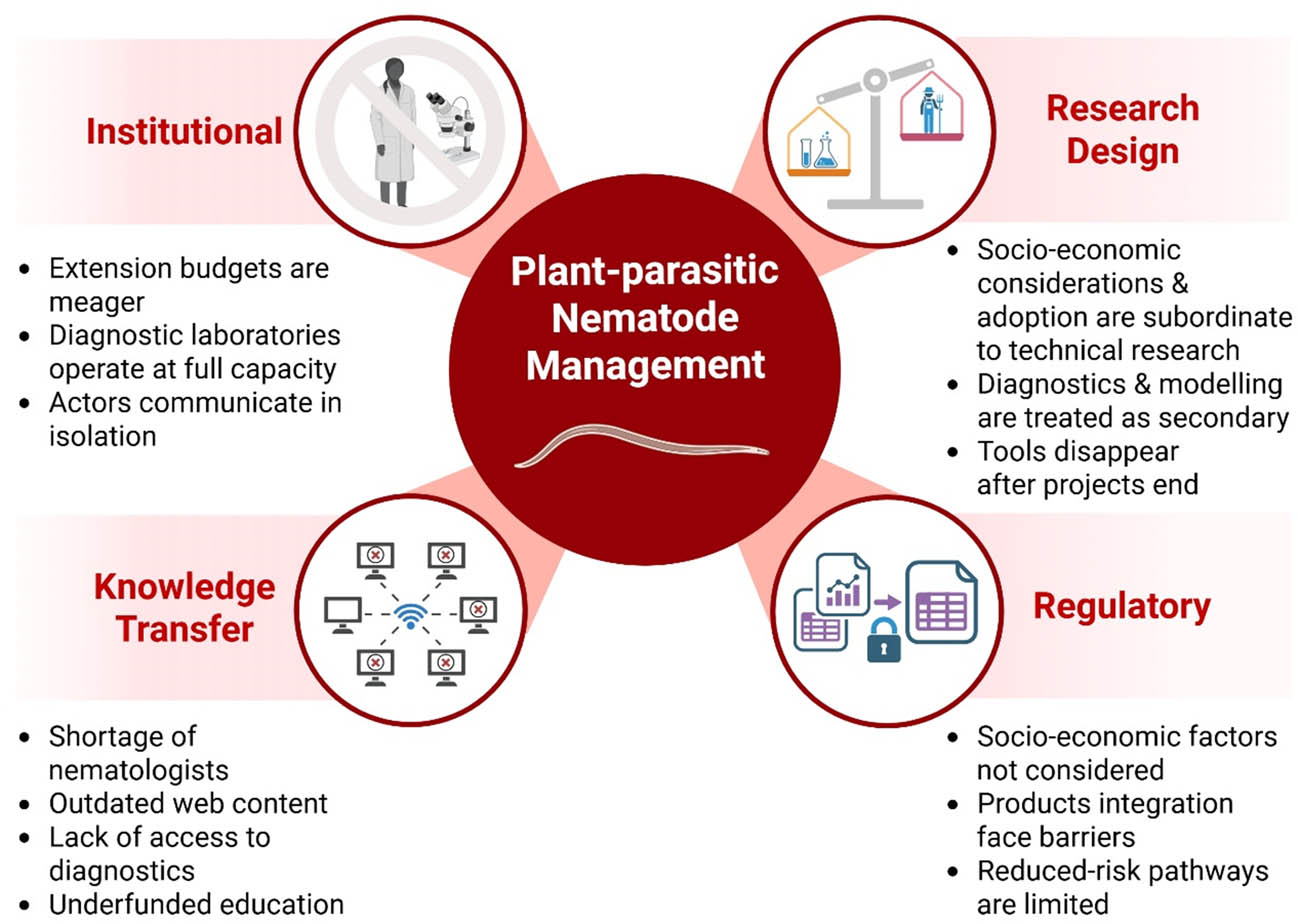
Figure 1
Challenges to building effective policy, collaboration, and extension frameworks for plant-parasitic nematode management. Created with BioRender.
This article highlights several complementary approaches that respond to these realities. One is to design research projects with adoption in mind. This approach integrates socio‑economic research into the core of projects and treats diagnostics and modelling as equal partners to breeding and field trials. Another is to work through coalitions that have a mandate to communicate a clear message through trusted channels. These coalitions invest in tools that translate risk into terms that matter on farms, and they measure whether messages change behaviour. A third is to align regulation with safer alternatives and with integrated programs that combine chemical and biological components. This requires pathways that are proportionate to risk and that allow the label to reflect integration. A fourth is to tailor strategies to national circumstances. In parts of Brazil, the constraints are soil structure, crop rotation patterns, and the limited reach of public extension. Private actors can fill gaps but need coordination. A fifth is to rebuild extension where it has atrophied. Digital platforms increase reach but do not substitute for regional hubs that house diagnostics, training, and programs focused on crop–nematode complexes. The sections that follow elaborate these approaches, draw out their implications, and identify practical steps for policy and practice. These systematic constraints – spanning institutional capacity, research design, regulatory frameworks, and knowledge transfer – are summarized in Figure 1.
This article is a proceedings-based synthesis arising from an OECD-sponsored symposium held during the 64th Annual Meeting of the Society of Nematologists in 2025. The objective is not to provide a comprehensive review of nematode management, but rather to integrate five international perspectives and use them to propose a conceptual framework for strengthening policy, collaboration, extension, and technology adoption in plant-parasitic nematode management.
1.1. NEM‑EMERGE: A collaborative research and innovation project to counter the emergence and proliferation of invasive and virulent nematodes in Europe and beyond
The burden imposed by the emergence and proliferation of invasive and virulent PPN in Europe is shaped by two drivers. The first is global warming. Tropical root‑knot nematodes are expanding their range as winters warm and extreme heat events increase (Gerič Stare et al., 2018). Moreover, resistance that worked effectively under earlier climates now fails more often. The Mi‑1 gene in tomato, for example, loses effectiveness under heat stress in the high twenties (°C) (Dropkin, 1969). The second driver is genetic host selection. In potato, a narrow genetic base for resistance has imposed strong selection for decades that favours virulence development in Globodera pallida field populations (Niere et al., 2014). The same phenomenon is observed for the emergence of novel virulent root-knot nematode populations due to selection by the major Mi-1 gene in tomato (Devran and Söǧüt, 2010; Djian-Caporalino et al., 2011). A research program that responds to these realities must integrate climate, genetics, diagnostics, and agronomy, as there is no single silver bullet. It must also embed socio‑economic analysis so that outputs are designed for use in the sectors.
NEM‑EMERGE is a Horizon Europe project (https://nem-emerge.eu/) that follows this logic with the aim of supporting the transition to more resilient and sustainable tomato and potato production (https://food.ec.europa.eu/horizontal-topics/farm-fork-strategy_en). The project is structured into work packages that span the distances between disciplines. One set builds spatial distribution models for monitoring and prevention. These models use climate data, soil information, and occurrence records to forecast where tropical root‑knot nematodes are likely to establish. The output is not only a map. It is a surveillance plan that tells services and policymakers where to sample and when to expect change. A second set examines why some resistances fail under heat, like the Mi-1 gene. This requires gene‑level analysis and phenotyping under controlled thermal regimes. The goal is not only to understand the mechanism but to breed for heat‑stable resistance that can be deployed in commercial varieties. A third set seeks the determinants of virulence in potato cyst and in root‑knot nematodes. Comparative genomics and functional assays are used to identify markers that can be tracked in field populations. A fourth set translates these findings into diagnostic assays for crop management to match varieties to field populations. This “pathogen‑informed” resistance strategy is a departure from blanket recommendations that ignore the diversity in virulence within PPN communities. A fifth set focuses on soil health. The objective is to enhance antagonistic potential through organic amendments and cover crops so that the need for chemical inputs is reduced and resilience is increased.
The technical strands are coupled to socio‑economics and adoption. A work package devoted to these questions runs in parallel to the technical work. Standardized baseline surveys are being deployed in the Netherlands, Spain, and Türkiye. These surveys measure growers’ knowledge, their preferences, and their demands. The results are used to shape the design of tools and to focus communication. Stakeholder mapping conducted at national scale identifies gaps in the chain from research to farm. In some countries, diagnostic services are well integrated into plant health agencies. In others, private laboratories are the most credible entry points for farmers. The project follows a multi-actor approach, bringing together researchers, industry partners, policymakers, extension professionals, diagnostic laboratories, and end users as active participants in the research and innovation process. These stakeholders are engaged as partners rather than observers. National plant protection organizations, breeding companies, universities and academic institutes, and diagnostic service providers are full project members. They are paid for their research and innovation contributions and accountable for outputs. The consortium includes nineteen beneficiaries across seven European countries, with associated partners in Kenya, Türkiye, and the United Kingdom (https://nem-emerge.eu/). This geographic breadth allows the project to test and implement tools across climates and sectors, taking local conditions into account.
The governance of the project reflects the evaluation criteria of Horizon Europe, which weighs scientific excellence and expected impact equally. This grading has design consequences. It obliges the consortium to plan for adoption and to budget for dissemination. It also encourages stakeholder engagement and public communication. The program includes workshops, science cafés and policy dialogues to explain why heat‑stable resistance matters or why range expansion requires new surveillance. Linkages to (transatlantic) sister projects on potato cyst and root-knot nematode problems like PAPAS (https://potatonematodes.org/) and PCN Action Scotland (https://www.pcnhub.ac.uk/) allow NEM‑EMERGE to join efforts and exchange methods and ideas to avoid duplication and align science-based solutions.
The project provides a model for how to organize research when the aim is not only to publish but to change practice using an integrated approach. It elevates diagnostics and modelling to parity with breeding. It builds adoption strategies into the body of the work rather than into a footnote at the end. It treats stakeholders, including services and companies, as partners. There are risks, though. Research tools and innovations that are developed during a project can disappear when the funding ends. To prevent this, tools and services need to be implemented and institutionalized with accreditation, budgets, and staff. Breeding for novel heat‑stable nematode resistance is not confined to a single gene or crop. The scope should be widened to other crops where heat undermines existing resistance while taking into account that genetic host selection drives the emergence of novel virulent populations. With these caveats, the multi-actor approach is aligned with the aims of managing natural capital and strengthening resilience of cropping systems. It is also a practical response to translate research into policy and into practice.
1.2. Fighting soybean cyst nematode with one voice: Lessons from a groundbreaking public–private partnership
Soybean cyst nematode (SCN), Heterodera glycines, remains the most economically damaging pathogen of soybean in North America, with estimated annual losses exceeding USD 1.5 billion (Telenko et al., 2026). It is also one of the major constraints to soybean productivity in the Brazilian Cerrado. The nematode continues to expand geographically across soybean-producing regions of the United States and Canada (Tylka and Marett, 2025). Yield losses frequently occur even when fields appear healthy because damage develops belowground and often goes unnoticed until populations reach damaging levels. Addressing SCN therefore requires more than technical recommendations; it requires widespread behaviour change among producers.
Farmers must routinely sample fields, rotate resistant varieties and non-host crops, and consider nematode-protectant seed treatments as part of an integrated management strategy. Achieving this behaviour change at scale requires consistent messaging, trusted messengers, and tools that translate risk into actionable information.
The SCN Coalition represents a coordinated public–private partnership designed to meet these needs. Public–private partnerships have increasingly been recognized as effective frameworks for delivering plant pathology extension and stakeholder engagement (Markell et al., 2020). The coalition includes state and national soybean checkoff organizations, universities, and industry partners. Since its relaunch in 2018, the Coalition has worked to deliver unified, evidence-based recommendations focused on soil sampling, crop rotation, and the strategic use of resistant varieties and seed treatments. The initiative relies on coordinated communication strategies to ensure that growers receive consistent messages across extension programs, agricultural media, and industry channels (The SCN Coalition, 2025a), illustrating how collaborative extension networks can translate research into coordinated action.
Tools that convert abstract risk into tangible outcomes have been central to this effort. The SCN Profit Checker is one such example. This decision-support tool integrates egg counts, soil characteristics, and virulence information to estimate potential yield losses and economic outcomes using large datasets derived from university research trials (The SCN Coalition, 2025b). By helping growers visualize the economic consequences of unmanaged SCN populations, the tool motivates soil testing and adoption of integrated management practices.
Evaluation of outreach programs remains an important component of the Coalition’s strategy. Surveys and outreach assessments indicate measurable increases in grower awareness and management practices since the Coalition’s relaunch (The SCN Coalition, 2025a). Nevertheless, a persistent challenge is that growers often underestimate the yield losses associated with SCN. While producers commonly estimate losses at approximately 5 bu/ac (≈336 kg/ha), research and field comparisons indicate that average losses may approach 14 bu/ac (≈941 kg/ha) (Telenko et al., 2026). In response to the broader importance of PPN in soybean production systems, the Coalition has expanded its efforts to include other economically important species through the development of the Soybean Nematode Management Guides (The SCN Coalition, 2026), which provide regionally relevant recommendations for managing multiple nematode threats affecting soybean production. In Brazil, where SCN frequently occurs in association with other nematode species, such as root-knot and lesion nematodes, accurately estimating yield losses remains difficult, exacerbating this perception gap between growers’ perceived and actual yield losses.
Efforts to strengthen the education pipeline complement these outreach activities. The GrowNextGen Ag Biotech Academy, supported by the Ohio Soybean Council and private partners, trains high school science teachers to incorporate agricultural biotechnology and plant pathology concepts into their classrooms. Through hands-on training in nematode extraction, soil sampling protocols, and inquiry-based instruction, the program equips educators to introduce students to real-world agricultural challenges, including PPN (GrowNextGen, 2026).
In parallel, the eFields program at The Ohio State University integrates on-farm research with extension delivery. Collaborative trials conducted with growers and extension educators generate region-specific data and evaluate management practices under real production conditions. These farmer-driven experiments help generate agronomic insights while strengthening the connection between research and producer decision-making (Hawkins et al., 2025, 2026).
Together, these initiatives illustrate the value of integrated frameworks that link research, education, and extension. Although GrowNextGen and eFields operate independently of The SCN Coalition, all three initiatives share a commitment to stakeholder-driven knowledge transfer. Their combined efforts generate the data, capacity, and engagement needed to support sustainable nematode management and inform coordinated policy, research, and extension responses to emerging nematode threats.
1.3. Impact of government policies on global trends in nematicide and biocontrol development – industry perspective
Government policies play a decisive role in shaping the discovery, development, registration, and adoption of nematode management solutions. While regulatory frameworks rightly prioritize the protection of human health and the environment, their predominant focus on risk assessment often overlooks the socio-economic and ecosystem benefits of effective nematode control. Drawing on industry experience, case study evidence, and regulatory examples, this section discusses how current policies influence global trends in chemical and biological nematicide development and highlights opportunities to better align regulation with sustainable agricultural outcomes.
PPN represent a major constraint to global crop productivity, threatening food security under conditions of climate change, intensification, and increasing pest pressure. Crop protection regulations worldwide have established high safety standards, but they are largely risk-based and rarely consider the broader benefits of nematicides, such as yield stability, farm income protection, and ecosystem services. As older synthetic nematicides are withdrawn and development costs rise, growers face increasing challenges in managing nematodes effectively.
A comparative case study (Deacon et al., 2016) in Italian tomato production (open field and protected cultivation) evaluated five nematode management systems over a two-year crop rotation using socio-economic and ecosystem service indicators. Results showed that the absence of nematode management led to significant yield losses and reductions in farm income, alongside negative effects on soil protection and resilience. Alternative non-chemical strategies such as solarization resulted in high costs and losses in habitat services without delivering comparable benefits. In contrast, effective chemical nematode control provided the most balanced outcomes across food provision, profitability, and ecosystem services.
Regulatory incentive systems can support innovation in nematode management. The US Environmental Protection Agency (EPA) Reduced Risk Pesticide Program demonstrates how expedited review processes can encourage the development and adoption of effective nematicides that are considered safer relative to older broad-spectrum nematicides. Such approaches help offset long development timelines and rising Research and Development (R&D) costs while maintaining high safety standards.
Integrated nematode management combining synthetic and biological nematicides aligns with global sustainability goals. However, current labelling and regulatory frameworks often restrict flexible use patterns, such as reduced chemical rates combined with biological products, even where field data indicate comparable efficacy. This regulatory gap can slow adoption of more sustainable systems.
Overall, the development and availability of nematicides are strongly influenced by regulatory policy. However, risk-based evaluations remain essential, greater consideration of socio-economic and ecosystem benefits is needed. Incentive systems that accelerate the registration of reduced-risk products and enable integrated management approaches will be critical to fostering sustainable innovation and effective nematode control.
1.4. Outpaced by nematodes? Rethinking research and collaboration in Brazil
Brazil is an essential hub in global food supply chains. In many production regions, climatic and management conditions allow two or even three harvests per year, with common crop sequences including soybean, maize, cotton, and common bean and other legume crops. These crops collectively host a wide range of nematode species, and extended cropping windows – particularly in areas irrigated by pivot systems – can facilitate nematode feeding for eight to twelve months each year. Losses attributed to nematodes exceed $6.5 billion annually (Machado, 2022). Biological products are widely used, with over ninety commercial product labels available; however, their performance is often inconsistent. This variability is largely driven not by product failure, but by suboptimal soil conditions, including compaction, low fertility, acidity, low organic matter, and shallow, fragile roots. Under such conditions, plants are less able to tolerate nematode feeding, and biological agents struggle to become established (Dias-Arieira et al., 2021). This is not an argument against the use of biologicals, but a reminder that their efficacy depends on the physicochemical and biological characteristics of the environment in which they are applied.
Recent field observations indicate that nematode life cycles accelerate under higher temperatures, contributing to the emergence of new problems. Helicotylenchus species have become more prominent, Pratylenchus brachyurus continues to spread, and other species, including P. penetrans and P. brasiliensis have been reported (Diniz et al., 2026a). In addition, cases of Meloidogyne enterolobii in cotton and soybean in the Cerrado region are increasing every year (Diniz et al., 2026b). This highly dynamic environment demands robust surveillance and a rapid response capacity.
Public investment in nematology research and extension services remains limited in Brazil. Consequently, private companies and cooperatives have assumed much of the outreach effort, organizing large farmer congresses, producing educational podcasts and videos, and hosting field trials. Universities also collaborate by conducting experiments within commercial fields. While these activities facilitate information exchange, they also introduce risks: messages may become fragmented, and some claims may outpace scientific evidence. Greater national coordination can help mitigate these risks, not by restricting private initiative, but by establishing frameworks to curate evidence and reinforce consistent messaging.
Restoring soil function in degraded areas is a top priority in Brazil. Programs must incorporate practices such as cover cropping, organic amendments, traffic management, and targeted tillage. Biologicals will perform better when roots are able to explore the soil fully and when diverse microbial communities can establish. Demonstration projects that integrate soil health practices with biologicals and crop rotation strategies can illustrate both the potential benefits and the associated costs. Economic analysis is essential, as farmers need clear information on returns. Developing national and regional networks will enhance diagnostic capacity and enable coordinated responses to emerging nematode threats. Given the country’s scale and the rapid pace of change, collaborative effort is essential; no single institution can meet these challenges alone. Two key investments will have an immediate impact: (1) programs to rebuild soil health as a foundation for biologicals, and (2) surveillance networks and diagnostic services capable of quickly detecting new problems and supporting local decision-making.
It is important to note that in response to the rising incidence of nematode-related problems, many soil analysis laboratories have expanded their services to include nematode analysis, often without the involvement of trained nematologists. To address this gap, the Brazilian Society of Nematology (SBN) is working to standardize diagnostic procedures and establish a certification seal for laboratories, ensuring reliable and accurate analysis across the country.
1.5. Policy development to drive knowledge transfer, extension, and technology adoption
The promised impact of new management tools on crop yields will not be realized unless they are adopted by farmers. In many regions of the world, technology adoption by farmers is impeded by the absence of effective extension programs. The numbers illustrate the mismatch. Africa has on the order of seventy‑nine million farms, and fewer than one hundred and twenty nematologists with doctoral training serve the entire African continent. A small number of diagnostic laboratories can only process a small fraction of potential samples. In China and India, the number of farms is far higher. Farm sizes average 1.2 ha and are trending downward. Access to the internet is in most cases limited by lack of financial resources. Conversely, in the United States and Europe, extension programs are generally better resourced, and farms are much larger in size, improving access to technical support and the implementation of management practices. However, too many extension positions have been either split among extension, research, and administrative appointments or eliminated altogether. Farmers in these two regions, therefore, use the internet more readily to find pertinent information. These farmers usually do not attend extension meetings or farm fairs in the numbers they once did. The content they find on the internet is not always adaptable to the region and is often not updated with new information. This is the context in which policy must act to improve extension programs.
A revitalisation of extension programs must be built on two pillars. The first is institutional, for example, with the funding and establishment of regional hubs of excellence. These institutions would house diagnostics, research programs, training, and communication. They should be organized around crop–nematode complexes that matter both locally and across borders. Cereal cyst nematode and root health problems, for example, are severe and extend from Morocco to China. Banana nematodes are a global problem. These regional hubs of excellence would interact with each other and coordinate programs like remote sensing and phenotyping to support surveillance in target regions. They would develop content that can be used by extension agents and by farmers on a global scale. The hubs of excellence would train a new cohort of extension professionals who understand communication, socio‑economics, and the technical side of nematology. The second pillar is digital. Farmers need access to credible content on their own devices. Mobile platforms should provide protocols, calculators, and decision support tools. Partnerships with telecom companies can extend reach into rural areas and reduce cost barriers.
These pillars must be supported by advocacy. Societies should work together to engage professional lobbyists who can explain to ministers, policymakers, and legislators why extension is a high-return public investment. Messages must be concise, clear, and grounded in measurable outcomes. The success of crop protection industry groups in influencing policy offers valuable lessons. Public‑good extension requires a similar level of professional advocacy and strategic engagement. Coordination across nematological societies is particularly important because decision-makers hear many competing voices. A coalition that includes industry partners is likely to be more effective than one that excludes them.
The strategy is consistent with the aims of managing natural capital and with the need to transform innovation into practice. It recognises that digital platforms are tools, not substitutes for institutions. It places diagnostics and training at the centre. It attends to equity by ensuring that content reaches all farmers across the farm-size continuum with management measures that do not impose costs that they cannot bear. Two important steps must be taken: (1) secure sustained funding and (2) establish broader forms of governance for running hubs and platforms. Finally, we need to train future extensionists with the skills needed for solving nematode problems across borders in the twenty-first century. This will require new and improved avenues of funding and a behaviour change in how we operate.
2. Discussion
The five perspectives presented in this symposium collectively illustrate how different components of the proposed framework (Figure 2) can be operationalized in practice. NEM‑EMERGE demonstrates how multi-actor research projects can integrate diagnostics, modelling, socio-economic research, and stakeholder engagement from project inception. The SCN Coalition illustrates how coordinated communication, outcome assessment, and public-private partnerships can translate scientific knowledge into measurable changes in grower behaviour. The industry perspective highlights the importance of regulatory systems that incentivize innovation while enabling integrated management approaches. The Brazilian experience emphasizes the need to align nematode management with soil health, diagnostic capacity, and coordinated extension efforts. Finally, the policy perspective underscores the importance of rebuilding extension infrastructure through regional hubs, digital tools, and long-term institutional investment. These examples collectively demonstrate that successful nematode management requires coordinated action across research, regulation, education, extension, and policy, providing the foundation for the framework proposed here.
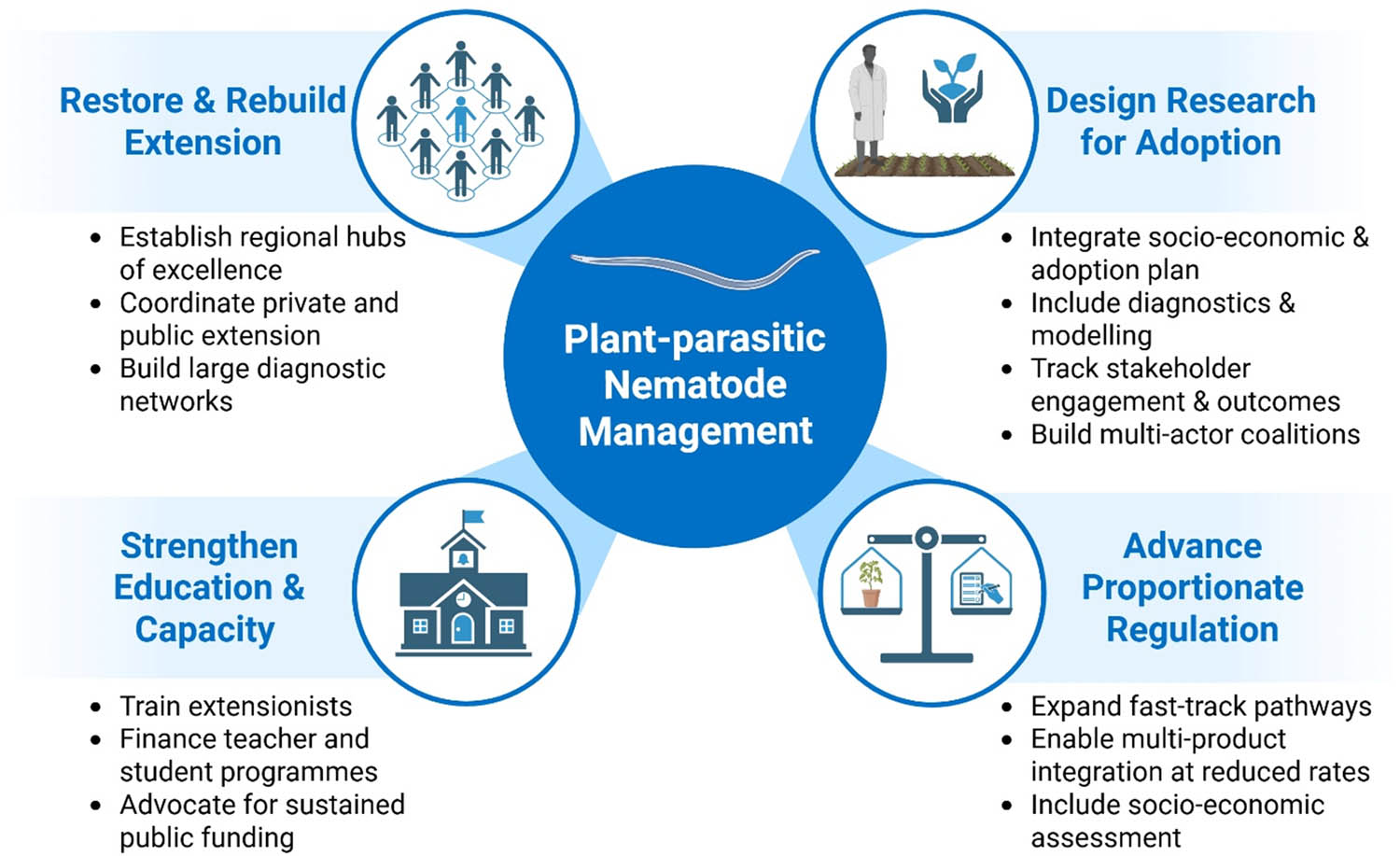
Figure 2
Strategic priorities for building effective policy, collaboration, and extension frameworks for plant-parasitic nematode management. Created with BioRender.
Regulation is the next piece. Agencies should expand reduced‑risk routes to biologicals and include benefit assessment in their decisions. They should pilot integrated labels that allow reduced chemical rates when combined with specified biologicals under stewardship plans. These actions would make integrated pest management tangible and would increase incentives for private-sector investment. National contexts matter. In Brazil, the most effective investment is not another product, but rather soil health and coordinated action. Private actors carry much of the financial and operational burden where public budgets are insufficient. These private-sector efforts should be harnessed through frameworks that curate evidence and align messages. The final piece is extension. Regional hubs of excellence and digital platforms are required to reach the number of farmers who need advice. Societies should collaborate to advocate for these investments.
A recurring theme across the contributions is that nematode management is rarely constrained by the absence of technical solutions alone. Rather, the challenge lies in aligning research, regulation, and extension systems so that available knowledge can be translated into coordinated action. In many agricultural systems, these institutional components have evolved independently. Research programs tend to prioritize disciplinary outputs, regulatory frameworks focus narrowly on risk mitigation, and extension services operate with limited resources and fragmented mandates. As a result, innovations that demonstrate efficacy in experimental settings often struggle to reach farms or to be implemented consistently across regions. Bridging these institutional gaps is therefore as important as developing new control strategies.
Another important insight is the growing need to treat nematode management as a systems-level challenge rather than a crop-specific problem. Climate change, intensified production cycles, and globalized trade are reshaping pest dynamics in ways that transcend individual commodities. Warming temperatures are expanding the geographic range of several nematode species while also accelerating life cycles and altering host–pathogen interactions. These changes increase uncertainty for producers and complicate the deployment of genetic resistance, which may become unstable under new environmental conditions. Addressing these dynamics requires surveillance systems capable of detecting emerging threats early and integrating climatic, agronomic, and biological data into predictive frameworks that support proactive decision-making.
Regulatory frameworks represent another critical interface between innovation and implementation. While stringent risk assessments are essential for safeguarding human health and environmental quality, the discussions presented herein highlight that regulatory processes sometimes struggle to accommodate integrated pest management strategies that combine chemical and biological tools. When regulatory pathways evaluate products in isolation rather than as components of integrated systems, opportunities for reduced-risk combinations may be overlooked. More flexible regulatory approaches that recognize the cumulative benefits of integrated management could accelerate the transition toward more sustainable nematode control strategies.
Finally, the contributions emphasize that capacity building remains one of the most significant long-term investments for addressing nematode problems globally. The shortage of trained nematologists, diagnostic laboratories, and extension specialists is particularly acute in regions where smallholder farming dominates. Strengthening training pipelines, expanding diagnostic networks, and creating platforms for international collaboration are therefore essential steps toward building resilient agricultural systems. Programs that connect education, research, and outreach, such as teacher training initiatives or on-farm experimentation networks, can help cultivate the next generation of scientists and practitioners while simultaneously improving knowledge transfer to farmers.
3. Recommendations
Embed integrated, multi-actor research, and adoption science: Future research should be embedded in multi‑actor programs that allocate resources to adoption science (the study of factors influencing adoption of technologies and management practices), diagnostics, and socio‑economics on the same footing as technical research. Heat‑stable resistance, virulence diagnostics, and soil health–biological synergies deserve priority in regions where warming accelerates risk. Demonstration projects should test integrated programs under real farm conditions and record adoption and outcomes with predefined metrics.
Strengthen collaboration, data sharing, and infrastructure: International collaboration platforms should facilitate exchange of knowledge and public–private policy experiences among researchers, extension programs, and industry partners working on nematode management. Policymakers should fund regional hubs of excellence and digital platforms in hotspots and mandate data sharing and harmonized diagnostics.
Advance proportionate and flexible regulatory frameworks: Regulatory frameworks should allow integrated labels and expand reduced‑risk pathways for biologicals. Decisions should consider benefits alongside risks.
Invest in education, communication, and outcome stewardship: Coalitions that deliver clear messages and tools should be supported with requirements for outcome monitoring. Education pipelines for teachers, students, and extensionists should be financed through competitive grants and recognized in accreditation.
Acknowledgements
The authors thank the OECD Co-operative Research Programme: Sustainable Agricultural and Food Systems (CRP) for sponsoring the symposium, the PROCINORTE Plant Health Task Force for providing the online broadcasting platform and simultaneous translation, the Society of Nematologists for hosting the symposium as part of its 64th Annual Meeting in Victoria, British Columbia, Canada, and Agriculture and Agri Food Canada for facilitating the event. Most importantly, the authors thank the speakers and participants for their exceptional contributions.
Funding information
The authors would like to thank the OECD Co-operative Research Programme: Sustainable Agricultural and Food Systems (CRP) for funding this symposium.
Author contributions
H.D.L.N.: Conceptualization; Project administration; Supervision; Writing – original draft; Writing – review & editing; A.G., T.T., C.R.D.A., and R.S.: Conceptualization; Writing – review & editing; B.M.: Conceptualization; Funding acquisition; Project administration; Writing – original draft; Writing – review & editing.
Conflict of interest statement
Authors state no conflict of interest.