
1. Introduction
The soybean cyst nematode (SCN; Heterodera glycines Ichinohe) is the most economically significant pathogen affecting soybean (Glycine max (L.) Merr.) production worldwide (Niblack, 2005). Annual yield losses caused by SCN infestation are estimated to exceed $1.5 billion in North America alone (Allen et al., 2017; Bandara et al., 2020). In China, it causes annual losses exceeding $120 million (Ou et al., 2008). As a sedentary endoparasitic nematode, the infective second-stage juveniles (J2) of SCN penetrate host roots, migrate to the vascular cylinder, and induce the formation of syncytial feeding sites via the secretion of effector proteins. This feeding structure is the sole nutritional source throughout the sedentary life cycle. Consequently, SCN infection impairs both nitrogen fixation and nutrient translocation in the host plant (Niblack et al., 2006a; Atkins and Smith, 2007; Arjoune et al., 2022). Females develop through subsequent juvenile stages while maintaining this feeding relationship, eventually producing cysts containing 200–600 eggs that persist in soil for years (Turner and Rowe, 2006). Generally, SCN infection is cryptic and often goes unnoticed in the early stage. Even under heavy infestation, root symptoms remain subtle, and above-ground manifestations (e.g., stunting, chlorosis, reduced plant vigor) often resemble those of nutrient deficiency or drought stress (Niblack et al., 2006b). Yield suppression caused by SCN occurs before visible foliar symptoms emerge, making timely detection difficult without systematic soil sampling (Wang et al., 2003).
SCN has been detected in almost all major soybean-producing regions in China, with notably high prevalence in the Huang-Huai-Hai Plain (Lian et al., 2022) and northeastern provinces (Peng et al., 2021; You et al., 2024b). Heilongjiang Province is China’s largest soybean-planting province, accounting for approximately 45% of the country’s total soybean planting area, and harbors a complex SCN population structure. Previous characterizations identified seven race types (races 1, 3, 4, 6, 9, 13, and 14) (Hua, 2018; Chen, 2019; You et al., 2024a) and nine HG types (HG type 0, 2, 6, 7, 2.7, 6.7, 2.5.7, 1.3.7, and 1.2.3.7) (Chen et al., 2021; You et al., 2024b). Current survey data show that SCN has spread to at least 63 counties in Heilongjiang (Hou, 2017), but documentation remains incomplete for the province’s eastern soybean-producing regions. The composition of SCN virulence phenotypes in Heilongjiang is dynamic. In Daqing and Anda counties, sustained cultivation of Peking-type resistant soybean cultivars has led to a shift in SCN populations from predominantly race 3 to races 4 and 14 (Chen et al., 2015; Yang et al., 2015, Hua et al., 2018). A comparative analysis from 2015 to 2021–2022 further showed increasing female index (FI) values on PI 548316, with the proportion of populations virulent on this resistance source rising from 64.5 to 71.7% (Chen et al., 2021; You et al., 2024b). This trend indicates that SCN populations are progressively adapting to widely deployed resistance genes, raising concerns about the long-term durability of current resistant soybean cultivars in Heilongjiang.
The Sanjiang Plain is located in the eastern sector of Heilongjiang Province, accounting for nearly one-quarter of the province’s total area, and serves as a strategically important grain production base (Dong et al., 2013; Fan and Chen, 2022). Since 2019, the soybean planting area in the Sanjiang Plain has expanded significantly, driven by increasing national demand for soybean and accompanied by greater mechanization intensity (Liu et al., 2024). Agricultural transformations in this region, including large-scale cross-regional machinery operations and the conversion of rice paddies to upland cropping, may alter SCN dissemination patterns and field population dynamics (Jin et al., 2022; Ning et al., 2024). Soil properties, including texture (which affects moisture retention, root architecture, and J2 movement) and chemical properties (e.g., pH, organic matter content, nutrient availability), may also influence SCN population dynamics (Koenning et al., 1988; Avendaño et al., 2004). Despite the Sanjiang Plain’s agricultural significance and the potential factors affecting SCN distribution, systematic nematode surveys in this zone remain limited. This creates a critical information gap, especially given the incomplete documentation of SCN in eastern Heilongjiang.
Characterizing SCN virulence phenotype and documenting their distribution in soybean-growing regions is essential for developing sustainable management strategies. This study characterizes the occurrence, population abundance, and virulence phenotypes of H. glycines across the major soybean production counties of the Sanjiang Plain. The specific objectives are to: (i) document current distribution of SCN and quantify population densities across representative production fields; (ii) identify prevailing virulence phenotypes using the standard race classification system; and (iii) evaluate differences in SCN population densities among distinct cropping systems and soil types. The resulting data address knowledge gaps for this expanding production region and provide an empirical foundation to guide region-specific resistance deployment.
2. Materials and methods
2.1. Plant materials
The following soybean cultivars were used for H. glycines race classification: PI 548402 (Peking), PI 88788, PI 90763, Pickett, and the susceptible check Lee 74. Additionally, we employed another susceptible cultivar Hefeng 50 for nematode propagation and as an alternative susceptible check. All seed materials were obtained from the Soybean Research Institute, Heilongjiang Academy of Agricultural Sciences, Harbin, China. Seeds were stored at 4°C until use to maintain viability.
2.2. Field sampling and site characterization
Field surveys were conducted across six counties in the eastern Sanjiang Plain of Heilongjiang Province (45°–48°N, 130°–135°E) in 2024. Sampling was conducted after soybean physiological maturity but prior to harvest. Locations included Baoqing and Raohe Counties (Shuangyashan Prefecture) and Huanan County, Tongjiang City, Fujin City, and Fuyuan City (Jiamusi Prefecture) (Fig. 1). Sites were selected in commercial soybean fields that had been continuously planted with soybean for at least three growing seasons or had documented histories of rotation with nonhost crops (corn). A total of 186 soybean fields were sampled, with 12–48 sites per county depending on production scale and accessibility, ensuring representation of the region’s primary soil types and cropping practices The sampled fields covered four major soil types according to Chinese Soil Taxonomy, with corresponding food and agriculture organization of the United Nations (FAO) classifications: black soil (Phaeozem), meadow soil (Gleysol), dark brown soil (Cambisol), and albic soil (Planosol with a bleached eluvial horizon). Soil type classifications and other soil texture were derived from National Earth System Science Data Center (http://www.geodata.cn). Cropping history was obtained through farmer interviews, categorizing fields as either continuous soybean (prior crop: soybean) or rotation (prior crop: maize). Fields with complex rotation histories or uncertain records were excluded.
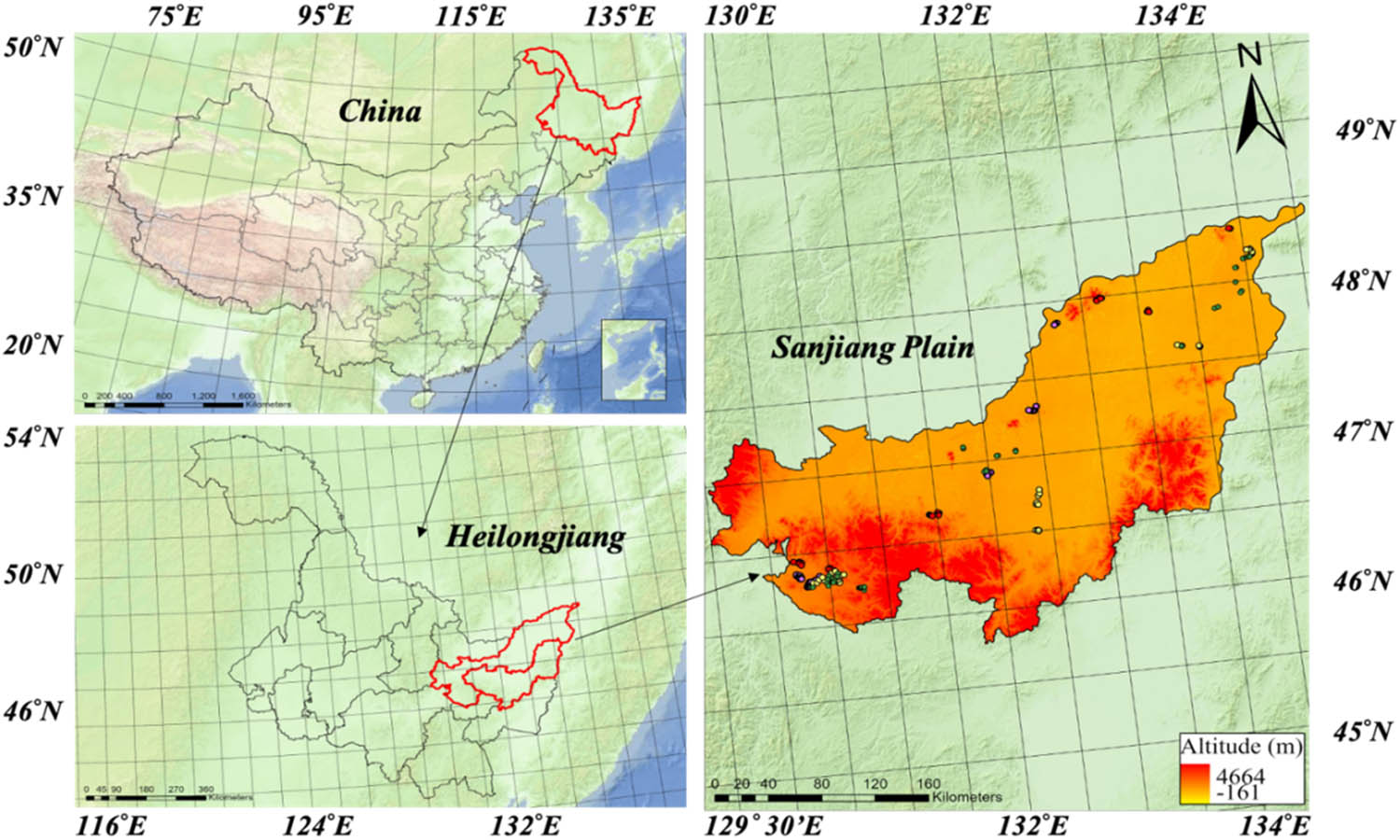
Figure 1
Geographic distribution of sampling sites in 2024 in the Sanjiang Plain. Symbols indicate soil type at each sampling location: pink circle, black soil (Phaeozem); blue circle, meadow soil; yellow circle, albic soil; red circle, dark brown soil (Cambisol).
Within each field, a modified S-pattern sampling strategy was employed to capture spatial variability while maintaining sampling efficiency. Using a 2.5 cm diameter soil probe, 10–12 cores were collected from the 0–20 cm profile per field, targeting the root zone where H. glycines populations concentrate. Cores were extracted approximately 5 cm from the base of individual plants, avoiding row middles, where nematode densities are typically lower. Visible crop residues and surface litter were removed from cores before compositing. All cores from a single field were thoroughly mixed to produce a single composite sample of approximately 1 kg, which was sealed in a labeled polyethylene bag. Each sample label recorded county, field coordinates (global positioning system (GPS)), collection date, soil type, and cropping history. Samples were transported to the laboratory in insulated containers and processed within 72 h of collection. Subsamples for cyst and egg enumeration were air-dried at room temperature for 48–72 h before extraction.
2.3. Cyst extraction and population quantification
Cysts were extracted using a decanting and wet-sieving protocol (Krusberg and Sardanelli, 1994). For each sample, 100 g of air-dried soil was transferred to a 1,000 mL beaker containing approximately 500 mL of tap water. The suspension was stirred vigorously for 30 s using a glass rod and then allowed to settle for 15 s. Sand and coarse particles sedimented, while cysts remained in suspension. The supernatant was poured through a nested sieve series consisting of a 20-mesh (850 μm) screen over a 100-mesh (150 μm) screen. The 20-mesh sieve retained coarse organic debris, while cysts were retained on the 100-mesh sieve. Material on the 100-mesh sieve was backwashed into a clean beaker using a gentle stream of distilled water. This decanting and sieving procedure was repeated three times per sample to ensure thorough recovery of cysts.
Recovered cysts were transferred to a glass Petri dish and examined under a stereomicroscope. Empty cysts were differentiated (translucent, collapsed, lacking visible eggs) from intact cysts (brown, turgid, with visible egg mass) and enumerated in each category separately. For population density determination, intact cysts were transferred to a nested sieve system (200 mesh [75 μm] over 500 mesh [25 μm]). Cysts were gently crushed with a rubber stopper to release eggs and juveniles, and the upper sieve was then rinsed thoroughly with high-pressure water from a wash bottle. Eggs and juveniles retained on the 500-mesh sieve were collected in sterile distilled water and transferred to a counting slide. Total eggs and juveniles were counted under a stereomicroscope using a gridded counting chamber. Population density was expressed as the number of eggs and juveniles per 100 g dry soil. Cyst density was expressed as total cysts (empty plus intact) per 100 g dry soil.
2.4. Nematode population propagation
For virulence phenotyping, soil samples with an average population density of more than 1,000 eggs and juveniles per 100 g dry soil were selected to ensure sufficient inoculum for greenhouse multiplication. Nine samples meeting this criterion and representing the geographic distribution of surveyed counties were propagated under controlled conditions. For each population, infested field soil was mixed 1:1 (v:v) with autoclaved sand in 15 cm diameter plastic pots (∼1.5 L capacity). Six seeds of the susceptible cv. Hefeng 50 were sown in each pot and thinned to four plants after emergence. All populations were maintained in a greenhouse at the Agricultural Technology Center, Northeast Institute of Geography and Agroecology, Chinese Academy of Sciences, Harbin. Greenhouse conditions were maintained at 23–28°C with a 16 h light cycle (approximately 300 μmol min⁻² s⁻¹ photosynthetically active radiation at plant height). Plants were watered as needed to maintain soil at near field capacity and fertilized weekly with half-strength Hoagland’s solution. Each population was propagated through three consecutive generations to increase nematode numbers and minimize contamination from soil organisms. After the third generation (96 days), plants were removed, and the soil was processed for cyst and egg extraction as previously described. Egg suspensions were incubated in darkness at 25°C for 4–6 days to allow J2 hatching. Freshly hatched J2 concentration was determined by counting three 0.1 mL aliquots under a dissecting microscope, and suspensions were adjusted to 1,000 juveniles per mL for subsequent inoculation.
2.5. Virulence phenotype characterization
Virulence phenotypes of H. glycines populations were characterized using the traditional race scheme based on the four-differential system of Riggs and Schmitt (1988), with the cv. Lee 74 serving as the susceptible control. Seeds were surface-sterilized by rinsing under tap water for 10 min, then in 1.5% (w/v) sodium hypochlorite for another 10 min, followed by three rinses with sterile water. Sterilized seeds were placed on moist filter paper in Petri dishes and incubated at 25°C in darkness for 48 h. Seedlings with approximately 2 cm radicles were transplanted into polyvinyl chloride (PVC) tubes (6 cm diameter × 12 cm depth) filled with autoclaved sand: soil (1:1, v:v). The experiment followed a randomized complete block design with six replicates per indicator line under the same greenhouse conditions as previously described. At 12 days after transplanting, each plant was inoculated with 1,000 J2s. Plants were harvested 21 days after inoculation, when females are fully developed but have not yet formed cysts, which facilitated enumeration. Tubes soaked in tap water for 10 min softened the soil, facilitating root extraction; the roots were then rinsed carefully. White females attached to roots were dislodged with a high-pressure wash, collected on a sieve, transferred to Petri dishes, and counted under a stereomicroscope. FI for each differential line was calculated as follows: FI = (average number of females on indicator line/average number of females on Lee 74) × 100. According to Riggs and Schmitt (1988), lines were classified as susceptible (“+”) if FI ≥ 10%, or resistant (“−”) if FI < 10%. Experiments were valid only when the mean female counts on Lee 74 exceeded 60, ensuring sufficient nematode pressure for accurate virulence assessment. The race classification for each population was tested twice, with an interval of 4–6 weeks between the experiments.
2.6. Statistical analysis
All statistical analyses were performed using SPSS Statistics version 27 (IBM Corp., Armonk, NY, USA). Nematode population density (eggs and J2 per 100 g dry soil) was analyzed using a one-way analysis of variance (ANOVA). Prior to analysis, data were assessed for normality using the Shapiro–Wilk test and for homogeneity of variances using Levene’s test. Although population density data exhibited positive skew typical of nematode distribution patterns, ANOVA was considered robust to this departure given the balanced sample sizes and moderate skewness coefficients (< 2.0). Where significant main effects or interactions were detected (P < 0.05), Tukey’s honestly significant difference (HSD) was used to compare treatments. FI values for race testing were averaged across replicates to obtain the mean FI for each combination. Variability was reported as standard error (SE). Graphs were generated using GraphPad Prism 10. Location maps were created in ArcGIS Pro 3.0, with coordinates in WGS 1984 and the Albers projection.
3. Results
3.1. Regional distribution and detection rates
Cysts were detected in all six counties surveyed, confirming widespread nematode distribution across the Sanjiang Plain. Out of 186 soil samples collected, 174 tested positive for SCN, yielding an overall detection rate of 93.5%. Empty cysts predominated across the survey area, accounting for the majority of recovered cysts at all locations. Detection rates varied across counties and prefectures. In Shuangyashan Prefecture, Baoqing County had a 92.9% detection rate, with empty cysts comprising 74.9% of the total, whereas Raohe County had 100% detection, with 61.0% empty cysts. Within Jiamusi Prefecture, detection rates were 96.9% in Huanan County, 92.9% in Tongjiang City, and 83.3% in Fuyuan City. Fujin City exhibited notably lower detection (25.0%), although empty cysts still accounted for 82.2% of recovered cysts in positive samples. Across all Jiamusi counties, the proportion of empty cysts ranged from 80.9 to 95.2% (Table 1).
Table 1
Heterodera glycines distribution and population density across six counties in the Sanjiang Plain of Heilongjiang Province, China
| Region | County | Soil samples | Positive (%) | Empty cysts (%) | Cysts per 100 g soil | Eggs and juveniles per 100 g soil | |
|---|---|---|---|---|---|---|---|
| Mean value ± SE | Maximum | Mean value ± SE | |||||
| Shuangyashan | Baoqing | 42 | 92.9 | 74.9 | 3 ± 0.5 | 17 | 288 ± 57.5 |
| Raohe | 12 | 100 | 61.0 | 4 ± 0.8 | 14 | 579 ± 178.2 | |
| Jiamusi | Tongjiang | 6 | 83.3 | 80.9 | 6 ± 3.0 | 47 | 386 ± 284.9 |
| Fuyuan | 14 | 92.9 | 88.5 | 8 ± 2.7 | 59 | 318 ± 107.5 | |
| Fujin | 16 | 25.0 | 82.2 | 2 ± 0.5 | 17 | 122 ± 68.4 | |
| Huanan | 96 | 96.9 | 95.2 | 10 ± 1.4 | 165 | 174 ± 29.8 | |
3.2. Population density patterns
Mean cyst densities ranged from 2 to 10 cysts per 100 g dry soil among counties, while population densities (eggs and juveniles) ranged from 122 to 579 per 100 g dry soil (Table 1). Huanan County samples yielded the highest mean cyst density (10 ± 1.36 per 100 g), with individual samples reaching 165 cysts per 100 g (Supplementary Table S1). Raohe County exhibited the highest mean population density of 579 ± 178.17 eggs and juveniles per 100 g, with a maximum density of 1,602 per 100 g in individual samples. Conversely, Fujin City displayed the lowest mean population density (122 ± 68.4 per 100 g), consistent with its reduced cyst detection rate. Maximum population densities across all counties ranged from 890 to 1,780 eggs and juveniles per 100 g, indicating substantial within-county variability (Table 1).
3.3. Influence of cropping system on population abundance
Cropping history influenced H. glycines population densities, though the magnitude of the effect varied with soil type. Fields under maize–soybean rotation harbored lower mean population densities (204 eggs and juveniles per 100 g dry soil) compared with continuous soybean systems (252 per 100 g), though this difference was not statistically significant across all soil types (P > 0.05; Fig. 2a). However, examination of continuous soybean fields revealed significant population density variation among soil types (P < 0.05; Fig. 2b).
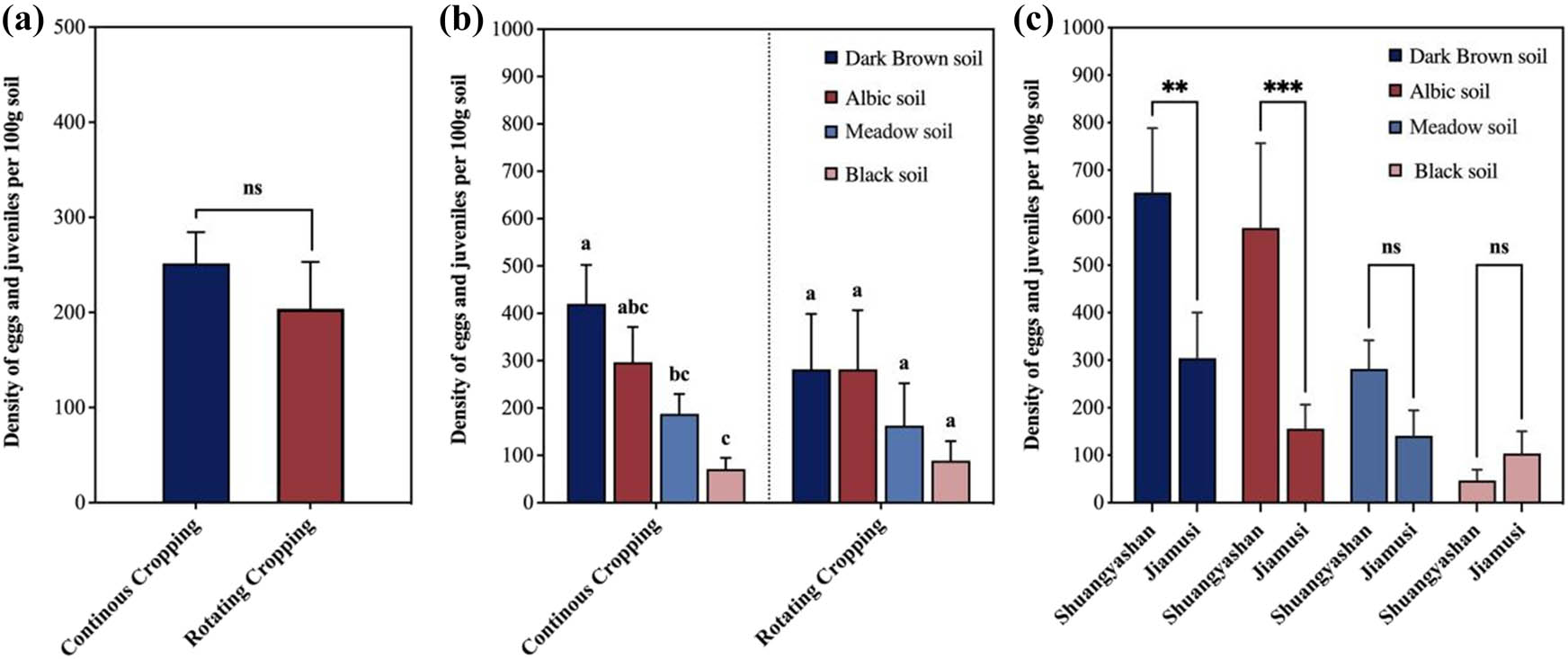
Figure 2
Population density of Heterodera glycines by cropping system and different soil types in the Sanjiang Plain. (a) Population density under different cropping systems. The bars represent the mean values ± SE (ns represents not significant, P > 0.05). (b) Population density across soil types under continuous soybean cultivation vs crop rotation. The bars represent the mean values ± SE. The same lowercase letters indicate no significant differences among soil types within the same farm system (Tukey’s HSD test, P > 0.05). (c) Population density across soil types under continuous soybean cultivation by prefecture (Shuangyashan and Jiamusi). The bars represent the mean values ± SE (**, P < 0.01; ***, P < 0.001; ns represents not significant, P > 0.05).
3.4. Soil type associations with population density
Under continuous soybean cultivation, dark brown soils supported significantly higher populations of H. glycines than other soil types. Mean population density in dark brown soils reached 420 eggs and juveniles per 100 g dry soil, exceeding that in black soils (71 per 100 g; P < 0.001) and meadow soils (188 per 100 g; P < 0.05). Albic soils harbored intermediate densities (297 per 100 g), which did not differ significantly from dark brown soils (Fig. 2b). Within dark brown soils, continuous soybean fields contained higher populations (420 per 100 g) than maize-soybean rotation fields (282 per 100 g), illustrating the interaction between soil type and cropping system. Among the 138 samples collected from continuous soybean fields, soil-type effects were consistent across prefectures, though absolute density levels varied (Fig. 2c). In both Shuangyashan and Jiamusi prefectures, dark brown soils had the highest mean densities (653 and 304 eggs and juveniles per 100 g, respectively), followed by albic soils (579 and 156 per 100 g) and meadow soils (282 and 142 per 100 g). Black soils consistently harbored the lowest populations in both prefectures (47 and 104 per 100 g). Population densities in Shuangyashan Prefecture exceeded those in Jiamusi Prefecture across all soil types (P < 0.01), with particularly pronounced differences in dark brown and albic soils (P < 0.001; Fig. 2c). Complete field-level data, including geographic coordinates, are provided in Supplementary Table S1.
3.5. Virulence phenotype characterization
We attempted to characterize virulence in 14 representative populations from Shuangyashan and Jiamusi prefectures. Nine populations produced sufficient females on susceptible check Lee 74 (mean counts: 66–172 females per plant) to permit reliable race designation (Table 2). All nine populations exhibited FI values below 10% on the four differential hosts: PI 548402 (Peking), FI = 0.7–4.3%; PI 88788, FI = 2.3–6.1%; PI 90763, FI = 0.4–3.7%; and Pickett, FI = 1.9–4.5%. These reaction patterns classify all tested populations as race 3 according to the Riggs and Schmitt (1988) scheme, indicating virulence on PI 548402 but avirulence on PI 88788, PI 90763, and Pickett. The uniform race 3 designation was applied to populations from Raohe County (three populations), Baoqing County (two populations), and single population from Fujin City, Fuyuan City, and Huanan County (two populations). FI values showed quantitative variation among populations on individual differential hosts, yet all remained well below the 10% susceptibility threshold. Despite differences in female numbers on Lee 74 (ranging from 66 to 172; 2.6-fold difference), all populations exhibited qualitatively similar reproductive patterns on the differential set, supporting their assignment to a single race type (Table 2).
Table 2
Virulence phenotypes of Heterodera glycines populations from the Sanjiang Plain determined using standard differential hosts
| Region | Population | Lee 74 females | FI (%)a | Raceb | |||
|---|---|---|---|---|---|---|---|
| PI 548402 | PI 88788 | PI 90763 | Pickett | ||||
| Shuangyashan | Raohe #1 | 79 ± 17.7 | 3.8 ± 1.4 | 4.4 ± 1.8 | 1.3 ± 0.7 | 1.9 ± 0.5 | 3 |
| Raohe #2 | 87 ± 18.7 | 2.6 ± 0.6 | 2.3 ± 0.4 | 1.1 ± 0.7 | 3.4 ± 0.7 | 3 | |
| Raohe #3 | 172 ± 17.4 | 0.7 ± 0.3 | 2.5 ± 0.8 | 0.4 ± 0.2 | 3.2 ± 0.6 | 3 | |
| Baoqing #1 | 66 ± 3.8 | 2.7 ± 1.1 | 2.7 ± 1.5 | 3.0 ± 1.2 | 4.2 ± 2.0 | 3 | |
| Baoqing #2 | 94 ± 7.8 | 3.5 ± 1.3 | 6.1 ± 1.0 | 3.2 ± 1.0 | 4.5 ± 2.8 | 3 | |
| Jiamusi | Fujin | 163 ± 10.6 | 4.3 ± 0.6 | 4.4 ± 1.2 | 3.7 ± 0.7 | 2.1 ± 0.6 | 3 |
| Fuyuan | 135 ± 6.7 | 2.8 ± 0.9 | 3.6 ± 1.0 | 3.0 ± 1.2 | 4.1 ± 1.0 | 3 | |
| Huanan #1 | 92 ± 3.2 | 4.3 ± 1.2 | 2.7 ± 1.0 | 2.7 ± 1.0 | 4.1 ± 1.6 | 3 | |
| Huanan #2 | 158 ± 22.3 | 3.5 ± 1.3 | 4.4 ± 0.8 | 2.1 ± 0.5 | 3.2 ± 0.8 | 3 | |
Notes: Female counts represent mean values from six biological replicates per population.
[ii] bRace assignment follows Riggs and Schmitt (1988): FI ≥ 10% indicates susceptibility, FI < 10% indicates resistance. All populations showed FI < 10% on PI 88788, PI 90763, and Pickett, indicating race 3.
4. Discussion
This survey documents the widespread distribution of SCN across the Sanjiang Plain. Cyst were detected in all six sampled counties, confirming its occurrence throughout this eastern Heilongjiang soybean production zone. The 93.5% detection rate indicates widespread SCN infestation of soybean fields, though population densities remain moderate or low relative to heavily infested regions elsewhere in Heilongjiang Province (Chen et al., 2021; You et al., 2024b). Empty cysts predominated across samples, with viable cysts comprising 5–39% by location. Population densities averaged 122–579 eggs and juveniles per 100 g dry soil, substantially below typical damage thresholds. Cyst densities (2–10 per 100 g) were lower than those commonly observed in continuous soybean monoculture systems. The high proportion of empty cysts in this region indicated the relatively lower reproductive fitness of the SCN population rather than its virulence. Several factors may contribute to the predominance of empty cysts in the surveyed fields. As an obligate parasite, SCN reproduction is strictly limited to periods when susceptible hosts are present. In crop rotation systems, SCN populations decline through natural mortality during non-host years, leaving empty cysts as vestiges of prior infestations (Rocha et al., 2021; Chen et al., 2025). The widespread adoption of maize–soybean rotation in this region likely promotes this dynamic (Zhang et al., 2025). Additionally, the Sanjiang Plain has a history of extensive rice production, with substantial paddy-to-upland conversion over the past decade (Jin et al., 2022; Ning et al., 2024), and fields recently converted from rice may harbor reduced SCN populations despite current soybean cultivation (Wendimu, 2022). Empty cysts may also represent older cohorts from which viable eggs have been depleted through hatching, mortality, or both.
The association between cropping systems and SCN population density is consistent with extensive research on the effectiveness of crop rotation for SCN control. Our results show that maize–soybean rotation reduced SCN densities (204 eggs and juveniles per 100 g dry soil) compared to continuous soybean cultivation (252 per 100 g), illustrating the nematode’s obligate parasitism and narrow host range. Without suitable hosts, SCN populations decline at annual rates of 40–70%, depending on environmental conditions (Niblack, 2005; Rocha et al., 2021; Wendimu, 2022). The observed 19% reduction in SCN density under rotation is modest compared to earlier studies, likely due to the single-season rotation interval typical in this area; multi-year rotations with consecutive non-host crops could achieve greater population suppression.
Soil type analysis revealed substantial variation in SCN abundance under continuous soybean cultivation, with dark brown soils harboring nearly fourfold higher SCN densities (420 per 100 g) than meadow soils (115 per 100 g). These differences reflect complex interactions among physical, chemical, and biological soil properties. Soil texture is a primary determinant of SCN distribution at field scales, affecting moisture retention, aeration, root growth, and J2 movement through soil pores. Previous studies consistently document positive associations between sand content and SCN density (Koenning et al., 1988; Avendaño et al., 2004), attributed to improved drainage and larger pore spaces that facilitate J2 migration. Dark brown soils in this region typically have loamy to sandy loam textures with moderate sand fractions, creating microenvironments conducive to SCN activity, whereas meadow soils (higher clay content, reduced permeability) impede J2 movement and create less favorable moisture regimes. Soil chemical properties may further modulate SCN population dynamics by affecting host physiology and nematode development. For example, several studies suggested that soil pH governs the distribution of SCN in fields, and high SCN population densities are typically found in areas with soil pH 7.0–8.0 compared with areas of pH 5.9–6.5 (Rogovska et al., 2009; Pedersen et al., 2010). It is possible that soil pH influences nutrient availability and root exudate composition, potentially altering host suitability or chemotactic cues guiding J2 to host roots. Additionally, organic matter content correlates with microbial community structure, including nematophagous fungi and bacteria that may suppress SCN through predation, parasitism, or antibiosis. Although we did not quantify these soil properties, the observed variation in SCN density among soil types highlights the need for systematic investigation of edaphic factors. Future surveys incorporating detailed soil characterization (texture, pH, organic matter, and nutrient profiles) will enable a more mechanistic understanding of SCN distribution patterns.
In contrast to the complex SCN population structure documented in western and northern Heilongjiang, race 3 was identified in all tested SCN populations, indicating remarkable virulence uniformity in the Sanjiang Plain. This phenotype, defined by avirulence on Peking, PI 88788, PI 90763, and Pickett (Riggs and Schmitt, 1988), represents the most common virulence type throughout Heilongjiang Province, China (Chen, 2019; You et al., 2024a). This implies that developing SCN-resistant cultivars using Peking or PI 88788-derived resistance, the most commonly used source in SCN-resistant soybean cultivars in China, remains effective in this region. The absence of races 1, 4, 6, and other virulence phenotypes may reflect insufficient selection pressure from the relatively recent intensification of soybean production or reduced SCN generations due to widespread crop rotation, as virulence shifts require sustained selection against single resistance genes over multiple generations to increase the frequency of rare virulent individuals. Regional contrasts provide valuable insights into SCN virulence evolution. In Anda, continuous cultivation of Peking-type resistant cultivars shifted SCN race composition from predominantly race 3 in the 1990s to races 4 and 14 by the mid-2000s (Chen et al., 2015; Yang et al., 2015); these derived races exhibit virulence on PI 88788, indicating evolution at the rhg1 locus or other genetic determinants of SCN parasitic compatibility. Similarly, recent Daqing surveys documented SCN races 1 and 6, which have broader virulence spectra encompassing multiple host species (You et al., 2024a). Most notably, province-wide comparisons from 2015 to 2021–2022 revealed increasing FI values on PI 548316, with virulent SCN populations rising from 64.5 to 71.7% (Chen et al., 2021; You et al., 2024b), suggesting a gradual decline in resistance effectiveness and raising concerns about the long-term durability of current SCN-resistant soybean breeding strategies.
Funding information
This work was funded by the High-tech Industrialization Cooperation Project of Jilin Province and the Chinese Academy of Sciences (Grant No. 2024SYHZ0051), and the Nematode Prevention and Control Post of the National Soybean Industry Technology System (Grant No. CARS-04-PS27).
Author contributions
LX: Methodology, investigation, formalanalysis and writing original draft preparation; LYF: methodology and investigation; LYS: sampling, review and editing; YJ: funding acquisition, review and editing; LSF, WJ, and SY: review and editing; HY: conceptualization, methodology, formalanalysis, validation, writing original draft preparation, funding acquisition, review and editing.
Conflict of interest statement
The authors declare that they have no conflict of interest.
Data availability statement
The data supporting the findings of this study are availablefrom the corresponding author upon reasonable request.