
Pistachio (Pistacia vera L.) is one of the most important economic agricultural products in the world, which is widely cultivated in the Kerman and Khorasan Razavi provinces of Iran (Ahmadi et al., 2016). Until 2016, Iran was the world’s leading producer of pistachios. However, despite an increase in cultivation, this position has now fallen to second place (Faostat, 2024).
Plant parasitic nematodes cause yield losses annually, which is estimated to be nearly $125 billion worldwide (Mesa-Valle et al., 2020). Among plant parasitic nematodes, root-knot nematodes (RKNs) are known as the most economically important group. The genus Meloidogyne Göldi, 1887 currently includes 101 species (Subbotin et al., 2021; Rolish et al., 2023; Gu et al., 2023; Sun et al., 2024). Pistachio yield is substantially reduced by RKNs (Fazeli Salmani et al., 2012; Shekari Mahoonaki et al., 2022).
Some studies have previously been carried out on RKNs in pistachio orchards in Iran. The results reported three species from pistachio orchards of Kerman province, including M. javanica (Treub 1885) Chitwood 1949, M. incognita (Kofoid and White 1919) Chitwood 1949, and M. arenaria (Neal 1889) Chitwood 1949. The latter species has been identified using both morphological and molecular data (Farivar Mehin 1986; Shekari Mahoonaki et al., 2024). M. javanica is one of the most widely distributed species and its prevalence has been documented multiple times in pistachio orchards across the country (Askarian et al., 2009; Neshat et al., 2011; Madani et al., 2012; Hadadfar et al., 2020).
Effective management of RKNs is dependent on the accurate species identification (Khanal et al., 2016). Identifying Meloidogyne species with conventional morphological methods is challenging, especially for members of the tropical group (Janssen et al., 2016). To solve this problem, an integrative approach using morphological and molecular data (ribosomal and mitochondrial markers) is applied (Kiewnick et al., 2014; Subbotin et al., 2021).
The aims of the present study are to (i) determine and visualize the distribution of M. javanica in Kerman and Khorasan Razavi provinces, the two main pistachio growing areas of Iran, (ii) characterize 37 isolates of the species based on the perineal pattern of females and species-specific primers, and (iii) characterize eight isolates based upon morphological, morphometric, and molecular data (small subunit [SSU] rDNA, COII-16S, and NADH dehydrogenase subunit 5 [Nad5] mtDNA sequences).
1. Materials and methods
1.1. Sampling, culturing in greenhouse, and Meloidogyne javanica isolates characterization
Eighty-four different localities of pistachio orchards in Kerman and Khorasan Razavi provinces, respectively in southeastern and northeastern Iran were selected for sampling during 2018–2024. Samples were kept in plastic bags (each soil + infected root inside a nylon bag was regarded as one sample) and the necessary data including codes, locality, and GPS information were recorded (Table 1) and then transferred to the laboratory for further processing. Due to difficulties in separating intact female specimens from woody roots of pistachio, all RKN isolates were reared on tomato (Solanum lycopersicum cv. Early Urbana) in the greenhouse using one egg mass, separated from infected roots (one egg mass from one infected root sample was inoculated into one pot including four seedlings). After 45 days, the infected tomato roots were cut and mature females were isolated.
Table 1
Geographical distribution information of Meloidogyne spp. in infested and non-infested areas of the sampling regions in two main pistachio growing provinces of Iran (GPS coordination in DMS format)
| No. | Isolate code | Sampling area | N | E | Pistachio rootstock | Species |
|---|---|---|---|---|---|---|
| 1 | KS1-1 | Kerman province, Sirjan | 29°10′44″ | 55°52′29″ | Baneh | M. javanica |
| 2 | KS1-2 | Kerman province, Sirjan | 29°10′44″ | 55°52′22″ | Baneh | M. javanica |
| 3 | KS1-3 | Kerman province, Sirjan | 29°10′49″ | 55°52′49″ | Kalleghoochi | M. javanica |
| 4 | KS1-4 | Kerman province, Sirjan | 29°10′52″ | 55°52′41″ | Baneh | Non-infested |
| 5 | KS1-5 | Kerman province, Sirjan | 29°10′28″ | 55°52′03″ | Fandoghi | M. javanica |
| 6 | KS1-6 | Kerman province, Sirjan | 29°10′34″ | 55°52′15″ | Fandoghi | Non-infested |
| 7 | KS1-7 | Kerman province, Sirjan | 29°10′52″ | 55°52′42″ | Baneh | M. javanica |
| 8 | KS1-8 | Kerman province, Sirjan | 29°10′46″ | 55°52′22″ | Baneh (male) | Non-infested |
| 9 | KS1-9 | Kerman province, Sirjan | 29°10′52″ | 55°52′41″ | Baneh | M. javanica |
| 10 | KS1-10 | Kerman province, Sirjan | 29°11′12″ | 55°53′20″ | Ahmad Aghaei | M. javanica |
| 11 | KS2-1 | Kerman province, Sirjan | 29°11′17″ | 55°51′02″ | Ahmad Aghaei | M. javanica |
| 12 | KS2-2 | Kerman province, Sirjan | 29°11′18″ | 55°51′10″ | Kalleghoochi | M. javanica |
| 13 | KR1-1 | Kerman province, Rafsanjan | 30°25′17″ | 55°49′41″ | Fandoghi | M. arenaria |
| 14 | KR2-1 | Kerman province, Rafsanjan | 30°25′56.3″ | 56°00′40.9″ | Fandoghi | Non-infested |
| 15 | KR3-1 | Kerman province, Rafsanjan | 30°25′51″ | 55°51′50″ | Fandoghi | M. javanica |
| 16 | KR4-1 | Kerman province, Rafsanjan | 30°31′19.6″ | 55°40′42.6″ | Kalleghoochi | Non-infested |
| 17 | KR5-1 | Kerman province, Rafsanjan | 30°27′50.4″ | 55°41′01.2″ | Kalleghoochi | Non-infested |
| 18 | KR6-1 | Kerman province, Rafsanjan | 30°30′20.0″ | 56°04′11.1″ | Kalleghoochi | Non-infested |
| 19 | KR7-1 | Kerman province, Rafsanjan | 30°25′39″ | 55°51′24″ | Fandoghi | M. incognita |
| 20 | KR8-1 | Kerman province, Rafsanjan | 30°22′53″ | 55°50′51″ | Fandoghi | M. javanica |
| 21 | KR9-1 | Kerman province, Rafsanjan | 30°20′11″ | 56°08′49″ | Kalleghoochi | M. javanica |
| 22 | KR10-1 | Kerman province, Rafsanjan | 30°32′13″ | 55°40′29″ | Kalleghoochi | M. javanica |
| 23 | KR11-1 | Kerman province, Rafsanjan | 30°21′20″ | 56°09′28″ | Kalleghoochi | M. incognita |
| 24 | KR12-1 | Kerman province, Rafsanjan | 30°23′49″ | 55°56′56″ | Fandoghi | M. incognita |
| 25 | KR13-1 | Kerman province, Rafsanjan | — | — | Unknown | M. javanica |
| 26 | KN1-1 | Kerman province, Nough (Rafsanjan) | 30°58′24″ | 55°35′36″ | Kalleghoochi | M. arenaria |
| 27 | KN2-1 | Kerman province, Nough (Rafsanjan) | 30°30′47.3″ | 55°59′02.2″ | Fandoghi | Non-infested |
| 28 | KN3-1 | Kerman province, Nough (Rafsanjan) | 30°35′55.5″ | 55°55′44.6″ | Fandoghi | Non-infested |
| 29 | KN4-1 | Kerman province, Nough (Rafsanjan) | 30°58′21.6″ | 55°35′47.6″ | Kalleghoochi | Non-infested |
| 30 | KN5-1 | Kerman province, Nough (Rafsanjan) | 30°46′03.4″ | 55°50′36.7″ | Kalleghoochi | Non-infested |
| 31 | KN6-1 | Kerman province, Nough (Rafsanjan) | 30°31′22.6″ | 55°58′46.2″ | Ahmad Aghaei | Non-infested |
| 32 | KN7-1 | Kerman province, Nough (Rafsanjan) | 30°55′02″ | 55°41′21″ | Fandoghi | M. javanica |
| 33 | KN8-1 | Kerman province, Nough (Rafsanjan) | 31°00′33″ | 55°33′18″ | Ahmad Aghaei | M. incognita |
| 34 | KN9-1 | Kerman province, Nough (Rafsanjan) | 30°57′24″ | 55°37′57″ | Ahmad Aghaei | M. javanica |
| 35 | KA1-1 | Kerman province, Anar | 30°42′49.8″ | 55°28′22.3″ | Kalleghoochi | Non-infested |
| 36 | KA2-1 | Kerman province, Anar | 30°46′31.2″ | 55°24′28.1″ | Akbari | Non-infested |
| 37 | KA3-1 | Kerman province, Anar | 30°55′18.0″ | 55°15′55.2″ | Kalleghoochi | Non-infested |
| 38 | KA3-2 | Kerman province, Anar | 30°55′21.0″ | 55°16′02.0″ | Akbari | Non-infested |
| 39 | KA3-3 | Kerman province, Anar | 30°55′20.0″ | 55°15′60.0″ | Kalleghoochi | Non-infested |
| 40 | KA4-1 | Kerman province, Anar | 30°52′48.9″ | 55°16′33.0″ | Kalleghoochi | Non-infested |
| 41 | KA4-2 | Kerman province, Anar | 30°53′02.3″ | 55°16′38.6″ | Akbari | Non-infested |
| 42 | KSh1-1 | Kerman province, Shahr-e Babak | 30°12′52″ | 55°03′32″ | Akbari | M. javanica |
| 43 | KSh2-1 | Kerman province, Shahr-e Babak | 30°10′52″ | 55°03′11″ | Akbari | M. cruciani |
| 44 | K-R-1-1 | Kerman province, Ravar | 31°16′09.5″ | 56°46′44.3″ | Kalleghoochi | Non-infested |
| 45 | K-K-1-1 | Kerman province, Kerman | — | — | Fandoghi | M. incognita |
| 46 | K-Z-1-1 | Kerman province, Zarand | — | — | Fandoghi | M. incognita |
| 47 | KhF1-1 | Khorasan Razavi province, Mahvelat | 34°58′08.0″ | 58°41′03.8″ | Sefid Badami | Non-infested |
| 48 | KhF1–2 | Khorasan Razavi province, Mahvelat | 34°58′37″ | 58°42′10″ | Sefid Badami | M. arenaria |
| 49 | KhF1-3 | Khorasan Razavi province, Mahvelat | 34°57′14″ | 58°39′28″ | Sefid Badami | M. arenaria |
| 50 | KhF1-4 | Khorasan Razavi province, Mahvelat | 34°57′81″ | 58°41′19″ | Sefid Badami | M. javanica |
| 51 | KhF2-1 | Khorasan Razavi province, Mahvelat | 34°59′89″ | 58°43′12″ | Sefid Badami | M. javanica |
| 52 | KF3-1 | Khorasan Razavi province, Mahvelat | 35°00′02.8″ | 58°35′15.9″ | Sefid Badami | Non-infested |
| 53 | KF3-2 | Khorasan Razavi province, Mahvelat | 35°00′11″ | 58°35′07″ | Sefid Badami | M. cruciani |
| 54 | KhF4-1 | Khorasan Razavi province, Mahvelat | 35°02′32″ | 58°49′31″ | Sefid Badami | M. javanica |
| 55 | KhF4-2 | Khorasan Razavi province, Mahvelat | 35°02′32″ | 58°49′42″ | Sefid Badami | M. javanica |
| 56 | KhF4-3 | Khorasan Razavi province, Mahvelat | 35°02′30″ | 58°49′06″ | Sefid Badami | M. javanica |
| 57 | KhF4-4 | Khorasan Razavi province, Mahvelat | 35°02′35″ | 58°49′33″ | Sefid Badami | M. javanica |
| 58 | KhF5-1 | Khorasan Razavi province, Mahvelat | 35°01′58″ | 58°47′58″ | Sefid Badami | M. javanica |
| 59 | KhF5-2 | Khorasan Razavi province, Mahvelat | 35°01′56″ | 58°48′01″ | Sefid Badami | M. javanica |
| 60 | KhSs1-1 | Khorasan Razavi province, Sarakhs | 36°03′53.1″ | 61°10′51.4″ | Ahmad Aghaei | Non-infested |
| 61 | KhSs1-2 | Khorasan Razavi province, Sarakhs | 36°03′46.7″ | 61°10′45.4″ | Ahmad Aghaei | Non-infested |
| 62 | KhSs2-1 | Khorasan Razavi province, Sarakhs | 36°04′20.8″ | 61°11′03.4″ | Ahmad Aghaei | Non-infested |
| 63 | KhSs2-2 | Khorasan Razavi province, Sarakhs | 36°04′19.6″ | 61°11′12.9″ | Ahmad Aghaei | Non-infested |
| 64 | KhKh1-1 | Khorasan Razavi province, Khooshab | 36°27′44″ | 57°57′56″ | Kalleghoochi | M. javanica |
| 65 | KhKh1-2 | Khorasan Razavi province, Khooshab | 36°27′48″ | 57°57′50″ | Kalleghoochi | M. javanica |
| 66 | KhKh1-3 | Khorasan Razavi province, Khooshab | 36°27′51″ | 57°57′61″ | Kalleghoochi | M. javanica |
| 67 | KhKh1-4 | Khorasan Razavi province, Khooshab | 36°27′53″ | 57°57′53″ | Kalleghoochi | M. javanica |
| 68 | KhKh1-5 | Khorasan Razavi province, Khooshab | 36°28′18″ | 57°59′24″ | Sefid Badami | M. javanica |
| 69 | KhS1-1 | Khorasan Razavi province, Sabzevar | 36°27′48″ | 57°57′50″ | Kalleghoochi | M. javanica |
| 70 | KhS1-2 | Khorasan Razavi province, Sabzevar | 36°10′54″ | 57°59′50″ | Ahmad Aghaei | M. javanica |
| 71 | Kh-S-2-1 | Khorasan Razavi province, Sabzevar | — | — | Unknown | Non-infested |
| 72 | KhB1-1 | Khorasan Razavi province, Bardaskan | — | — | Unknown | M. javanica |
| 73 | Kh-B-2-1 | Khorasan Razavi province, Bardaskan | — | — | Unknown | Non-infested |
| 74 | KhKh1-1 | Khorasan Razavi province, Khalil Abad | — | — | Unknown | Non-infested |
| 75 | KhR1-1 | Khorasan Razavi province, Roshtkhar | 34°41′49.7″ | 59°14′18.4″ | Akbari | Non-infested |
| 76 | KhR2-1 | Khorasan Razavi province, Roshtkhar | 34°42′00.5″ | 59°15′03.5″ | Fandoghi | Non-infested |
| 77 | KhR2-2 | Khorasan Razavi province, Roshtkhar | 34°41′55.2″ | 59°15′10.1″ | Kalleghoochi | Non-infested |
| 78 | KhR3-1 | Khorasan Razavi province, Roshtkhar | 34°42′33.7″ | 59°15′12.8″ | Fandoghi | Non-infested |
| 79 | Kh-K-1-1 | Khorasan Razavi province, Kashmar | 35°19′10.0″ | 58°28′03.9″ | Baneh-Koohi | Non-infested |
| 80 | Kh-K-2-1 | Khorasan Razavi province, Kashmar | 35°20′38.3″ | 58°28′02.0″ | Baneh-Koohi | Non-infested |
| 81 | KhN1-1 | Khorasan Razavi province, Neyshabur | 35°53′41″ | 59°07′46″ | Ahmad Aghaei | M. javanica |
| 82 | KhN1-2 | Khorasan Razavi province, Neyshabur | 35°54′14″ | 59°07′34″ | Akbari | M. javanica |
| 83 | KhTj1-1 | Khorasan Razavi province, Torbat-e Jam | — | — | Kalleghoochi | M. javanica |
| 84 | KhTj1-2 | Khorasan Razavi province, Torbat-e Jam | — | — | Kalleghoochi | M. javanica |
1.2. Morphological characterization
The females, males, and juveniles were heat-killed by adding boiling 4% formaldehyde solution, transferred to anhydrous glycerin, and mounted on permanent slides (De Grisse, 1969). The specimens were observed using a stereomicroscope and a light Olympus BH2 microscope. Perineal patterns were cut from female specimens preserved in lactic acid (Taylor and Netscher, 1974). The recovered populations of Meloidogyne species were primarily identified morphologically based on the characteristics of perineal pattern of females (Jepson, 1987). In second step, species-specific primers Fjav and Rjav (Zijlstra et al., 2000) were used. Finally, the infestation percent of the sampling points to M. javanica was calculated. Eight isolates of M. javanica (KS1-1, KS1-10, KN7-1, KR3-1, KR8-1, KSh1-1, KhF1-4, and KhF2-1) showing morphological/morphometric variations in comparison with the other isolates were selected for detailed studies. Interpretation of morphological features was based on Jepson (1987) and Subbotin et al. (2021).
1.3. Molecular characterization
A single female nematode specimen of each isolate was picked out and transferred to a small drop of tris-ethylenediaminetetraacetic acid (TE) buffer (10 mM Tris-Cl; 0.5 mM ethylenediaminetetraacetic acid; pH 9.0) on a clean slide and squashed using a clean coverslip. The suspension was collected by adding 50 μl of TE buffer. The prepared raw DNA samples were stored at −20°C until used as a polymerase chain reaction (PCR) template and no further purification was performed.
The primers used for PCR and DNA sequencing are given in Table 2. The 25 μl PCR mixture contained 12.5 μl 2X Taq red master mix DNA polymerase (Amplicon, Stenhuggervej 22 DK-5230 Odense M Denmark), 7.5 μl distilled water, 1 μl each of 10 μM forward and reverse primers, and 3 μl of raw DNA template. The PCR was performed in a Biometra® thermocycler (Analytik Jena AG, Jena, Germany). All amplifications were carried out under the following cycling conditions: 94°C for 5 min, then 35 cycles of 94°C for 30 s, 55°C for 30 s, 72°C for 30 s, and final extension at 72°C for 10 min.
Table 2
Primers used for sequencing different loci in the present study
| Locus | Primers | Sequence: 5′–3′ | Reference |
|---|---|---|---|
| SCAR | Fjav | GGTGCGCGATTGAACTGAGC | Zijlstra et al. (2000) |
| Rjav | CAGGCCCTTCAGTGGAACTATAC | ||
| SSU rDNA | 988F | CTCAAAGATTAAGCCATGC | Holterman et al. (2006) |
| 1912R | TTTACGGTCAGAACTAGGG | ||
| 1813F | CTGCGTGAGAGGTGAAAT | ||
| 2646R | GCTACCTTGTTACGACTTTT | ||
| COII–16S | C2F3 | GGTCAATGTTCAGAAATTTGTGG | Powers and Harris (1993) |
| 1,108 | TACCTTTGACCAATCACGCT | ||
| NADH dehydrogenase subunit 5 (Nad5) | NAD5F | TATTTTTTGTTTGAGATATATTAG | Janssen et al. (2016) |
| NAD5R | CGTGAATCTTGATTTTCCATTTTT |
Amplified PCR products were loaded into 1% agarose gel and were electrophoresed at 80 V for 40 min with Tris, borate, and ethylenediaminetetraacetic (TBE) buffer and Green-Viewer® for gel staining. The successfully amplified PCR products were sequenced using the same primers used in PCR by Macrogen Co., South Korea. The accession numbers of newly obtained sequences are given in Table 3. Molecular identification using species-specific primers (Fjav and Rjav) was exploited to identify 37 isolates of M. javanica (Zijlstra et al., 2000) (no sequencing was performed for this purpose).
Table 3
Eight isolates of Meloidogyne javanica sequenced in the present study and accession numbers of newly generated sequences
| No. | Isolate code | Province/species | Sequenced locus | Accession no. |
|---|---|---|---|---|
| 1 | KS1-1 | Kerman/M. javanica | COII-16S | OR619478 |
| 2 | KS1-10 | Kerman/M. javanica | SSU rDNA | OR583695 |
| NAD5 | OR619481 | |||
| 3 | KN7-1 | Kerman/M. javanica | NAD5 | OR619482 |
| 4 | KR3-1 | Kerman/M. javanica | NAD5 | OR619483 |
| 5 | KR8-1 | Kerman/M. javanica | NAD5 | OR619484 |
| 6 | KSh1-1 | Kerman/M. javanica | NAD5 | OR619485 |
| 7 | KhF1-4 | Khorasan Razavi/M. javanica | SSU rDNA | OR583696 |
| COII-16S | OR619479 | |||
| 8 | KhF2-1 | Khorasan Razavi/M. javanica | COII-16S | OR619480 |
1.4. Phylogenetic analyses
The basic local alignment search tool for nucleotide (BLASTn) at the National Center for Biotechnology Information (NCBI) was used to unravel the identity of the newly generated sequences compared with previously deposited ones. The relevant sequences were downloaded for the three loci to infer phylogenetic relationships of the newly generated sequences. The SSU rDNA sequence of M. artiellia Franklin, 1961 and Pratylenchus thornei Sher & Allen, 1953, COII-16S sequence of M. enterolobii Yang & Eisenback, 1983 and Radopholus similis (Cobb, 1893) Thorne, 1949 and Nad5 sequences of two isolates of M. enterolobii were used as outgroups for phylogenies of corresponding loci (Kiewnick et al., 2014; Trinh et al., 2022).
The Q-INS-i algorithm of the online version of MAFFT (version 0.91b) was used to align the SSU rDNA, COII-16S, and Nad5 datasets, and the resultant alignments were manually edited using MEGA7 (Kumar et al., 2016). The model of base substitution was selected using MrModeltest 2. The Akaike-supported model, a general time reversible model, including among-site rate heterogeneity and estimates of invariant sites (GTR + G + I), was used in phylogenetic analyses of three loci. Bayesian analyses were performed using MrBayes v3.1.2 running the chains for two million generations. After discarding burn-in samples (the burn-in was set to 25%), the remaining samples were retained for further analysis. The Markov chain Monte Carlo method within a Bayesian framework was used to estimate the Bayesian posterior probabilities (BPP) of the phylogenetic trees using the 50% majority rule. Convergence of model parameters and topologies were assessed based on an average standard deviation of split frequencies and potential scale reduction factor values. Adequacy of the posterior sample size was evaluated using autocorrelation statistics as implemented in Tracer v.1.7 (Rambaut et al., 2018). The output files of the trees were visualized using Dendroscope v3.2.8 and trees were digitally drawn using CorelDRAW software, version 2020.
1.5. Geographical distribution map
Based on the dataset summarized in Table 1, QGIS (https://qgis.org/) was employed to visualize the spatial distribution of infested and non-infested localities associated with RKNs, including Meloidogyne javanica, M. incognita, M. arenaria, and M. cruciani Garcia-Martinez et al., (1982), across studied regions in Kerman and Khorasan Razavi provinces (Fig. 1). A Digital Elevation Model (DEM) was integrated as the base layer to improve interpretation of the geographical and topographical characteristics of the highlighted regions. All spatial datasets were projected using the WGS 1984 geographic coordinate system.
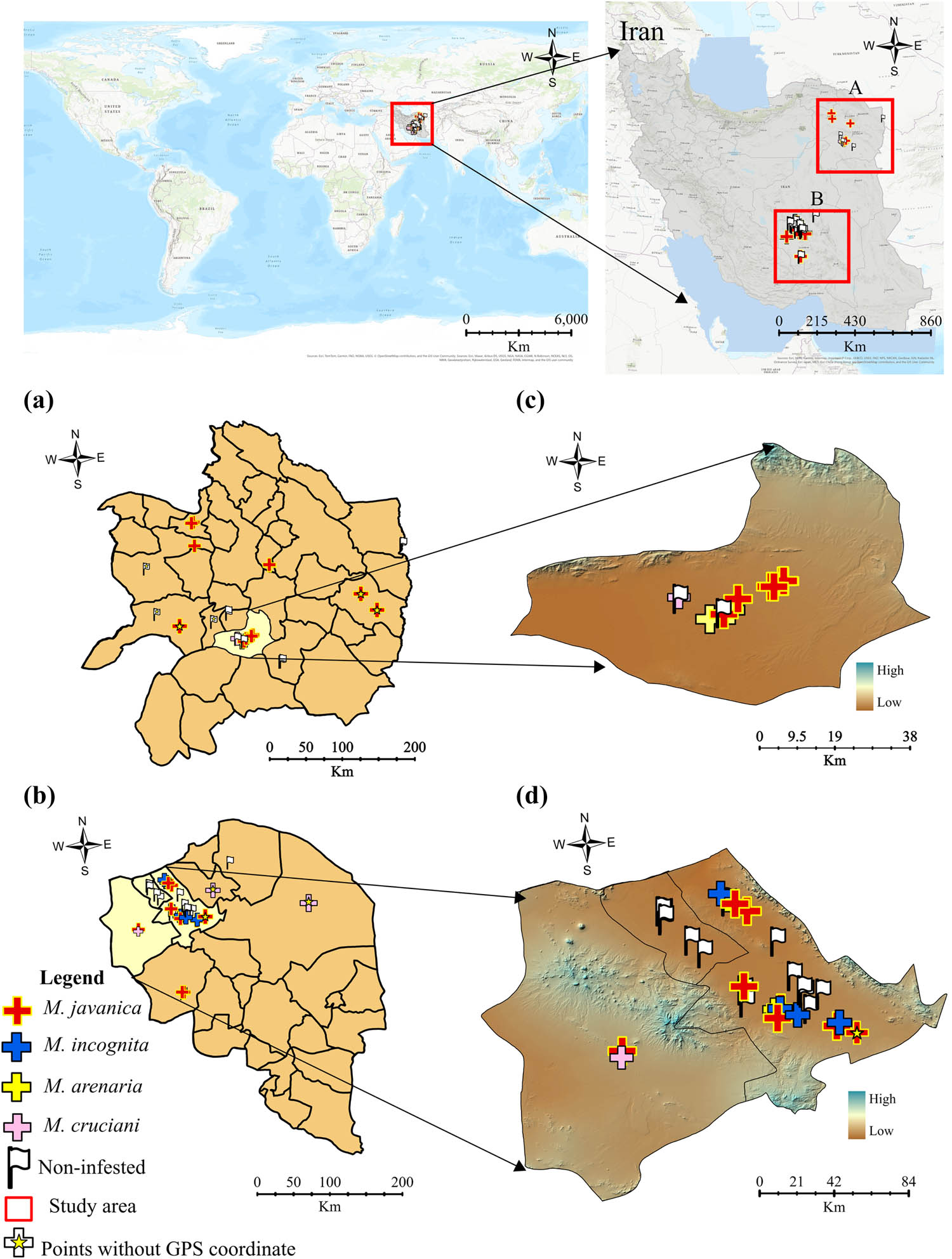
Figure 1
Geographical distribution of root-knot nematode species (RKNs) in the infested and non-infested regions in Khorasan Razavi and Kerman (A and B), two major pistachio-producing provinces of Iran. (a) Khorasan Razavi province and (b) Kerman Province. (c and d) Enlarged maps displayed with a DEM background; c: Mahvelat county, d: Cities of Shahre-e Babak, Anar, Rafsanjan. Legends and scale bars are shown.
2. Results
2.1. Characterization of the recovered isolates in two main pistachio growing provinces of Iran
Thirty-seven isolates of M. javanica were identified from pistachio orchards in Kerman (17 isolates) and Khorasan Razavi (20 isolates) provinces. Eight isolates of M. javanica showing morphological/morphometric variations in comparison with other presently and formerly recovered isolates were studied in detail.
2.2. Morphological profile
2.2.1. Female (Based on eight isolates from both provinces)
Light microphotographs and morphometrics of females of the studied Meloidogyne javanica isolates in the two main pistachio growing provinces of Iran are shown in Figs 2 and 3 and Table 4, respectively.
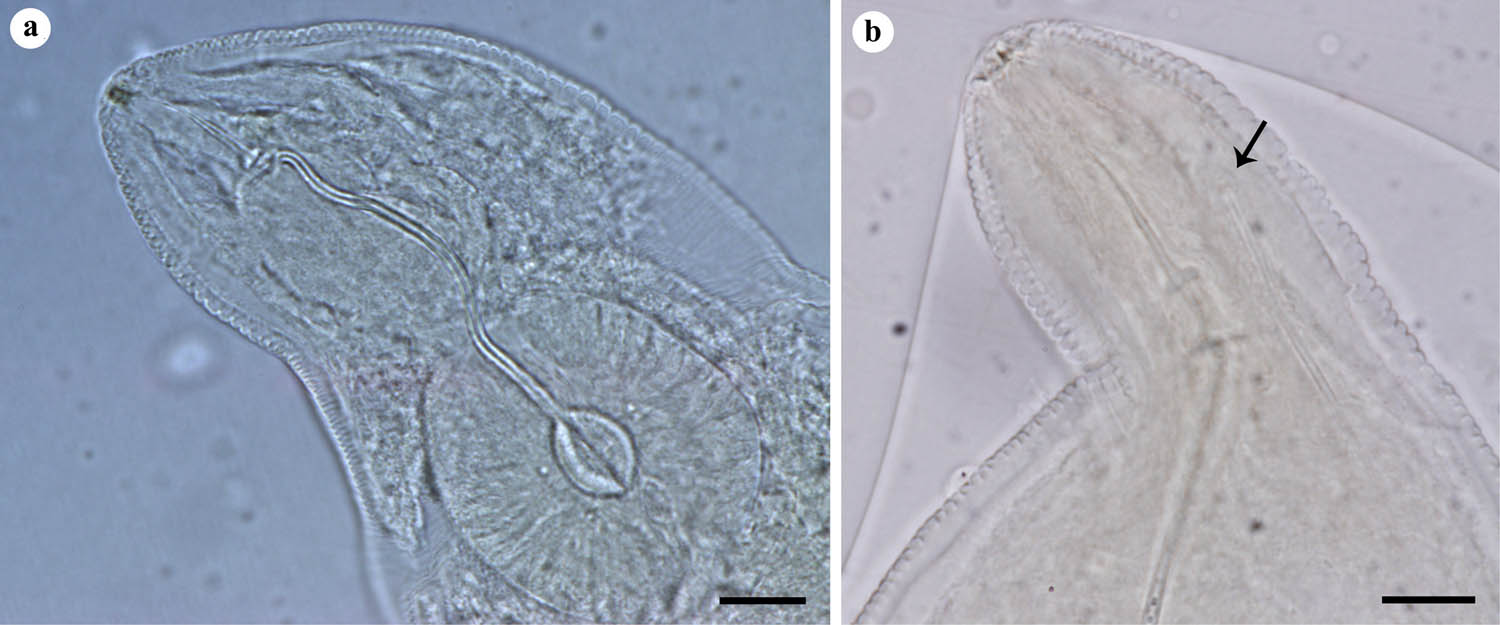
Figure 2
Light microphotographs of the anterior region of adult females of the studied M. javanica isolates, KhF1-4 (a) and KS1-10 (b). Arrow in b shows the EP (all scale bars = 10 μm).
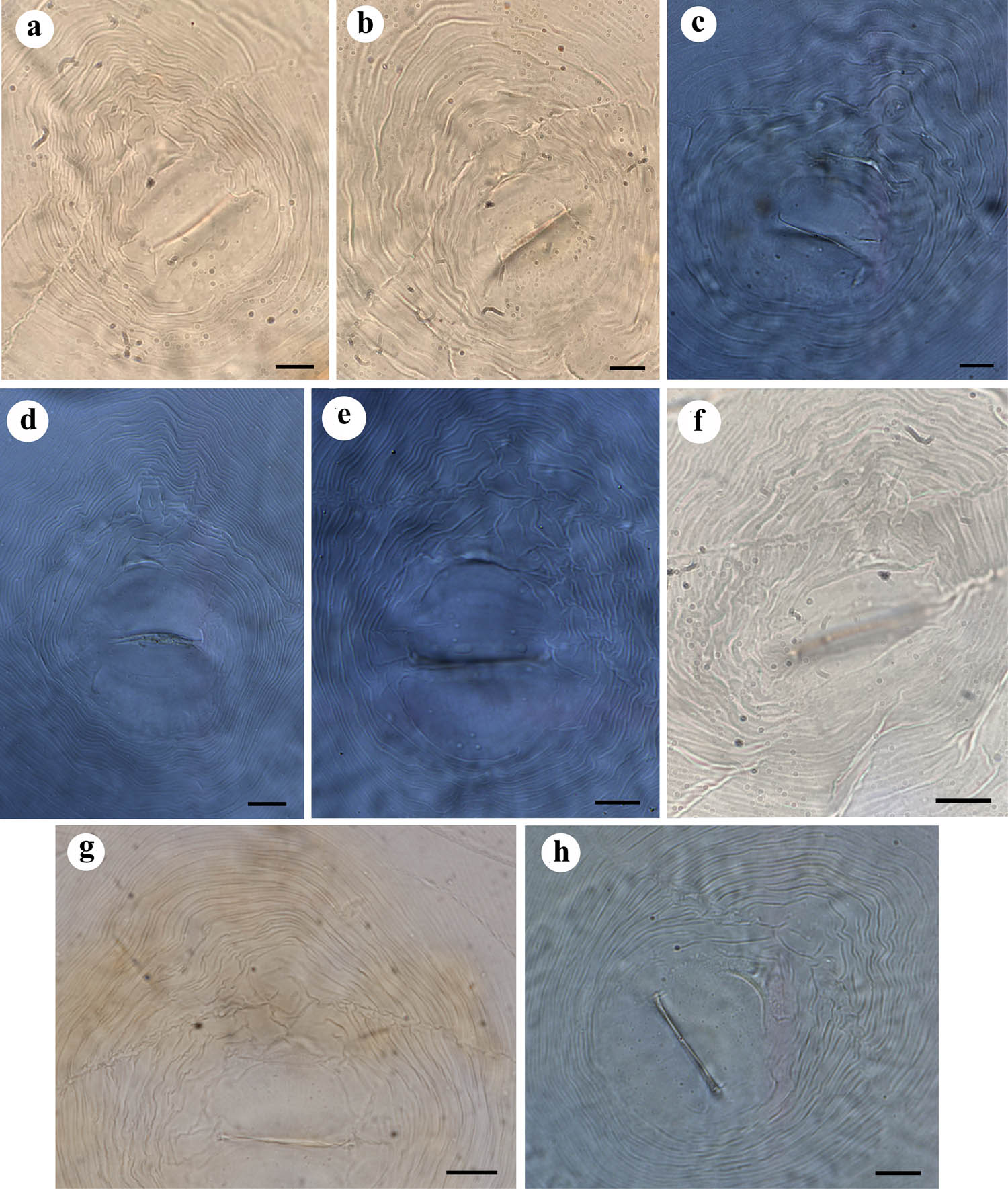
Figure 3
Light microphotographs of perineal patterns of adult females of studied M. javanica isolates. (a) Isolate KS1-1, (b) Isolate KS1-10, (c) Isolate KR3-1, (d) Isolate KR8-1, (e) Isolate KSh1-1, (f) Isolate KN7-1, (g) Isolate KhF1-4, (h) Isolate KhF2-1 (all scale bars = 10 μm).
Table 4
Morphometrics of females of the studied Meloidogyne javanica isolates in two main pistachio growing provinces of Iran
| Isolates | Chitwood (1949), Rammah and Hirschmann (1990) | |||||||||
|---|---|---|---|---|---|---|---|---|---|---|
| Character | KS1–1 | KS1–10 | KN7–1 | KR3–1 | KR8–1 | KSh1–1 | KhF1–4 | KhF2–1 | Total | M. javanica |
| n | 7 | 7 | 7 | 7 | 7 | 7 | 7 | 7 | 56 | |
| Body length | 854.3 ± 70.2 | 917.1 ± 48.9 | 854.3 ± 147.4 | 885.7 ± 69.2 | 850 ± 75.3 | 714.3 ± 78.1 | 933.6 ± 43.1 | 949.3 ± 49.5 | 869.8 ± 101.4 | 545–800a |
| (740–950) | (830–970) | (640–1,050) | (800–980) | (750–950) | (590–820) | (850–970) | (870–1,020) | (590–1,050) | ||
| Body width | 588.6 ± 48.1 | 541.4 ± 38.9 | 412.1 ± 81.5 | 540 ± 49 | 571.4 ± 39.8 (520–630) | 430 ± 36.6 | 652.1 ± 37.8 | 613.6 ± 30.9 | 543.8 ± 91.0 | 300–545a |
| (490–630) | (480–610) | (315–540) | (480–600) | (380–480) | (590–700) | (570–650) | (315–700) | |||
| Stylet | 16.2 ± 1.7 | 16.9 ± 1.0 | 17.6 ± 1.3 | 16.6 ± 0.6 | 15.7 ± 0.6 | 16.7 ± 0.6 | 18.1 ± 1.2 | 18 ± 0.9 | 17.0 ± 1.3 | 16.0a |
| (14–18) | (16–19) | (16–19) | (16.0–17.5) | (15.0– 16.5) | (16.0–17.5) | (16.0–19.5) | (17–19) | (14.0–19.5) | ||
| DGO | 3.7 ± 0.6 | 4.7 ± 0.8 | 3.8 ± 0.5 | 2.9 ± 0.4 | 4.9 ± 0.6 | 4.8 ± 0.8 | 4.6 ± 0.5 | 4 ± 0.7 | 4.2 ± 0.9 | 3.0–4.0a |
| (3.0–4.5) | (4–6) | (3.0–4.5) | (2.5–3.5) | (4.0–5.5) | (4–6) | (4.0–5.5) | (3–5) | (2.5–6.0) | ||
| EP from anterior end | 34.6 ± 8.9 | 34.4 ± 14.1 | 44.6 ± 4.9 | 34.3 ± 6.8 | 26.1 ± 6.9 | 27.8 ± 4.4 | 45.6 ± 4.8 | 48.9 ± 6.2 | 37.0 ± 10.7 | 44.8a |
| (24–43) | (23.0–57.5) | (37–50) | (25–43) | (20–37) | (23–35) | (40–52) | (40.5–57.0) | (20.0–57.5) | ||
| Vulval slit | 25.7 ± 3.1 | 23.3 ± 1.8 | 25.1 ± 2.3 | 24.9 ± 1.7 | 24.6 ± 1.9 | 25.2 ± 2.5 | 26.2 ± 1.4 | 25.5 ± 2.7 | 25.1 ± 2.2 | 25.4 ± 0.5b (21.5–28.1) |
| (21.0–29.5) | (20–25) | (20.5–27) | (22–27) | (22–27) | (22–25) | (24–28) | (22.0–29.5) | (20.0–29.5) | ||
| Vulva–anus | 19.4 ± 3.6 | 15.9 ± 1.7 | 17.1 ± 2.6 | 23.6 ± 1.8 | 18.6 ± 2.3 | 17.9 ± 1.6 | 19.5 ± 1.1 | 19 ± 2.1 | 18.9 ± 3.0 | — |
| (16–25) | (13–18) | (12–20) | (20.5–26.0) | (14.0 – 20.5) | (16–20) | (18–21) | (16–22) | (12–26) | ||
| Inter–phasmid distance | 29.9 ± 3.8 | 27.9 ± 6.1 | 23.4 ± 4.6 | 31.9 ± 5.2 | 26.7 ± 2.4 | 26.6 ± 4.1 | 27.9 ± 3.2 | 27.4 ± 3.5 | 27.7 ± 4.6 | 27.9 ± 0.5b (24.1–34.2) |
| (23–35) | (21–39) | (20.5–27.0) | (25–39) | (14.0–20.5) | (21–32) | (22–31) | (20.5–31.0) | (18.5–39.0) | ||
The females are pear-shaped, no posterior terminal protuberance, 640–1,050 μm long. Stylet is 14.0–19.5 µm long, robust, anterior conus slightly curved dorsally, basal knobs are well-developed and slightly posteriorly directed. Perineal pattern is rounded, dorsal arch is low, striae are smooth, tail whorl is often distinct, two prominent lateral lines are well visible. Phasmids are usually distinct.
2.2.2. Male (Based on four isolates from Kerman province)
Light microphotographs and morphometrics of males of Meloidogyne javanica isolates in Kerman province of Iran are shown in Fig. 4 and Table 5.
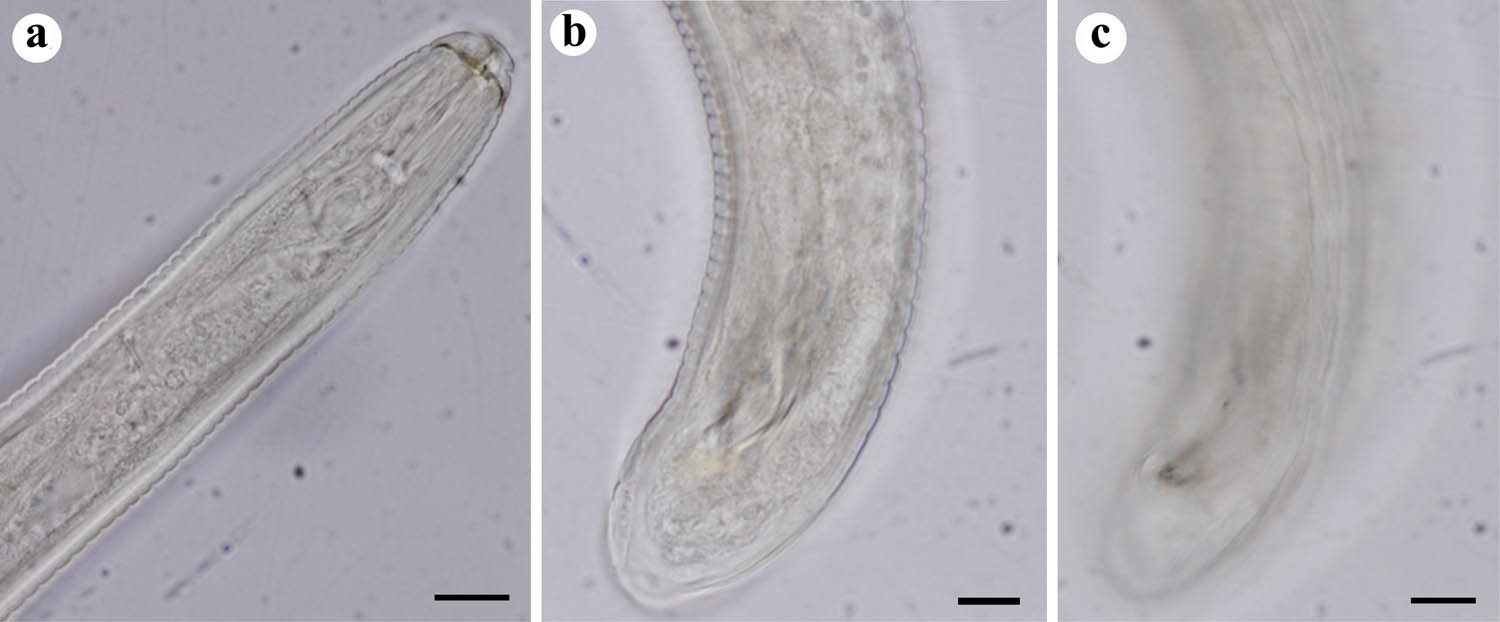
Figure 4
Light microphotographs of male M. javanica (isolate KN7-1). (a) Anterior end region, (b) tail region and spicules, (c) Lateral lines in tail region (all scale bars = 10 μm).
Table 5
Morphometrics of males of the four studied Meloidogyne javanica isolates in Kerman province of Iran
| Character | KS1–1 | KS1–10 | KN7–1 | KSh1–1 | Total 13 | Chitwood (1949), Rammah and Hirschmann (1990) |
|---|---|---|---|---|---|---|
| n | 5 | 3 | 3 | 2 | ||
| Body length | 1,276 ± 96 (1,120–1,350) | 1,307 ± 51 (1,250–1,350) | 1,238 ± 114 (1,115–1,340) | 1,005 ± 148 (900–1,110) | 1,233 ± 135 (900–1,350) | 940–1,440a |
| Body width | 45 ± 5.0 (40–51) | 35.3 ± 2.3 (34–38) | 36.3 ± 1.5 (35–38) | 35 ± 4.2 (32–38) | 39.2 ± 5.8 (32–51) | 43.8 ± 0.6 (37.0–49.4)b |
| Stylet | 21.2 ± 1.6 (19–23) | 22.3 ± 0.6 (22–23) | 21 ± 2.0 (19–23) | 20.5 ± 0.7 (20–21) | 21.3 ± 1.4 (19–23) | 20–21a |
| DGO | 3.8 ± 0.6 (3.0–4.5) | 2.7 ± 0.6 (2–3) | 3.7 ± 1.5 (2–5) | 3.3 ± 0.4 (3.0–3.5) | 3.4 ± 0.9 (2–5) | 3a |
| Median bulb | 85.6 ± 3.8 (82–92) | 85.7 ± 1.5 (84–87) | 103.3 ± 12.6 (90–115) | 86.5 ± 3.5 (84–89) | 89.8 ± 9.6 (82–115) | — |
| Spicules | 32.3 ± 2.8 (28.5–35.0) | 28.3 ± 1.5 (27–30) | 33.3 ± 3.5 (30–37) | 29.5 ± 2.1 (29–31) | 31.2 ± 3.1 (27–37) | 30.0–31.0a |
| Gubernaculum | 7.9 ± 0.4 (7.5–8.5) | 7.7 ± 0.3 (7.5–8.0) | 9.5 ± 0.5 (9–10) | 7.8 ± 0.4 (7.5–8.0) | 8.2 ± 0.8 (7.5–10.0) | 8.2 ± 0.2 (7.4–9.4)b |
The males are vermiform, 900–1,350 μm long. Labial region is not offset, and the labial disc is not elevated. Stylet is 19–23 μm long, basal knobs are well-developed, and DGO = 2–5 μm. Lateral field with four lines. Tail is short and bluntly rounded. Spicules are slightly curved, 27–37 μm long, and gubernaculum is distinct.
2.2.3. Second-stage juveniles (J2s) (based on eight isolates from both provinces)
Light microphotographs and morphometrics of second-stage juveniles of studied Meloidogyne javanica isolates in the two main pistachio growing provinces of Iran are shown in Fig. 5 and Table 6.
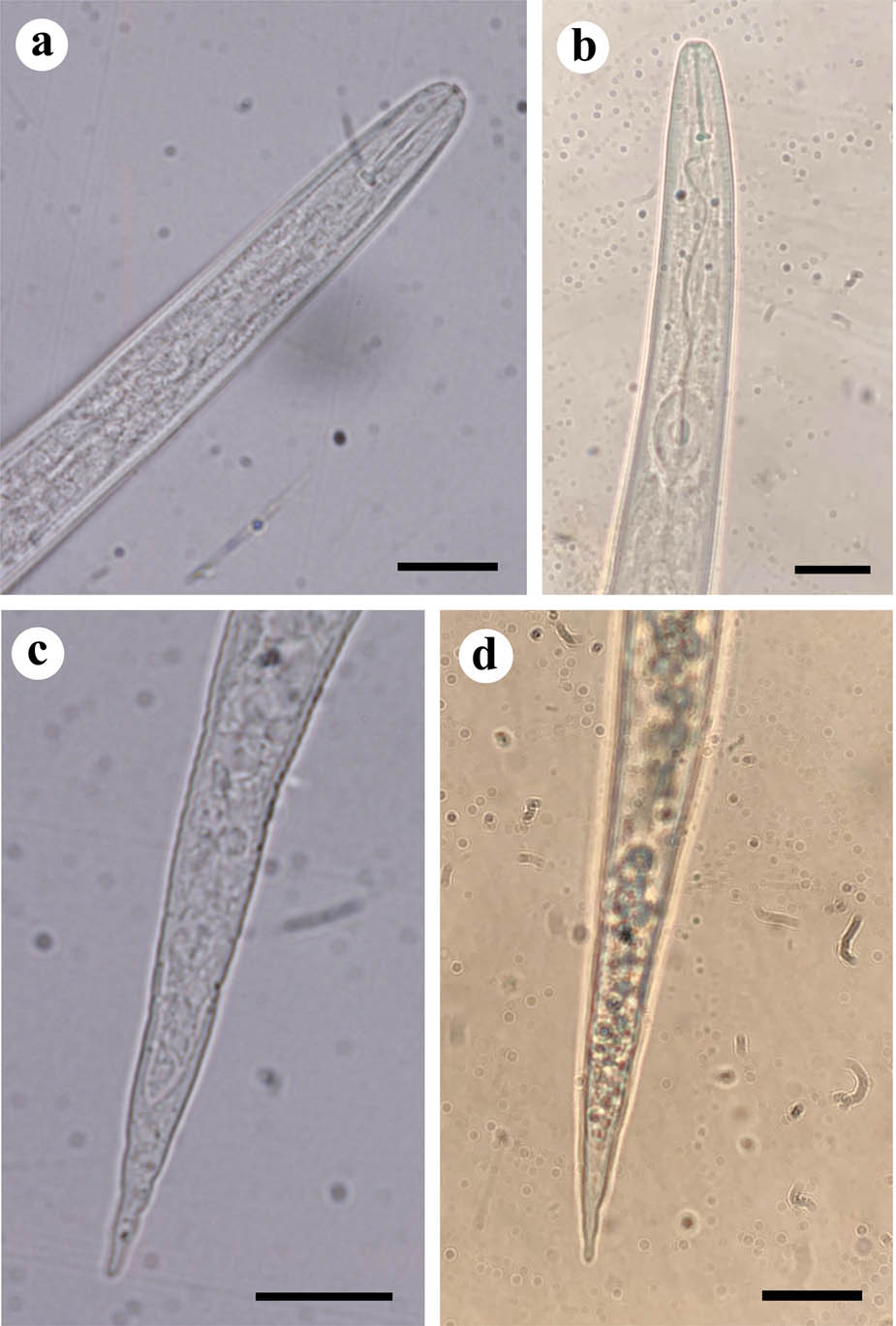
Figure 5
Light microphotographs of J2s of M. javanica. (a and b) Anterior body region of isolates KhF1-4 and KS1-10, respectively, (c and d) Tail region of isolates KhF1-4 and KS1-10, respectively (all scale bars = 10 μm).
Table 6
Morphometrics of J2s of the studied Meloidogyne javanica isolates in two main pistachio growing provinces of Iran
| Character | Isolates | |||||||||
|---|---|---|---|---|---|---|---|---|---|---|
| KS1–1 | KS1–10 | KN7–1 | KR3–1 | KR8–1 | KSh1–1 | KhF1–4 | KhF2–1 | Total | M. javanica | |
| n | 7 | 7 | 7 | 7 | 7 | 7 | 7 | 7 | 56 | |
| Body length | 446 ± 34 | 443 ± 24 | 454 ± 21 | 427 ± 26 | 441 ± 47 | 427 ± 29 | 414 ± 22 | 446 ± 27 | 437 ± 31 | 340–400a |
| (420–510) | (393–537) | (420–485) | (395–470) | (380–500) | (390–475) | (385–450) | (410–480) | (380–537) | ||
| Body width | 14.4 ± 1.1 | 15.9 ± 1.2 | 13.7 ± 0.8 | 15.4 ± 1.1 | 16.1 ± 0.8 | 13.5 ± 0.9 | 14.1 ± 0.6 | 14.5 ± 0.7 | 14.6 ± 1.2 | 15.6 ± 0.1b |
| (13–16) | (14.5–18) | (12.5–15) | (12.5–16) | (15–17) | (12.5–14.5) | (13.5–15.0) | (13.5–15.5) | (12.5–18.0) | (14.8–16.9) | |
| Stylet | 11.6 ± 0.8 | 13.1 ± 0.9 | 11.9 ± 0.8 | 12.1 ± 0.8 | 11.2 ± 1.0 (10.0–12.5) | 11.2 ± 0.5 | 10.4 ± 0.6 | 10.7 ± 0.8 | 11.5 ± 1.1 | 10a |
| (10.0–12.5) | (12.0–14.5) | (11–13) | (11–13) | (10.5–12.0) | (9.5–11.0) | (10–12) | (9.5–14.5) | |||
| DGO | 3.3 ± 0.6 | 3.3 ± 0.7 | 3.2 ± 0.8 | 3.9 ± 0.9 | 3.8 ± 0.6 | 3.0 ± 0.5 | 3.3 ± 0.4 | 3.1 ± 0.6 | 3.4 ± 0.7 | 4a |
| (2.5–4.0) | (2–4) | (2.5–4.5) | (3–5) | (3.0–4.5) | (2.0–3.5) | (3–4) | (2.5–4.0) | (2–5) | ||
| Median bulb | 57.9 ± 4.6 | 56.6 ± 3.4 | 55.6 ± 2.7 | 56.4 ± 3.2 | 57.4 ± 3.0 (54–62) | 56.6 ± 5.2 | 56.7 ± 3.7 | 58.1 ± 2.5 | 56.9 ± 3.5 | — |
| (52.5–65.0) | (52.5–61.5) | (51.5–60.0) | (53–62) | (52–65) | (52.5–63.0) | (55–61) | (51.5–65.0) | |||
| EP from anterior end | 79.7 ± 3.0 | 82.9 ± 3.6 | 81.6 ± 4.4 | 82.9 ± 5.6 | 86 ± 4.6 | 81.9 ± 5.8 | 77.4 ± 4.9 | 82.4 ± 6.9 | 81.8 ± 5.2 | 83.9 ± 0.4b |
| (75–84) | (77.0–86.5) | (75–88) | (75–90) | (79–92) | (74–89) | (69–85) | (75–93) | (69–93) | (80.8–86.7) | |
| Tail length | 45.4 ± 4.8 | 50.8 ± 8.0 | 51.3 ± 5.9 | 47.7 ± 6.9 | 49.9 ± 5.2 | 44.1 ± 4.8 | 49.4 ± 5.0 | 47.1 ± 4.7 | 48.2 ± 5.9 | 56.1 ± 0.5b |
| (38.0–52.5) | (35–57) | (43.5–57.0) | (38–55) | (43–56) | (36–51) | (43–55) | (41–54) | (35–57) | (51.8–60.8) | |
| Hyaline | 13.4 ± 1.2 | 14.5 ± 1.6 | 13.9 ± 1.6 | 11 ± 0.8 | 13.2 ± 1.4 | 13.0 ± 0.9 | 11.6 ± 1.3 | 12.7 ± 1.5 | 12.9 ± 1.6 | — |
| (12–15) | (12.5–17.0) | (11.5–16.0) | (10–12) | (11.5–15.0) | (12.0–14.5) | (10.0–13.5) | (11–15) | (10–17) | ||
The second-stage juveniles are vermiform, 380–537 μm long. Stylet is slender, 9.5–14.5 μm long, with rounded small knobs. Lateral field with four incisures. Tail is 35–57 μm long with 10–17 μm long hyaline region and finely rounded tip.
2.3. Remarks
The morphology and morphometrics of the eight studied isolates were similar to those given by Whitehead (1968) and Orton Williams (1972). Compared to other isolates, the presently studied isolates showed morphological and morphometric variations. For instance, the female body in isolate KN7-1 was longer (not pear shaped). Body length of females ranged from 590 to 1,050 μm. The KSh1-1 isolate had the shortest body while KN7-1 isolate had the longest body. Their body width ranged from 315 to 700 μm. The KN7-1 isolate had the lowest and KhF1-4 isolate had the highest range. Their stylet length ranged from 14.0 to 19.5 µm, the KS1-1 isolate had the lowest and KhF1-4 isolate had the highest range. The excretory pore (EP) distance from anterior end showed remarkable variation, ranging from 20.0 to 57.5 µm. The lower range belonged to the KR8-1 isolate and the greatest range belonged to the KS1-10 isolate. The perineal patterns of the isolates were variable, but the general pattern was conserved. The vulval slit ranged from 20.0 to 29.5 µm wide. The shortest in the KS1-10 isolate and the longest in the KhF2-1 and KS1-1 isolates. The distance between anus to vulval slit ranged from 13 to 26 µm. The shortest in KS1-10 and the longest in KR3-1. The inter-phasmid distance ranged from 14 to 39 µm. The shortest belonging to KR8-1 and the longest to KR3-1. Males were not common in all studied isolates and were only seen in KS1-1, KS1-10, KN7-1, and KSh1-1 isolates. Their body length ranged from 900 to 1,350 μm. The KSh1-1 isolate had the shortest and KS1-1 and KS1-10 had the longest body. Their stylet ranged from 20.5 to 22.3 µm. The KSh1-1 isolate had the lowest and KS1-10 had the highest range. Mean male DGO ranged from 2.7 to 3.8 µm. The shortest in KS1-10 isolate and the longest in KS1-1 isolate. Spicules length ranged from 27 to 37 µm. The KS1-10 isolate had the lowest and KN7-1 isolate had the longest ones. The J2s body length showed no remarkable variation between isolates. Their stylet ranged from 9.5 to 14.5 µm. The Khorasan Razavi isolates (KhF1-4 and KhF2-1) had the shortest stylet. Their tail length ranged from 35 to 57 µm. The KS1-10 isolate showed both values. The hyaline region of tail ranged from 10 to 17 µm. The KhF1-4 isolate had the shortest and KS1-10 isolate had the longest hyaline region.
2.4. Molecular profile and phylogenetic analyses
2.4.1. Species-specific primers
The javF/javR primers amplified a 670-bp DNA fragment for all 37 isolates of M. javanica. No band was amplified for the control and the species M. cruciani. The result of the specific band amplification using these primers for eight selected isolates is given in Fig. 6.
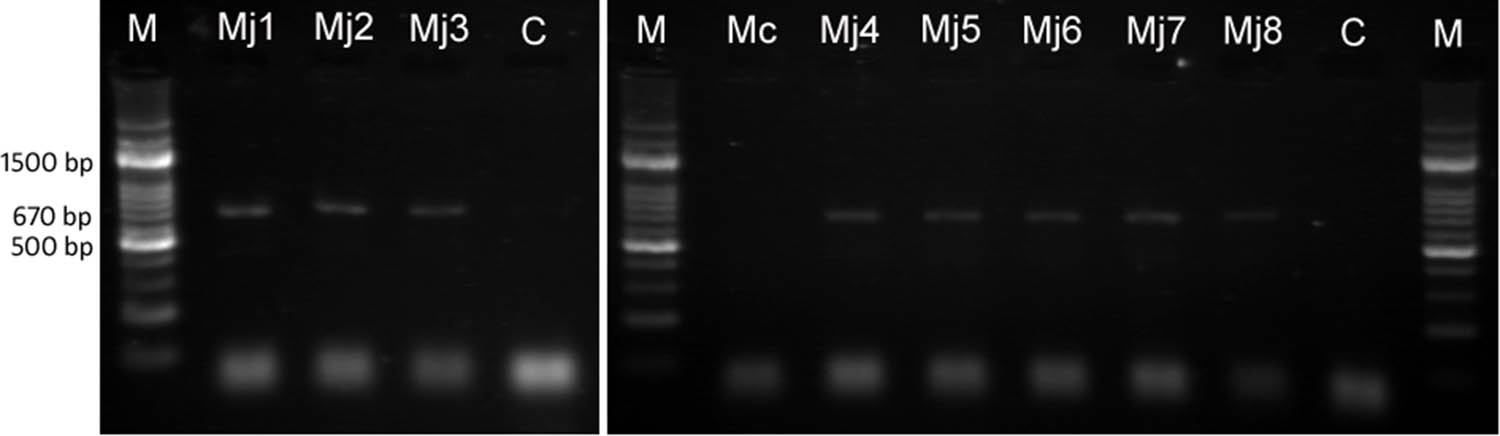
Figure 6
Amplification products (∼670 bp) generated from individual females of Iranian isolates of Meloidogyne javanica from two pistachio growing provinces in Iran, using species-specific primer sets (Fjav/Rjav) for M. javanica. M: DNA Ladder, C: Negative control (No DNA template was used), Mc: M. cruciani (non-target species), Mj1-Mj8: M. javanica isolates; Mj1: KS1-1, Mj2: KS1-10, Mj3: KN7-1, Mj4: KR3-1, Mj5: KR8-1, Mj6: KSh1-1, Mj7: KhF1-4, and Mj8: KhF2-1.
2.4.2. SSU rDNA
The BLAST search using the partial SSU sequences of KS1-10 (1,689 bp) and KhF1-4 (1,672 bp) isolates of M. javanica showed a 98% identity value with many sequences of tropical species already deposited in GenBank.
The SSU dataset was composed of 25 sequences of species/isolates with two outgroup sequences of M. artiellia and Pratylenchus thornei. The phylogenetic tree based on this dataset is presented in Fig. 7. In this tree, the SSU sequences of two isolates (KS1-10 and KhF1-4) were placed in a monophyletic, polytomous clade (clade A) that also includes sequences of other tropical RKN species, e.g., M. javanica, M. incognita, M. arenaria, M. cruciani, M. floridensis Handoo et al., (2004) and M. luci Carneiro et al., (2014).
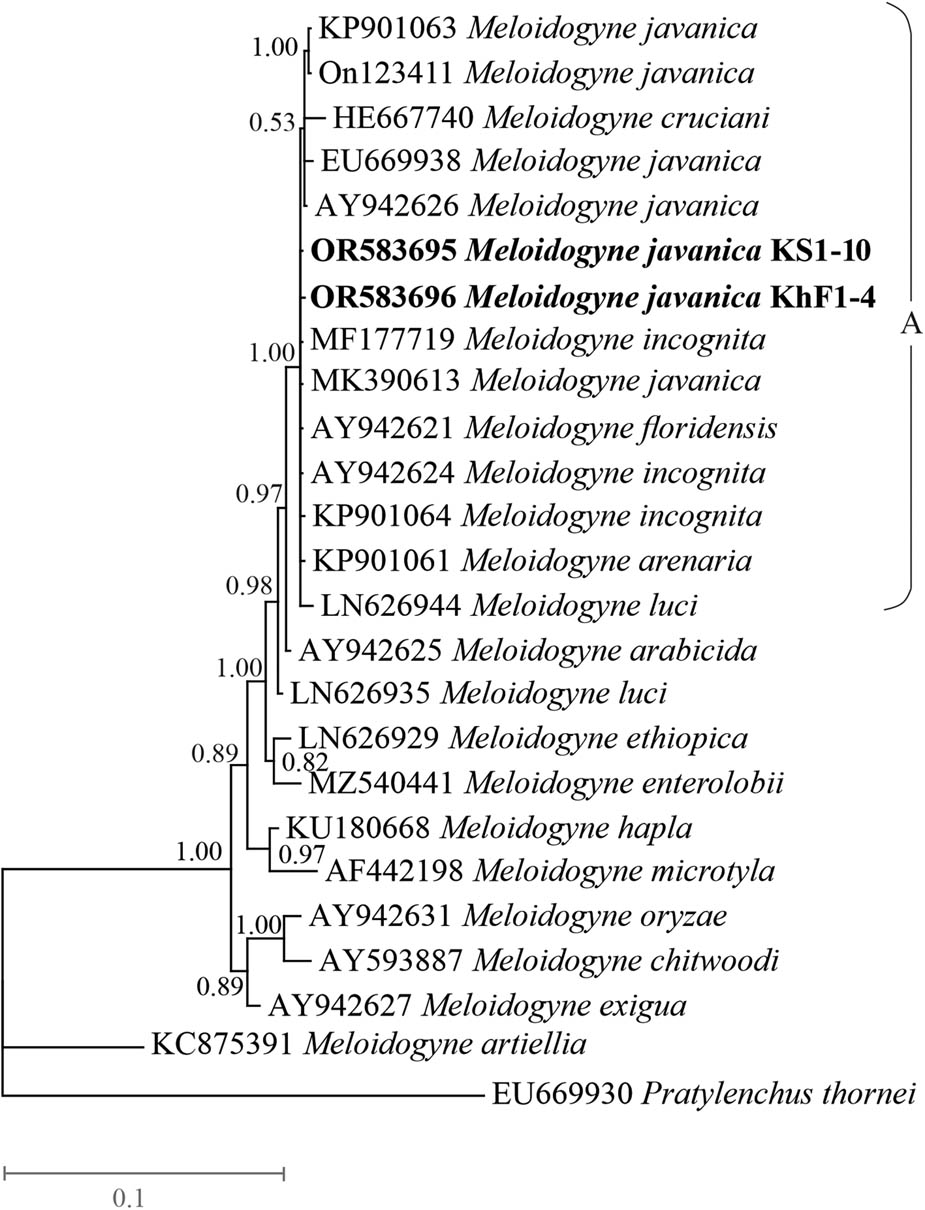
Figure 7
Bayesian 50% majority rule consensus tree inferred from SSU rDNA segment of two isolates of Meloidogyne javanica recovered from pistachio orchards of Iran, using the GTR + G + I model. BPP more than 50% are given for appropriate clades. Newly generated sequences are in bold font.
2.4.3. COII-16S mtDNA
The COII-16S mtDNA sequences of M. javanica isolates KS1-1, KhF1-4, and KhF2-1 were 1,053, 1,066, and 1,659 bp long, with 2–3 bp differences when aligned with each other. The BLAST search of these sequences showed their 99% identity with many sequences of M. javanica available in GenBank (MK033436 to MK033441, OR038715, NC–026556, FJ159611, AY635612, and LT602894).
The COII-16S dataset was composed of 20 sequences of species/isolates of Meloidogyne with two sequences of M. enterolobii and Pratylenchus vulnus as outgroups. The phylogenetic tree based on this dataset is presented in Fig. 8. In this tree, three newly generated sequences of Iranian isolates of M. javanica occupied placements inside a major clade (clade B) that also includes several sequences of M. javanica with 0.56 BPP.
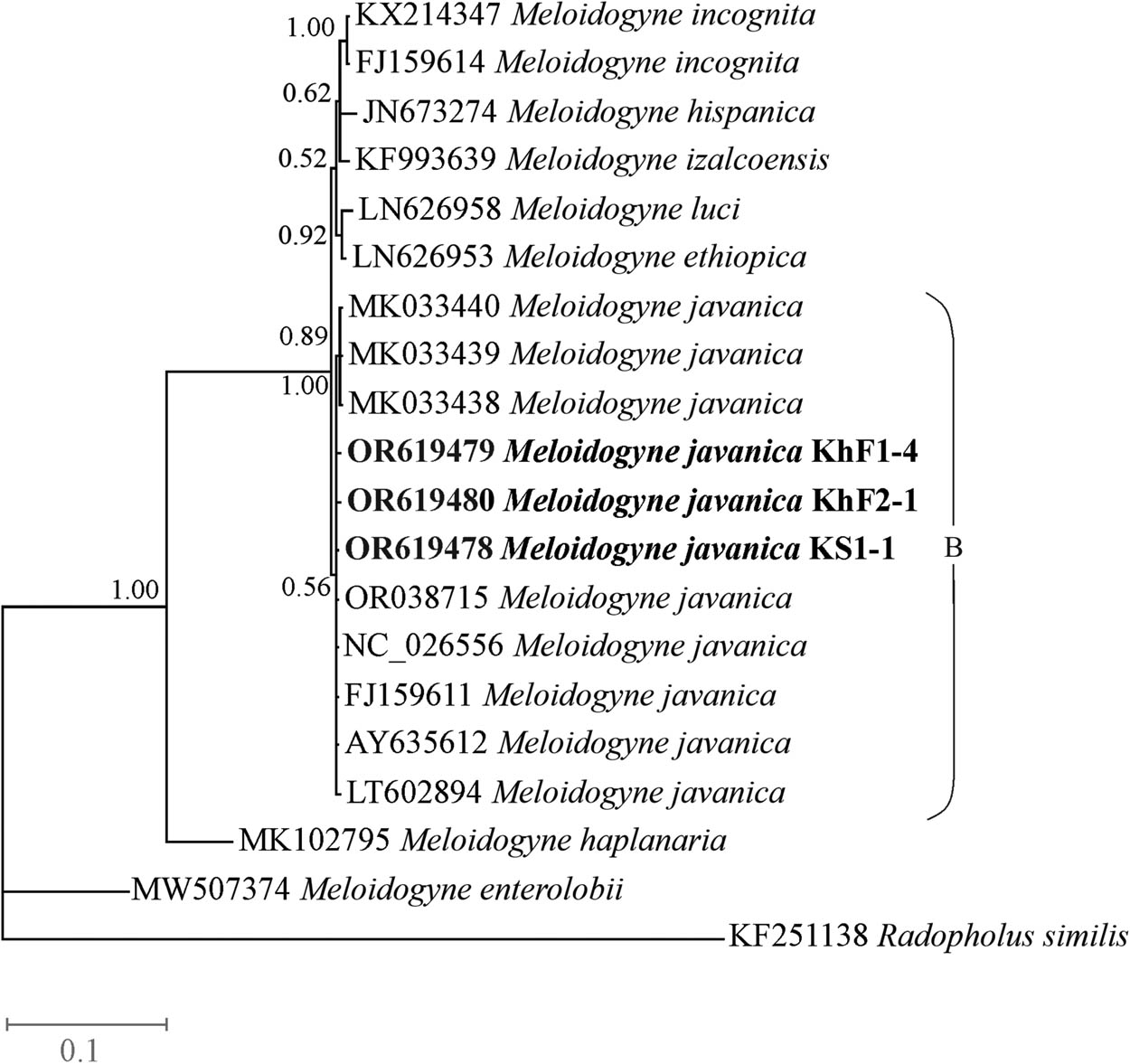
Figure 8
Bayesian 50% majority rule consensus tree inferred from mitochondrial COII-16S segment of three isolates of Meloidogyne javanica recovered from pistachio orchards of Iran, using the GTR + G + I model. BPP more than 50% are given for appropriate clades. Newly generated sequences are in bold font.
2.4.4. Nad5 mtDNA
The five newly generated sequences of Nad5 for KS1-10, KN7-1, KR3-1, KR8-1, and KSh1-1 isolates of M. javanica were 543, 539, 489, 446, and 533 bp long. They were almost identical when aligned. The BLAST search using these sequences revealed they have 99.80–100% identity to the sequences belonging to M. javanica.
The Nad5 dataset was composed of 29 sequences of species/isolates with two outgroup sequences belonging to M. enterolobii (MT683468 and MG948240). The phylogenetic tree based on this dataset is presented in Fig. 9. In this tree, sequences of M. javanica (the newly generated sequences plus sequences previously deposited in the database) formed clade C (0.74 BPP).
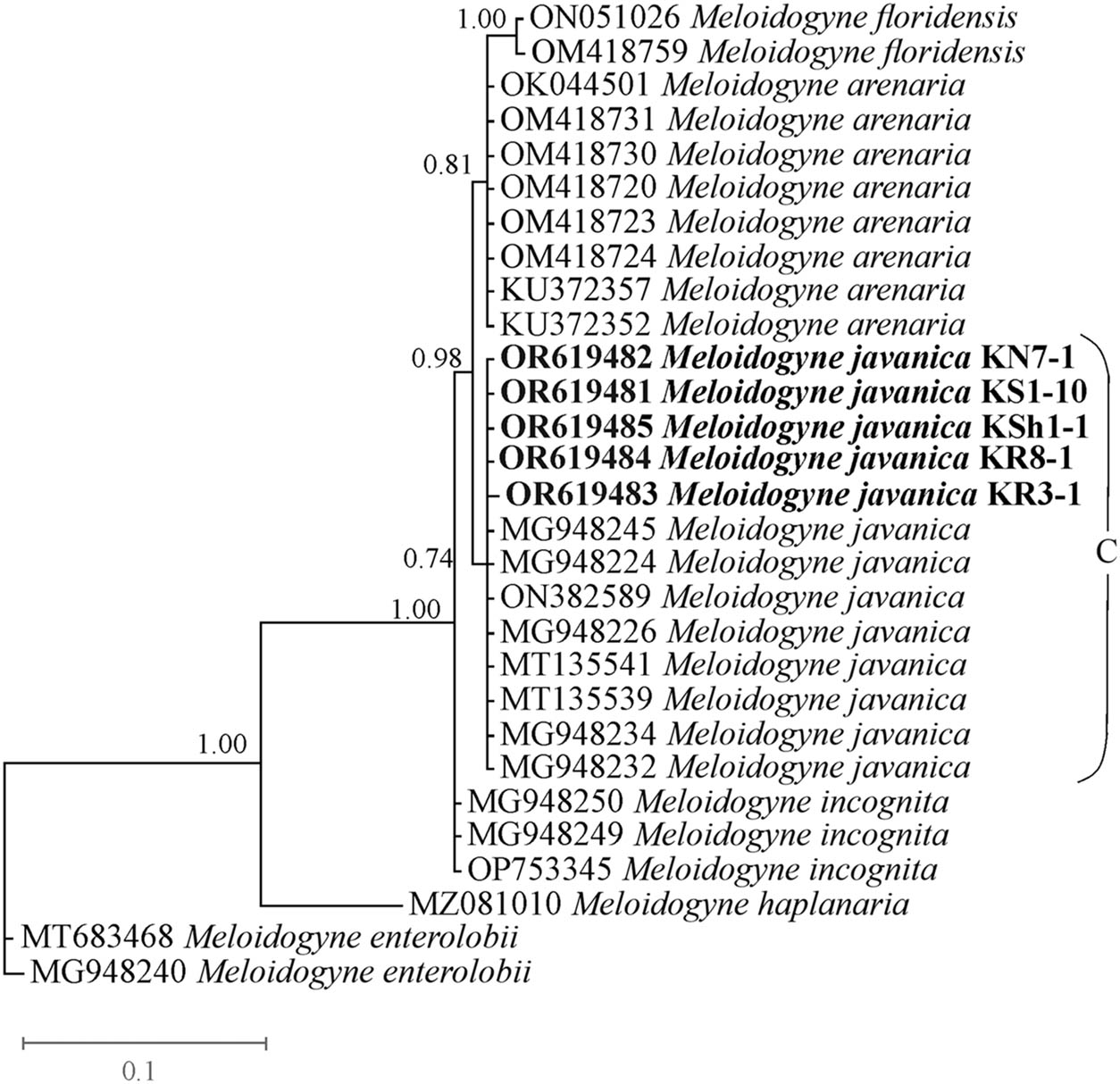
Figure 9
Bayesian 50% majority rule consensus tree inferred from mitochondrial Nad5 segment of five isolates of Meloidogyne javanica recovered from pistachio orchards of Iran, using the GTR + G + I model. BPP more than 50% are given for appropriate clades. Newly generated sequences are in bold font.
2.4.5. Species occurrence percent
From 84 collected samples, 37 samples were positive for M. javanica, 6 for M. incognita, 4 for M. areniaria, 2 for M. cruciani, and 35 soil/root samples were non-infested and not infected. The prevalence of M. javanica in the pistachio orchards of the studied regions was 44.04%, indicating its widespread distribution. 36.95% of the samples in Kerman province and 52.63% in Khorasan Razavi province were positive for occurrence of M. javanica. The city of Rafsanjan in Kerman province and Mahvelat in Khorasan Razavi province were respectively highly infested (Fig. 1, Table 1).
3. Discussion
In the present survey, isolates of Meloidogyne spp. were recovered from infested pistachio orchards in Kerman and Khorasan Razavi provinces of Iran. As already urged, the most prevalent species in sampling regions belonged to M. javanica. RKNs were not found in the city of Sarakhs in Khorasan Razavi province. It is hypothesized that the absence of RKN infection in certain regions may be attributed to the relatively recent establishment of pistachio cultivation. Further future samplings, however, could update present status.
Morphological and morphometric data of M. javanica isolates in this study are largely in agreement with the data given in original description of the species and its other populations reported worldwide (Subbotin et al., 2021), except for some variations in body length and body width of females in case of the isolate KN7-1. Formerly, an isolate of Meloidogyne javanica from Iraq was reported by Jepson (1987) to have a long body, although no morphometric data were provided. However, it is known that there are remarkable variations in measurements of adult RKNs between different populations (Whitehead, 1968; Ghaderi et al., 2020). According to Subbotin et al. (2021), M. javanica is morphologically close to M. arenaria and M. incognita, from which it can be differentiated by females’ perineal pattern, that has distinct lateral lines delineating the dorsal and ventral regions of the perineal pattern, and the distance from anterior end to EP divided by female stylet (1.8–2.8 vs 2.4 and 1.2–2.5, respectively). In line with Subbotin et al. (2021), the perineal pattern of M. javanica distinguished it from M. arenaria and M. incognita in our study; however, EP/stylet ratio in studied isolates ranged 1.66–2.7, showing some overlaps with those of M. arenaria and M. incognita (Subbotin et al., 2021).
Accurate identification of M. arenaria, M. javanica, and M. incognita is challenging using molecular data, i.e., using ribosomal DNA sequences. In accordance with Zijlstra et al. (2000), sequence characterized amplified region (SCAR) markers were successfully used for distinguishing 37 isolates of M. javanica from other RKNs in the present study.
As already mentioned, eight isolates of M. javanica, that showed variations in their morphology in comparison with other isolates, were further characterized using SSU rDNA, COII-16S, and Nad5 mtDNA sequences. The SSU rDNA sequences of two isolates of M. javanica (KS1-10 and KhF1-4) occupied placements inside the clade that included sequences of other tropical species. This result is in line with previous studies corroborating that SSU rDNA is highly conserved among the three most common tropical RKN species, viz., M. incognita, M. arenaria, and M. javanica (McClure et al., 2012; Humphreys-Pereira et al., 2014; Ye et al., 2015).
The mitochondrial DNA has higher rate of evolution than nuclear genes, giving opportunity for species delimitation (Kiewnick et al., 2014). In the presently resolved COII-16S tree, the sequences of Iranian, Iraqi, Turkish, and American isolates of M. javanica formed a clade. Also, the Nad5 sequences of several isolates of M. javanica, together with the newly generated sequences, formed a clade. Similar observations have already been achieved by others (Janssen et al., 2016; Hajihassani et al., 2019; Phan et al., 2021), emphasizing on usefulness of these two markers for molecular identification of M. javanica.
Meloidogyne javanica association with pistachio has been reported several times in Iran, along with M. incognita (Madani et al., 2012; Zeynadini-Riseh et al., 2018; Askarian et al., 2009; Neshat et al., 2011; Hadadfar et al., 2020). In our study, M. incognita was not found in Khorasan Razavi province.
Furrow irrigation is the most common method used in pistachio orchards of Iran (Sherafati and Eskandari Torbaghan, 2023); and this method may contribute to the spread of RKNs. However, available evidence, mostly collected from experienced farmers, suggests that infected seedlings are the primary source of nematode dissemination in the studied regions. Therefore, the nurseries should always be monitored.
4. Conclusion
In the present study, infestation of formerly unexplored pistachio growing areas of two sampled pistachio producing provinces by M. javanica was determined, georeferenced, and mapped. The obtained results necessitate adopting regulatory measures to prevent further spread of RKNs. The present study provided morphometric data of M. javanica parasitizing pistachio in sampled regions and showed that mitochondrial markers could be exploited to separate it from other RKN species.
Acknowledgements
The financial support of the Ferdowsi University of Mashhad under research project number 47889 was appreciated. The authors gratefully acknowledge the personnel of the Pistachio Research Center, Horticultural Sciences Research Institute, Agricultural Research, Education and Extension Organization (AREEO), Rafsanjan and Tarbiat Modares University, Tehran, Iran. We would like to thank Mr. Fallahi and Ms. Filehkesh from the Agriculture Jahad organization of Khorasan Razavi province for their assistance in sampling and acknowledge Dr. Hossein Shafizadeh-Moghadam for his expert technical support and guidance in the preparation of the geographical maps.
Funding information
The research leading to these results received funding from Ferdowsi University of Mashhad, Iran under Grant Agreement No: 47889.
Author contributions
F. Sh. Mahoonaki: Conceptualization, methodology, phylogeny, writing, review. E. Mahdikhani Moghadam: Conceptualization, methodology, writing, review. M. R. Atighi: Writing, methodology, data curation, review. M. Zakiaghl: Writing, data curation, review. F. Bazeghi: GIS, writing, review. M. Pedram: Phylogeny, writing, review.
Conflict of interest statement
The authors declare that they have no conflict of interest.