
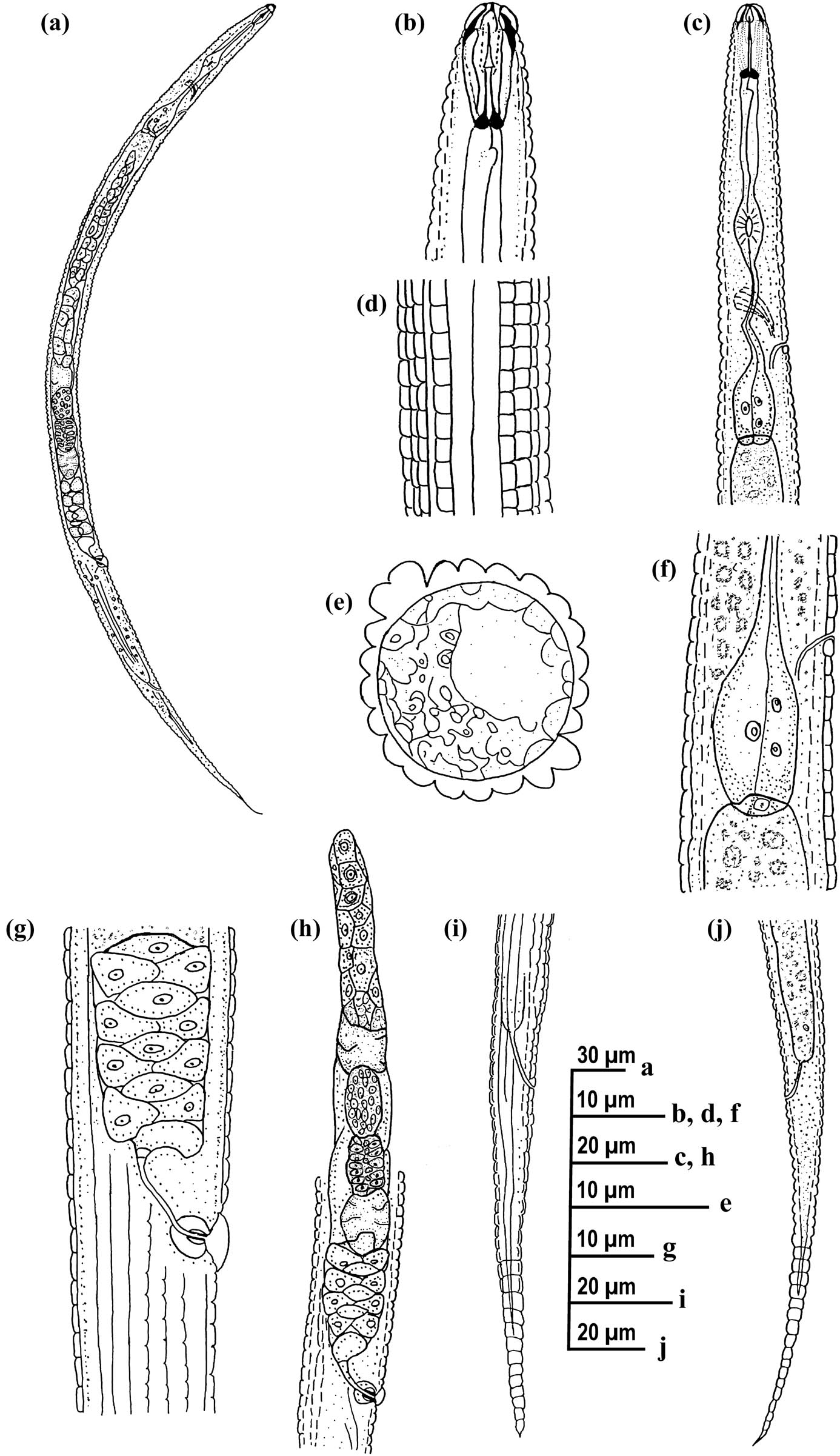
Figure 1
Line drawings of Coslenchus iranicus n. sp. from Iran. (a) Entire body; (b) anterior body region; (c) pharyngeal region; (d) lateral field at mid-body; (e) mid-body cross-section; (f) terminal bulb; (g and h) part of reproductive system; and (i and j) posterior body region.
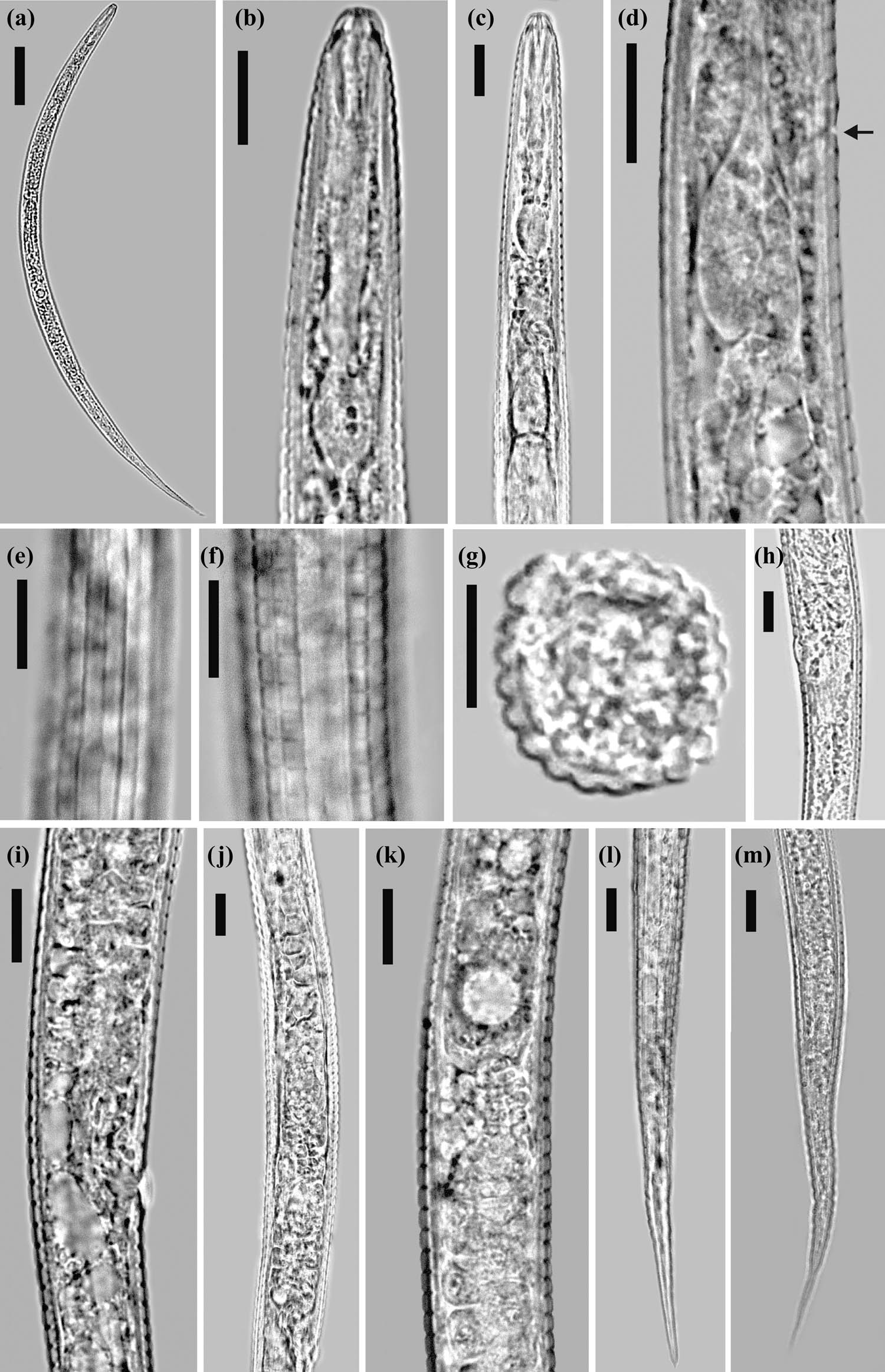
Figure 2
Light photomicrographs of Coslenchus iranicus n. sp. from Iran. (a) Entire body; (b and c) anterior body region; (d) terminal bulb (the arrow indicates the excretory pore); (e) lateral field at mid-body; (f) cuticle showing longitudinal ridges; (g) mid-body cross-section; (h and i) vulval region; (j and k) part of reproductive system; and (l and m) posterior body region. Scale bars: (a) = 50 μm; (b–m) = 10 μm.
Table 1
Morphometrics of Coslenchus iranicus n. sp. from South Khorasan province, Iran.
| Character | Holotype female | Paratype females |
|---|---|---|
| n | 1 | 11 |
| L | 501.5 | 484.7 ± 24.6 (447–525) |
| a | 26.7 | 27.8 ± 1.3 (25.8–29.7) |
| b | 5.0 | 5.4 ± 0.6 (5–7) |
| c | 5.6 | 5.8 ± 0.5 (5.3–6.9) |
| c′ | 9.2 | 8.5 ± 1.1 (6.9–10.8) |
| V | 66.6 | 67.2 ± 1.1 (66.0–69.8) |
| V′ | 81.1 | 81.3 ± 0.6 (80.6–82.2) |
| Stylet length | 11.8 | 11.1 ± 0.9 (9.4–12.0) |
| m | 45.8 | 42.5 ± 5.1 (34.5–52.0) |
| DGO | 1.8 | 2.1 ± 0.2 (1.8–2.5) |
| Annuli width | 2.5 | 2.2 ± 0.2 (1.9–2.5) |
| MB | 49 | 49.9 ± 1.1 (48.6–51.5) |
| Pharynx length | 100 | 90.4 ± 6.8 (74.7–100.0) |
| Anterior end to excretory pore | 71.8 | 71.7 ± 5.1 (57–77) |
| Rst | 9 | 7.5 ± 0.9 (6–9) |
| Rex | 33 | 33.1 ± 2.7 (25–35) |
| Roes | 45 | 41.8 ± 2.7 (35–45) |
| Rv | 141 | 137.2 ± 4.2 (130–142) |
| Ran | 171 | 168.2 ± 4.5 (161–173) |
| Rvan | 30 | 31.0 ± 1.2 (30–34) |
| Lip region-vulva | 334 | 325.6 ± 14.7 (303–350) |
| Lip region-anus | 411.8 | 400.6 ± 19.0 (368–412) |
| Maximum body width | 18.8 | 17.8 ± 0.9 (16.3–19.0) |
| Vulval body width | 15.7 | 15.3 ± 0.6 (14.3–15.8) |
| Vulva-anus | 77.8 | 75.0 ± 4.9 (65.5–83.0) |
| Tail length | 89.7 | 84.1 ± 8.5 (66.3–93.4) |
| Tail/vulva-anus | 1.2 | 1.1 ± 0.1 (0.9–1.2) |
Note: All measurements are in μm and in the form mean value ± SD (range).
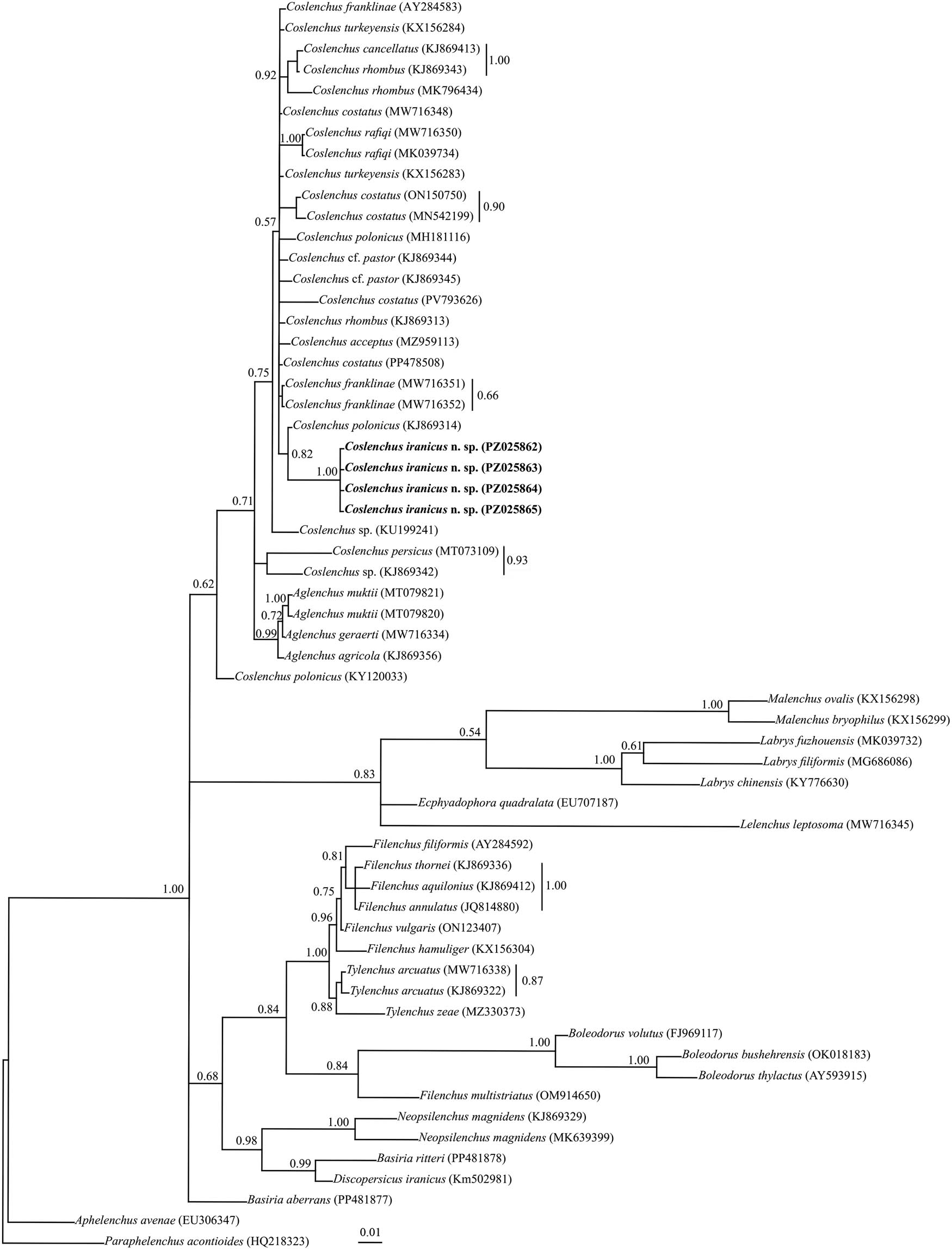
Figure 3
Bayesian 50% majority rule consensus tree inferred from analysis of the SSU rDNA sequences of Coslenchus iranicus n. sp. under the GTR + G + I model. BPP values more than 0.50 are given for appropriate clades. New sequences are indicated in bold.
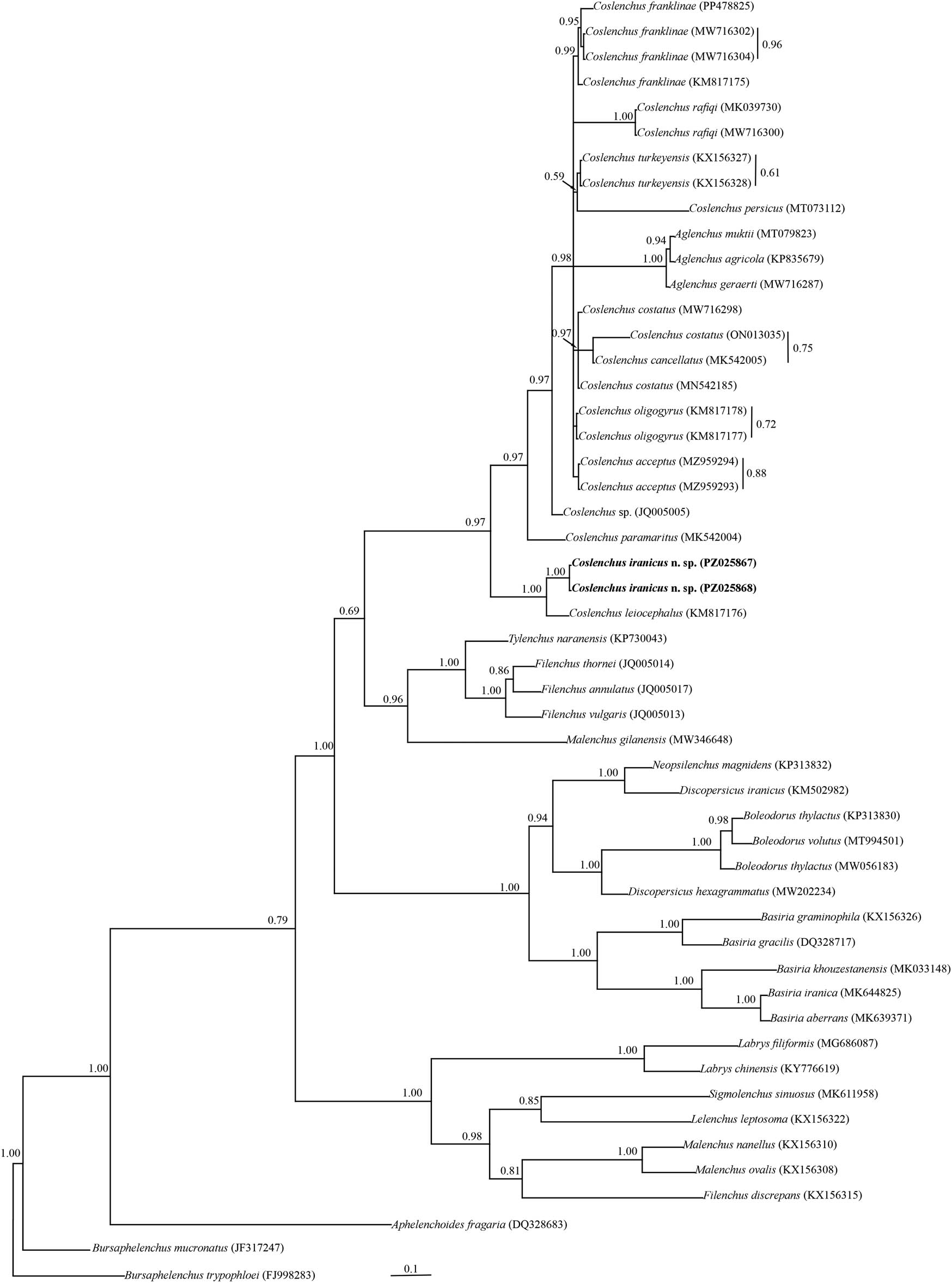
Figure 4
Bayesian 50% majority rule consensus tree inferred from analysis of the D2–D3 domains of the LSU rDNA sequences of Coslenchus iranicus n. sp. under the GTR + G + I model. BPP values more than 0.50 are given for appropriate clades. New sequences are indicated in bold.
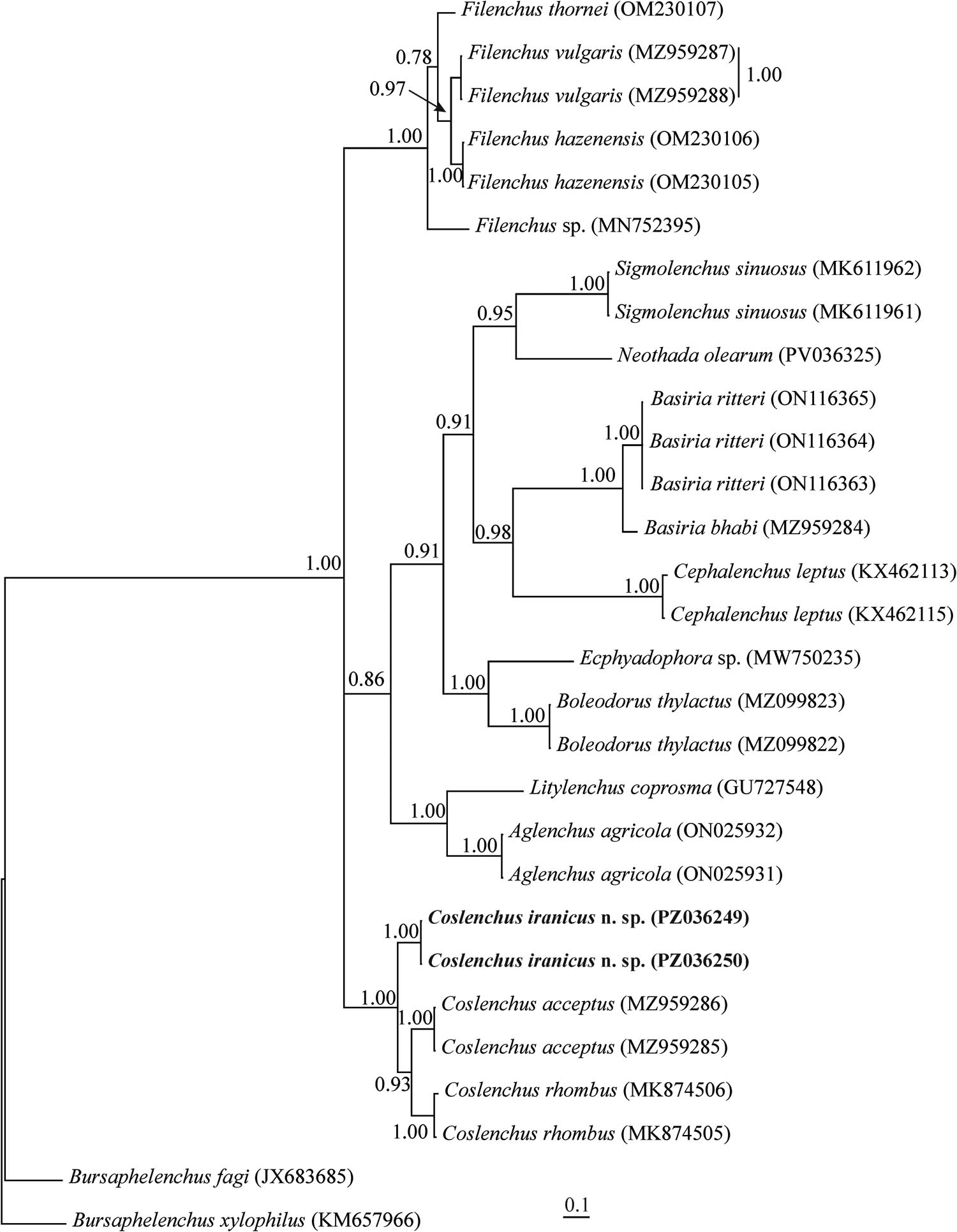
Figure 5
Bayesian 50% majority rule consensus tree inferred from analysis of the ITS rDNA sequence of Coslenchus iranicus n. sp. under the GTR + G + I model. BPP values more than 0.50 are given for appropriate clades. New sequences are indicated in bold.