
1. Introduction
Chrysanthemum is highly favored ornamental plant, which is cultivated for cut flower trade, and considered the second most important floricultural crop worldwide after roses (Mekapogu et al., 2022). Spray chrysanthemum (Chrysanthemum × grandiflorum) represents a vital floricultural crop in Korea, especially valued for its multiple blooms and strong consumer demand in the domestic and export markets (Song and Kim, 2021). However, quality degradation due to climate-induced stress and pest pressure has weakened its competitiveness, particularly in the Japanese market (Kim et al., 2024). One such factor involves plant-parasitic nematodes, which are often overlooked yet can cause significant root damage and yield loss in chrysanthemums. A previous nematode survey in Korean chrysanthemum fields identified Paratylenchus spp. (root-lesion nematodes) and Paratylenchus spp. (pin nematodes) as the major pathogenic nematodes affecting chrysanthemums (Han et al., 2006).
The genus Paratylenchus (Micoletzky, 1922), commonly known as pin nematodes, includes some of the smallest plant-parasitic nematodes, with body lengths ranging from 160 to 600 μm (Micoletzky, 1922; Ghaderi et al., 2016). Most species feed as migratory ectoparasites on root epidermal cells and root hairs, while some possess a longer stylet (>40 μm), allowing them to feed deeper in the root cortex as sedentary ectoparasites (Ghaderi et al., 2016). These nematodes reproduce rapidly, often forming high population densities, particularly in perennial cropping systems and under greenhouse cultivation (Kwon et al., 2019; Hallmann and Molendijk, 2022).
Among the many species in this genus, particular attention has been recently focused on Paratylenchus enigmaticus (Munawar et al., 2021), a species associated with multiple crops in different regions. Initially detected as an undescribed Paratylenchus sp. in greenhouse-grown butterhead lettuce in Belgium (Claerbout et al., 2020), it was later formally described from potato fields in Alberta, Canada (Munawar et al., 2021), based on integrative morphological and molecular analyses. The detection of Paratylenchus enigmaticus in diverse plant hosts, including potato, lettuce, leek, cherry, peach, and various grasses, across multiple countries such as Canada, Belgium, and Spain (Claerbout et al., 2020; Clavero-Camacho et al., 2021b; Munawar et al., 2021) indicates that this species may possess a broader host range and more extensive geographic distribution than previously recognized. Despite its increasing worldwide occurrence, there is still insufficient information on its morphological characteristics, ecological distribution, and phylogenetic relationships due to its small body size, and it is also hard to classify because of its similarity with other species (Clavero-Camacho et al., 2021a; Maosa et al., 2024).
During a survey of plant-parasitic nematodes in spray chrysanthemum cultivation field in Korea, populations of pin nematodes belonging to the genus Paratylenchus were detected in the rhizosphere of spray chrysanthemum. These nematodes were morphologically similar to several described species in the genus, prompting further investigation. Based on detailed morphological examinations and molecular sequence analyses, the populations were subsequently identified as Paratylenchus enigmaticus, a recently described species. The objectives of this study were to characterize the Korean P. enigmaticus population using both morphological and molecular approaches, and to evaluate the reproduction factor (RF) of this species on different spray chrysanthemum cultivars following controlled inoculation.
2. Materials and methods
2.1. Nematodes isolation
A population of Paratylenchus enigmaticus was isolated from soil samples collected from the rhizosphere of spray chrysanthemum (Chrysanthemum × grandiflorum) cultivated in Icheon (37°13′N, 127°24′E), Gyeonggi-do, Korea. Soil samples were collected at a depth of approximately 15 cm of soil around roots of spray chrysanthemum using soil auger. Nematodes were extracted using the modified Baermann technique (Whitehead and Hemming, 1965). Following extraction, females, males, and juveniles were hand-picked under a stereomicroscope (SZX16, Olympus, Japan) and transferred to a watch glass containing tap water. Specimens were stored at 4°C until further processing.
2.2. Morphological and morphometric characterization
For light microscopic observations, females, males, and juveniles of Paratylenchus were killed and fixed by addition of 80℃ FG 4:1 fixative (Southey, 1986). Nematodes were fixed for at least 24 h, then processed according to the Seinhorst method (Seinhorst, 1959; Cid Del Prado Vera and Subbotin, 2012). Specimens were mounted on Cobb slides and sealed with a paraffin ring and glycerin (Cobb, 1917). Observations, measurements, and photographs were made with a compound microscope (BX53, Olympus) equipped with a digital camera (DP73, Olympus).
The following morphometric characters were measured in Paratylenchus: total body length, maximum body width, stylet length, pharynx length, vulva position (V% in females), anterior end to excretory pore, tail length, anal body width, and spicule length (in males). Juveniles were measured for body length, stylet length, pharynx length, and tail morphology.
2.3. Molecular characterization
Single female and male specimens, confirmed morphometrically, were transferred to a glass slide with a drop of distilled water. Each nematode was dissected and its internal contents were crushed using a 2 mm × 2 mm filter paper chip and fine forceps. Using forceps, the chip having crushed specimens were transferred into a polymerase chain reaction (PCR) tube containing 10 µL lysis buffer (autoclaved triple distilled water, 1 M Tris-HCl, 10% Triton-X 100, 100 µg/mL Proteinase K, 2 M KCl, 1 M MgCl2) for extracting nematode DNA (Iwahori et al., 2000). Lysis was carried out using a T100 Thermal Cycler (Bio-Rad, USA) at 60°C for 30 min followed by 94°C for 10 min.
Two rRNA fragments, i.e., the LSU D2–D3 segments and internal transcribed spacer (ITS) regions were amplified. Primers for D2–D3 segments amplification were D2A (5′-ACAAGTACCGTGAGGGAAAGTTG-3′) and D3B (5′-TCGGAAGGAACCAGCTACTA-3′) (Subbotin et al., 2006). Primers for ITS amplification were TW81 (5′-GTTTCCGTAGGTGAACCTGC-3′) and AB28 (5′-ATATGCTTAAGTTCAGCGGGT-3′) (Subbotin et al., 2000). PCR amplifications were performed using AccuPower® PCR PreMix (Bioneer, Korea) following the manufacturer’s instructions. Briefly, each reaction contained one PreMix tube, 0.5 µM of each primer, and 3 µL of DNA extract, and the final reaction volume was adjusted to 20 µL with sterile distilled water. PCR was initiated with a 5-min denaturation at 94°C, followed by 40 cycles of amplification (94°C for 1 min; 56°C for D2–D3 or 58°C for ITS for 1 min; and 72°C for 2 min). A final extension was performed at 72°C for 10 min. In order to confirm the successful amplification of DNA by PCR, electrophoresis was performed using 0.5× tris-acetate-EDTA buffer on 1% agarose gel. Amplified products were purified using the PCR Purification Kit (Qiagen, Valencia, CA). All strands of the PCR amplicons were cycle-sequenced with an ABI PRISM BigDye Terminator version 1.1 Cycle Sequencing Kit and electrophoresed in each direction on an ABI Prism ABI 377 Genetic Analyzer (PE Applied Biosystems, USA). The obtained sequences were submitted to the GenBank database under accession numbers PX218636-PX218637 (LSU D2–D3) and PX219901-PX219902 (ITS region).
2.4. Phylogenetic analysis
Sequences obtained from Paratylenchus specimens were compared with existing sequences in the GenBank database using the BLASTn algorithm to identify closely related taxa (Singh et al., 2022; Abdolkhani and Azimi, 2023). Representative sequences showing the highest similarity were selected for subsequent phylogenetic analysis. Tylenchulus semipenetrans Cobb, 1913 was chosen as the outgroup based on previous phylogenetic frameworks for pin nematodes (Singh et al., 2022). Multiple sequence alignments were performed using MUSCLE, and poorly aligned terminal regions were manually trimmed using molecular evolutionary genetics analysis (MEGA) version 11.0.8 (Tamura et al., 2021). The best-fit nucleotide substitution model (GTR + I + G) was selected based on the Akaike Information Criterion within molecular evolutionary genetics analysis (MEGA). Phylogenetic inference was conducted using Bayesian inference (BI) in MrBayes v3.2.6 (Huelsenbeck and Ronquist, 2001). Two independent Markov Chain Monte Carlo analyses were run for 1 × 10⁶ generations, sampling every 1,000 generations, with the first 25% of trees discarded as burn-in. A 50% majority-rule consensus tree was generated, and posterior probabilities were calculated to assess branch support (Larget and Simon, 1999). Phylogenetic trees were visualized and edited using TreeView v1.6.6 (Page, 1996).
2.5. Inoculum preparation
The initial inoculum of P. enigmaticus used in the reproduction experiments originated from a Korean population isolated from spray chrysanthemum fields. To culture the nematode population, ten females were inoculated onto lettuce (Lactuca sativa), a known host species. Lettuce plants were grown in 9 cm plastic pots containing sterilized soil and maintained in a controlled-environment greenhouse (25 ± 2°C, 16:8 h light:dark photoperiod). After 8 weeks, nematodes were extracted from the entire soil and root systems using the modified Baermann funnel method (Whitehead and Hemming, 1965). The recovered nematodes were used to prepare standardized inoculum suspensions for subsequent bioassays.
2.6. Pathogenicity test at different inoculum densities
A greenhouse experiment was conducted to evaluate the effect of different initial population densities of P. enigmaticus on the RF in the spray chrysanthemum cultivar “Milky Star.” Three inoculum levels (100, 1,000, and 10,000 nematodes per pot) were tested, each with three replicates. Each 9 cm diameter plastic pot was filled with 500 mL of sterilized sandy loam soil as the growing medium. The nematode suspension, containing mixed developmental stages, was thoroughly homogenized, and aliquots corresponding to the desired inoculum levels were applied to the root zone of two-week-old seedlings. Plants were grown under controlled greenhouse conditions (25 ± 2°C, 16:8 h light:dark photoperiod) and irrigated as needed. After 7 weeks, entire root systems and soil were collected, and nematodes were extracted using a modified Baermann funnel technique. The RF was calculated as the ratio of the final nematode population (Pf) to the initial inoculum (Pi).
2.7. Host response assay in five chrysanthemum cultivars
The host response of five spray chrysanthemum cultivars, “Crown White,” “Golden Wave”, “Miracle Eye,” “Pretty Purple,” and “Sweet Pink,” to P. enigmaticus was evaluated. Rooted cuttings were transplanted into 9 cm diameter plastic pots, and each pot was filled with 500 mL of sterilized sandy loam soil. For each cultivar, three replicates were established and inoculated with 100 nematodes per pot using a standardized suspension of mixed developmental stages. Inoculation was delivered to the root zone of 2-week-old seedlings. Plants were maintained under greenhouse conditions (25 ± 2°C, 16:8 h light:dark photoperiod) and watered as needed. Seven weeks post-inoculation, the entire root systems and associated soil were collected, and nematodes were extracted using the modified Baermann funnel method. Evaluation of the cultivars’ host preference to P. enigmaticus was categorized based on the RF, as described by Oostenbrink (1966). The Pf was determined for each pot, and RF values were calculated as Pf/Pi. Cultivar susceptibility was assessed based on RF, with higher values indicating greater host suitability.
3. Results
3.1. Description of Paratylenchus enigmaticus Korean population
Adults are small, slender, vermiform pin nematodes (Fig. 1a and b). Females measured 361.2 ± 18.8 μm in body length (range 328.6–403.0), with maximum body width 16.7 ± 1.4 μm and stylet 26.0 ± 1.3 μm (23.5–28.3). The lip region is low and continuous with the body contour; stylet knobs rounded (Fig. 1c). The esophageal gland overlap is moderate, excretory pore located 74.1 ± 2.5 μm (70.4–80.6) from the anterior end. Vulva posteriorly located at V = 83.6 ± 0.6% (82.5–84.4). Tail is conoid to subcylindrical, 26.5 ± 2.4 μm long (22.1–30.1), with c = 13.7 ± 1.3 and c′ = 2.8 ± 0.3; anal body width 9.5 ± 0.9 μm (7.9–11.1) (Fig. 1d). Males were present, with body length 354.1 ± 15.5 μm (331.3–370.2) and spicule 17.9 ± 0.9 μm (16.9–19.3) (Fig. 1e). Juveniles measured 266.4 ± 27.1 μm (217.6–300.0) with stylet 14.8 ± 3.2 μm (10.7–18.6) and tail 19.4 ± 2.0 μm (16.5–22.5). These qualitative features conform to the diagnosis of P. enigmaticus, and detailed morphometric characters are presented separately for females (Table 1) and for males and juveniles (Table 2). In addition, the Korean population was characterized using the matrix coding system of the Paratylenchus polytomous key proposed by Palomares-Rius et al. (2022). The resulting matrix code is provided in Table 3.
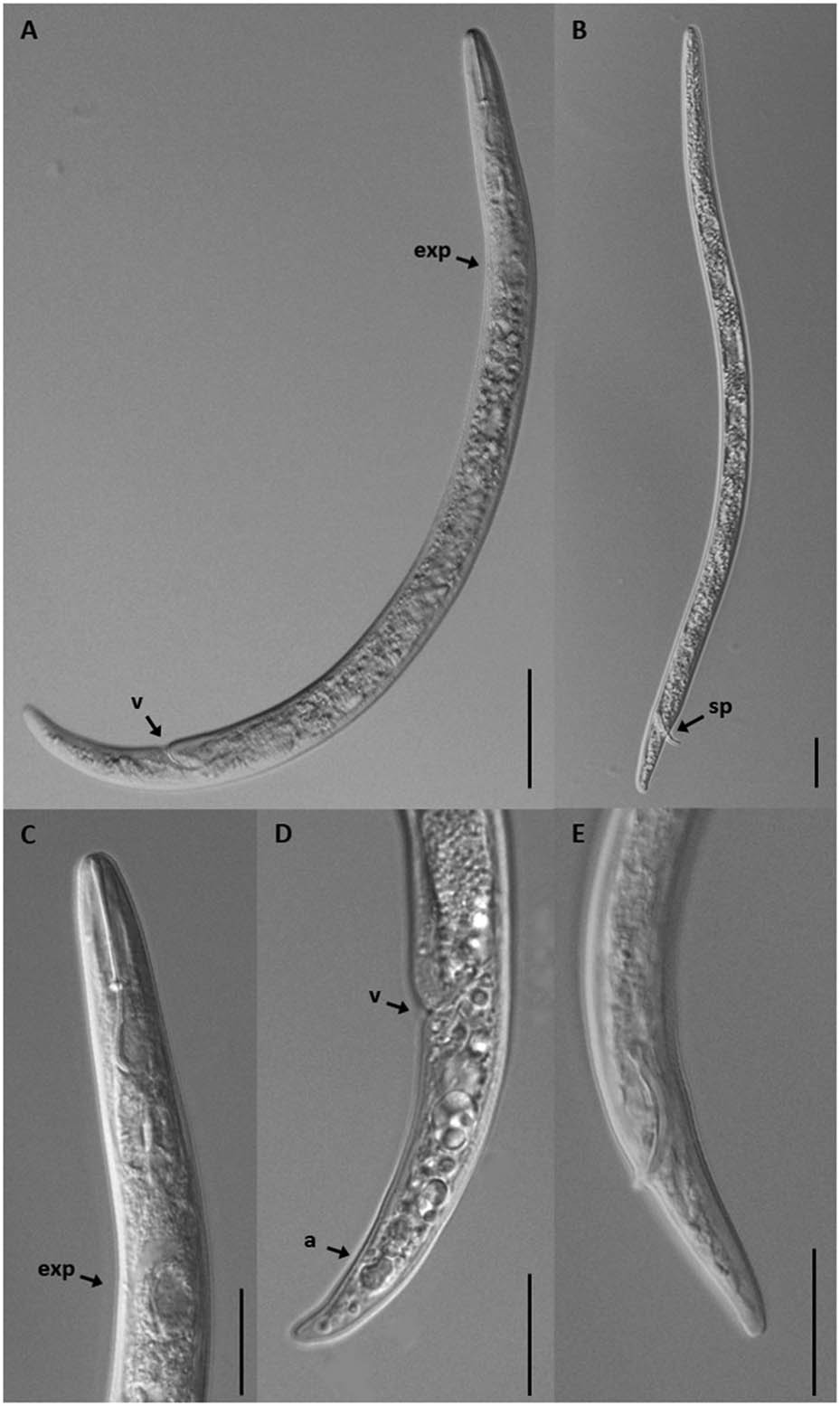
Figure 1
Light microscope photos of Paratylenchus enigmaticus Korean population. (a) Entire body of female; (b) Entire body of male; (c) Anterior region of female; (d) Posterior region of female; and (e) Posterior region of male. (exp = excretory pore; v = vulva, a = anus, sp = spicule). Scale bars: 20 µm.
Table 1
Morphometrics of Paratylenchus enigmaticus females from Korea and comparison with the previous description
| Characters | Korean population (this study) | Canadian population (Munawar et al., 2021) | Spanish population (Clavero-Camacho et al., 2021) | Belgian population | |||||
|---|---|---|---|---|---|---|---|---|---|
| Crop | Chrysanthemum | Potato | — | Lettuce (Claerbout et al., 2020) | Leek (Maosa et al., 2024) | ||||
| n | 12 | 11 | 5 | 10 | 10 | 10 | 10 | 10 | 19 |
| Body length | 361.2 ± 18.8 (329–403) | 383 ± 31 (343–431) | 364.6 ± 23.5 (324–383) | 365 ± 40 (308–465) | 335 ± 20 (302–360) | 365 ± 39 (313–422) | 358 ± 43 (300–411) | 328 ± 31 (293–268) | 374 ± 40 (284–443) |
| a | 21.8 ± 1.3 (19.0–23.7) | 25.7 ± 2.1 (22–29) | 19.9 ± 1.5 (17.6–21.6) | 24.2 ± 3.8 (14.9–27.6) | 24.3 ± 3.4 (19.3–27.2) | 26.7 ± 2.3 (22–29) | 23.7 ± 2.6 (18.5–27.5) | 23.2 ± 3.3 (18.1–28.1) | 22.1 ± 2.3 (18.4–25.7) |
| b | 4.3 ± 0.1 (4.0–4.5) | 4.1 ± 0.3 (3.7–4.7) | 3.8 ± 0.2 (3.6–4.2) | 3.7 ± 0.7 (2.7–4.6) | — | 3.4 ± 0.7 (2.5–4.9) | 3.2 ± 0.5 (2.8–4.2) | — | 4.2 ± 0.5 (3.3–5.3) |
| c | 13.7 ± 1.3 (12.1–16.7) | 15.4 ± 1.3 (12.9–17.5) | 14.6 ± 1.6 (12.0–16.0) | 15.0 ± 1.5 _12.3–17.2) | 14.9 ± 1.5 (13.2–17) | 14.9 ± 1.9 (12.7–17.8) | 14.8 ± 2.3 (13.7–19.8) | 13.0 ± 1.5 (10.1–15.7) | 13.3 ± 2.1 (9.8–16.2) |
| c' | 2.8 ± 0.3 (2.4–3.2) | 2.6 ± 0.3 (2.3–3.1) | 2.7 ± 0.1 (2.5–2.8) | — | — | — | — | — | 2.9 ± 0.3 (2.5–3.4) |
| V | 83.6 ± 0.6 (82.5–84.4) | 85 ± 0.9 (83–86) | 83.4 ± 1.3 (81.2–84.4) | 83 ± 2.1 (80–88) | 83 ± 2.1 (80–87) | 83 ± 1.5 (80–84) | 84 ± 0.9 (83–85) | 83 ± 2.1 (80–88) | 83 ± 1.2 (81–85) |
| Stylet length | 26 ± 1.3 (23.5–28.3) | 28.8 ± 1.1 (27.3–31) | 27.6 ± 0.9 (27.0–29.0) | 27.3 ± 1.3 (23.5–28.4) | 25.5 ± 1.6 (22.3–26.5) | 26.6 ± 1.5 (25.2–31) | 26.8 ± 1.3 (24.6–27.9) | 27.0 ± 1.5 (24.6–28.6) | 27.9 ± 1.1 (25.0–29.7) |
| St/L% | 7.2 ± 0.4 (6.2–7.6) | 7.6 ± 0.5 (6.8–8.2) | — | 7.5 ± 0.9 (6.0–8.8) | 7.6 ± 0.7 (7.2–8.8) | 7.3 ± 0.7 (6.2–7.9) | 7.6 ± 0.8 (6.6–8.4) | 8.3 ± 0.5 (7.3–8.9) | — |
| Ant. to SE | 74.1 ± 2.5 (70.4–80.6) | 76 ± 4.2 (70–82) | 87.6 ± 5.7 (81.0–94.0) | — | — | — | — | — | 83 ± 7.7 (67–95) |
| Pharynx length | 84.4 ± 2.4 (81.9–90.8) | 94 ± 5.2 (83–100) | 96.2 ± 6.5 (88.0–103.0) | 101 ± 19.7 (75–138) | 88 ± 23.3 (43–106) | 110 ± 16.9 (83–124) | 115 ± 18.4 (85–126) | 120 ± 14.6 (95–144) | 90 ± 7.7 (77–107) |
| Max. body width | 16.7 ± 1.4 (15.1–19.8) | 13.1 ± 1.0 (11.4–14.7) | 18.4 ± 1.7 (16.5–21.0) | — | — | — | — | — | 17.0 ± 1.9 (13.6–20.0) |
| Anal body width | 9.5 ± 0.9 (7.9–11.1) | 9.7 ± 0.9 (7.7–10.6) | 9.4 ± 0.4 (9.0–10.0) | — | — | — | — | — | 9.8 ± 1.0 (8.0–11.5) |
| Tail length | 26.5 ± 2.4 (22.1–30.1) | 24.9 ± 2.1 (22.0–29.0) | 25.0 ± 1.4 (23.5–27.0) | 24.4 ± 3.1 (21.7–30.8) | 22.6 ± 1.6 (20.3–26.2) | 24.6 ± 1.8 (21.0–26.1) | 24.5 ± 3.3 (21.2–23.7) | 25.4 ± 2.6 (22.0–30.0) | 28.5 ± 3.8 (23.5–36.0) |
Note: All measurements are in μm and in the form: mean value ± SD (range).
Table 2
Morphometrics of Paratylenchus enigmaticus males and juveniles from Korea and comparison with the previous description
| Characters | Male | Juvenile | ||
|---|---|---|---|---|
| Korean population | Belgian population | Korean population | Belgian population | |
| Crop | Chrysanthemum | Leek | Chrysanthemum | Lettuce |
| n | 5 | 4 | 10 | 5 |
| Body length | 354.1 ± 15.5 (331–370) | 311 ± 18.5 (290–335) | 266.4 ± 27.1 (218–300) | 344 ± 9.5 (331–357) |
| a | 28.1 ± 0.6 (27.4–28.9) | 26.0 ± 3.0 (24.4–30.5) | 18.3 ± 1.9 (15.3–20.5) | 23.8 ± 0.4 (23.1–24.4) |
| b | 4.9 ± 0.2 (4.6–5.1) | — | 3.6 ± 0.3 (3.2–4) | 4.2 ± 0.2 (3.9–4.4) |
| c | 15.4 ± 1.3 (13.6–17.2) | 12.5 ± 0.6 (11.8–13.1) | 13.8 ± 1.4 (12.1–16.5) | 14.9 ± 0.5 (14.4–15.7) |
| c' | 2.9 ± 0.2 (2.7–3.2) | — | 2 ± 0.1 (1.8–2.2) | 2.3 ± 0.3 (1.9–2.6) |
| Stylet length | — | — | 14.8 ± 3.2 (10.7–18.6) | 12.5 ± 0.9 (11.2–13.5) |
| St/L% | — | — | 5.7 ± 1.8 (3.6–8) | — |
| Ant. to SE | 61.3 ± 1 (59.9–62.4) | 69 ± 9.8 (57–81) | 61.9 ± 2.8 (55.7–65.1) | 65 ± 2.8 (63–70) |
| Pharynx length | 72.9 ± 1 (71.7–74.3) | — | 73.1 ± 2.5 (67.4–75.7) | 82 ± 4.3 (76–88) |
| Max. body width | 12.6 ± 0.7 (11.9–13.4) | — | 14.7 ± 2.3 (10.9–18.1) | 14.4 ± 0.3 (14.2–14.9) |
| Anal body width | 7.9 ± 0.5 (7.6–8.7) | — | 9.7 ± 0.7 (8.8–10.8) | 10.2 ± 1.2 (8.8–11.7) |
| Tail length | 23.2 ± 1.6 (20.5–24.3) | 25.0 ± 2.2 (23.8–28.3) | 19.4 ± 2.0 (16.5–22.5) | 23.2 ± 0.8 (22.0–24.0) |
| Spicule length | 17.9 ± 0.9 (16.9–19.3) | 19.6 ± 0.9 (18.6–20.7) | — | — |
Note: All measurements are in μm and in the form: mean value ± SD (range).
3.2. Molecular and phylogenetic analysis
LSU D2–D3 segments of 28S and ITS region gene were amplified as indicated in methodology section. The sequenced LSU D2–D3 segments and ITS region are 728 and 750 bp, respectively. A BLASTn search of P. enigmaticus on the LSU D2–D3 segments revealed high-scoring matches with some Paratylenchus species, the most similar to P. enigmaticus (GenBank accession number MW282760), which is the species isolated from potato growing regions of Southern Alberta in Canada. The identities of these two sequences were 100% (704/704), with no insertions/deletions. ITS region results also revealed the most similar species with P. enigmaticus (MZ265019), with 100% identities (739/739) and no insertions/deletions. This population was isolated from the grasses in Córdoba, Spain. Phylogenetic relationships of the Korean P. enigmaticus population were inferred based on LSU D2–D3 and ITS rRNA gene sequences using BI (Figs 2 and 3). Based on both the D2–D3 and ITS trees, the Korean population formed a strongly supported clade with previously described P. enigmaticus sequences.
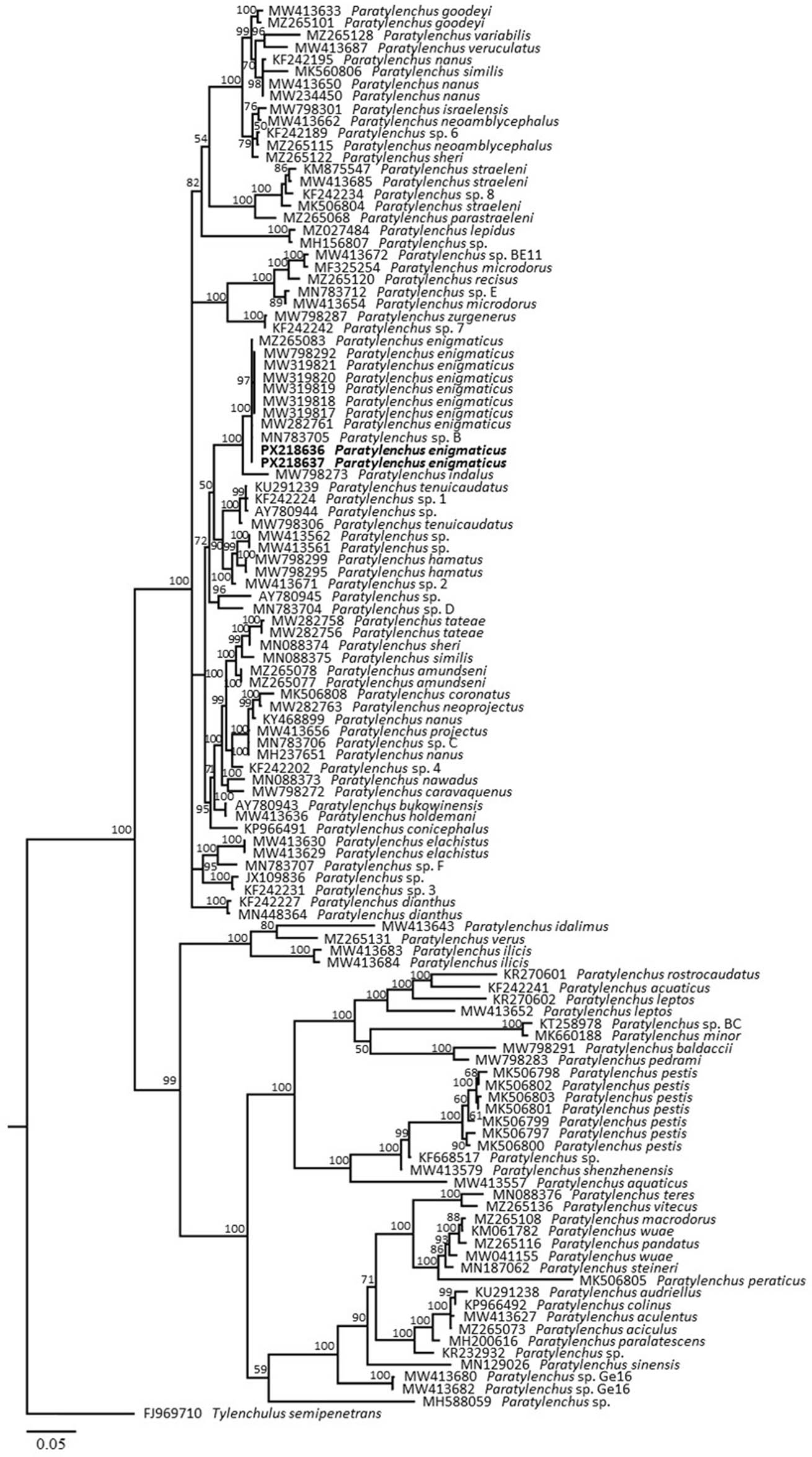
Figure 2
Phylogenetic relationships within population and species of Paratylenchus. Bayesian 50% majority rule consensus tree from two runs as inferred from the analysis of the D2–D3 of 28S rDNA gene sequences under the GTR + I + G model. Posterior probability values more than 50% are given in appropriate clades. Newly sequenced sample is indicated in bold font.
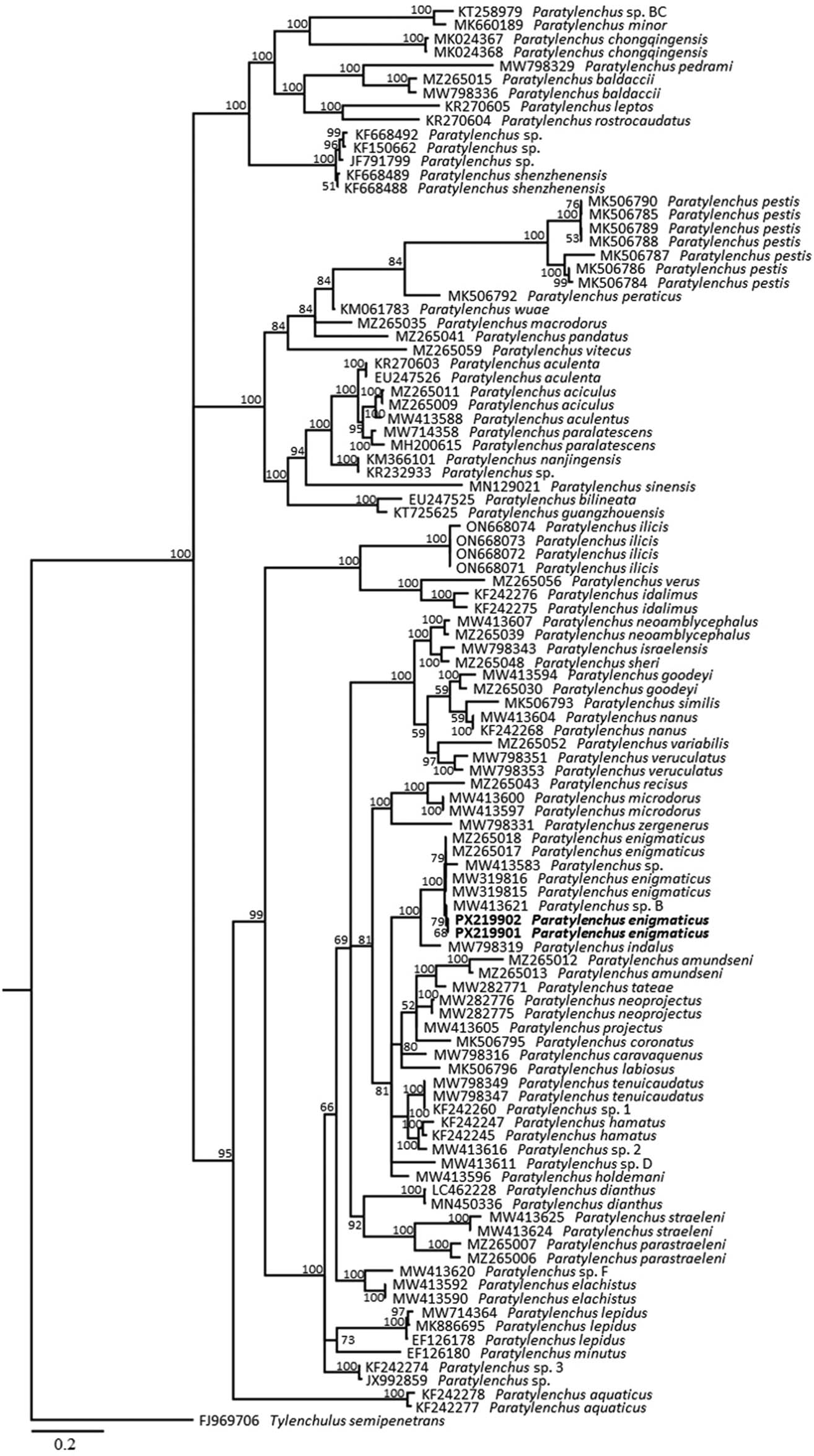
Figure 3
Phylogenetic relationships within population and species of Paratylenchus. Bayesian 50% majority rule consensus tree from two runs as inferred from the analysis of the ITS region gene sequences under the GTR + I + G model. Posterior probability values more than 50% are given in appropriate clades. Newly sequenced sample is indicated by bold font.
3.3. Effect of inoculum density on reproduction and plant growth
The RFs of P. enigmaticus on chrysanthemum cultivar “Milky Star” varied depending on the initial inoculum density (Fig. 4). In the control treatment (Pi = 0), no nematodes were recovered (Pf = 0, RF = 0). At the lowest inoculation density (Pi = 100), the mean Pf reached 359 ± 66 individuals, resulting in the highest RF (RF = 3.59 ± 0.54). At Pi = 1,000, the mean Pf increased to 1,492 ± 843, but RF declined to 1.49 ± 0.69. At the highest inoculum level (Pi = 10,000), Pf averaged 3,695 ± 1,084, while RF decreased further to 0.37 ± 0.09. These results indicate density-dependent suppression of nematode reproduction, with reproduction efficiency declining as inoculum density increased. Statistical analysis confirmed these patterns. One-way ANOVA showed a significant effect of inoculum density on both Pf (F = 13.71, p < 0.01) and RF (F = 20.87, p < 0.01). Tukey’s honestly significant difference (HSD) test revealed that RF values were significantly higher in the 100 inoculum treatment compared with both the 1,000 (p < 0.05) and 10,000 (p < 0.01) treatments, whereas no significant difference was detected between the 1,000 and 10,000 groups. Plant growth parameters showed numerical differences but no statistically significant treatment effects (Table 4). In the control group, mean shoot height, shoot weight, and root weight were 11.4 ± 1.65 cm, 2.72 ± 0.62 g, and 4.57 ± 0.89 g, respectively. Inoculation with 100 nematodes produced similar growth values (shoot weight 2.79 ± 1.35 g, root weight 4.75 ± 1.76 g). Plants inoculated with 1,000 nematodes exhibited the highest biomass (shoot weight 4.67 ± 1.07 g, root weight 6.10 ± 1.01 g), whereas those inoculated with 10,000 nematodes displayed reduced growth (shoot weight 3.95 ± 0.76 g, root weight 5.34 ± 1.52 g). However, ANOVA indicated that these differences were not statistically significant (shoot height: p = 0.093; shoot weight: p = 0.114; root weight: p = 0.531). Taken together, these findings demonstrate that P. enigmaticus reproduces most efficiently at low inoculum density, while higher densities result in diminished reproduction efficiency. Although plant growth parameters did not differ significantly among treatments, plants at the highest inoculum density showed a non-significant tendency toward reduced growth compared with the control.
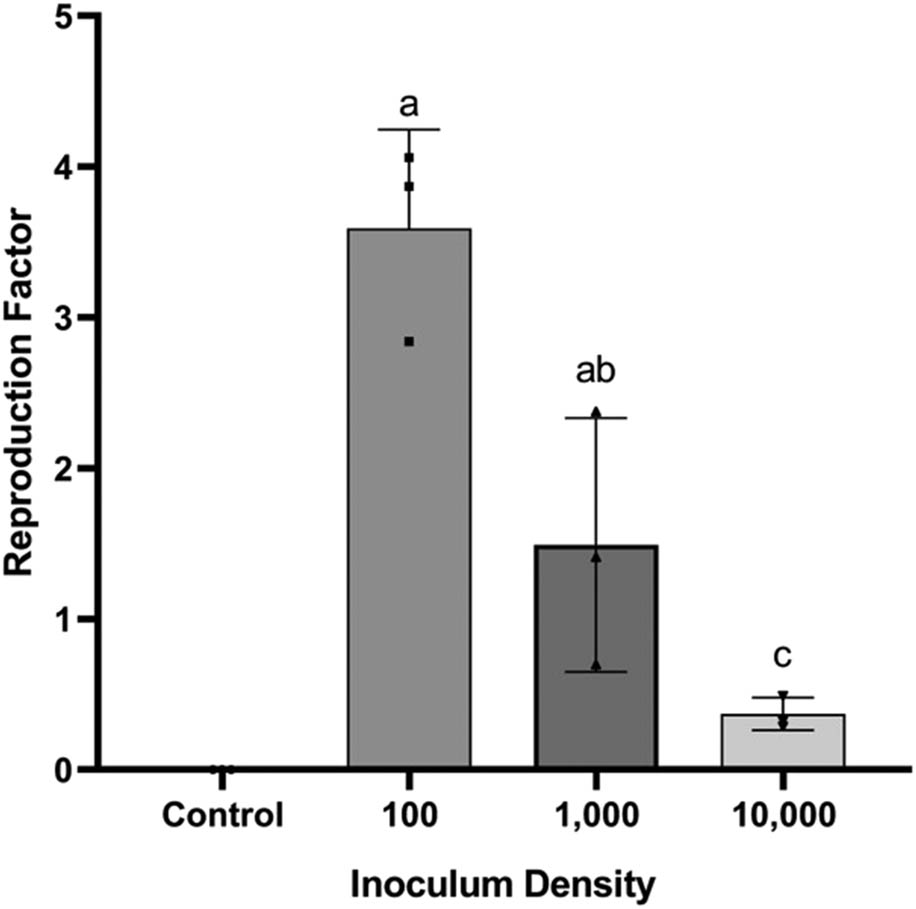
Figure 4
Effect of initial inoculum density of Paratylenchus enigmaticus on RF of chrysanthemum cultivar “Milky Star.” Bars represent mean values ± standard deviation (SD) (n = 3). Different letters indicate significant differences among treatments based on Tukey’s HSD test (p < 0.05).
Table 4
Growth parameters of chrysanthemum “Milky Star” after inoculation with different initial densities of Paratylenchus enigmaticus
| Inoculum density (Pi) | Shoot height (cm) | Shoot weight (g) | Root weight (g) |
|---|---|---|---|
| 0 (Control) | 11.4 ± 1.65 | 2.72 ± 0.62 | 4.57 ± 0.89 |
| 100 | 12.1 ± 2.01 | 2.79 ± 1.35 | 4.75 ± 1.76 |
| 1,000 | 13.8 ± 1.42 | 4.67 ± 1.07 | 6.10 ± 1.01 |
| 10,000 | 12.6 ± 1.88 | 3.95 ± 0.76 | 5.34 ± 1.52 |
3.4. Host response assay in five chrysanthemum cultivars
All plants were inoculated with 100 nematodes per pot (Pi = 100). Across cultivars, P. enigmaticus reproduced in every pot (Table 5). RF values (mean ± SD) were as follows: “Miracle Eye” 5.66 ± 3.22, “Crown White” 2.15 ± 0.55, “Sweet Pink” 2.03 ± 0.09, “Golden Wave” 1.59 ± 0.27, and “Pretty Purple” 0.69 ± 0.16. Using RF ≤ 1 as the criterion for poor host status, “Pretty Purple” was classified as a poor host, while all replicates of the remaining cultivars had RF > 1 and were therefore classified as hosts. Despite numerical differences, one-way ANOVA detected no significant among-cultivar differences for Pf or RF (Pf: F = 1.67, p = 0.232; RF: F = 1.67, p = 0.232). Within-cultivar variability of RF (coefficient of variation, CV%) ranged from 7.4% (“Sweet Pink”) to 98.5% (“Miracle Eye”).
Table 5
RF of Paratylenchus enigmaticus in five chrysanthemum cultivars inoculated with 100 nematodes
| Cultivar | RF (Mean value ± SD) | CV (%) | Host status |
|---|---|---|---|
| Crown white | 2.15 ± 0.55 | 25.6 | Host |
| Golden wave | 1.59 ± 0.27 | 17.0 | Host |
| Miracle eye | 5.66 ± 3.22 | 98.5 | Host |
| Pretty purple | 0.69 ± 0.16 | 23.2 | Poor host |
| Sweet pink | 2.03 ± 0.09 | 7.4 | Host |
4. Discussion
Pin nematodes (Paratylenchus Micoletzky, 1922; Tylenchulidae) are polyphagous plant parasites with a wide host range and broad geographical distribution, comprising more than 130 valid species worldwide (Ghaderi et al., 2016; Hosseinvand et al., 2020). Despite this global diversity, only four species, P. aquaticus, P. lepidus, P. nanus, and P. projectus, have been reported in Korea (Pinochet and Raski, 1977; Chung et al., 2004; Kwon et al., 2019; Mwamula and Lee, 2021). The present study provides the first record of Paratylenchus enigmaticus in Asia, thereby expanding its known geographical distribution beyond North America and Europe. It also demonstrates that spray chrysanthemum can serve as a host for this species, as confirmed by integrative morphological, molecular, and pathogenicity analyses.
Paratylenchus enigmaticus has been recently described from Canada, Spain, and it has also been reported in Belgium (Munawar et al., 2021; Clavero-Camacho et al., 2021a; Clavero-Camacho et al., 2021b; Maosa et al., 2024). Comparative morphological analysis of P. enigmaticus populations from different geographic regions and host plants reveals subtle but notable variations that may reflect host-adaptation or environmental influence. The Korean population, isolated from spray chrysanthemum, exhibited female body lengths ranging from 328.6 to 403.0 μm, with a mean stylet length of 26.0 ± 1.3 μm. These values are broadly consistent with the original description of P. enigmaticus from potato fields in Alberta, Canada (Munawar et al., 2021). Interestingly, despite the consistency in major diagnostic features (e.g., stylet morphology, lip region shape, and tail shape), minor morphometric variations were observed in traits such as tail length, excretory pore position, and c/c′ ratios among populations from different hosts and regions. The Korean population exhibited slightly shorter tail lengths compared to the Belgian leek-associated population. These differences could be attributed to phenotypic plasticity influenced by host plant physiology or environmental conditions, such as soil type, temperature, and moisture (Álvarez-Ortega et al., 2023).
Reproduction of P. enigmaticus in spray chrysanthemum was strongly influenced by initial inoculum density, showing the highest RF (RF = 3.59) at the lowest density (100 nematodes per pot), with a marked decline at higher inoculum levels. While the absolute number of nematodes recovered generally increased with higher inoculation densities, reproductive efficiency plateaued or declined at the highest level. Similar density-dependent responses have been reported in other plant-parasitic nematodes (Gutiérrez-Gutiérrez et al., 2012; Sangronis et al., 2014), likely due to site saturation, intraspecific competition, or limited host resources (Wallace, 1968; Moens et al., 2009). Despite active reproduction, no significant reduction in plant growth was observed, suggesting that under moderate population pressures, P. enigmaticus may act as a low-impact or latent parasite in chrysanthemum. The host status assay across five cultivars further revealed variability in nematode reproduction. While all cultivars except “Pretty Purple” supported RF > 1, RF varied substantially among cultivars; most notably, “Miracle Eye” exhibited a high mean RF (5.66) with a CV of 98.5%, indicating strong within-cultivar variability. In contrast, “Sweet Pink” maintained a low CV (7.4%) despite moderate RF, suggesting more stable host-nematode interactions. Interestingly, “Pretty Purple” was the only cultivar classified as a poor host (RF = 0.69), suggesting potential partial resistance or reduced host suitability for P. enigmaticus. These differences may reflect genotypic variation in root exudates, root architecture, or defense responses among cultivars. The high CV in some cultivars may also suggest that environmental micro-conditions or phenotypic plasticity in nematode behavior could play a significant role in host response, consistent with prior observations of environmentally driven morphological variability in Paratylenchus species (Álvarez-Ortega et al., 2023).
The geographic and host range of Paratylenchus enigmaticus is extended to Asia and spray chrysanthemum, respectively. Although reproduction occurred across all but one tested cultivar, the substantial variability in reproductive factor suggests a complex interplay of factors. Rather than host genotype alone, environmental micro-conditions or subtle physiological differences among cultivars may have influenced nematode performance. These findings underline the importance of evaluating nematode-host interactions under diverse environmental scenarios. Future studies should explore how soil conditions, temperature fluctuations, and crop management practices affect P. enigmaticus reproduction and potential damage in commercial floriculture.
Acknowledgments
This work was carried out with the support of the Cooperative Research Program for Agriculture Science and Technology Development (RS-2025-02214353), Rural Development Administration, Republic of Korea; and NRF grant funded by the Ministry of Education, Science and Technology (RS-2025-02213915); and a New Faculty Research Grant of Pusan National University, 2024.
Funding information
Authors state no funding involved.
Conflict of interest statement
Authors state no conflict of interest.