
Figure 1
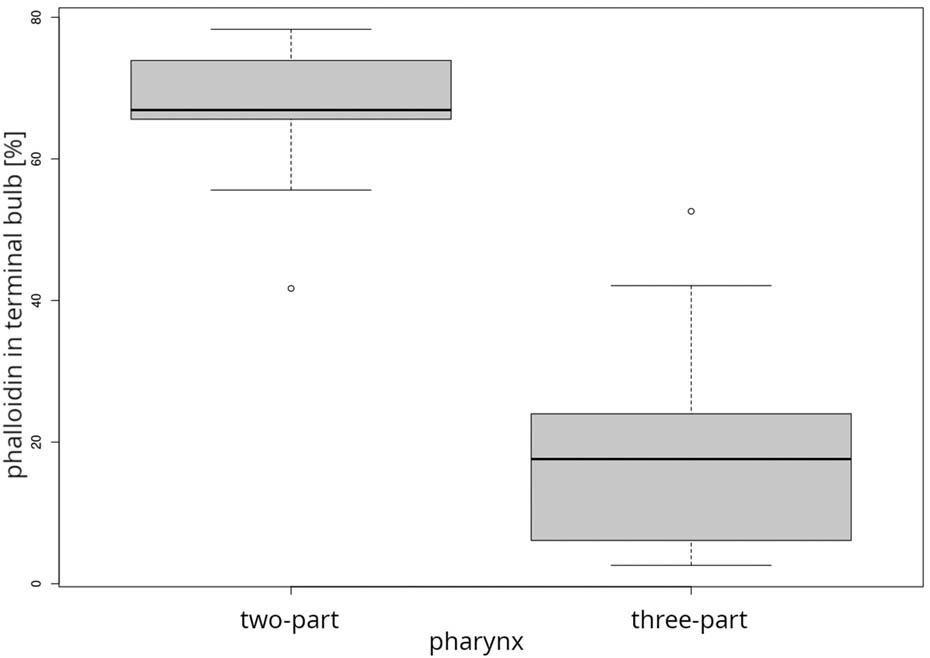
Box plot comparing the relative muscle volume inside the terminal bulb of Stilbonematinae specimens with a two- and three-part pharynx.
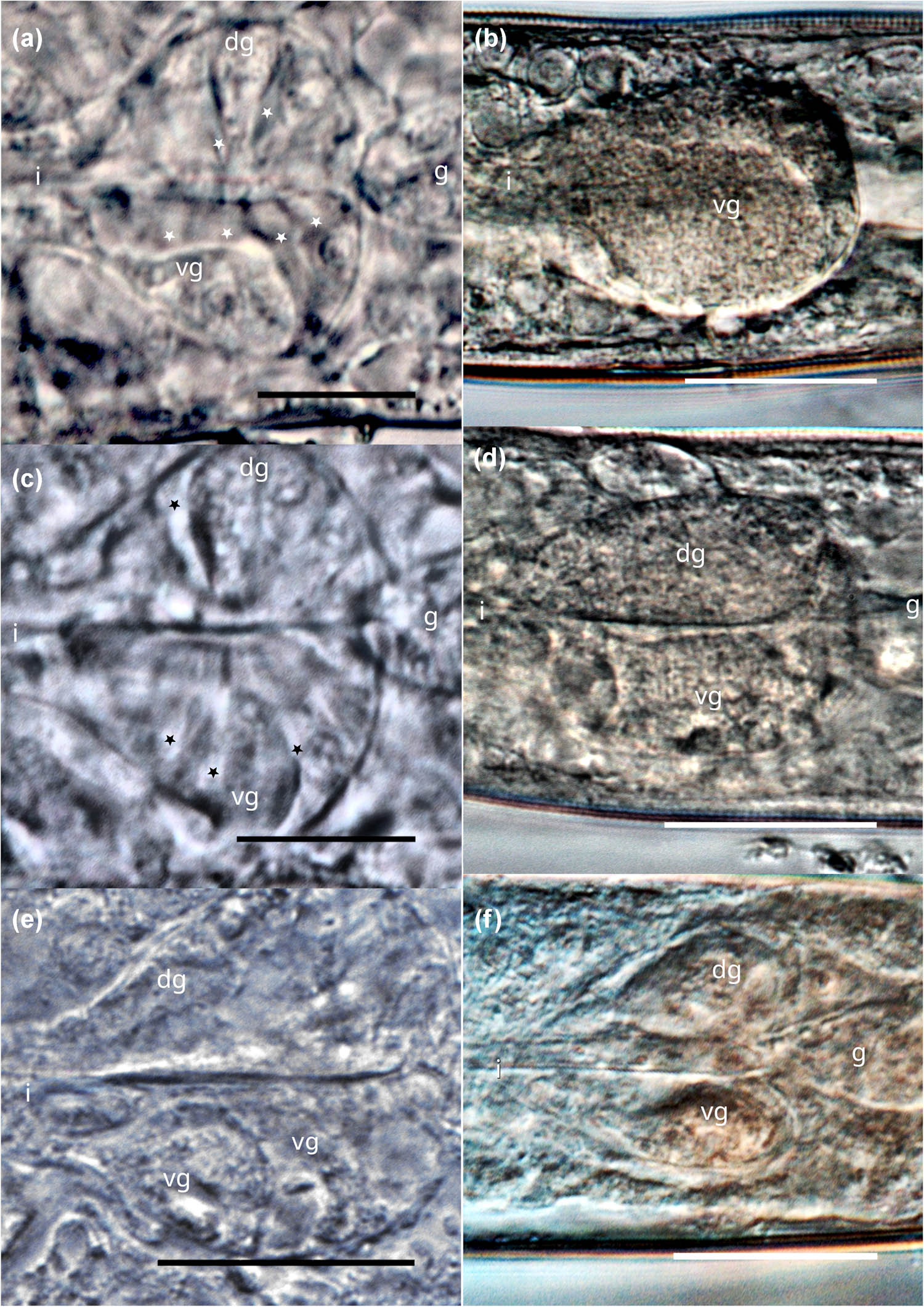
Figure 2
LM micrographs of the terminal bulb and its glands of Stilbonematinae with a two-part (a, c, and e) and three-part pharynx (b, d, and f). Anterior on the left. (a and c) Eubostrichus topiarius, male. Asterisks indicate the prominent radial musculature wrapping around the gland cells. (b and d) Catanema schiemeri, female. Prominent gland cells prominently occupy the basal bulb and are indicated by their granular interior. (e) Laxus cosmopolitus, male. The small dorsal and ventrosublateral glands are shown. (f) Catanema schiemeri, male. The expansion of both dorsal and ventrosublateral glands are shown. Note: dg: dorsal gland, g: gut, and sv: ventrosublateral gland. Scale bar: 20 µm.
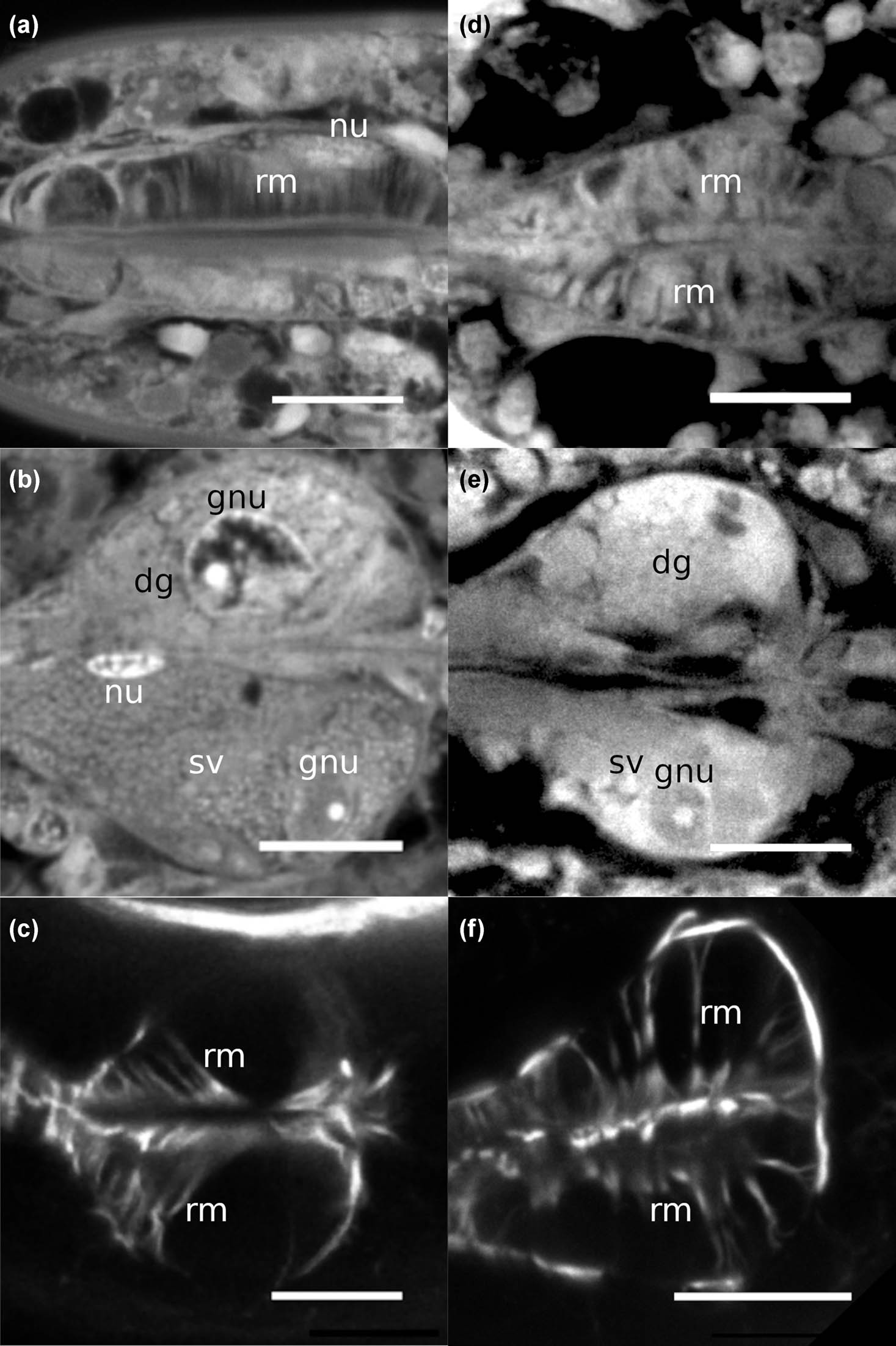
Figure 3
Comparison of autofluorescence signal between radial musculature of the corpus and gland tissue of the terminal bulb. Anterior on the left. (a, b, d, and e). Autofluorescence micrographs. (c and f) CLSM micrographs of phalloidin staining. (a) Catanema schiemeri, female. Corpus. Myofilaments of the radial musculature of the dorsal sector are highly ordered and well visible. (b) C. schiemeri, same individual as in A. Terminal bulb. Dorsal and ventrosublateral gland cells are prominently expanded throughout the terminal bulb. The gland vesicles are visible as smaller (dorsal) and slightly larger (ventrosublateral) granules. Oblique longitudinal section. (c) Catanema schiemeri. Terminal bulb. Myofilaments are diagonally arranged in both the anterior half and the posterior end of the terminal bulb. In between, a large gap, corresponding to the position of the voluminous gland cells, is present. (d) Cyathorobbea ruetzleri. Corpus. Radial musculature well visible as radially arranged filaments. (e) Cyathorobbea ruetzleri, same individual as in d. Terminal bulb. The expansion of both dorsal and ventrosublateral glands is shown. Oblique longitudinal section. Scale bars: (a, b, d, e, and f) 10 µm and (c) 20 µm.
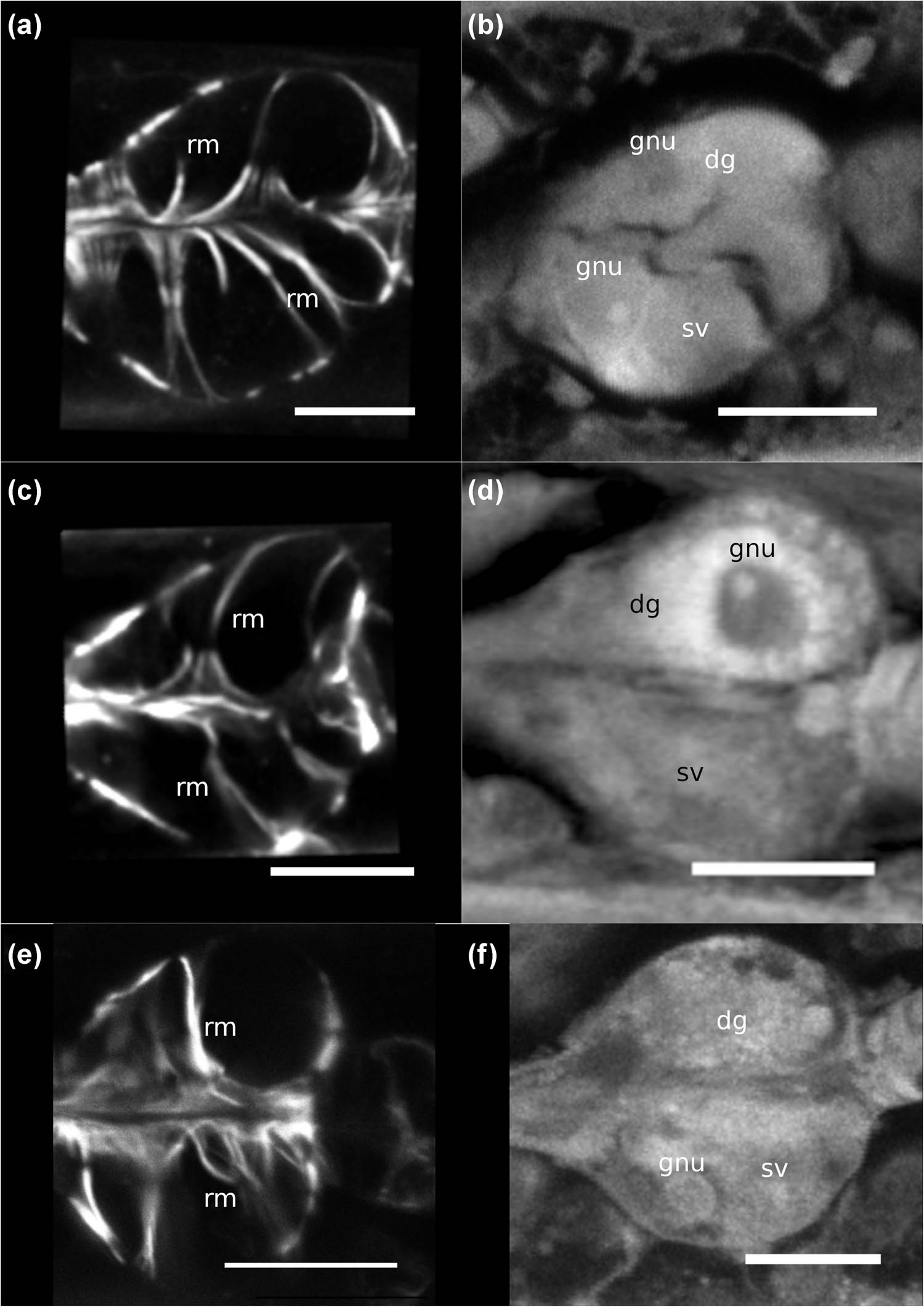
Figure 4
Terminal bulb of the genus Robbea. Phalloidin staining of myofilaments and autofluorescence signal of pharyngeal glands. Anterior to the left. (a) Robbea lotti, male. Radial myofilaments loosely arranged. (b) Robbea lotti, female. Prominent gland cells occupy the terminal bulb. Dorsal gland reaching into the ventral half. (c) Robbea weberae, male. Radial myofilaments loosely arranged. (d) Robbea weberae, female. Dorsal and ventrosublateral glands prominently occupy the terminal bulb. Gland content appears slightly granular. The dorsal gland shows more brightness than the ventrosublateral gland. (e) Robbea judithae, male. Radial myofilaments loosely arranged. (f) Robbea judithae, male. Dorsal and ventrosublateral gland cells prominently occupy the terminal bulb. Gland contents appear slightly granular. Note: dg: dorsal gland, gnu: gland nucleus, rm: radial muscle, and sv: ventrosublateral gland. Scale bar: 10 µm.
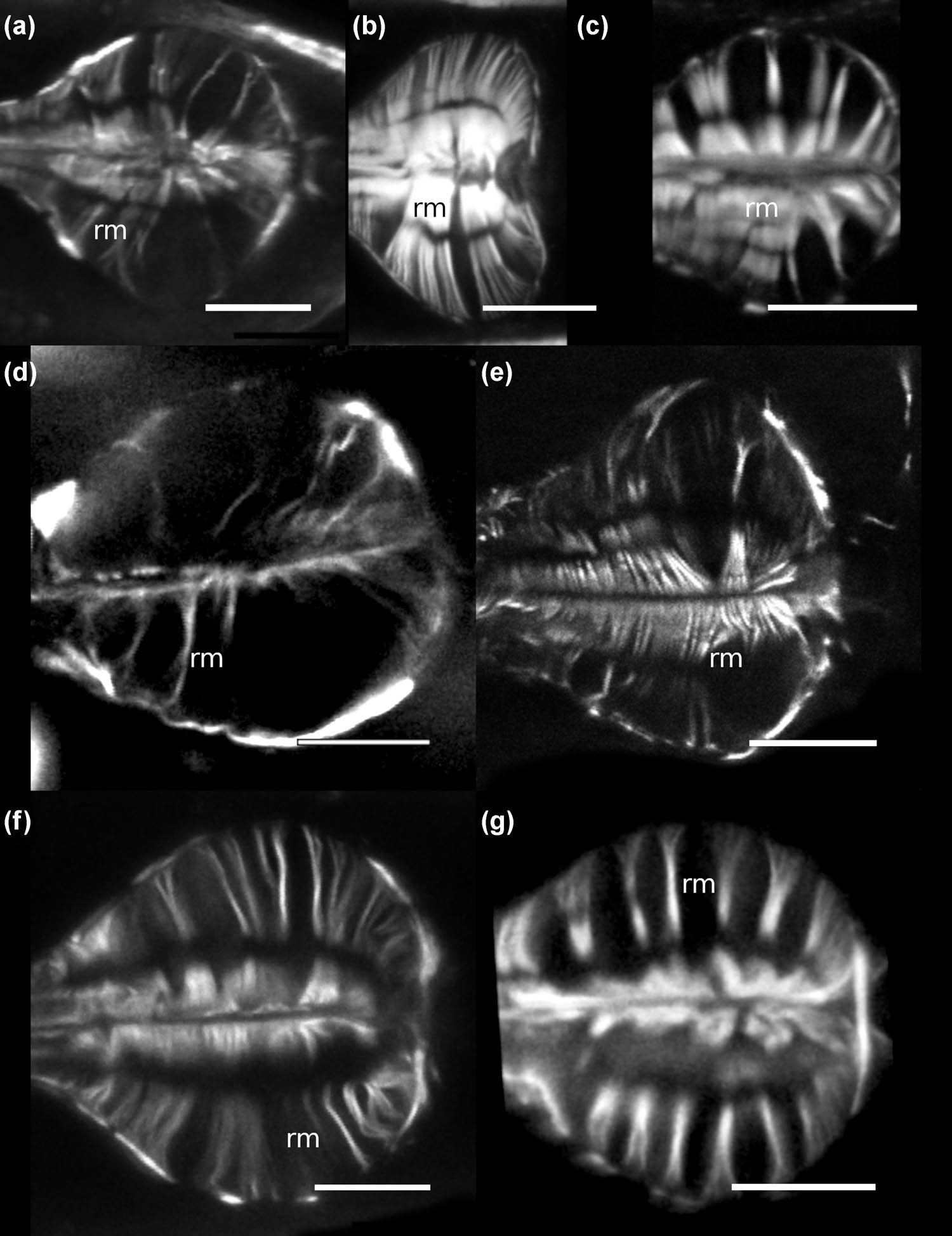
Figure 5
CLSM micrographs of longitudinal sections of the terminal bulb of Stilbonematinae species with phalloidin staining. Anterior on the left. (a) Laxus sp, male. Three-part pharynx. (b) Eubostrichus topiarius. (c) Leptonemella juliae, male. (d) Cyathorobbea hypermnestra. (e) Laxus cosmopolitus. (f) Laxus oneistus. (g) Paralaxus cocos. Note: rm: radial muscle. Scale bar: 10 µm.
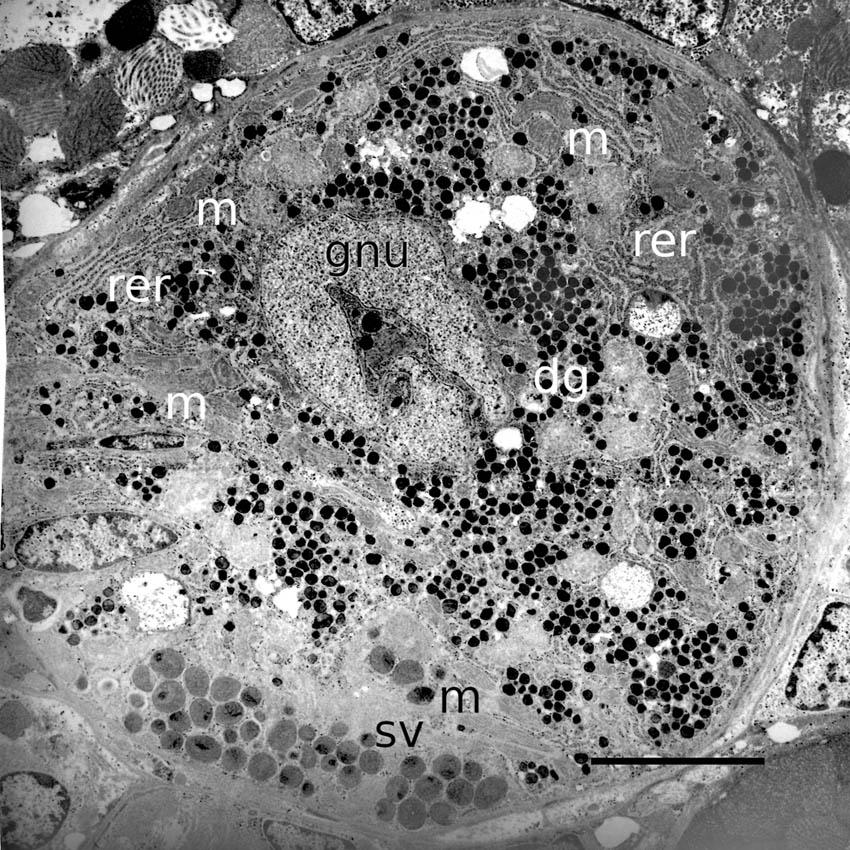
Figure 6
TEM micrograph of the terminal bulb of Catanema schiemeri. Anterior on the left. Oblique longitudinal section through large parts of the dorsal gland and a small portion of the ventrosublateral gland. Note: dg: dorsal gland, gnu: gland nucleus, m: mitochondrion, rer: rough endoplasmatic reticulum, and sv: ventrosublateral gland. Scale bar: 5 µm.
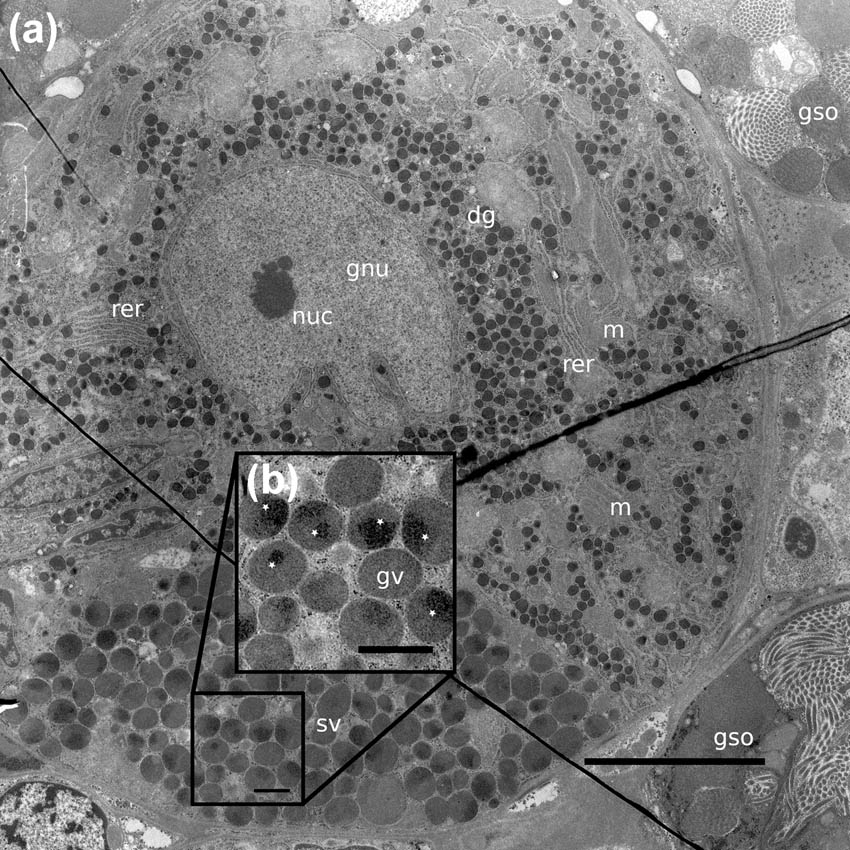
Figure 7
TEM micrograph of the terminal bulb of Catanema schiemeri. Same individual as in Fig. 6. Anterior on the left. (a) Oblique longitudinal section through dorsal and ventrosublateral gland. Distal portion of dorsal gland possesses many mitochondria and rough endoplasmatic reticulum. (b) Detail of ventrosublateral gland showing small electron-dense areas of gland vesicles (asterisks). Note: dg: dorsal gland, gso: epidermal glandular sensory organ, gnu: gland nucleus, gv: gland vesicle, m: mitochondrion, nuc: nucleolus, and rer: rough endoplasmatic reticulum. Scale bar: (a) 5 µm, (b) 1 µm.
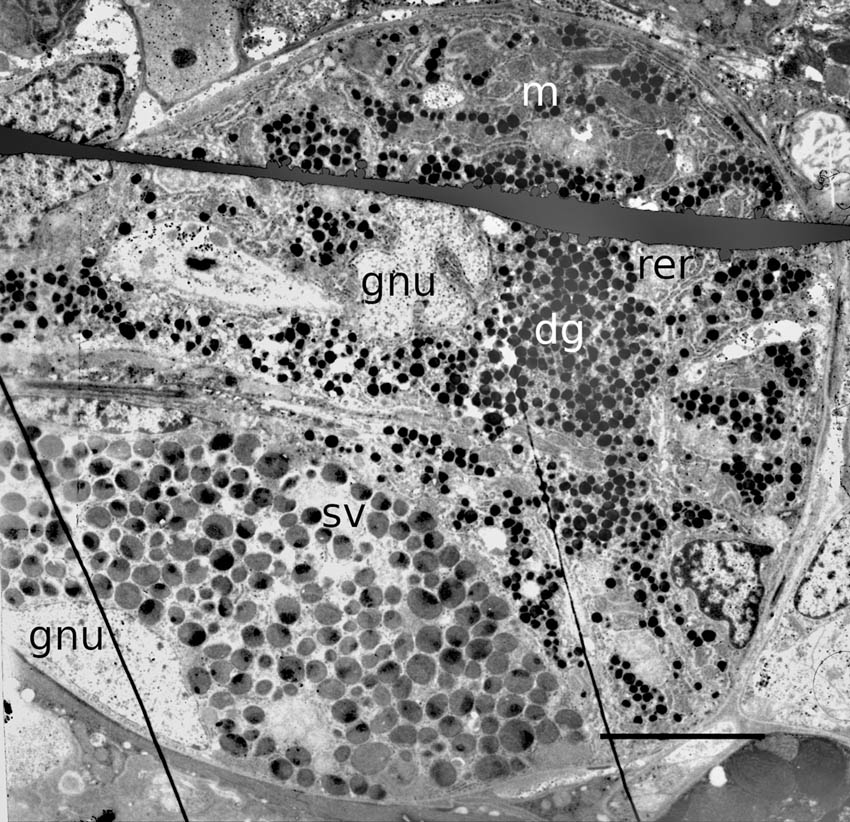
Figure 8
TEM micrograph of the terminal bulb of Catanema schiemeri. Same individual as in Fig. 6. Anterior on the left. Oblique longitudinal section through dorsal and ventrosublateral gland. Gland nuclei of both dorsal and ventrosublateral glands possess large amounts of euchromatin. Note: dg dorsal gland, gnu gland nucleus, m mitochondrion, rer rough endoplasmatic reticulum, sv ventrosublateral gland. Scale bar: 5 µm.
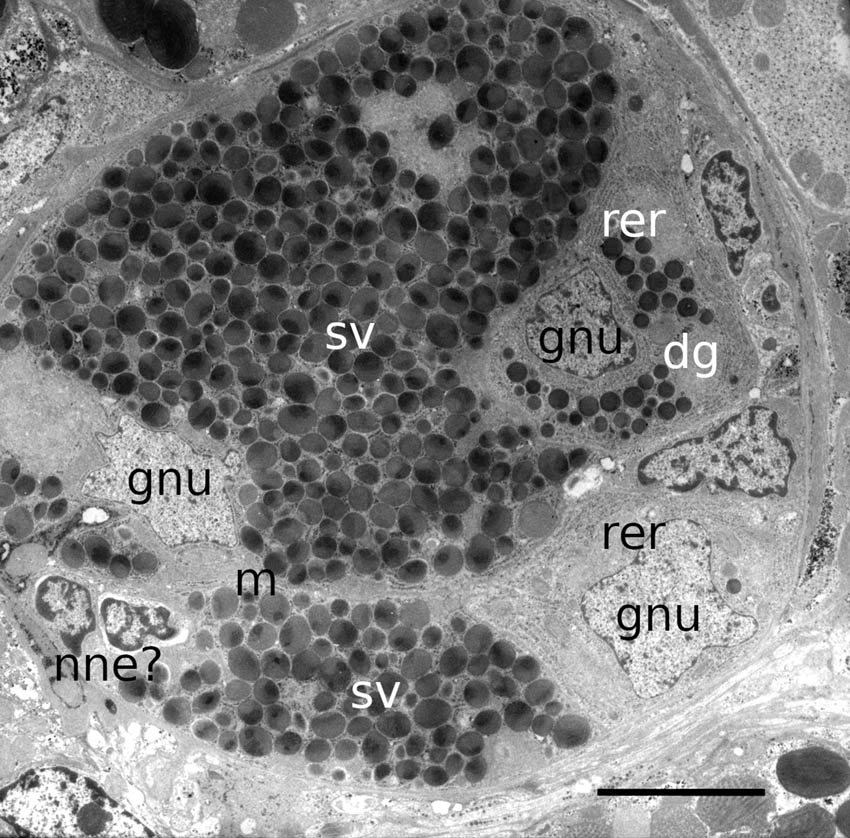
Figure 9
TEM micrograph of the terminal bulb of Catanema schiemeri. Same individual as in Fig. 6. Anterior on the left. Oblique longitudinal section through ventrosublateral glands. Gland vesicles of both ventrosublateral glands show the same shape and interior structure. Gland nuclei show large amounts of euchromatin. Putative neuron nuclei in the bottom left corner. Note: dg: dorsal gland, gnu: gland nucleus, m: mitochondrion, nne: putative neuron nuclei, rer: rough endoplasmatic reticulum, and sv: ventrosublateral gland. Scale bar: 5 µm.
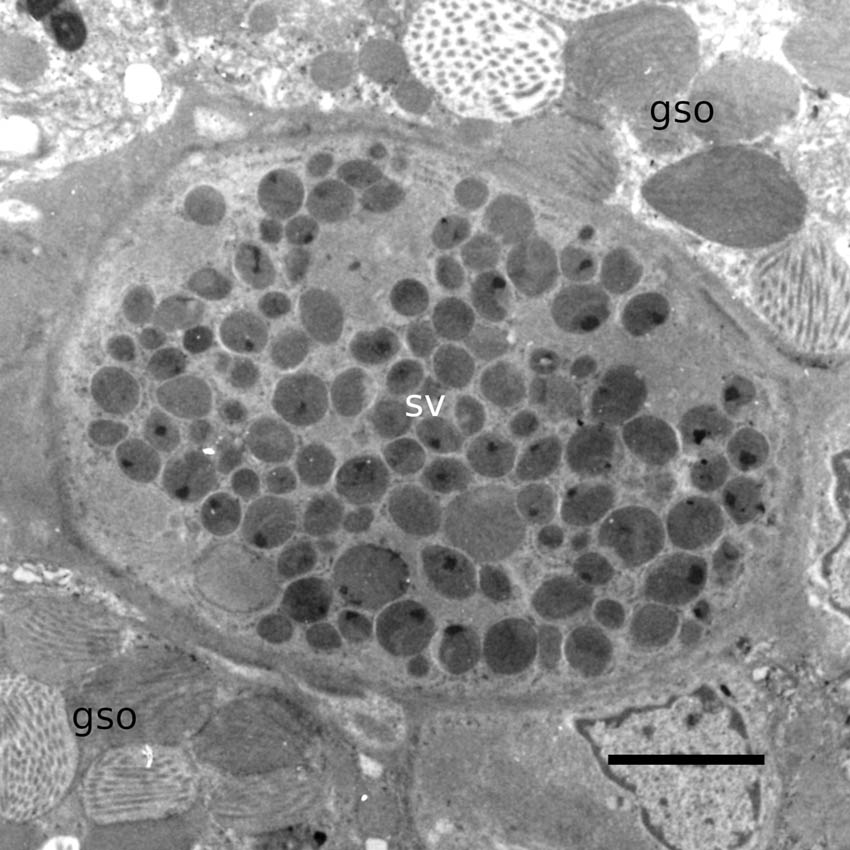
Figure 10
TEM micrograph of the terminal bulb of Catanema schiemeri. Same individual as in Fig. 6. Anterior on the left. Oblique longitudinal section through distal portion of ventrosublateral gland. The gland expands to the distal margin of the terminal bulb. Note: gso: epidermal glandular sensory organ and sv: ventrosublateral gland. Scale bar: 2.5 µm.
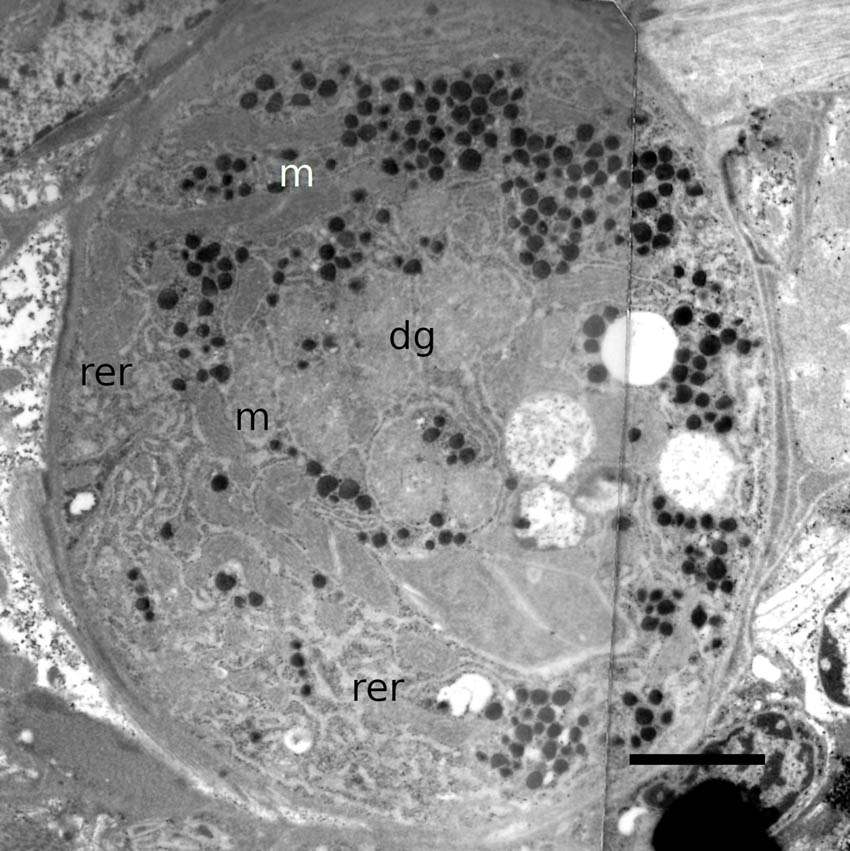
Figure 11
TEM micrograph of the terminal bulb of Catanema schiemeri. Same individual as in Fig. 6. Anterior on the left. Oblique longitudinal section through distal portion of dorsal gland. The gland expands to the distal margin of the terminal bulb. The distal part of the gland contains a lot of mitochondria and endoplasmatic reticulum. Note: dg: dorsal gland, m: mitochondrion, and rer: rough endoplasmatic reticulum. Scale bar: 2.5 µm.
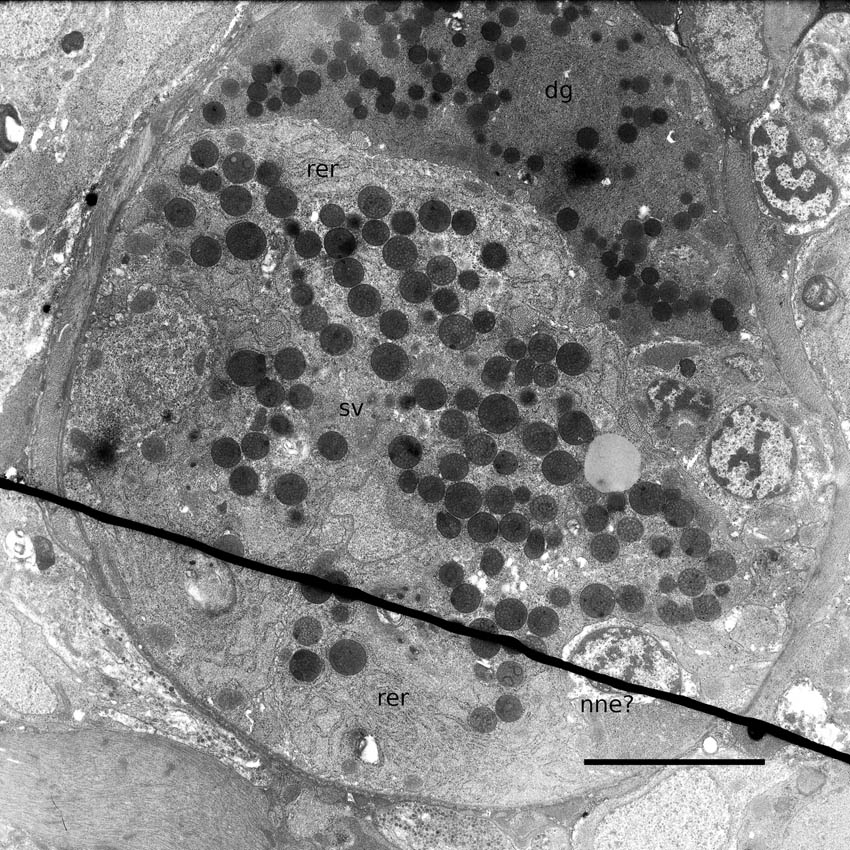
Figure 12
TEM micrograph of the terminal bulb of Cyathorobbea hypermnestra. Anterior to the left. Oblique longitudinal section through parts of the ventrosublateral and dorsal gland. Vesicles larger in the ventrosublateral gland compared to the dorsal gland. Distal portion of the ventrosublateral gland contains large amounts of rough endoplasmatic reticulum. Dorsal gland interior is more electron-dense than ventrosublateral gland. A putative neuron nucleus is indicated in the ventrosublateral sector. Note: dg: dorsal gland, nne: putative neuron nucleus, rer: rough endoplasmatic reticulum, and sv: ventrosublateral gland. Scale bar: 5 µm.
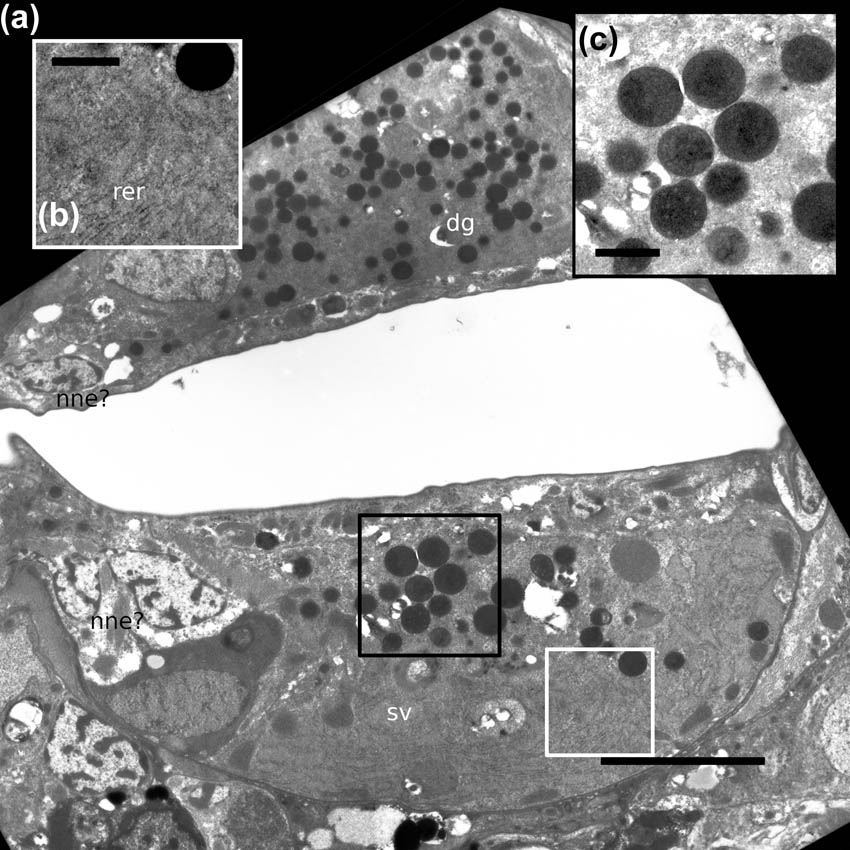
Figure 13
TEM micrograph of the terminal bulb of Cyathorobbea hypermnestra. Anterior to the left. Longitudinal section through roughly the median line of the terminal bulb. A nucleus of a putative neuron at the ventrosublateral anterior end of the terminal bulb is strongly lobulated. (a) Ventrosublateral gland occupying large parts of the ventrosublateral sector. (b) Distal portion of the ventrosublateral gland contains large amounts of rough endoplasmatic reticulum. (c) Proximal part contains gland vesicles, which contain small, less electron-dense areas. Note: dg: dorsal gland, nne: putative neuron nucleus, rer: rough endoplasmatic reticulum, and sv: ventrosublateral gland. Scale bars: (a) 5 µm and (b and c) 1 µm.
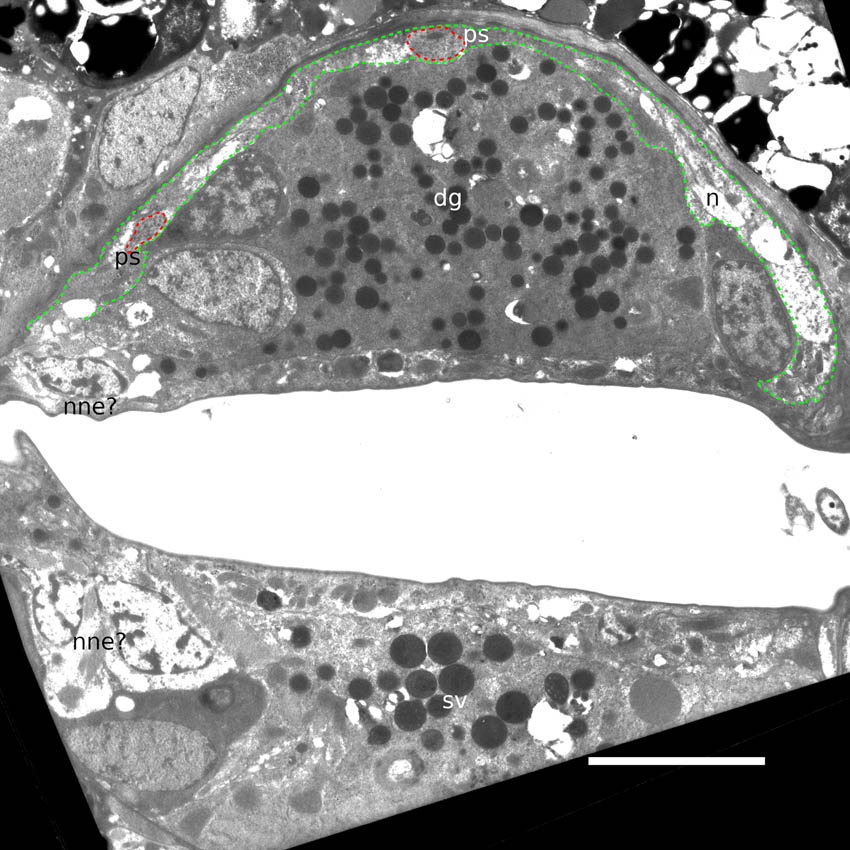
Figure 14
TEM micrograph of the terminal bulb of Cyathorobbea hypermnestra. Same individual as in Fig. 13. Anterior to the left. Longitudinal section through roughly the median line of the terminal bulb. Dorsal gland occupies most of the dorsal sector. Distal to the gland, a neurite traverses the inner border of the terminal bulb. Neurite indicated with a green, dashed outline. Presynaptic terminals indicated with red, dashed outlines. Note: dg: dorsal gland, n: neurite, nne: putative neuron nucleus, ps: presynaptic terminal, and sv: ventrosublateral gland. Scale bar: 2.5 µm.
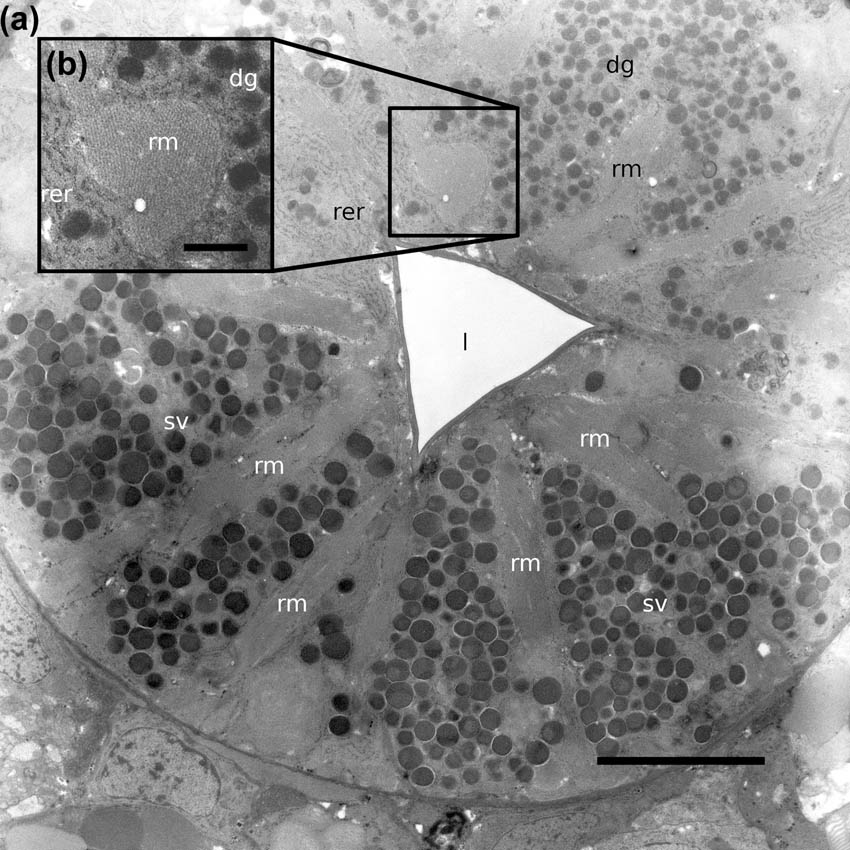
Figure 15
TEM micrograph of the terminal bulb of Cyathorobbea hypermnestra. Cross-section through roughly the center of the terminal bulb. (a) Terminal bulb prominently occupied by gland cells. Cell borders obscure. Marginal cells not distinguishable from muscle cells. (b) Gland tissue is regularly interrupted by radially arranged myofilaments. Note: dg: dorsal gland, rer: rough endoplasmatic reticulum, rm: radial muscle, and sv: ventrosublateral gland. Scale bars: (a) 5 µm and (b) 1 µm.
Table 1
Calculated relative volume of measured F-actin signal from inside the terminal bulb of Stilbonematinae species with a two-part and a three-part pharynx.
| Pharynx | Species | Muscle volume (%) | Coat thickness (µm) | Coat layering | Reference |
|---|---|---|---|---|---|
| Two-part | Eubostrichus topiarius (3) | 66.1–78.3 | 22–25 | Multilayer | Berger et al. (1996) |
| Two-part | Laxus cosmopolitus (1) | 76.9 | 1.8 | Monolayer | Ott et al. (1995) |
| Two-part | Leptonemella juliae (3) | 41.7–65.6 | 4 | Multilayer | Hoschitz et al. (1999) |
| Two-part | Paralaxus cocos (2) | 66.9–73.9 | 7.5 | Multilayer | Scharhauser et al., 2020 |
| Three-part | Catanema schiemeri (4) | 5.5–17.6 | 1.5 | Monolayer | Ott et al. (2020) |
| Three-part | Cyathorobbea hypermnestra (5) | 2.6–8.6 | 2 | Monolayer | Scharhauser et al. (2024) |
| Three-part | Cyathorobbea ruetzleri (1) | 52.6 | 2 | Monolayer | Scharhauser et al. (2024) |
| Three-part | Laxus oneistus (6) | 17.6–27.4 | 2.1 | Monolayer | Ott et al. (1995) |
| Three-part | Laxus sp. (1) | 42.1 | 3 | Monolayer | Ott (unpublished data) |
| Three-part | Robbea judithae (1) | 15.6 | 1 | Monolayer | Scharhauser et al. (2024) |
| Three-part | Robbea lotti (1) | 24.1 | 1 | Monolayer | Scharhauser et al. (2024) |
| Three-part | Robbea weberae (2) | 6.1–24 | 1 | Monolayer | Scharhauser et al. (2024) |
The number in parenthesis next to the species name indicates the number of specimens used for measurements. W = 187, p-value = 3.127 × 10⁻⁵. Data on bacterial coat thickness were extracted from species descriptions, as well as from LM, scanning electron microscopy, or TEM micrographs from the collection of JAO. There are two types of bacterial coat in Stilbonematinae (refer Scharhauser et al., 2020).
Source for Laxus sp.: Author’s contribution. Source for the remaining species: Berger et al., 1996, Hoschitz et al., 1999, Ott et al., 1995, Ott et al., 2020, Scharhauser et al., 2024.