Have a personal or library account? Click to login
Evaluation of Meloidogyne chitwoodi Race 1 and Pathotype Roza in Arabidopsis thaliana and Tomato Plants Cover

Evaluation of Meloidogyne chitwoodi Race 1 and Pathotype Roza in Arabidopsis thaliana and Tomato Plants

Open Access
|Jan 2026

Figures & Tables

Figure 1:

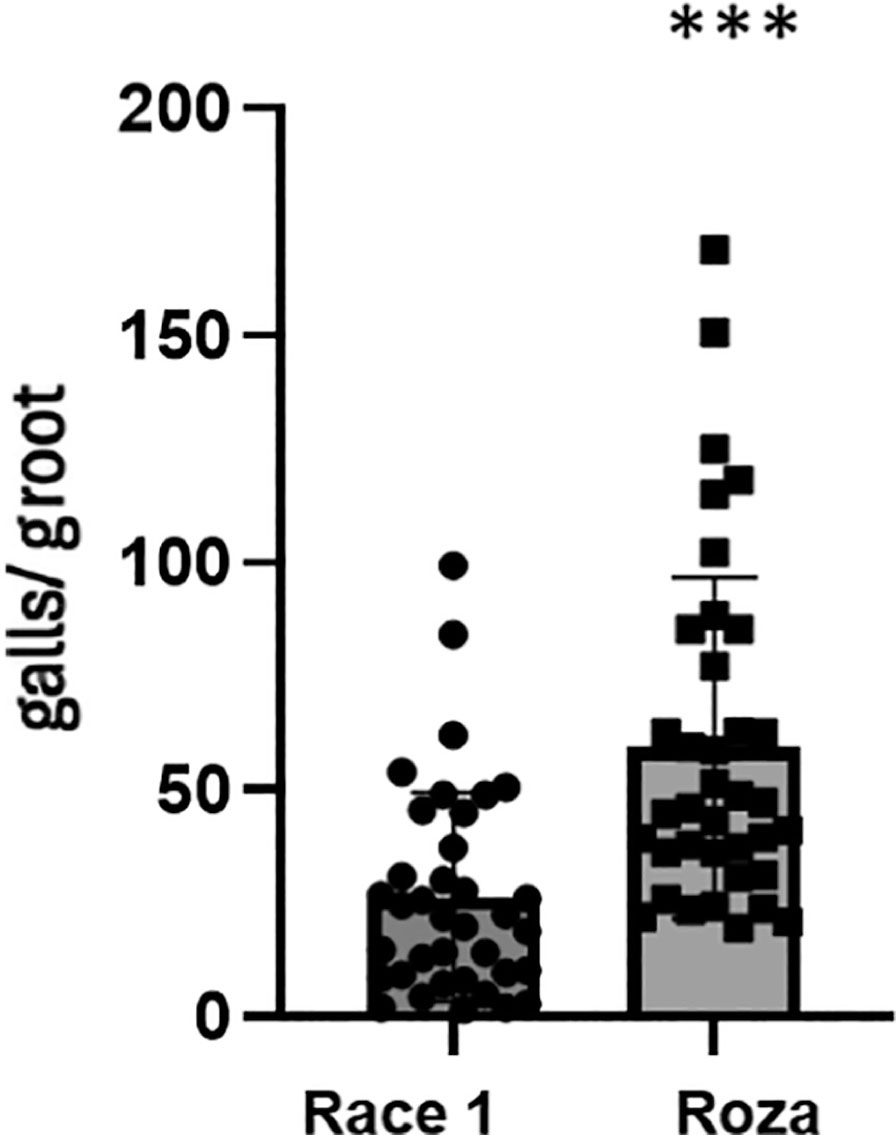
Meloidogyne chitwoodi Roza causes more galls than race 1 on Arabidopsis roots. 2-wk-old Arabidopsis seedlings were inoculated with approximately 150 J2s of M. chitwoodi race 1 or Roza. Galls per gram (g) of roots were counted at 14 d post-inoculation. Data represents the mean galls per gram of plant roots for two independent experiments combined (n = 37) +/− SD ***P-value <0.0001, Mann–Whitney test. SD, standard deviation.
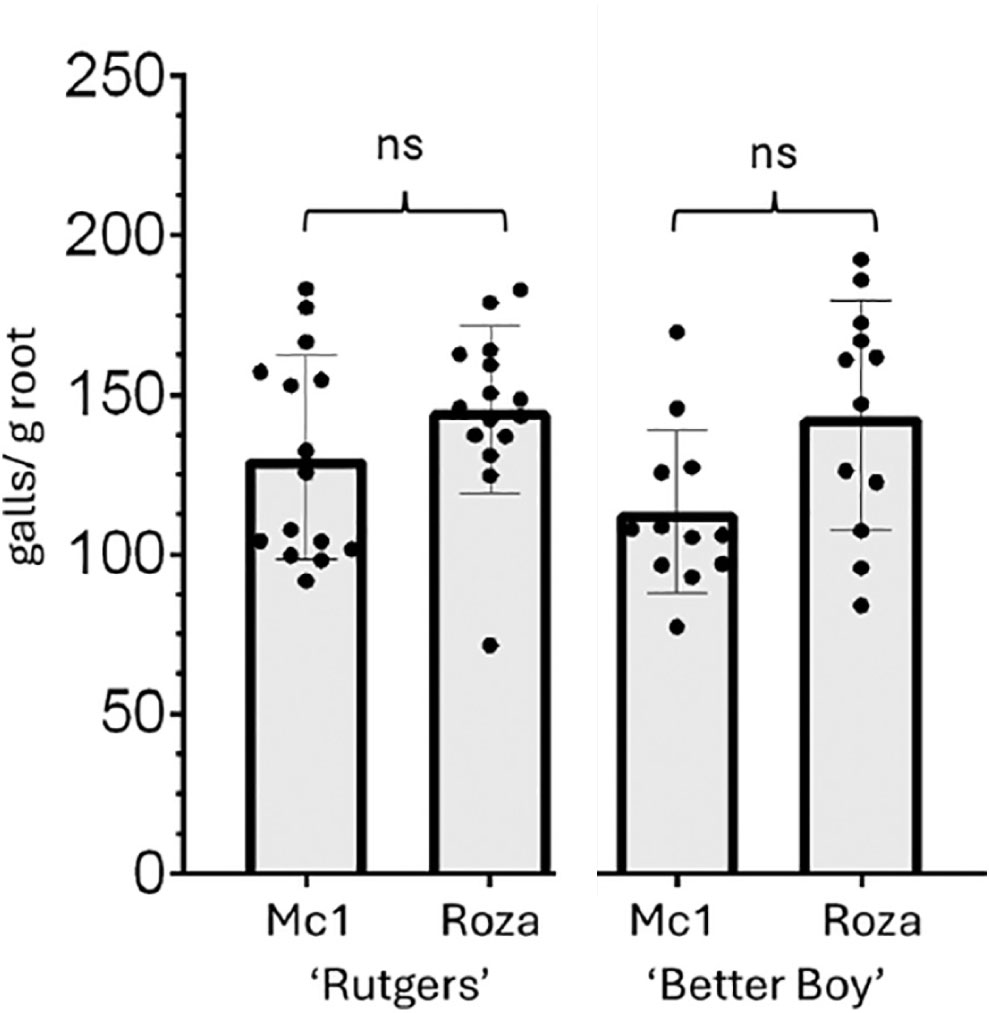

Figure 2:

Meloidogyne chitwoodi race 1 and Roza can infect ‘Rutgers’ (mi/mi) and ‘Better Boy’ (Mi/mi). 4-wk-old tomato plants were inoculated with 3,000 eggs of either race 1 or Roza. Galling severity was quantified as the number of galls per gram (g) of root at 30 dpi. Bars represent mean galls per gram of root (n = 12–15 plants) ± SD, and experiment repeated twice with similar results. ns, as determined by Mann–Whitney test. ns, not significant; SD, standard deviation.
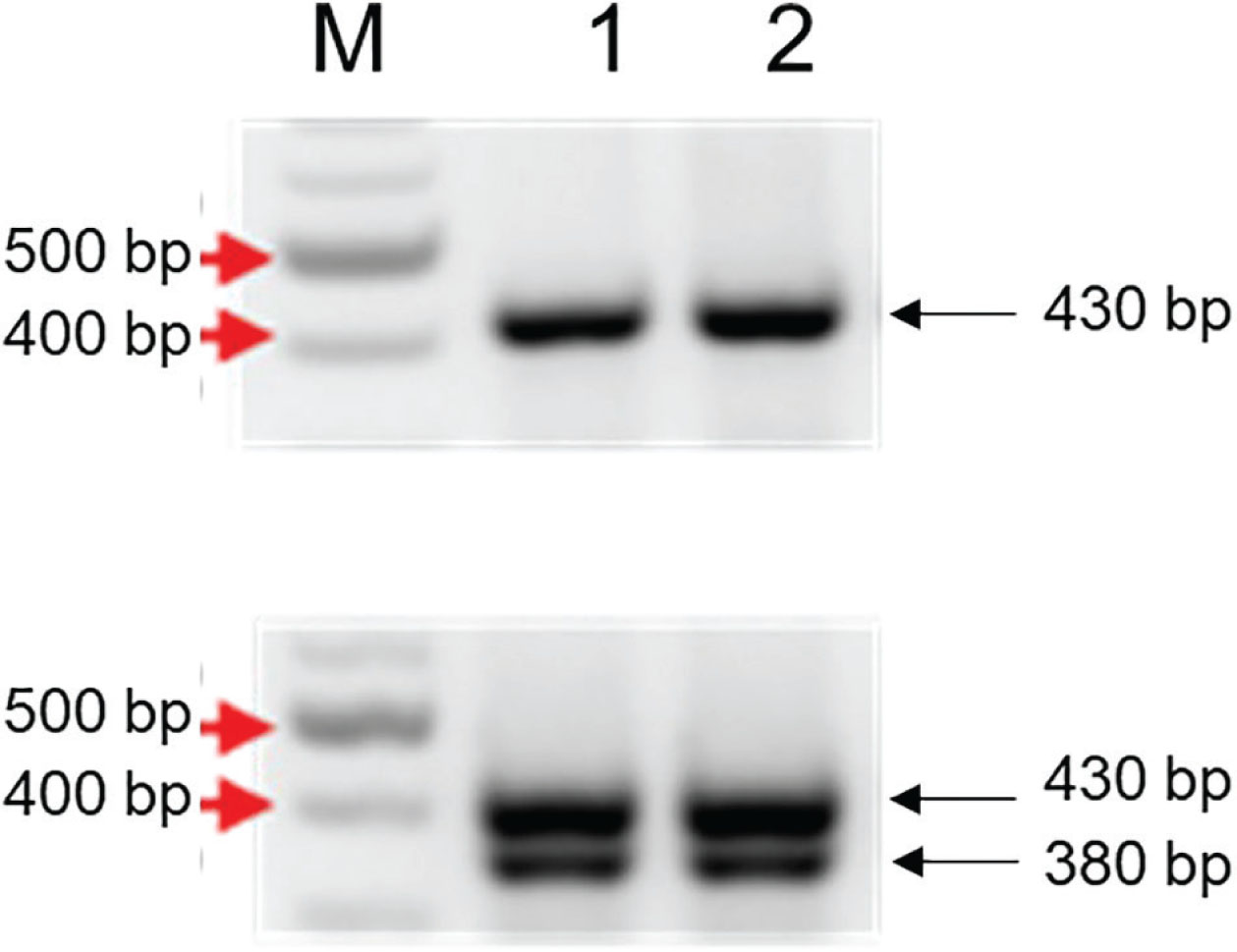

Figure 3:

Detection of Mi-1.2 in ‘Better Boy’ tomatoes. Galls were collected from M. chitwoodi-infected ‘Better Boy’ and ‘Rutgers’ tomatoes and subjected to DNA extraction and PCR with primers Mi23F and Mi23R (Seah et al., 2007). PCR from ‘Rutgers’ results in a 430 bp band, indicating that it is the mi1.2 susceptible allele. PCR from ‘Better Boy’ resulted in 380 bp and 430 bp bands, indicating that the plant is heterozygous for Mi1.2 resistance. 1 Kb + ladder, from New England Biolabs. Red arrows indicate band sizes. Lanes 1 and 2 indicate that PCR was performed on DNA from nematodes inside galls from two independent plants. MM, molecular marker; PCR, polymerase chain reaction.
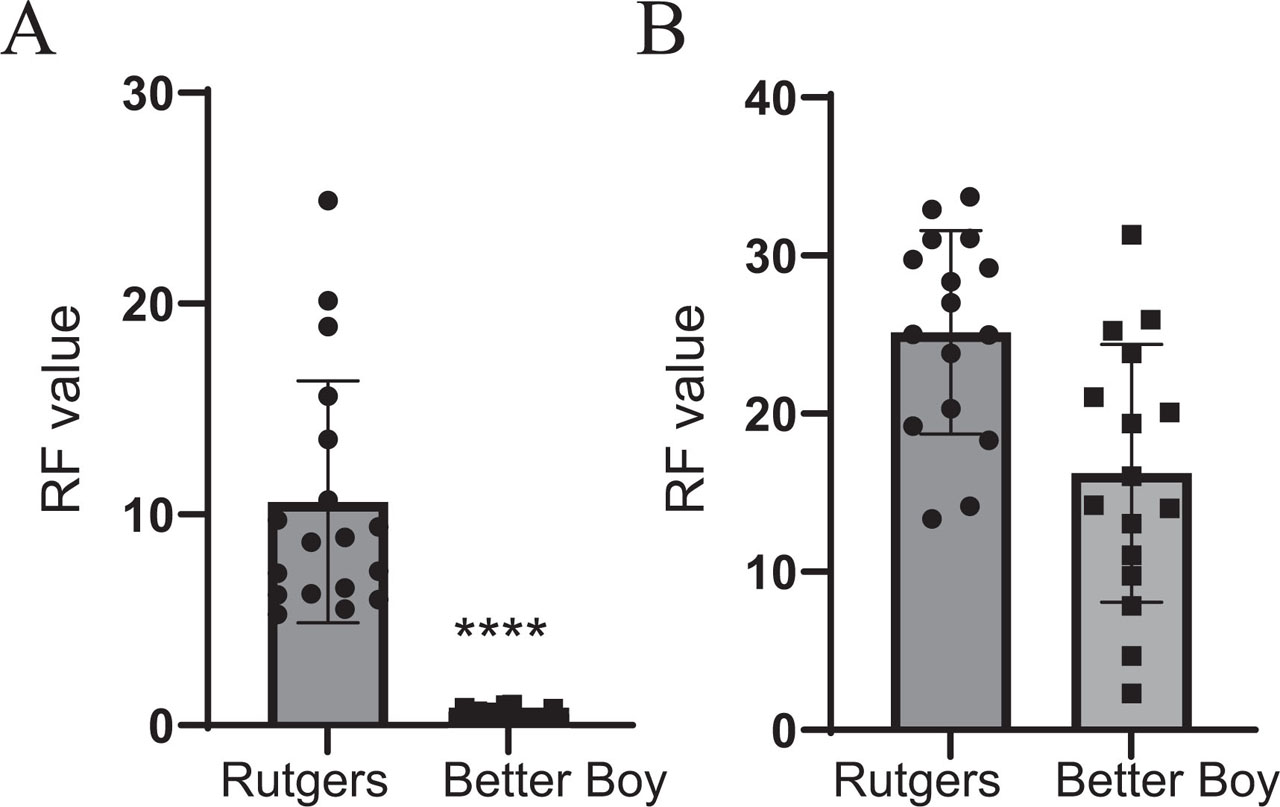

Figure 4:

RF values for M. incognita and M. chitwoodi race 1 on ‘Rutgers’ and ‘Better Boy’. (A) 4-wk-old tomato plants were inoculated with 5,000 M. incognita eggs and evaluated 60 d later for RF values. Data represent the mean reproduction factor per plant of two independent experiments combined (n = 18–19) ± SD. (B) 4-wk-old tomato plants were inoculated with 5,000 M. chitwoodi race 1 eggs and evaluated 60 d later for RF values. n = 16. Data represent the mean reproduction factor per plant of two independent experiments combined (n = 16) ± SD. Statistical significance was determined using the Mann–Whitney test *P < 0.002; ***P < 0.001. RF, reproductive factor; SD, standard deviation.
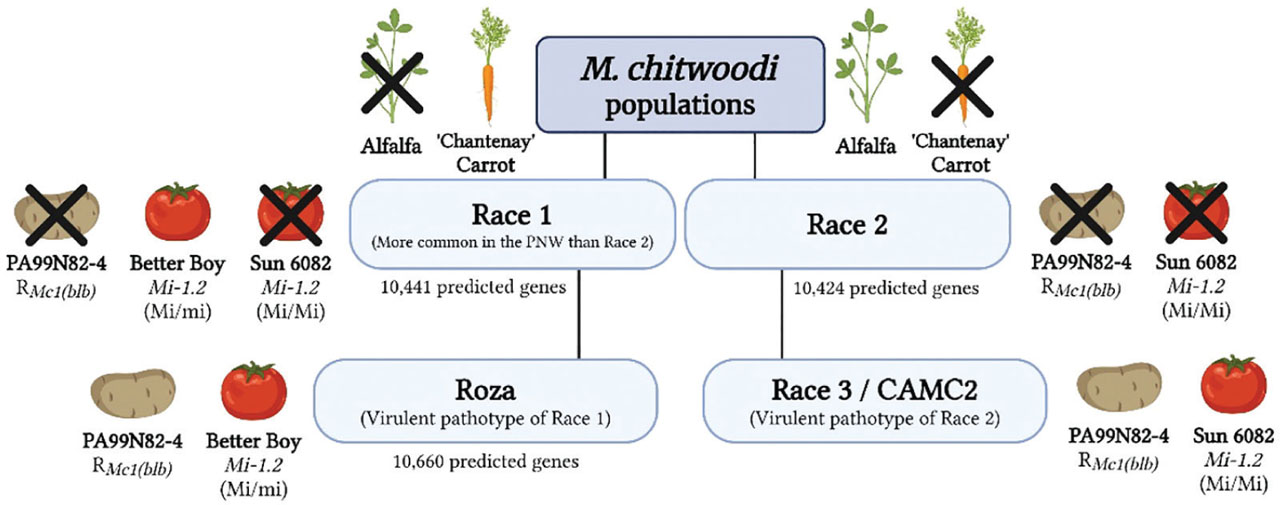

Figure 5:

Diagram showing populations of M. chitwoodi, with black X’s marking plants where the nematodes do not reproduce. Races 1 and 2 are distinguished by their ability to reproduce either on ‘Thor’ alfalfa or ‘Chantenay’ carrot due to non-host immunity (Mojtahedi et al., 1988). In this study, race 1 is shown to infect ‘Better Boy’ tomato (Mi/mi). Previous research found that both races 1 and 2 cannot reproduce on Sun 6082 tomato (Mi/Mi) or PA99N82-4 potato carrying RMC1(blb) resistance (Brown et al., 1997, 2009). Race 3, a virulent pathotype of race 2, can infect and reproduce on both PA99N82-4 and Sun 6082 (Mi/Mi). The Roza population can also infect and reproduce on PA99N82-4, though it has not been tested on Sun 6082. This study shows that Roza can infect and reproduce on ‘Better Boy’ (Mi/mi), suggesting that Mi-1.2 resistance cannot control this M. chitwoodi population. The number of genes associated with race 1, Roza, and race 2 was estimated by Bali et al. (2021).

Primers used in the experiments_

PrimerSequence 5′ to 3′Reference
Mi genotypingMi23FTGGAAAAATGTTGAATTTCTTTTGSeah et al. (2007)
Mi23RGCATACTATATGGCTTGTTTACCC
M. chitwoodi race1Mc1MR_FTTTTGTGCGATTGGCAAGGAHu et al. (2023)
Mc1MR_RATACATTCGCTCGGTTCCCG
M. chitwoodi RozaROZMR_FCACGGAACGTTGGAAGGGTAHu et al. (2023)
ROZMR_RCCTCGTGATCAGCGCAGTAA
DOI: https://doi.org/10.2478/jofnem-2025-0061 | Journal eISSN: 2640-396X | Journal ISSN: 0022-300X
Language: English
Submitted on: Jun 10, 2025
|
Published on: Jan 14, 2026
In partnership with: Paradigm Publishing Services
Publication frequency: 1 issue per year

© 2026 M. Teixeira, K. S. Clements, K. O. Chandler, C. Gleason, published by Society of Nematologists, Inc.
This work is licensed under the Creative Commons Attribution 4.0 License.

Volume 57 (2025): Issue 1 (February 2025)